2023 SEC Play Action Study
Play action is often thought of as a cheat code; an easy button for any offensive coordinator to prop up the pass game and provide some schemed downfield wins. Even if a team cannot “establish the run”, the tactic still has been proven to displace backenders and buoy production.
That said, the tactic can be a double-edged sword. Though play fakes can goad more aggression, potency, and overall efficiency, premier precision often suffers. Deception can manipulate coverages and create more separation for targets. But, inviting extra bodies towards the line of scrimmage tends to pad pressures, which can lead to bad things. Nuance and prudence is required to optimize these plays.
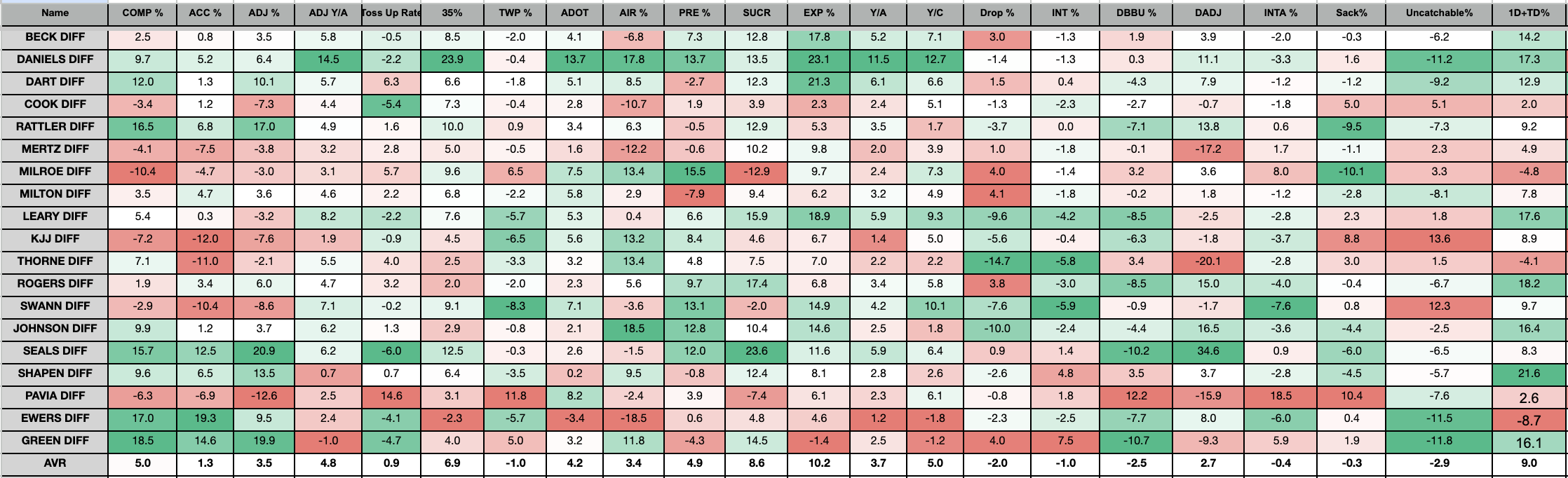
Using 20 true play action attempts as our threshold for a decent review, 15 conference passers qualified. And after parlaying numbers from our On3 Impact Study, 4 transfers were added into the mix. For the most part, the general hypothesis held true when comparing results against true dropbacks (ie: attempts not targeting a screen, RPO, or tap pass).
Within the SEC, the general hypothesis held true.
19/19 increased in Y/A; average gain was 3.7 yards
18/19 increased in ANY/A ; average gain was nearly 5 yards
18/19 increased in EXP%; average gain was 10% points
16/19 increased in Success Rate; average gain was 8.6% points
13/19 saw a drop in INTA%; only 3 saw a +6% point worsening
13/19 increased in Accuracy% and Completion%; Comp saw 5% average gain, Acc around 1%
12/19 saw a drop in Defender Breakup%; only one QB’s clip increased by +3.6%
13/19 saw a drop in Uncatchable%; average gain was 3% points
18/19 increased ADOT; average gain was 4 yards; only one QB’s clip shrunk
16/19 increased in 1D+TD Rate; average gain was 9% points
Sample +- on true play action vs true dropbacks
(FOR OPTIMAL DISPLAYS FOR STAT TABLES, TILT DEVICE SIDEWAYS)
But, not every passer was affected the same. Some benefited more than others. With 2024 quickly approaching, knowing which QBs were helped most by play action could be worthwhile. Of our 19 qualifiers for our baseline findings, 10 will again be ready to rock this fall. So, let’s find which performed best as misdirection magicians.
2024 SEC Returning Starters
(FOR OPTIMAL DISPLAYS FOR STAT TABLES, TILT DEVICE SIDEWAYS)
Carson Beck: Georgia

The Bulldogs haven’t been shy giving their passers scheme elements to boost bottomlines of late. Only four SECers used more true play action than Beck last year; as over a quarter of his dropbacks qualified. The deception aided in defining his reads and greasing his receivers ability to separate. And looking at his robust stats, the stats justify the means. Despite seeing more drops on average, Beck’s Success, Explosive and First Down+TD Rates both ballooned by over a dozen percentage points compared to his straight dropback numbers, which were already sterling. Subsequently, his catchability and interceptability also improved in this context. Ultimately, no returning SEC starter experienced a higher increase in their ANY/A nor captured a higher outright figure than his 14.2 mark.
Jaxson Dart: Ole Miss
Ole Miss’s super spread frequently bakes eye candy and trickery into its normal offense. No returning SECer produced more yards or saw a higher chunk of their yards come off true play action than Jaxson Dart. Even though he faced pressure more often, he largely saw gains across the board compared to straight dropbacks. All of his ball placement metrics improved, highlighted by a 8 point gain in Depth Adjusted Accuracy. Despite generally being mid by conference standards in play action precision, his top5 Uncatchable Pass Rate in 2023 was a clear exception to that. And with more on-target attempts, the results followed. No returner experienced a bigger percentage point bump in Explosive Pass Rate than his terrific 21.3 figure. Nearly half of his play action throws either moved the chains or scored points.

Jalen Milroe: Alabama

Already a passer who struggles to place throws consistently, Milroe’s accuracy further soured in this context. No SECer saw a worse dip in Completion% or Success Rate compared to normal dropbacks. In fact, the Tider was the only QB to see those metrics worsen by double-digits. Sure, some of these snaps can be explained by his unapologetically high average depth of target as well as inviting more heat. But, he was also more prone to turnover worthy passes. Over an eighth of his tosses could’ve been picked off, which was the league’s 2nd-worst clip last fall. Plus, his First Down+TD Rate shrunk. Still, the playmaker’s potency puffed up on play fakes. Just 4 SECers topped Milroe’s 27% Explosive Pass Rate, and only the Heisman posted a higher rate of attempts that netted at least 35 yards.
Brady Cook: Missouri

Cook wasn’t the SEC’s sharpest play action passer. Nearly 30% of his attempts were uncatchable. Plus, his Completion, Adjusted Completion, and Depth Adjusted Accuracy all worsened against his straight dropbacks. His 56% raw Accuracy fell below the league average. In the end, only one SEC recorded a lower makeup of yards off the tactic than his 13.3% clip. That said, the scheme elements tended to bail him out and present wins. Even though his gains weren’t as mighty as some of his peers, Cook was a more fruitful version of himself on these snaps. After all, he didn’t log a single interception. The defined reads resulted in Cook not trying as many closed windows or targets where defenders could create incompletions as often. Despite moderate bumps in Success and Explosive Pass Rates, his 7.7 dropback ANY/A shot up to 12.1 using deception. Cook’s wonky process is worth monitoring, but that doesn’t make him any less dangerous ahead of 2024.
Graham Mertz: Florida

In case you didn’t know, about 32% of Mertz’s passes came off fakes last year. No returning SEC starter owns a higher figure. So obviously, these are snaps Florida must maximize, especially considering how they fit in to helping the offense’s big play problem. Mertz morphed into the conference’s premier caretaker, often avoiding risks for safe, underneath targets. Potential explosives were routinely turned down for surefire completions. But off play action, the Gator showed some teeth. His ADOT was 1.6 yards higher and he was twice as likely to deliver an explosive completion compared to straight dropbacks. Plus, he experienced a 10 point gain in Success Rate while his ANY/A improved by over 3 yards. Trickery clearly helped him. The added aggressiveness, however, wasn’t all rosy. The verticality saw all of his ball placement metrics sink. His Depth Adjusted Accuracy plummeted 17 points and over a fifth of these throws were uncatchable. Moreover, he logged as many interceptables on his 96 play action attempts as his 163 on normal dropbacks. The bang-for-buck is apparent, but Mertz must shore up his inconsistent precision, specifically on downfield throws.
Payton Thorne: Auburn

Though Auburn frequently incorporated RPOs into its attack under Hugh Freeze, true play action wasn’t utilized at a crazy high rate. Thorne’s mixed bag profile explains why it wasn’t a trusty aspect of the scheme. By SEC standards, his metrics were a bit bland. Down-to-down accuracy was a clear concern. Barely half of his throws were deemed on-target. Compared to straight dropbacks, his raw and depth adjusted figures soured by 11 and 20 percentage points, respectively. Naturally, the errancy made it more difficult to secure key connections. Among SECers last year, only Milroe experienced a bigger drop in First Down+TD Rate. That said, completions came easier thanks to diamond grips. Only one play action pass was dropped. And without butterfingers, his Success and Explosive Pass Rates were each boosted by 7 percentage points despite his underlying inconsistency.
2024 SEC Newcomers (Impact Study)
Quinn Ewers: Texas

Steve Sarkisian loves motions and play actions. So, Ewers was no stranger to scheme elements. But for whatever reason, against his hardest opponents, he opted to take what defenses gave him when using play action. Typically checking down, peppering underneath and avoiding coveragemen, he portrayed a polar opposite approach compared to straight dropbacks modus operandi. He hardly hunted for splash plays and happily took plenty of gimmes. Ewers was the only QB in this piece to see his ADOT shrink. His 2.3 yard dip was stark but definitely lowered his bar. In our On3 summer Impact Study, his play action Adjusted Completion%, Accuracy%, and Uncatchable% all cracked the crop’s top5. His gains weren’t outstanding, but Ewers still snagged value. He was 5x more likely to log an explosive than an interceptable. And with his live arm, no secondary can afford to let its guard down when he’s on the field.
Taylen Green: Arkansas

The combustible Green was commonly inserted into Boise State’s lineup to provide a spark. And while his 2022 Impact Study projected him to be a fairly dependable performer off play fakes, he had trouble taking the next step this past fall. His down-to-down dependability shored up considerably, but he posted a negative interceptable:explosive ratio as the tactic saw reduced usage year-over-year. A number of his accuracy scores shined. So, a silver lining exists, especially considering his Success Rate beefed up over 14 points. But, too many turnover worthy passes have been logged over the last two years to ignore.
Diego Pavia: Vanderbilt

As an undersized passer who was often stressed, Pavia didn’t always have the luxury to turn to play action elements. Not every QB is cut out to drop their eyes to sell a run and then locate an open man while big bodies obstruct their vision. Moreover, the degree of difficulty is often upped for shorties. Pavia rocked an admirable Uncatchable Pass Rate against the meat of his schedule in this context. But like his stature, his precision came up short. Both his Accuracy% and Success Rate worsened. Plus, a number of attempts were placed near defenders. Even though play action provided a boost to his potency, he was twice as likely to throw an interceptable than a gain of at least 20 yards. Pavia has grit to his game. But with Vandy’s small margin of error, that carelessness can’t happen.
Blake Shapen: Mississippi State

Shapen was a better passer across the board when using true play action – at least when honing in on the games when he faced heightened competition. Considering he’ll be playing in a super spread scheme that loves that kind of thing, that should be music to Jeff Lebby’s ears. Mississippi State’s spring game was a preview of the Bulldogs’ passing potency. But against his hardest opponents last year, Shapen was more than twice as likely to toss an explosive on dropbacks with play fakes compared to ones without one. Additionally, his Accuracy% and Interceptable Pass Rate both improved, which led to his Success Rate holding a 12 point edge. His Impact sample size is on the small side and can be attacked. But across all of last year on play fakes, Shapen’s Completion% sharpened by 7 points along with his Y/A boosting nearly 3 yards.