2024 Impact Study - One Thing to Fix: QBs 26-50
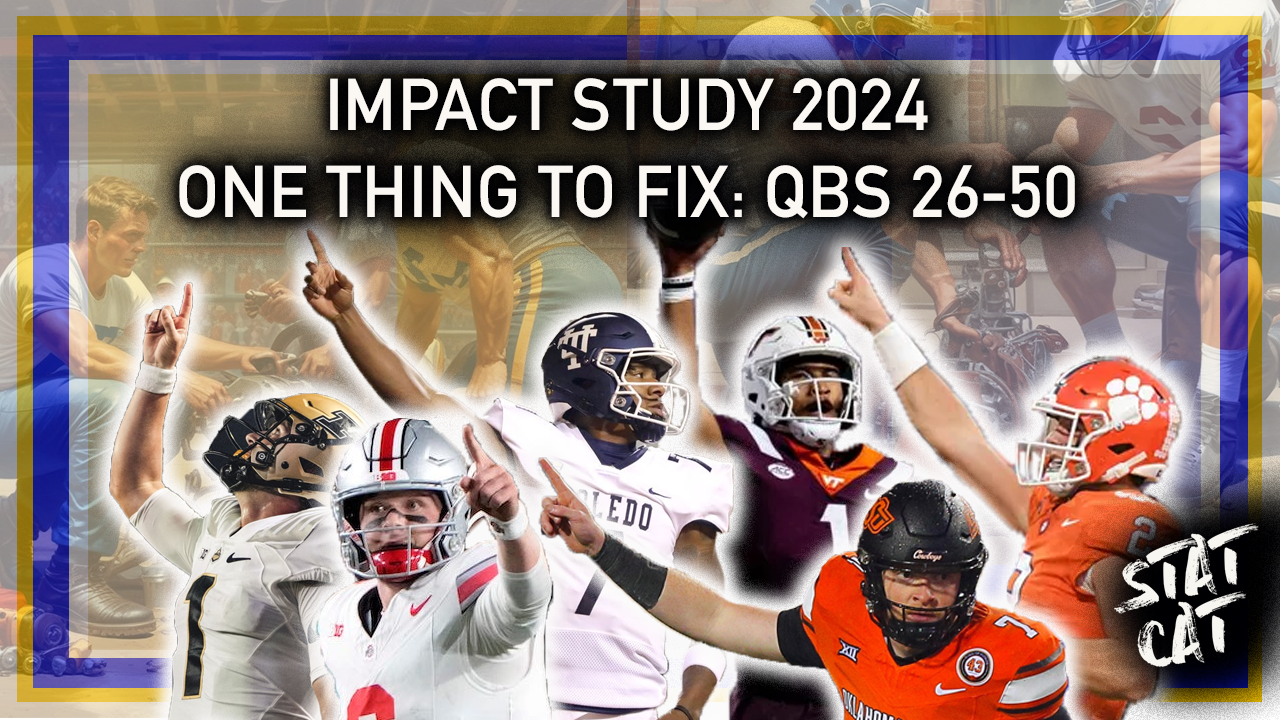
One Thing to Fix (Impact QBs 26-50)
Pobody’s nerfect – especially college quarterbacks. Even the best prospects have fixable flaws or concerning habits that can be addressed.
Naturally, these traits can be exacerbated when playing heightened competition. While showings against Poop State and Awful A&M might be nice for the statsheet, true ability can be muddied thanks to the lightened degree of difficulty. And when trying to find guys that can do things others can’t, watching dudes beat up defenses most can knock out is an overly worthless exercise.
That is the basis of the Impact Study: analyze the nation’s top passers against their hardest opponents to better gauge their performance, upside, and shortcomings. Even though the metrics might take a hit, the tape can be full of helpful insight into how a fellow might translate to the next level.
No, not every QB’s slate is the same. Some were even excluded from the study due to cupcake schedules. But “standardizing” the group in this manner still was immensely beneficial… particularly identifying elements each passer needs to fix this fall. Let’s focus on the QBs ranked 26-50 in On3’s Impact Ratings and see what they should shore up this season.
“High Volume” Impact Qualifications (38 passers)
+88 Pre-Season On3 Impact Grade
+125 pass attempts in 5/6/7 game sample
+2 games vs Top50 SP+ AND EPA/Pass DEF
Key Terms:
Accuracy% - percentage of perfectly placed, on-target passes that don’t require unnecessary adjustments
Uncatchable% - percentage of passes that had no chance of being completed due to off-target placement
Depth Adjusted Accuracy - weighted Accuracy% that gives more risk/reward based on distance of target
ADOT - average depth of target, or how far a receiver is when thrown the ball on average
“Floor” Passing - clean, non-Screen/Play Action/RPO attempts inside the pocket
Dropback - non-screen/RPO attempts
Downfield - targets over 10 yards past the line of scrimmage
Deep - targets over 20 yards past the line of scrimmage
Explosive Pass Rate - a pass that nets 20 yards or more
Interceptable Pass Rate - a pass with potential to be picked off due to bad timing, vision, ball placement
ANY/A - adjusted net passing yards per attempt
Brock Vandagriff: Kentucky – General Consistency
Though UK’s pass game had the potential to score on any snap last year, it was riddled with blunders. Issues ranging from botched blocks, drops, bats, and uncatchable passes saw the Cats finish inside the SEC’s bottom5 for the second-straight year in Passing Success Rate. Trying to put those issues behind them, the talk out of Lexington this spring has been all about honing consistency. As new OC Bush Hamdan put it, he wants “boring golfers.” No drift, no insane torque, no pinseekers. But go out and “hit it (using a 3-wood) 200 yards straight down the pipe”. In other words, take what’s there and don’t try to do too much. Well, there certainly was a lot of that during UK’s spring game. Vandagriff routinely peppered underneath, hunting for surefire completions and not pushing the ball vertically. With arguably the school’s most talented receiving room ever, just getting them the ball can be a low-bar for success. And in terms of the team’s goals this fall, the Cats will only go as far as the former five-star’s arm will propel them.
Anthony Colandrea: Virginia – Downfield Catchability
Despite his diminutive frame and unassuming stats, Colandrea popped as a passing prospect during our Impact study. He didn’t always close games well, especially in his earlier appearances. But if he tightens up his downfield catchability, he can work himself into being one of the top options in his conference. Capable of driving the ball over 50 yards beyond the line of scrimmage, Colandrea routinely aimed to hit his man’s upfield shoulder. Still, he tended to miss long and overshoot his guys a little too much. Despite cracking the group's top12 in downfield Accuracy% he also fell into the bottom12 in Uncatchability. An ‘all-or-nothing guy’, his arm has to do a better job of allowing his pass catchers to come down with targets. For the most part, his calculated shots were game-altering throws. Being just a few steps too long wiped out AT LEAST 5 homerun TDs in his sample. As is, Colandarea was twice as likely to log an explosive pass than an interceptable pass against heightened competition. Not bad for a first-year. So if he can mature into a more consistent downfield placer, he’ll become a star.
DJ Uiagalelei: Florida State — Dropback Accuracy
Uiagalelei might be coming off his best season, but that doesn’t mean he completely solved his accuracy issues of yesteryear. Though a passer that favors throwaways, all of his ball placement metrics finished below the Impact study average. And when excluding screens and RPOs, his profile became even more flimsy. A third of these throws were uncatchable (over a quarter when omitting throwaways). DJU did suffer from one of the group’s highest Pressure Rates (33.5%), but those snaps cannot be strictly blamed for his misfires. When clean, guiseless, and within structure, his dots were overly dull – again seeing subpar ball placement metrics with about a 23% Uncatchable Pass Rate. While the decrease in negative plays is commendable, he’ll likely function as his offense’s secondary facet since he’s still a little untrustworthy.
Sam Leavitt: Arizona State – Vertical Drive
Leavitt showed promise in his limited freshman snaps. And in case you missed it, solid play this spring helped entice Jayden Rashada to take his talents elsewhere. Clearly with him ranked this high among Impact QBs, we at On3 are big believers in Leavitt. He has a smooth dropback, appears to possess advanced processing skills for his age, and displays fine anticipation. There are some things he can work on to speed up his delivery. But strengthening his legs and improving his vertical drive would give his game extra credibility. Though a sharp passer capable of carving up foes in the short and midrange game, his work outside the numbers wasn’t sharp. Passes died and he failed to show he can lead his men vertically. A beefier base will go a long way – pun intended – in boosting his deeper throws and adding additional pop to his offerings.
Kyle McCord: Syracuse – Interceptable Passes
One of McCord’s key characteristics last year was that he showed immense trust in his pass catchers to prevail at the catch point. He just had a habit of tossing bang-bang throws against tight coverage. About 28% of his passes against his best opponents were charted as contested. In other words, he pressed and pressed hard; especially to his WR1 Marvin Harrison Jr. And with defenders often in the vicinity, they were able to affect a large number of attempts. Nearly a tenth of McCord’s overall Impact sample had turnover potential. Only two of his peers logged a worst Interceptable Pass Rate. Perhaps, he will feel less inclined to test tight windows with a dropoff in weaponry. And his decent accuracy figures provide some silver linings for his profile. But there’s a slim chance this former five-star will resurrect his reputation if he keeps giving opponents opportunities to create takeaways.
KJ Jefferson: UCF – Play Versus Pressure
Despite owing a top5 ANY/A back-to-back years amongst SECers and being one of PFF’s best graded passers in 2022 when pressured, the Dan Enos Experience saw the former Arkansas QB flustered, frustrated, and on his back for much of the season. Jefferson’s hardest foes especially had little trouble upending the Razorbacks’ offense and frequently foiled blockers. The team surrendered a comical 42% Pressure Rate and 14% Sack Rate across his sample. And as Captain Obvious reminds us, Arkansas as a whole couldn’t overcome that level of adversity. KJJ’s personal 0.4 ANY/A under duress was the lowest figure in our study. Moreover, none of his peers posted a worse Depth Adjusted Accuracy than his 22.1% clip. And, his overall Dropback Sack Conversion Ratio has been a problem no matter who the former Hog faced for three seasons – commonly flirting with the 50% threshold. The Gus Bus will provide him some gimme completions and help pad his stats. Still, Jefferson must speed up his clock and refine his ball placement; especially when under the gun.
Preston Stone: SMU – Refine Mechanics
Stone’s 28.1% Deep Pass Rate was the top mark in all of college football last year. While there’s little doubt he’ll remain one of the nation’s most prolific bombardiers, his mechanical operation could see his results nosedive with SMU’s transition into the Core4. Stone holds the ball by his belly and tends to release it by his collarbone, which makes his motion resemble a shot putter. Sometimes drifting mid-motion, he generally presents worrisome lower body work. At times, throwing the ball seems unnecessarily arduous, and he’ll slip when trying fastballs. Against his three Core4 foes, the end result saw a good amount of off-target attempts. An eighth of his passes were interceptable. And despite a limited sample, Stone’s “passing floor” figures were anything but rocksteady. Less than half of his clean dropback attempts inside of structure without guises were accurate; and most of his metrics tracked to fall below Impact standards. Stone will probably put up good numbers; but long term, he has to develop better habits to aid his process.
Haynes King: Georgia Tech – Refine Mechanics
King sneakily was good at securing key completions and playing backyard ball last season. But while he is an underrated athlete and Core4 producer, he still exhibits wonky mechanics. Granted, his throwing operation is coming along. But there’s still loads of room for improvement. On his worst examples, King resembles an off-filter marionette – with his arms being out of sync and overall posture somehow being both fluid and rigid at the same time. Tthanks to his inconsistent throwing motion, he naturally landed inside the bottom10 in overall Accuracy% in our Impact study. Nearly a quarter of his throws were uncatchable. And his erraticism also generated an Interceptable Pass Rate near 9%. Moreover, his unique release and poor placement tended to cross up his pass catchers. Almost 14% of his throws against his best opponents were dropped. King has talent. After all, his Explosive Pass Rate and Depth Adjusted Accuracy fell on the good side of the Impact average. But, he will remain overly mid unless he refine his mechanics and is able to capture more completions.
Cameron Rising: Utah – Downfield Production
While there’s a decent case to be made Rising’s pass floor is among the top nationally, his pass ceiling cannot be raised until he can show he can produce downfield. Only about a third of his throws traveled over ten yards across his 2021-22 Impact studies. And against heightened competition, he struggled to shine vertically. In 2021, his 54% Deep Uncatchable Pass Rate was the group’s floor. Plus, Rising’s 16% Deep (+20) Accuracy% from 2022 also earned that honor. And with lackluster midrange metrics, less than 40% of his downfield (+10) tries were on-target – firmly coming in below standards. Taking a step back and just examining his overall stats from his last two studies, Rising’s Interceptable Pass Rate trumped his Explosive Pass Rate both years. FYI, big gainers come easier from downfield targets than ones around the line of scrimmage. Utah cannot earn a playoff berth by nickel-and-diming alone. Rising has to give his team a larger margin of error by being a more potent and trustworthy downfield thrower.
Lanorris Sellers: South Carolina – Play Versus Pressure
While it remains to be seen how well Sellers performs under stress, it’s a safe bet the Gamecocks will once again be among the SEC’s worst at allowing pressure. Under Beamer, the team’s Pressure Rate Allowed has slumped three-straight seasons and has finished inside the SEC’s bottom3 twice. The heap of hurries translated into SC falling inside the league’s bottom5 each year in taken sacks. Spencer Rattler was able to circumvent some of the adversity. Both his raw Accuracy% and Uncatchable Pass Rate were top2 within the league last year. Plus, no SECer topped his 50.9% Depth Adjusted figure. But even with the prominent placement under pressure, he wasn’t immune from mistakes, errant throws, or interceptables. Avoiding negatives and limiting snaps behind the chains, is a practical way for the Gamecocks to stay on track and manage expectations. But, only time will tell if the sturdy Sellers can be a calming force when under the gun.
Aidan Chiles: Michigan State – Anticipation
Chiles has the potential to be a fun collegiate playmaker with both his legs and his arm. He can get north in a hurry and can drive the ball nearly 60 yards downfield. But while it was clear Oregon State tried to scheme things up for big plays, the soon-to-be sophomore failed to see the field well and was often troubled when an immediate answer didn’t present itself. Still not quite up to speed of the college game, he would buffer slightly and miss some openings. Other times, he straight-up pre-determined his read and put the ball into harm’s way. With staff continuity in his corner, his timing and confidence will come along with more reps as they continue to play towards Chiles’ strengths. If the ball can come out quick in rhythm, Sparty might have a sparky offense this fall.
Will Rogers: Washington – General Consistency
With over 2,000 career dropbacks, Rogers is a known commodity. We have a much better read on his game than basically any returning QB. There’s real clarity on what he does well, where he falls short, and how he operates as a passer. So while scouts might crave a better display of arm talent, the best version of Will Rogers has always consistently and dependably delivered catchable passes. Unfortunately, that hasn’t been the case when up against the meat of his schedule the last couple of seasons. Looking at his Impact stats, his Success Rate, raw Accuracy%, Adjusted Completion% and Uncatchable Pass Rate have worsened three years in a row. Yes, he’ll need to throw downfield some. But, Rogers needs to focus on taking care of business of compiling completions. Luckily, he landed in a great scheme that will lean into his strengths as an underneath distributor and savvy operator. And while perhaps not the most explosive QB, his timing in rhythm can be golden. In the last three Impact studies, he’s twice finished among the group’s top performers in deep accuracy.
Rocco Becht: Iowa State – Passing Potency
The son of a coach, Becht is well-programmed to seek safe completions. Overly a point guard QB with strong pre-snap processing skills, he likes to pepper short and commonly excelled in the quick game. Keeping his offense on track, Becht’s quick trigger within structure limited sacks and presented a fine passing floor. But his hot potato reads hardly led him to look downfield or generate much pop. His 7.5% Explosive Pass Rate fell into the Impact study’s bottom8. Plus, only four Impacters dedicated a lower amount of their sample throws beyond ten yards downfield than his 27.2% figure. Though 4 of his 10 scores against his hardest foes came on deep attempts, receiver work after the catch typically buoyed his big gainers. His downfield placement figures were resoundingly mediocre. While some physical limitations and mechanical flaws exist, Becht still has enough tools to be a crafty, effective passer. That said, he’ll largely remain toothless, like a number of his peers, unless he can add more splash plays. And strictly targeting screens, sticks, slants, spacing patterns, or snag routes won’t accomplish that.
Kyron Drones: Virginia Tech – Deep Passing
The Hokies sport a “dink and chuck” pass game with hardly any emphasis on intermediate attempts. As far as the dinky stuff goes, Drones looks really sharp attacking short. But despite a juicy arm, he failed to stand out when chuckin’ it deep. Tending to miss long, 60% (15/25) of his 20+ yard throws in his Impact sample were uncatchable. Only Riley Leonard and Graham Mertz served up more slop in that area of the field on a rate basis. And when expanding the scope to all throws over 10 yards, his Adjusted Completion% fell into the Impact group’s bottom5. Said inconsistency enticed Drones to hone in on what he does well: hammer underneath targets. Plus, his tremendous rushing ability further raises his floor. But, only two Impacters rocked a lower Explosive Pass Rate. For his upside to be realized, Drones has to do a better job of seizing splash completions. Frankly, improving his deep ball is the simplest path to success.
Taylen Green: Arkansas – General Accuracy
In back-to-back Impact studies, Green’s iffy ball placement metrics have muted his outlook. Though a game-breaking rusher with great physical tools that have also flashed on dropbacks, he once again failed to finish on the good size of the group average in raw Accuracy%, Depth-Adjusted Accuracy%, Adjusted Completion%, Uncatchable Pass Rate, and Interceptable Pass Rate. Even omitting pressured dropbacks and stuff outside the pocket – elements that can undercut a passer’s profile – most of his process stats stayed stinky and below standards. Considering he largely faced Mountain West foes, there’s a chance his numbers could tumble even further transitioning into the Core4. If Green is a subpar SEC passer, Arkansas will probably miss its goals, which will likely result in a new regime taking over in Fayetteville.
Cade Klubnik: Clemson – Interceptable Passes
Clemson’s pass offense favors patterns close to the line of scrimmage. One reason might be because of Klubnik’s downfield carelessness. Overall in our Impact study, a tenth of his passes were interceptable. By rate, only one Impacter was worse. And of those 23 throws, 15 came on targets over 10 yards past the line of scrimmage. Though he donned a top8 downfield Completion%, his bang-for-buck was one of the worst in the Core4. Along with five of his peers, he sported a negative Explosive:Interceptable Pass Ratio. His hapless heat-seeking was further amplified by his tendency to test tight windows. Granted, the scheme’s stagnant route combos and so-so separators played their parts. But, almost 30% of his throws against his best adversaries were contested. Replicating those returns will in no way help the Tigers get their teeth back or put them on track to crack the playoffs. Batman can recover from backbreaking mistakes, but Clemson sure-as-hell cannot.
Avery Johnson: Kansas State – General Consistency
There’s little doubt Johnson will run wild for the Cats this fall. But, there are still questions regarding his reliability as a passer. The scheme will likely serve him up some fun stuff, and he’ll have opportunities for splash plays. But he’ll become all the more difficult to defend if he can find consistent completions, keep KSU’s offense ahead of the chains, and counterpunch opponents that sell out to stop the run. In his limited usage last fall, both his First Down+TD Rate and Success Rate failed to beat standards no matter the context. No doubt he was just getting started. But, finishing with acceptable overall efficiency – even with potent playmaking in both facets– will be a hard ask if he fails to finish on the good side of the Impact average in those metrics this fall.
Byrum Brown: South Florida – Downfield Accuracy
Downtown Byrum Brown might have one of the strongest arms in college football. But presently, he leaves far too many plays on the field with shoddy accuracy. The Super Spread scheme provides plenty of chances to pepper opponents short. And Brown typically takes care of business on those targets. But no Impacter in our study had a lower Completion% on throws over 10 yards downfield than his 28.6% clip. Only one was more likely to log an uncatchable pass. Plus, his 37% such Accuracy% fell 6 percentage points under the group average. To stop the Joe Milton comparisons, Brown must shore up his offerings and deliver more dimes. With his verticality, he just cannot keep wasting half of his deep tries and expect to generate much credibility even if he possesses tantalizing traits.
Alan Bowman: Oklahoma State – General Catchability
Considering his supporting cast – consisting of Impact RB1, a top10 O-Line, and pair of burly pass catchers – Bowman shouldn’t have to do much heavy lifting this fall. As long as he gives his weapons decent targets, they should shine. After all, that was overly the case last year even with him turning in dismissable placement figures in OK State’s hardest games. His raw Accuracy%, Uncatchable Pass Rate, Adjusted Completion%, and Depth-Adjusted Accuracy% all fell below the group standard despite a middle-of-the-road ADOT. If Bowman can climb to just an average passer, the playoff very much will be in reach. But even with the abundant offensive talent, again wasting a quarter of his attempts (including nearly a third of his downfield throws) will probably result in the Pokes missing their mark.
Josh Hoover: TCU – Vertical Drive
With tight mechanics and snappy release, Hoover cleaned up as a short-to-intermediate passer during his debut. Inside of structure, he commonly sliced and diced opponents; particularly between the numbers. But while he’s set to have a fine pass floor, his ceiling won’t rise until he can improve his offerings deep downfield and towards the perimeter. Far too many passes died outside the numbers. By SEC standards, his Impact sample tracked to produce a bottom5 Accuracy%, Uncatchable%, and Interceptable% targeting this area of the field. And when isolating his deep attempts at large, less than a quarter were on-target with nearly 30% being turnover-worthy. Apparently, OC Kendall Briles took note of these shortcomings. Hoover only targeted outside the numbers on 29% of his attempts and less than 9% traveled more than 20 yards past the line of scrimmage. The affinity for throwing over the middle also saw a high number of contested attempts. Though Hoover did well hitting tight window throws, the congestion made it tougher for big plays to manifest. An improved vertical drive would not only help the Frogs create more explosives, but also it would help clear up Hoover’s hot spots from constant contests.
Dequan Finn: Baylor – Refine Mechanics
Finn is a fun ball player. Depending on who you ask, he’s the fastest quarterback in college football. And while his ability to scramble and dash to open grass will raise his general floor, the former MAC star needs to become more dependable on dropbacks to satisfy his true upside. And in order for that to occur, Finn must fix some of the issues in his mechanics. He consistently hunches in the act of delivering passes, often with his release point occurring ear-level. Additionally, he has a bad habit of sinking his upfield hip at the top of his drop. Plus, he often worked from wide, unstable throwing bases, which caused a concerning level of errancy and hurt his downfield spray. Excluding screens and RPOs, his impact sample yielded a 31% Uncatchable Pass Rate with just over half charted as accurate. Finn’s deep passing was especially flimsy. With the aforementioned inconsistency in his feet, platform, and release, his process is clearly flawed. Finn can still nab serviceable stats without fixing a thing. But if he wants to round out his game and max-out his time in the Core4, he’s got to strengthen his ball placement. And, that will come much easier by refining his operation.
Kurtis Rourke: Indiana – Passing Potency
Standing at 6’5, Rourke is a prototypical pocket passer who’s excellent at finding completions within structure. With a high-elbow release, balanced follow-thru, and tight rotation, he certainly looks the part. But for a guy capable of highlight heaves, he didn’t look to test his best opponents vertically last year. Only about a tenth of his throws traveled beyond 20 yards downfield. And when Rourke eyed homerun opportunities, he tended to deliver cans of corn. His deep production across the entire season fell off a cliff and amounted to only about a third of his output the year prior. His such Completion% sunk by 20 percentage points. His 13 deep attempts in our study generated 4 interceptables and 6 uncatchables. Overall only 8 explosives were produced against his hardest opponents no matter where he targeted. Rourke undoubtedly needs to produce more key completions moving forward. Though a fine down-to-down option, Indiana isn’t in the position to grind out ball games playing small. But a couple extra big gainers here or there might see them destroying expectations and have Rourke shoot up draft boards.
Chandler Rogers: California – Vertical Drive
Rogers may have transformed into a bombardier year-over-year, but he could still stand to improve his vertical drive. His Deep Adjusted Completion% dipped roughly 9 percentage points with the increased emphasis targeting past the sticks. And for the second-straight season, Rogers was a poor performer targeting outside the numbers; particularly downfield. On throws over ten yards past the line of scrimmage, only 39% of his perimeter throws were completed compared to 61% towards the middle across the last two years. As a short passer, targeting the heart of the defense can be dangerous. He’s more susceptible to bats, obstructed vision, and general forms of havoc that can result in turnover-worthy plays. For what it’s worth, 6/11 of Rogers’ such throws came targeting between the numbers since 2022 per PFF. But if he can create more juice when working outside, he can mitigate those issues and help generate big plays more consistently – a crucial element if the Golden Bears are to have a successful first season in ACC.
Blake Shapen: Miss State – Deep Passing
Shapen certainly sizzled during Miss State’s spring. Based on that showing, you would have had no idea that he connected on less than a third of his deep balls over the last two seasons. In that time, his Deep Adjusted Completion% fell into the bottom40 amongst college QBs. Though a smooth operator with quick feet and tight delivery, sometimes he uses too much of his upper body, which forces his longer throws to lose zip and become floaters. Though capable in his own right, Shapen isn’t the kind of passer that can see an open man deep late and still lead him to paydirt. Most of his vertical wins are when he’s in rhythm and he can still hit his man before he’s out of range. And for the most part, Baylor’s passing offense didn’t stretch the field much. Less than eighth of his throws topped 20 yards past the line of scrimmage each of the last two years. As it stands, his play against his three hardest foes last year stresses his dodgy downfield ball placement. A fifth of his throws over 10 yards past the line of scrimmage had interception potential. Still, Jeff Lebby will lean into winning the explosive play battle. So Shapen will have ample opportunities to compile deep completions. How consistent he can do so, however, will determine if the Bulldogs can snatch a few unexpected victories.
Hudson Card: Purdue – Passing Potency
Diplomatically, Card is not the most sexy passer ahead of 2024. Though a somewhat safe underneath operator, he fails to get the heart racing and fails to take care of business downfield. One major way Card can climb out of mediocrity is if he generates more big plays. Purdue’s pseudo-Air Raid likes the short stuff. But when our guy did try longer throws, his results were far from noteworthy. Against his hardest foes, both his Completion% and Accuracy% finished about 6 percentage points worse than the Impact average. Moreover, Card’s downfield Interceptable Pass Rate was among the 10-worst in our study. His 6.6% clip overall was fine. But, it still trumped his meager Explosive Pass Rate, which placed inside the group’s bottom5. It’s never a good look to rock a negative bang:buck ratio. Whether via improved downfield offerings or otherwise, Card must find a way to become a more potent passer.