2021 Offensive Review: Alabama
2021 Offensive Review: Alabama
We have firmly entered talking season in anticipation of this fall. But while most folks are already revved up and frothing at the mouth with hot takes itching to discuss 2022, forgive me for straggling back a bit. Before I am ready to turn the page and focus my mind on what might happen in college football this year, I first wanted to examine the operations and macro results of the SEC offenses. Though players and personnel might change, some of the same ideas and tactics might continue to show up on Saturdays. Plus, finding out how a unit functions can be quite illuminating in discovering potential opportunities or revealing why previous strategies were doomed to fail.
For this piece, I’ll be taking a look at the Crimson Tide’s offensive staples and modus operandi that helped capture yet another SEC crown and playoff berth – as well as the schematics that saw Alabama regress in some areas.
THE RESULTS
Alabama’s 2020 offense was an all-timer. Replicating those returns would have been a very hard ask for any unit – let alone one tasked with replacing its bell cow, two gamebreaking wideouts, one of college football’s most efficient passers, and the offensive playcaller masterminding the attack. But, the Tide hung tough and put up pretty sturdy offensive metrics this past fall. Though they averaged almost 9 less points per contest year-over-year, they still sat atop the SEC with a 39.8 figure. Additionally, they almost averaged gaining five full football fields per game. However with less efficiency, they tumbled to the two-spot within the conference in Points/Play (0.54) and Scoring Drive Rate (50.3%).
Imagine complaining about scoring points on over half of one’s drives! But that’s the high standard the Tide have set for themselves. That said, it wasn’t just their series’ results that dipped. Alabama’s First Down+TD Rate soured by almost ten points – to where only a third of its non-penalty offensive snaps resulted in a key win. Plus, both their down-to-down Rushing and Passing Success Rate failed to crack 48% – hammering home the good, not great operation.
Diving head-first into modern trends, Bill O’Brien served up a 47% RPO Rate to start a set of downs in standard time, which was the SEC’s greatest clip by ten percentage points. However, despite attempting to give his troops winnable options, first downs were often a great source of the Tide’s miscues. Behind a below-average 44% Success Rate, both Alabama’s 7.0 Yards/Pass and 5.2 Yards/Carry fell into the league’s bottom5. Fewer early situational victories meant more later down tries, which had a direct result in the drop in overall output. And relative to their conference peers, the Tide went from having the lowest percentage of snaps occur on thirds to the middle of the pack. Plus, their Early Down Conversion% dropped from 75.4% to 68.5%. From an offensive perspective, third downs ought to be avoided due to their one-off nature. Obviously, missing on one of those matters more than missing on first or second.
Fortunately, Alabama remained the SEC’s most successful team at converting on the money down. Of the 13 regular season games, seven rocked a conversion rate north of 50%. And by year’s end, Kentucky was the only other SEC offense to sport an average north of that threshold. But like most metrics, the Tide’s Success Rate in these spots worsen by six points year-over-year. As the only conference squad to allow a Pressure Rate over 50% in these spots, their aptitude to convert was simply remarkable. But of course, with that volume of duress, even Superman couldn’t emerge unscathed. Over a tenth of their money down plays resulted in a loss, which was the conference's 3rd-highest mark. All in all, over a sixth of their drives ended in a 3-and-Out, which was just good enough to remain inside the conference’s top5. Comparatively, only a tenth of the Tide’s drives met that criteria the previous fall; it remains to be the lowest on StatCat’s records.
Of the SEC six playoff teams since 2017, this offense was easily the runt of the lot. No other unit turned in an overall Success Rate under 52%, a TD Rate under 6.9%, a Points/Drive under 3.60, a HAVOC Rate over 31%, a Sack Rate over 5.1%, or a Negative Play Rate over 7.5%. But despite being flawed and frazzled, the Tide predominantly maintained their composure behind their matador signal caller. Negating biffs, managing the money down, and taking care of the football saw Alabama not give their opponents many freebies. Considering they rode a razor thin margin of error for chunks of the season, preventing turnovers was a pretty sound strategy. In fact, their such 1.17% clip was one of the few items that improved since last season. But make no mistake, this offense’s process was undeniably sloppy and choppy even if its results brought home some hardware.
BAD BLOCKING
From where I sit, nothing served as a greater catalyst for Alabama’s backstep more than their big boys upfront. From the first snaps of the season, the front-five’s falterings were seemingly incessant. Pro Football Focus seemingly agrees with that assessment as neither this line’s run or pass block grades were deemed top-50 worthy. Within the league, they went from being a top2 unit in preventing Run and Pass HAVOC plays to being bottom2. And since the Tide couldn’t dependably pave run lanes or maintain pockets, their consistency obviously suffered. The wonky execution often forced O’Brien’s hand in what looks to call (or not call) as the year progressed.
First, Alabama dropped back more often. They weren’t as pass-happy to start games, but their standard time Pass Rate ballooned by six points. Though playing in competitive contests influenced the increase, the staff sought to optimize the situation. All else equal, the average pass gains more than the average run. Plus, runs generally require more cohesion to work than passes. No doubt, the Tide were living examples of that notion this past season. With the SEC’s 4th-worst rush yard before contact average (1.88), 22% of their designed carries in meaningful minutes experienced initial defensive contact behind the line of scrimmage. Though Brian Robinson helped batter and bash towards serviceable numbers, Alabama’s Expected Points Added/Run finished at net-neutral (0.01). Conversely, only two teams in the country bested the Tide’s 0.31 EPA/pass. Again, the line wasn’t particularly skilled at pushing around pass rushers. They surrendered an SEC-high 37% Pressure Rate.
Second, Run-Pass Options were more ingrained to the scheme. Outside of the three “Baylor/Super Spread” offenses in Ole Miss, Tennessee, and Arkansas, no SEC offense featured those designs as often as the Tide. But while their volume was impressive, their efficiency was relatively average. Still, the threat of an outlet towards the flat or a quick strike created a cushion to operate. With safeties and flank defenders in conflict, Alabama saw both its Rushing and Passing Success Rate crack 50% – noticeably better than its overall returns. Plus, the Tide’s Yards/Carry upticked by a half-yard. And as aforementioned, that approach became this offense’s preferred method to start a set of downs thanks to the boosts. But while RPOs helped the offense technically find some consistency, it was detrimental to its potency. Namely, the team’s Explosive Pass Rate was essentially sliced in half when using the tactic compared to not.
Thirdly, the halfcocked hole-making influenced the concepts this run game featured. Spread elements and modern misdirects might be well-implemented into this program’s offense, but Alabama has always had an affinity for hard-nosed gap schemes to win between the tackles and control the timbre of the game. Other than South Carolina, no other SEC offense favored power runs to zones besides the Tide the last couple of seasons. Not to mention, Counter was their most-repped play in meaningful minutes in 2020. But due to inefficiency, that and other looks like it were eventually shelved. A 40% Success Rate and 4.1 Yards/Carry, 8 percentage points and 2 yards worse than the previous year’s output, hardly justified more attempts. So once the bye week arrived in week 10, this staff decided to scrub those collective concepts from the Tide’s script down the stretch. After running 45 up until that point, only ten more were called over the eight remaining games. Additionally, zone looks shot up the call sheet.
MORE DELIBERATE APPROACH
While RPOs helped buoy the Tide’s bottomline, they also helped distribute the ball to playmakers in a timely fashion. Bryce Young and his targets overly played hot potato on RPO passes with a relatively low average time to throw – predominately neutralizing headhunters in the process. But the constant threat of pressure materialized in Alabama using less razzmatazz than in years passed. With Sark running the show, the Tide used a form of action on 48% of their attempts in 2020 – an insanely high number that accentuates his desire to have a Na’vi relationship between his run and pass games. Just under 32% used a true dropback play fake. Under O’Brien, that dwindled to 19.4% with action only occurring on about a third of throws.
One reason for using less fakes came about from having no back in the backfield. Empty formations were seen during the first half of the season, but these sets really took off after the bye week, logging 66% of their reps from then though the title game. Behind that inflation, the team’s year-over-year makeup more than doubled. Only one other SEC offense topped their 6.4% mark. Empty formations accentuated this offense’s best and worst qualities. With Young under the gun and alone in the backfield, his Pressure Rate increased. Subsequently, so did the team’s Broken Play Rate. Over a quarter of such reps met that criteria. But while the miscues were plentiful and marred the Tide’s 42.3% Success Rate, the Heisman’s boogy and prowess playing backyard ball helped Alabama’s Explosive Play Rate increase in these spots. Plus, the formations naturally stretched defenses horizontally, which helped his pre-snap keys on where to go with the ball. A number of the Tide’s staples from empty wound up among their favorite concepts, but more on that later.
And naturally with the offense leaning into spread tactics, it had less need to trot out two-tight end sets. Coinciding with the rise in empty, this grouping was less featured after the bye week – less than a tenth of Alabama’s sets were composed of two tight ends from week 10 on.
Stepping back and looking at the numbers, 12 personnel was mostly used in first halves on early downs. Only 25% and 14% of its tries occurred after halftime or on 3rd down, respectively. But all in all, the grouping remained the Tide’s best terms of Success Rate (52.4%) and owned the league’s 2nd-best Explosive Play Rate (15.2%) in meaningful minutes. While the Tide botched blocks just as often if not more from this grouping, their rush yards before contact average beefed up over a half a yard to 2.50 – good for the SEC’s 4th-best clip. And though Alabama tended to take to the skies, they exhibited great balance with two tight ends on the field. Still, passes had a clear edge on a per attempt basis (8.4 vs 3.9). O’Brien directed a 20% reduction in usage compared to the previous fall. Though that move seems questionable on the surface – especially considering the opportunity cost lost to lesser empty attempts, the returns were skewed thanks to two early season games in Southern Mississippi and Mississippi State. Eight games turned in a Y/A from 12 personnel under 7.0.
But while more RPOs, less play actions, more empty sets, and less 12 personnel were all clear deviations from the previous braintrust, the most visible tweak involved being more prudent with motion. But no matter the tactical changes, keeping up with Sark’s previously insane usage would’ve been awfully tough. Despite placing 2nd within the SEC, the more static-minded Tide experienced a 11.5% reduction in pre-snap motion year-over-year. At-the-snap motion was seen on 18.6% of their snaps in 2020 but only 11% this past fall. Expectantly, their Orbit usage also slipped to the two-spot while Alabama’s percentage of snaps with shifts and Jet motion placed inside the bottom5. When Jets and Orbits did show up, they appeared mostly as outlets on Outside Zone RPOs, inverted Sails or other Flood Variations, and Yankee Shot plays. But while motion took a backseat with O’Brien driving the bus, at-the-snap designs significantly received more play during the postseason. 22 were called over the course of Alabama’s last three games. Ten were scripted in the SEC championship game where the Tide captured a 70% Success Rate and 6.3 Y/A. And even though the Bulldogs avenged their performance in the Nattie, motion substantially helped the Tide’s overall output. When any form of the tactic was used, their Rushing and Passing Success Rates bumped up to 62.5% and 52.2%, respectively.
RUN STAPLES IN MEANINGFUL MINUTES (margin within 18 points)
Outside Zone Read: 7.3% Play Share, 49.2% Success Rate, 5.2 Y/A
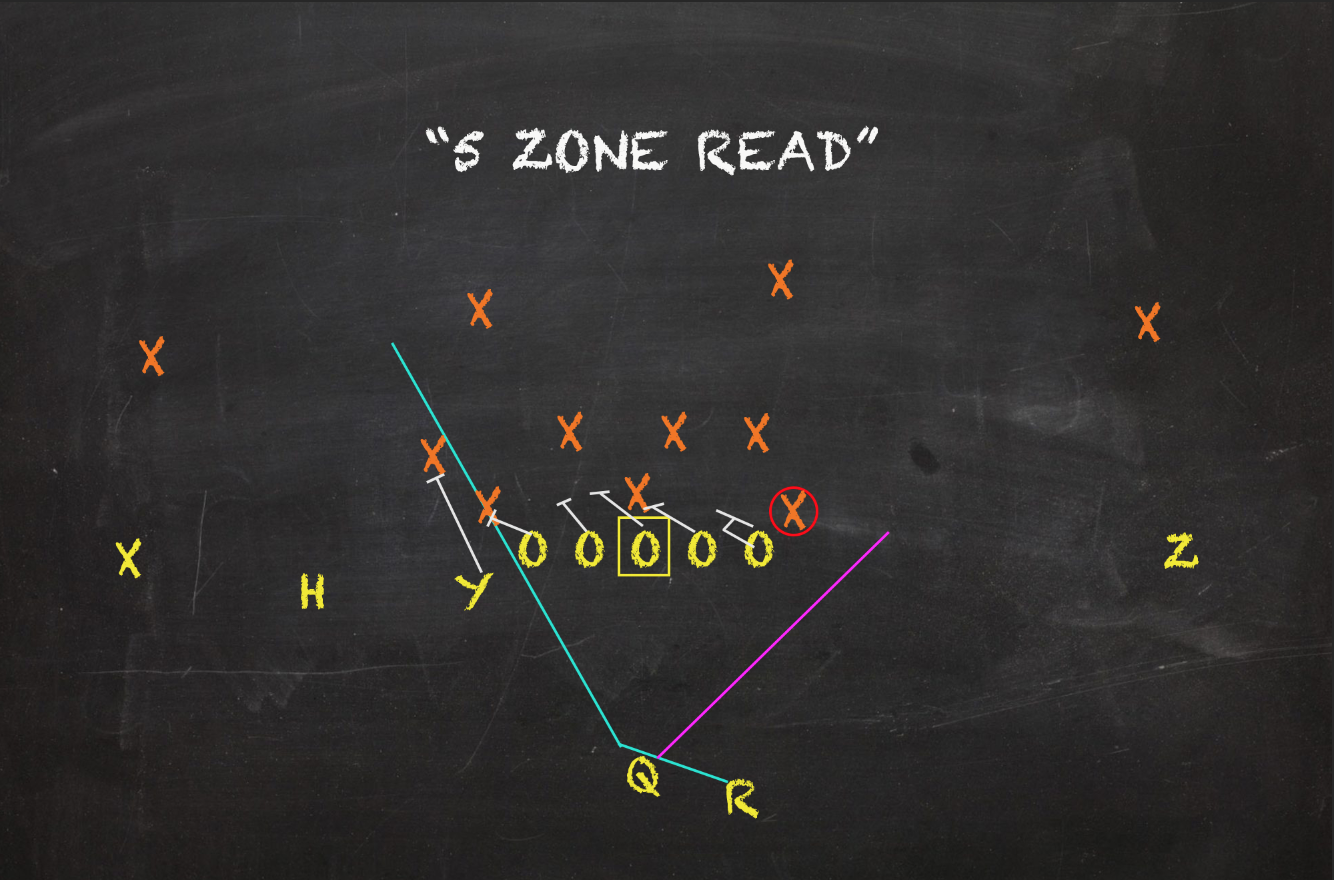
With the offensive braintrust electing to supplant a good amount of their gap runs with zones, this perimeter concept wound up as the Tide’s most repped play in meaningful minutes. Understandably, Alabama turned to this look more than any other to start a set of downs. And it often helped them “establish it”. Almost 70% of its tries occurred in these spots. Nearly half of the concept’s attempts beat situational goals and a sixth gained at least ten yards. No other individual design gained more yards than its 314. Most of the tries were normal zone flows with the box blockers all working in a hive mind towards the direction of the run. But, nine in our sample were categorized as split zone – or “Bluff” – reads. However, these reps were major letdowns with underwhelming returns. All ten of the OZ Read’s explosives came from the straight version. Exactly 80% of the concept’s attempts incorporated RPOs; and the returns were basically flat to its overall numbers.
The Outside Zone Read saw its best cluster of efficiency early; particularly against Southern Mississippi and Texas A&M. Only one regular season game after the bye sported a Y/A over 5.0. That said, that game happened to be its best performance. Against poor New Mexico State, all seven reps followed the lead of first round pick Evan Neal leftward. And, all seven gained at least six yards. The major highlight came off Robinson’s 63-yard TD in the 2nd Quarter, which was the look’s only score of the season. Closing the year strong, the concept logged ten snaps in the Iron Bowl and helped establish a fun wrinkle with “shoot”/inertia motion a few times in the SEC Championship before totaling 19 more reps in the playoffs. Behind this late surge, the OZ Read managed to accumulate more calls in meaningful minutes than any other look by this offense in at least the last three seasons.
Inside Zone Slam Read: 6.3% Share, 62.3% Success Rate, 5.9 Y/A
Rounding out the rise of zones within this scheme, this basic design finished as the Tide’s beta concept in both tries (53) and yards (316). As a tried and true concept seen in every offense, Alabama found little trouble executing it with flying colors. From week 5-12, this offense managed to generate a 60% Success Rate or better in 6/8 games. Truly one of Alabama’s best plays, over a fifth of its attempts generated a gain of at least ten yards. Plus, it was responsible for five tuddys. Like its Outside Zone counterpart, the majority of the Slam Read’s attempts featured RPOs – mostly as a way to dispel Young from being a ball carrier and taking unneeded thwaps. The pass outlet was both his “keep” and “pitch” read in many instances. And expectantly, half of its appearances occurred on first down. But, the concept was its best self on second downs where it boasted a 68% Success Rate. And for what it’s worth, 3/4 money down tries worked.
As a staple, the Slam Read saw steady usage all season but did have a couple of interesting appearances. In week 4 against Ole Miss, O’Brien tagged the “Popcorn” RPO wrinkle against the Rebels and helped manufacture an explosive completion. If you recall, Lane Kiffin quipped, “Get your popcorn ready.” in a typically buzz-worthy pregame interview moments before kickoff. “Popcorn” is a hot seam/slant – or pop pass – pattern with a playside bubble screen from trips. And funny enough, it’s a combination known within Kiffin’s scheme. This concept also racked up 13 touches in the playoff against Cincinnati. While garbage time carries distorted the figures, this concept logged four explosive carries. All in all, only two concepts bested its success rate in meaningful minutes.
Inside Zone Bluff Read: 4.0% Share, 44.1% Success Rate, 4.6 Y/A
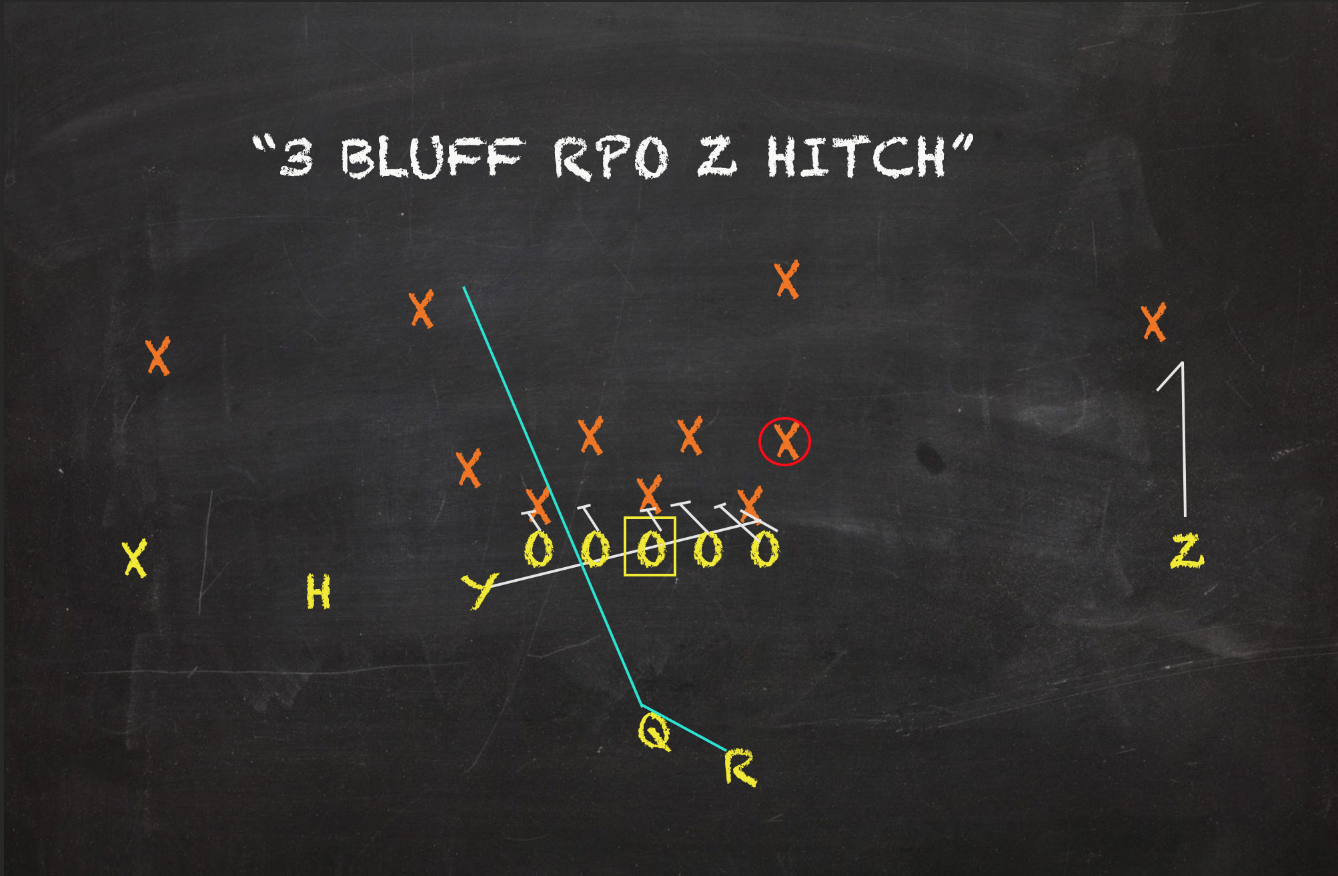
Like outside split zones, Inside Bluff Reads were responsible for worse numbers than their straight zone parallels. But even though the down-to-down returns weren’t special, it matched the Slam Read with a 20% Explosive Run Rate. And like the previously mentioned zone staples, it saw a high concentration of attempts to start a set of downs. Three-fourths of its tries took place on first down, and 80% were RPOs. The split zone flow’s niche within the operation was further heightened behind O’Brien’s fancy for using the action on play fakes.
As a tertiary look within the offense, its usage was sporadic. Against Florida, it secured three successful first down carries. The Bluff Read delivered an explosive carry against Ole Miss. But its most featured showing occurred against New Mexico State. With the inferior opponent in town, the Tide had plenty of chances to call numerous runs. Ultimately, this concept totaled 13 carries with a pair of splash runs. The design’s best run of the season happened two weeks later against Auburn when Robinson ripped off a 37-yarder in the 4th quarter.
OZ Off-Tackle: 3.9% Share, 24.2% Success Rate, 2.1 Y/A
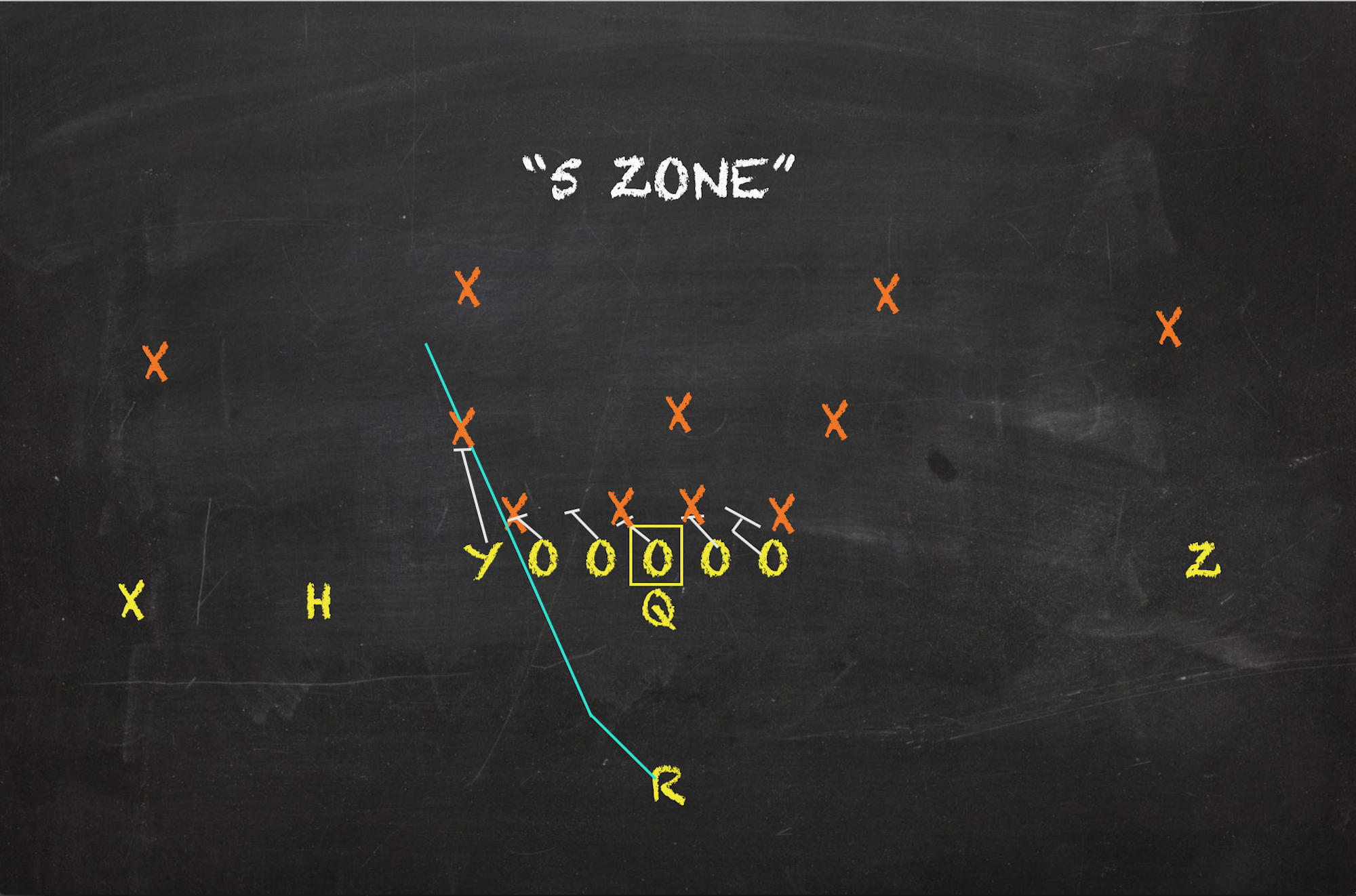
The Off-Tackle tended to see most of its usage after halftime when Alabama needed to chew some clock. In fact, it logged more tries outside meaningful minutes than in. The boom-or-bust concept manufactured eight explosive carries in 2021. Seven were off a straight zone flow with one coming via a split. Like Outside Bluff Reads, that variety was a changeup to a changeup with little vigor. Of the such 11 attempts, eight took place in the postseason. Despite the chunk runs, Outside Zones without a read element typically sucked when dialed up. Considering all but two of its reps occurred on either first or second down, this concept was a stinky seed of inefficiency that put the Tide behind the chains often. Less than a quarter resulted in success in meaningful minutes while serving up a patry 2.1 Y/A. Forecasted by a lousy 1.1 rush yard before contact average, about a fifth of its tries resulted in a loss.
The play’s best showing occurred against Southern Mississippi where it totaled ten attempts; all before the 4th quarter. Three runs cracked ten yards highlighted by a 25 and 43-yarder. Plus, half of its reps worked. But after that, the look experienced a dry spell. The Tide went from week 7 until the playoffs without logging an explosive carry on an Off-Tackle in meaningful minutes.
Counter (Read+Traditional): 2.5% Share, 27.3% Success Rate, 3.3 Y/A
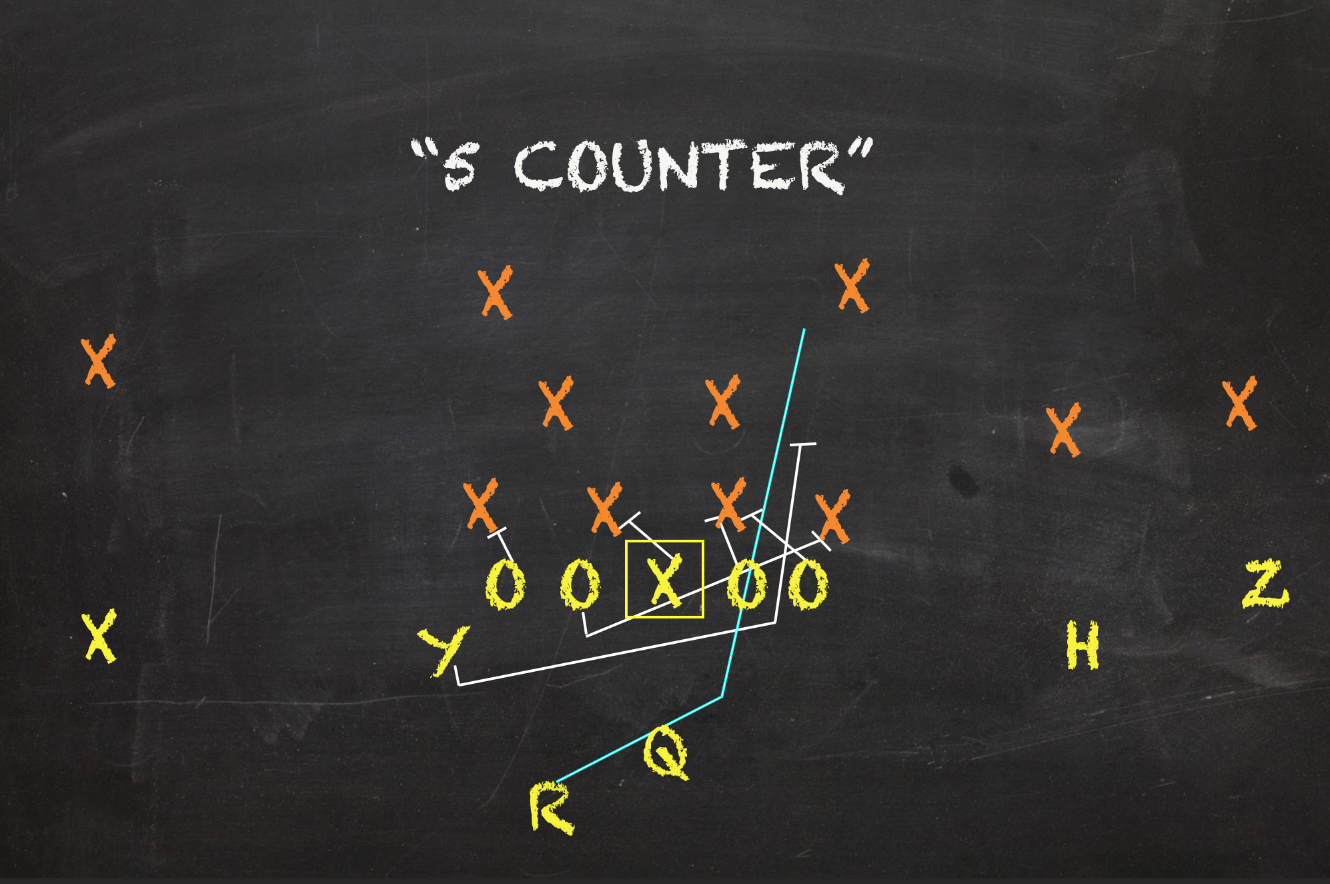
Whether straight handoffs or designs with a read/RPO element, this gap scheme misdirection supplied a good amount of misfires. Looking at all gap runs, only two of the Tide’s lineman finished with a PFF grade north of 70. But as aforementioned, it took some time for O’Brien to come to his senses and fade the concept due to its futility. In fact, Counter started the year strong after being featured on nine snaps in week 1. Six resulted in an outright attempt with a pair of conversions and a ten-plus yarder. But the concept produced only two explosives the rest of the season with none coming after the Southern Miss game in week 4. Fitting in with the great power run purge at the bye week, only six counters were attempted after the Tennessee game.
Though a physical play at its heart, O’Brien tended to call Counters from 11 personnel sets. But with less girth, run lanes were unspectacular. That said, it’s not like having an extra tight end did much to boost the numbers. And staying true to the rest of its run staples, 64% of Counters in meaningful minutes were RPOs. However, those snaps were detrimental to the look’s bottomline. As bad as the concept’s output was in meaningful minutes, RPO attempts spat out a moribund 21% Success Rate and 2.1 Y/A.
Duo Dive: 2.3% Share, 47.3% Success Rate, 3.6 Y/A
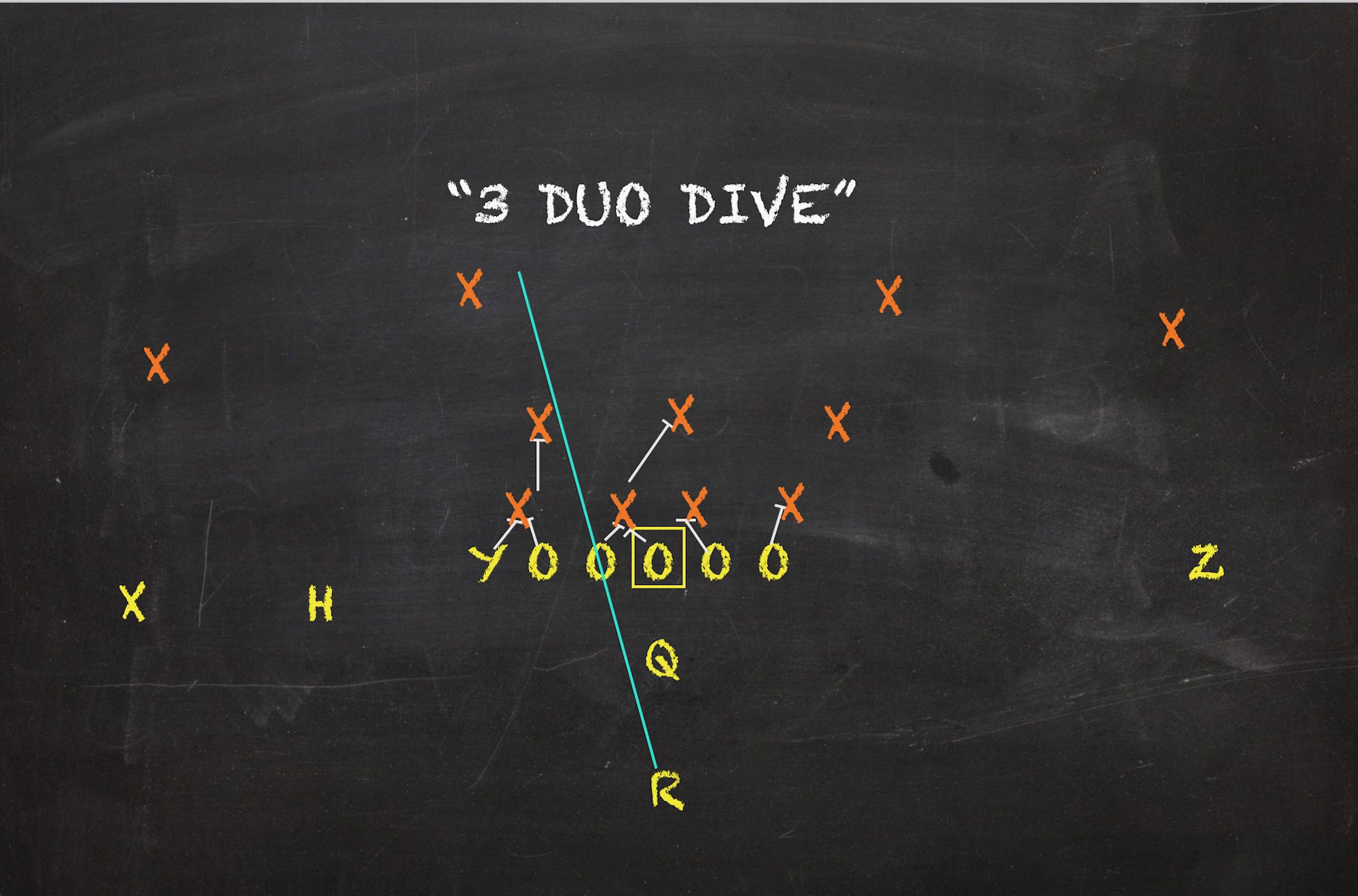
Since most of Alabama’s core runs aimed to work defenses laterally, the offense had a practical need for a north-south play to drive opponents back with some cutoffs and double teams. Largely unsexy in both process and results, the Duo Dive carved out a decent role as a counterpunch. Though its nature makes it a popular short yardage design, the Tide spread its reps around the three downs equally. When attempting to start a series positively or move the chains against a short porch, this concept was executed well. But since only 20% of its second down tries worked, Duo Dive’s returns were pretty muted. As a “aim small, miss small” design meant to capture a dollop of gridiron, the Tide never sought major gains with it. And to that point, only two tries topped ten yards without a single score in meaningful minutes.
And when things were close, a straight handoff from 11 personnel was the prefered modus operandi. But some of the concept’s best reps occurred with multiple tight ends (80% Success Rate) or via RPO renditions (50% Success Rate, 4.8 Y/A). In second halves, the Duo Dive also functioned as one of this offense’s go-tos to ice games away. Half of its tries occurred when Alabama commanded over an 18 point lead. The closeout against Mississippi State was singularly strong as two 20+-yarders and a tuddy were notched across its seven tries outside of our parameter. But while those snaps helped distort returns, the Tide went 0/5 finding success after halftime in meaningful minutes. And like other gap schemes – even though no pullers are present – its usage shrunk down the stretch. Only one was seen in the postseason.
PASS STAPLES IN MEANINGFUL MINUTES (margin within 18 points)
Slant Variations: 4.5% Share, 55.6% Success Rate, 9.3 Y/A
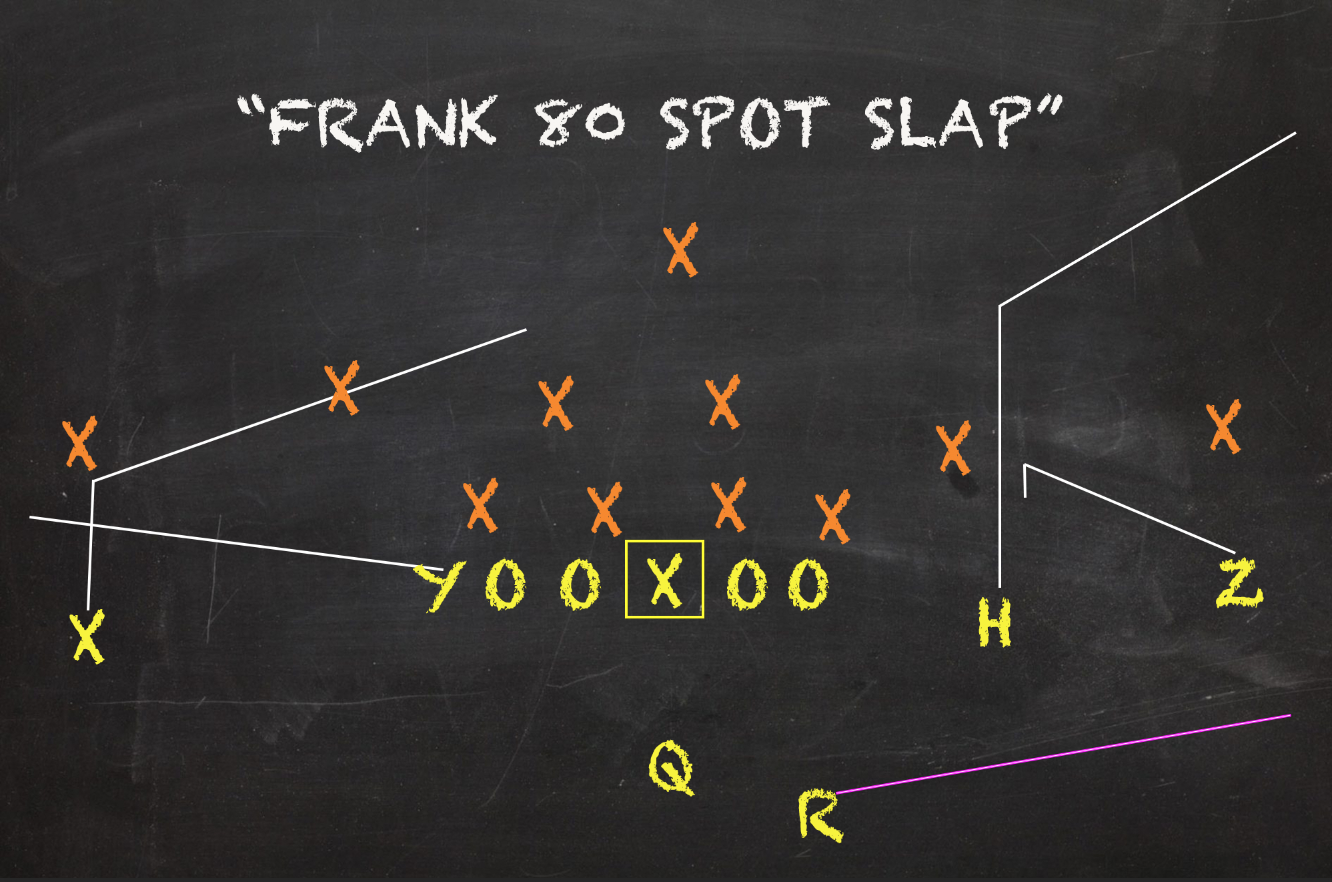
Slants were very visible within Alabama’s scheme. Only two routes were outright more targeted this season by this offense. But, these patterns were more than just a compiler concept that strung together strings of modest gains. When pooling all the subconcepts together, Alabama’s 9.3 Y/A was tops in the SEC. Only two teams bested their 55.6% Success Rate and 352 yards gained. Though they showed up in a variety of ways, Slant Variations were prominently seen on first downs. About 55% of the concept group’s total targets occurred in those spots; no other pass look totaled more than 12 in meaningful minutes. And unsurprisingly, the Tides top2 wideouts were often on the receiving end of these attempts. John Metchie notched 14 (with a 7.2 Yards/Target) and Jamison Williams chipped in another dozen (but was far more incendiary per a 14.5 Yards/Target).
Slants tended to operate as “trigger” targets depending on how the defense rotated. On RPOs – which composed just over 47% of the concept’s attempts – they inherently complimented run looks by keying on a safety. If he sat back or played 2-deep, the give would get the rep. But if he barreled towards the line of scrimmage to plug a rush lane, the natural manbeater was there to do its thing. In the dropback game, Slant Variations were coupled with Stick, Spot, and deep double moves. So they remained an answer to tilted single-high coverages with those others being a response to deal with 2 safety shells. Though both arguably presented simple pitch-and-catch chances and produced a 9.3 Y/A, non-RPO slants were far more successful (64.7% Success Rate vs 38.9%). Regardless of how it was utilized, the subconcept Slant+Flat (“Slap” in StatCat lingo) wound up as the best wrinkle. Across its nine targets, eight worked while boasting a sterling 12.1 Y/A.
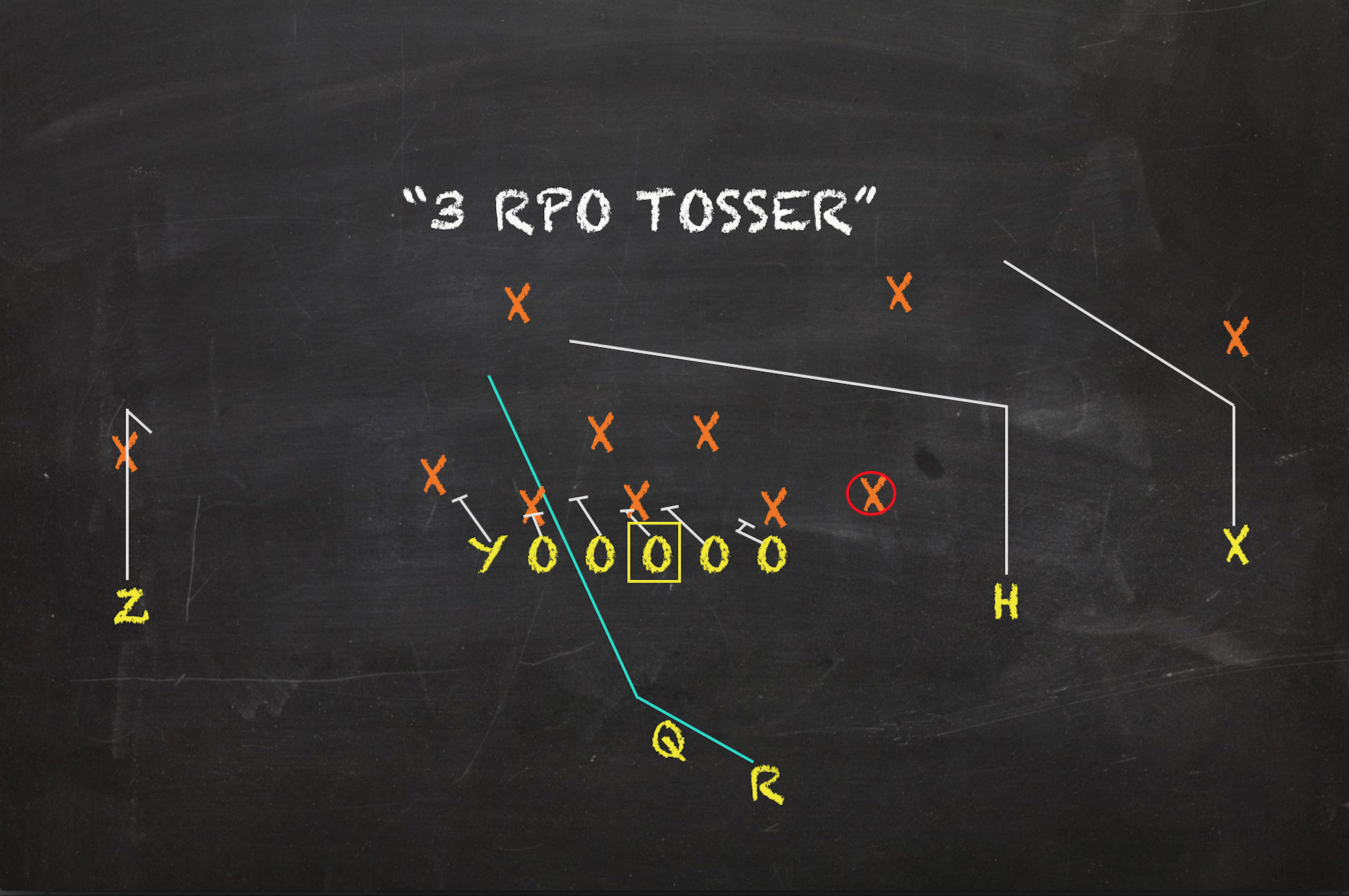
Though steady, Slant Variations were spotty generating splash gains. The Tide scored a tuddy on a big gainer double-slant pattern (“Tosser” in StatCat lingo) in week 4 against Ole Miss, but didn’t see another worthwhile completion until week 11. But after a 50-yard RPO TD against NM State, the concept experienced an uptick on the call sheet. Over the next four games, they were featured on 43 snaps and targeted 18 times. And though a broken play and pristine pocket helped, it even found paydirt in the SEC Championship.
Cross: 3.6% Share, 55.6% Success Rate, 6.3 Y/A
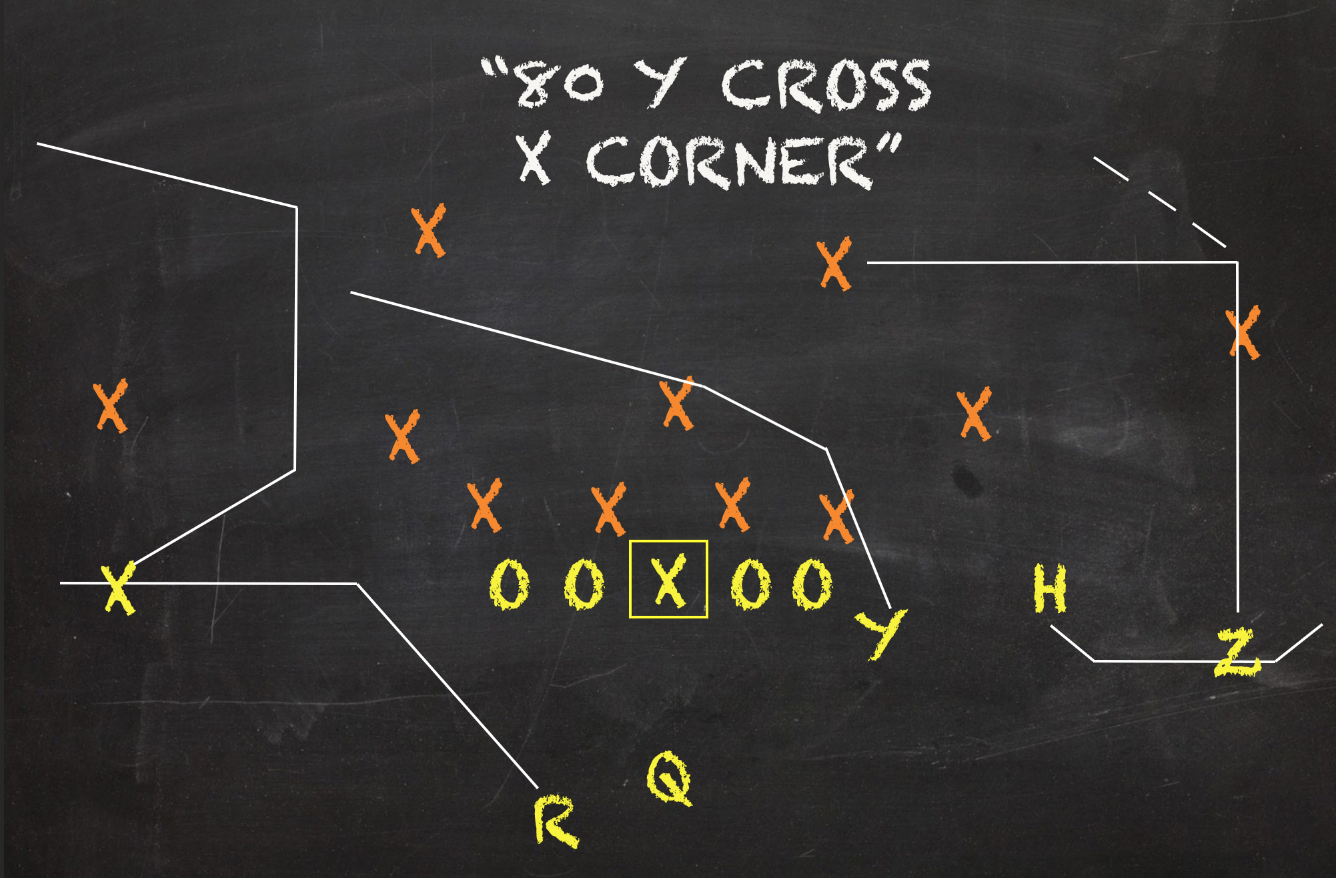
This Air Raid pattern has become incredibly common across various schemes over the last decade. And in recent years, it’s solidly been one of Alabama’s most steady pass concepts. Though the weakside flood failed to replicate 2020’s tub-thumping numbers, Cross still produced dependable down-to-down results while seeing an increase in tries in meaningful minutes. Speaking to its rise up the script, 10% of Alabama’s pass plays featured this combo. The Tide turned to roughly 15 different designs to optimize the look; and that’s excluding potential Yankee Shot designs (with deep vertical high-lows). And playing into its natural prevalence against single-high coverages, 40% of its snaps used play action to grease the operation. All in all, Cross birthed a 20+ yard completion on 16% of its targets – certainly puffing up Alabama’s overall figure. Three of its explosives resulted in points. Two of them occurred the first two weeks of the season. The other occurred to start the 2nd half in the SEC Championship on a Williamson go-route, which was Cross’s best rep of the season. Behind the fuel and malleable window dressing, this concept finished tied with this offense’s 5th-most yards of any one look.
Featured at least once in every game, Cross drew a target in all but two contests. It experienced its highest usage against Miami and Mississippi State, where it totaled 8 snaps and 6 targets in both appearances. Situationally, the flood experienced fairly balanced targets across the three downs (12, 7, 11) in our parameter. But, it was its best self on seconds where it flaunted a 57.1% Success Rate and 10.1 Y/A. The other two downs failed to see their clip of the former climb over 46%. But for what it’s worth, Cross finished as Alabama’s 3rd-most favorite play on the money down.
Stick Variations: 3.1% Share, 46.2% Success, 7.2 Y/A
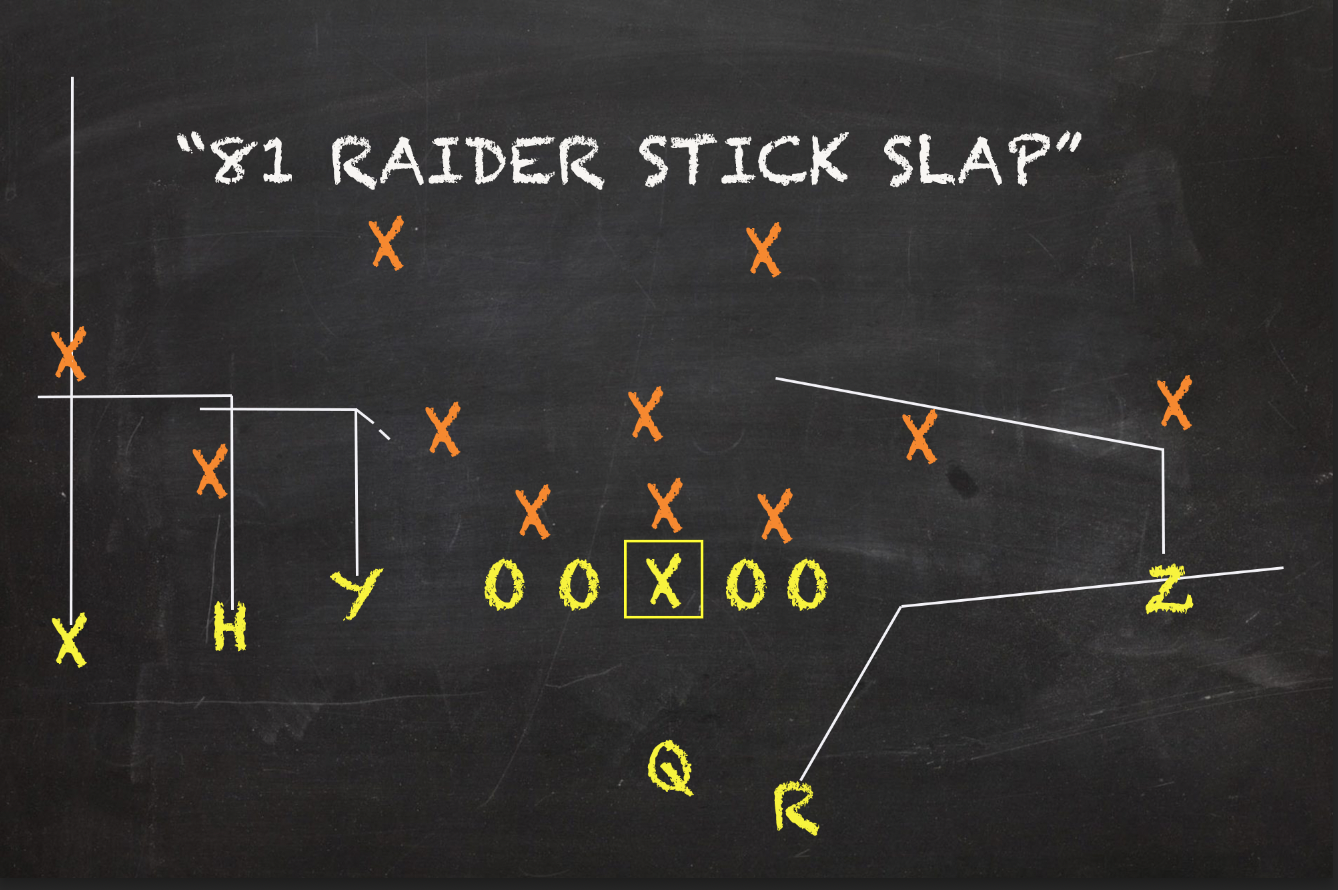
With the need to get the ball out quick and attack underneath, featuring Stick was a no-brainer for O’Brien. As a short-minded concept, most of its completions occurred less than ten yards downfield. And due to the nature of the pattern, a mere 31% of its targets resulted in either a first down or touchdown. But, the vertical option was successfully targeted three times with a pair of explosive gains. Only one of its other attempts gained more than 20-yards.
Both from normal and empty sets, the Tide featured seven different forms of the concept across 60 different snaps. That said, the inverted design “Shock” was overwhelmingly Alabama’s most favorite Stick Variation accounting for 35 of those reps. Its 16 outright targets doubled the next closest form of the concept. Often from 5-wide towards the 3-receiver side, the outside man (No. 1) acts as the hot route towards the flat. But since he’s already aligned there, he’ll just run a speed hitch. The middle slot (No. 2) then overtakes the role as the vertical stressor. Depending on leverage, he’ll run a fade or bend a seam. And like most Sticks, the innermost man (No. 3) is tasked with the titular stick read. Shock tended to be paired with Slant Variations or a “stack read”. We’ve already talked about slants, but the other is a relatively novel within the SEC. The two-man side of empty sets aligned with a vertical stack and each ran a read-based option route. One would take a midrange depth with the other working underneath. Sometimes, both receivers would break outward creating a Bench concept, or inward for a combo that resembled Levels, or diverge like on Under or Snag looks. Just describing it sounds galaxy-brained. Imagine trying to defend it; especially with a jitterbug passer conducting the show.
Aligning with the usage of empty sets, Stick experienced more volume after the bye week. The concept was featured 37 times over the final five games. Furthermore, it was called ten times with five targets in the national championship. Ultimately in meaningful minutes, Stick gained the 7th-most yards of any look for this offense with 187. Situationally, it was a favorite to help buy back some real estate on second downs. But despite accounting for 62% of Stick’s targets in meaningful minutes, these spots oversaw a hacky 37.5% Success Rate – the concept’s worst clip on any down.
Spacing/Curl+Flat: 2.9% Share, 62.5% Success Rate, 8.2 Y/A
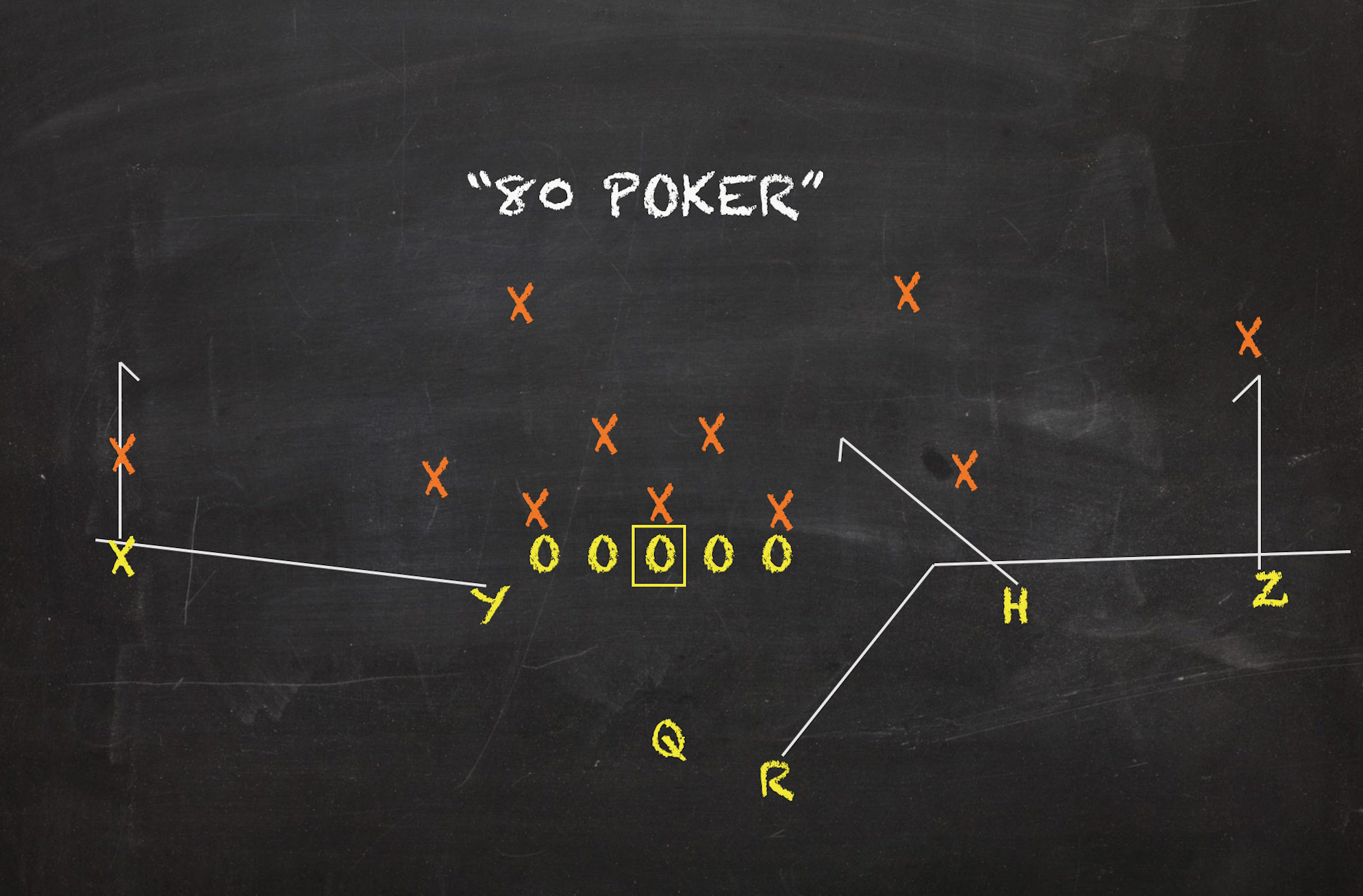
Like Stick, its offshoot cousin Spacing also provided Young quick, defined avenues to get the ball out for a win. Likewise, it was set up and executed numerous ways to prevent opponents from thwarting the attempt. From trips, bunch, 2x2, O’Brien toyed with who would work the flat, where the sit hook would originate from, and the matchup for the outside curl. Alabama even tinkered with Jet/Orbit motion to accentuate the hot route towards the flat in the first matchup against Georgia. Most of its patterns had an answer no matter the defensive response, and Spacing’s 62.5% Success Rate backs up that claim. No other Crimson Tide pass concept owned a preferable figure in meaningful minutes. When including all reps, only one other SEC offense that targeted Spacing more than ten times put up a better clip than the Tide. A mere three targets failed to result in a completion; and one was a drop. It was especially good on first down where two-thirds of its tries ended in situational success.
Despite their dependability, Spacing looks were unpredictable when they’d appear on the script. Only three were called the first four games. But then, 11 were dialed up the next three. And though it helped set up a deep double move and was responsible for a scramble TD in week 8, it failed to sport a noticeable performance until the postseason. Though UGA held the Tide to modest results in both contests defending Spacing, four curl+flat patterns generated 45 yards – including the concept’s lone explosive play – against Cincinnati. Being on the receiving end of that big gainer, Williams’ 77 yards off Spacing plays were a team-high.
Trails: 2.9% Share, 58.3% Success Rate, 10.9 Y/A
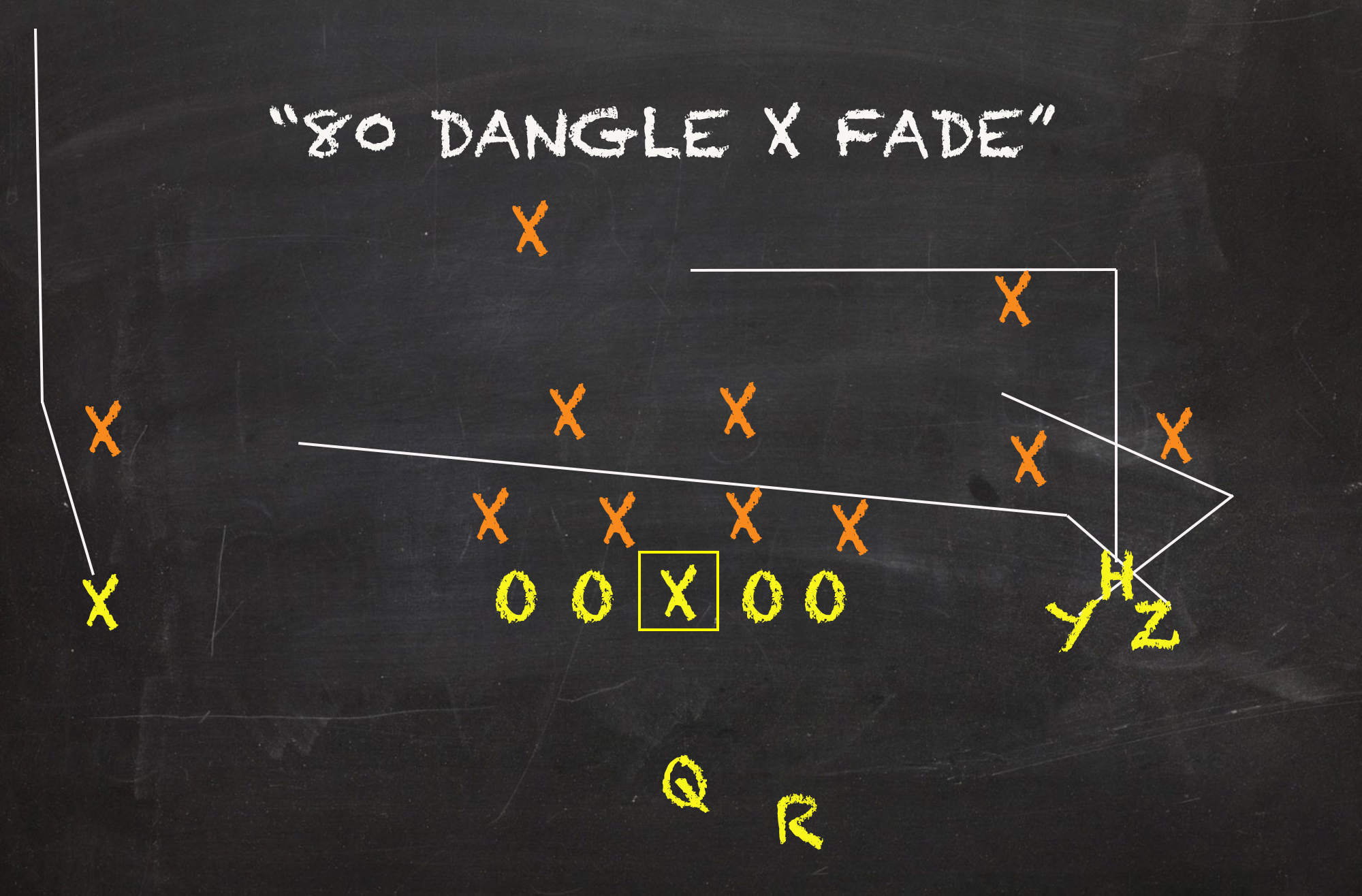
Though O’Brien tweaked Alabama’s pass concepts to suit the situation, he overly stuck with the same staples year-over-year. However, Trail patterns soon became an exception to that notion. They emerged as a later down favorite as well as one of this offense’s best plays. But ahead of the postseason, the OC was rather shrewd featuring them on the script. Only eight were called through week 10. But after the concept produced three successful plays, two explosives, and a 2pt-conversion on five snaps in a dramatic Iron Bowl rally, the Tide made a concerted effort to ensure they remained on the call sheet for the remainder of the season. In fact, half of its targets in meaningful minutes occurred in the final three games. Though some splash scores occurred earlier in the year against Mississippi State, Williams’ 66-yarder in the SEC championship was Trail’s best clip. In the end, some of its efficiency waned with increased reps, but these patterns secured a 37% First Down+TD Rate and finished among the Tide’s five most successful looks and top producers in Y/A. Moreover, no other look gained more through the air.
Trails can take an extra beat to gestate – a portion of the play is designed to move the defense out of position, and that just takes time. But, they generally generate short-distance throws without much risk. Only three of its targets occurred outside the numbers, and only four occurred beyond 14 yards downfield. Of its 25 tries, 18 resulted in a completion. No doubt it would’ve been higher without the five charted drops. Like a good amount of its passing staples, Alabama fancied swapping the route assignments and around to stress out opponents and keep them on their collective heels. I caught a dozen different designs. Some even had a HB-option wrinkle coming out of the backfield. But while the responsibilities varied, these patterns mostly fell into two main categories: Arches and Dangle. In addition to the hot drag and trailing angle route, the three-man Trail combo features a midrange route. Depending on whether its orientation was inward or outward determined the subconcept’s classification.
Mesh: 2.9% Share, 53.6% Success Rate, 8.6 Y/A
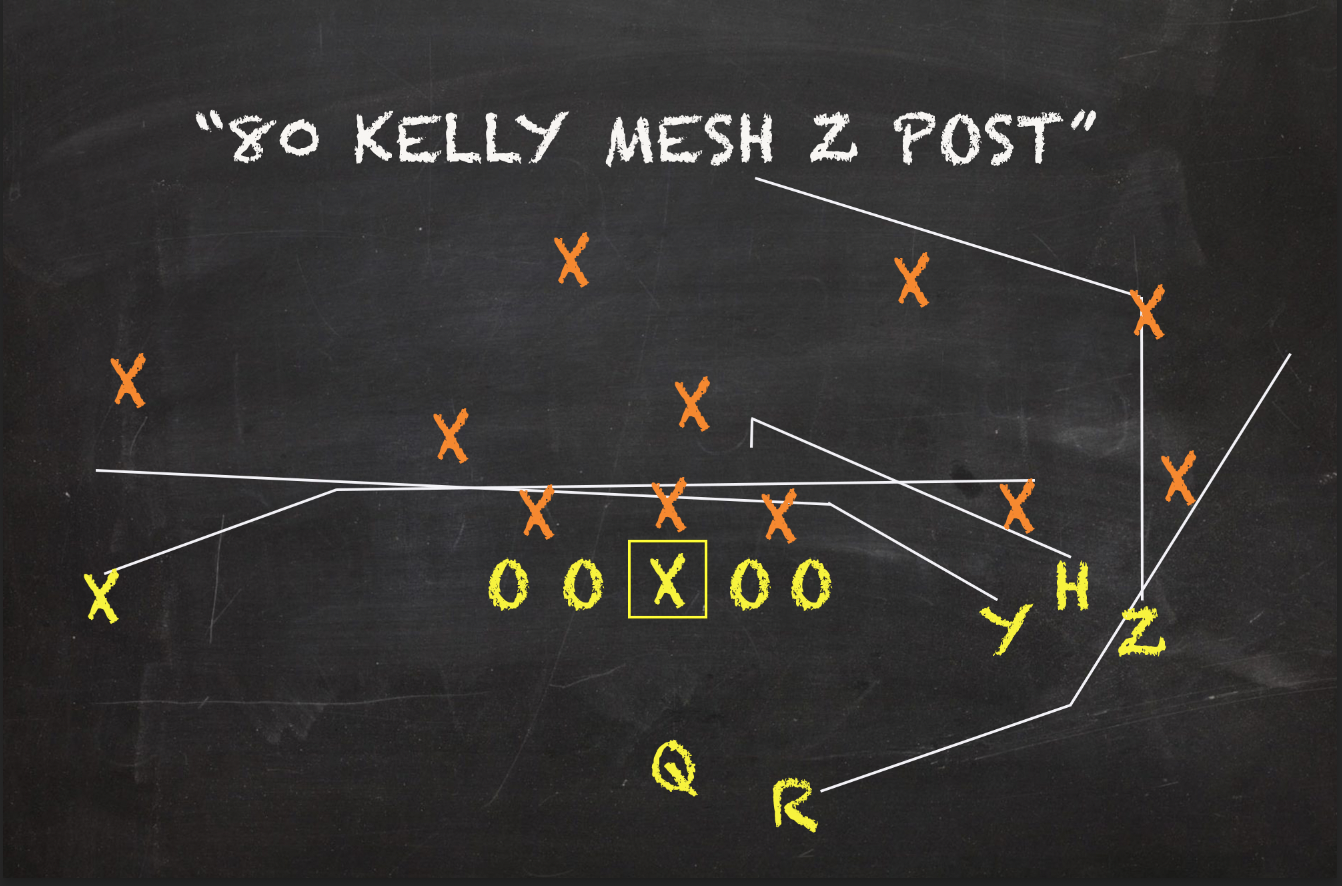
For the last few years, Mesh has been one of Alabama’s third down mainstays. And, this past season was no different. Two-thirds of its targets occurred in those spots in meaningful minutes. Only aforementioned Trails totaled more tries in those spots than the Rub Variations’s 16. But, none outperformed its mighty 68% Success Rate. Designed to work man coverage with intersecting drags and routes through traffic, a sixth of its opportunities birthed a completion of at least 20-yards. The Kelly Mesh was the Tide’s favorite form of the pattern. Named after the variety Chip Kelly popularized with a playside HB wheel and sit hook, all but three of Alabama’s meshes were categorized as such. O’Brien changed meshers and tertiary route tags to keep opponents honest. And, the Kelly Mesh finished with 187 yards, tied with the 5th-most yards of any look. Metchie hauled in both of the concept’s two scores.
Mesh had a clear role as a later down champion and was rarely shoehorned into the script. That meant the concept’s appearances were wonky and depended on certain criteria. Also, opponents soon grew to expect them in crunch spots. And as a result, only two of the six Meshes worked across a modest 5.0 Y/A in the postseason – a complete about-face from its 14.4 clip and 71.4% Success Rate across its first seven tries between weeks 3-7.
OTHER STUFF
Y-Insert: 1.2% Share, 70.0% Success Rate, 6.2 Y/A
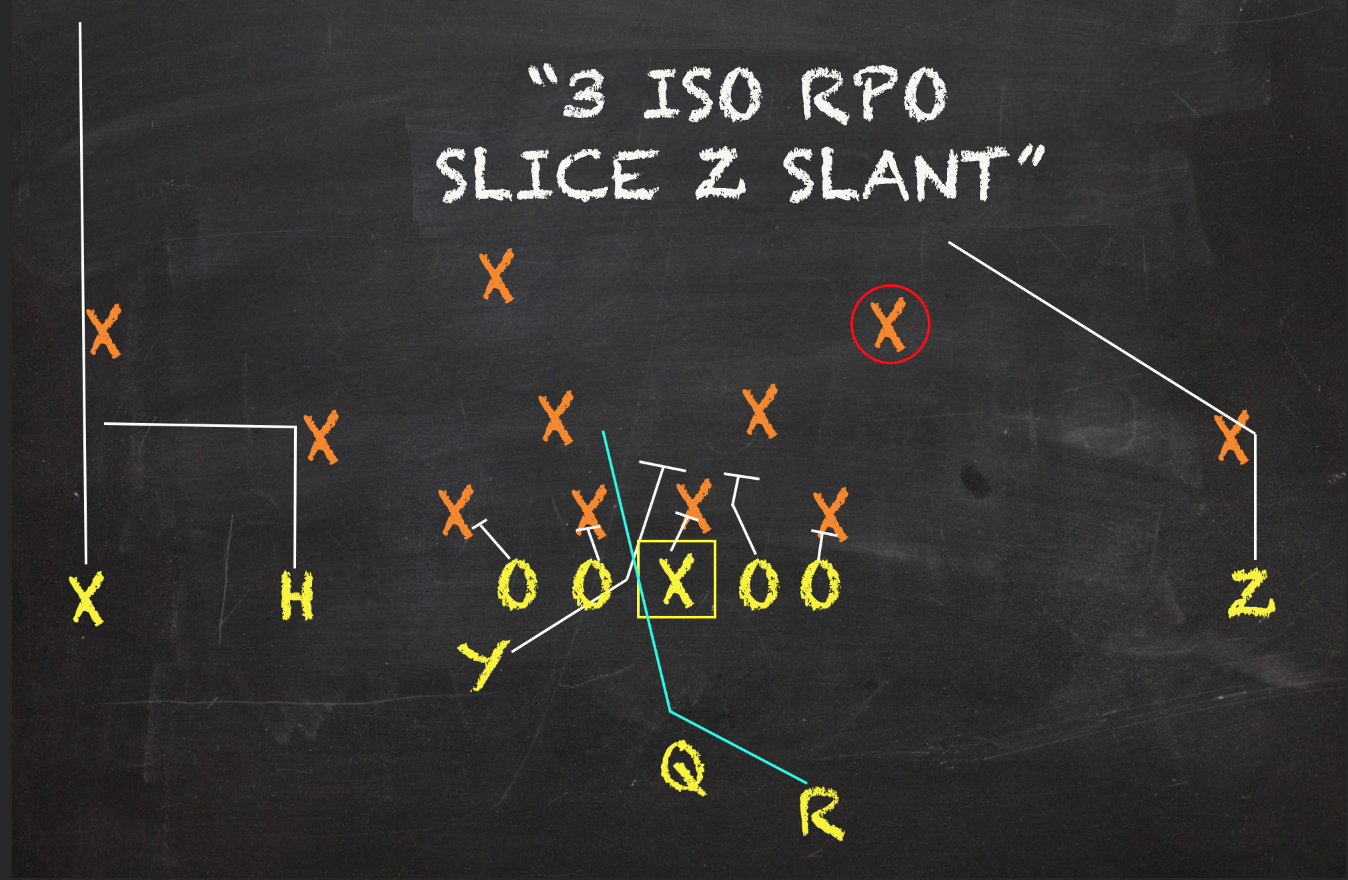
Y-Insert has been a fixture within this offense for a couple of seasons as a curveball inside run complementing their normal run staples like Counter or Split Zones. Though it doesn’t rack up many reps, it's consistently been an even-steven play with positive value. And this past fall, it finished as Alabama’s “most successful” look. Among the concepts that totaled at least ten tries in standard time, none bested Y-Insert’s 70.0% clip. Insert action was its most visible against Florida, Arkansas and Cincinnati. Against the Bearcats, the Tide called a season-high four Inserts; all of them had RPO slant tags. And, half of them moved the chains.
All Curls: 1.9% Share, 56.3% Success Rate, 5.1 Y/A
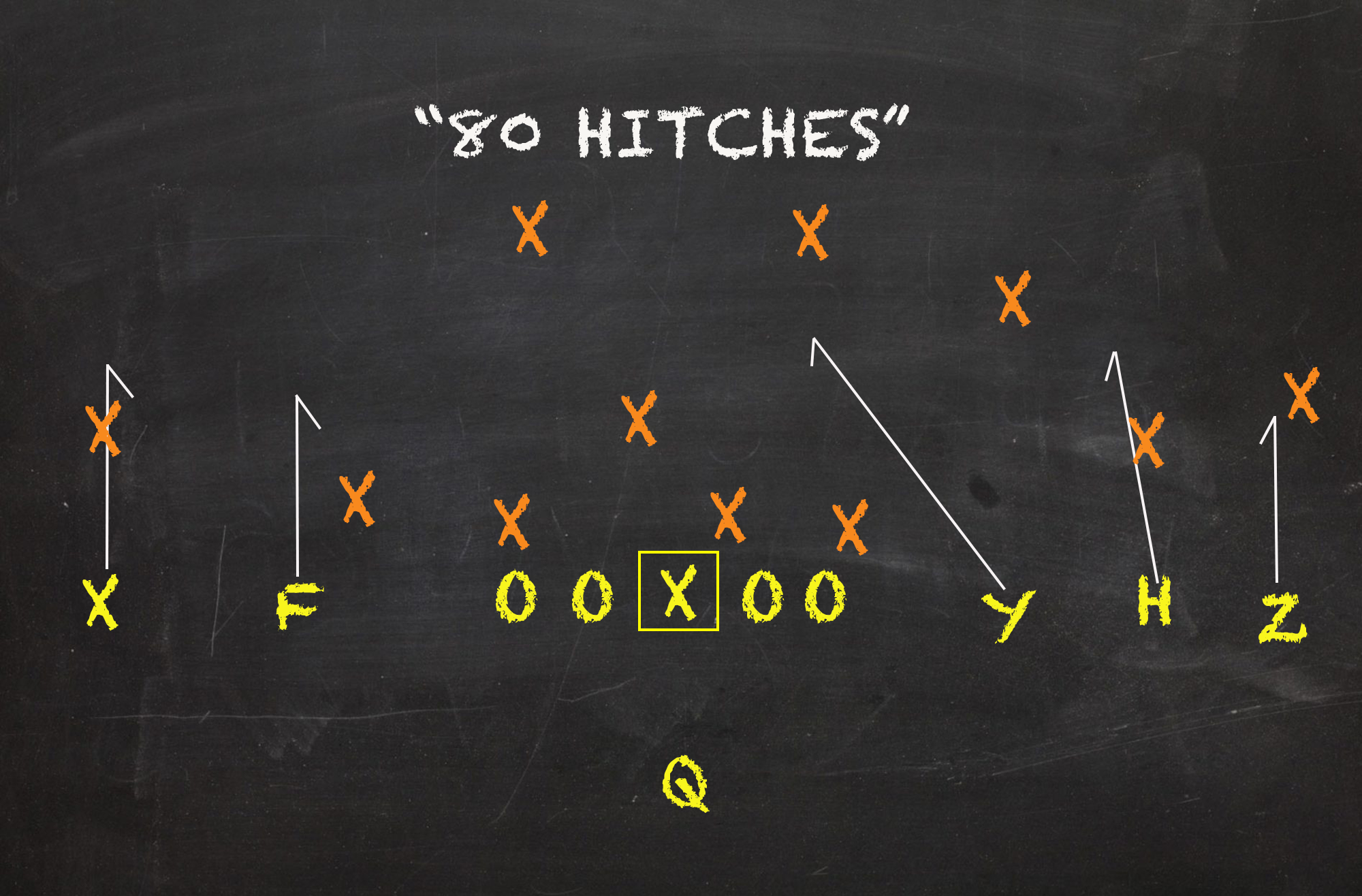
There’s certainly nothing fancy about three or four six yard curl routes. But the reason this rudimentary concept remains a popular staple is because it gets results. Any passer can complete passes targeting it. And with good timing and savvy, a good amount of coverages are bound to surrender a pitch-and-catch opportunity. Alabama used All Curls from empty as a horizontal stretcher and as RPO outlets. Sporadic but dependable, the Tide featured the concept the most in week 12 against Arkansas. It notched eight reps - five as RPO designs.
Deep Double Move: 0.8% Share: 42.9% Success Rate, 19.1 Y/A
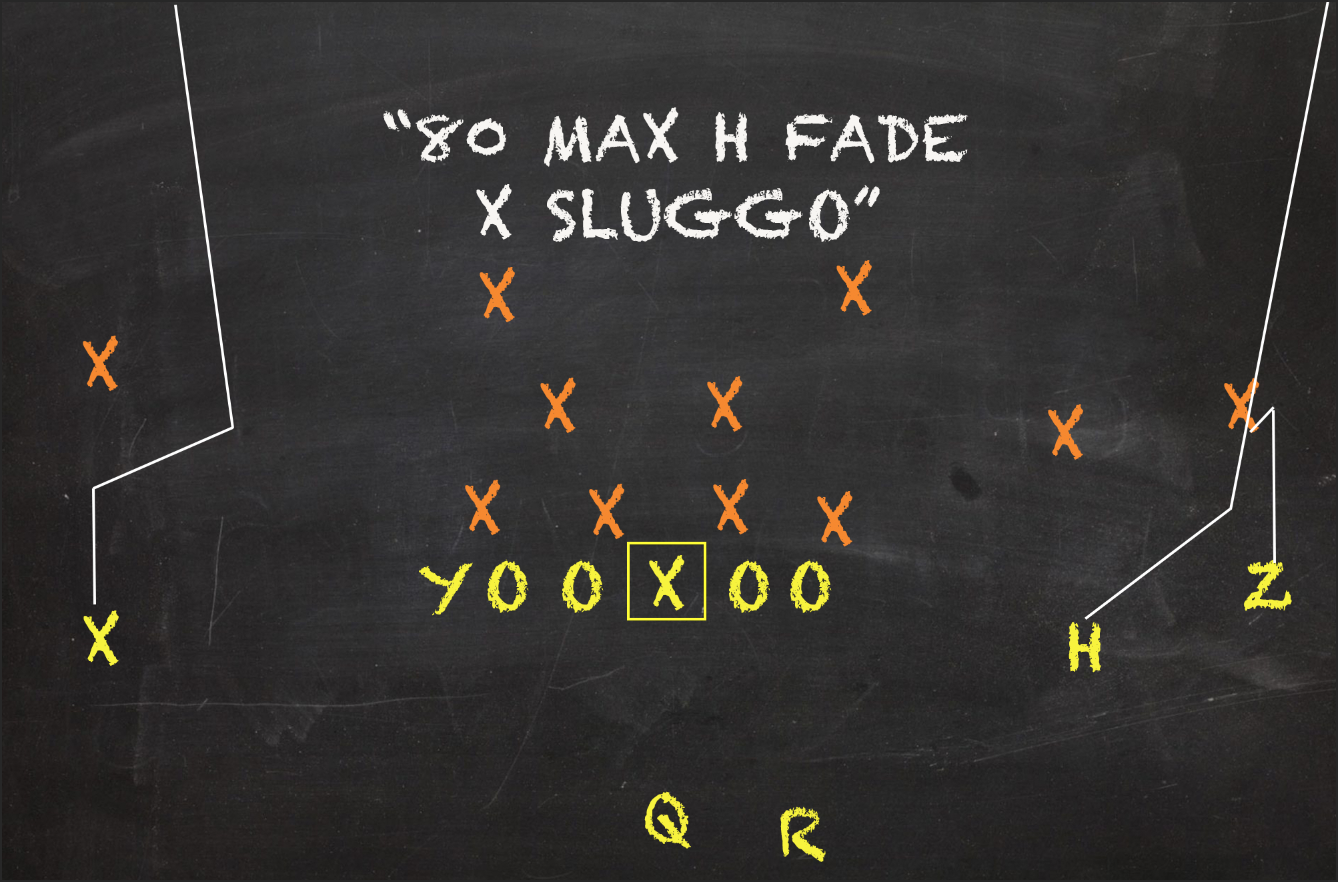
On the year, Alabama took a chance on a deep double move ten times. But in meaningful minutes, only 3/7 were completed. At least, two of them resulted in points. The first to reach the promised land occurred against Texas A&M. Playing off an all-slants pattern, Williamson at the X-spot executed a superb sluggo. The next DDM to win deep showed up against Tennessee where Traeshon Holden hauled in a Spaces-and-Go target. While the inside receivers ran their normal curl switch, the outside man (Holden) normally tasked with a quick out proceeded to execute a vertical multi-breaker. And for good measure, the solo receiver opposite the trips commonly seen running a slant chipped in a sluggo.
Now at its heart, this concept is rooted in West Coast Offense philosophy. Without the rinky dink, YAC-oriented designs geared toward completions near the line of scrimmage, these counterpunches wouldn’t be impactful. Before getting duped deep, backenders have to be put to sleep or forced to creep. And short stuff like Spacing and Stick are excellent patterns at boring secondaries or forcing quick rallies. The last DDM to hit paydirt was the most clever for my money. Notably against Arkansas, O’Brien set up a dig-n-go off the Tide’s fancied Shock+”stack read” pairing from empty. After running the combo earlier in the match in a similar situation, Williams burst through the secondary on a dig – as he would on a potential “read” in-breaker – and once the safety peaked from his perch, it was a wrap. Williams snapped his route upfield towards the end zone, and that’s where he ended up.
Alabama dialed up a DDM the first three games of 2021, but they all failed. Other misses include a missed post-corner rep against TAMU, a hitch-n-go opposite a curl+flat combo in the Iron Bowl, and a missed out-n-up in the playoff against Cincinnati.
Hoss: 1.7% Share, 50.0% Success, 11.0 Y/A
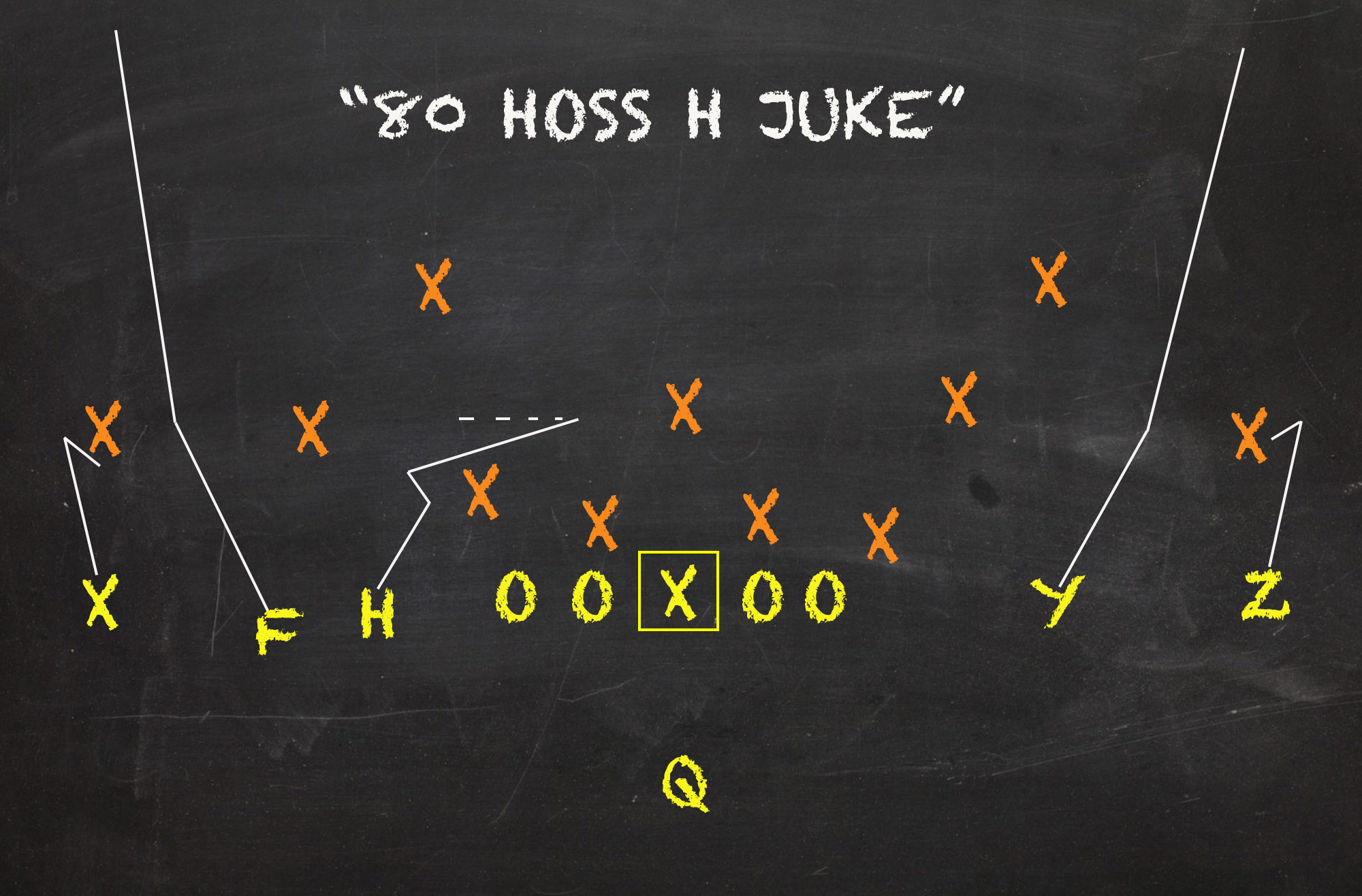
Hoss – an ordinary curl+seam combo – is a conventional pattern seen from empty or balanced sets. Often mirrored with a stressing juke, slant, or option route from the innermost receiver, it’s an easy matchup-creating design. Whether isolating the inside man against a slow-footed backer, placing a deep threat with preferable leverage against the backend, or spreading the defense sideline-to-sideline, Hoss can get results. As far as Alabama goes, half of its targets towards this concept ended in success. And, only three other looks produced a higher Y/A. Hoss was featured on 18 snaps; 11 of them included a multi-breaking “juke” or jerk route. Its most productive outing was the Arkansas game where three were seen with one birthing a big gainer. On the year, Hoss+Juke accounted for 3/4 of the concept’s first downs.
Inverted Sail: 1.5% Play Share, 25.0% Success Rate, 11.9 Y/A
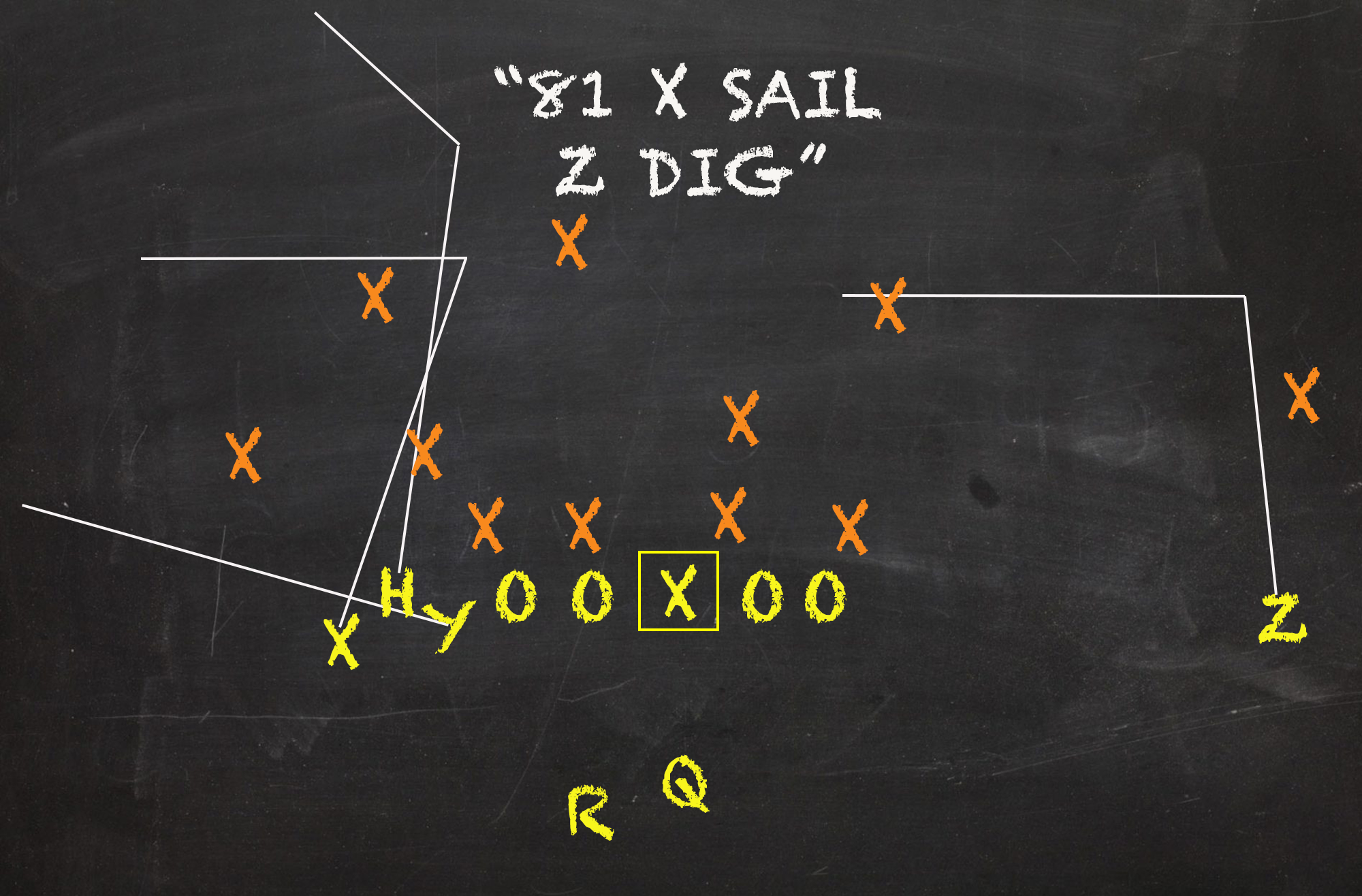
Strongside floods – a three-man high low consisting of a vertical, medium outbreaker and flat – are pretty quotidian. In one way or another, most offenses feature them. But few got as cute with route responsibilities as O’Brien’s bunch. The Tide dialed up an Inverted Sail a dozen times this season. The inversion – or swapped assignments – revolves around the No. 1 and 2 receivers. And, it didn’t take too long for the concept to make an impact; Williamson raced for a 94-yard TD in week 1 thanks to the look. And, former tight end Jahleel Billingsley seized a late down conversion off a 19-yarder the very next week. But barring a decent scramble and serviceable checkdown, Alabama failed to log another successful rep of an Inverted Sail until the final game of the season when former wideout Agiye Hall snagged an explosive catch. Just as many tries resulted in a sack as success. But thanks to the soft spot the OC held for this pattern in addition to its early highlights, it deserved a blurb.
RPO Outlet Screens: 4.4% Play Share, 48.6% Success Rate, 6.4 Y/A
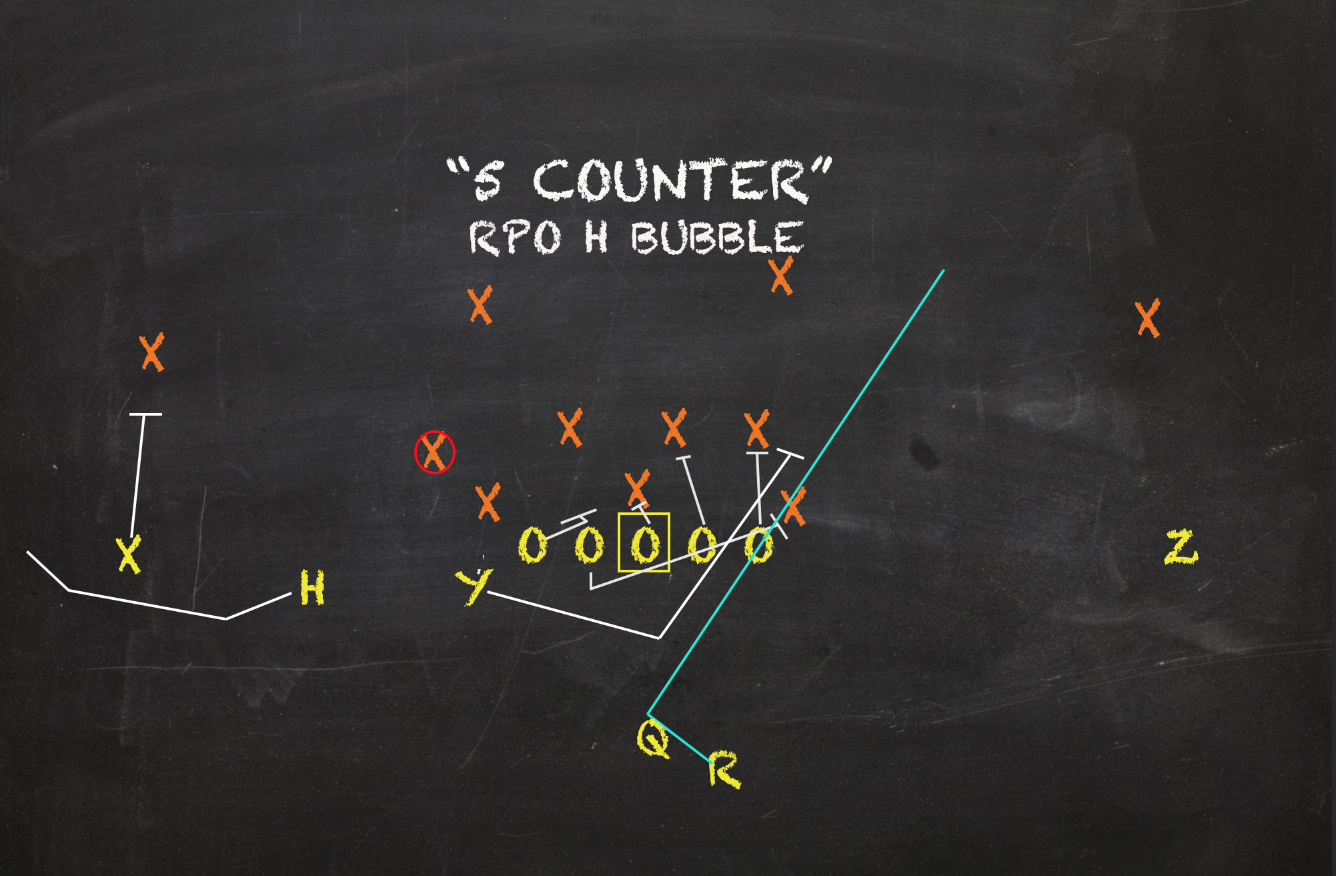
We almost made it through this deep dive without mentioning the Tide’s copious outlet screens seen on Run-Pass Options. Designed to do damage with advantageous numbers or angles, these outlets were low floor, high ceiling avenues. Alabama targeted 21 bubbles and 17 tunnels in meaningful minutes. And of course, they were featured way more snaps than that across the season. Bubbles were the more successful of the two when broken out (52.4% vs 43.8%) and averaged two more Y/A in comparison. But when leaning into the modern tactic of “shoot” motion late in the year, three of the four tunnels worked. Teasing a more prominent role for the concept in 2022.