Setting Expectations: South Carolina QB Spencer Rattler
Setting Expectations: South Carolina QB Spencer Rattler
Though it can be defined many ways, I like to point to the old adage that interprets happiness as the positive differential between expectation and reality. If one elevates their aspirations and desired outcomes over the most likely result, the door is opened for regret, disappointment, and loathing to alter moods and memories. Underselling and over-delivering certainly creates more smiles than failed guarantees that fall short of expected benchmarks.
Since the Gamecocks beat their projected win total by three games – including securing the team’s first bowl birth in just as many seasons – folks are awfully giddy in South Carolina entering this offseason. And, that was before former blue chipper and Oklahoma starting quarterback Spencer Rattler decided to take his talents to Columbia for 2022. With him joining the fold, the ‘Cocks bar has been raised; some even have them as a dark horse to win the division.
However, that optimism aligns with the notion Rattler will be able to replicate portions of his magical freshman campaign where he logged 28 TDs, over 3,000 yards, completed over two-thirds of his passes, and finished inside the top12 of ESPN’s QBR metric nationally. Running back his recent slump of a season certainly won’t make Gamecock backers happy in the slightest; nor will those results accelerate USC’s rebuild into a respectable force within the SEC.

Football is very much a “what have you done for me lately” kind of entity, but Rattler’s tantalizing ceiling is 100% worth overlooking his sophomore slump. Though not all five stars are built the same, few check the boxes like SCar’s new QB1, and his pros far outweigh his cons. Besides donning a mini Howitzer for a right arm and being a natural playmaker outside of structure, he’s mobile and offers a multi-faceted skill set; meaning he’s capable of running any required scheme.
Plenty are in Rattler’s corner and are confident he will get back to serving up sizzling statsheets and producing eye-popping highlights. And while his bandwagon is seemingly growing daily, forgive me for playing the role of devil’s advocate. He lost his job for a reason. And despite his background, he has plenty of flaws on his profile.
To see how his play stacks up with SEC standards, I charted Rattler against his five hardest opponents across his time in Norman with help of ESPN’s SP+. This is a standard practice by StatCat that has helped forecast other former incoming transfers quite well; especially signal callers. And after looking at this crop of numbers, this process is justified. Even with Vanderbilt’s carcass stinking up the rest of the conference, an average SEC team from this past season compared nicely to our subject’s most challenging foes over the last two years. And I’m sure South Carolina fans are more interested in how Rattler performed in those spots than against teams like Missouri State or Western Carolina. But just in case you are dubious on the sample size, his 175 such attempts in these six games include 37 and 32 more attempts and completions, respectively, than any SC passer amassed in 2021.
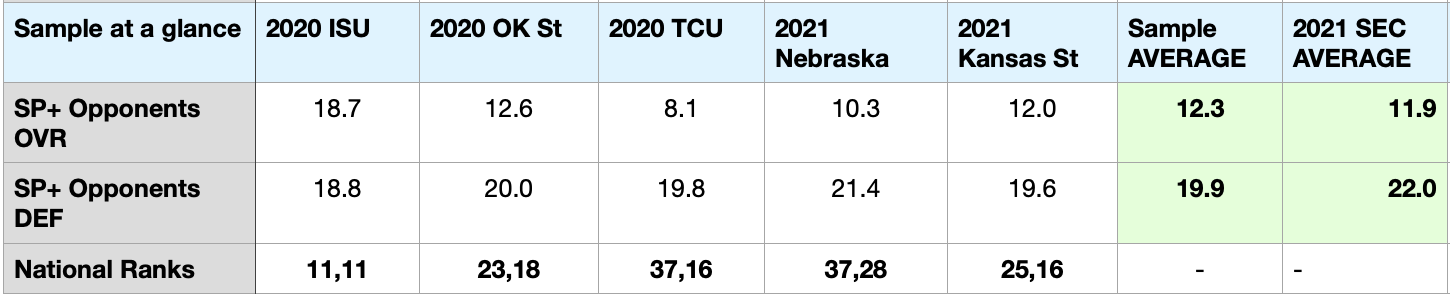
This is not meant to be a definitive statement on Rattler’s game. That said, you will undoubtedly have more substantial takeaways on his short-term offerings than just glancing over his box scores. Using this applied parameter, let’s check out how his ball placement, decision-making, performance under the gun, and “passing floor” compares to his new contemporaries’ returns in the Land Where It Just Means More!
ACCURACY / ball placement
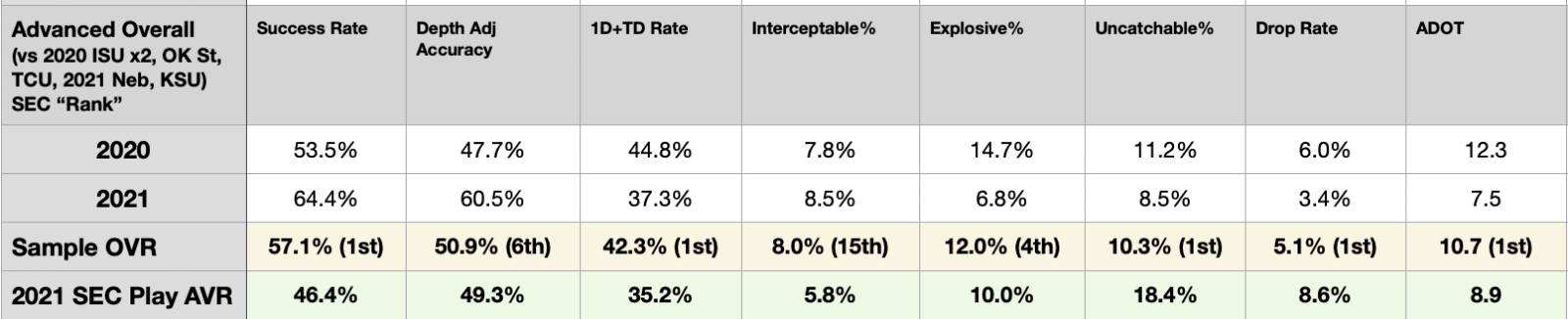
Based on his showings against his hardest opponents, Rattler definitely has adequate ball placement to make an impact in the SEC. His 65.7% raw Accuracy% across his sample was akin to Alabama’s Bryce Young’s clip from 2021. And even though he pressed tight windows and low-percentage targets at times, he usually gave his receivers a chance to make a stab at the ball. Only a tenth of his attempts across his sample were deemed uncatchable. No SEC starter posted a lower such rate than his this past fall. Considering Rattler is a passer who seemingly plays in perpetual motion, that’s pretty remarkable.
That said, there’s a clear demarcation between delivering catchable balls and exhibiting premier downfield precision. Since Rattler was constantly on the move, his mechanics faced more challenges than the average passer, which led to occasional errancy. When applying more weight the further his passes traveled downfield, SCar’s new QB1 projects to have a Depth Adjusted Accuracy% closer to average than elite. Though not a total liability – or any bit of reason why he won’t succeed – scouts rarely drool over average traits.
Granted, he has the strength and capabilities to fire from numerous platforms, and his receivers hardly left many plays on the field when clean targets were in reach. But, 10.3% of his attempts were altered by defenders, which could present trouble down the line if refinement fails to occur. After all, the SECers that cracked that threshold this past season faintly instill optimism on this front (Ken Seals, Emory Jones, TJ Finley, Zach Calzada, Max Johnson, and Mike Wright).
Captain Obvious wanted me to remind you that allowing defenders to get their mitts on throws is never good for offenses. At minimum, a snap is likely to be wasted. At maximum, it could result in a giveaway. Plus, a constant presence inherently makes a receiver’s job more difficult.
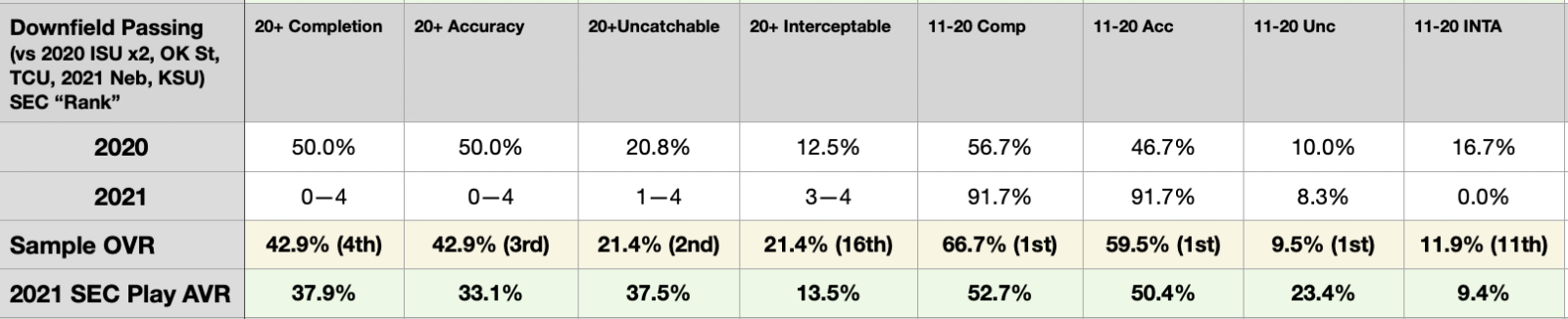
Still, Rattler lived up to his pedigree as a bombardier; especially as a freshman. Half of his deep balls were completed and on-target against his hardest opponents in 2020. And even with the recent duds, his resume paired with this dazzling arm should provide an instant pop to an offense that combined for a 25% Deep Accuracy% this season. After all, these throws are simplest avenues to logging explosive gains through the air. The Gamecocks have failed to sport a double-digit Explosive Pass Rate as a team the last four seasons.
However, keeping an eye on his verticality would be prudent in assessing his immediate upside. Though Rattler squarely falls into the camp of “toosly” quarterbacks (passers who yearn to deliver big plays with their bazooka arms or magical legs apt at evading rushers), his potency dissipated last year. In his two games against his hardest opponents from 2021, Rattler logged a mere 7.5 average depth of target, which easily would’ve placed inside the SEC’s bottom3. And with less bombs, his Explosive Pass Rate was sliced in half year-over-year. Hell, two of his last four starts needed help from a double pass design in order to kickstart the offense. Small sample size yes, but it helps hint why he lost his job despite seeing a number of metrics enhance in the process.

DECISION-MAKING / Aggressiveness
As a first-year, Rattler suffered from ghost pressures and buffered at times when honing in on his primary target. Though not ideal, those are common characteristics seen in a boatload of young passers; particularly ones not used to taking care of business within structure. But as of right now, he’s still overly “see it, throw it” passer and could stand to improve is anticipatory skills.
If he didn’t like what he saw or became the slightest bit uncomfortable, he would break rank. But since the phenom was really good at stretching the field and providing an obvious statistical jolt to Oklahoma’s bottomline, these growing pains were tolerated. After all, it wasn’t like he couldn’t diagnose coverages or identify one- versus two-high shells. Plus, his down-to-down results were laudable. But, Rattler predominantly banked on his skills to win the day rather than being a cerebral pre-snap mastermind.
In an attempt to speed up his passer’s processing power and seize a tad more consistency, Riley felt inclined to give his former QB more scheme elements to dictate where to go with the ball. Hinted by his aforementioned reduced average depth of target, Rattler’s Play Action+Screen+RPO Makeup increased from 55% to 63% year-over-year. Matt Corral and Hendon Hooker were the only SECers to claim a larger figure in 2021. Plus, the concepts and designs were noticeably less aggressive compared to the previous fall. Looks like Hoss/Comebacks, All Verts, Vertical Shots, Switches, and Double Posts were replaced by things like Curls, Floods, and Slants. Though well over a fifth of his attempts had an average time to throw greater than 3 seconds, this tweak helped bring his clip down from 29% to 22%.
Though completions and successful plays increased in regularity during his sophomore season, the conservative lean did diddily to curb Rattler’s number of turnover-worth throws, which is a massive red flag. And his cause definitely wasn’t helped by a dwindling First Down+TD Rate. Risky throws sometimes come with the territory when one lives dangerously and has a propensity for pushing the ball deep downfield. But, they are far less acceptable when paired with a style comparable to the one Rattler displayed in 2021. Just ask Florida fans how it felt to constantly balance between goading a passer to seek big gains while trying to prevent giveaways. Zero fun, sir.
Like most strong arm QBs, the former-Sooner wasn’t immune from thinking he could make every throw. And again, he had a tendency to test tight windows downfield. No SECer with at least eight starts last fall managed to produce a Contested Target Rate greater than Rattler’s 21.7% figure from his sample (FWIW, SCar combined for a 16.7% in 2021 despite not exactly having premier separators at receiver). Despite the practice, these tries netted dissatisfying returns. On a gaudy 19.2 average depth of target, Rattler only nabbed three explosive passes. He was just as likely to log a successful completion as see a defender affect a tight window attempt. Moreover, these throws were the major source of Rattler’s interceptable passes. Against his hardest opponents, over a quarter of his attempts met that criteria. Only Vanderbilt’s scattershot Ken Seals produced a worse figure this fall within the SEC. Yikes.
Overall, Rattler logged an 8% Interceptable Pass Rate across his sample (14/175) even though he only finished with a pair of picks. In both years, his respective clips tracked to place inside the SEC’s bottom4. So it wasn’t just a one-year concern. And when specifically looking at throws beyond ten yards downfield, he was more likely to serve up a TWT than an uncatchable attempt, which tracks since those tries generally face more defensive resistance.
No matter how Rattler operates – handcuffed by scheme elements or given free rein to sling it deep – fixing his interceptable passes is the single most important aspect the new Gamecock must address this offseason. South Carolina’s rebuild is ahead of schedule largely thanks to how the team maximized its slim margin of error last year. That obviously takes a hit by constantly teeing up gifts for opposing defenses. And it should go without saying, scouts tend to shy away from dudes who are careless with the football.
PLAYMAKING / Under Pressure
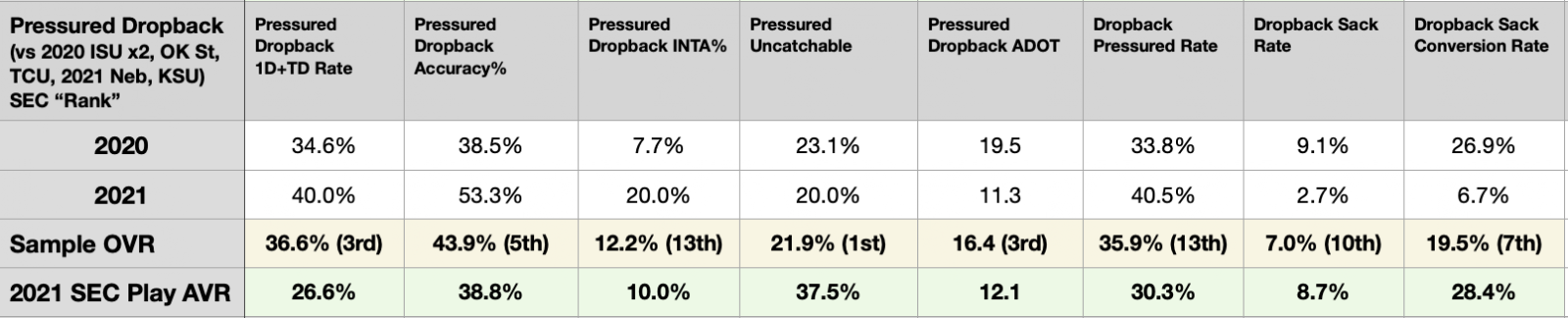
Rattler was well-accustomed to pressure as a Sooner. If his OL didn’t crumble from the initial onslaught, he invited plenty more examples when roaming around attempting to extend plays . His 29.1% raw rate in our sample would have been the 5th-highest in the SEC this past season. And when excluding screens and RPOs, well over a third of his dropback experienced a form of defensive harassment.
Pressure or no, over 32% of Rattler’s attempts in our sample occurred outside the pocket. Again, some of that was by design with bootlegs and designed rollouts. But, a fair amount was due to his own volition. As a fellow 6’1 man, I understand the inherent frustration that can come trying to read and diagnose coverages when standing behind big bodied lineman that tend to be taller in stature. Either way, the movement naturally helped Rattler’s throwing lanes become more prominent and they facilitated his preferred playing style. In return, his 70.7% Completion%, 84.7% Adjusted Completion%, 68.9% Accuracy%, 12.3 Adjusted Net Passing Yards/Attempt, 51.7% First Down+TD Rate, 62% Success Rate, 5.2% Defender Breakup Rate, and 6.9% Interceptable Pass Rate on these tries all propped up his overall numbers in our parameter. Regardless of context, those are some sterling stats and articulate how much of a special talent he can be when things break down.
To that point as a passer constantly buying time or playing backyard ball, over a quarter of his throws had a time to throw greater than 3 seconds. No other SEC starter with at least five starts this fall had a clip greater than 23% (But since it’s relevant, Jason Brown logged a clip north of 30%). Moreover, none of his future peers managed to match his 51% Success Rate or 12.1 Yards/Attempt. And for good measure, both his raw Accuracy and Depth Adjusted Accuracy track to be top5-worthy in this context by SEC standards.
Against pressure in general, Rattler’s graded well. Sure, his returns looked up to his cumulative figures from our sample (and obviously other circumstances). But measuring them against SEC benchmarks, Rattler’s playmaking shines through. Along with projecting to own a top5 First Down+TD Rate and Accuracy% when under the gun, he championed a lower Uncatchable Pass Rate in these spots than any of his contemporaries. The year-over-year dip in verticality seen in other categories remained firm, but Rattler still tracks to be an aggressive chance taker who’s skilled at making pass rushers look silly. Despite the high degree of duress, his dropback pressure:sack ratio finished on the right side of the SEC mean each year including a magnificent 6.7% figure in 2021.
However, his most pressing concern was front and center in this context; potentially creating the figurative turd in his otherwise sweet punchbowl. Almost an eighth of his pressured dropbacks had potential to be picked off across his sample. This past fall was particularly sour as his such clip practically tripled year-over-year.
Though volatile spots that are less indicative of future performance due to the numbers of variables involved, pressured throws tend to show a QB’s true colors. And, Rattler stands to be a clear asset under duress. That said, if he continues to toss an interceptable pass every fifth attempt behind a line that’s been less-than-stellar curbing pressure, dissenters will have some ammunition to point to when clamoring why he’s not a homerun product.
FLOOR Passing
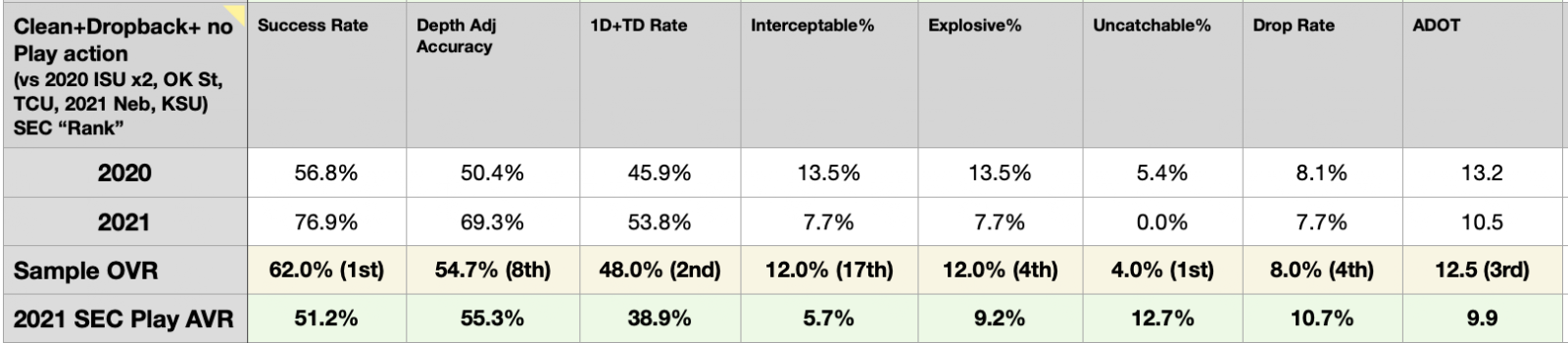
Though pressured attempts and plays outside of structure are used to guesstimate a passer’s potential, one’s “floor” is determined by measuring efficiency on clean+dropback+non-play action snaps. The idea behind this parameter aims to strip all the variables that might potentially affect a QB’s efforts and track them under more stable conditions. The premise is simple: When asked to execute the scheme as designed with no excuses or guises, can you go out and get completions? No blitzers to blame for busting a design, no screens or RPOs to fudge the numbers, no play fakes manipulating coverages. How consistent and reliable can you be on schedule?
Even without the blessing of Riley’s razzmatazz and deception tactics, Rattler’s passing floor projects to be among the best around. His Drop Rate doubled his Uncatchable Pass Rate and his Success and First Down+TD Rates each project to be near or at the top of the league. And outside of his Explosive Pass Rate, everything improved during his sophomore year.
Though his stats impressed, his sample’s Depth Adjusted Accuracy% fell below the SEC average. And despite the circumstances, Rattler’s “risk it for the biscuits” mentality carried over when in structure. His 12% Interceptable Pass Rate across his sample would’ve been the worst in the conference. Plus his 14% Defender Breakup Rate would’ve only trailed Zeb Noland and Mike Wright. In every single context, Rattler’s occasional pressing remains to be his biggest flaw and the trait that has the greatest potential to undercut his overall perception.
Before closing, I also peeked at what happened to these findings when exclusively looking at “floor” attempts inside the pocket. And unfortunately, some warts emerge on Rattler’s profile. His 54% Accuracy% and 69% Adjusted Completion% each would have been two of the worst clips within the SEC this past season. And behind a loud 41% Toss Up Rate (off-target or contested passes that are still deemed catchable), his 49.4% Depth Adjusted Accuracy was bad enough to place inside the bottom4. His 54% Success Rate – though good in a vacuum – fell below the conference mean. So even though Rattler’s amazing play outside the pocket fuels his hype train, this level of relative inefficiency cools his radiant resume. Again “floor” attempts are much more common and immune from variables, so they best reflect a passer’s down-to-down trajectory than other parameters.
CONCLUSION
Rattler shouldn’t have to compete for the job and should be inoculated into this offense by the end of spring. He’s a clear talent at the position and he should be given every possible opportunity to succeed. Marcus Sattersfield and Shane Beamer might recalibrate their offense to better suit Rattler’s fancy; but either way, South Carolina should see a bump on its bottomline even if his future supporting cast fails to match up with his running-mates at Oklahoma.
At the very least, he has a wonderful chance to wind up as the Gamecocks’ best passer in a decade. Best case scenario, he’s an all-time great who will continue to propel the program’s legacy with a notable professional career.
Again on a per-pass basis, Rattler’s accuracy projects to be among the best the SEC has to offer. So even if the conservative approach remains, he can put up some pretty figures riding sturdy down-to-down efficiency. That said, Rattler’s decision making – either when playing gung-ho or attempting to take what’s being given – remains to be a big red flag thanks to a high level of turnover-worthy throws across his sample. And since a good deal of his appeal comes after structure, last season's dip should be a cautionary tale of backing a passer that seeks chaos in order to thrive. Still, you'd have to be a grade-A moron to shove you head in the sand and ignore what the Good, Ole Fashion Eye Test has to say about this fella.
To quote the great Proximo from the epic Gladiator: “You are good, Spencer; but not that good. Still, you could be magnificent.”
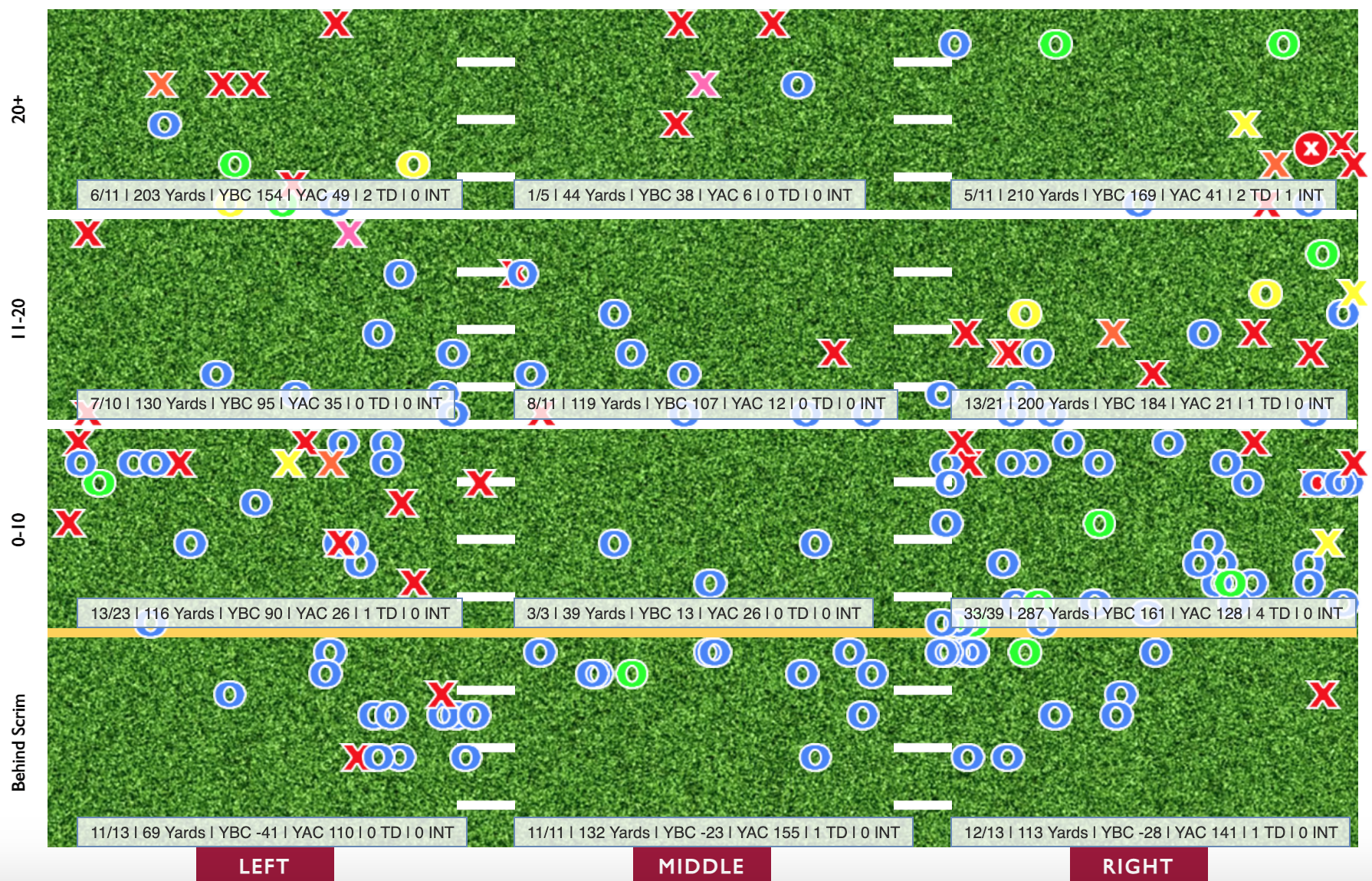
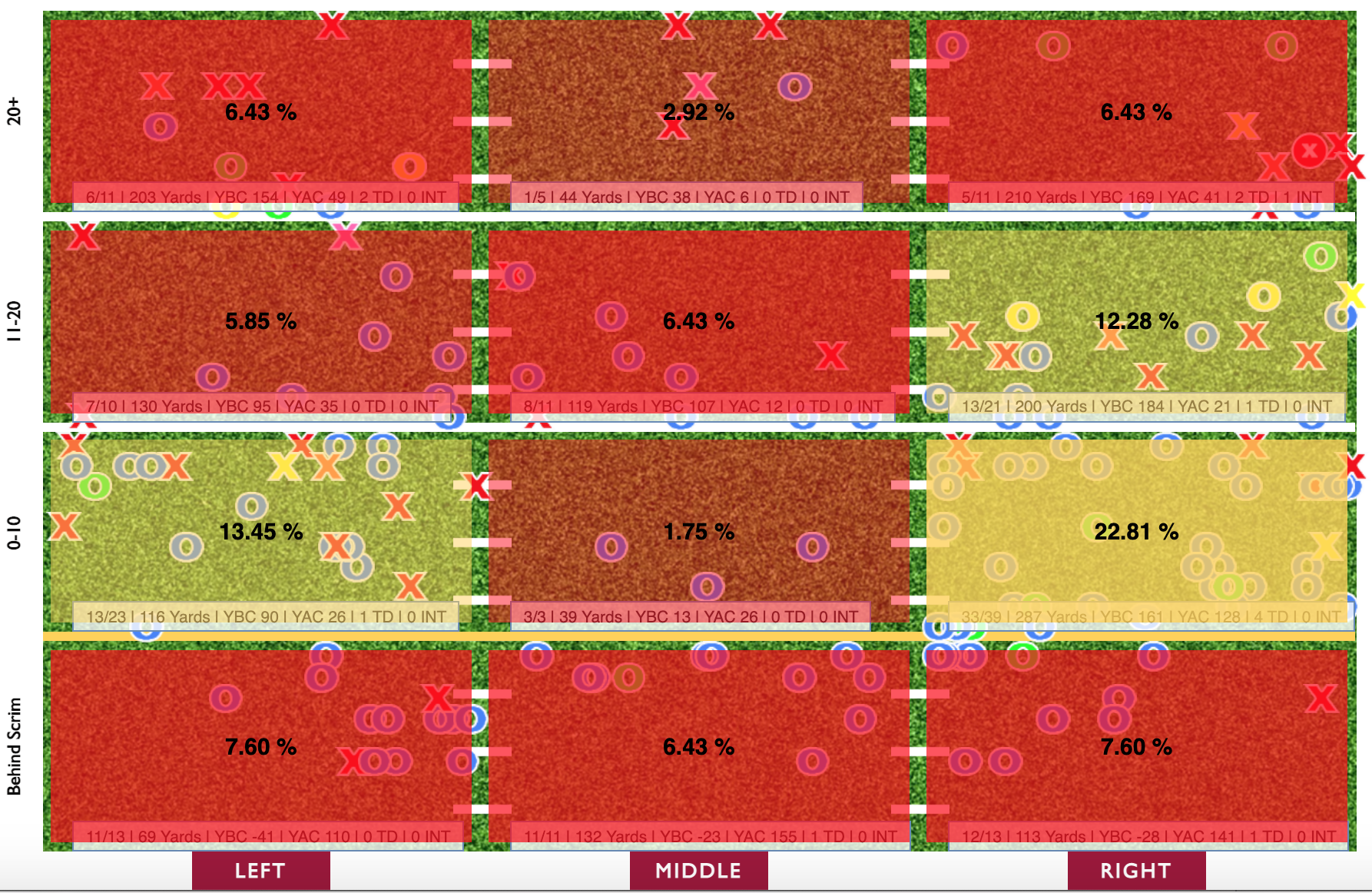
Spencer Rattler's Pass Chart and Target Heat map against 2020 Iowa State, 2020 OK State, 2020 TCU, 2021 Nebraska, and 2021 Kansas State
