Setting Expectations: Auburn QB Zach Calzada
Setting Expectations: Auburn QB Zach Calzada
Though it can be defined many ways, I like to point to the old adage that interprets happiness as the positive differential between expectation and reality. If one elevates their aspirations and desired outcomes over the most likely result, the door is opened for regret, disappointment, and loathing to alter moods and memories. Underselling and over-delivering certainly creates more smiles than failed guarantees that fall short of expected benchmarks.
Zach Calzada’s sophomore showing was met with mixed reviews. His early appearances filling in for the injured Haynes King hammered home why Jimbo Fisher passed over him to be the Aggies’ QB1. With him behind center, TAMU barely beat a forgettable Colorado team and dropped its first two games in SEC play. The obvious highlight of the year was Calzada’s gutsy performance against the eventual SEC champion Alabama – a game that saw him complete over two-thirds of his passes and post a career-best 285 pass yards. However, this was the only game where the Cuban Missile managed to amass more than 200 yards with a Completion% in the 60’s.
Calzada failed to break those plateaus for the next three games. The Aggies were winning, but palpable frustration started to boil surrounding their quarterback. And despite tossing for well over two benjamins in both of TAMU’s final conference games, his case certainly wasn’t helped by losing both matchups.
Taking a step back and looking at his pedestrian traditional metrics (199 yards/game, 56% Completion, not even a 2:1 TD:INT ratio), Aggieland’s concerns about his short-term prospects are warranted on the surface. Calzada was serviceable; but after getting banged up against the Tide, he simply failed to pop on the statsheet. Seeing the writing on the wall, he entered the transfer portal. And Jimbo signed former LSU QB Max Johnson four days later; he made it known a week earlier that his services were available.
With Bo Nix dipsetting to Oregon and TJ Finley serving up pretty lousy showings, Auburn gave Calzada a chance to play closer to home while still being an SEC QB. Though his arrival on The Plains won’t receive much fanfare, there’s enough noise beyond his basic stats for War Eagle to trumpet some aspects of Calzada’s game. He’s not quite in the mold of the modern “toolsy” passers, but his arm is just below that threshold. In other words, his nickname is well-earned. Zip and velocity are not concerns with this passer. The Ole Fashioned Eye Test certainly is intrigued with his natural traits and gumption. That said, it’s not blind to the occasional waywardness of his passes. And while he might have some rosy analytics, Calzada remains rocky in plenty of areas.
ACCURACY / Ball Placement

Like a good deal of young, strong-armed passers, Calzada struggled delivering accurate passes consistently. Though one could come to that conclusion looking at his dismissible Completion% that finished seven percentage points below the next closest SECer who started at least ten games, his 55.5% raw Accuracy% finished inside the conference’s bottom4. On a per throw basis, even Vanderbilt’s scattershot Ken Seals turned in a preferable figure.
First and foremost, that’s an undeniable red flag. Passers have to be dependable down-to-down throwers. Captain Obvious wanted me to relay that to you in case you weren’t already aware. Though Completion% can be skewed by drops, Accuracy% is more reflective of a QB’s true precision. And after one year of extended snaps, this characteristic is worrisome. Accentuating this flaw, Calzada finished inside the SEC’s bottom5 in Uncatchable Pass Rate. By volume, his 73 were the SEC’s 3rd-most; that’s an awfully lot of wasted opportunities.

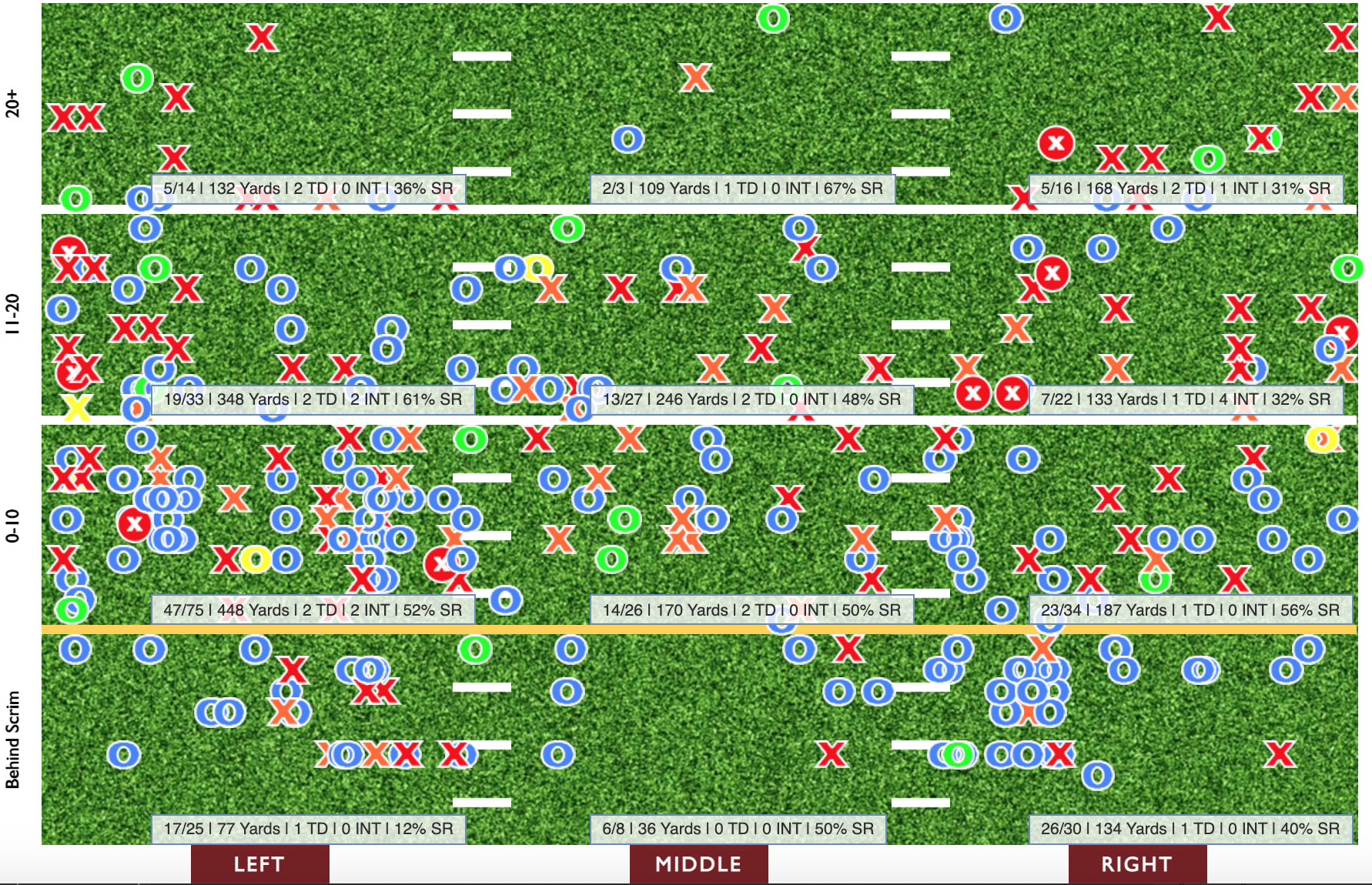
Despite the boo boos, Calzada’s big arm delivered a good amount of big time throws; especially deep. When applying more risk/reward the further his attempts traveled downfield, the former-Aggie logged the conference’s 4th-best Depth Adjusted Accuracy%. Looking at just his 20+ yard attempts, only Arkansas’ KJ Jefferson topped his 45.5% Accuracy%. For a cross-reference, that was just as good as Mac Jones’ figure from 2020.
But even though he was predominately a bang for buck bomber, his overall errancy remained. His intermediate ball placement figures were average at best, and he still threw numerous uncatchable balls. And since only one of his peers dedicated a higher percentage of attempts towards midrange chances, his relative mediocrity negatively skewed his cumulative profile behind the voluminous attempts. Moreover, his intermediate Completion%, Accuracy%, Uncatchable%, and Interceptable% all finished ranked in the double-digits within the SEC. In fact, six of his nine INTs occurred on throws between 11-20 yards downfield.
While it remains to be seen if Auburn continues to ride its recent about-face regarding RPOs with Mike Bobo no longer leading Bryan Harsin’s offense, Calzada is at least used to functioning without many props. The plurality of the Aggies’ pass concepts worked short, but the grander scheme rarely bestowed him many gimmies. Jimbo’s pro-style approach gave little attention to things like screens or RPOs. Only three SECers with 100 dropbacks turned in a lower such rate. Even a facilitating tactic like play action was only used on less than a sixth of Calzada’s pass attempts this past season. And with less stat-padders, Calzada had fewer chances to beef up his bottomline. Granted, his metrics aren’t as fraudulent as some of his contemporaries thanks to this modus operandi. But regardless, questions about his precision remain firm. Despite showing some flashes, improving his downfield ball placement stands to be his single most-important chore for Calzada this off-season.

DECISION MAKING / Aggressiveness
Of course, there was a lovely silver lining to his half-cocked precision: If his guy wasn’t catching his pass, nobody was. By volume, Calzada posted the league’s 3rd-fewest turnover-worthy passes and finished on the good side of the SEC average with a 4.9% clip. And when isolating attempts that traveled beyond ten yards downfield, he placed inside the top5. Considering it's not uncommon for big arms to suffer from hubris testing tight windows, his numbers in this regard are certainly commendable and a nice selling point.
Speaking of contested chances, Calzada noticeably refused to overindulge in this context. His 17.7% Contested Target Rate was pretty middle-of-the-road by SEC standards this year. But in case you were curious, his cannon captured a top5 Accuracy% with only the risk-averse Hendon Hooker of Tennessee boasting a lower Interceptable Pass Rate targeting tight windows. Plus, the Tiger’s 27.6% Defender Breakup Rate held the bronze medal amongst SEC starters. Even if Calzada’s accuracy is still a work in progress, he is well-aware of the difference between acceptable and unacceptable ball placement.
But, Calzada’s admirable decision-making hardly shined through via his result-metrics. Only Vanderbilt’s two QBs and his potential backup posted a lower Yards/Attempt than his 6.7 figure within the SEC. And I’m sure you noticed, both his Success and First Down+TD Rates finished 11th. With the inadequate team speed and lack of shots, Calzada was limited to a 9.6% Explosive Pass Rate.
Moreover, he was downright disastrous on the money down. Though a sizable chunk of his early down figures could be categorized as okay to serviceable, his 3rd down Accuracy%, Depth Adjusted Accuracy%, Success Rate, Uncatchable Pass Rate, and Defender Breakup Rate all finished inside the SEC’s bottom2. Since the do-or-die down is rooted in knowing where to go effectively with the ball despite the inherent stress, Calzada’s statistical stumbles in these spots present another alarming red flag to his profile. Luckily for him, 3rd downs are naturally unstable and unpredictable for future performances. But until he can show he can take care of business on later downs, he will keep getting the side eye.
On account of his underwhelming ball placement, those returns aren’t out of left field. That said, Calzada’s teammates had the worst case of butterfingers in the league. On the year including all downs, his targets combined for 45 drops for a SEC-high 13.8% rate. Excluding potential gains after the catch, his receivers left approximately 417 yards on the field thanks to those miscues. Per game, none of his peers averaged more than his 38 “drop yards”. Admittedly, passes are easier to corral when they aren’t contested or off-target. Still, 20/45 of his drops occurred on open+accurate attempts, which generated a clip within one percentage point of the horrible, aforementioned overall figure. No matter how you slice it, Calzada was marred by his receivers' untrusty mitts.
While the new supporting cast could see some amelioration on this front, Nix finished with the SEC’s 2nd-highest Drop Rate. Though the Tigers’ Duke of the Drop – Kobe Hudson – transferred out, this element should be closely monitored before the action picks back up for War Eagle. Though it’s a slippery slope, if Calzada cannot rely on his pass catchers to do their jobs, he might buffer longer, invite more pressure, and log more broken snaps, which is never a great ingredient for an efficient pass game.
PLAY MAKING / Under Pressure

Whether overall or on pure dropbacks, Calzada was no stranger to defensive harassment. Of SECers with at least a handful of starts, Mike Wright and the constantly-pressured Bryce Young were his only peers to log a higher Pressure Rate. By volume, his 95 durressed attempts were tied for the SEC’s 3rd-most.
Calzada wasn’t really a liability, but he was far from an asset when facing pressure. In fact, he was objectively mediocre. His First Down+TD Rate, Accuracy%, and Uncatchable Pass Rate under duress were all within a percentage point of the conference mean. Unlike his cumulative profile, he couldn’t blame drops as the primary saboteur; his 7.3% such clip in this context was considerably better than average by SEC standards. But even under the gun, Calzada did a praiseworthy job of not throwing dangerous passes. Despite logging the 5th-highest average depth of target, only Ole Miss’s Matt Corral trumped his 5.2% Turnover-Worthy Play Rate among conference starters. Considering the large amount of pressures, this – along with his relative ordinariness – can be seen as a positive. Of the 13 passers that received their first SEC start this year, seven posted a double-digit Interceptable Pass Rate in these spots.
On pressured attempts outside the pocket, however, Calzada displayed some carelessness. Expectantly, only the Heisman experienced more such attempts and totaled more than the Cuban Missile’s 215 such yards. Yet, over a third of these tries were uncatchable, nearly a quarter were altered by defenders, and almost a tenth had potential to be picked off.
Even without duress, he struggled to produce consistently when on the move. Besides owning the SEC’s 6th-worst Turnover-Worthy Play Rate on all attempts outside the pocket, both his Accuracy%, Success Rate, and Yards/Attempt all finished inside the bottom4. With the game gravitating towards passers who excel playing backyard ball, that’s not the best endorsement for his play-making acumen.
But no matter where he is, Calzada has shown to be skilled at avoiding sacks. Despite his wicked-high 34% Pressure Rate on pure dropbacks – ie no screens or RPOs – less than a fifth of these pressures resulted in a sack in 2021. Only four SECers turned in a preferable conversion rate than his 18.4% clip. Plus, TAMU’s 3.0% Scramble Rate as a team was the lowest in the conference. So while other QBs broke rank and sought gains with their legs, Calzada was more about buying time or negating a loss.
Though he fails to check all the necessary boxes in order to be considered “toosly”, Calzada’s nice arm and mobility are excellent building blocks to enhance his play outside of structure. Still, it’s difficult to get too worked up looking at his resume. To reiterate, he isn’t worthless, but the lack of value plays and inability to overly make opponents pay with either his arm or his legs while pressured lowers Calzada’s ceiling.
FLOOR Passing

Though pressured attempts and plays outside of structure are used to guesstimate a passer’s potential, one’s “floor” is determined by measuring efficiency on clean+dropback+non-play action snaps. The idea behind this parameter aims to strip all the variables that might potentially affect a QB’s efforts and track them under more stable conditions. The premise is simple: When asked to execute the scheme as designed with no excuses, can you go out and get completions? No blitzers to blame for busting a design, no screens or RPOs to fudge the numbers, no play fakes manipulating coverages. How consistent and reliable can you be on schedule?
Despite being a passer that presents a cloudy ceiling, Calzada’s passing floor seems to be just as flimsy. Following suite to his overall profile, a high level of drops and uncatchable targets were detrimental to generating worthwhile result metrics. Only the beleaguered Ken Seals owned a worse First Down+TD Rate in pristine conditions than Auburn’s new QB. Though a top5 average depth of target suggests he didn’t mind throwing downfield, his raw Accuracy% stayed near the bottom of the conference and his Depth-Adjusted figure came in below the SEC average. Despite the increased verticality, Calzada’s Explosive Pass Rate dipped a few points and placed inside the bottom3. In fact, his 6.5 “floor” Yards/Attempt looked up to his overall figure. From a scouting standpoint, that’s a big ole wart and a sign he might not be such an instant impact; drops be damned. After all, his 73.9% Adjusted Completion% finished as the 3rd-lowest mark within the SEC.
Ironically, a good deal of Calzada’s “floor” metrics are comparable with Nix’s. That said, there’s a decent argument Calzada might be an upgrade within structure. The former-Aggie was less prone to tossing interceptable passes and more susceptible to drops. Yet, his 53% Depth Adjusted Accuracy% was nearly six points higher in comparison. And despite being on opposite ends of the spectrum in terms of ADOT (Nix being on the lower side), Calzada’s raw Accuracy% still trumped the ex-Plainsman’s by a couple of points.
Conclusion
TJ Finley only posted a mere 32% Depth Adjusted Accuracy%, 36% Success Rate, and 65% Adjusted Completion% in his three starts following Nix’s injury. The bar isn’t high for Calzada to come riding in and earn the starting nod. Even with the backsteps and miscues skewing his stats, the Sugar Hill, GA-native easily has the edge on paper. On tape, he matches the incumbent's zip and drive while predominantly being a more consistent thrower of the football. Plus, Calzada’s mobility widens the gap.
Based on Calzada’s wonky accuracy, blah bottomline playing backyard ball, and unflashy passing floor, he should be met with tempered expectations. While he does have experience beating War Eagle’s arch nemesis, there’s more evidence he’ll be closer to average than exemplary in 2022 despite possessing a crowd-pleasing cannon of a right arm. The consistency might not come due to target location issues and presumed drops. So this might give Calzada the green light to further lean into capturing explosive plays. Maintaining his tip-top deep accuracy certainly would do wonders in helping him earn some cred. Doing so won't be easy. But if it's refined, the Tigers could turn some heads winning the big play battle -- and potentially a couple games they weren't supposed to.
In today’s climate, Auburn should at least view him as the best short-term option for Harsin to gain some steam. If this year ends disastrously and Calzada is a dud, they can always turn to the portal this time next year and try again. Sure no Auburn backer will be pleased with another irrelevant fall. But if Calzada stinks, mechanisms are in place for the Tigers to plow forward in another direction.
Zach Calzada's 2021 pass chart