Setting Expectations: Texas A&M QB Max Johnson
Setting Expectations: Texas A&M QB Max Johnson
Though it can be defined many ways, I like to point to the old adage that interprets happiness as the positive differential between expectation and reality. If one elevates their aspirations and desired outcomes over the most likely result, the door is opened for regret, disappointment, and loathing to alter moods and memories. Underselling and over-delivering certainly creates more smiles than failed guarantees that fall short of expected benchmarks.
Max Johnson’s LSU career started with a low bar. He was the team’s 3rd-string QB and possessed middling arm talent. Not to mention, the Tigers were struggling down the stretch in a pandemic-plagued season. That said, he managed to bring some life to a so-so offense. Prior to trotting out with the ones, Johnson completed at least 62% of his passes in each of his appearances without logging a single turnover. Interim starter TJ Finley only accomplished that twice in the five games following Myles Brennan’s injury. Plus, he gave the ball away 8 times. LSU really needed someone just to stop the bleeding. And with little less to lose, Johnson was given the reins.
MJ not only helped slow the sputtering of LSU’s offense, he also was one of the major catalysts for the team’s strong finish. He guided the Tigers to two underdog victories in which he racked up nearly 800 yards of total offense and 8 scores. LSU fans were subsequently giddy of their young gun’s upside, which naturally led to a QB competition entering the off-season.
However, instead of outright earning his stripes, Johnson won the job due to a freak fishing trip accident involving Brennan. And since that made him The Guy by default, Johnson’s bar was raised. Not to mention, the thirst was strong to wash away the nasty aftertaste of the previous season. Johnson had to be the Tigers’ driving force under Jake Peetz’s and DJ Mangus’ pass-happy scheme. If he sucked in 2021, the team would suck in 2021.
Well, the lefty was just okay; and LSU was just okay. Obviously, that wasn’t the desired outcome. All else considered, Johnson’s counting metrics were pretty good. He topped 2,800 yards with 27 tuddys. (averaging 230+ yards/game on about a 4:1 TD:INT ratio isn’t bad at all). But, these stats were overly empty as Ed Orgeron and dem boys delivered another dysfunctional campaign that resulted in a total overhaul of the direction of the program.
In recent weeks, Johnson decided to trade in his purple and gold for Aggie maroon. Texas A&M had its own experience with rocky QB play this season but views him as a stabilizing force. The Good Ole Fashioned Eye Test sees a passer that leaves plenty to be desired in terms of ability, but Johnson can still evolve into a worthwhile collegiate passer. A change in environment with a fresh crop of teammates could see his modus operandi – and consequently his bottomline – totally enhance. But based on his previous showings, I’m sure Aggie fans are curious how their new toy stands relative to his contemporaries in key quarterbacking areas.
ACCURACY / Ball Placement

Johnson displayed serviceable accuracy during his time in Baton Rouge. His ball placement was neither a strength or weakness on the whole. Mechanically speaking, he holds the ball mid belly and has a somewhat looping release. Though he’s worked out his rhythms within the pocket, that throwing style can be prone to off-target chances when the base is altered due to the extra movement in the operation. That trait is not a dealbreaker by any means, but maybe TAMU’s staff feels Johnson can throw with a more concise motion.
Either way, if he has next-level aspirations, he must sharpen up his precision on big boy throws. Behind his increased role, Johnson’s Depth Adjusted Accuracy% and Interceptable Pass Rate worsened year-over-year. There’s no getting around the fact that his arm talent is only asi asi. He can thread the needle on a number of horizontal throws, but he’s just not the most gifted downfield driver; especially deep.
Granted, Johnson did a pretty good job of giving his guys a chance at hauling in a homerun. But, his dead ducks tended to wind up in precarious spots. Exactly a fifth of his deep throws were turnover-worthy by StatCat’s charting this season, which placed outside the conference’s top-dozen. His results on 20+ yard targets were well-below the SEC average; about 8 percentage points this past season to be exact. Thus, his such Accuracy% and Completion% finished comfortably in the double-digits within the SEC. FYI: he only tossed 14 deep attempts as in 2020 So, don’t put too much weight into his respectable 42.9% Accuracy or deplorable 50% Uncatchable due to the flimsy sample size.

Johnson’s midrange output provides no solace to his subpar resume when pushing the ball downfield either. Despite the eased degree of difficulty, his 26% Uncatchable Pass Rate equaled his such clip throwing deep. Only four SECers were worse in that regard as well as his 48.8% Completion% on throws between 11-20 yards past the line of scrimmage.
Since Johnson’s overall ball placement figures were ho-hum and his downfield stuff was pretty dismissible, one can deduce his short targets were fairly decent. And, you’d be right. But Johnson’s precision really shined when he released the ball under 2.0 seconds. Excluding screens and RPOs, he logged the SEC’s 3rd-best raw Accuracy% (70.4%) and 2nd-best Adjusted Completion% (81.8%) on such attempts. Jimbo should be able to work with that.
If he can learn to find more intermediate consistency while maintaining his hot potato accuracy, his value will skyrocket. Kellen Mond, Haynes King, and Zach Calzada all finished inside the SEC’s top4 in Midrange Makeup% the last two years. Jimbo Fisher very much likes to send routes to there, and Johnson will either boom or bust as an Aggie based on his proficiency to hit these passes. He’ll still have opportunities to target slants, but Johnson must expand his game and show more regularity hitting receivers 10+ yards downfield.

DECISION MAKING / Aggressiveness
Jimbo ought to like a passer who seemingly is a decent pre-snap processor. The Joe Brady offense is generally “Air Raidy” in the sense it seeks to attack vulnerable parts of the defense even if it means periodically dinking and dunking. And knowing where to go with the ball without much indecision is key to effectively pestering opponents. Of course, Peetz and Mangus ran that style of play back, and Johnson experienced a substantial uptick in targets behind the line of scrimmage as well as on screens and RPOs. His such rate of the latter increased 430% with the scheme change.
Moreover, slants, Stick concepts, and play action bootlegs buoyed LSU’s script. These structured reads overly guided Johnson to fast and easy outlets. But, any LSU fan will tell you Johnson buffered way too much for a passer that leaned on the quick game. Credit to the kid for not being too reckless or trying to press his luck. But he needs work on limiting these biffs, moving off his first read, and checking his prudence when testing tight windows.
Kayshon Boutte deservingly drew MJ’s attention the majority of the time prior to his injury. He captured the most fuddy tuddys (combined first downs and touchdowns), the 2nd-most catches and YAC yards, and 4th-most total receiving yards in the SEC. Plus, his 58.5% Success Rate was top10-worthy. Once his season was lost, Johnson’s bottomline paid the price.
After that point, he spread the wealth around a little better. But he still honed in on guys and forced things on occasion. Only two other SECers turned in a higher Contested Target Rate than his 20.4% clip. This element of adversity undoubtedly hurt the final product. Though his 32.9% Defender Breakup Rate on challenged chances was relatively average within the conference, the volume faced skewed his overall clip to reach 11.8%; only Vanderbit’s Mike Wright posted a worse number in the league. Besides the deflections, bats, and hits, Johnson’s hubris in his arm’s abilities resulted in a good amount of boo boos. Of his 24 interceptable passes this year, 14 targeted tight windows. No SECer had more. Luckily, only two were picked off. Meanwhile, 6/10 turnover-worthy passes on misreads or WR errors played out in the defense’s favor.
And naturally with such a high concentration of attempts attacking the middle of the field, Tiger pass catchers experienced a good amount of bang-bang targets. Of Johnson’s 38 drops, 14 were on challenged chances. On the year, his 10.3% Drop Rate was the conference’s 4th-worst. That mark nearly matched his figure from 2020.
Cursed by drops and miscues, Johnson’s results portray a middle-of-the-road passer. Both his Success and First Down+TD Rate finished a little under the SEC average the past two seasons. So, Johnson could conceivably see some sort of statistical boost assuming his future teammates do a better job of holding onto passes. (Is it a bad time to bring up Zach Calzada posted the league’s worst Drop Rate at 14.1%?). Sure, Johnson’s decision-making – like his general accuracy – is fine enough. But, average rarely wins over scouts.
PLAY MAKING / Under Pressure

Johnson’s limited cannon caps his upside outside of structure. Unlike the modern wave of “toosly” passers that love to show off their bazookas with varying launch angles outside the pocket, the Aggie’s new QB just can’t fire it all over the gridiron in that fashion. Instead, his playmaking acumen relies on his savvy feet, vision, and finesse passing.
Johnson resoundingly earned himself some street cred rallying the Tigers to end 2020. In addition to giving the #QBWinz crowd the desired result, he teased a nice ability to manufacture value under the gun. Johnson’s mobility and giddy-up not only allowed LSU to stress bootlegs but he was keen on erasing negative plays. Despite posting a bottom5 Pressure Rate on pure dropbacks, only 4.3% resulted in a sack – good for the SEC’s bronze medal. Moreover, he retained that honor on his Pressure/Sack Conversion Rate; only about a sixth of opposing pressures got home.
His such 1D+TD Rate cracked the conference’s top5, but his precision’s placement resembled his cumulative profile. Despite the sour accuracy, he made sure that if his guy couldn’t get it nobody could. Johnson ranked 14th in Uncatchable Pass Rate but had the 2nd-best INTA%. Though volatile spots, his relative upside paired with little backbreakers hinted great things lied ahead for the lefty.
But with a greater sample size and more intense Pressure Rate this fall, the poise and escapability of yesteryear evaporated. Johnson’s Sack Rate reached double-digits and nearly 40% of pressures took him down. Considering those clips were among the highest in the conference, a good amount of folks are extending him some slack. Others, however, expectantly harangued him over his about-face to toss the ball into danger. Though once an area of pride, Johnson’s INTA% under pressure doubled year-over-year. All the while, he still wasted the same amount of attempts.
That regression in backyard ball definitely ropes in his potential a bit. Though Johnson’s athleticism and extender skills are theoretically still a viable trait moving forward, the panicky play was an undeniable backstep. On “broken plays” specifically, his passing generated only 57 yards across 36 attempts, which were the 2nd most in the SEC. While placing in the bottom4 in Yards/Attempt, Accuracy%, and Adjusted Completion%, none of his peers produced a Success Rate as pathetic as his 8.3% figure.
FLOOR Passing

Though pressured attempts and plays outside of structure are used to guesstimate a passer’s potential, one’s “floor” is determined by measuring efficiency on clean+dropback+non-play action snaps. The idea behind this parameter aims to strip all the variables that might potentially affect a QB’s efforts and track them under more stable conditions. The premise is simple: When asked to execute the scheme as designed with no excuses, can you go out and get completions? No blitzers to blame for busting a design, no screens or RPOs to fudge the numbers, no play fakes manipulating coverages. How consistent and reliable can you be on schedule?
On first glance, Johnson’s passing floor appeared to sink in addition to his ceiling. His Success, Interceptable, and Uncatchable Pass Rates all worsened. Plus, his Depth Adjusted Accuracy% dipped more than 6 percentage points. But, an increased emphasis in downfield throws were responsible for those stats souring more than anything. Not to sound like Perd Hapley, but again, this mirrored what happened to much of his overall metrics this fall.
While Johnson was predominantly a Checkdown Charlie within structure last year, his ADOT shot up to 12.2 ADOT and finished as 2nd-highest in the SEC. Coupled with the increased degree of difficulty, Johnson maintained a dissatisfying Drop Rate that kept gnawing away at his bottomline. Under these circumstances, some might be willing to extend him the benefit of the doubt and assume positive progression will occur regardless. But no matter which camp you all in, Johnson is hardly a standout passer without the guises of scheme to assist his throwing efforts. And because of that, he remains a vanilla option down-to-down.
Conclusion
Hopes and goals are steadily rising within TAMU’s program. But while Johnson is an experienced conference passer with a notable pedigree, he will let down Aggieland if he winds up being nothing more than what his advanced stats have shown to date. No matter how Johnson’s game is compartmentalized, the numbers say he’s an average Joe passer by SEC standards. And though plenty of programs have historically competed with caretaker QBs, the most dangerous playoff teams tend to have game-changers at the position. At the very least, Johnson can be plug-and-play QB. His new team, however, will expect him to develop into a top5 passer within the conference next fall (assuming he wins the starting gig).
No doubt, his capped capabilities of slinging downfield strikes lowers his ceiling, but Johnson can easily earn himself some style points in his new environment. That said, until he does it on the field, StatCat’s feelings towards him will remain tepid due to his C-level profile.
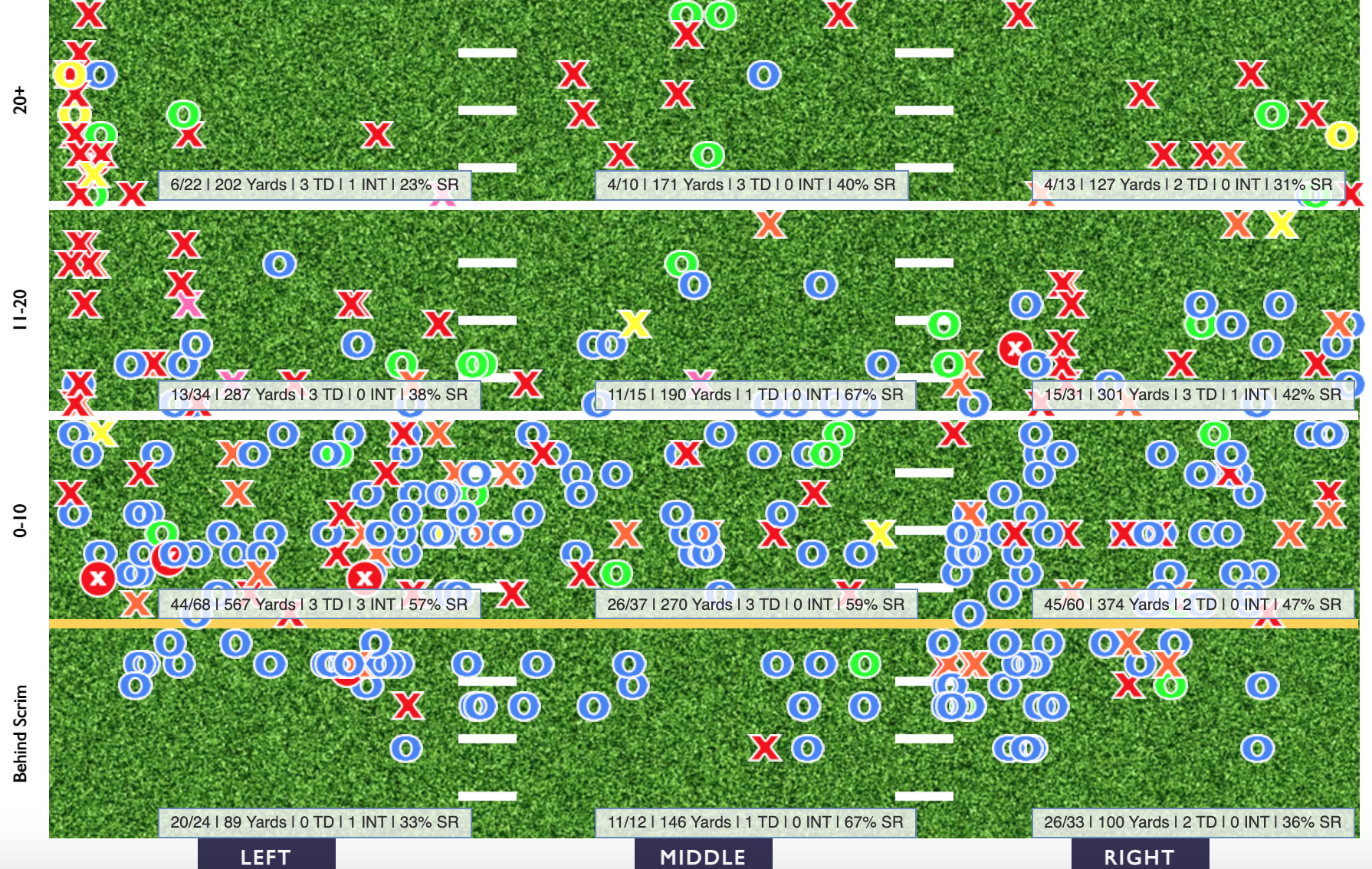
Max Johnson's 2021 pass chart