2021 CFP Sideline to Sideline: Cincinnati's Offense
2021 CFP Sideline to Sideline: Cincinnati’s Offense

But, the Bearcats earned a bid for a reason. They stomped their inferior foes, went undefeated and boast a top10 scoring offense and defense entering the Goodyear Cotton Bowl Classic. Luke Fickell and his frisky defense have been phenomenal against both facets. According to cfb-graphs.com, their EPA/play defending the run and the pass both equal -1.6 and place inside the nation’s top4. In turn, that domination created plenty of short fields and scoring opportunities for UC’s offense.

Still before analyzing this offense further, we need to address the elephant in the room regarding the Bearcats’ cupcake schedule. Since they are members of a Group of 5 conference, they only faced three top50 teams in ESPN’s SP+ this season. Of course, their crown jewel was taking down top10 Notre Dame. But, the Cats were hardly challenged by their conference contemporaries. Captain Obvious wanted me to remind you of that. So to get a better picture of who they are, I charted this offense against its best opponents. And to take it one-step further, I didn’t bother with plays in garbage time.

As an SEC homer, I do enjoy measuring other programs against the conference’s standards. And when such a league produces the most pros, wins the most bowls, and earns the most attention, that’s a fair course of action.
Interestingly enough, Cincinnati’s four hardest opponents-faced align quite nicely with a typical SEC conference schedule. So even though UC played a far easier Strength of Slate than the rest of the CFP, we can at least play apples to apples through this perspective. So with that, let’s chug ahead and check out what the Bearcats’ offense is all about.
Offense at a Glance
Cincinnati is a multi-spread offense that seeks balance. Some might even be so bold to call it an off-shoot of a modern pro-style scheme. But, the Bearcats love zone read options with nearly a fifth of their plays in our sample constituting as an RPO.
Living out the desire for balance, Mike Denbrock’s squad posted exactly a 50% run/pass ratio in standard time against its hardest opponents; four points below the SEC average in league play. And while the run game clearly had a favorite concept, 15 different pass concepts logged between 3-5 targets. Only three looks eclipsed that mark in volume with none seeing more than 8 tries. The Bearcats don’t like to be predictable and tend to mold their dropback script based on who they face. In other words, there are very few carryover pass designs week-to-week. For instance, Cincinnati’s most featured pass concept, Stick, saw 7/8 targets occur vs Notre Dame.
The Bearcats’ deliberate unpredictability is also highlighted by their affinity for pre-snap motion. A moving target is a more challenging key than something that’s overly static. Excluding Jets and Orbits, over 34% of Cincinnati's snaps used that tactic. Alabama last year has been the SEC’s only comparable offense in terms of loving pre-snap motion as much as Denbrock’s lot. In terms of strategy, the Cats use it to alter numbers and angles in the run game. While motion is used a considerable amount on passes, a whopping 43% of their runs experience that happenstance.
Schematically, the biggest benefactor by pre-snap motion was Cincinnati’s beloved Inside Zone Reads. Consisting of over a third of the offense’s reps on motion plays, both the Slam and Bluff Read averaged over 5.0 Y/A on a combined 55.6% Success Rate; drastically better than the remaining opportunities (4.3, 37.5%). Though it helped bring sustained consistency to its top looks, pre-snap motion overly hurt the team’s down-to-down output. The Bearcats’ Yards/Carry and Yards/Pass dipped 0.5 and 1.5 yards, respectively, compared to their overall clips.
About 30% of UC’s snaps occurred from spread formations (either a true 2x2 or wideout trips alignment). But, the brawny Bearcats found an edge creating opportunities with multi-tight end sets. On the 78 snaps where Cincinnati used 12/13 personnel (or one RB and 2/3 tight ends for the laymen), this offense rocked a praiseworthy 8.4 Yards/Attempt and 53.4% Success rate. The Cats logged only one negative play from these groupings in our sample.
In general, UC’s O-line logged a sterling rush yard before contact average; and their figure was heightened when at least two TEs were on the field. But despite notching a 4.4 YBC from these sets, the Bearcats Explosive Run Rate actually shrunk by a few points. The pass game, however, experienced tremendous gains in potency. Donning a 12.1 Yards/Pass, 22.2% of their throws begat a 20+ yard completion. Of the 18 such gains in Cincinnati’s sample, six were from 12/13 personnel.
Speaking of this pass game’s potency, the Bearcats do not mind dialing up shots; especially to start a set of downs. Though there are many methods on conjuring up splash plays, the easiest and simplest avenue is chucking the ball deep. Of Desmond Ridder’s 27 20+ yard attempts, 18 of them occurred on 1st down as did 12/15 of his such completions. Overall, Ridder targeted someone 20+ yards downfield on 28% of his attempts against UC’s hardest opponents. The SEC’s leader in Deep Pass Rate, Hendon Hooker, turned in a clip half of that. While homeruns are way down year-over-year in The Land Where it Just Means More, doubling up a league-leader should stress just how much bombs mean to this offense.
Playing into the effective run-pass balance Denbrock orchestrated, 47% of Ridder’s 1st down throws used a form of action to keep defenses in the dark; just under 30% used a true play fake. Helped by the guises and buoyed by the big gainers, over 60% of Ridder's yards were captured in these spots. Georgia’s Stetson Bennett was the only SEC starter to sport a clip north of 55%. But while the fireworks and highlight plays drive the conversation, Cinci’s air assault has been remarkably consistent to start a set of downs. The Cats 57.1% Success Rate against their hardest foes was five points better than any figure seen in SEC action this year.
When on schedule possessed with the element of surprise, few had answers to upend UC this season. Unhindered by a 3.6% Negative Play Rate in these spots, the Cats eclipsed a 50% Success Rate when including all early down snaps. Georgia and Mississippi State were able to claim the same based on their showings within conference play, but no SECer bested Cincinnati’s 9.1 Yards/Attempt or 18.5% Explosive Play Rate.
An astounding 80% of their conversions occurred either on 1st or 2nd down. While part of that lies with Cinci’s sizzling early down returns, the rest falls on the Bearcats’ failures on thirds. On the year, UC ranks 56th nationally with a 41.4% 3rd Down Conversion Rate. But against their top foes, the Cats’ normally sturdy Success Rate plummeted to a putrid 29.4% figure. Even Vanderbilt managed to log a preferable clip despite a substantially higher degree of difficulty. And like the ‘Dores, UC occasionally sputtered with a 3-and-Out. In our sample, they notched ten in meaningful minutes. By a rate basis, only three SEC offenses were worse in league play than the Cats’ 22.2% figure.
Desmond Ridder
Over the last few years, “toosly” passers have been all the rage for professional scouts. These are quarterbacks who are fluid runners, blessed with big arms, and shine in plays outside of structure. While accurate pocket passers still have value for NFL offenses, the athletic archetypes are thought to be more prone to potency and possess higher ceilings. As the game gravitates towards seizing splash plays, offenses crave passers who can whip the ball all over the yard from varying platforms. Why bring this up? Ridder falls into this class of quarterback. The draft hype surrounding him is legit, and his gifts make him a nice prospect. That said, there are still some areas of vulnerability Alabama can exploit.

The traditional metrics reflect a profile of a future professional passer. Ridder has completed nearly two-thirds of his passes with his number of TDs almost quadrupling his interceptions. His 9.0 Yards/Attempt is higher than most quarterbacks average depth of target. In addition to throwing for more than 3,000 yards and 30 scores, Ridder commands a top20 total EPA figure in college football.

While it’s easy to poo-poo his easy workload, Ridder’s efficiency still holds up favorably to the average SEC passer even when judging him against his hardest foes. Cincinnati’s verticality is accentuated by his 13.5 ADOT, which is nearly 2.5 yards more than the SEC’s leader. You’ll see just how good he’s downfield playmaking was versus his premier competition in a second; but his 18.9% Explosive Pass Rate is extremely laudable. Like that and his 42.1% 1D+TD Rate, no SECer posted better numbers in league play. And, that’s with Ridder suffering from a double-digit drop rate. Sure, the Bearcats have had a talent edge; and that helps. But, Ridder has predominantly been a pretty good decision maker. His process metrics do present some concerns. But based on his returns, they are still far from being major red flags. His downfield accuracy is a bit mediocre and he’s a little careless with his ball placement. That said, some of that is a natural byproduct of his propensity to push the ball deep downfield.

By SEC standards, Ridder’s downfield passing figures against his best foes would be considered elite. He would be top4 across the board with the exception of his middling Interceptable Pass Rate on throws beyond ten yards downfield. No SECer posted a preferable Deep Completion% or Midrange Accuracy%. For what it’s worth, four of Ridder’s six turnover-worthy passes in our sample occurred on chances 20+ yards downfield.
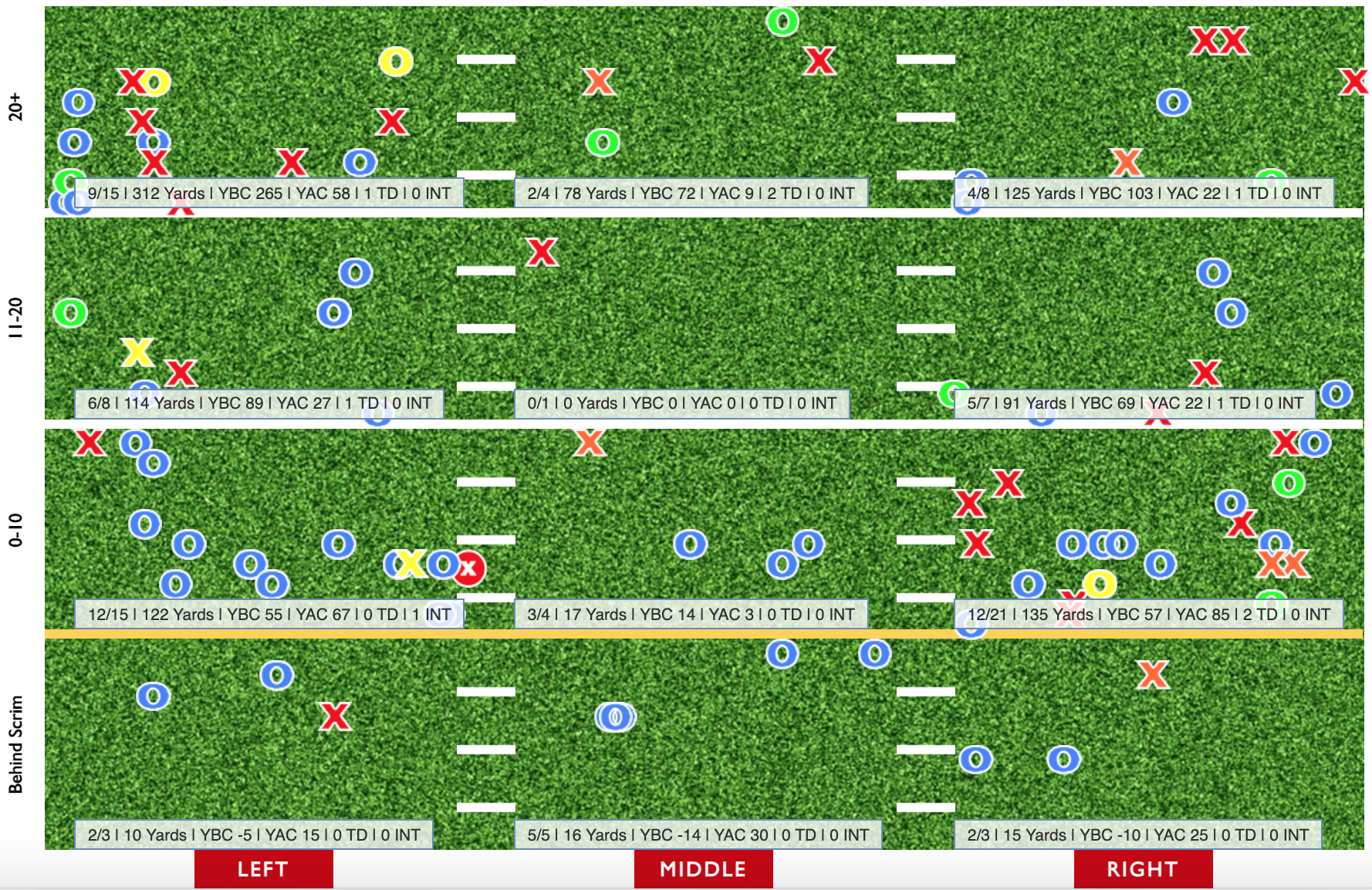
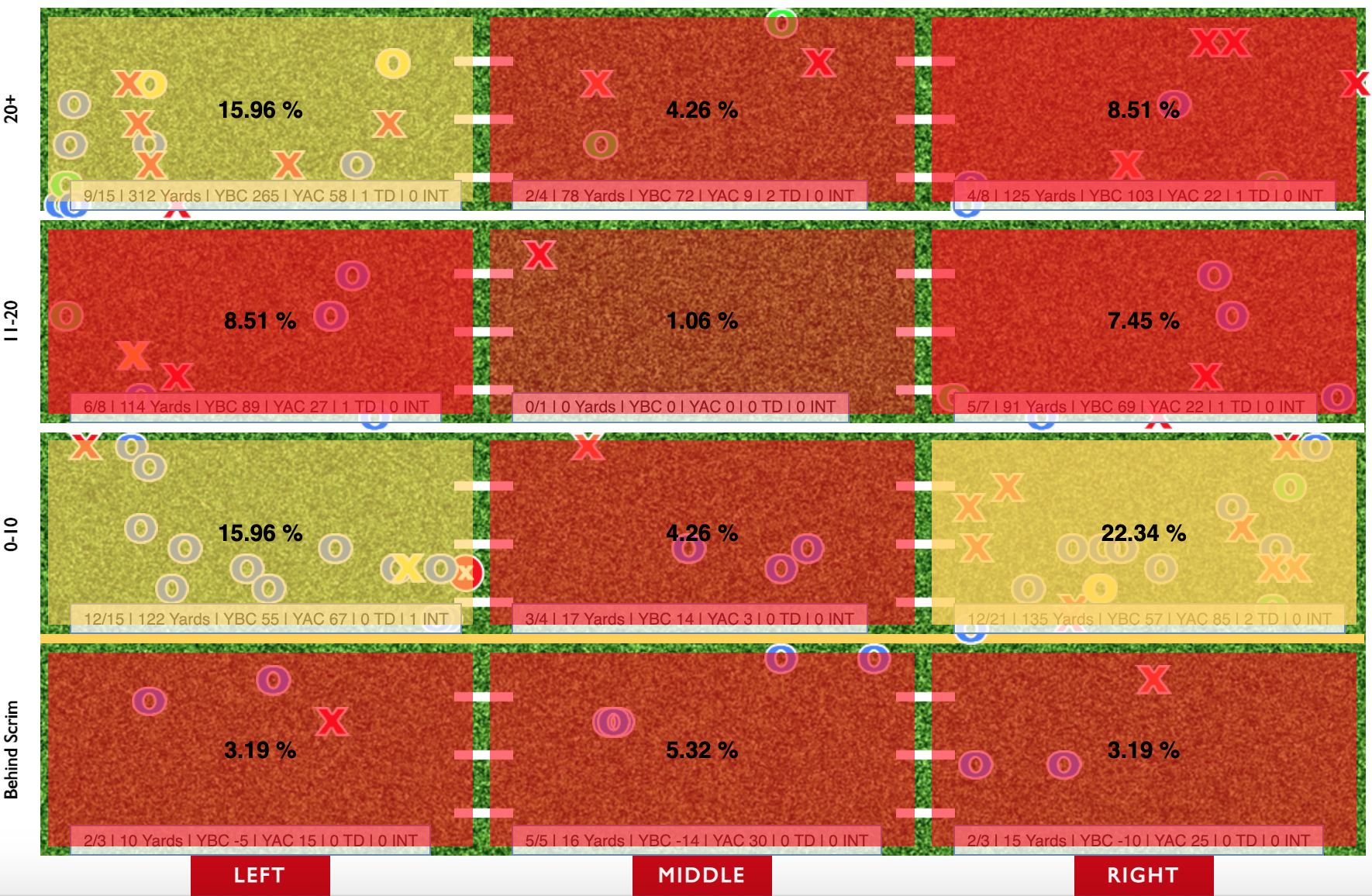
Desmond Ridder's Pass Chart and Target Heat Map vs. Notre Dame, Houston, SMU, and Tulsa

Cincinnati’s staff fed Ridder a decent amount of prop plays to facilitate the operation. About a sixth of his attempts targeted RPOs and about a quarter of his dropbacks used play action. As aforementioned, Ridder’s Deep Pass Rate more than doubled the SEC’s leader. Plus, over 45% of his throws traveled further than ten yards; no SEC starter put up a figure north of 42%. With the dedication to downfield opportunities, the short passing game experienced less love as a result.

Ridder’s production when under duress has also caught scouts’ eyes. In our sample, he was accurate on half of his pressured passes and posted a Success Rate 12 points better than the average SEC passer in league play. No doubt with Nick Saban’s history of getting after passers, Ridder will have to make some throws staring down the gun against the Tide. For Bearcat backers, his showings provide some solace. But while his down-to-down results when kept clean were sturdy, his Accuracy% was rather discouraging. It would have ranked dead last in the SEC, which isn’t exactly 1st round material. When conditions are perfect, you need to be counted on to make throws within structure; no matter how many cool backyard ball beauties you can complete. That said, Ridder has overly made good decisions without putting the ball into harm's way too much when his line holds up.

Some cracks start to form around Ridder’s profile when looking at his situational stats. I mentioned earlier that Cincinnati’s staff likes to provide guises and scheme-driven tactics like play fakes, RPOs, and tap passes on early downs to keep defenses off-kilter. With those ploys and prudent playcalling, Ridder’s bottomline was noticeably enhanced by his showings on 1st and 2nd downs. His such Success Rate trumped the SEC mean by nearly 11 points and his Accuracy% was 4 points better than his overall clip. But while Ridder was serviceable when behind the chains, he was unequivocally dismal on the money down. No QB was less efficient in SEC play than his showings against his hardest opponents; only ex-Aggie Zach Calzada was less accurate in those spots.
Taking a step back, what passer does this remind you of? A dude who has posted incendiary numbers on schedule but has ball placement concerns and seemingly has a severe complex at converting on later downs. A dude like the guy Alabama just neutered in the SEC Championship game, maybe? It’s not for me to say…
Pass Catchers
We start in an obvious spot with X-receiver Alec Pierce. Practically doubling the next Bearcat in line in the counting metrics (catches, yards), he maintained his priority usage across the meat of UC’s slate. As a burly pass catcher standing at 6’3, Pierce has a terrific build to win contested jump balls and dominate undersized DBs downfield. Though not necessarily a bankable stat, he caught half of his challenged chances in our sample.
Thanks to being on the receiving end of most of Ridder’s bombs, over a quarter of his targets gained at least 20 yards. Overall, a third of Pierce’s routes were either a go or a goalline fade. Despite his elevated degree of difficulty, all but one of his catches brought about a situational win. Along with racking up three scores against UC’s four hardest opponents, he logged two created catches. Eliminating him should be Alabama’s secondary main objective.
Tre Tucker and Tyler Scott are the beta options. The duo’s counting stats are fairly comparable. Though Scott struck gold more often over the course of the season, both topped 400 yards. Versus UC’s best, the pair each logged a +60% Success Rate, double-digit Yards/Target, and at least three explosive catches. Tucker matched Pierce in creations with one of them being a TD. Besides bringing in a pair of deep scores himself, Scott caught 6/7 catchable targets without a drop.
Though Leonard Taylor and Josh Whyle might spend most of their snaps run blocking, they play important roles in the Bearcats matchup-oriented pass game, too. Both stand at least 6’5 tall and can line up all over the formation. But while their size and versatility are nice traits, the stats haven’t necessarily been the best for this position group. Among UC pass catchers with at least a half-dozen targets, Taylor and Whyle are the only two with a Success Rate under 50%. As a result, they own the team’s two worst Yards/Target. The numbers are totally lackluster, but the Tide can’t rule out one of these tight ends potentially snatching a splash gain down the seam.
Running backs
Former Crimson Tide running back Jerome Ford is the main man in the backfield for the Bearcats. Though his 3.0 rush yard before contact average hints his carries were blessed with great cushion, his resume was skewed thanks to his two long, untouched tuddys against Houston. When omitting them, his YBC plummets to 1.1. Ford wasn’t hit behind the line at an alarming rate, but most of his tries were obviously met with resistance. But like during his last season in Tuscaloosa, he posted a +3.0 YAC average and a Broken Tackle Rate in the 30’s; both easily top the SEC’s respective averages in league play. In fact, Ford’s stable metrics align nicely with TAMU’s Isaiah Spiller. Thanks to his push and zeal, less than a fourth of his attempts gained less than three yards; a typical SEC back logged a clip around 30%. Only two tries went down as a loss.
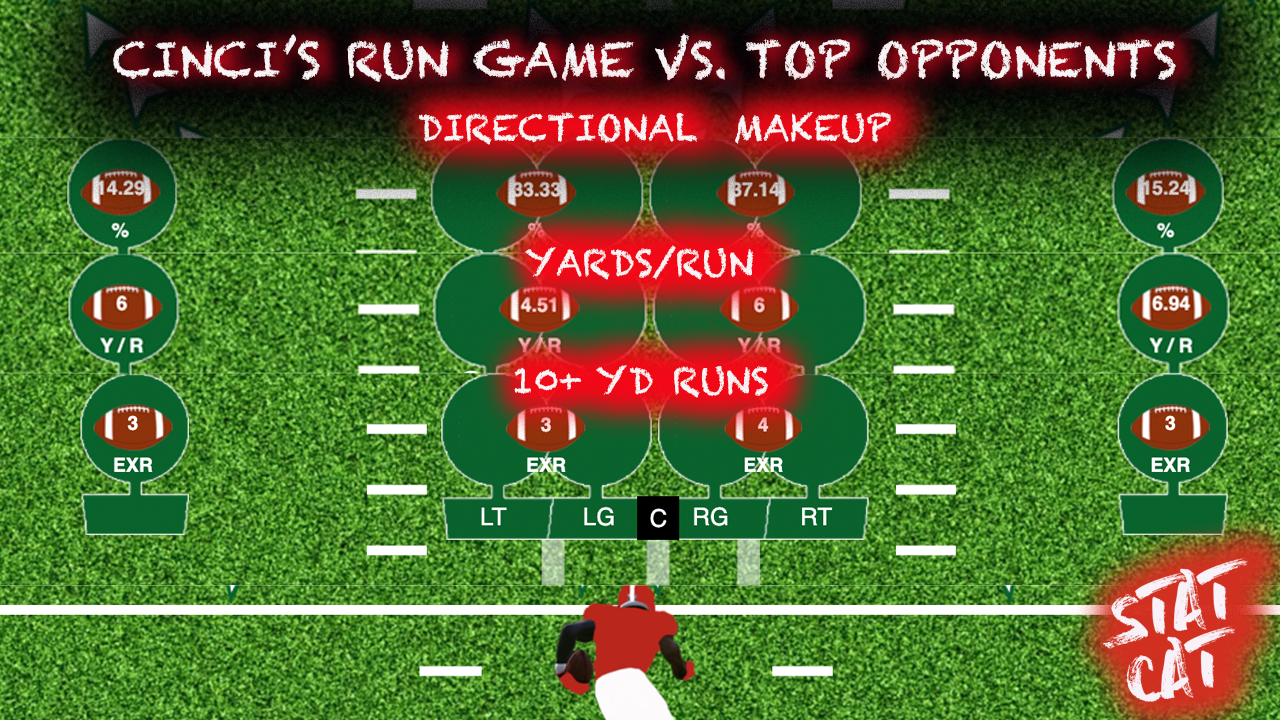
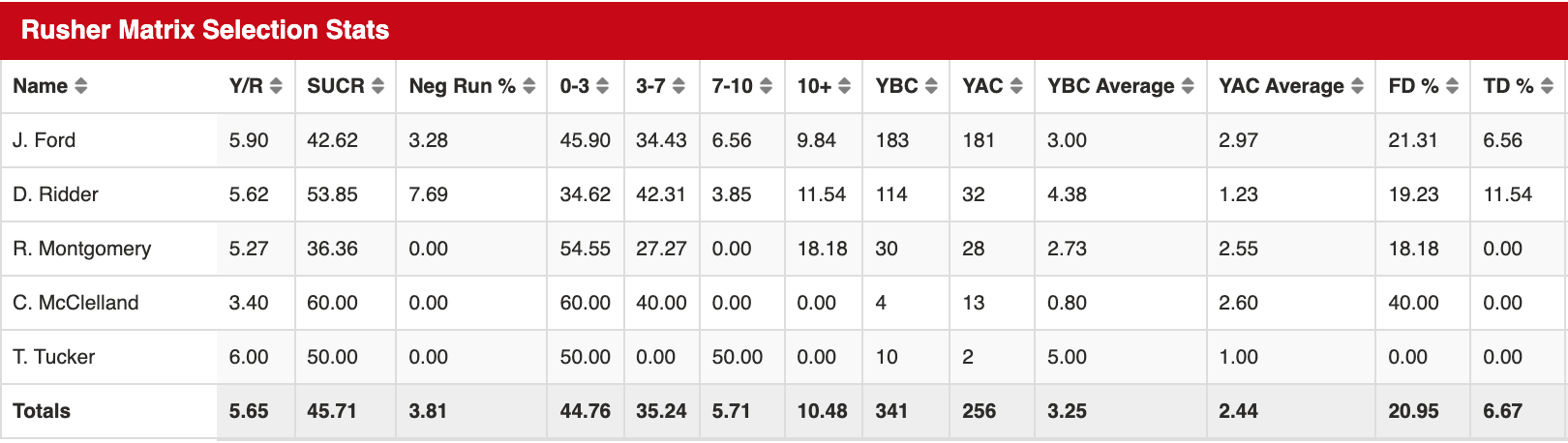
Ford might have held his own in terms of his stable metrics against his hardest opponents, but the early defensive engagement predictably had a massive effect on his output. Less than an eighth of his carries gained at least ten yards – a fate only seven SECers succumbed to this fall in conference play. Plus, his 42.6% down-to-down Success Rate and 27.9% 1D+TD are decidedly average. Ford is used to running hard and earning most of his yards, but those kinds of returns certainly won’t help the Bearcats win against a stingy run defense.
As a receiver, his 15.4 Yards/Target led the team in our sample. Though screens were seen some by this offense, Cinci didn’t seem particularly good at executing them. As far as Success Rate goes, none worked. But as a checkdown outlet or on wheels along the sideline, Ford is a proven weapon in UC’s dropback game.
Ford’s usage, as one would expect, increased against Cincinnati’s top foes. On the year, he rocked a 45% carry share. In these four games, it hovered around 60%. Against their hardest foes, reserves Ryan Montgomery and Charles McClelland combined for a mere 16 attempts. Of course, thanks to the diminished degree of difficulty across their season, more opportunities existed for those two to get touches. But by the counting metrics, Ford received over 150 more carries than the next Bearcat back in line and generated 63% of the position group’s ground production.
Montgomery is their preferred RB2 and has a knack for nabbing splash runs. This year, he’s averaging just under 7 Yards/Carry. Looking specifically at games versus UC’s premier competition, his 18.2 Explosive Run Rate – albeit in a small selection of plays – was easily the Bearcats’ best.
RUN SCHEME
Inside Zone Slam Read: 35 attempts, 4.9 Y/A, 48.6% Success Rate
This basic, bread-and-butter spread run concept composed a sixth of Cincinnati's offense against its hardest foes in meaningful minutes. The Slam Read was the Bearcats favorite series starter; 24 of the look’s 35 reps occurred on first down. No other concept logged more than six. For whatever reason, UC was terrible executing this look on 2nd down (2.6 Y/A, 28.6% Success Rate). But in other spots, it was a sturdy and solid foundational run play in our sample.
As their core run, the Slam Read was used straight up and on play fakes; the look was also the Bearcats top ground concept for RPOs. But despite being theoretically set up to win, these designs only mustered a lousy 2.4 Y/A and 27.3% Success Rate. Inversely, Slams were way more satisfactory when Ridder threatened defenses with his legs rather than his arm. On non-RPO reps, UC rocked a meaty 6.2 Y/A and 58.3% Success Rate. And, Ridder was responsible for three of the team’s four explosive runs with a pair of tuddys; the highlight coming on a 40-yard score against SMU.
Inside Zone Bluff Read: 23 attempts, 4.7 Y/A, 43.5% Success Rate
The Bluff – or split zone – Read is this offense’s beta look. Trailing its brother concept in tries, yards, and efficiency, this design is also fittingly Cincinnati’s favorite 2nd down play. With Slams being utterly dreadful in those spots, it makes sense that Denbrock would explore alternatives. But the returns here overly inflate the rest of the Bluff Read’s bottomline (6.2 Y/A, 53.9% Success Rate). Only 3/10 reps on other downs found success across a stinky 2.6 Y/A.
Slams themselves weren’t really a great source for splash runs; but Bluffs were even more muted. Only two tries gained more than ten yards, and both of them occurred against their easiest hardest foe in SMU. And though the “bluffer”/ arcing tight end can act as a personal protector on QB keeps, Ridder posted a blah 4.0 Y/A.
Together the two zone reads held a 27% Play Share and 17.5% Yard Share over our sample. In terms of the latter, no SEC offense had a concept group amass a figure bigger than 22%. And looking at subconcepts, only Missouri’s Off-Tackle and Vanderbilt’s Inside Zone tallied a larger share than UC’s Slam Read. I mean, together these two reads account for over half of the Cats rushing attempts. While undoubtedly a narrow approach, it has allowed this O-line to focus on enhancing its execution of this offense’s main look rather than something superfluous.
That said, the straightforwardness has invited defenders towards the box to clog run lanes. As hinted, Ridder has done just fine on prudent pulls. He might have some negative tries. But thanks to a 6.31 YBC clip by overly attacking green grass, 56.3% of his keeps have resulted in either a first down or a score. On the other side of the coin, both running backs have experienced YBC average under 1.3 and a 1D+TD Rate under 28%. Considering the ravenous wolves Nick Saban has at his disposal, UC’s previous performances are a bit of a red flag. But this won’t be the only area where Ridder’s athleticism needs to excel in order for the Cats to capsize the Tide.
Duo Dive: 11 attempts, 5.6 Y/A, 45.5% Success Rate
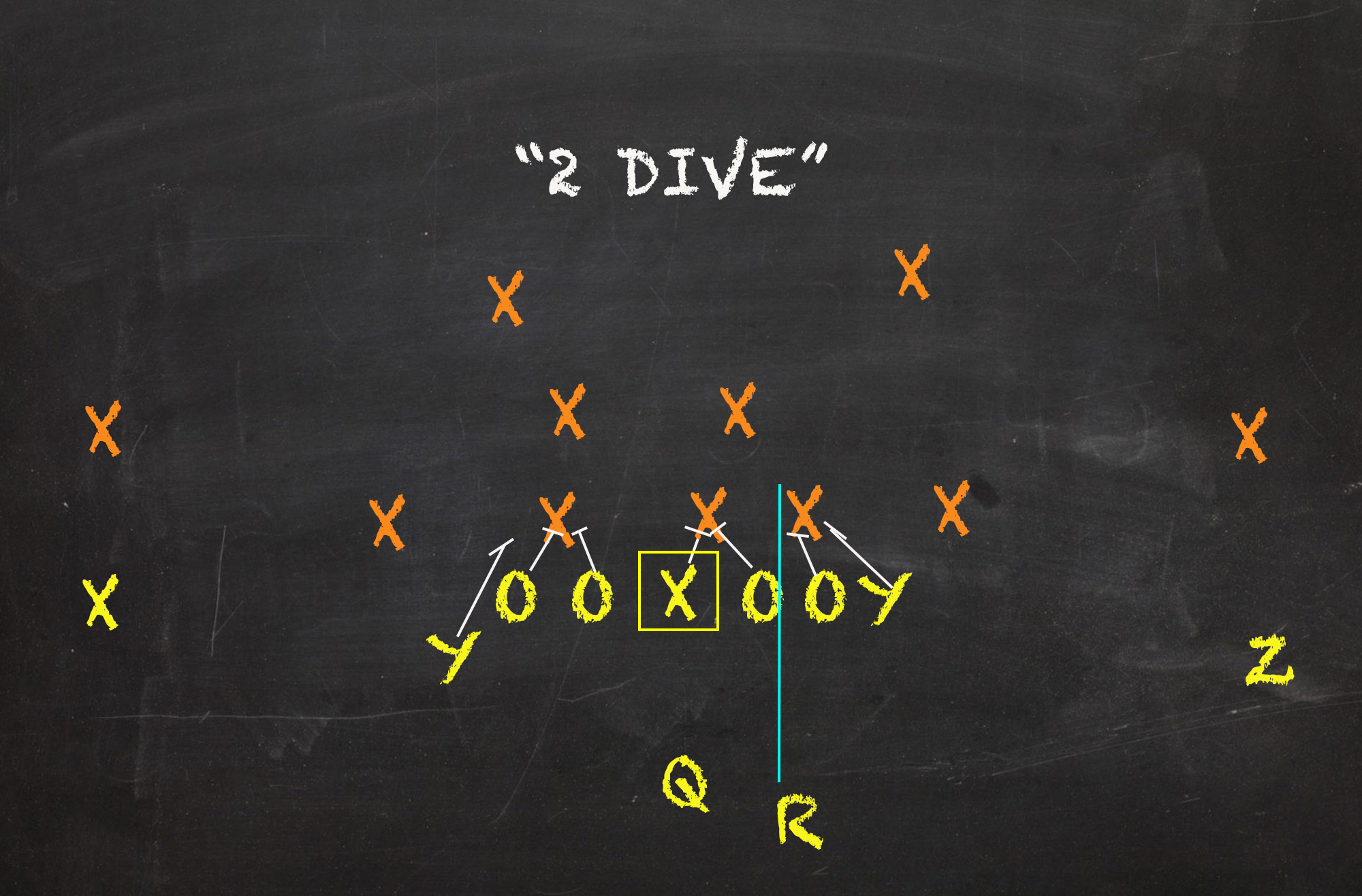
With a pair of zone looks largely being this ground game’s standard bearers, the Duo Dive has found a niche as a gap scheme when fronts anticipate a coordinated flow. Itchy and expecting the patented playside flow, defenders can sabotage themselves when combos quickly turn out to be double teams and diverging hard edges. Instead of being a step ahead beating a reach, they are out-positioned with a big body between them and the ball carrier.
Unlike most offenses these days that tend to turn to the Duo Dive to convert in short yardage, this look was almost exclusively an early down design for the Bearcats against their most challenging opponents. Outside of one measly rep – which was a goalline attempt – all of its tries were either on 1st or 2nd down. Though somewhat decent in terms of consistency, 56% of its production came on its two explosive carries.
Other Runs:
Outside of Cinci’s three main runs, no other ground concept received more than a half-dozen tries in our sample. But, the Bearcats dabbled with misdirections and powers to round out their rushing attack. In fact, both of UC’s big gainers in its conference championship game came off such designs. Ford’s first TD was off a Counter Read and his second was off a Power RPO. Thanks to those carries, both concept’s Y/A reached the double-digits. Despite the limited usage, the pullers clearly have helped generate some pop when defenses are just expecting typical zone action and should be on Saban’s radar.
And speaking of this offense’s plays with pullers, Ridder’s mobility has allowed Denbrock to feature Bash Counters when in a pinch. On Bashes, the backfield swaps running assignments and the QB becomes the primary rusher following the line with the back attacking the perimeter. Furthering their knack for misdirections, Cincinnati also has the “Nakie” (feign zone away+speed) Option, QB Draw, and Split Counter/Windback Duo in its grab bag of tertiary run looks.
PASS SCHEMES:
Dual Curls: 13 featured snaps, 7 outright targets, 7.4 Y/T, 42.9% Success Rate
As aforementioned, the Bearcats’ favorite pass concepts change week-to-week. Their patterns are very much matchup-oriented and molded to their current opponent. Denbrock has chosen to overly pursue looks with an up-and-down route tree. For the uninitiated, this translates to most patterns consisting of varying combinations of verticals and curls. And while Dual Curl patterns saw most of their snaps against Notre Dame, they did wind up as UC’s most featured concept through the air in our sample with the second-most outright targets.
Basic yet effective, curl routes provide relatively easy completions for passers versus both man and zone coverages. But not only does Cincinnati use curls to seize underneath yards when backenders are expecting a shot, the Bearcats pair curls with verticals on the other side of the formation. In short, one side of the formation provides a dropback pitch-and-catch outlet; and the other provides a more aggressive downfield opportunity. Of the three Divide+Dual Curl targets in our sample, two were caught for 59 yards. Plus, both instances of our concept in question’s coupling with Hoss (curl+seam) generated explosive completions. Besides one spotting of an All Curls pattern and two RPOs, UC also tried out a duo of Switches opposite Dual Curls as well as a Smash Variant. The malleability can make these designs tricky to pinpoint and defend. But against his hardest opponents, Ridder only found success on 3/7 Dual Curl targets.
Stick Variations: 12 featured snaps, 8 outright targets, 6.1 Y/T, 50% Success Rate
Though Dual Curl patterns predominantly operated in the standard dropback game, Stick Variations were the Bearcats top quick pass concept. Assorted combos of hitches, outs, flats, and an occasional vertical threat provide even quicker avenues to play hot potato and get the ball to a playmaker posthaste. As accustomed, Cincinnati likes Stick Variations to start series with an easy completion or to stay ahead of the chains. Cumulatively in our sample, Sticks experienced most of their tries on 2nd downs; tracking with Dual Curls.
Plus, Sticks also experienced concentrated usage against the Fighting Irish. Four different renditions of the concept were deployed, but two flat out biffed it. A pair of tight formation “swap” Sticks as well as the Air Raid subconcept inflated the look’s overall output. While each captured a couple of successful catches, these Sticks donned a combined 10.0 Y/A. However, the Bearcats failed to log a single successful rep in their remaining scouted games. The inverted pattern, Shock, was featured the most with 5 snaps. But again, none of its three outright targets worked.
Divide: 9 featured snaps, 7 outright targets, 24.4 Y/T, 85.7% Success Rate
This concept is known by many names: Divide, Middle Read, 989, etc. But in and around Porkopolis, it’s known as UC’s most dangerous pass play. The Cincinnati Bombardiers have connected on 6/7 outright targets for 171 yards – the most of any look against top competition. Leading from the front, six of its chances occurred on 1st down. Again, Ridder and Co. aggressively looked to start drives passing; and firsts were their favorite shot down. Something had to scratch that itch, and Divide doubled up the next most-targeted pass concept in those spots.
Hardly sophisticated, this Shot Variant was predominantly featured from multi-tight end sets off play action. When the defense allocated resources to curb the run, UC’s wideouts were left with a prime one/one opportunity downfield on their verticals. And just in case the remaining deep safety inclines to help along the sideline, an inside pass catcher runs a bender threatening the middle of the field. That said, their main man Pierce finished with the lion’s share of Cincinnati’s Divide yardage with 137. On shot plays in general, he was the clear dude to target seeing 9/12 such chances in our sample.
All Verts (+Outside Fades): 8 featured snaps, 6 outright targets, 23.3 Y/T, 66.7% Success Rate
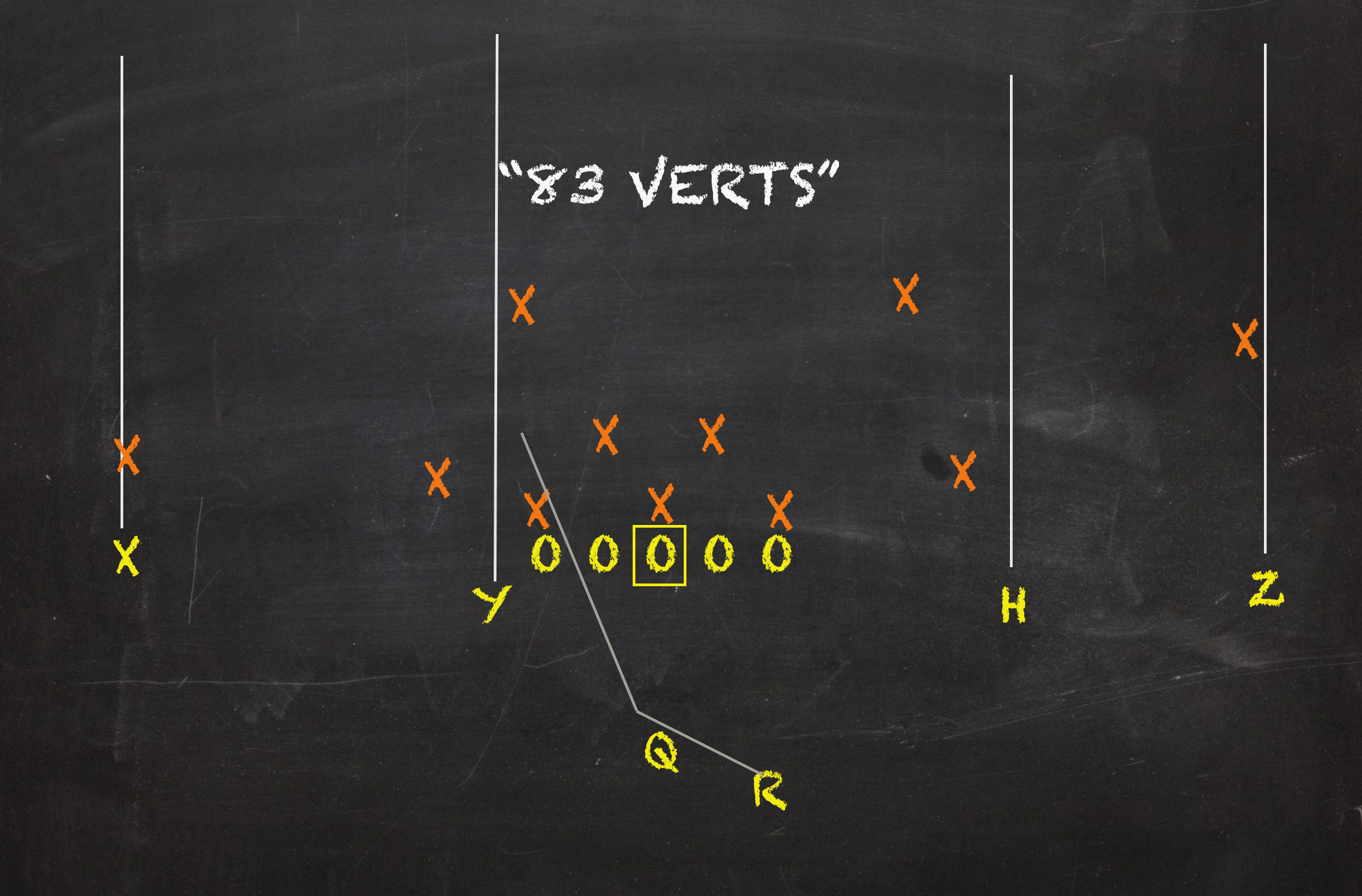
The Bearcats downfield passing game was further buoyed by All Verts. Including a pair of fade targets that were coupled with the Shallow concept, verticals averaged an explosive gain each attempt; two-thirds of these attempts found their mark. And like on the Divide concept, Pierce was UC’s primary target. He fielded four of the look’s chances for two catches and 76 yards.
While curls and Stick patterns can find gains when coveragemen play off, All Verts and Shots can easily win when DBs peek short. And for an offense that digs matchup ball, taking a guy downtown is one helluva way to exploit an advantage. After all, 4 deep beats 2/3 deep any day of the week.
Other Passes:
The Bearcats run a decent amount of RPOs. So folks should at least be on the lookout for a few slide/flat outlets as well as quick-outs. These avenues combine for 30% of the team’s RPO output in our sample across a 55.5% Success Rate. With their pesky motion usage, the Cats can toy with backers creating favorable matchups for swift pass catchers. Think about how Arkansas utilized Treylon Burks in this fashion; same thing. You should see at least a couple of these tries against the Tide on early downs.
And considering Saban’s history with man coverages, Cincinnati will probably call some Rub Variations. Along with Mesh, the Cats targeted a slant/wheel rub on a handful of reps. The friction of the route pairing can either aid the deep route to separate or create cushion for the slant to operate underneath. But it bears mentioning, this concept group hasn’t sizzled on the statsheet against UC’s hardest foes. Rubs have only worked on 2/9 chances on a deflated 3.8 Yards/Attempt.
Floods and Smashes ought to log a try or two based on their popularity and past showings in this scheme. Sure, their usage was incredibly limited. But across the dozen combined targets on these concepts, they rocked a 58.3% Success Rate and 7.8 Y/A.
And based on UC’s verticality, previously seen deep combos like Dagger and Mills/Double Post cannot be ruled out either. Though the Cats went o’fer on the former, the latter produced two 25+ yard touchdowns, both to Tyler Scott.