Sideline to Sideline: 2021 SEC Championship
Sideline to Sideline: 2021 SEC Championship
Happy Championship Saturday! After another season full of follies, memorable moments, and plenty of utterances of dirty words both in exuberance after elevating victories and disdain following nasty defeats, we will know which four teams will square-off for the national crown in just a few hours.
While the ACC, Big Ten, and Big 12 are fielding surprise matchups -- at least based on pre-seasons predictions -- the SEC’s championship tilt features the two betting favorites in Alabama and Georgia. Over the course of the season, the odds have steadily shifted UGA’s way. On gameday, the spread favors the Bulldogs by about a touchdown. ESPN’s prognostication programs agree with that margin. But both Pro Football Focus’ and cfp-graphs.com’s analytic predictive models give the Tide a 51% edge.
So without wasting more words setting up the premise of this Sideline to Sideline, let’s take a glance at each team’s offense, defense, QB, and schemes to see which side of the line to place our $$$.
Alabama’s offense at a glance
Judging Alabama’s offense against last year’s juggernaut isn’t entirely fair. After all, the Crimson Tide broke loads of records, compiled plenty of hardware, and accomplished the ultimate goal with an undefeated national championship campaign. That said, it’s important to focus on the team that’s taking the field this Saturday. Tide supporters should know exactly where I’m coming from. But for the casuals: Alabama has plenty of flaws.
Last year, Alabama’s front was adorned with the Joe Moore Award, adding to that team’s allure and further cementing its case for B.O.A.T. status. They surrendered the league’s lowest HAVOC Rate with top3 Pressure and Sack Rates. Despite returning versatile vet Evan Neal, that’s certainly not the profile of the Tide’s current front.
From the very get-go this fall, Alabama’s O-line has generated poor rushing cushion, failed to maintain clean pockets, and logged a good deal of misfires. In fact, Alabama has been so bad in some respects that even lowly Vanderbilt has preferable figures. Excluding non-conference and garbage time snaps, the Tide will come to Atlanta with the SEC’s worst rush yard before contact average (1.2), 2nd-worst Pressure Rate (37.7%), 3rd-worst HAVOC Rate (37.8%), and 5th-worst Sack Rate (7.4%). Over a fifth of their designed rush attempts have faced initial contact behind the line of scrimmage, and a seventh of their plays can be constituted as “broken”.
These bumblings have mostly blundered Alabama’s early down efforts. With nearly a third of their plays suffering from a form of havoc, the Tide represents the SEC’s median in both Success Rate and Yards/Play in league play. The middling production has resulted in the conference’s 4th-lowest Early Down Conversion Rate -- meaning Alabama relies heavily on 3rd downs to sustain drives. Setting yourself up for regular do-or-die opportunities is normally not recommended.
Luckily for them, their Young Gun has been one of the nation’s best at exhibiting value on the money down. Within SEC play, the Tide’s such 51% Passing Success Rate holds a five point gap over the next team in line. Over a sixth of their throws have gained at least 20 yards. When including scrambles, 12 carries have notched at least ten yards. This translates to a conference-best 23.4% Explosive Play Rate and 8.3 Yards/Play. Considering the offensive line has allowed a deplorable 57% Pressure and HAVOC Rate in these spots, that’s undeniably remarkable. The data backs the Good, Ole-Fashioned Eye Test.
While StatCat doesn’t recommend the dangerous habit of banking on the do or die down, the Tide have no choice but to ride its hot hand. After all, the Tide have produced nice numbers. Alabama averages the 4th-most plays/drive and remains pretty good at putting up points. The Tide command the 2nd-best Points/Drive (3.0) and Scoring Drive Rate (45.9%) in conference play. Despite the unit’s shortcomings, their 49.1% cumulative Success Rate is a mere few hundredths of a percent away from Georgia’s figure. The Tide’s potency and pre-snap activity joins the squad’s collective dip on the statsheet, but no offense averaged more yards/game in SEC play this season than Alabama; and they did average over 37 points/game in those contests.
Using ESPN’s SP+ Ratings as a gauge, Alabama’s five hardest opponents faced defensively are Texas A&M (8), Auburn, (20), Mississippi State (27), Arkansas (32), and Tennessee (35). Of course, the two former had the most success in their matchups. And, they are the only two opponents to hold the Tide to under a 42% Success Rate. With the nonstop havoc and uptick in defensive acumen, those results should be expected and should be a decent precursor for Saturday. But on the whole, the Tide’s metrics from these games more-or-less match their good, not great resume. That said, the SP+ really likes this collection of talent. It ranks Alabama’s offense 3rd nationally and only a half-point behind UGA’s.
No doubt the end product is still fine, but the degree of difficulty of meeting those standards with the present play of this O-line is awfully high. However, Alabama has no other chance at victory unless their Heisman hopeful once again is able to bailout breakdowns, make miraculous backyard plays, and seize situational wins.
Wideouts Jameson Williams and John Metchie anchor Alabama’s pass catching efforts. They have combined for over 2,200 yards, 200 targets, and 150 catches. Williams especially has been one of the conference’s most dynamic newcomers. His speed and fluidity working downfield make him Alabama’s most dangerous weapon. The Ohio State transfer leads the SEC in receiving yards and Yards/Target. Over a fifth of his targets have resulted in a gain of at least 20 yards and 47% of them have generated either a first down or a TD.
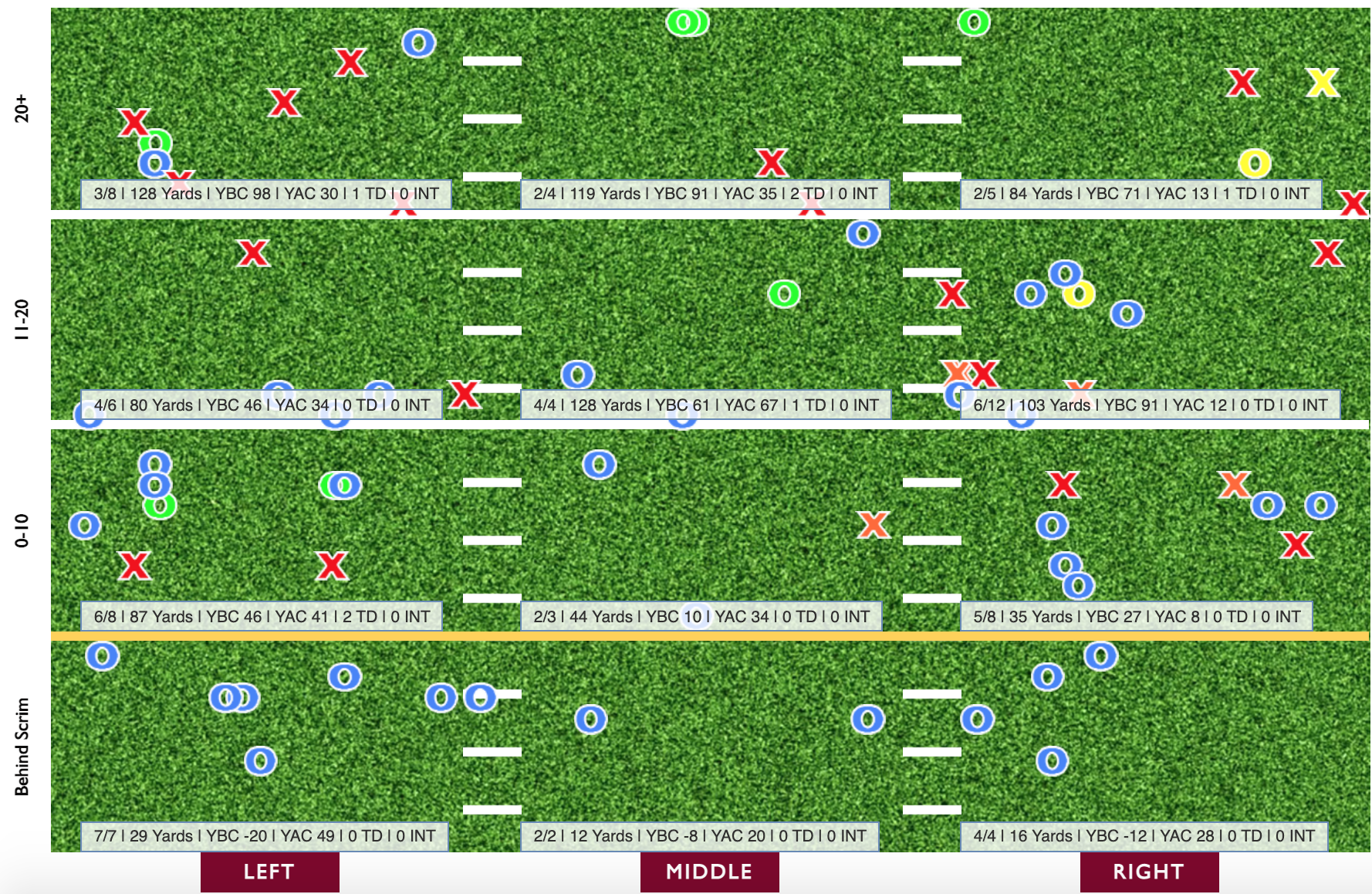
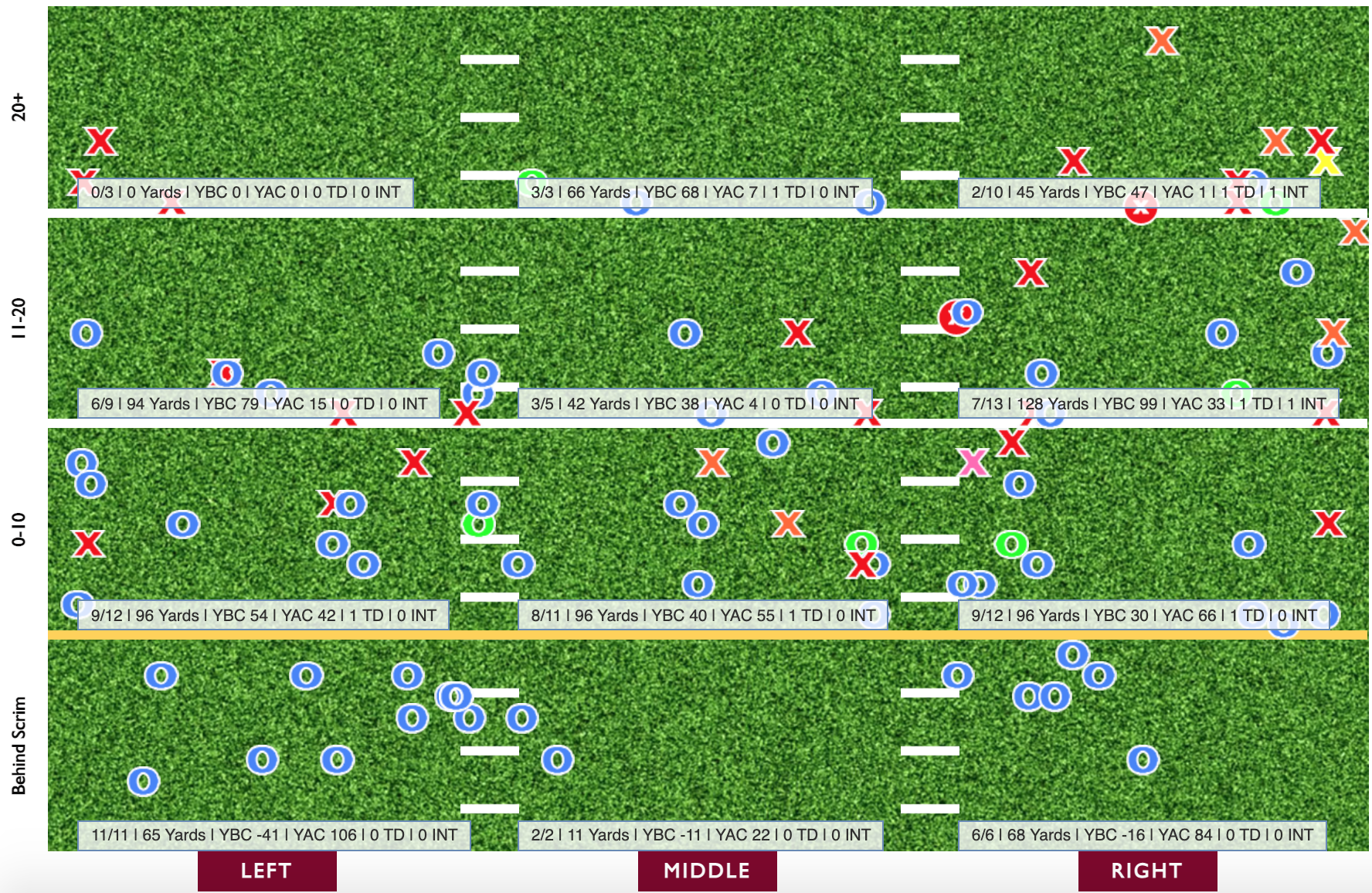
Jameson Williams's Target Chart in SEC play John Metchie's Target Chart in SEC Play
On the SEC’s 5th-highest average depth of target (14.7), he seeks to make splashes. Coming with the territory as one of the conference’s best X-factors, he champions the conference’s most deep receiving yards and 2nd-most grabs. He’s been able to snag 11/15 deep catchable targets. And of his 13 scores, seven of them have occurred on chances 20+ yards downfield.
Though Metchie was a field-stretcher and potent pass catcher in 2020, O’Brien has utilized him as this offense’s safety valve. Well over a quarter of his targets occur behind the line of scrimmage and his 44 screen+RPO targets lead the SEC. The abundant bunnies across his profile have strengthened his top10 Catch Rate within the SEC. But the conservative style, lack of vertical production, and 8% Drop Rate birthed a Yards/Target five yards less than his teammate’s. Not that the Canadian is a chump. But the Iron Bowl was a nice experiment showing what happens to Alabama’s offense when it loses its best burner.
Slot Slade Bolden and tight ends Jaheel Billingsley and Cameron Latu are tertiary options. Though Bolden and Billingsley are effective eye candy threats and provide occasional matchup opportunities, both have a sub-50% Success Rate and Yards/Target under 8.0. Hopes were high one or both would be valuable contributors due to their past experience and skill sets. But, the converted linebacker has managed to sport favorable overall metrics. Yet, the trio all have Drop Rates in the double-digits and combine for 19 by volume. Perhaps that explains why O’Brien has funneled the looks towards his top-two receivers. The potential for these guys to make a crucial impact can’t be overlooked, but their play this year points to why it can’t be guaranteed either no matter how tantalizing their traits might be.
Traeshon Holden and Ja’Corey Brooks are two of the youngsters to monitor out-wide. The former has hauled in 13/16 targets with four 20+ yarders and eight first down+TDs. Relieving the ejected Williams, Brooks caught a key equalizer last week and has seen spot work at Z often working up-and-down the right sideline.
With the way the O-line has been performing, it’s presumed Young and his outlets will have to do the heavy lifting. Workhorse Brian Robinson is questionable with a lower body injury and Trey Sanders is the only other healthy back on scholarship. And, there’s precedent the Tide leans on its passing game against its hardest foes thanks to the underwhelming returns running the rock. On the year, Alabama’s run game has delivered negative Expected Points Added and are flirting with being ranked in the triple-digits. And, that’s at full strength.
Still, it’s not like the Tide’s backfield is totally worthless. If Robinson can go, he and Sanders will present a dastardly duo of tackle breakers for Kirby Smart and his defense. Per StatCat’s charting, Robinson has totaled the SEC’s most by volume (86) on the 6th-best such rate (41.6%); Sanders’ 38% own Broken Tackle Rate is top10-worthy. Those skills have helped offset the halfcocked blocking and result in each rocking Success Rates over 50%, but unquestionably have hindered their potency as ball carriers. Both have below average Explosive Run Rates. And while Robinson has a healthy 3.4 YAC average, Sanders 2.3 clip is near the SEC floor. Plus, his 13-attempt sample in standard time hints at an even lower ceiling with a clip under 1.9, one 10+ yarder, and a Success Rate below 40%. That’s not a too auspicious outlook if Robinson doesn't suit up.
Though Young has managed to keep the Tide afloat, the consistent element of danger and wonky supporting cast makes Alabama susceptible to succumb to college football’s best defense.
Georgia’s offense at a glance
Todd Monken helped bring more zeal and aggressiveness to an offense that had grown stale, predictable, and unable to get Georgia over the hump. Along with leading the conference in deep pass rate last fall, the Dawgs emphasized mobility and versatility up front. While the change in philosophy helped UGA improve its Rushing Success Rate 8 points year-over-year, frustrating quarterback play birthed the SEC’s 3rd-worst Passing Success Rate. But the gung-ho approach helped both facets find increased potency; especially once JT Daniels entered the chat. With a strong close to 2020, it was presumed he would be the Golden Boy to lead the Dawgs back to glory.
But despite helping UGA beat Clemson in Week1, something was obviously up with Daniels. The man who burst onto the scene as a bomber transformed into a point guard slinging screens and picking wins with RPOs. Of course, we now know he wasn’t 100% healthy. Kicking ass in a few post-Clemson appearances have enabled his metrics to look fantastic, but injuries have allowed a future Disney movie unfold before our eyes with SB4 getting another crack behind center. Accumulating the 18th-most Expected Points Added nationally, Bennett is presumed to be this offense’s elderly caretaker to close the year. And it certainly helps, Georgia has like a dozen quality playmakers to where Monken can spread the wealth around and not be too concentrated.
The Dawgs have one of the most unique running back rotations in America. Five dudes have logged at least 45 carries and every one of them commands a YAC average over 3 yards. Three of the five have a Success Rate north of 50% and a Broken Tackle Rate above 40%.
Zamir White and James Cook are the de facto 1-2 punch with complementary skill sets. The pair have combined for 25 explosive carries versus only 8 TFLs.
White is the bellcow ball carrier and has consistently been one of the conference’s best short yardage backs over the last 2 years. He leads the team in most counting metrics but lacks the pizzaz of other elite conference backs. Both his First Down+TD Rate and Broken Tackle Rate are below-average. No question a 2.0 rush yard before contact average has hurt, but his pedigree as a former-five star leaves spectators expecting just a little bit more out of him.
“The Captain” frequently has been a top performer in EPA/touch since logging significant snaps and has been running with noticeably more fire this fall. Among SEC RBs with at least 50 carries, Cook boasts a top6 YAC average and top5 Broken Tackle Rate. All the while, his pop remains strong. His 18.7% 10+ Run Rate and 5.5% 20+ Run Rate rank 10th and 5th, respectively, within the conference. He’s also caught 16/20 targets with half resulting in either a fresh set of downs or six points.
Though two fumbles and six negative runs sour his profile, third-wheeler Kenny McIntosh has been Georgia’s most well-rounded back. He has the best YAC average (4.1), Broken Tackle Rate, (51%), Success Rate (55%), and Explosive Run Rate (20%) on the team. Plus, he has double-digit Yards/Target as a receiver.
Though injuries have prevented Monken from rolling out a clean corps of pass catchers, Brock Bowers has captured plenty of folks' attention despite being a first-year. Along with leading the Bulldogs in targets, catches, and yards, Bowers doubles-up the next-closest teammate in terms of TDs and explosive receptions. All the while, he has only dropped one pass and has logged a 57.7% Success Rate and 12.6 Yards/Target, which rank 9th and 2nd among SECers with at least 35 opportunities.
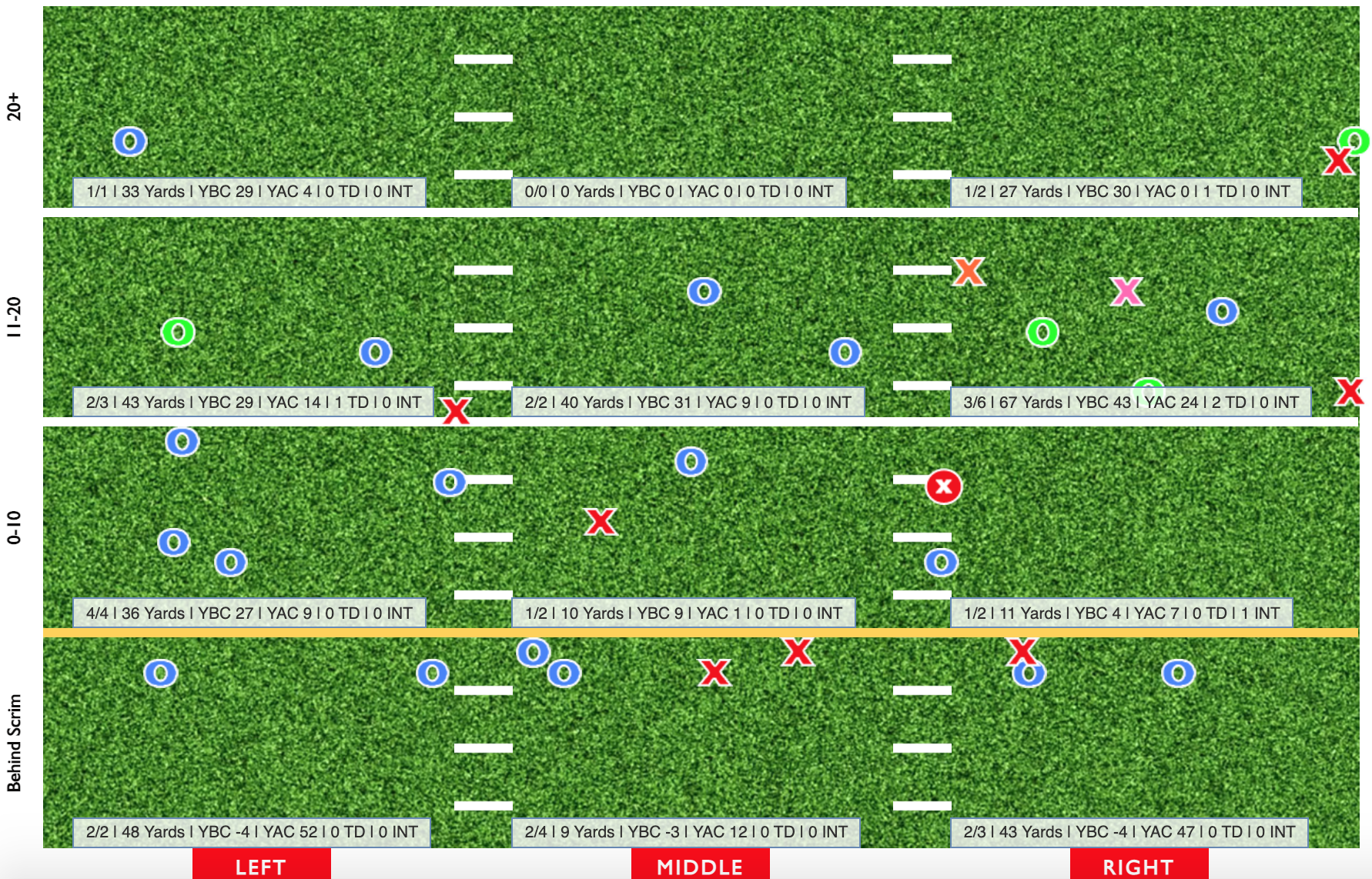
His fellow tight ends might not have been as featured this year, but they stand to be effective targets in their own right. Combined, Darnell Washington and John Fitzpatrick have hauled in all but two of their 15 catchable chances for 200 yards and five explosive receptions. (I’ll have more about UGA’s 2-tight end set usage later).
Despite varying usage, Adonai Mitchell, Ladd McConkey, and Jermaine Burton have all logged between 20-26 catches for over 330 yards. Since he has fielded a team-high 10 uncatchable targets and five drops on the league’s 4th-highest average depth of target, Mitchell’s degree of difficulty has resulted in worse metrics compared to the other two. Though over half of his targets have resulted in success, McConkey and Burton have figures in the 60’s with Yards/Target both over five yards better.
And now, mended veterans George Pickens and Dom Blaylock have started to log snaps again. If they are in the mix, that’s a whole lot of Jimmies and Joes to prepare for.
Brock Bowers' Target Chart in SEC Play
While the skill guys are the headliners, let’s not forget about the Red Bricks as this offense’s foundation. Contrary to their adversary’s tendency to suffer from defensive disruptions, Georgia boasts either the best or 2nd-best Turnover Rate (0.7%), HAVOC Rate, Broken Play Rate, rush yards before contact average, Sack Rate, Pressure Rate, and Broken Play Rate in SEC play. Keeping opponents at bay better than any other of their contemporaries has facilitated the Dawgs’ desire to stay ahead of the chains. UGA’s 4.7% Negative Play Rate is the lowest figure within the conference and nearly half the league average.
Opponents might pester and annoy Georgia’s offense occasionally -- after all there is evidence the Dawgs periodically like to play with their food and execute snaps with less urgency -- but with less mess, the results have been blessed. Not only have fewer backsteps boosted the Bulldogs’ bottomline, but no SEC offense is more prone to gains of 15+ yards in conference play. On average, one out of seven plays is either a 10+ yard run or 20+ yard pass. Knowing that, one can understand why UGA dons the top Yards/Play (7.4) in league play. And while the Tide are overly propped up by their pass game efficiency, Georgia is the only SEC offense with a +50% Success Rate in both facets in standard time.
Potent and consistent, UGA has crushed it on first and second downs behind a 0.26 EPA/play -- good for 2nd in the country. The Dawgs have only logged nine 3-and-Outs in meaningful minutes against SEC defenses. Naturally, these ingredients have helped the Dawgs sport the gold medal in TD Rate (8.3%), Points/Drive (4.6), and Scoring Drive Rate (62.2%). The latter is 18 points better than the next clip in line.
Despite the excellent positioning, Georgia isn’t perfect. And a good deal falls on the shoulders of its sprite QB. I’ll have more on Bennett later. But even though his play has improved, he still has glaring issues carrying over from last year. Bennett throws an uncatchable attempt on a fifth of his chances and has an Interceptable Pass Rate well below the conference mean. Though he started the season on pace to be the one of the most accurate passers targeting beyond ten yard downfield ever, he finished with a Depth Adjusted Accuracy% under 50% when facing conference opponents. For the most part, his results hardly can be challenged, but his process hints of a potential downturn facing a Nick Saban defense.
Moreover, Bennett has simply been a bad passer on 3rd down. Though he has managed to enhance his Success Rate to where he is no longer the conference floor and has a handful of nice scrambles, SB4 has only converted ten of his 33 such chances against conference foes. He has been just as likely to throw an uncatchable pass in these spots. And despite being gifted a top5 Pressure Rate, his 3rd Down Yards/Attempt (5.1) and Depth Adjusted Accuracy% (40.8%) are bottom5 in league play. Additionally, his Interceptable Pass Rate climbs into the double-digits. Among SECers with at least a dozen attempts, no one has a lower average distance to gain than his 6.9 figure. That paired with a relatively average 50% Rushing Success Rate on the money down has seen 62% of UGA’s latter down plays end with negative EPA, which ranks 98th per cfp-graphs.com. This is a massive problem for Georgia and an incredible opportunity for the Tide to potentially upend this offense.
But with the aforementioned might, getting Georgia into those situations will be awfully tough. Over 77% of their conversions occur on first or second down. Still against the meat of their schedule, the Dawgs’ worst inefficiency was heightened.
According to the SP+, Georgia’s hardest defensive opponents have been Clemson (3), Auburn (20), Arkansas (32), Kentucky, (34), and Tennessee (35). In these games, Georgia’s offense was solid but not overly spectacular. The Dawgs posted a 48% Success Rate and scored on nearly 60% of its drives while maintaining its wonderful levels of limiting defensive disruption. They experienced a dip in big runs, but potent passing was comparable to their overall numbers. However, these are the matchups where UGA struggled the most to maintain drives. Even omitting the Clemson game, over a quarter of its drives in these games resulted in a 3-and-Out. Only about a quarter of 3rd downs through the air were converted, which hammers the point home that those instances will be quite important in Atlanta.
Georgia is deep and talented. The Dawgs do a lot well as they are overly the premier offense in the SEC. And despite that feat, it still can be argued plays have been left on the field and UGA has yet to reach its ceiling. Still, don’t ignore those dissatisfying 3rd down returns in a one-off.
Alabama’s defense at a glance
Though Georgia’s defense rightfully leads the discussion and the majority of metrics across the conference, Alabama is overly the next team in line after the Bulldogs. TAMU might be favored more by the SP+; but the Tide rank 2nd in league play in 1D+TD Rate (25.9%), Yards/Play (5.0), Explosive Play Rate allowed (9.6%), and rush yards before contact (1.5). In fact, Saban’s squad is a mere 0.01 from having the same figure of the latter as UGA. In terms of down-to-down Success Rate, the Tide have the 3rd-best clip in SEC play allowing offense’s to average a 39.4% figure.
Alabama’s early down figure is nine points worse than its league-leading 31.5% 3rd Down Success Rate. But in terms of EPA, the two situations flip flop in value. The Crimson Tide ride all the way to 2nd nationally while still being moderately savvy on thirds ranking 18th. Their 7.31 average distance to gain on 3rd down is 2nd-highest in conference play. When isolating runs, their ADG remains as one of the highest in the SEC. And yet, the Tide allows a league-best 0.34 YBC.
Emphasizing stopping the run is defensive axium; and of course, Alabama has done phenomenal things this autumn thwarting run lanes and bottling up ball carriers. The Tide flaunt the top HAVOC Rate, Run Tackle Rate, YAC average and TFL Rate in league play. By volume, UGA has only allowed eight less run yards/game with a mere 0.1 yard advantage on a per/carry basis. According to cfp-graphs.com, their defensive EPA against the run is the best mark in college football (-0.229). And believe me, I know that stat can be hard to conceptualize; but that should stress how burly the Tiders have been on this front.
Alabama’s showings stifling SEC opponent run games is a major catalyst in the SP+ ranking its defense 11th nationally. According to that metric’s projection, the Tide are “expected” to allow one more TD/game than top-ranked UGA. What was the spread again?
Statistically, Alabama’s pass defense has been just fine. Far from the best thing in the world but still more-than-serviceable. The Tide have a top15 EPA/pass with a 8.8% Sack Rate. But since the end result is only lukewarm, most teams don’t mind taking a bath considering the scalding run defense. Allowing the 4th-highest Completion%, conference opponents have averaged 244 yards per contest through the air, which is the 6th-most. The Tide’s 41.9% Passing Success Rate allowed is only about a point better than the conference mean. They also rank 7th in Yards/Pass.
Conference opponents have hauled in half of their deep attempts for 5 TDs against 2 INTs. Though several more INTs occurred on midrange throws, Alabama has allowed a 56.1% Completion% on attempts beyond ten yards downfield -- they happen to face the SEC’s leader in that respect in this matchup. SB4 dons a clip hovering around 68% against SEC defenses; the average passer’s figure is about 47%.
Though the numbers might not be especially praiseworthy, the Tide’s secondary has two Pro Football Focus All-SEC teamers in Jordan Battle and Jalyn Armour-Davis. And Star/Nickelback Malachai Moore is a promising youngster. But more consistency will be needed behind the pressure Saban is presumed to bring against Georgia’s dropback game.
Rarely does Saban sit back passively, and sometimes that results in some losses downfield when man coverage falters. If you skipped that section, the Tide tee-up opponents for 3rd down snaps behind the chains as well as anyone. And since the old man has another pass rush fiend on his hands, it’s understandable why he’s playing some of his classics. Sophomore linebacker Will Anderson has logged national-high 14.5 sacks and 30.5 TFLs. Again, see Alabama’s such rates as a team. Anderson very much is the engine behind that much of that smoke. I mean, some people are even given weight to a potential Heisman campaign for the second-year. Because of his prowess attacking the line of scrimmage, he has been named SEC Defensive Player of the Week five times this season.
But Anderson isn’t just doing it alone on the second-level. Tennessee-transfer Henry To’o To’o Christian Harris, and freshman Dallas Turner have chipped 10.5 more sacks and 87 stops. D-Lineman Phidarian Mathis has been responsible for seven more sacks and is the only Tider with both a forced fumble and fumble recovery this season.
Georgia might be one of the top teams preventing havoc, but Alabama is more-than-willing to test their metal to rattle Bennett and burden Georgia’s ground game.
Georgia’s defense at a glance
To be blunt, Kirby Smart has fielded one of the best defenses in recent memory. And many fans and analysts alike haven’t been shy at hopping on the Bulldogs’ bandwagon proclaiming them as the Best of All Time. The downs are mobile Frisian horses, the linebackers are ravenous wolves, and the secondary is a murky myst that’s ept at making opposing passers see ghosts.
At least within SEC play over the last four seasons, Georgia is the only defense that has forced a 3-and-Out on over half of its defensive possessions. No other defense has allowed less than their 7 TDs. In fact, the next closest performer -- Mississippi State in 2018 -- allowed 10. The Dawgs’ 14.4% Scoring Drive Rate is the only instance of a team turning in a clip under 20%. Their down-to-down 31.9% Success Rate is several points better than the next-best figure on record. And of course by the old ways of measuring defenses, UGA has only allowed 265 yards/game and 8.3 points/game in conference with a pair of shutouts.
On average, about one out of every five plays experiences a form of havoc. Plus the Dawgs’ 9.7% Sack Rate is best in the SEC by a whole percentage point. Despite being a noticeably disruptive defense, UGA has only created 9 takeaways on a 1.6% clip. Only TAMU was less fortunate in that sense in league play this year.
Though the group wasn’t especially heralded before the year, there were firm expectations to meet Smart’s status quo. Mission accomplished. Nine defenders made Pro Football Focus’ All-SEC First or Second Team. Jordan Davis and Jalen Carter are easy on the eyes and are total bruts on the inside helping maintain a league-low 1.4 rush yard before contact average. Lewis Cine, Christopher Smith, and Derion Kindrick have helped limit SEC passing games to a 36.5% Completion% and 1 TD on throws beyond ten yards downfield. Channing Tindall and Quay Walker have been key second level ball hawks in capturing a 2.1 after contact average and holding conference foes to an uninspiring 2.0 Yards/Attempt and passes behind the line of scrimmage.
But from where I sit, Nakobe Dean has been the most impressive Bulldog defender; and it’s not even close. As someone who typically preaches to attack linebackers with varying looks and dropback concepts, the spunky Dean has kicked that philosophy in the nuts by mastering all trades. He’s quick enough to roam sideline to sideline against backs, slots, and tight ends alike but still has the might to clog run lanes and be a menace on the edge. According to PFF, he’s the only Power5 off-ball linebacker to ever grade with a 90+ score both as a blitzer and coveragemen. Speaking of the latter, no P5 linebacker held QBs to a lower passer rating this season. Across his 26 targets, he’s only surrendered 61 yards while picking off a pair of passes and deflecting two others. And depending on who you ask, Dean has logged between 5 and 7 sacks. Not bad for a 6’0, 225 pounder.
Stylistically, the Dawgs are all about getting opponents to 3rd down and winning with a deep toolbox once opponents are in obvious passing spots. You will see a lot of 3-down lineman, mug fronts -- aka simulated pressures or “creepers” -- to occupy gaps and manipulate offensive rules, and two-deep shells pre-snap to maintain maximum versatility on the backend. PFF’s Diante Lee wrote a fantastic piece on how Smart defends the spread offense in such a manner. The coverage anticipating glance posts, hitches, or other cheeky RPO combo invites the run. But since they have monsters in the middle that can plug an extra gap with their navel while being swift enough to gobble up dashers toward the perimeter, Smart and Co. are able to have their cake and eat it too. They can take away the quick game, cover their ass against shots, and have enough girth to extend the gestation period of runs plays to where backenders can rally for minimal gains. Obviously, figuring out that puzzle has been one of the trickiest assignments in some time.
Unsurprisingly, that effective approach has seen the Dawgs produce a 30.1% Success Rate allowed; just 13.9% of early down plays result in either a first down or a TD versus conference foes. Think about that: On average only three out of every ten 1st and 2nd down plays worked situationally against this defense. Practically two full series are needed on average to secure the next set of downs. In turn, their early down EPA/play of -0.245 is easily the best in the nation.
UGA is admittedly not elite on the money down, but still nowhere close to being a pushover with a 36.1% Success Rate allowed. Their 15+ Play Rate creeps up to nearly 10% in these spots, and the Dawgs’ Explosive Play Rate is essentially average. Best of All Times aren’t supposed to be middling. Georgia is still top15 as far as EPA/play is concerned on 3rd downs. But considering their opponent, Kirby might want to have an extra wrench or two in that deep toolbox of his for these moments.
The Quarterbacks
While a lot of factors go into winning a conference championship, QB play is pretty important in postseason play. The last three SEC champions either had their passer toss 4 TDs or rallied behind a QB swap to guide them to glory. And since both offenses are bound to clash with rambunctious run defenses, the odds are strong that either Byrce Young or Stetson Bennett will be major catalysts in the final line.

Young has better counting stats, but Bennett has been just a little more efficient. The Tider has logged over 1,000 more yards, 19 TDs, and 37 Expected Points Added than Spry Stet. But, he also has over 100 more attempts than Bennett does completions. His offense has simply asked for his services far more in comparison than the Bulldog. Despite that, SB4 has tossed one more INT and has a noticeably worse Completion%. But, his potency and the manner in which UGA’s offense operates has driven his 88.8 QBR and 10.8 Yards/Attempt. Both rank as the 2nd-best figures in college football entering Saturday. Like his EPA total, Young’s 86.7 score places 4th nationally.

Monken scheme usually asks QBs to press vertically. And for the 2nd-straight year, Bennett commands one of the league’s highest average depths of target. And despite the challenging aspect of finding regular downfield completions, Bennett has managed to log preferable down-to-down numbers than Young. Though having the silver medal in two key efficiency stats hint at Bennett's edge in this respect, both his Explosive Pass Rate and First Down+TD Rate hold sizable gaps over Young’s.
But, the enhanced degree of difficulty paired with lacking arm talent highlights Bennett’s process isn’t sterling and stresses why his tape is full of rust. He ranks outside of the top dozen SECers in both Uncatchable and Interceptable Pass Rates. Plus his Depth Adjusted Accuracy% -- that applies more risk/reward the further a pass travels past the line of scrimmage -- falls under the rosey plateau of 50%. This flawed modus operandi leaves the door slightly ajar for JT Daniels to play hero.
Young’s result metrics might look up to Bennett’s, but the dude from Mater Dei is a Heisman hopeful for a reason. Along with the healthy traditional numbers, the Tider has been dynamic without being careless with the football. While being runner-up in Explosive Pass Rate, no SEC QB has thrown the ball into harm’s way less often. I know that doesn’t quite align with the reasoning behind some of the Aaron Rodgers comparisons earlier this fall, but the Packer revolutionized downfield precision while minimizing turnover-worthy tosses. Young does that better than anyone else in the SEC. And considering the pressure he’s faced, knowing half of his attempts have found success paired with a 52.8% Depth Adjusted Accuracy% makes this resume pretty special.

Despite both completing north of 40% of their deep passes, these two QBs aren’t strong bombardiers. Yes, both crack the conference’s top6 in deep Yards/Attempt but neither beat that threshold in terms of deep Accuracy% when facing SEC defenses. Young’s numbers appear to be more firm as there’s a significantly lower margin between his two figures (meaning his supporting cast is not bailing him out as much in comparison. Bennett has benefited from the 5th-best Completion% even though his Accuracy% is 15 percentage points worse.
The same happenstance has occurred with the Bulldogs midrange offerings, but at least Bennett has been tops being on-target 11-20 yards downfield in SEC play. When accounting for drops and other things outside the QB’s control, his 82.6% Adjusted Completion% on these throws is nearly ten points better than the next SECer in line. The ample connections and the somewhat dependable ball placement has his such 13.4 Yards/Attempt sit nearly two whole yards higher than the No. 2 spot. But like his overall resume suggests, a good number of passes get away from Bennett. Very few of his contemporaries have been worse at preventing interceptable passes on attempts beyond ten yards downfield. On average, roughly a sixth of his tries met that criteria when facing SEC foes. The range of outcomes accentuates why Monken has had to be prudent with Bennett despite his desire to test backends.
Young’s West Coast archetype looks far less sturdy on intermediate attempts placing 8th in Accuracy% and 10th in Completion%. This shortcoming has some of Alabama’s core passing concepts posting pretty dismissible returns. The Bulldogs’ defense has only surrendered a 42% Completion% to conference opponents on midrange targets. So the likelihood of the Tide finding their footing in this matchup is lacking. Despite the downturn in precision, Young still limits risk very well. Among his peers with at least 15 intermediate throws, only Tennessee’s Hendon Hooker has a preferable Interceptable Pass Rate.

Getting after these passers presumes to be a big coaching point for both defenses, but one is simply less sound handling the heat. To reiterate, Young’s passing environment has been entirely less stable than Bennett’s. Well over a third of the Tider’s dropbacks encounter pressure compared to less than a quarter of the Bulldog’s. But thanks to God-given traits and plenty of practice at the craft, Young is the conference’s best passer under duress even if SB4 has a better pressured Yards/Attempt. While having the top such Success Rate by about four points, no SECer can trump Young’s 48.2% Accuracy%.
For Bennett’s sake, he has been very lucky his supporting cast have limited havoc elements from souring his sample. Though his down-to-down Success Rate is relatively mediocre, his usual red flags of subpar ball placement and risky decisions are accented. With only about a third of his pressured passes being deemed “on-target”, over an eight had potential to be picked off.
Unfortunately, Bennett’s boo boos have also occurred when he’s been kept clean. With screens and RPOs taken out of the equation, the Bulldog presents incredibly concerning figures. The pristine pockets might have facilitated good gains and robust results, but Bennett failed to stand out with his precision under these conditions. Both his Accuracy% and Interceptable% rank 16th on clean dropback attempts, which is not what you want from QB1 on the best team in the country.

Despite Bennett’s verticality and acumen as a midrange specialist, his subpar ball security has seen him be fed more true screens than Young. The pair have a comparable RPO throw rate. But considering the Bulldog’s high propensity to pass using play action, it’s hard to argue that he’s not the more coddled of the two QBs.
Over a quarter of Bennett’s attempts have utilized play action and no SECer has a higher such yardage makeup than his 38% clip. Using this tactic, Bennett’s numbers are boosted into the stratosphere (60% 1D+TD Rate, 15.1 Y/A, 30% Explosive Pass Rate). Within the conference, his clip of the former is the best figure over the last four years. Naturally playing small behind one’s big bodies and gritty ground game allows for such opportunities. And play action can be a great tool to simplify reads and maximize output. Despite the game manager label, credit Bennett for finding these valuable completions.
Though Young has dedicated more attempts short, he still sends a decent concentration of throws beyond ten yards downfield. And, some of that has been a late season swing. Despite still targeting an RPO on about a fifth of his chances and giving short attempts about a 41% share, only 14% of his attempts have attacked behind the line of scrimmage since Week11. Perhaps trying to expand the team’s verticality or honing in on splash gains, a sixth of his attempts have traveled beyond 20 yards downfield in that time. Again, UGA’s secondary has been rather stingy. But, the explosive play battle has been more correlated to winning SEC ball games the last four years than takeaways.
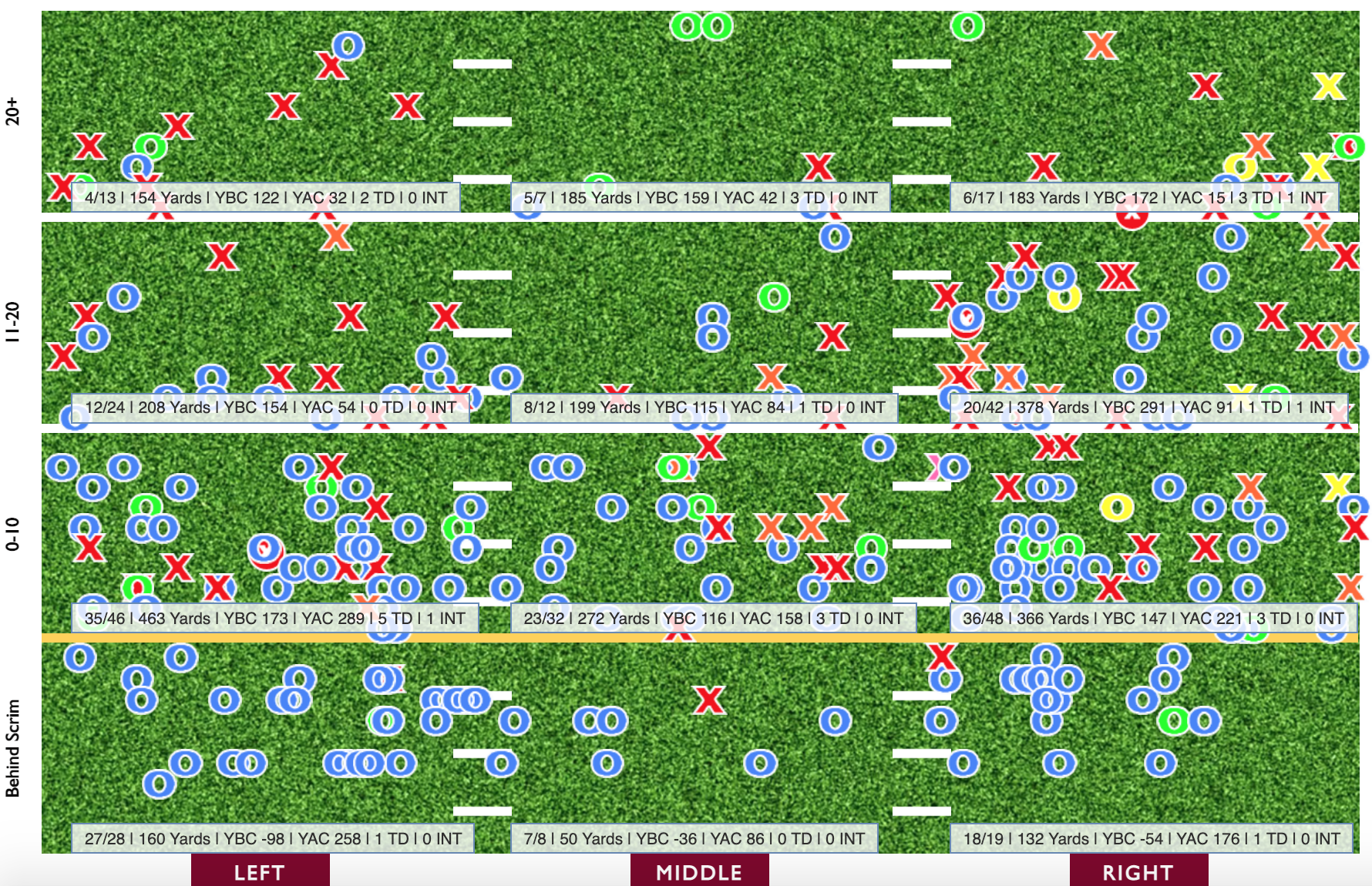
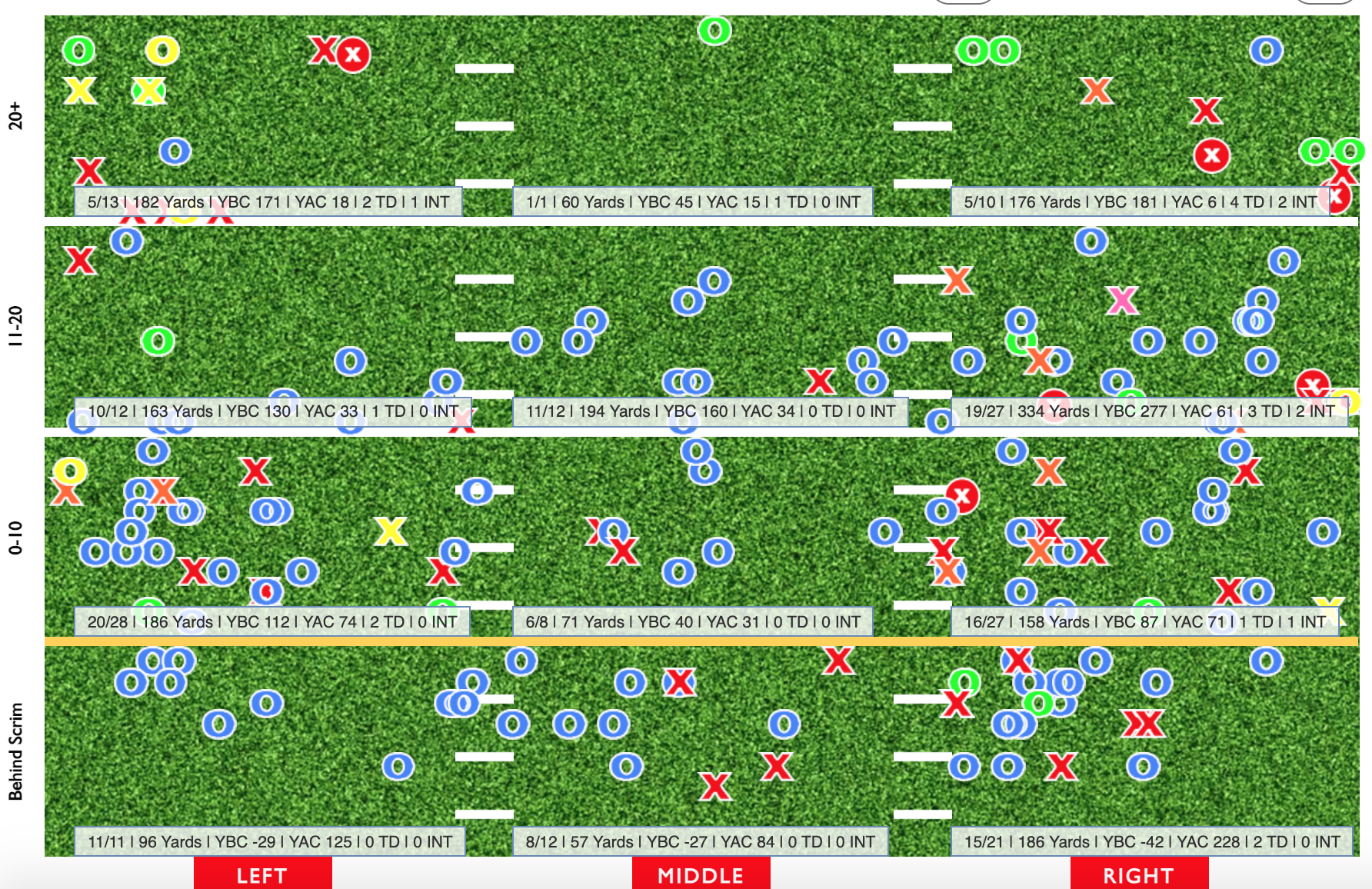
Bryce Young's Pass Chart in SEC Play Stetson Bennett's Pass Chart in SEC Play
Alabama's Offensive Scheme (and how Georgia has defended similar looks)
Like his predecessor, Bill O’Brien has refused to dedicate over a 7% play share to any one offensive look in meaningful minutes against conference opponents. For the second-straight season, no pass concept has a clip over 4%. Some of the previous staples -- like Inside and Outside Zone Reads, Off-Tackles, Duo Dive, Split Zones, Cross, Mesh, Yankee Shots, and Slant variations -- still remain atop Alabama’s call sheet. But, the Tide strive to keep opponents guessing for what might come next by balancing relatively equal love amongst their favorite concepts.
It’s the little things that BOB has done -- or not done -- that has taken the Tide’s offense to a new direction.
Though 12 personnel, or two-TE sets, once again finished as this team’s most effective grouping in terms of Success Rate (53.8%) and Yards/Play (7.0), Alabama’s play share in these formations was more than cut in half year-over-year. They went from a league-high 37.8% to 17.7%. Alabama has lined up with at least three WRs on 78% of its snaps. No SEC team played less in those groupings in 2020 than the Crimson Tide. In fact, their 57.6% play share was nearly ten points behind the next closest contemporary.
Georgia has yet to be turkey tapped by 12 personnel. Though largely similar to its overall figures, this defense’s 1D+TD Rate, Explosive Play Rate, and rush yards before contact all improve when against two-TE sets. But for what it’s worth, two of the five 35+ yard passes UGA has given up in SEC play have occurred from this grouping. Still with their multi-talented linebackers, the Bulldogs are well equipped to matchup with the Tide in these instances. When offenses have tilted to other groupings with more receivers, the Dawgs are a tad less frugal but are more consistent down-to-down. Both their Sack and TFL Rates crack 10% and they allow a mere 31.7% Success Rate.
Steve Sarkisian was a fervent believer in motion and tipping defenses. Though losing a Heisman hurts, most of the pass catching supporting cast was back and all had experience as deceivers. Yet, Alabama’s motion rate has shrunk from 33.3% to 19.3%, its Jet motion rate has dipped from 10% to 4.9%, and its Orbit motion rate has worsened from 8.2% to 6.9% in standard time versus conference opponents. Running at a brisk pace is a decent explanation for fading motion. But, there’s no question BOB would incorporate them more often if he was a fan.
When pre-snap motion is called, Alabama’s Explosive Play Rate increases 4 points, it’s rush yard before contact average improves by nearly half a yard, and its overall Success Rate marginally improves. When Jet or Orbit motion have been called, the Tide’s Success Rate climbs all the way to 52.3% as their Yards/Carry is bumped up by 0.7. The havoc elements have had more of an effect on these snaps, but the net positive is apparent. That said, Georgia has been terrific adjusting to motions.
Already a brawny bunch that limits cushion beautifully, UGA’s YBC average shrinks to 0.7 with over 60% of their defended attempts experiencing a form of havoc using pre-snap motion. And when taking a step back and including passes, SEC foes have only logged four explosive plays all year. While allowing a 1D+TD every five snaps is fabulous on its own merit, Georgia’s figure gets sliced to 11.7% when defending Jet or Orbit motion plays. While these motions are great at collapsing backends and help tip coverages, that can act as a double-edged sword for crafty defenses. Those tactics can have cons, and Smart squad has been well-instructed on how to discombobulate these plays.
O’Brien has also chosen to fade pulling lineman. While some of his tweaks may have been philosophical, this move was practical. The Tide have absolutely sucked on these designs. Counter (33.3%), Power (22.2%), Dart/Tackle Wrap (33.3%) all have turned in lousy Success Rates. Last year, Counter was the team’s most-repped run in meaningful minutes but have only dedicated a 2.7% play share to the misdirection against SEC foes thanks to the stinky execution.
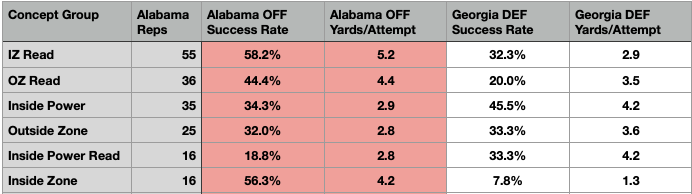
Poor effort upfront unfortunately hasn’t just been isolated to these runs. Three of Alabama’s five favorite run concepts (OZ Read, Off-Tackle, and Duo Dive) rock Success Rates under 45% and Yards/Cary under 4.5. Knowing the upside and makeup of Alabama’s roster, this ineptitude is hard to fathom. At least, Inside Zone Reads have managed to prop up the Tide’s run game in conference. Though a lot of their core runs are canvases to build RPO designs, 85% of Alabama’s Slam or Bluff Reads have been utilized in that fashion. With or without route tags, these have been the Tides two best run concepts donning Success Rates of 62% and 54%, respectively. These five main looks account for 62% of this offense’s run plays.
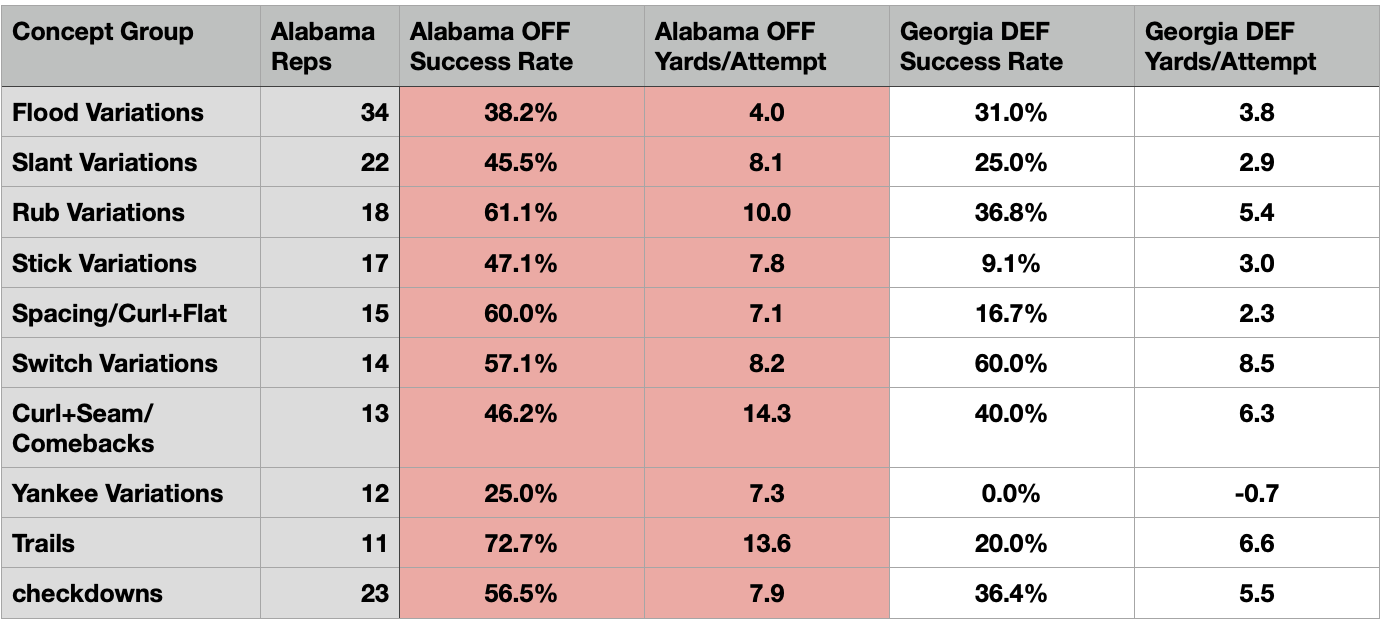
Cross has remained a passing cornerstone, but its productivity has fallen off a clip. Across 20 outright targets in SEC play, the weakside flood has only a 30% Success Rate and 3.2 Yards/Attempt. Though a play action favorite and effective pattern against a number of coverages, deep overs in general just haven’t been as fruitful in 2021. Along with Cross, Yankee Shots -- deep over+post combinations --have seen their per opportunity outputs diminish by over 100% year-over-year.
Slants -- both as RPO outlets and as backside manbeaters on dropback patterns -- have combined for 22 targets and a 45.5% Success Rate. As of late, the Tide have been calling some basic patterns that have paired some variants with Stick. But the majority of his group's targets have been from RPOs. Yet, only 5/14 have brought about situational success. Bubble Screens are Alabama’s next most targeted RPO outlet. And though seen less YOY, these attempts have a respectable 6.4 Y/A and 54.6% Success Rate.
Sticks -- particularly Y Shock -- have seen one of the biggest jumps on the script of any concept for this offense. Mostly from empty formations, this pattern has been a visible feature of this scheme over the back half of the season. Of its 17 targets, 11 have occurred from five-wide sets. Though its returns are better from others, Sticks have gained the 4th-most yards of any single pass look despite being considered a short concept. Again, Alabama likes to pair Slant Variants on the backside but also utilize “Dag”, Levels, and option elements too.
Staying with the idea of presenting his west coast passer safe targets close to the line of scrimmage, Spacing patterns have also seen a usage increase with BOB guiding the offense. Mostly used to beat single-high coverages to their horizontal breaking points, these patterns mostly consist of curls and flats. Despite its juvenile appearance as a rinky-dink concept, some of the best offenses ever have featured Spacing plays regularly. Still, it’s reputation as the poster child for conversative pass patterns is well-known. Alabama has only executed a handful of concepts better than its 60% Success Rate targeting Spacing/Curl+Flat designs.
Attacking vertically with Curl+Seam combos and deep comebacks should also be expected. With the abundant Spacing and Stick calls, sending an extra man or two upfield is a nice way to steal a downfield gain. Though really, really ordinary, this notion has been responsible for the most pass yards of any aerial concept group across a 14.3 Yards/Attempt. While “Hoss” can be seen from empty with an inside juker, Comebacks and Deep Hooks get resourceful with eye candy and big set play fakes.
While Wheelie Switches, Fake Screens, and deep double moves like Sluggo, Diggo, Skipper, or SkicknNod cannot be overlooked when the Tide are feeling frisky, Mesh and Trail have been this offense’s two best concepts and its two most targeted looks on the money down. Of the designs’ 28 combined targets in SEC play, 19 have occurred on 3rd down where each boasts a Success Rate in the 70’s and a double-digit Yards/Attempt. If Alabama cannot TCOB with these plays, the Tide might not find much latter down success.
Both plays are meant to thwart man coverage or confuse zones with organized chaos. Mesh is rooted in two short intersecting drags. The most common complementary routes these days include a playside RB wheel and overtop sit hook. Alabama's two main Trail patterns are known as “Arches” and “Dangle”. The video has all you need to know about how they are built to win.
Georgia’s Offensive Scheme (and how Alabama has defended similar looks)
Excluding penalties, Georgia’s offense has only logged 231 snaps against conference opponents in meaningful minutes. While having a mighty defense helps, the Bulldogs didn’t wind up as a high-scoring, entertaining, and explosive offense by accident. Monken is running most of his top looks from last year -- like their bread and butter Inside Zone Reads, perimeter runs, Tackle Counter Reads, Cross, play action bootlegs, and Vertical Shots -- even in this reduced sample. But like their opponent, the Dawgs feature a bevy of concepts.
Though Monken has helped somewhat modernize Georgia's offense, the Bulldogs still very much want to win by mashing faces with a physical ground game. UGA trotted out multiple tight ends on nearly 30% of its snaps last year; only the Tide were more prone to line up in heavy sets within the SEC. This year, however, the Dawgs have either been in 12 or 13 personnel on a whoppin’ 43.9% of their plays. But unlike the lumbering offenses of old under Mike Bobo or Jim Chaney, this crew is malleable and particularly shifty.
Out of multiple TE sets, Georgia averages pre-snap motion on every fifth snap and has performed the 24 formational shifts. Monken has been incredibly dastardly with this tactic to where it’s almost cruel. On the 16 executed in SEC plays in meaningful minutes, 14 have found success while averaging exactly 10 Yards/Play. It’s hardly been a fair fight.
The Dawgs should feel confident with a 52% Success Rate in their back pockets, but Alabama has held 12/13 personnel groupings to a league-low 3.9 Yards/Play and 20.4% 1D+TD Rate. The Tide have managed to log a TFL on 16.3% of these snaps. Opponents have been able to only snag four explosive gains on them all year with no passes over 35 yards. Georgia averages an SEC-best 3.08 rush yards before contact against conference defenses, but their clip in these groupings dips to 2.3. The Tide currently average well under that mark with a 1.4 figure.
Though it was hinted in the QB section above, the most impactful year-over-year tweaks to this offense has been it’s usage in dropback play action. Bennett’s overall play action rate increased ten points compared to last season. Going run-heavy behind big sets has traditionally been a nice precursor to a potent play action attack, and this offense is just the latest success story. In the process of trying to make Bennett beat them, plenty of defenses have played themselves selling out to stop play fakes only to let SB4 throw over top of their yards for an explosive completion. In league play in standard time, the Dawgs have logged 16 20+ yard passes versus only two negative plays when using play action.
Alabama’s defense has held its own against play fakes this year. Tennessee did a number on them going 5/8 for 159 yards and 3 scores using the tactic. But with that game excluded, the Tide only average a 6.8 Y/A with one play action TD allowed in SEC play. Including all conference games, just under half of opponents’ attempts have found success despite logging an unassuming 36% 1D+TD Rate.
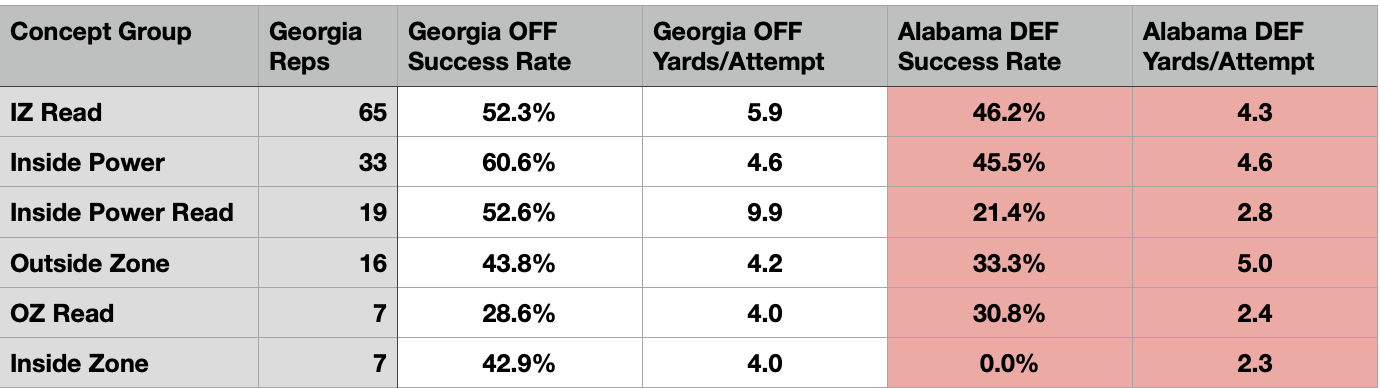
This scheme’s focal point like last year is the Inside Zone Slam Read. Unabashedly, this basic basic concept has commanded a 15% play share in meaningful minutes. But as sturdy as the Bulldogs’ 5.2 Yards/Carry and 53% Success Rate were last year, this offense has boosted this design’s output considerably this fall (7.1 Y/C, 58.3% SR). As their favorite drive-starter, two-thirds of UGA’s first down Slam Reads have gained at least five yards.
Like a good amount of team’s, the Slam Read is Georgia’s favorite run design for RPOs. But no other concept has more than five reps in our sample. The look very much is the primary engine for this element of UGA’s scheme. Over 70% of this offense’s Slam Reads executed in SEC play in meaningful minutes have been RPOs.
The Duo Dive is also a blunt object this offense uses to bash opponents into submission; especially after halftime where it sports a snappy 84.6% Success Rate and 7.4 Yards/Carry (in case you were wondering this excludes garbage time carries).
Tackle Counter Reads have been the Bulldogs’ most incendiary run. Seizing a few big gainers against Florida with this concept certainly helped, but UGA will trumpet a 10.2 Yards/Carry and 54% Success Rate with this misdirection.
Georgia’s foundational rushing concepts have been bankable, but Monken will test folks on occasion with something off the beaten path. The Buck Sweep versus Kentucky comes to mind. The Dawgs haven’t called one before or since despite ripping off a 35-yarder. That said, most tertiary and fringe designs have not been bang for buck. Looks like Off-Tackle, Outside Zone Read, Inside Zone Bluff Read, and Split Counter have Success Rates ranging from 20-37%. Besides the main trio, Toss, Counter Read, and Draw are the only other run concepts with at least four tries in our sample to crack a 50% clip.
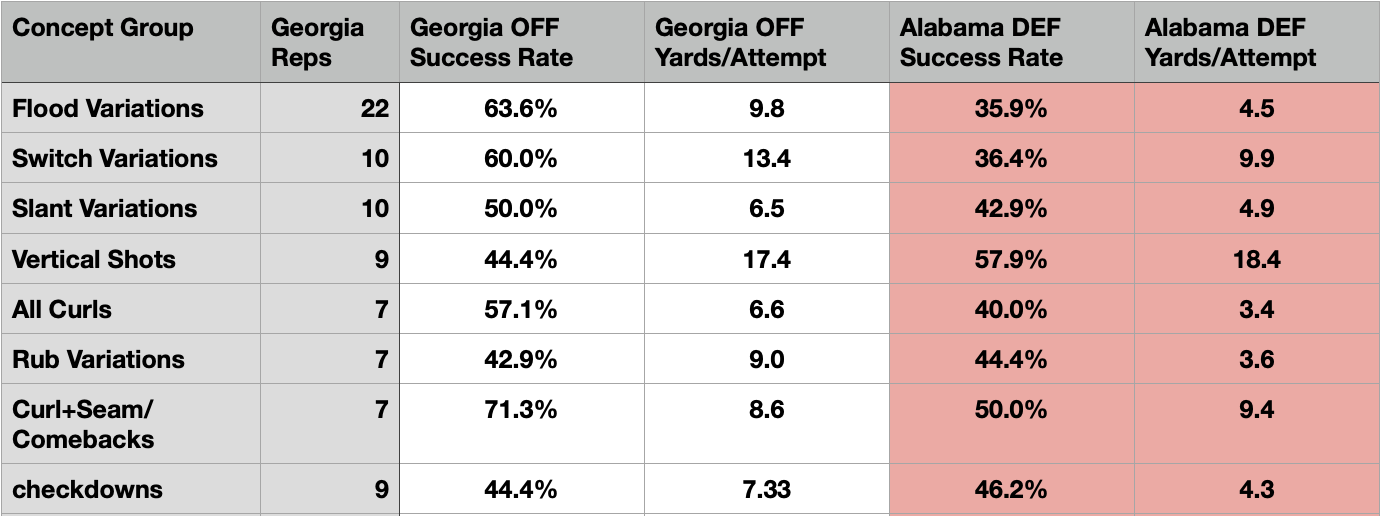
Weakside floods like Cross, Bootlets, Waggles, and Sprints have been Georgia's favorite pass patterns. With the ample play actions, these designs ought to be expected. Once opponents dedicate an extra body in the box anticipating a run, this scheme has been ready to send a crosser over their heads and overload an area of the coverage. Complimentary football, yes; but this has also aided Bennett’s throwing lanes and allowed him to use his wheels outside the pocket. Still, this group has only accounted for about 7% of this offense’s plays in meaningful minutes. Based on the returns, most would suggest they target them more. While posting a 10.7 Y/A, 6/9 Crosses have found success along with 6/10 PA Boots.
Various slant and vertical shot combos come next in line. Though both have been incorporated into UGA’s RPO game, their best work has occurred as pure dropback patterns. Looking at the homerun balls, 4/7 have connected across a 23.0 Yards/Attempt.
Since Georgia's passing game hasn’t been bloodied, Monken has been liberated exploring numerous plays. All Curls, Spacing/Curl+Flats, Hoss, Mesh, and Leak have also been targeted a handful of times. Again, nothing has seemed specifically fancied. But it’s hard to ignore the number of times Georgia has hit on a certain route combo.
Wheelie Switches have become one of the trendiest pass concepts in football. Consisting of a root inside-outside wheel+post/dig exchange, this combo is fantastic winning against single-high coverages or manufacturing a room against two-deep shells. Georgia has window dressed Wheelies several different ways including fake screens, play action, shifts, adding an additional post to the route combo and tinkering with complimentary patterns.
For the first half of the season, Georgia was electric targeting these looks. Excluding sacks and scrambles and examining only outright targets, Wheelie posted a line of 10/12 for 338 yards, 5 TDs and 1 INT. With those returns, it’s easy to see why others want to get in on that action and test secondaries in a similar fashion. But since the UK game, the Dawgs have only connected on 2/7 for 36 yards. Glass half full, the last target begat a 25-yard TD. This pairing might not be as fiery as it was a couple of months ago, but don’t discount it showing up if this offense needs a spark.
I think they win if….
I think Alabama wins if it can continue its 3rd down magic and capture at least four explosive gains through the air. Bryce Young has been sensational under duress and has copious clutch plays during his first year as a starter. With how ineffective the Crimson Tide’s down-to-down run game has been in SEC play, it's hard to imagine their O-Line miraculously figuring it out against one of the most immovable fronts in the history of the sport. And Young will have to make some plays and pad his Hesiman profile with some splashes. Nickel and diming could be the path. But if Alabama can figure out a way to turn four passes into four scoring chances, they might have a shot at the upset.
Again Stetson Bennett has shown to be an unsteady passer under pressure and on 3rd downs. Now, he gets to face Nick Saban. Assuming this matchup plays out, the Tide’s defense should be able to make things competitive. However, that’s assuming Alabama doesn’t get absolutely worked on early downs. Still with how prone Bennett is to turnover-worthy plays, safe money is on Alabama’s defense coming away with a takeaway or two. If they can survive on first and second, and thrive on third, there’s a chance the Tide pulls this off.
I think Georgia wins if it can control the line of scrimmage and make sure Stetson Bennett doesn’t screw it up. Look, the Bulldogs’ path to victory is a lot more straightforward than Alabama’s. Even for the team with the best rush yard before contact average, steering the Tide’s front isn’t an easy assignment. Bennett will have to make some throws. But, it’s hard imagining the gameplan calling for him to attempt over 24 passes. If the Bulldogs can limit his involvement and SB4 can find occasional situational wins, their rock solid defense presumably should have them in good position to secure the No. 1 seed.
If things get rocky for the Bulldogs, the question is: How long is Bennett’s leash? Though Alabama has made some postseason switches at QB in recent memory, what would it take for JT Daniels to lead the offense? His numbers are inflated but still incredibly satisfying. A strong defensive performance would make that thought moot. But don’t think Georgia can skate by Nick Saban if they have to overly rely on Bennett.