2021 Vision: Previewing South Carolina
2021 Vision: Previewing South Carolina
With talking season winding down, preview season is among us! I'm sure this isn't the first preseason article you've viewed. You should know the drill by now with these bad boys. But if this is your first experience with StatCat, be ready to learn a thing or two about the Gamecocks' returning QB1, receiver room, rushers, OL, its most important stats to maintain and/or improve on both sides of the ball, and how South Carolina's schedule breaks down with help of ESPN's SP+ Rating!
South Carolina Passers

With the page turned on the Will Muschamp era, a new story about South Carolina’s offense awaits to be written. The buzz is the Gamecocks will look to blend elements from Baylor’s 2019 attack, Joe Brady’s philosophy, and some fun wrinkles from Lincoln Riley’s offense. Though that all sounds wonderful on paper, the Gamecocks don’t have a proven passer and overly lack aspects that made those other attacks some of the best in the game. That notion aside, Luke Doty will be the incoming offensive braintrust’s first Guinea pig after having a more impressive spring than rival Jason Brown. Expectedly, he looked raw and rough as a first year, but playing in a scheme more suited for his strengths can make a world's worth of difference. Don't get me wrong, he's a cut well-below some of the Sooners' past passers. But, Oklahoma’s offense has looked unstoppable at times when helmed by QBs with similar styles as the sophomore.
Mobile and athletic, there’s little question Q-run designs will be apart of this offense’s plans thanks to Doty’s fluidity as a ball carrier. Bash Tackle Counter Reads, Power Toss actions, and Draw wrinkles should be expected; as should increased usage of RPOs. Coinciding with South Carolina’s dip in passing efficiency the last couple of years has been the Gamecocks’ increasingly averse relationship to those tactics. In 2018, the team’s RPO Play Rate was the SEC’s 5th-highest figure at 27.3% but finished in the bottom3 this past season with a 13.9% clip when facing conference opponents. Considering Doty’s legs and his ability to break down underneath defenders in space, stressing the defense in this manner should begat decent short term results and provide an engine for momentum.
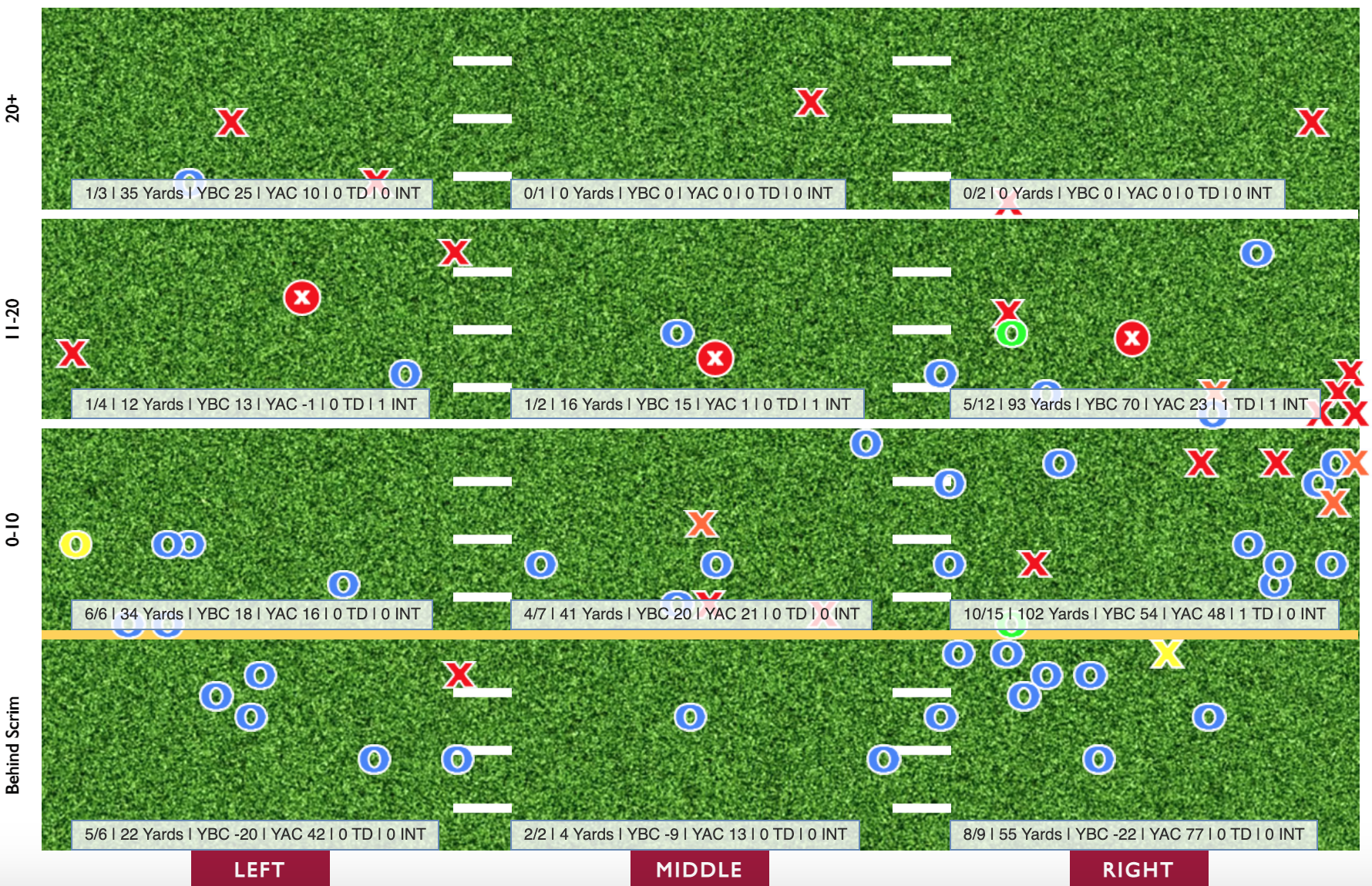
That said, Doty is not a strong passer from the pocket entering this season. Fair or not, that’s the reality. While targeting short helped pad his static Accuracy% to be the 3rd-highest clip amongst his conference contemporaries, his 42.6% Depth Adjusted figure placed 14th out of 20 qualifying passers in 2020. Metrics like Explosive Pass Rate, Uncatchable Pass Rate, and Yards/Attempt are the SEC’s 2nd-worst ahead of this fall with no returner putting up a lower First Down+TD Rate. His boogie allowed him to sport some value when under duress; good thing, because Doty’s 37.1% Pressure Rate was the highest amongst his peers. Throwing underneath carried over when facing pressure, but he was more precise with his chances in comparison. He’ll rock the SEC’s top such Depth Adjusted Accuracy% and Uncatchable Pass Rate along with a top3 Y/A and Explosive Pass Rate. These plays certainly helped buoy his bottomline, but their volatile nature doesn’t mean this output is entirely replicable even if Doty’s dynamism infers the Gamecock can keep this up.
Measuring his passing floor from clean+dropback snaps — ie situations where a QB is left with no excuses but to go out and play pitch and catch within structure — concerns about Doty’s acumen are justified. None of his major metrics rank better than 4th-worst among the qualifying conference returners. Without screens and RPOs inflating his numbers, his Accuracy% dipped by 9.5 percentage points (by far the largest decrease), his Uncatchable Pass Rate worsened by 6.5 points (which more than quadruples the next-worst downturn), and he was the only one to see his Y/A lose ground. Only Ken Seals was more prone to interceptable pass attempts in this context than Doty’s dismal 11.8% clip. Though South Carolina appears to have its QB1 for this fall, his showings as a first-year should be concerning and not swept under the rug. That said, his career ultimately won’t be decided by mop up starts in a pandemic year as a 19 year-old. Feel free to join in me in being skeptical on his outlook, but don’t discount Doty from making discernible improvement either.
Luke Doty 2020 Pass Chart
South Carolina Rushers

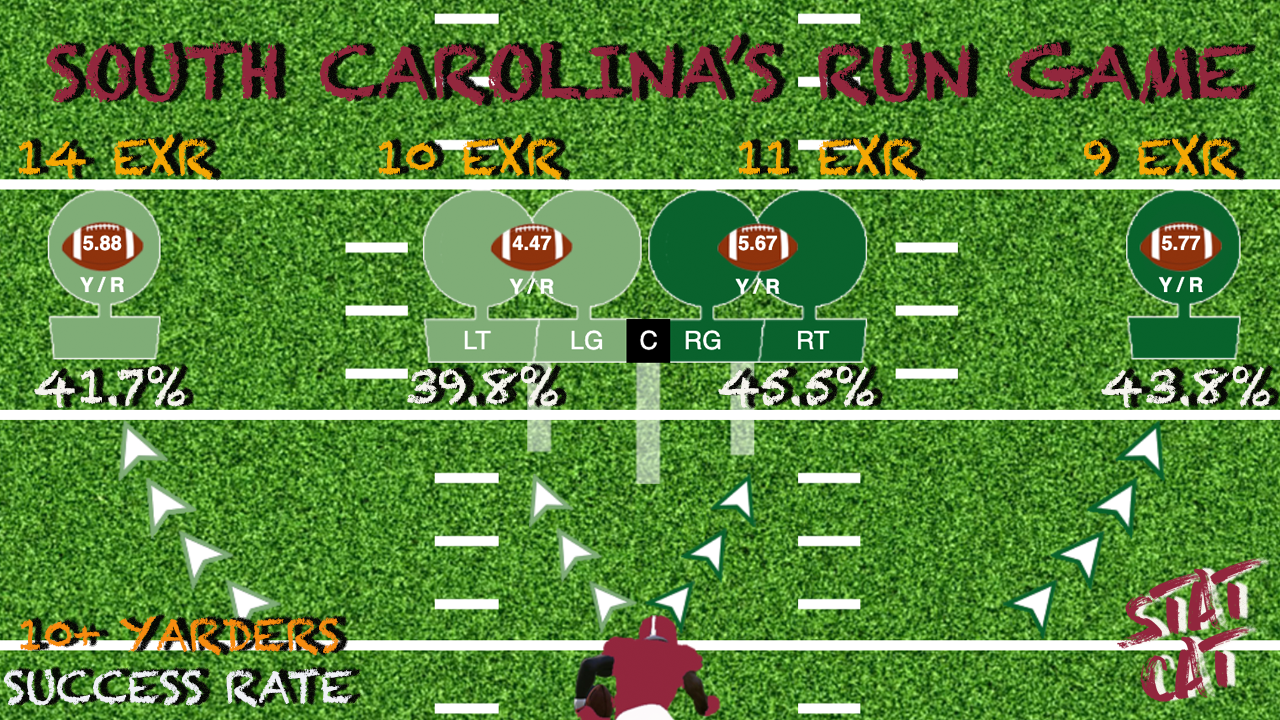
While implementing elements of Oklahoma’s Q-run game will be an interesting characteristic for this offense, Kevin Harris should lead the discussion surrounding South Carolina’s rush attack for 2021...assuming his back has him ready for the opener. In terms of the counting stats, he’s one of the best amassers of metrics in the conference. Amongst SEC ball carriers back for this fall, Harris secured the most combined first downs and TDs, ran for the most yards, logged the most explosive carries, broke the 3rd-most tackles, and holds the 2nd-best Yards/Carry. By the old ways of measuring guys, he’s an incredibly easy ball carrier to like.
But when looking at his advanced metrics, Harris doesn’t hold the disposition of a standout. Though you wouldn’t know it by South Carolina’s 33.4% Run Havoc Rate or league-worst 13.8% Negative Play Rate, the Gamecock was blessed with the SEC’s 2nd-highest rush yards before contact average. If you recall, the majority of his long runs generally came with no one in his path. With the cushion, he managed to crack the conferences top10 in both First Down+TD Rate and Explosive Run Rate. But thanks to the copious mentioned disruptions and a middling ability to deal with adversity, none of his remaining major metrics reached that threshold. His stable metrics — stats designed to show how a ball carrier manages his environment — were pretty disappointing considering his perception in the Palmetto State. Among his Broken Tackle Rate, Gumption Rate, and YAC average, only the later bested the conference mean last fall. Behind those subpar returns and the dysfunction up front, Harris’ 44.3% Success Rate placed 21st; Captain Obvious wanted me to let you know that figure is fall from elite. Hell if you want to go there, there’s a decent amount of evidence the now-departed DeShawn Fenwick was a more efficient rusher last season. But thanks to his splash carries, his 0.21 Expected Points Added/run is the conference’s 4th-best for this season according to cfp-graphs.com.
Harris’ exploits on 3rd downs and within the redzone helped that value-based metric view him favorably. Despite being his most volatile to start a set of downs, he is among the SEC’s most consistent returning ball carriers in those spots. On thirds, he dons a top5 YAC average, a top3 Gumption Rate, and the best Explosive Run Rate in the SEC. Just under a fifth of his money down tries went for ten yards or more. And for good measure, only three returners trump his 57.1% such Success Rate. Inside his opponents’ 20-yard line, he earned the conference’s bronze medal in First Down+TD Rate despite his usual blasé stable metrics. But on goal-to-go carries his Broken Tackle Rate and YAC average are 3rd-best for 2021.
Stylistically, Harris was his best self off power and gap designs. Lucky for South Carolina, those looks were deployed at one of the highest rates in the SEC. The Gamecock was still relatively middling, but there’s no denying his cumulative numbers were buoyed by these snaps. Despite facing contact behind the line of scrimmage on over 15% of these tries, over a third resulted in either a first down or a score with just under half besting situational goals. And though his YAC average and Broken Tackle Rate were generally drags on his profile, his respective 3.04 and 30.1% clips both sit inside the SEC’s top5. While topsy-turvey conditions persisted, Harris results imply further usage of these designs should be explored.
Outside of Harris, South Carolina is excited to see what MarShawn Lloyd can finally bring to the table. The former-four star and top5 running back prospect per 247 has had no shortage of fanfare since signing with the 'Cocks. Though Harris was opportunistic and has the secure grip on the RB1 spot, the chorus on Lloyd getting touches probably won't quell anytime soon. Lest not forget, many expected him to shoulder this offense's load in 2020 prior to his injury. With an unpredictable workload ahead, Lloyd will have to be bang for buck and not waste many chances. With a solid build and low center of gravity, you can see why some were giddy on his workhorse skills. But, guys prone to fighting through carnage rarely begat worthwhile efficiency figures. A few have likened him to Frank Gore, who is often though of as a compiler. Either way, potential to steal snaps exists especially if Harris' effectiveness per touch fails to improve. And if needs be former JUCO stud ZaQuandre White and Rashod Amos will fight over the scraps. With both logging less than 20 carries in 2020, there’s no point digging into their numbers. But for what it’s worth, the pair both did a good job at breaking tackles on those attempts.
South Carolina Catchers
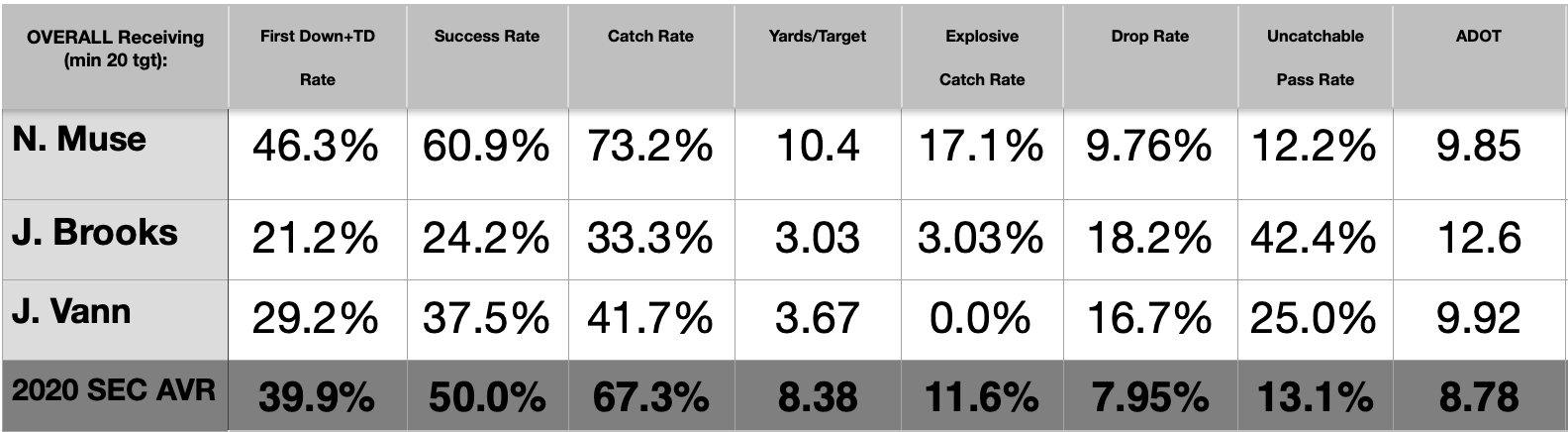
Generally speaking, there’s really nothing worthwhile to point out among the Gamecocks’ returning receivers. None with at least 15 attempts logged a Success Rate over 40%, Catch Rate over 60%, Yards/Target over 6.0, or single-digit Drop Rate. Of their top half-dozen pass catchers last year, only the departed Shi Smith turned in an Uncatchable Target Rate under 10.5%. To quote the great Marty Huggins: bring your brooms, because it’s a mess.
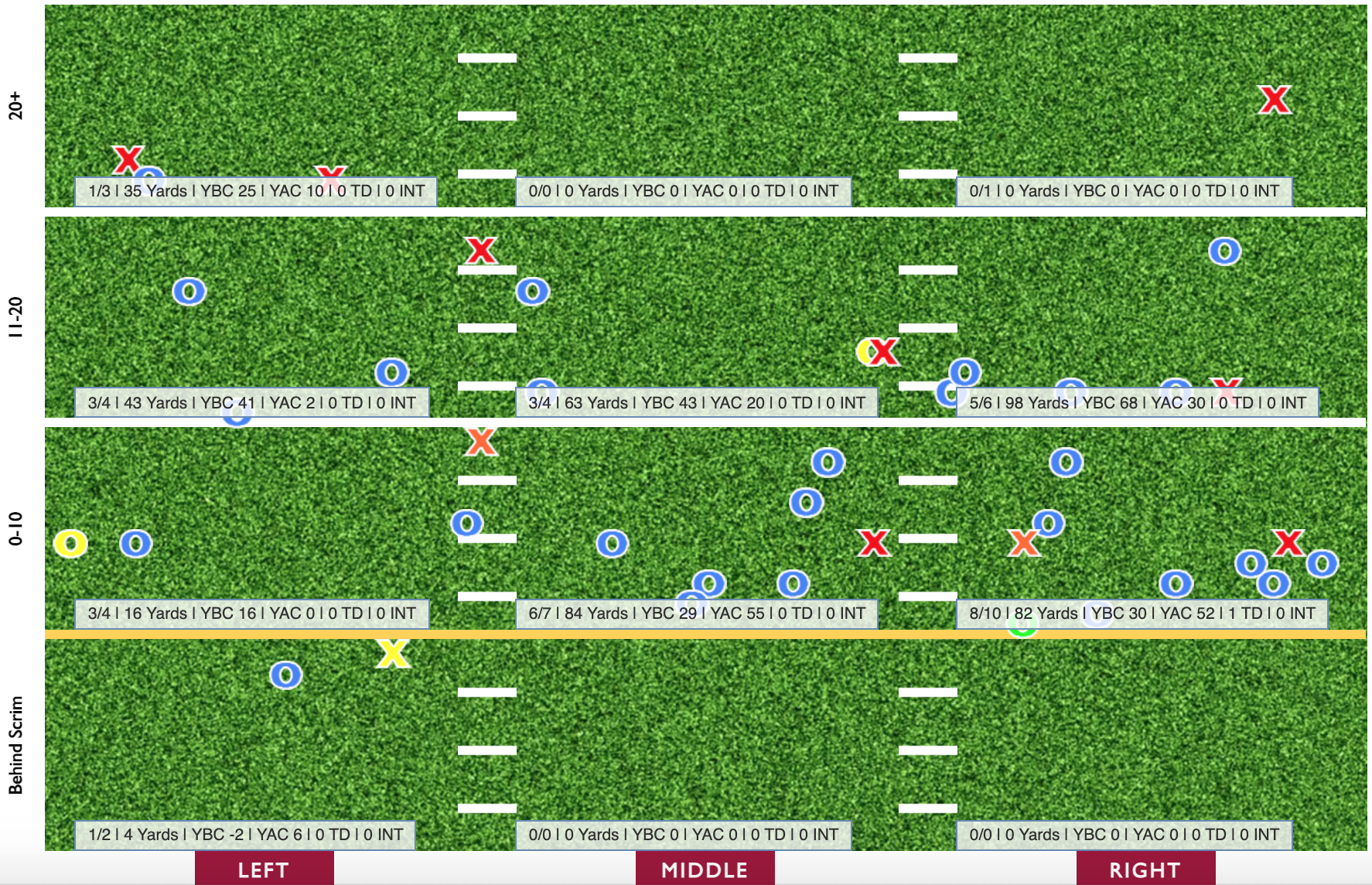
So, I’ll circle back to talk about the wideouts after first discussing SCar's most productive returning pass catcher in tight end and super senior Nick Muse. His counting stats from last year only trail All-American Jalen Wydermeyer amongst returning SEC Y-men, but his value came from his bang-for-buck efficiency. Opening up our scope to all conference players, Muse’s advanced metrics are entirely laudable and optimistically sustainable. Despite a 9.76% Drop Rate and an eight of his targets being deemed uncatchable, he enters 2021 with the SEC’s 2nd-best Success Rate, 5th-best Yards/Target, 7th-best First Down+TD Rate, and 8th-best Explosive Catch Rate. Assuming the old man's drops and wayward passes don’t further sour with increased volume, his already nice numbers should tick upward in theory. Muse overly did his damage in the midrange game. Over 50% of his yards came via intermediate throws despite these targets only accounting for a third of his total makeup. He shares the conference’s 3rd-best such 78.6% Catch Rate and 5th-best 14.6 Yards/Target. Situationally, Muse produced handsomely on early downs as his 63.3% such Success Rate and 82.1% Depth Adjusted Catch Rate rank 4th and 6th ahead of his fall.
In the Joe Brady scheme, tight ends don’t really do much in the pass game. For the most part they either function as a sixth offensive lineman, chip and release, or work underneath routes. But when the team goes empty, they can line up all over and create mismatches for themselves or others. Lincoln Riley’s Air Raid, too, follows the latter to an extent. But in terms of tight end’s responsibility in the pass game, the role is much more multiple with deception and vertical tactics being the foundation. At SEC media days, Shane Beamer proclaimed he wants to make South Carolina TE-U. But while this presumed blend of philosophies asks a lot of its Y-men in both facets, it’s still a hard sell on it being THE feature position looking at previous renditions. StatCat thinks 60 catches and 600 yards is possible. But if that’s the top production from this aerial attack, the final product probably won’t be too hot.
Nick Muse's 2020 Target Chart
Depending on the staff’s preference, SCar's starters at receivers could certainly shake out a numbers of ways. But for what it’s worth, Jalen Brooks is the most tried returning Gamecock. Unfortunately, he was the most unlucky conference receiver in 2020. No one was undercut by a higher Uncatchable Target Rate than his 42.4%. But, the former Tarleton State transfer didn’t help his bottom line with a lousy 18.2% Drop Rate, which is the conference’s 2nd-worst clip. Consequentially, his dismal 3.03 Yards/Target represented the SEC’s floor. With such a clusterf*ck of a showing, it’s hard to rally together a great sales pitch for Brooksy. But based on that ridiculously high rate of off-target attempts his faced, optimism in his abilities needs to remain firm despite the bad case of butterfingers. For what it’s worth, both of his receptions over 13 yards downfield were “creations” where he had to go above and beyond. Let’s see what he can do when he can catch passes in rhythm before chastising him, shall we?
Georgia Tech-transfer Ahmarean Brown, Josh Vann, Xavier Legette, and Dakereon Joyner will round out the receivers. The former should the this unit’s starting slot. Based on his tape, the buzz around his potential in this offense is somewhat credible. The Gamecocks have desperately lacked a vertical passing game in recent years, and Brown is a natural option on an inside fade with his quickness and ability to reroute coveragemen. The similarities to Shi Smith are there per their comparable size, position, and ability to get open. And if Brown’s verticality continues, he could wind up as SCar’s leading receiver. Last year, Brooks came on as a Z while Vann operated from X. For now, StatCat is assuming that stays pat. Like Brooks, Vann was hindered by an insane amount of inaccurate attempts. In fact among SECers with at least 15 attempts, none suffered from a worse Inaccurate Target Rate than his 66.7% clip. Yikes. So it’s a damn good thing his such adjusted Catch Rate was the best the SEC had to offer last year ( AKA when uncatchable tries were omitted). The wildcard options are Legette and Joyner both of whom are looking for any salience of stability to get their college careers going.
Glancing at South Carolina’s Offensive Line
Akin to its volatile run game and humble passing product, South Carolina’s offensive line was halfcocked and inconsistent. No doubt, the final product was dissatisfactory, but SCar improved some of its result-based metrics year-over-year in league play. After finishing 2nd-to-last within the SEC in rush yards before contact and Yards/Carry in 2019, the ‘Cocks rose their clip of the former by nearly a whole yard and comfortably finished in the middle of the pack in both respects. Consequentially with more cushion on average, the team’s Rushing Success Rate and Explosive Run Rate showed gains as well. However, an eight percentage point plunge in Run Havoc Rate highlighted South Carolina’s blocking variance. A third of their designed runs encountered contact behind the line of scrimmage. Though three SEC offenses finished in the double-digits in Negative Run Rate, none could trump the Gamecocks’ 13.3% figure. Moreover, the shakiness continued when SCar dropped back to pass. Both of the Gamecocks’ Pressure and Sack Rates fell inside the SEC’s bottom3 in 2020 after ranking 6th and 2nd, respectively, prior to the pandemic. StatCat wasn’t the only dissenter who was displeased with SCar’s showings upfront. Pro Football Focus graded the Gamecocks as the conference’s 9th-best run blocking and 12th-best pass blocking unit last year. That benchmark cannot become the normal and improvement needs to occur ASAP. Though optimism is waning around this group, it does return three previous starters and over 100 combined appearances by the guys likely to get significant snaps. Middle rightward, the ‘Cocks return center Eric Douglas, guard Jovaughn Gwyn, and tackle Dylan Wonnum, who collectively didn’t miss a game last year. While Jazston Turnetine has the inside track to run it back at left tackle, replacing Sadarius Hutcherson at the sinister guard has created a more competitive position battle. Jaylin Nichols is seemingly the frontrunner for that spot, but Jakai Moore will be a hard man to leave off of the first five assuming he’s at full strength. As the ‘Cocks 3rd-highest graded PFF blocker last year, he’s a prime candidate to start. Perhaps if their shoddy showings continue despite their veteran stature, Moore could be in the discussion to potentially replace one of the bookends, who have both struggled as maulers throughout their careers.
Key Offensive Metrics in SEC Play
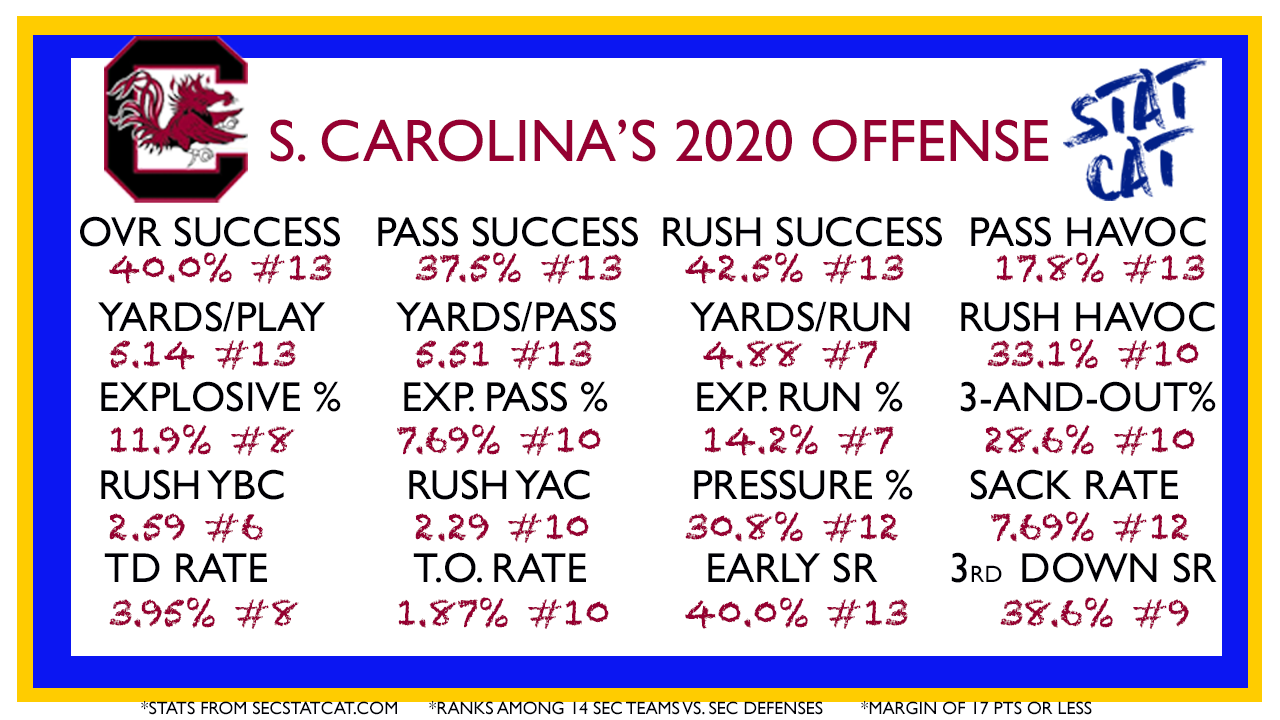
With the third different play caller in as many seasons, establishing an identity that sticks will be crucial for the short term development of this unit. Of course, an identity only manifests through routine, buy-in, and consistency; that is all player-driven. Whether it’s down-to-down accuracy, finishing a block, running crisp routes, or making a tackler miss, South Carolina’s offense could stand to improve in all spots. The last two years, most of their major metrics failed to climb out of the conference’s bottom5. In 2020, the Gamecocks had the SEC’s worst or 2nd-worst Success Rate (Pass, Run, Early down), Yards/Play, Yards/Pass, and Pass Havoc Rate. Sustaining pockets and preventing contact behind the line of scrimmage was a constant issue for this front, which bled over into muting the other areas of this offense. I mean, both their Run Havoc Rate and Pressure Rate exceeded 30% — conditions were tremendously volatile. Rounding out the rough edges and delivering more dependable returns will go a long way for Beamer and Co. to kickstart SCar’s rebuilding process. Either by the traditional Yards/Play or the more advanced Success Rate, it’s hardly a stark revelation the Gamecocks need to significantly improve in those areas. Luckily, the scheme at hand will be borrowing tactics from two of the most rock-steady and effective college offenses of the last half decade.
Despite the turbulent sample, great things tended to happen when South Carolina’s line clicked; especially in the run game. Padded by long, untouched breakaways, the Gamecocks logged an admirable yards before contact average. Year-over-year, that clip improved by almost half a yard. Kevin Harris and Marshawn Lloyd are this offense’s best assets. To maximize their output, this group needs focus its efforts to providing them with considerable cushion. It’s obvious and trite; but it’s the truth. With Lloyd yet to log a collegiate snap and Harris underwhelming as a tackle breaker, this offense’s best bet for sustaining its semi-decent run game is for the line to do the heavy lifting and lead the way. After all, the shortest distance between two points is a straight line without a handful of burly defenders in the path. South Carolina’s line doesn’t necessarily have to drastically improve in this respect. Based on some of their blockers’ pedigrees, they might regress even. But as long as this group can muster a YBC over 2.5 yards, Harris and Lloyd will be well-positioned to make good impressions this season.
Key Defensive Metrics in SEC Play
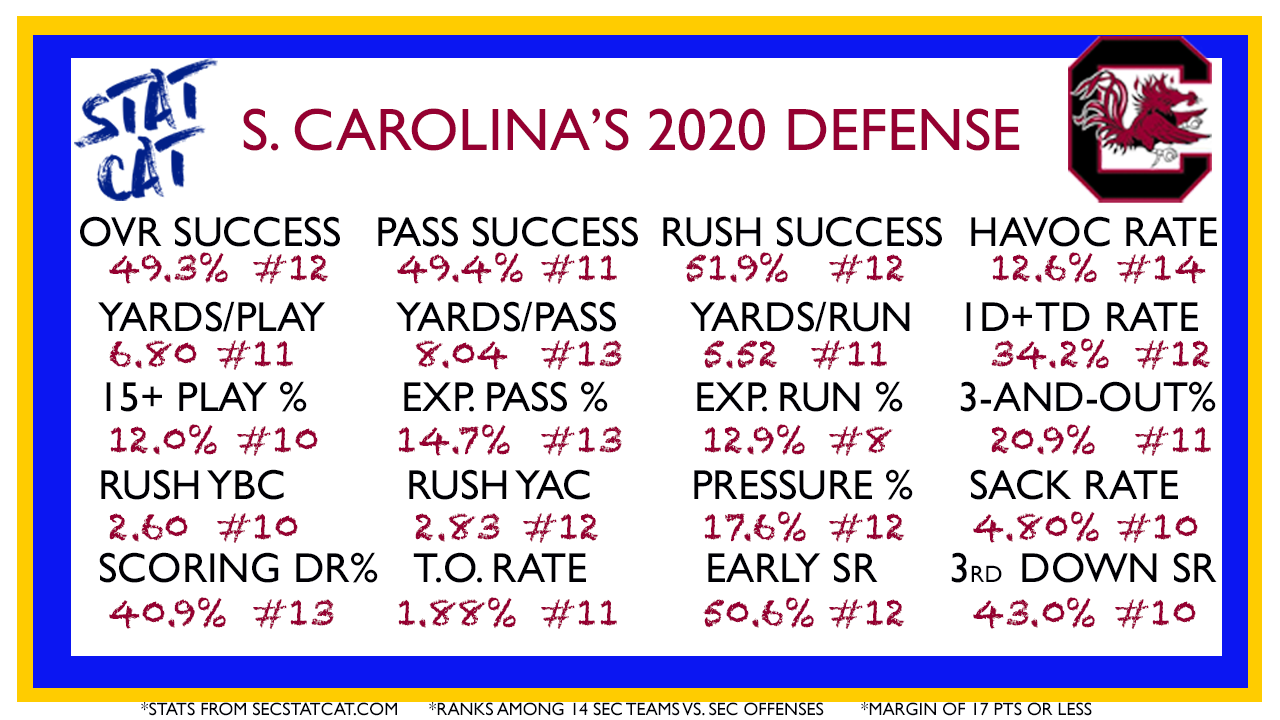
As an offensive guy, I generally gloss over defensive previews. Not that I don’t think individual defensive players aren’t valuable or dislike a blindside sack or athletic INT every once in awhile, but I typically treat that side of the ball as a collective unit. As only one guy, I can only track so much, yanno? You won’t get many fun defensive nuggets from me. That said, South Carolina is coming off its worst finish in the SP+ on that side of the ball in five seasons. Though overly mediocre in SEC play in 2019, the Gamecocks finished ranked 10th or worse in every major metric except Explosive Run Rate this past season. A seventh of their faced passes resulted in a gain of at least 20 yards. Half of their first and second down snaps resulted in situational success for the offense. They surrendered either a conversion or a TD on every third play on average. Only an eighth of their defensive downs logged a form of havoc. This unit was frequently lifeless, frustrating, and underwhelming. In short, they just had immense difficulty getting off the field last year. Only Ole Miss’s sad sack of a defense averaged more first downs/drive or logged a higher Red Zone Play Makeup than the Gamecocks. No stat highlights this group’s ineffectiveness more than their 40.9% Scoring Drive Rate, which was the SEC’s 2nd-worst figure in meaningful minutes.
South Carolina’s defense literally did nothing well. So recommending that they stay the course maintaining any stat category from last year is clownish. That said, the single most important thing this unit should look to curb moving forward is opponents' explosiveness. As aforementioned, the Gamecocks struggled to stifle big gainers by land and air. Besides being obvious boo boos and the source of embarrassing highlights, field flippers have been the single most important correlating factor to winning ball games in this conference over the last three years; not turnovers, the middle8, time of possession. Just over 63% of victors have reigned supreme in the explosive play battle. Offensively, South Carolina probably will labor to birth big gainers; so their best bet to come out on top in this statistical skirmish is for Clayton White and his staff to do their damnedest to ensure this defense is sound and stingy. Less splash plays should in theory set up less scoring opportunities. With a fewer amount of those, the odds the Gamecocks let up 36 points/game should significantly decrease.
Glancing at South Carolina’s Schedule
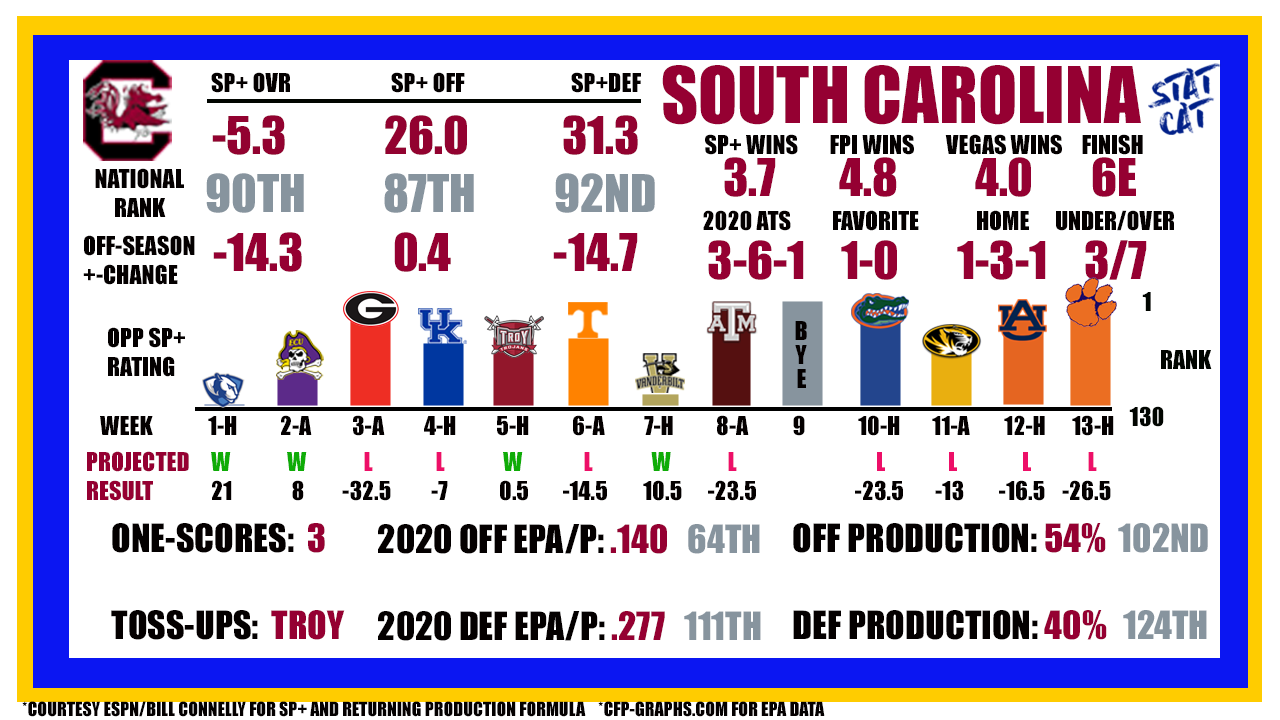
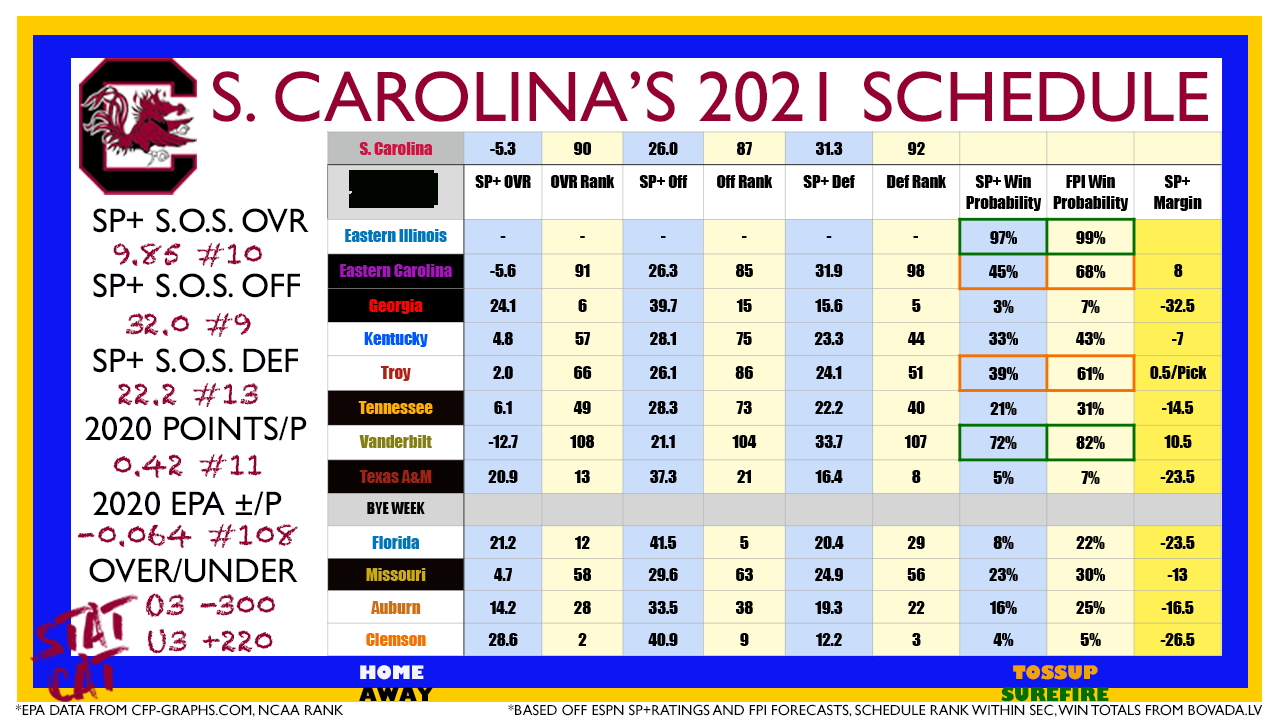
ESPN’s SP+ metric isn’t overly buying what the Gamecocks are selling entering 2021. Then again, that’s also most people. After all, the SEC media picked South Carolina finish 6th in the East. Coming off a year where they were one of the most frustrating bets in the SEC certainly doesn’t help. Plus, their outlook hardly lightens up riding behind a rookie head coach and the conference’s 5th-hardest slate. In fact, only Arkansas faces a more difficult set of offenses within the SEC. Four opponents are SP+ top20 units with two falling inside the top10. Again since South Carolina’s defense is coming off its worst fall in half a decade, leaning into the pessimism surrounding this program is easy. But debate among prognosticative figures makes the Gamecocks an interesting team to back. Looking at their schedule through the more “rosy” perspective, South Carolina has the potential to start the year 4-1. Outside of the Georgia game, the Gamecocks have a conceivable path to victory against Eastern Illinois, Eastern Carolina, Kentucky, and Troy. But after their Week 7 tilt with Vanderbilt, each remaining game projects to be a double-digit loss. Still, assuming Vandy can be sunk in Columbia, a credible recipe for five wins exists.
On the whole, Vegas still appears to be gun-shy siding with South Carolina. Despite opening their win total at four, SCar’s figure has since dipped to 3.5. While most of the money sides with the over thanks to the early line, a bankroll opportunity exists for dissenters. Per Bovada, the Cocks’ current under/over reading is (-300, +220). Meaning if they only win three games or less, bettors on that side of the line will more than double their investment. Whether or not South Carolina tops that number could come down to the Week5 matchup with Troy. Using the SP+ as a forecast, that game projects to be decided by less than a point; essentially operating as a pick ‘em. At this point, this outcome could go either way. While conventional wisdom tends to take the home SEC team in those spots, the SP+ and ESPN’s Football Power Index are split on which team comes out on top. In fact, this disagreement overly explains why there’s considerable variance in the Cocks’ range of outcomes. While the SP+ has their average result at 3.7 wins, the FPI is more bullish on their chances with a 4.8 clip. Seeing that both figures are higher than their set win total, one could take that information and hammer their over despite the lacking ROI. But the SP+ only outright favors South Carolina in two games: vs. its FCS foe and the cellar-dwelling Commodores. In the three other “winnable” games, the metric gives the ‘Cocks less than a 45% chance to win in each contest. Still, playing five of its first seven games at home presents a fantastic opportunity for this program to beat expectations. In the eyes of the FPI, South Carolina should win each of those battles in its backyard outside of the UK game. With such little opportunity after that run to seize victories, Beamer and his boys best be ready to come out swinging the first month-plus or this team could be in for another long fall.