2021 Vision: Previewing Texas A&M
2021 Vision: Previewing Texas A&M
With talking season winding down, preview season is among us! I'm sure this isn't the first preseason article you've viewed. You should know the drill by now with these bad boys. But if this is your first experience with StatCat, be ready to learn a thing or two about the Ole Miss's QB1, receiver room, rushers, OL, its most important stats to maintain and/or improve on both sides of the ball, and how the Lane Train's schedule breaks down with help of ESPN's SP+ Rating!
TAMU Passers
If I’m being candid, I do not feel good about Texas A&M’s short term prospects at the quarterback spot. Neither Haynes King or Zach Calzada are experienced nor prominently displayed overt competence in the Aggies’ spring game. At least from the offensive braintrust’s perspective, both are in similar molds to one another. No matter which is in the game, the Aggies shouldn’t have to call the game discernibly different. The positive is that both King and Calzada are mobile, which will allow TAMU to maintain is healthy usage of read options, speed options, and Q-stretches to compliment is West Coast passing staples. And if the script from the Maroon and White Game was any indicator, more play action bootlegs could be on the horizon to facilitate these fellow’s passing lanes. Traditionally, Jimbo Fisher doesn’t go out of his way to gift his QB’s easy completions via screens, RPOs, or abundant play fakes. While he could change his tune on that front, short-to-midrange patterns like Levels, Stick, Spot, Slants, and Smash are likely to buoy his aerial assault. Though both passers are eager to show off their arms, those designs should curb carelessness with the football by offering relatively safe outlets.
That said, no doubt this unit should explore ways to unlock more verticality through the air. Only freshman Ken Seals and Will Rogers were less prone to 20+ yard attempts than Kellen Mond within the SEC last year. Furthermore, TAMU finished bottom3 Explosive Pass Rate under 8% back-to-back seasons. Let’s not forget one of the big reasons the Aggies were left out of last year’s College Football Playoff was because of the Good Ole-Fashioned Eye Test, which is code for “your offense is f***ing boring as shit and no one wants to watch seven yard passes and a good run game.” Jimbo might opt to take the air out of the ball behind his ground game and mighty defensive continuity, but this offense will certainly be capped if it once again struggles to produce big gainers through the air.
Again, I am not entirely sold on either option. But at this point in time, I would go with King for QB1. Despite that endorsement, qualms I do have. As enticing as his four-star background, athleticism, glimpses of magic on film are, overly ignoring his inconsistency and inexperience would be unwise. Some of his said kinks could be shored up by tweaking his throwing mechanics. King’s release is a bit long for my liking. The delay in getting the ball from point A to point B could potentially negate a target’s ability to separate and allow opponent’s to recover, defend a pass, or even create a takeaway. Plus, more steps in the operation hurts functionality. It's not like he was showing off lights-out precision this spring. Tightening up his process into a more compact delivery could do wonders improving his on-target regularity. But of course, that’s no overnight fix. Calzada might be more “seasoned”, but he appears to be slightly more reckless with his opportunities. To reiterate, if Jimbo and Co. want to lean on an old-school approach, playing the safer QB option is a no-brainer. That said, it’s still not obviously clear which passer that is. Though usually a man driven by data and figures, my gut currently sides with King to be that guy to start 2021.
TAMU Rushers
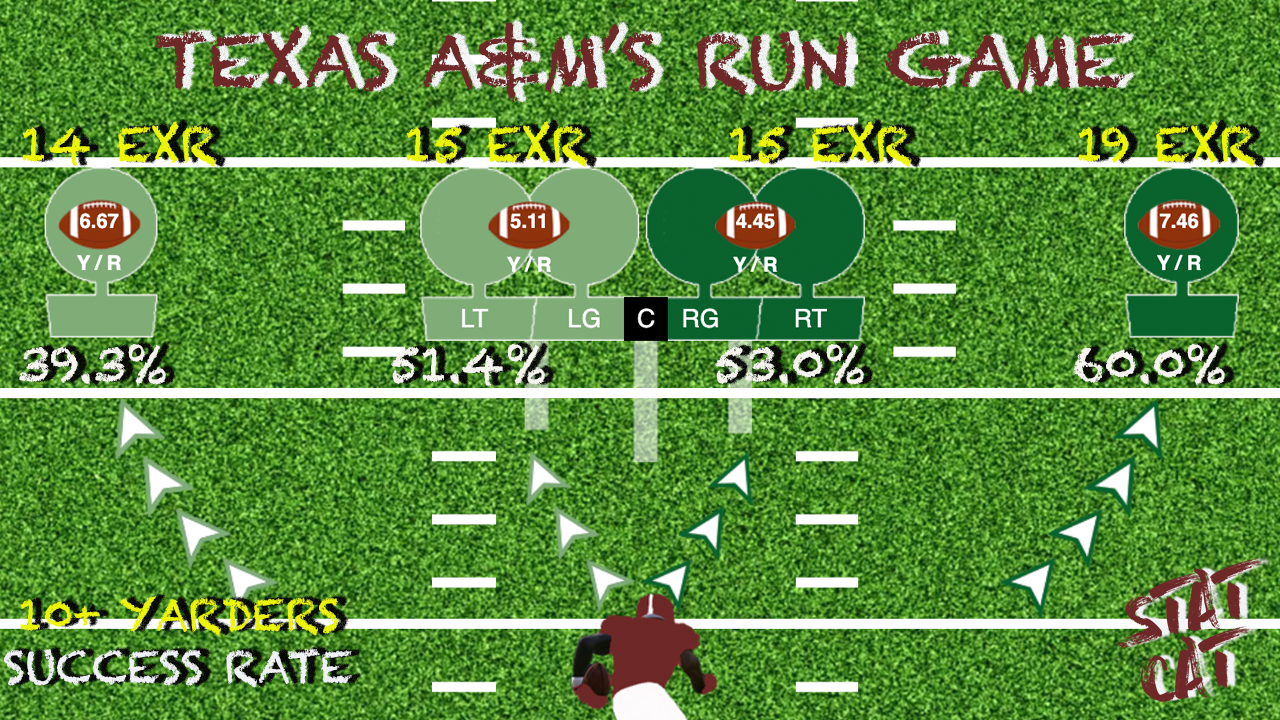
The Maroon Goons did one helluva job paving run lanes in 2020. In case you never heard, the Aggies finished as the SEC’s most explosive rushing attack with over a fifth of their designed carries gaining at least ten yards. In meaningful minutes, Texas A&M was the only SEC offense to average over three rush yards before contact, which played an immense role generating their gaudy clip of splash carries as well as their top3 Success Rate. The big boys certainly responded when called upon. Year-over-year, the Aggies improved their Rushing Success Rate seven percentage points, boosted their Yards/Carry by over a yard and a half, and sliced their Run Havoc Rate by well over a third against conference defenses. Behind this magnificent overall production, TAMU leaned harder on the run on early downs than every other conference offense besides Kentucky.
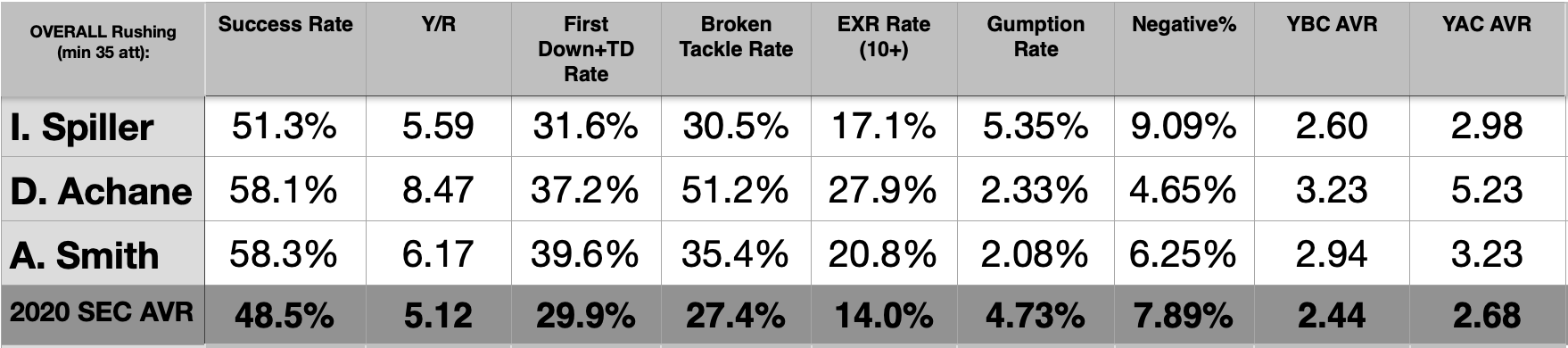
Of course, most of their efforts came via Isaiah Spiller. By the old ways of measuring running backs Spiller checks a lot of boxes. As far as his volume stats are concerned, he rushed for the conference’s 3rd-most yards, broke the 3rd-most tackles, and secured the 2nd-most first downs conversions. Behind those figures, plenty of folks in the media are impressed with his ability to compile counting metrics. Only Larry Rountree, Najee Harris, and Kevin Harris totaled a higher percentage of their team’s designed carries amongst SECers. But while Spiller received plenty of touches, a good amount of his efficiency stats cracked the conference’s top10.
While returning one of the five best YAC averages within the SEC ahead of this fall, the Aggie boosted his individual Broken Tackle Rate 12 percentage points year-over-year. Spiller’s newly-found tackle breaking and proclivity at providing yards after contact will surely be put to the test replacing four of the five starting OL. At least he’ll have a whole lot of continuity with TAMU’s zone-heavy scheme as He finished in the top dozen SECers in terms of such makeup. On these runs, his Success Rate, First Down+TD Rate, Broken Tackle Rate, and YAC average bested their respective counterparts on power/gap designs despite facing more defensive contact behind the line of scrimmage. However despite the turbulence, Spiller rocks the SEC’s the bronze medal in Y/C and Explosive Run Rate on such attempts. Chris Rodriguez, Brian Robinson, Zamir White, and Dameon Pierce are the only other SECers returning for this fall to see at least half of their tries in each fashion end in success. Flexible, consistent, determined; that’s Spiller in a nutshell.
Coming on as a late season wunderkind, Devon Achane is poised to take on a bigger role in 2021. I mean, if he hits the ground running like he did to close last year, it’s a pretty safe bet Spiller’s bodacious carry share will cede ground to this young fellow. Among conference ball carriers with at least 40 carries, Achane holds the premier Y/C (8.47), YAC average (5.23), and Explosive Run Rate (27.9%) and sits inside the top5 in Broken Tackle Rate (51.2%), Success Rate (58.1%), and TD Rate (9.3%). Small sample size, COVID-year, or whatever: that level of output is simply mouth-watering even for a self-diagnosed passing zealot like myself. Now, fat chance he’s able to come close to cloning that bottomline with an extended workload. But, the kid definitely deserves to operate as TAMU’s beta back day one. Even for those jabronis that want to insist on Ainias Smith rounding out the backfield, Achane’s teased potential should streamline TAMU’s rotation.
Speaking of Smith, it’s not that he’s been an inept ball carrier. But his talents are grossly needed out wide to provide this unassuming receiving corps some speed and consistent pass catching. As a freshman, he carved out a very nice role as dependable slot that could get open quickly and feast on slow-footed linebackers. But with Texas A&M’s fluid running back situation, Jimbo was obliged to realign his X-factor to help provide depth to a thin position group. As a natural playmaker, Smith’s metrics justified the move on the surface. Though I’d argue his opportunity value was lacking compared to his upside as a receiver, he topped Spiller in Y/C, YAC average, Broken Tackle Rate, and Explosive Run Rate while logging a team-high Success Rate in the process. Though he benefited from a tremendous YBC figure, his 3.23 after contact clip is the SEC’s 7th-best ahead of this fall. In terms of versatility, one would be hard-pressed to find a more suitable candidate within the SEC.
To me, Texas A&M has the most complete backfield in the conference ahead of this season. It has bruisers, speedsters, pass catchers, and homerun threats. While Georgia might have more ferocity, I’m tipping the scales in total talent to TAMU. The new blockers and inexperienced QBs will be putting a load of faith into the team’s best position group to shoulder the load, win its matchups, and help the Aggies upend some major players this fall. Without the very best out of these ball carriers, it’s awfully hard to image TAMU winning the West.
Texas A&M Catchers
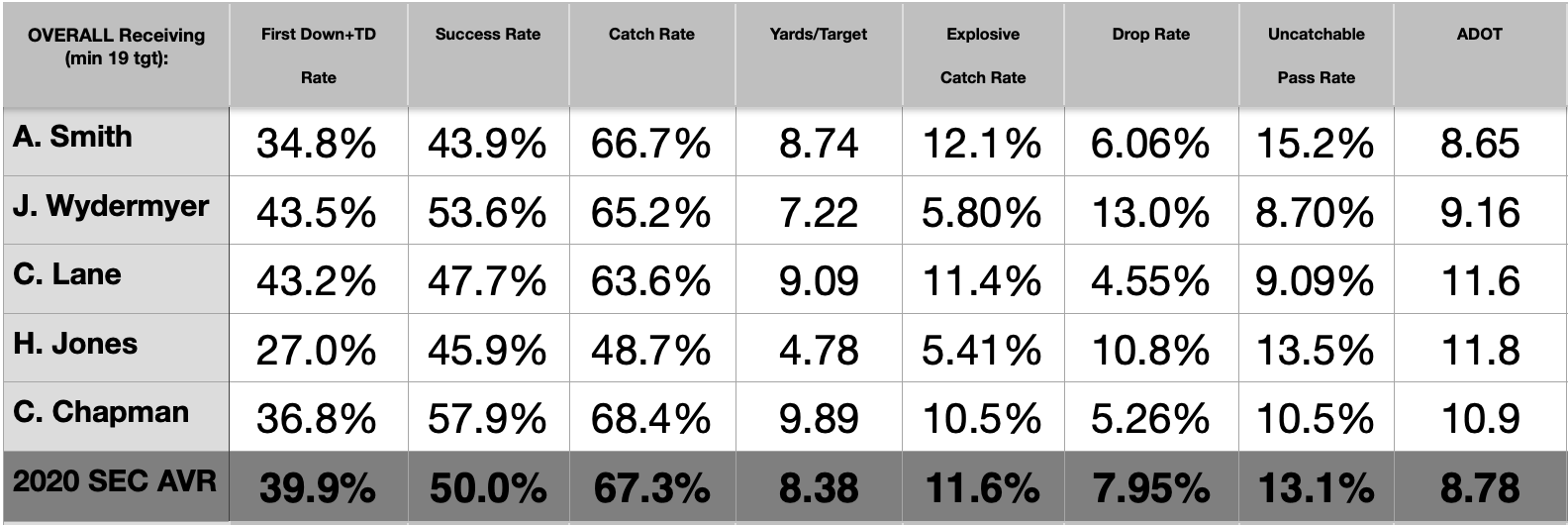
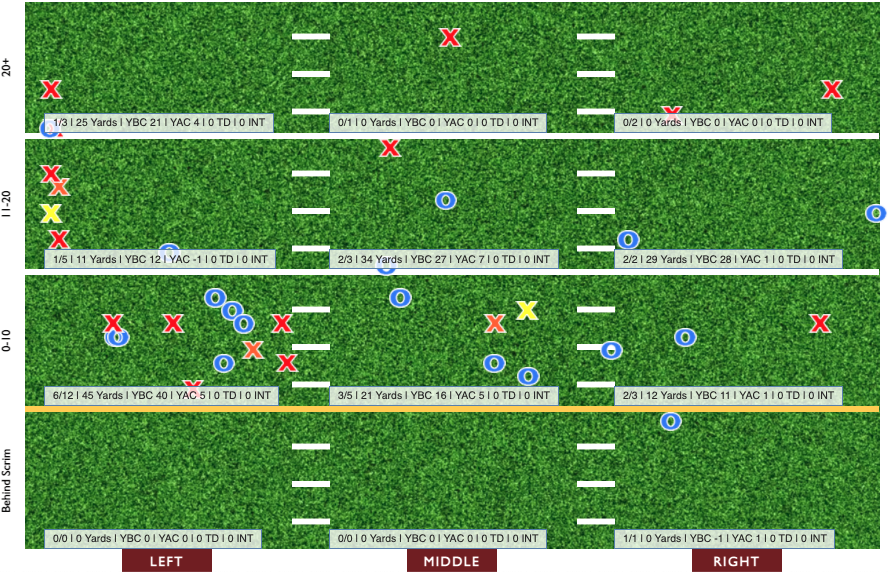
When he’s not multi-tasking as a ball carrier, Ainias Smith should lead TAMU’s pass catching efforts from the slot. Though a team-high Uncatchable Target Rate didn’t do him any favors last year, he still logged the Aggies’ best Drop Rate and Explosive Catch Rate. Still, a relatively average Yards/Target with a Success Rate well under 50% is hardly the buzz this dull aerial attack needs from its best receiver. Moreover, how he was utilized hardly gets butts out of seats. About 46% of his targets occurred between 0-10 yards downfield with another 20% coming on throws behind the line of scrimmage. But, Smith did deliver chunk gains on occasion. Plus, he produced a 50% First Down+TD Rate within the red zone, which is among the top clips amongst his peers. While his profile from last year is ho-hum on the surface, he provides this position group speed and someone who can get open quickly. Assuming Jimbo sticks to his past tendencies and opts to not dial up a plethora of deep patterns, this offense thirsty for splash plays through the air will have to settle to get their big gainers through YAC efforts — and speed is one hellauva good way to seize those victories in the open field.
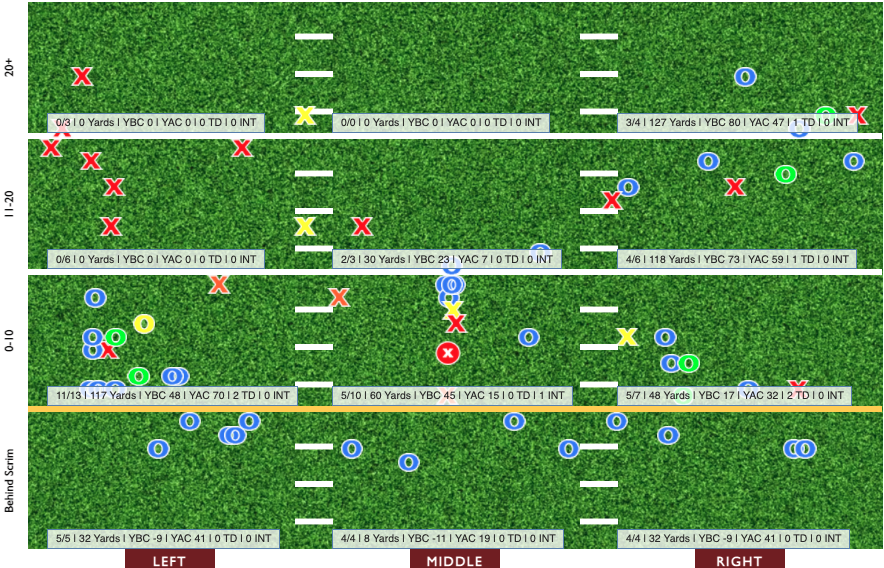
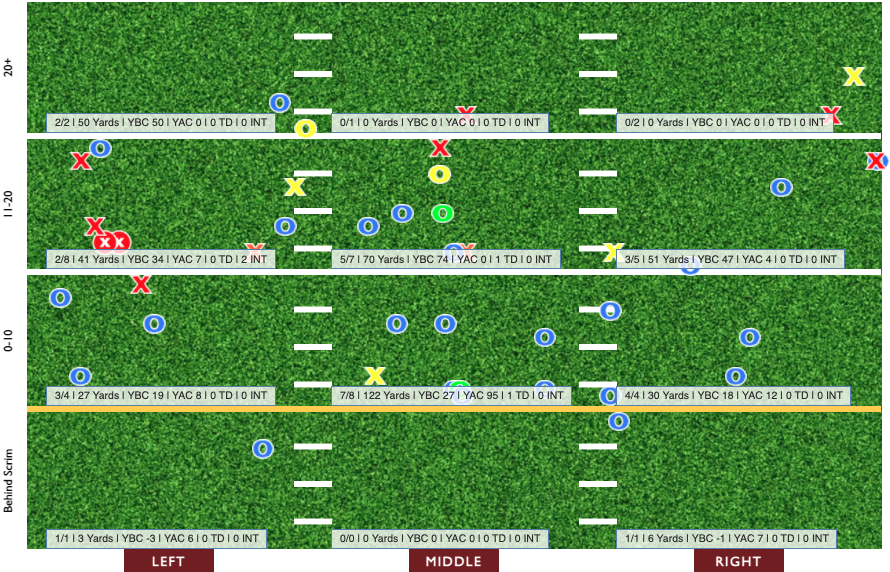
Ainias Smith's 2020 Target Chart Chase Lane's 2020 Target Chart
As far as volume, Chase Lane was the next most productive wideout. He wasn’t overly featured in any one game, but he captured the team’s best Yards/Target. For a freshman, he showed savvy beyond his years. Like Smith he was a versatile chess piece; but instead of time-sharing as a running back, he lined up all over the Aggies formation. His usage largely came in the midrange or smack dab in Kellen Mond’s line of sight between the hashes short. His moxie was on full display on the money down where he rocks a top5 Success Rate and Yards/Target amongst SEC returners. TAMU was one of the best 3rd down teams in the nation; someone had to be on the receiving end of those passes. Plus, the youngster looked fairly capable winning contested targets. The Aggies’ West Coast staples often sent routes into the teeth of the defense. So, Lane experienced his fair share of such attempts (38.2%). On tight window targets, he dons the SEC’s 2nd-best Success Rate and 4th-best First Down+TD Rate. With a solid year under his belt, I’d hope his number is called more often as his expands his game.
Hezekiah Jones wasn’t a particularly efficient option last year. Actually, he was one of the SEC’s worst in that respect. Only a couple of SEC receivers posted a less preferable Yards/Target than his 4.78 clip. Plus, he sported a double-digit Drop Rate. Though his Success Rate ended up being rather modest, he was the only Aggie receiver with significant attempts to finish 2020 with a Catch Rate under 50%. But as the team’s most tested option at X, he’s likely to get a fair shake this fall. Keep in mind, the green passers may not help his bottomline from looking that much better by season’s end.
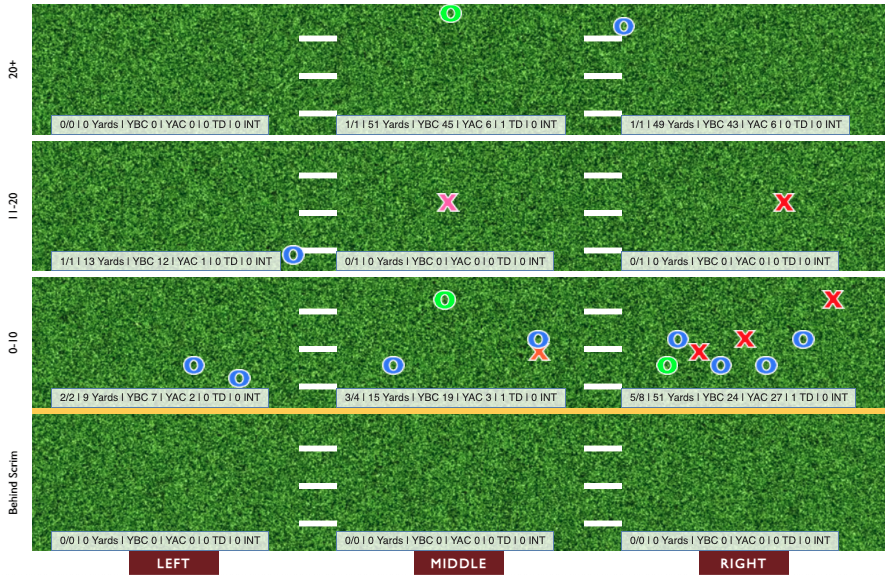
Hezekiah Jones 2020 Target Chart Caleb Chapman's 2020 Target Chart
Before his injury, Caleb Chapman was the Aggies’ most efficient pass catcher. For what it’s worth, his 57.9% Success Rate, 14.5 Yards/Catch, and 9.89 Yards/Target on his 19 attempts would have been team-highs. Of course, his potency was padded by two deep completions in the Florida game including his fateful TD. Assuming he rebabs normally and is good to go, that element will be welcomed back with open arms. Again, this offense needs to do whatever it can to manufacture field flipping plays through the air.
Last, but certainly not least, is All-American tight end Jalen Wydermeyer. As a freshman, he quickly turned heads as TAMU’s most explosive receiver and weapon after the catch. As a sophomore, he emerged as a dependable option in crunch situations. Though his down-to-down efficiency dipped this past season — as his Drop Rate rose to a disappointing 13.8% — he enters this fall among the SEC’s most accomplished red zone and 3rd down pass catchers. Within the conference, only the Heisman accumulated more than the Aggie’s 94 red zone yards or eight such catches last year. Meanwhile, no returner can put up a preferable Yards/Target than his 8.55 clip. Only four other guys in the conference finished with a higher percentage of their yards occurring inside their opponent’s 20. Plus, Wydermeyer sports the 2nd-best such Success Rate and First Down+TD Rate. As far as his showings on the money down, The Aggie’s results remain mighty. His 59.1% Success Rate is 4th-best, his 21.4% TD Rate is 5th-best, and his 8.14 Yards/Target is tops. Though his cumulative metrics are marginally inferior to some of his contemporaries, his skillset supersedes his stat sheet. Jimbo isn’t afraid to deploy Wydermeyer as a RPO outlet, underneath safety valve, or threat down the seam. But, I wonder where his diverse aptitude makes the biggest impact in 2021. Either way, there’s a decent probability he’ll lead the Aggies in targets and catches for the second-straight season.
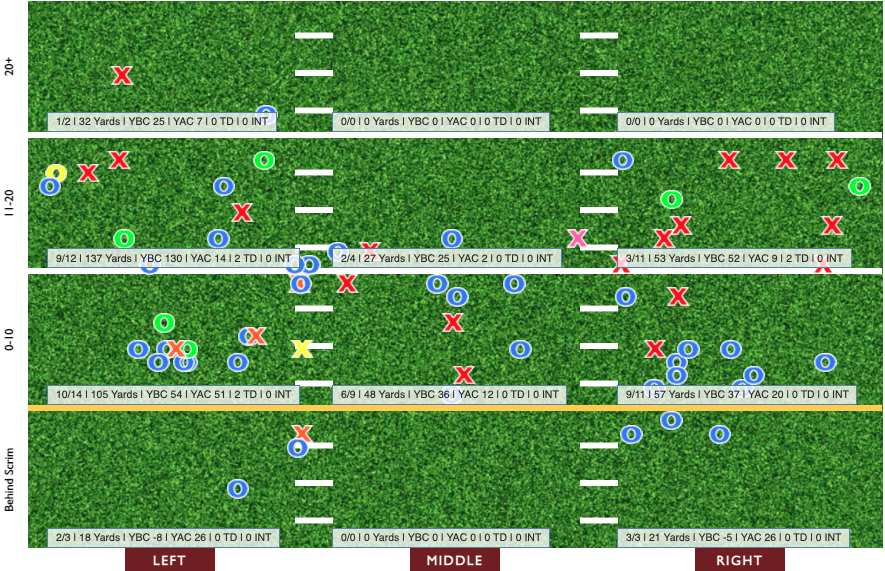
Jalen Wydermeyer's 2020 Target Chart
Glancing at Texas A&M’s Offensive Line
The Maroon Goons did one helluva job paving run lanes in 2020. In case you never heard, the Aggies finished as the SEC’s most explosive rushing attack with over a fifth of their designed carries gaining at least ten yards. In meaningful minutes, Texas A&M was the only SEC offense to average over three rush yards before contact, which played an immense role generating that gaudy rate of splash carries as well as their top3 Success Rate. The big boys certainly responded when called upon. Year-over-year, the Aggies improved their Rushing Success Rate seven percentage points, Yards/Carry by over a yard and a half, and their Run Havoc Rate was sliced by well over a third against conference defenses in meaningful minutes. Behind this magnificent overall production, TAMU leaned harder on the run on early downs than every other conference offense besides Kentucky. In other words, trust was high in the line to Establish It and keep the Aggies on schedule. Chemistry was just was important to this group as talent. That can’t gel overnight for the new starters. So while I get the optimism in College Station, assuming that level of efficiency continues with four new offensive lineman is a bit presumptuous. No doubt, the run game should continue to be this unit’s base with raw passers. But, StatCat expects the Aggies’ advanced metrics to sour some with the turnover. Moreover, rocking one of the nation’s elite Sack Rates for the second-straight season is inherently a hard ask.
But, returning their best offensive lineman is a great place to start. All-American and aspiring first round pick Kenyon Green will be sliding over to left tackle. As the team’s best blocker, it’s clear Jimbo has a good amount of confidence in his abilities to protect the blindside. After all, Green earned a five-star rating kicking ass as a LT in high school. Hopes are high he thrives anchoring this position group. Though the remaining final four remain to be influx, Layden Robinson and Aki Ogunbiyi are projected to be the starters at guard and Luke Matthews at center. Despite coming off surgery, the latter has a bit of buzz around him thanks to his pedigree with Hall of Famer Bruce Matthews being his dad and all. The right tackle spot is also up in the air. As of now, Tennessee transfer Jahmir Johnson is dueling with Blake Trainor to round out this lot. Johnson is well experienced, but mostly operated on the left side of the formation on Rocky Top. Savvy could win him the job. That said opting into a raw, yet powerful 6’7 bookend is awfully tempting. Though the collective talent is easy to like, StatCat remains a little pessimistic the Aggies immediately find their footing. Luckily, the opening of their schedule is rather rosy.
Key Most Important Offensive Metrics
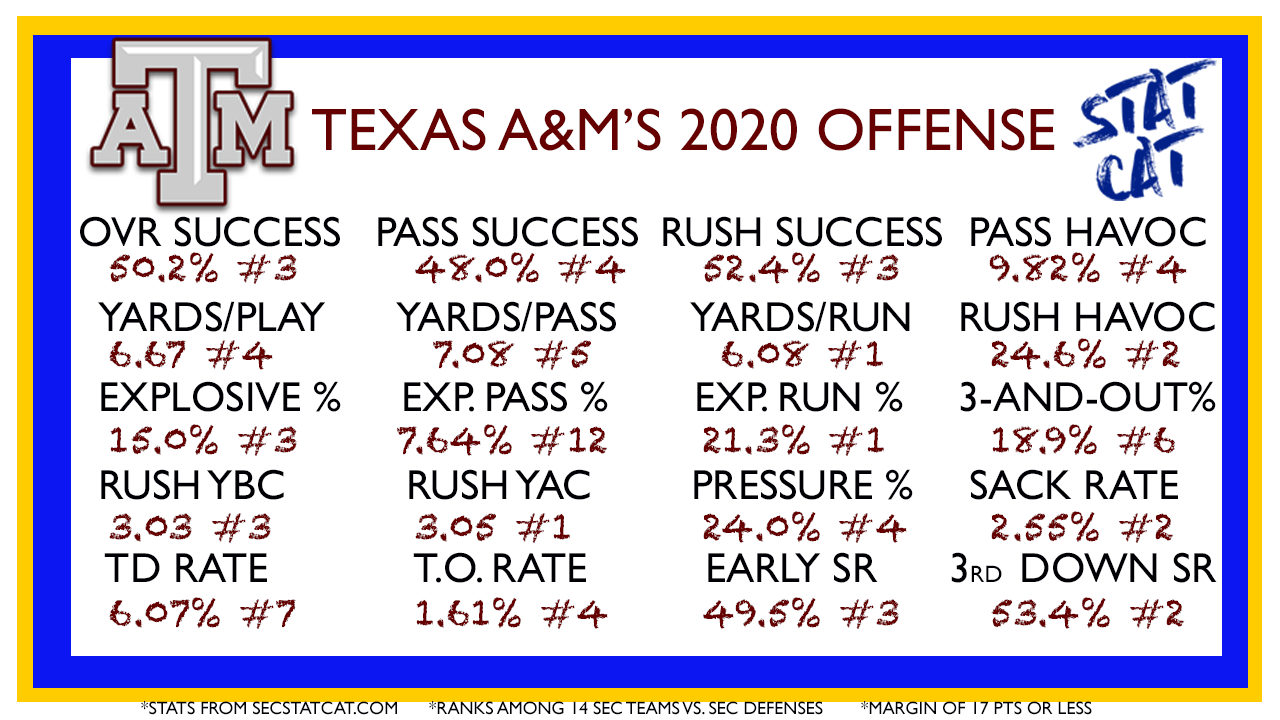
Behind veteran savvy, the Aggies played sound, old school football last fall. They clung to the ground game, opted to keep it safe through the air, and kicked butt on defense. Only three of their 20 major metrics finished outside the conference’s top5 in league play. Anchored by the Maroon Goons, no SEC team bested their YBC, Explosive Run Rate, Yards/Carry, or YAC average. Plus, both of their Havoc Rates, Pressure Rate, and Sack Rate finished no worse than 4th. While it’s a bit presumptuous and outright foolish to assume an overly new front picks up where last year’s elite line left off, trench warfare will likely hinge the Aggie’s season. This bunch doesn’t have to clone last year’s output, but they unequivocally have to remain among the SEC’s best units carving out run lanes and limiting hits on their QB. Going the extra mile to ensure neither of these young guns doesn’t get shellshocked would be a sound business decision. And though Isaiah Spiller is pretty good accumulating YAC, his job becomes a helluva lot easier when he can attack space rather than brace for a collision. StatCat doesn’t expect the Aggies to average over three yards before and after contact this year versus SEC foes. But for those splash runs to keep buoying this offense, providing a consistent buffer between one’s ball carrier and would-be tacklers is a vital element.
To reiterate, this offense didn’t project many weaknesses last year. However, the three stats where TAMU finished outside of the top5 spell a bad trend. The Aggies haven’t broken that threshold with their TD Rate, 3-and-Out Rate, or Explosive Pass Rate since 2018. With the fresh-faced passers and four new lineman, it’s hard to feel good about this offense’s prospects changing that happenstance. The collective underwhelming team speed and Jimbo’s aversion to vertical patterns seriously caps this unit’s upside. Since that’s not likely to change, the odds of this team transforming into a potent down-to-down threat are poor. That honestly should change. Outside of the style points TAMU lost itself in the eyes of the College Football Playoff Committee, obtaining explosive plays is the highest correlating factor to winning in this conference over the last three years. Both aesthetically and analytically, bombs, shots, dingers, and deep balls are quite important. But apparently, they aren’t entirely desired by TAMU’s head man. With that, this plodding passing game and ravenous run game should focus their efforts on extending drives executing situationally. Over a sixth of their opportunities resulted in a 3-and-Out despite their prowess on the money down. While okay, when has okay ever contended within the SEC? If the Aggies opt to lean into small ball, their margin of error is bound to stay thin. And, logging more wasted drives is one way to shrink it even further.
Key Most Important Defensive Metrics
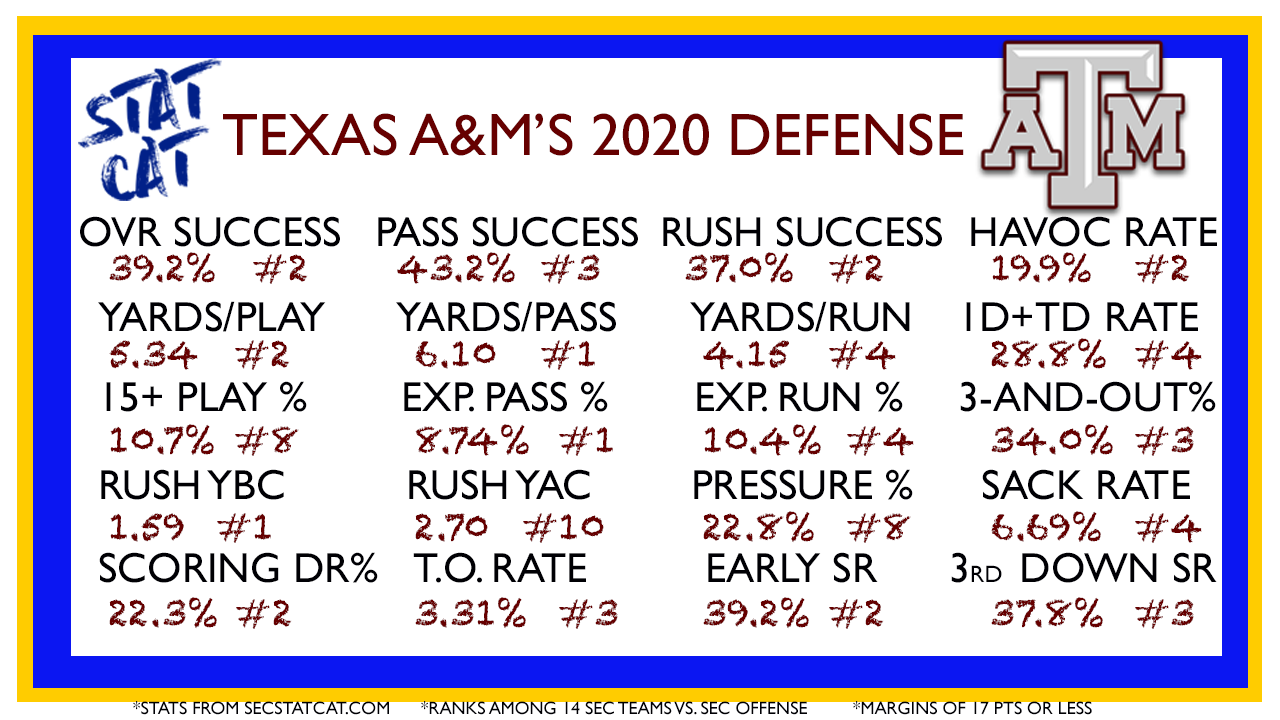
As an offensive guy, I generally gloss over defensive previews. Not that I don’t think individual defensive players aren’t valuable or dislike a blindside sack or athletic INT every once in awhile, but I typically treat that side of the ball as a collective unit. As only one guy, I can only track so much, yanno? You won’t get many fun defensive nuggets from me. That said, it’s undeniably a good thing when a defense returns nine starters including its whole daggum secondary. The Aggies were one of the most improved units year-over-year in SEC play. Only two of their 20 major metrics in 2019 finished inside the conference’s top5 compared to 17 last fall. Largely enhanced across the board, only the national champions bettered their Scoring Drive Rate by a bigger amount than TAMU. Along with their 22.3% such clip, this defense finished runner-up within the conference in Overall Success Rate, Early Down Success Rate, Havoc Rate, and Yards/Play. Meanwhile, the Aggies were the SEC’s premier unit limiting big gainers through the air and minimizing rush yards before contact. If a team struggles to produce chunk completions, the next best alternative is to make sure opponent’s suffer a similar fate. And based on the aforementioned importance of these plays dictating the outcome of ball games, maintaining this stinginess is paramount. Again, the Aggies returning their entire secondary is massive for Mike Elko. Plus, hitting opposing backs before they generated positive inertia and constantly smacking them in the backfield certainly helped curb explosive carries. TAMU’s TFL Rate in league play finished just under 11% and rocks the SEC’s gold medal. Neither traditional nor advanced stats have many concerns with this unit ahead of the season. Expectations will be high, and maintaining these lofty stat lines won’t come easy (despite a very soft schedule). But with so much continuity in their corner, Texas A&M has as good a chance as anyone to field the nation’s top defense.
There aren’t many areas of opportunity for Elko and Co. But, StatCat would like to see more consistent duress from his defense in 2021. For the past two seasons, the Aggies have finished 8th or worse in Pressure Rate with their such figure failing to match 26%. Though this group secured its fair share of sacks, havoc plays, and takeaways, sometimes the stifled pass rush allowed opponents to snatch sizable gains. To reiterate, this defense was pretty good capping big gainers in both facets. But for the second-straight year, their 15+ Play Rate hit double-digits and placed in the below the SEC mean. Again, this is overly nitpicking. But if there was any aspect this defense should focus on improving, it’s a more consistent and ferocious pass rush. Since TAMU is well-experienced on the back end, Elko might feel more inclined to dedicate more resources to attack the backfield. Or — he might just stay the course and take last year’s returns with open arms.
Glancing at Texas A&M’s Schedule
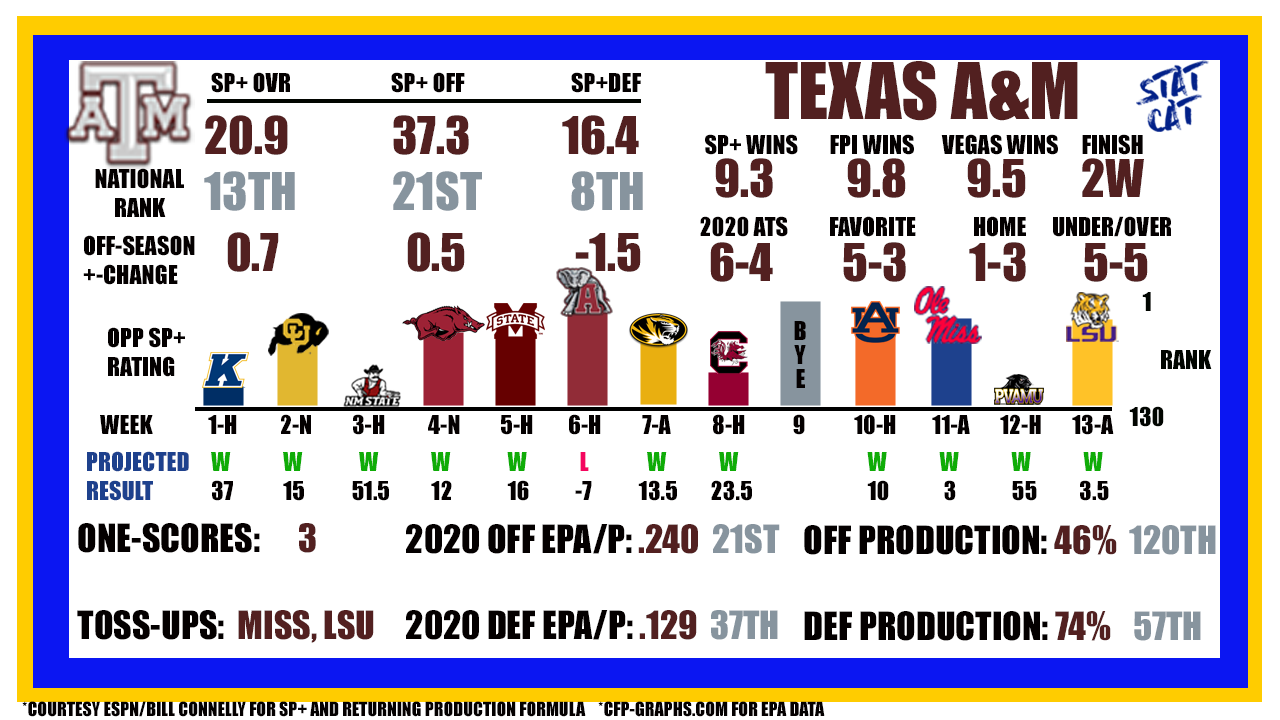
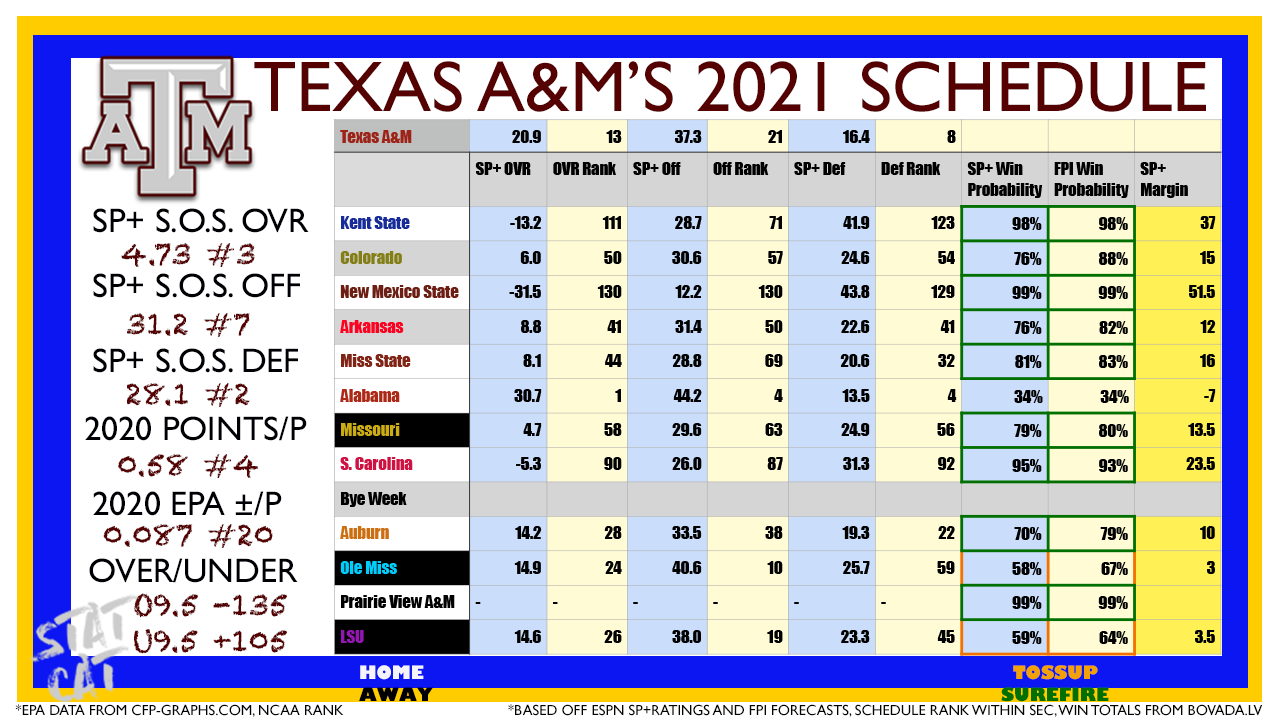
While Aggieland is excited for 2021 based on the merits of its roster, Texas A&M once again rocks one of the easiest slates in the SEC. Only Kentucky and Vanderbilt’s opponent composite score in ESPN’s SP+ metric were lower than Jimbo’s crew. If that figure manifested into a single adversary, TAMU would play a team akin to Boston College each week — which is a decent way to say the 13th-ranked Aggies overly are favored across their schedule. Though this seasoned defense will face three top20 units, the offense only faces two in the top30. So perhaps the lack of resistance on paper results in more incendiary figures on the field for Jimbo’s squad. Either way, wins will come easy on most of their schedule. Both the SP+ and Football Power Index give them at least a 58% chance of victory in every game they're favored; nine of them have a predicted margin of victory in the double-digits. Behind that and the idea the Aggies are one of the better teams within the SEC this fall, TAMU’s season hinges on capitalizing on its one-score games against the other conference elites. While the Aggies project to be a TD underdog at home versus the defending national champs, both Ole Miss and LSU presume to prevail by a field goal thanks to the implied home field advantage.
Despite projecting TAMU to win every game except against the Tide in its straight-up forecasts, the SP+ likens the Aggies’ win total to be closer to nine. That would translate to either them going o’fer in their one-score contests or being clipped in a surefire matchup. Obviously, either of those two happenstances would be quite disheartening for the 12th Man et al.; not only for supporters yearning for an appearance in Atlanta or beyond, but also for optimistic degenerates who banked on them beating their 9.5 under/over win total. The FPI’s simulation, in comparison, is much more bullish. In half of the games, its probability figure is five points higher than the SP+ in both swing games versus Ole Miss and LSU. Thusly, its 9.8 win total projection hints a rosier outlook. Though questions around the QB and OL remain unanswered, this bunch hopefully should be in its groove and primed to take it to a couple of defense that themselves are craving drastic year-over-year improvement. Practically speaking, they can still split those games, drop their tilt versus the Tide, and still cover. The current money appears to be backing the Aggies, so if a heartier payout is what you require, fading the Aggies changes in those games is always an option. But considering the SP+ likes their prospects each week when analyzing TAMU’s matchup in a vacuum paired with the FPI’s overall optimism, this team seems like an easy buy.