2021 Vision: Previewing Mississippi State
2021 Vision: Previewing Mississippi State
With talking season winding down, preview season is among us! I'm sure this isn't the first preseason article you've viewed. You should know the drill by now with these bad boys. But if this is your first experience with StatCat, be ready to learn a thing or two about the Bulldogs' QB1, receiver room, rushers, OL, its most important stats to maintain and/or improve on both sides of the ball, and how MSU's schedule breaks down with help of ESPN's SP+ Rating!
Mississippi State Passers

This time last year, a healthy amount of folks were all-in on the transfer of KJ Costello. And of course for a brief moment in history, their optimism culminated in a Week 1 shootout victory on the road against the reining national champs. But not to long after, the slow-moving passer with a long, swooping release who constantly held the ball like a loaf of bread looked more and more awkward and left-footed playing in Mike Leach’s Air Raid as the season progressed. And, it’s not like the former Cardinal was dynamic in any sense to begin with. In a scheme that often thrives with decisive surgeons, Costello appeared to play in a daze with borderline lackadaisical body language; almost sloth-like. His drops lacked urgency and balls typically came out with a flutter. In fact, quite a lot wound up in a defender’s vicinity. By my charting, he tossed 29 turnover-worthy passes with no other SECer topping his nauseating 13.8% Interceptable Pass Rate. For dissenters, the Air Raid’s struggles were cheered and applauded as previous conceived notions of the scheme floundering in the SEC gained credibility. Furthermore, Costello’s trials hammered home not every QB is suited to general Leach’s legions.
That level of futility was enough for the Pass-Happy Pirate to hoist the Jolly Rogers to weather the remainder of his inaugural campaign in Starkville. Will Rogers lacks premier, or even above-average, arm talent slinging the pill. I get not every 18 year-old can slide into an SEC game and light things up. But, the Bulldog certainly wasn’t one of those kinds of quarterbacks. Like his predecessor, he had a nasty habit of throwing the ball near opponents and processing drop-8 coverages. By year’s end, only Kyle Trask and Ken Seals tossed more interceptable attempts. When he wasn’t putting the ball into harm’s way, Rogers orchestrated one of college football’s most methodical attacks. Despite the phrase of “matriculating the ball down the field” being associated with the age of three yards and a cloud of dust, Leach’s unit re-branded that mantra to the tune of Rogers’ snooze-worthy 5.73 average depth of target, which is over a yard and a half less than the next lowest clip amongst conference returners. With that, it’s no surprise he enters 2021 representing the SEC’s floor in Expected Points Added/attempt, Explosive Pass Rate, and Yards/Attempt. At least, the proclivity to target short provided beaucoup opportunities to pad his down-to-down passing numbers. In fact, none of his contemporaries can best his 65% raw Accuracy% or 13.5% Uncatchable Pass Rate. Still, a below-average Success Rate and the second-worst First Down+TD Rate vehemently mutes any further optimism regarding his profile. Additionally, he only connected on 10/43 attempts beyond 15 yards downfield with a dismal 18.2% Deep Completion%.
As the Bulldogs saw last year, their shortcoming stretching secondaries resulted in defenders crowding the box and playing closer to the line of scrimmage, clogging up MSU’s short passing lanes and testing its quick game in the process. Despite being overly precise across his sample, Rogers isn’t blessed with tip-top arm strength. Now, that isn’t necessarily a prerequisite in order for a QB to shine in this scheme. The Air Raid has succeeded in the past even when it lacks a great vertical element, but the sophomore must progress his prowess attacking defenders. Only Luke Doty rocks a lower yardage makeup on throws beyond ten yards downfield than Rogers’ 38.5% mark. Again, Rogers was better than most of his contemporaries directing on-target attempts. Leach values accuracy above all else; so at least, the young gun has that going for him. But obviously, this offense can increase its margin of error by increasing its potency and eliminating the backbreaking number of interceptable pass attempts. That should (hopefully) come to fruition with Rogers’ sea legs stabilizing and a full, normal off-season of development. Continuity should aid in the year-over-year product, but Leach and Co. might have to get creative to account for their QB1’s flaws to maximize this offense. If things sputter and stall, the Air Raider certainly will explore former Southern Miss slinger Jack Abraham — who averaged over 260 passing yards/game as a Golden Eagle — as the next man up. Though I don't have much data on the fellow, based on what we know about Rogers, Abe should have an honest chance to undercut Rogers for the gig.
Mississippi State Rushers

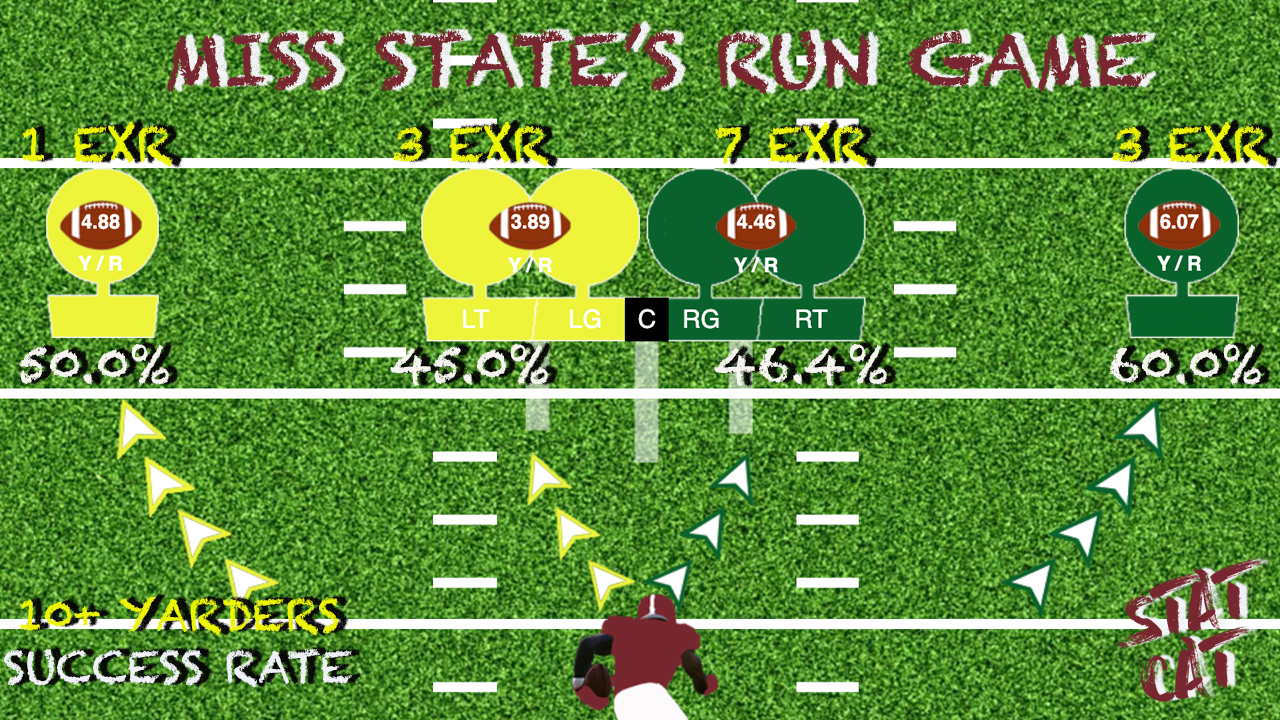
Mike Leach’s version of the old school Air Raid has hit some schematic snags. When smacked with drop-8 coverages and tight fronts, it has shown immense difficulty getting off the ground. Not only has the extra man in coverage typically stifled his passing staples, but the defensive ends clogging both B-gaps neutralize the offense’s de facto quick run play — the Inside Zone Slam — at the point of attack. The back generally has two choices: run into a pile or bounce outside. With the constipation up front, enough time usually passes for backend defenders to rally to the ball and limit gains; or at least, that’s the theory. That plan overly worked last year as the Bulldogs averaged less than 2 rush yards before contact for the 3rd-worst clip in the SEC. Their Explosive Run Rate also fell into that threshold. Though teams have slowed Leach’s efforts on the ground with the figurative Frisian horse that is the tight front, the group produced a Success Rate in the conference’s top5 even if lackluster runs were frequent.
Looking at the returning duo, Jo’qavious Marks was the more potent rusher. But, he also benefited from better cushion up front on average. While logging a team-high Yards/Carry, Explosive Run Rate, and First Down+TD Rate, only half of his yards came after contact. His before contact average of 2.24 was almost 0.8 yards higher than Dillon Johnson’s figure with his Broken Tackle Rate being 15 percentage points worse in comparison. Despite logging 15 more carries than Johnson, Marks finished with three less total broken tackles than his teammate. And while both were hit in the backfield on over an eighth of their tries, Johnson commands the preferable Negative and Gumption Run Rate. Since I know you were thinking about it, two-thirds of Johnson’s production on the ground came after defensive engagement.
Thanks to Johnson’s blustering ball carrying, Miss State finished right at the conference mean in terms of YAC average. His personal clip of 2.94 is positioned right behind Isaiah Spiller's figure ahead of 2021. But perhaps more impressive, his 41.2% Broken Tackle Rate is less than a percentage point off from league leader Tank Bigsby’s clip among the returners with at least 50 attempts last fall. Though his rate of delivering conversions or scores per touch is lacking to Marks, his 52.9% Success Rate has the edge by over six points. If you’re out to find a dude who runs with purpose, look no further. Though some of his result-based metrics are mediocre at best, popping off some of the best stable metrics the SEC has to offer hints Johnson should be the top dog in Miss State’s backfield. Leach is still pass-first; but when he does turn to the ground to steal some quick yards, wouldn’t it behoove him to go with the option better at fighting through potential carnage?
Mississippi State Catchers
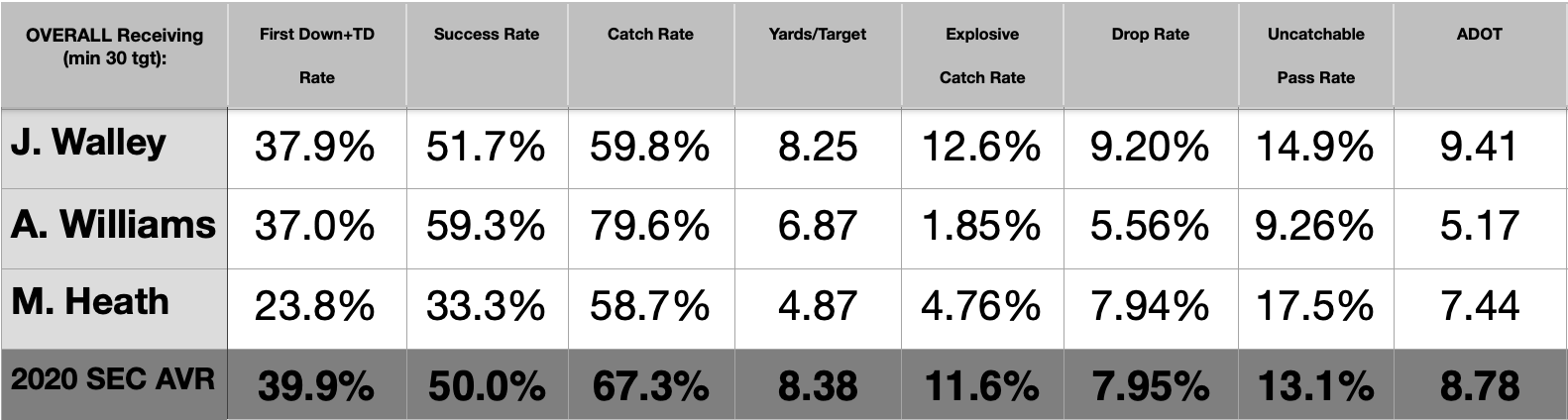
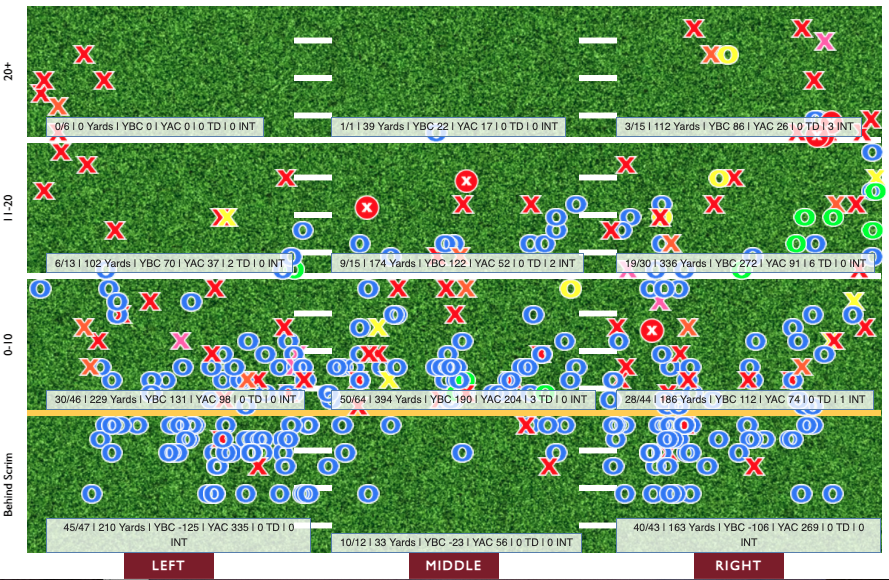
Though not a bastion of efficiency, this position group will be fueled by its dependable inside receivers in Jaden Walley and Austin Williams. Though running back Jo’quavious Marks is the team’s returning leader in catches, Walley sits atop the rest of MSU’s volume figures. He enters 2021 with the SEC’s 4th-most yards and catches in addition to the 3rd-most combined first downs and TDs. Plus, his per opportunity numbers were more-than-adequate. While donning the Bulldogs’ best Yards/Target, Yards/Catch, YAC average, and Explosive Catch Rate, only Malik Heath logged a higher Uncatchable Target Rate on the team. Yet, over half of his chances resulted in situational success. Considering the underwhelming QB play, that level of output is commendable. No doubt as the year progressed, MSU passers tried to shoehorn passes to him. Over 8% of his targets were interceptable with five resulting in straight picks. For what it’s worth, three of them came in the same spot — 20-22 yards downfield outside the right numbers. As a receiver with natural giddy-up, he functioned well off of a horizontal route tree. Nearly 44% of his targets came via two routes: drags and crosses. Fans of the Air Raid know that translates to the Mesh, Follow, Shallow, and Slot Cross concepts fueling the plurality of his usage. With an increased role and the crazy amount of volume folks tend to see from this pass-happy scheme, Walley has a great chance to be the SEC’s pass catching king as far as the counting stats are concerned. While StatCat would like to see increased potency and dynamism to help his advanced metrics, he’s clearly the Bulldogs most dangerous offensive weapon ahead of this fall.
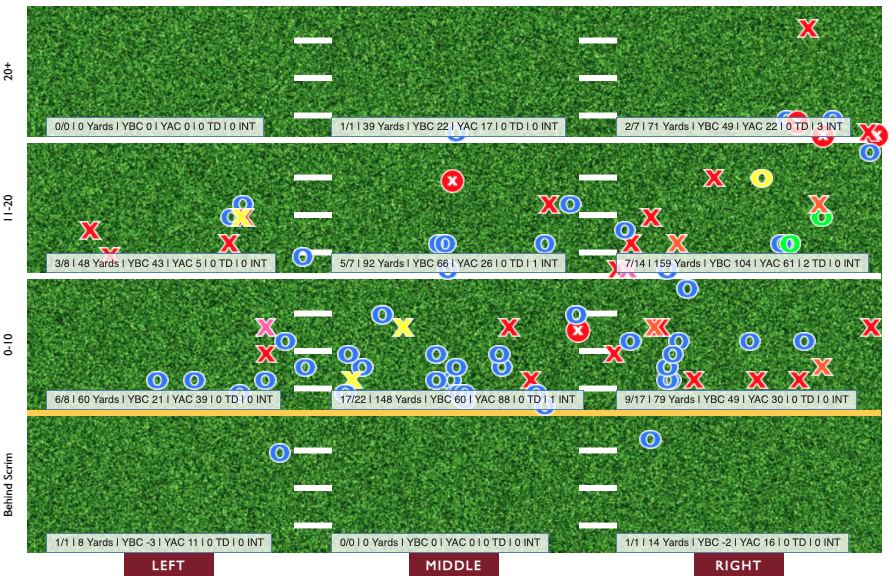
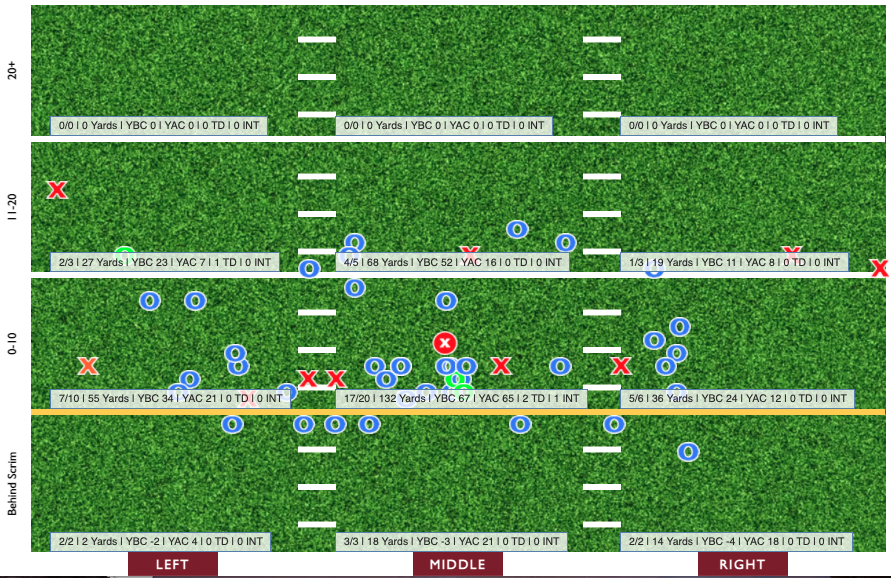
Jaden Walley's 2020 Target Chart Austin Williams' 2020 Target Chart
When describing Williams, one of the first words that comes to mind is “dependable”. In fact when speaking to conference media members in Hoover this summer, Leach stressed MSU’s scrappy slot brings consistency to this unit. If an offense cannot be explosive — which Miss State wasn’t — then damn-well needs to be consistent. Speaking to that, Williams commands a team-best 59.3% Success Rate and 79.6% raw Catch Rate. Among his non-running back peers, only Alabama’s Slade Bolden put up a preferable clip last year; while his 88.2% Depth Adjusted Catch Rate reigns supreme. However, his degree of difficulty can be challenged with the lowest average depth of target from a conference receiver. Only a fifth of his targets occurred over ten yards downfield. Still, Williams' reliable pass catching shined through in extra situations. Omitting uncatchable attempts, his DACR is heightened by the SEC’s 2nd-best Adjusted Inaccurate Catch Rate and the 5th best Adjusted Contested Catch Rate. As a usually safe outlet, his early down production puffed up his final numbers. Commonly targeted on Under, Follow, and Stick concepts in these spots, his first and second down 62.5% combined Success Rate is the conference’s 5th-best for 2021. Plus, his 50% First Down+TD Rate on attempts behind the chains shares the SEC’s 4-spot for this fall. Far from titillating, there’s at least some consolation in Williams’ consistent pass catching capabilities in case Leach and Co. are resigned to plod their way down the gridiron behind copious underneath throws.
Heath logged the Bulldogs’ most reps from the outside and looks to hold down the X-spot. Touted as one of the nation’s best JUCO prospects ahead of 2020, the 6’3 wideout never reached his potential in his first outing in Starkville. Along with the 2nd-lowest Yards/Target amongst SEC receivers with 30 chances, Heath’s 33.3% Success Rate and 54% Depth Adjusted Catch Rate represented MSU’s floor. Behind subpar passing and a shortcoming attacking deep, he only fielded ten targets over 15 yards; he saw 11 behind the line of scrimmage. Though it should go without saying, the Air Raid hardly will fly if its main outside receiver replicates that level of ineffectiveness. With JaVonta Payton and Cameron Gardner transferring, Heath’s competition is pretty thin. Outside of Cal-transfer Makai Polk, no Bulldog presents a case to get extended reps on the exterior. Fellow transfer and Leach recruit Jamire Calvin as well as the returning Lideatrick Griffen seem more suited to operate as slots, but maybe the Magnolia State Madman gets kinky with this rotation this fall.
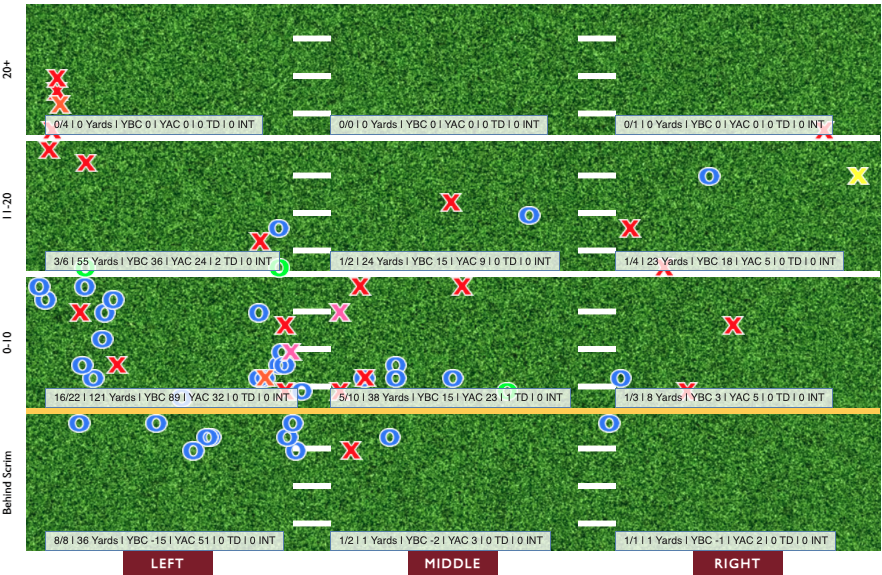
Malik Heath's 2020 Target Chart
Glancing Mississippi State Offensive Line
Like the rest of Mississippi State’s offense, the Bulldogs’ line wasn’t immune from suffering growing pains in the switch to the Air Raid. While staying inside the SEC’s bottom5 in Run Havoc Rate, their YBC average went from 2nd-best to 3rd-worst. Despite being the conference’s leader in Pressure Rate, they surrendered 97 by volume. Considering 34 led to a sack and 19 others generated a turnover-worthy throw, that level of volume was insurmountable for this rinky-dink passing product to overcome. Plus, it’s never a good when five lose to three on a consistent basis. And not to pile on, but their Pressure and Sack Rates in obvious passing situations — like on 3rd downs — sunk to the SEC mean. You know Leach won’t be changing up his operation much, so it’s on the big boys to figure it out and become more dependable. No doubt some of the snafus are schematic; but no matter what offense the Bulldogs run, they can’t get by averaging under 2 yards before connect and allow nearly 100 pressures.
Former-five star and aspiring first round pick Charles Cross returns at left bookend. His personal expectations are pretty high. So, StatCat presumes he’ll be highly motivated to become one of the premier pass blockers in college football. Previous spot starter LaQuinston Sharpe appears to have the inside track to lock up left guard with Kwatrivous Johnson favored for the other. But, competitions at center and right tackle prevent a clear forecast for Leach’s line. Cole Smith could wind up as the main man in the middle, but Reed Buys is giving him a run for his money to win the gig. Scott Lashley and Kam Jones are duking it out for open bookend. This position battle is youth and upside versus a veteran on the mend. Practically speaking, the odds are good we see a mix of all these guys at some point this fall. But to reiterate, whoever is in there can’t replicate last year’s lukewarm performance in the trenches if the Bulldogs want to commence their climb to reclaim relevance.
Key Important Offensive Metrics in SEC Play
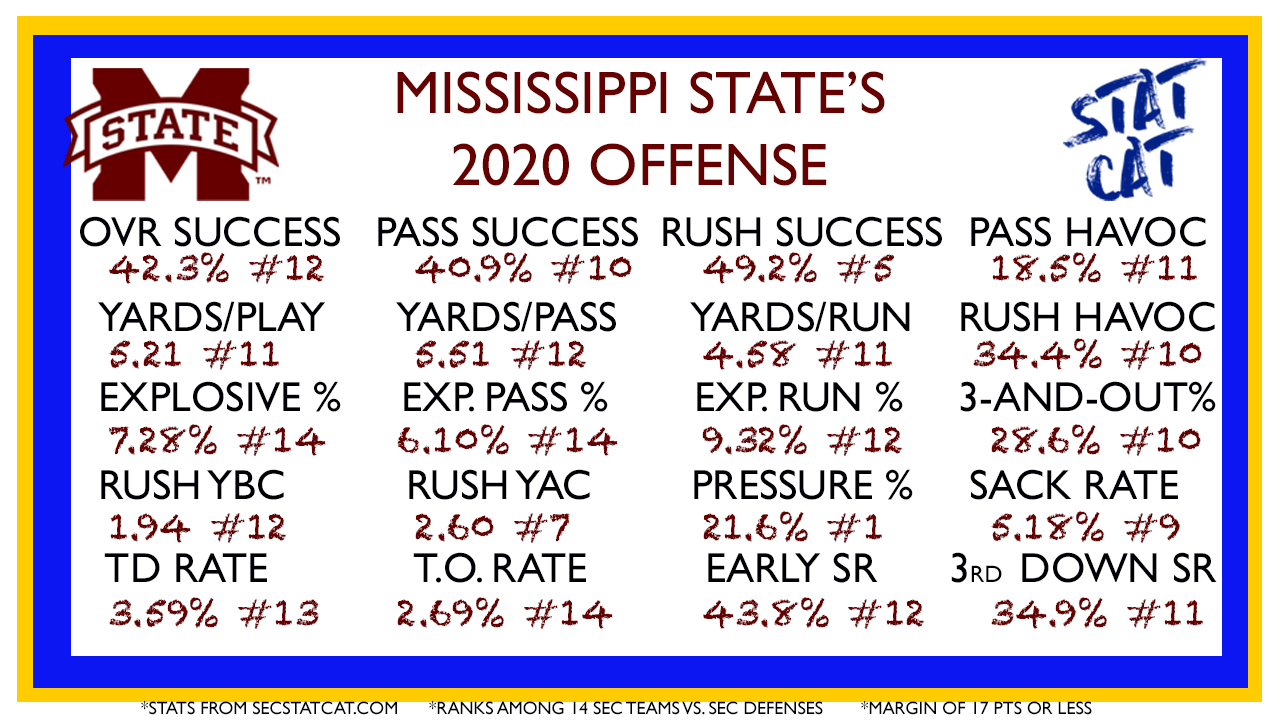
When pegged with ‘what’s the single most important trait Mississippi State’s offense needs to instill before this season' the answer is obvious: potency, potency, potency! StatCat doesn’t want to see the Air Raid fade into that good night and become another stale scheme of yesteryear. No doubt plenty of this philosophy’s patterns remain effective and fruitful, but skimping ahead five yards at a time is undeniably sad. It’s almost akin to watching a formerly great high-riser struggle to finish around the rim on the hardwood. The Bulldogs' offense was more watered down than punch at a middle school dance. MSU’s Explosive Pass Rate dwindled from 8.2% to 6.1% despite averaging more per attempt year-over-year. Hammering home the cruciality of big gainers, winning the explosive play battle has been the single highest correlating factor to victories within the SEC the last three seasons. The Air Raid is far from dead, but there’s no question the Pass-Happy Pirate’s number one goal this fall should be to generate more explosiveness. Mint front and drop-8 coverage weren’t invented last year; and there are ways to best those defensive looks with his core concepts. Obviously, having a passer with some arm talent will help this scheme’s bottomline. Settling for short stuff and hoping on a YAC gain hardly wins in this conference. Moreover, a pass-first scheme finishing inside conference’s bottom5 in Passing Success Rate, Yards/Pass, and Turnover Rate is awfully disheartening.
As discussed earlier, nearly logging triple-digit pressures absolutely had a nasty effect on MSU’s passing product. Though the Bulldogs were the SEC’s best by a rate basis, the shear volume of allowed disruptions is simply too much to ignore and dismiss as fine. Certainly, this line should strive to lead the conference in Pressure Rate again. But, the debate rages on regarding their actual collective pass blocking acumen. Outside of hoping to maintain that figure, logging consistent wins with its secondary facet will be important. We all know the Air Raid wants to let it fly, but it still isn’t above stealing a few quick yards on the ground. Now, teams are working to make the scheme less effective, but the Bulldogs saw almost half of their carries end in situational success in league play. Sexy? No. But, this ground game allowed this offense to plod along. To reiterate, fans should hope this offense increases its potency. But as long as it has a semi-valuable run game that can win in spots and occasionally move the chains when called upon, this year’s the end product should best 2020’s.
Key Defensive Metrics in SEC Play
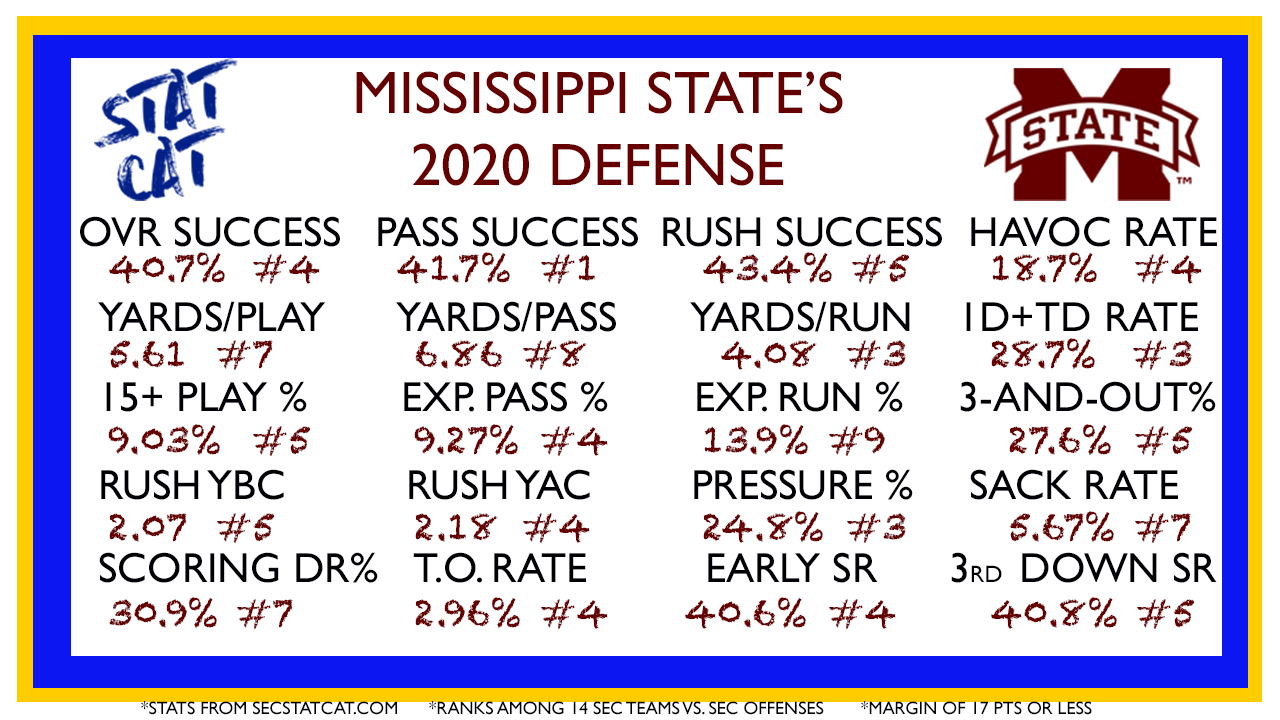
As an offensive guy, I generally gloss over defensive previews. Not that I don’t think individual defensive players aren’t valuable or dislike a blindside sack or athletic INT every once in awhile, but I typically treat that side of the ball as a collective unit. As only one guy, I can only track so much, yanno? You won’t get many fun defensive nuggets from me. That said, Zach Arnett delivered a praise-worthy performance in his first season guiding a SEC defense. Handcuffed by youth and rocking his staple 3-3-5 structure, the Bulldogs opted to play fast and aggressive. Often undermanned and the less-talented team, Miss State often took calculated risks in order to trigger bad decisions or offensive misreads. In the end, they finished with the SEC’s 4th-best Havoc Rate and Takeaway Rate. Largely one of the worst units in league play a year prior, Arnett’s lot basically ranked inside the conference’s top5 across the board. There were exceptions, of course, but no metric of theirs ranked worse than 9th in 2020. Year-over-year, no defense improved its Success or First Down+TD, or 15+ Play Rate more than the Bulldogs. The risk-reward approach was particularly noteworthy against the pass. Despite finishing with a below-average Yards/Pass, MSU dons the SEC’s 4th-best Explosive Pass Rate with the top Passing Success Rate. Considering their counterpart's own miscues manufacturing field flippers, this stinginess is bound to be an incredible luxury should it continue with seven returning starters. Though repeating that performance will be a challenge, controlling the skies will keep this team competitive.
Assuming the aggressive play doesn’t bite the Bulldogs in the ass in 2020 — and the majority of their stats stay on the good side of the SEC average — the biggest area of opportunity for this unit is to focus on capping big gainers on the ground. Like their metrics on the whole, MSU’s run defense was overly sturdy. From the malleable and smaller fronts that Arnett liked to deploy, they did a good job limiting opponents to a top5 rush yards before and after contact average, which resulted in a top3 Yards/Carry. But with abundant off-ball defenders, tackling often became an issue once ball carriers reached the second level. Behind the SEC’s 2nd-worst 31.5% Run Tackle Rate, chunk runs often followed. MSU’s 13.9% Explosive Run Rate finished in the back half of the schedule. The scheme is bound to operate similarly; so its natural vulnerabilities will remain. As such, the Bulldogs must wrap up better and be more sound taking down rushers. That’s often the trade-off moving away from base packages. You trade size and brawn for athleticism and speed. Sometimes the latter just isn’t as capable as a tackler. Youth was also the other culprit. Behind a strong offseason of work, natural progression, and bringing back the majority of their starters, Miss State’s defense is well-worthy of some attention.
Glancing at Mississippi State’s Schedule
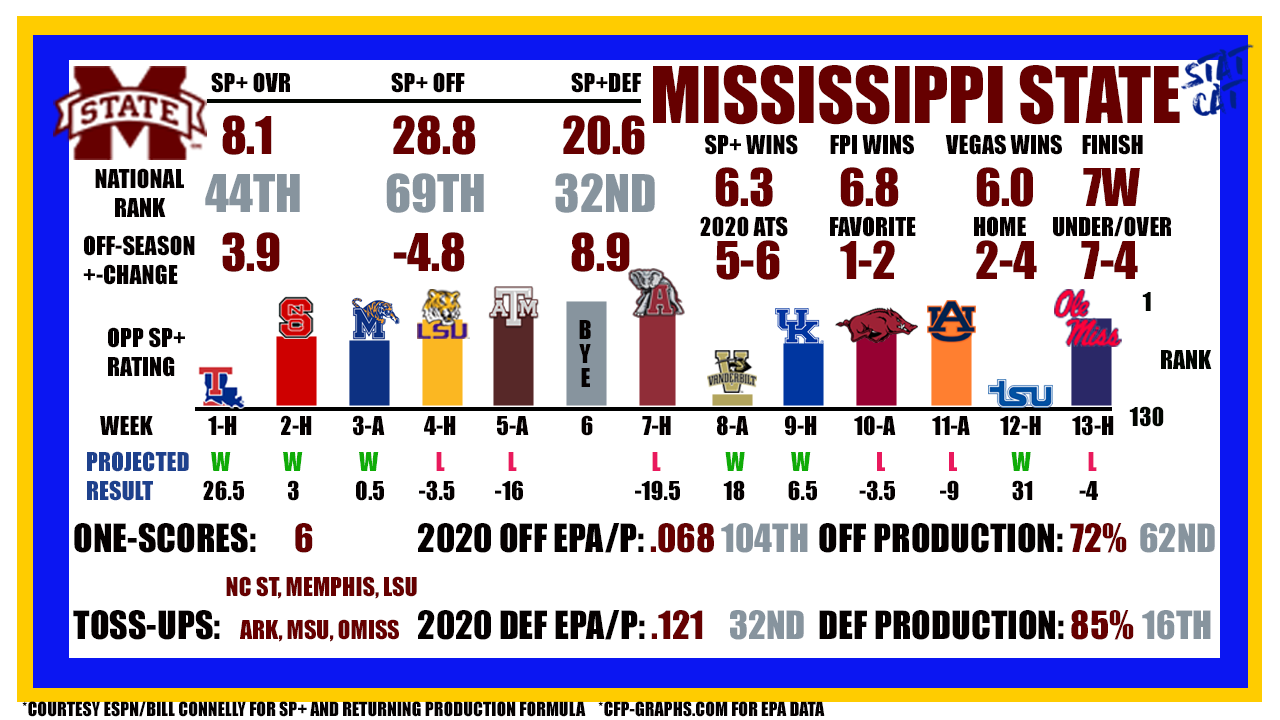
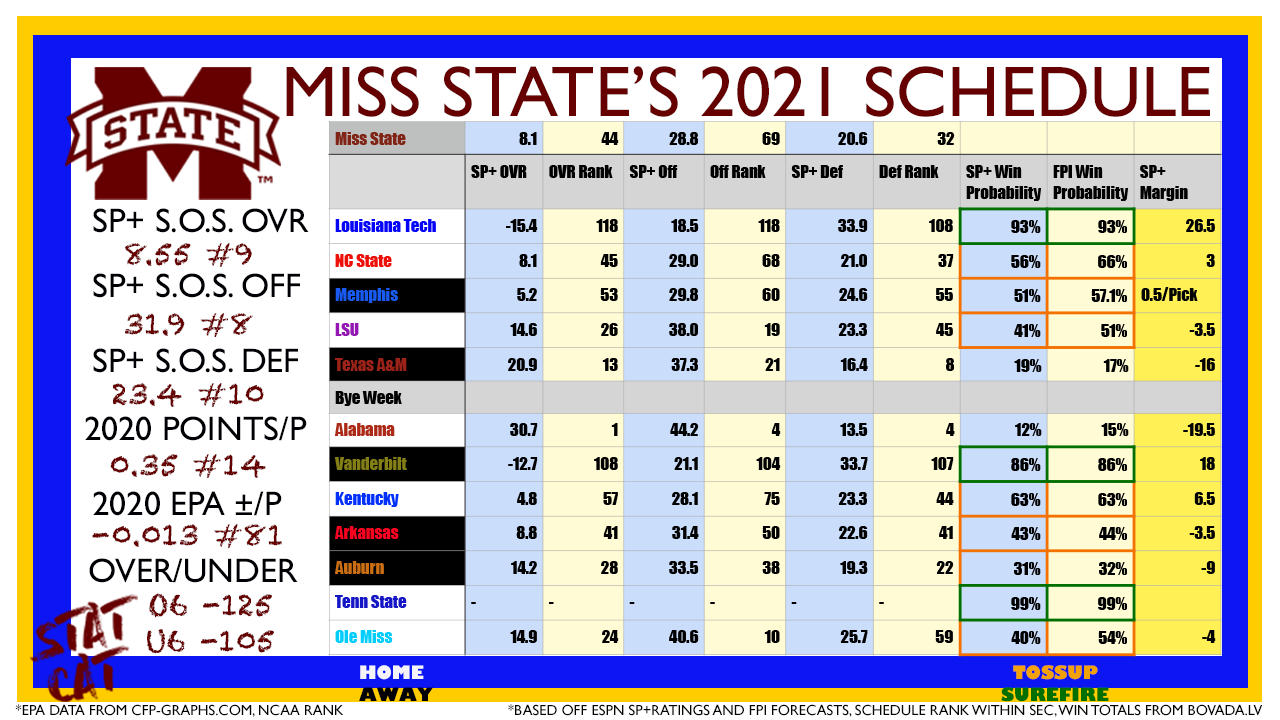
In the eyes of ESPN’s SP+, Mississippi State’s schedule is on the harder side, but it’s still manageable. If their opponent’s average such score manifested into a single adversary, the Bulldogs would face a team akin to Pittsburg each week. FYI if that game were to be played on a neutral field, it would generally be forecasted as a pick ‘em. Championing the shaky slate ahead, MSU has six tossup games per the prognosticative metrics. Seven games look to be decided by single digits. With so many potential potholes ahead, the Bulldogs present ceiling is somewhat low. Though the odds like their chances to go bowling, they sure as hell don’t expect them to make too much noise. Still, they might be a nice weekly underdog to bet considering MSU was 4-2 against the spread last year when not favored. The SP+ is a little less optimistic in the Bulldogs than the Football Power Index. Three games have a double-digit gap in their respective probably figures, all of which are one-score forecasts. The biggest and potentially most impactful is the differing opinion in the Egg Bowl. As such, the FPI’s average win forecast is about a game higher in comparison. If the schedule broke that way, then backers of the Bulldogs hitting their 6.0 under/over win total would hit their mark.
Three one-score margins the first month of the season will reveal this team’s 2021 trajectory mighty quick. Though expected to outlast non-conference foes NC State and Memphis, Mississippi State can’t afford to take either for granted. The Tigers especially should be on their radar considering the tilt in Memphis projects to essentially be a true 50/50 affair. Dropping those two games — or even splitting them — drastically diminishes MSU’s chances to beat their over. I mean as is, that’s a third of their projected victories. Though recuperating those losses by toppling Arkansas and Ole Miss is probable, that still only gets them six. The Air Raid is good for one decent upside a season. So maybe Texas A&M, Alabama after Miss State has its bye, or Auburn get caught napping one week. But that’s a hard sell at this point in time. Until this offense shows it has some firepower and can score points, StatCat is pessimistic in this team’s outlook coming out on top if it has to keep playing rock fights each week in the hardest division in football.