2021 Vision: Previewing Ole Miss
2021 Vision: Previewing Ole Miss
With talking season winding down, preview season is among us! I'm sure this isn't the first preseason article you've viewed. You should know the drill by now with these bad boys. But if this is your first experience with StatCat, be ready to learn a thing or two about Ole Miss's QB1, receiver room, rushers, OL, its most important stats to maintain and/or improve on both sides of the ball, and how the Lane Train's schedule breaks down with help of ESPN's SP+ Rating!
Ole Miss Passer

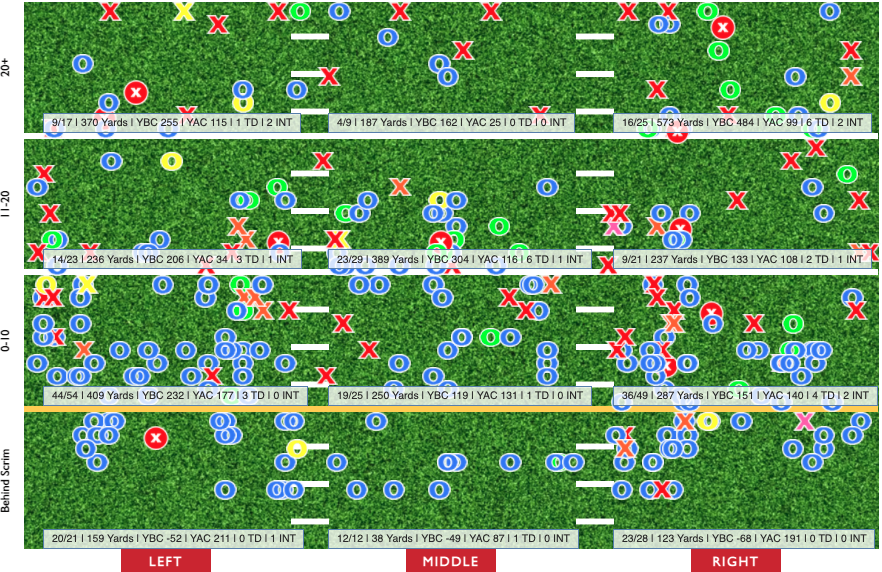
Without filibustering or beating around the bush, Matt Corral is the SEC’s best QB entering this upcoming season. Posting a top8 Expected Points Added/attempt last year nationally, the Rebel’s Success Rate and First Down+TD Rate are tops within the SEC ahead of 2021. Plus, his raw Accuracy%, Depth Adjusted Accuracy%, Explosive Pass Rate, and Yards/Attempt all hold down the 2-spot. Not to mention, his counting stats are pretty good too. Of course, those two landmines on his game log are major red flags. That in addition to losing his top pass catcher, Corral has his fair share of haters dismissing his aerial acumen. Lane Kiffin and Jeffy Lebby created a fantastic environment to extract both efficiency and potency out of their QB. Again, look at his profile. He’s good. Nonetheless ample RPO usage and a high Play Action Rate have some dissenters crediting his offensive braintrust for the passing game’s ascension rather than Corral's cannon. Though the Rebel is still making nice throws, playing pitch and catch when a target is wide-the-hell open thanks to well-timed play call or a brilliant design unequivocally facilitates things. Even excluding RPO meshes, just under a third of the Rebel’s dropback attempts utilized play action. His 32.9% makeup is nine percentage points higher than the next returning SECer that started multiple games last season. For what it’s worth, Corral’s ball placement and down-to-down Success and Interceptable Rate remained the basically same compared to his overall output. But, his Explosive Pass Rate increased ten points to a robust 25.7% clip.
Compartmentalizing his bottomline into stat categories, Corral stands to be the conference’s best deep ball passer, pressured passer, 3rd down passer, “behind the chain” passer, and contested window passer according to my charting (Go watch those StatCat's crappy Top5 videos if you want the specifics). And, that’s not mentioning the areas where he sits inside the SEC’s top5 ahead of this fall. The Rebel is truly one of, if not the most well-rounded, QBs the league has to offer. In terms of next-level traits, I think he has adequate arm talent and the sufficient speed to evade rushers, extend plays, or make something happen outside of structure. No, he’s not a jitterbug like John Rhys Plumlee. But, Corral is quick enough to keep opponents honest. Good thing, because I don’t care much for liars. But his down-to-down output should be one of his best selling points. From clean+dropback situations, his potency remains firm. His 59.1% Success Rate is the best amongst returners and his Yards/Attempt, Explosive Pass Rate, and First Down+TD Rate rank 2nd. Even though all of his ball placement figures slightly soured compared to his overall metrics, his Depth Adjusted Accuracy holds the conference's bronze medal for this fall.
The More-than-OK Corral has as good a chance as anyone to be the nation’s top passer by year’s end if he can continue his current trajectory and improve his ball security. His accuracy is relatively strong amongst returners, but it still needs to be shored up as does his tendency to eye guys down. Nick-picking his game aside, I believe he’s primed to do big things in 2021.
Matt Corral's 2020 Pass Chart
Ole Miss Rushers
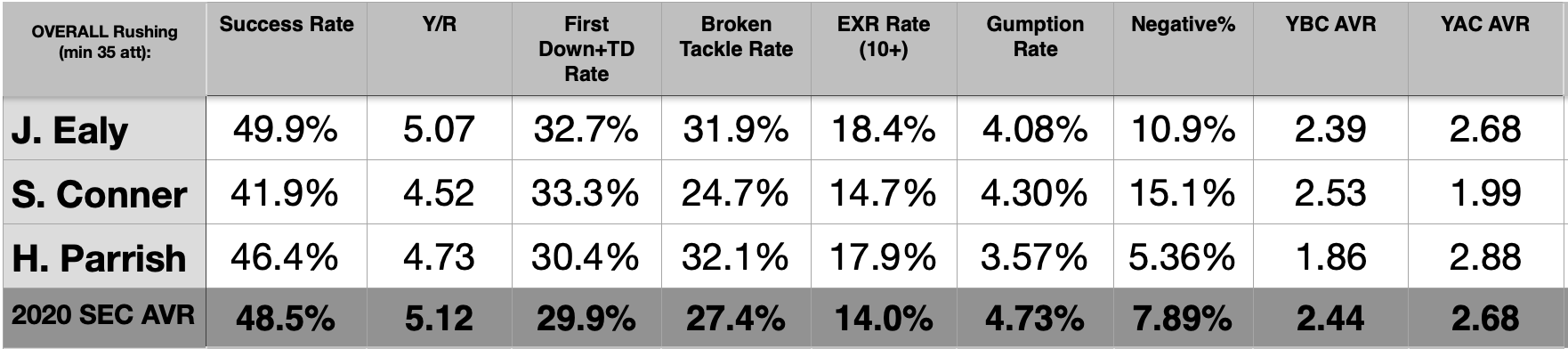
While the Lane Train ushered back in the importance of the pass, the ground game still made up the majority of Ole Miss’s plays in meaningful minutes. Down-to-down, the Rebels maintained their modest Rushing Success Rate versus conference foes. But with more constipation, allowed havoc, and runs dedicated to running backs, the group’s yards before contact average dropped by 0.4 of a yard, which had an obvious effect the team’s Yards/Carry. Despite these events, Ole Miss’s Explosive Run Rate increased thanks to their lead back Jerrion Ealy. Generating splash gains isn’t supposed to be a reliable metric year-in and year-out, but he is aggressively debunking that notion. In part with his Broken Tackle Rate reaching the 30’s, his personal Explosive Run Rate cracked 18% — the second-straight year for both of those occurrences. Among SECers with at least 50 carries returning this fall, those metrics rank 3rd and 1st, respectively. Per Pro Football Focus, 48% of Ealy’s runs gained over three yards after contact, which was the 8th-best mark in the Power5. Overall, Ealy was hit behind the line of scrimmage on nearly a sixth of his attempts. Busting out of tackles and making stuff happen consistently is a must under these conditions. All in all, StatCat’s charting placed his raw YAC average at 2.68 that was good enough for 13th within the SEC in 2020.
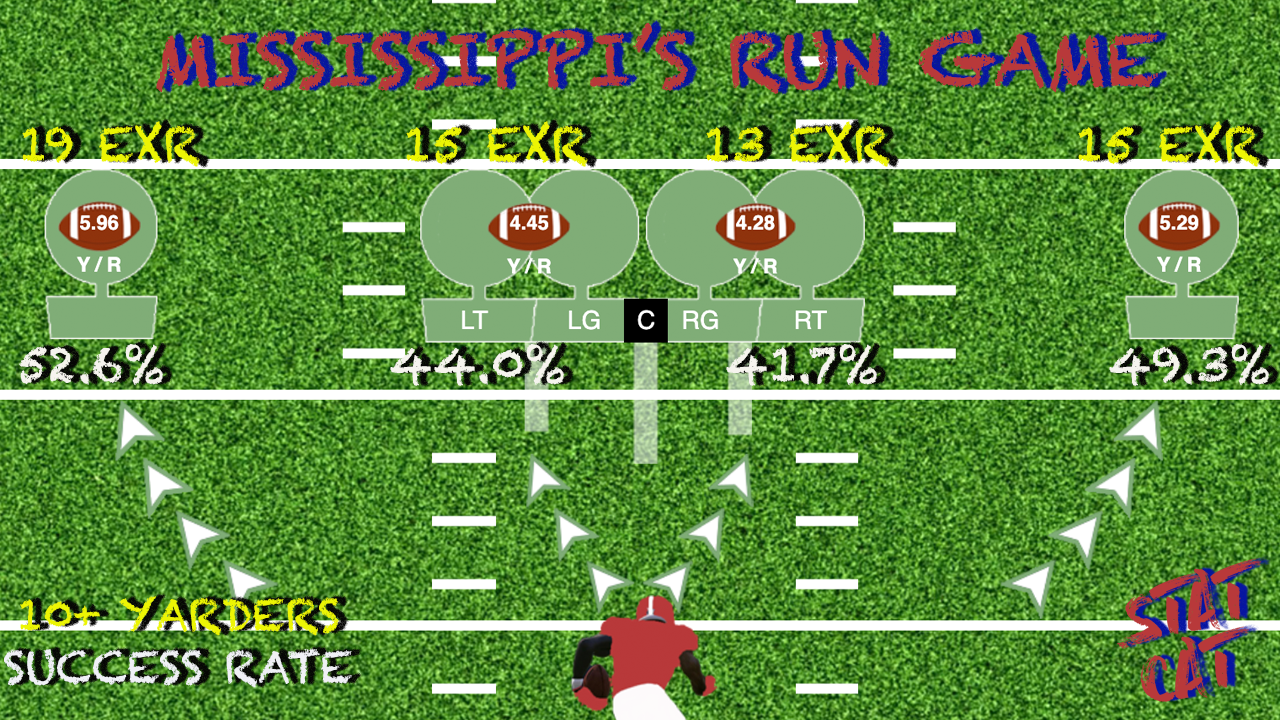
Maximizing pace with a highly-centralized zone scheme lost its luster long ago within this conference. So opponent’s usually had no problem stifling Ealy and the rest of his teammate’s efforts on the ground on early downs. Collectively over half of the Rebels’ first and second down runs gained less than three yards. Again, a 41.7% team Success Rate doesn’t exactly melt your face especially along side an average rate at ripping off chunk carries. Still, Ealy’s personal clip topped the team average by eight percentage points in meaningful minutes. Though not really laudable when matched up with other SECers’ returns, he certainly wasn’t a drag for this offense. In fact his 24.6% First Down+TD Rate to start a set of downs was a top5 figure within the conference. But first downs were Ealy’s most muted showings in terms of making magic happen after defensive engagement. Both his Broken Tackle Rate and YAC average in these spots comfortably finished ranked in the 20’s. As the most common situation in football, first and 10 generally helps provide a nice, standardized barometer for one's trajectory -- for what it's worth.
In other spots like short yardage, 3rd down, or red zone opportunities, Ealy ran hard relative to his contemporaries, but his results weren't entirely impressive. Though no area was a real let down, the results no doubt could've been better. That said, his Broken Tackle Rate in all three contexts sit inside the SEC’s top3 ahead of this fall. So if that might continues, Grovers should be optimistic for an overall uptick to his cumulative product. One area, however, where Ealy bested expectation was his snaps when disadvantaged by down and distance. When behind the chains, he sits inside the conference’s top5 in Success Rate, First Down+TD Rate, Broken Tackle Rate, Explosive Run Rate, and YAC average. Nearly a quarter of these carries resulted in a gain of at least ten yards. As a homerun hitter, Ole Miss is poised to be one of the SEC’s most potent offenses regardless of facet this season.
Snoop Conner was simply the lesser of the Rebels’ main options last year. Despite being the only person not named Matt Corral to average over 2.5 rush yards before contact, he posted a team-low Broken Tackle Rate, YAC average, and Negative Run Rate. His personal Success Rate and Explosive Run Rate were nearly eight and five percentage points worse than Ealy’s figures. His output last year would firmly be categorized as “nothing special”. Though his breakaway potential shined as a freshman, that part of his game was less prominent last year. Again while Ealy seems to be pretty darn good at delivering in that manner, Conner showed why that element isn’t bankable. He should be the first ball carrier off the bench, but he must recapture some fire and log better numbers if he wants to keep his place in the rotation.
Knowing how Kiffin likes to operate, there’s no doubt he and Jeff Lebby will get creative with their change-of-pace options in Henry Parrish and John Rhys Plumlee. Though Plumlee failed to overly dazzle last year, most SEC fans are aware of his zip-zap speed and potential to score anytime he touches the ball. Plus, you can’t tell me their “Wild Reb’l” set with both him and Corral in the backfield doesn’t sound interesting from a schematic standpoint. But no matter how fun Ole Miss might be, it certainly won’t be too good of a time if Plumlee fails to heighten his game and bring about efficiency with his touches. Parrish had pretty admirable metrics for a first year. In fact, both his Broken Tackle Rate and YAC average cracked the conference’s top10 last fall. Moreover, he's placed directly behind Ealy in the Explosive Run Rate rankings. If Conner falters with his chances, Parrish’s potency might be explored behind an increase in usage. Either way you slice it, Ole Miss unquestionably has high-quality ball carriers and playmakers coming out if its backfield.
Ole Miss Catchers
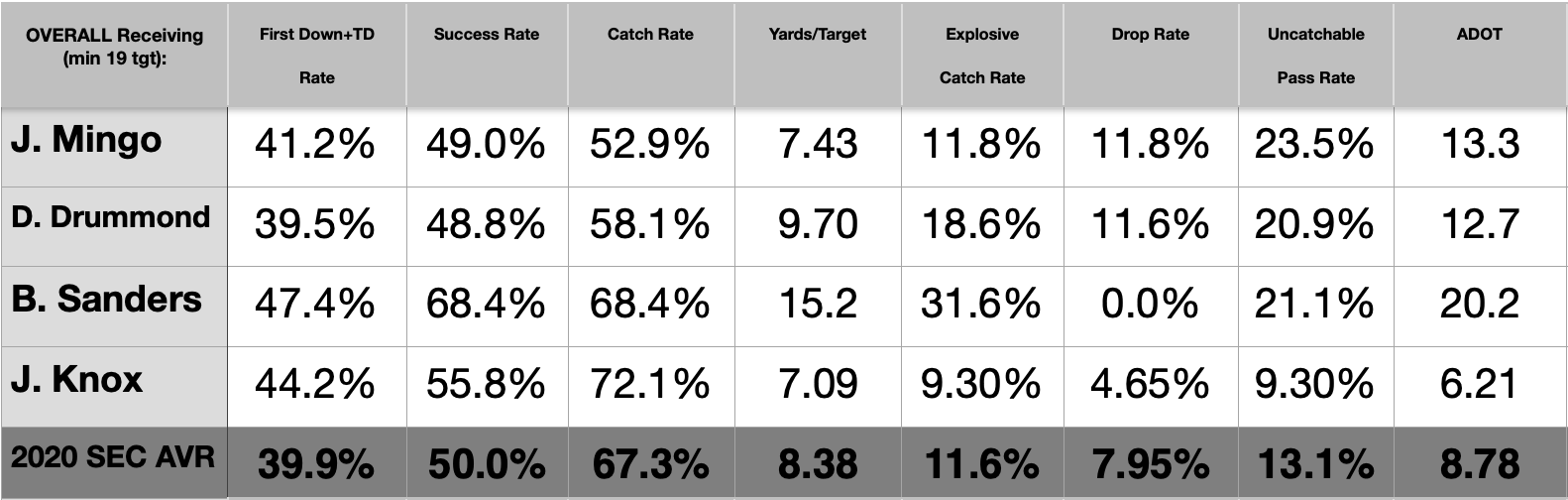
Without last year’s main attraction driving this unit, Ole Miss hopes to maintain its previous potency through a collective effort. A base consisting of Jonathon Mingo, Dontario Drummond, Braylon Sanders, and Jalen Knox looks pretty good on paper. For the second straight year, Mingo has the X-spot on lock with Drummond and Sanders swapping reps at Z. But without energy source Elijah Moore funneling defensive attention from the slot, it remains to be seen if the former Mizzou Tiger fills that role or if a returner slides inside.
As aforementioned, Mingo predominately operated as Ole Miss’s X; aligning on the far left of the formation. In the Baylor Spread system, he was generally asked to run off a vertical route tree. That said, he mostly cut off his routes and worked short. His most targeted routes include slant, hitch, Utah (tap pass), tunnel screen and out. All received between 8-14 targets and made up 52% of his attempts. When he did have an opportunity to haul in a shot, only a third wound up complete. Not that it was all on him; however. His 23.5% Uncatchable Target Rate was a team-high. Dealing with a fair share of off-target throws, Mingo “created” a reception for himself four times. His 7.84% such rate only trails Georgia’s George Pickens for 2021. But, he is responsible for the Rebels’ worst Drop Rate at 11.8%. All in all, those misfires and deficient potency, generated a team-low 7.43 Yards/Target 55% Depth Adjusted Catch Rate. And, his Success and First Down+TD Rate were each about average within the SEC in 2020. But looking at him when solely targeted on underneath routes (slant, hitch, drag, etc), Mingo’s Success Rate and Yards/Target sit inside the top4 with none of his peers knocking his 57.2% First Down+TD Rate. Assuming Corral can give him more accurate targets outside of that context, his cumulative metrics should look much better by year’s end.
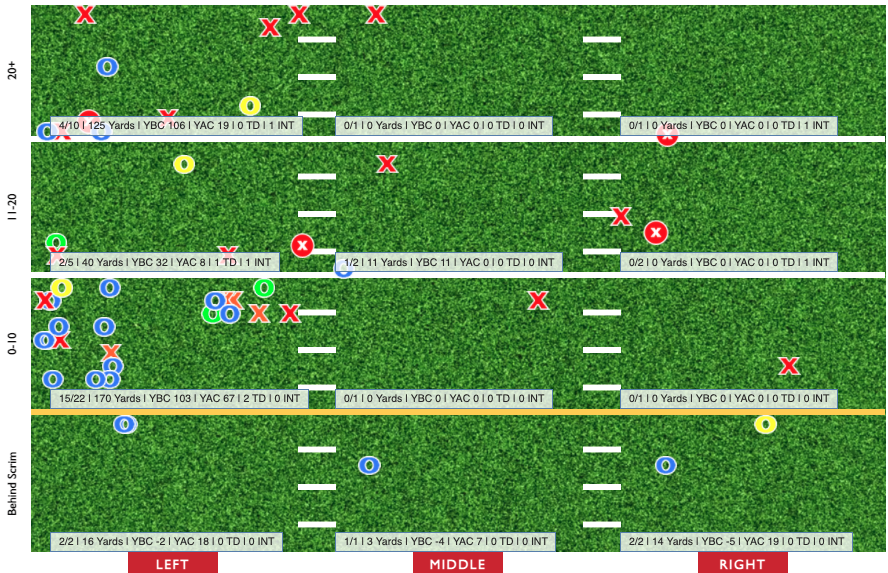
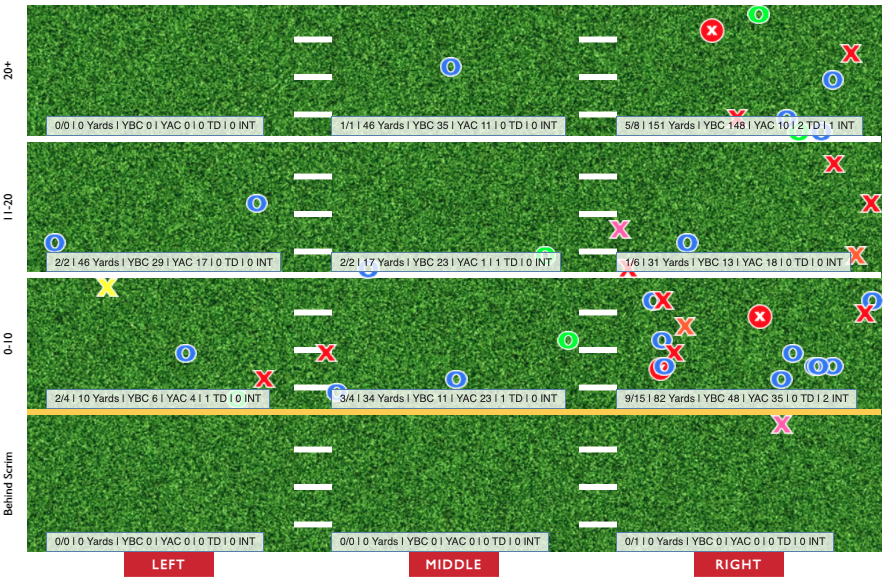
Jonathon Mingo's 2020 Target Chart Dontario Drummond's 2002 Target Chart
Drummond was basically used in the same way but functioned from Z on the far right of the formation. He mostly worked underneath and ventured deep on occasion. But comparatively, Drummond was the better deep receiver. In fact, no returning SECer bests his 66.7% such Catch Rate. Over 47% of his yards came from his six deep receptions. But like his fellow wideout, he suffered from a similar Drop Rate, saw a fifth of his attempts as uncatchable, and had less than half of his targets result in situational success. But unlike Mingo, Drummond didn’t create an opportunity for himself. Outside of his downfield heroics, he was an overly dismissible receiver with a 6.47 Yards/Target. But because of his verticality, he demands attention, which will open up other areas of attack. Though running back that kind of efficiency on his chances beyond 20 yards downfield will be a challenge, he has one of the nation’s best deep ball QBs slinging him the pill.
Braylon Sanders could remain getting spot work at Z or become Ole Miss’s new slot. Either way, he’s been one of the SEC’s most dedicated deep threats in recent years. Though he’s far from a household name and doesn’t log enough volume for anyone to be aware of his exploits, his Yards/Catch has exceeded 19 the past two seasons. No conference returner matched his 42.1% Deep Target Rate in 2020. Moreover, he caught every single one of his such catchable attempts. Though he finished under the 20 target threshold, a 31.6% Explosive Catch Rate is truly incendiary. Perhaps, this is the year his opportunities increase. Based off his overall 15.2 Yards/Target, 68.4% Success Rate, and 0% Drop Rate last fall, StatCat says he’s worth a shot.
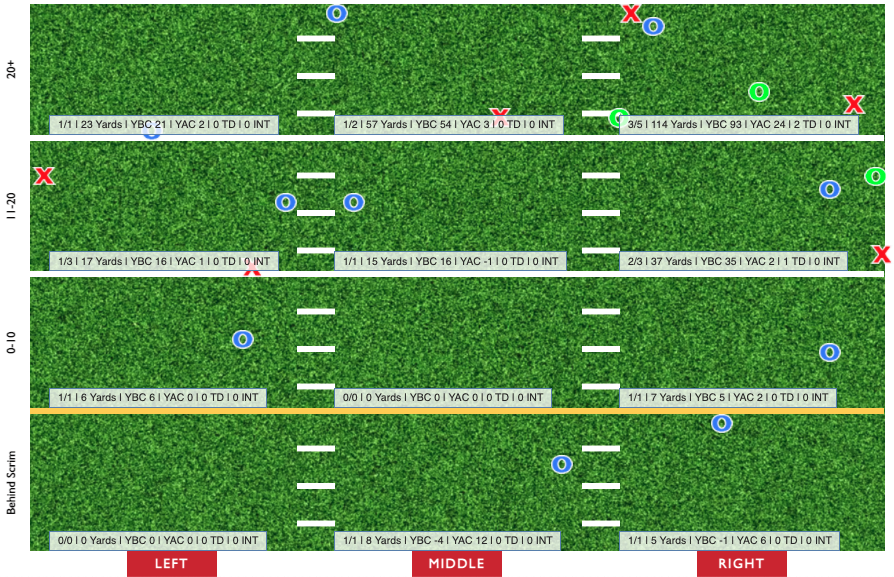
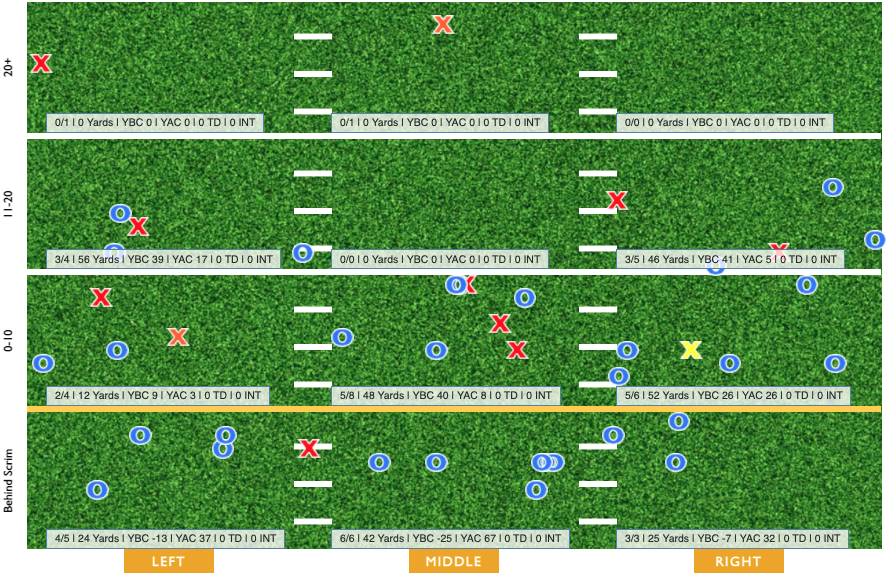
Braylon Sanders' 2020 Target Chart Jalen Knox's 2020 Target Chart
Jalen Knox is a sensible option to be the starting slot. But before last season, most of his collegiate work came operating outside. In fact prior to his position change, he was one of the SEC’s most potent pass catchers. His 16.1% Explosive Catch Rate was the SEC’s 5th-best figure ahead of last 2020. But from the H in Eli Drinkwitz’s scheme, he constantly worked short, picked on backers, and looked moderately successful. This style brought some sound analytics, but no one was jumping up and down about his subpar 7.09 Yards/Target. While Mingo was a specialist on “underneath” routes, Knox commands the conference’s top such Success Rate ahead of 2021. Expanding to all attempts on pure dropback designs (ie no screens or RPOs), he rocks the SEC’s 4th-best Success Rate, 6th-best First Down+TD Rate, and 9th-best raw Catch Rate. Changing schemes and responsibilities could prevent further amelioration towards his bottomline, but his foundation is Ole Miss’s best among this position group. While StatCat isn’t advocating for Knox to receive the kind of volume Moore received, he’s the kind of versatile receiver that Kiffin and Lebby would love to prioritize.
While the Rebels can recoup the loss of Moore through a few receivers, replacing Kenny Yeboah with Casey Kelly is bound to result in a drop-off in efficiency. Sure, the soon-to-be sophomore hauled in all eight of his targets for 115 yards, 4 first downs and a TD. But the former starter saw over two-thirds of his attempts result in situational success with the best First Down+TD Rate in the conference. Kelly could be due for 30+ targets and be a valuable pass catcher, but expecting him to lead the league in a number of bang-for-buck metrics is foolish at this point in time albeit his wonderful offensive braintrust. Pragmatically, Kelly is hardly a liability. Plus, his versatility will ensure Ole Miss's run game doesn't get too straightforward thanks his ability to pull, lead block, and shoot from a sniffer position.
Glancing at Ole Miss’s Offensive Line
Looking at the advanced numbers and the abrupt firing of former OL Coach and Run Game Coordinator Randy Clements, Lane Kiffin apparently isn’t too pleased with the product or trajectory of his guys upfront. This might come as a surprise as no SEC run game topped Kiffin and Co.’s raw attempts/game or yards/game. Plus, the scheme and skill level elevation in the backfield helped Ole Miss’s down-to-down Success Rates climb. However, their Run Havoc Rate, rush yards before contact average, and Explosive Run Rate collectively dipped year-over-year. Outside of their clip of the latter which finished top5, all of those mentioned metrics finished comfortably into the back half of the conference; as did the Rebels’ 26.7% Pressure Rate. Almost one out of ten dropbacks last year resulted in a scramble. So, the Grovers’ 4.99% Sacks Rate — which is average — is a little fraudulent thanks to Corral’s escapability. His hocus pocus skills might continue, but no doubt his blockers need to step up.
Jake Thornton is coming from the minor leagues, but seems to have the Midas touch developing youngsters. His reputation will be put to the test developing this group. The Rebels displayed a fantastic run game in spurts. But obviously, more consistency is needed from the guys upfront. Returning four starters certainly is a great place to start in terms of continuity and chemistry. Nick Broeker at left tackle, Ben Brown at center, and Jeremy James at right guard are ready to run back their roles. Reece McIntyre and Utah-transfer Orlando Umana are the main candidates to slot in at left guard. The former is still raw but started OM’s first two games as a true freshman; the latter has 26 starts under his belt but has primary played center. That said, he does have some experience at LG. Jalen Cunningham and Caleb Warren are names to also keep an eye on. Former-four star Eli Acker has the inside track at right tackle. Finding the right recipe, in addition to bringing these guys along, was one of the reasons Thornton was brought on. But as the new OL coach molds these guys to his liking, the first five could undergo some changes in the early weeks 2021 if the Rebels don’t find their footing.
Key Important Offensive Metrics in SEC Play
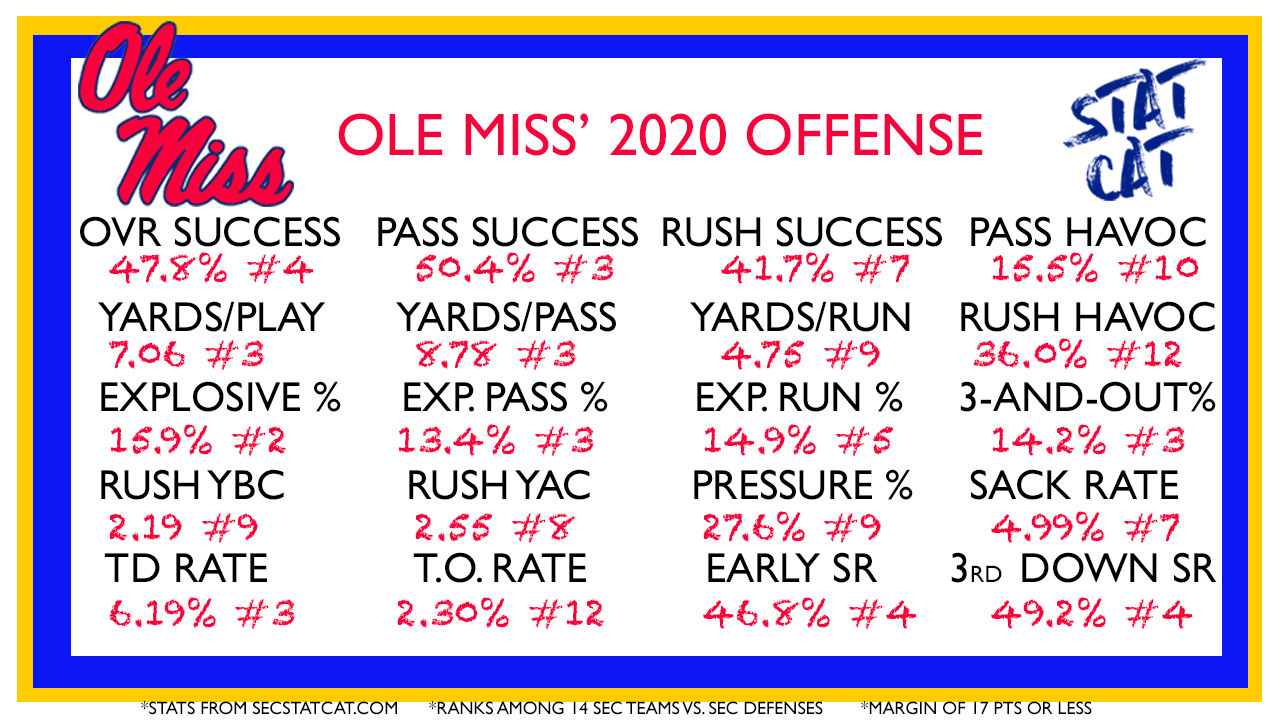
The pass game took a massive leap in 2020 and should be looked to be sustained at all costs. Though Jerrion Ealy and others were pretty decent down-to-down and delivered a healthy amount of splash runs, the Rebels averaged over four yards more per play through the air than on the ground. While over half of their attempts found situational success, their 13.4% Explosive Pass Rate cracked the SEC’s top3. When proposed with the question on 'which one stat is the most important to maintain', deciding between consistency and potency can be quite the quandary. Obviously, keeping both traits steady is the most desired course. But at the end of the day, this pass game needs to remain incendiary and threaten to score each time it drops back. Voluminous rush attempts, plenty of play action, and Kiffin's and Lebby’s own wrinkles should facilitate a decent amount of Corral’s workload. In other words, he's set up to TCOB. It helps that Corral is one of the SEC’s top returning bombers and that two of his main threats were worthy deep targets; but these plays cannot be taken for granted. After all, the winner of the explosive play battle has won 62% of games the last three years in the SEC. Still, he needs to continue coming through zipping accurate downfield completions and stay the course — and avoid those nasty blowups
For the most part, this offense finished among the conference's top5 with its major metrics. But obviously, Corral’s couple of clunkers hurt the team’s Turnover Rate. Though presumptuous, StatCat feels that self-corrects in 2021. The real area of opportunity exists upfront. In order to smooth their operation, this braintrust must focus on correcting this line’s issues allowing havoc plays. As you can see, both of Ole Miss’s such clips finished inside the SEC’s bottom5. Massive improvements aren’t needed in order for the betterment to be extremely impactful. After all, despite the constant disruptions, this offense was as formidable as any in the conference. Even a moderate reduction in havoc could turn send this offense to another level. With a double-digit Broken Play Rate and the highest Scramble Rate, redistributing those reps towards more downfield attempts certainly will help this offense exhibit its firepower more efficiently. The goal should get this group playing average; everything else beyond that will be gravy assuming the high level of chemistry and continuity carry over into this fall.
Key Important Defensive Metrics in SEC Play
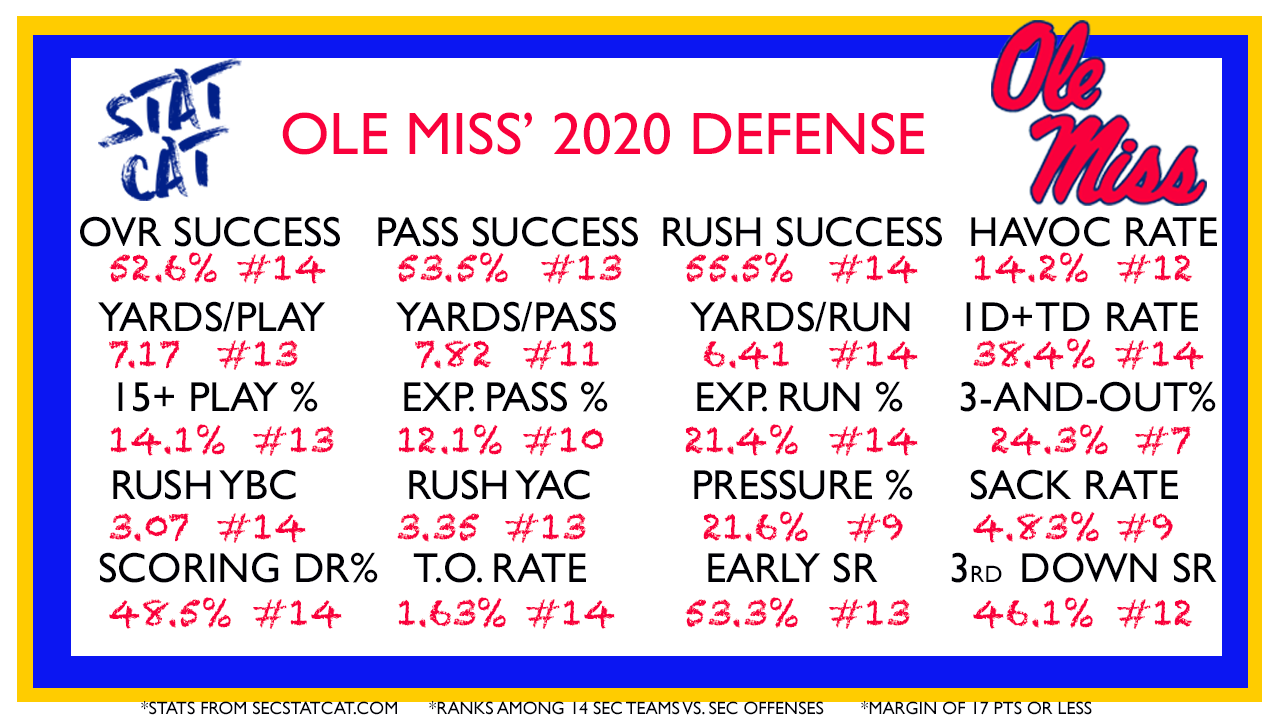
As an offensive guy, I generally gloss over defensive previews. Not that I don’t think individual defensive players aren’t valuable or dislike a blindside sack or athletic INT every once in awhile, but I typically treat that side of the ball as a collective unit. As only one guy, I can only track so much, yanno? You won’t get many fun defensive nuggets from me. That said, Ole Miss’s effort on that side of the ball seemingly gave the same level of resistance akin to tissue paper in a tornado. The Rebels were constantly blown back, whipped around, and upended to the extent that they finished inside the SEC’s bottom2 in Success Rate, Yards/Play, First+TD Rate, 15+ Play Rate, Explosive Run Rate, rush yards before and after contact, and Takeaway Rate. However, the most damning of all was representing the conference’s floor in Scoring Drive Rate. A nauseating 48.5% of Mississippi’s defensive drives surrendered points in meaningful minutes. Notably, that glaring flaw often sabotaged the Rebels’ season. Allowing over 38 points per game (or 5 TDs and a FG) puts a lot of pressure on an offense to go out and best that figure weekly. Being such an atrocious product on that side of the ball brings attention to loads of aspects this team needs to shore up ahead of this season. But at the end of the day, this defense simply can’t allow that number of points week-in and week-out if the Rebels have any chance to be a dark horse division contender.
Ole Miss returns a good amount of starters. Shoddy or no, having the majority of their defenders back should hint improvement — and perhaps even competent play — is on the horizon. Though operating under the natural assumption experience will aid future performance, this defense running back that level of woebegone returns for the second-straight year would be inexcusable. And again, glancing at their defensive profile last year hardly fills one will a sense of hopefulness. But if there’s any area for the Rebels to sustain on this side of the ball, their adequate 3-and-Out Rate would be the prime candidate. Sure, forcing one such an occurrence every four drives on average is truly nothing special. But as long as Ole Miss is at least middling at getting their opponents off the field, it will be a much needed leap in the right direction for this unit. If year-to-year progression bestows even an average level of play from this group, the Rebels could contend nationally. But allowing offenses to run train on them all season certainly will keep them on the outside looking in of the CFP; especially if they allow a 20+ yard pass every eighth dropback or 10+ yard run every fifth handoff once more.
Glancing at Ole Miss’s Schedule
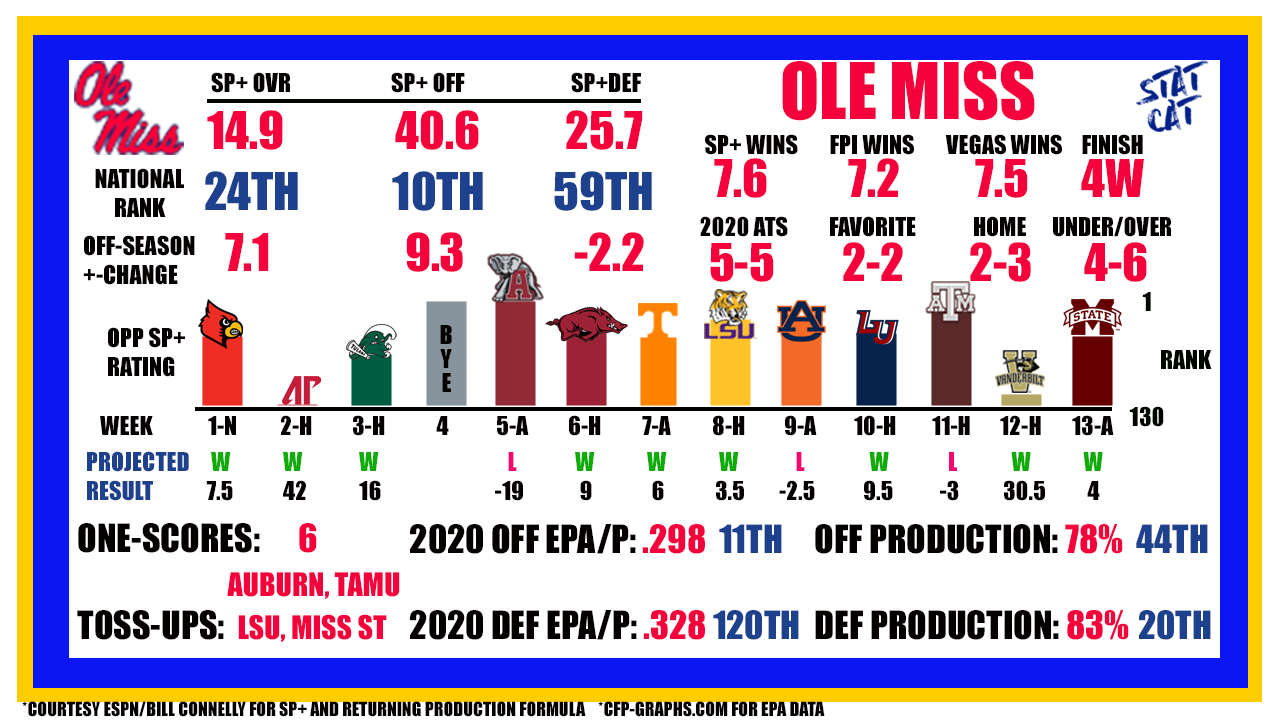
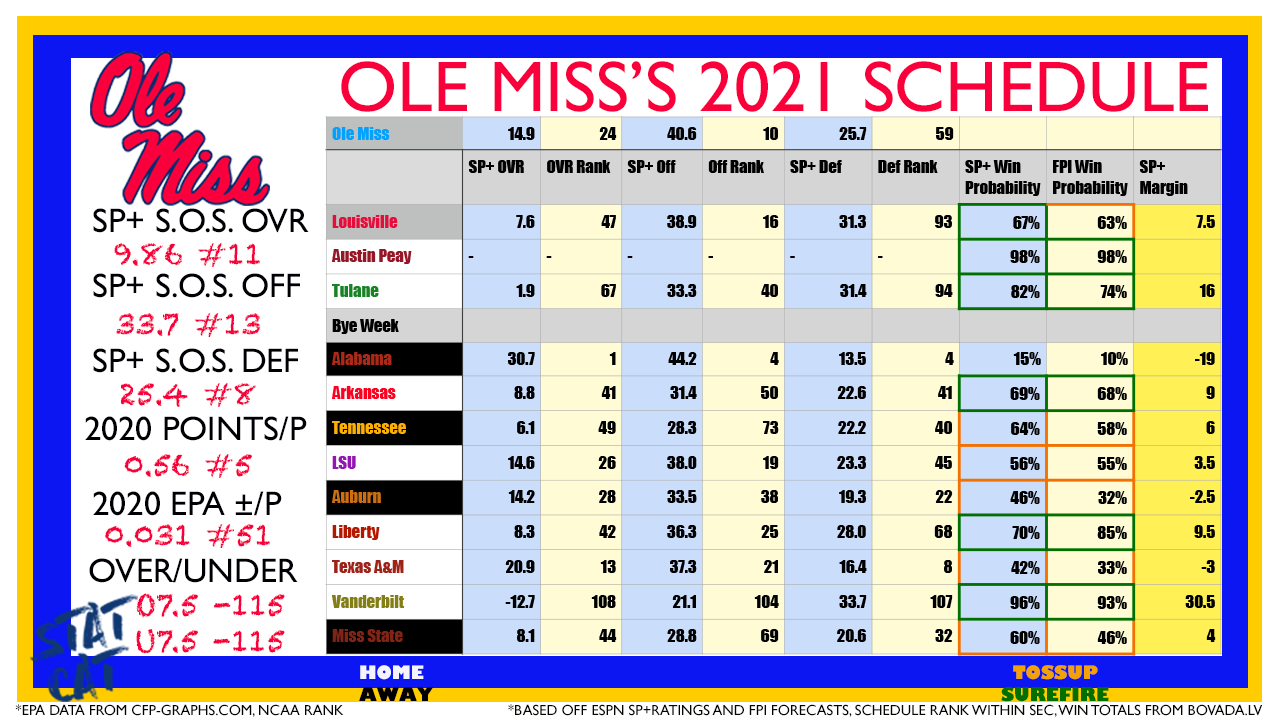
Ole Miss is a sexy dark horse candidate to contend in the West and ultimately sneak into the College Football Playoff this fall if its offense reaches its potential and its defense doesn’t totally suck. But if the Rebels wind up among the SEC’s elites in 2021, they will have to survive the conference’s 4th-hardest schedule. Looking at their offensive opponents, only LSU’s slate of foes dons a higher cumulative score than Ole Miss’s within the SEC. With five top25 adversaries on that side of the ball across its schedule, no other SECer can make such a claim. Considering the absolutely befuddling defensive effort from this team last year, that has to dampen the flames fueling the Lane Train. Though fixing the defense was a big bullet point during talking season, we are well past that stage. We’ll see how it holds up against UofL’s 16th ranked offense in Week 1. Good or bad, that should be a great barometer for what they can offer this fall. Then once they eat their two cupcakes, Ole Miss has the earliest bye in the conference, which StatCat thinks is a bad thing. After traveling to Tuscaloosa — where they project to be three-score underdogs — seven of the Rebels’ next eight games forecast as single-digit affairs; Vanderbilt being the only exception in that stretch. That slate, which includes four top30 SP+ teams, is quite a gauntlet and could create potential slip-ups considering five of those games look to be decided by one score or less. Despite the high upside, that looming risk curbs their outlook.
All in all, Ole Miss’s six one-score matchups is the second most in the conference this season. The folks in the desert are well aware of that fact and have set their under/over win total at a respectable 7.5. Interestingly enough, both ESPN’s SP+ and Football Power Index each projected the Rebels to average that amount of wins when those metrics simulated the season a boatload of times. Despite that, the two metrics have very different opinions on Ole Miss. Being the more bearish forecast, the FPI shortened their odds six points lower than the SP+’s probability in four games. In fact because of that, it flipped its pick in the Egg Bowl to Mississippi State. On the other hand, the bullish SP+ has the Rebels as an outright favorite in nine contests. And if you ask me, Auburn being favored at this point in time — even if aided by the home field advantage — seems like easy betting fodder. Obviously if they stick to that projection, they will hit their marks and continue on an upward trend. And with that overbearing offense, this team is an easy buy. Either way, the SP+ gives the Rebels six surefire wins. While that can change and this staff surely is striving for more than just a bowl birth, let’s see if fatigue and attrition kicks in when Ole Miss is in the meat of their schedule. Again, only Arkansas, LSU, and Auburn have tougher cumulative slates within the conference.