2021 Vision: Previewing LSU
2021 Vision: Previewing LSU
With talking season winding down, preview season is among us! I'm sure this isn't the first preseason article you've viewed. You should know the drill by now with these bad boys. But if this is your first experience with StatCat, be ready to learn a thing or two about the Tigers new QB1, receiver room, rushers, OL, its most important stats to maintain and/or improve on both sides of the ball, and how the LSU's schedule breaks down with help of ESPN's SP+ Rating!
LSU Passers

While StatCat would have liked to turnaround this preview series quicker, the delay in release allowed a few breaks to shake out the LSU QB competition. For the second-straight season, Myles Brennan will be sidelined significant time after an unfortunate injury, which presents a clear path for sophomore Max Johnson to start. Wasting no time and opting to rally around this young gun, Ed Orgeron quickly named him QB1 with true freshman Garrett Nussmeier backing him up. Last year, the lefty operated off of more horizontal-based patterns through the air, and the staff didn’t mind getting him on the move occasionally. On the other hand, Brennan was more stationary, statuesque, and inclined to test secondaries vertically. But of course with fate deciding the winner of the QB gig for the Tigers, new play caller Jake Peetz doesn’t have to learn that dance of tailoring his designs specifically one passer’s skillset. Going all in on Johnson will have this offense hopefully in lockstep from day one with a clear plan moving forward. Had the positional skirmish extended a few weeks, LSU’s unit might have been more well-rounded but less sharpened.
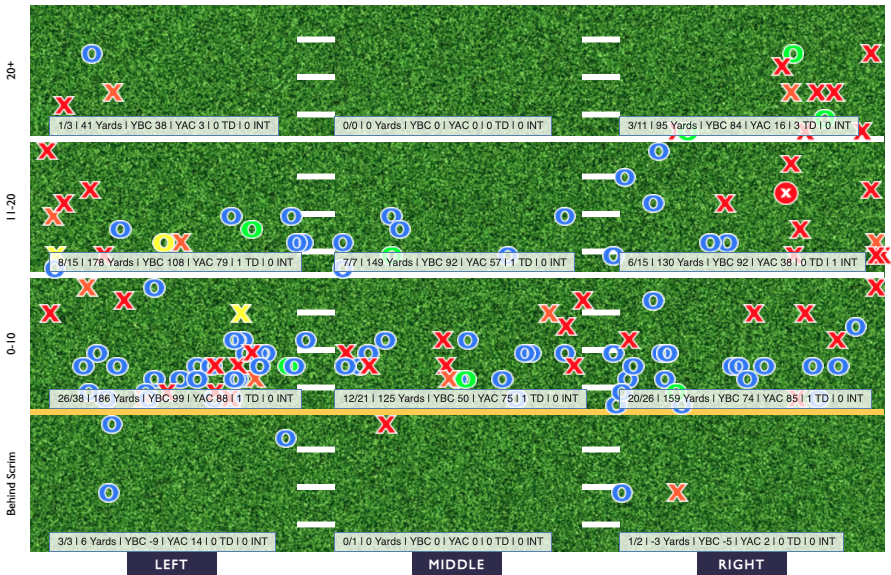
Johnson’s natural arm talent as a first year was adequate but generally vanilla. That said, loads of folks love vanilla because it hardly disappoints while offering potential for supplemental enhancements like nuts, chocolate syrup, chunks of candy, or what have you. His zip, pop, and snap throwing the ball should improve as he gets older and stronger — as should his downfield drive — but Johnson’s God-given accuracy presents a fantastic foundation for him to build off of as a passer. Plus, his boogie gives this offense an element it otherwise would have lacked with Brennan. Not that he’s a burner in the open field, but Johnson’s backyard skills seem capable, which boosts his upside as a prospect. Cumulatively, most of his freshman numbers were relatively fine but overly looked up to Brennan’s returns. No SECer rocks a lower Interceptable Pass Rate, and his Depth Adjusted Accuracy% cracks the top3 amongst returners. Despite serving up a lot of deep duds, his accuracy marks beyond 20+ yards downfield hold the SEC’s bronze medal ahead of this fall. His on tape traits might be humble, but floor as a passer nonetheless appears to be elevated. On clean+dropback attempts (aka pure instances where a passer is asked to go out an execute), all four of his ball placement metrics sit inside the top4 including the SEC’s 2nd-best 56.3% Depth Adjusted Accuracy. Considering he was dreadfully underwhelming with this result-based metrics in this context, its assuring to see his precision wasn’t a mirage. Still, Johnson’s figures leave plenty to be desired. Overall amongst his peers, the sophomore ranks no better than 6th in Success Rate, raw Accuracy%, First Down+TD Rate, Explosive Pass Rate, Uncatchable Pass Rate, and Yards/Attempt. Sure, there are plenty of things to be excited about Johnson’s passing profile especially considering the shift back to Joe Brady’s scheme. But, the youngster has a good amount of warts on his profile to address in the short term
Prior to Brennan’s injury, LSU had the best QB room in the conference. Despite iffy play on latter downs and being a subpar performer playing backyard ball, he was overly the SEC’s most accurate returner. While donning the SEC’s second lowest Uncatchable and Interceptable Pass Rates ahead of this fall, he trumpets the conference’s top Depth Adjusted Accuracy% with a 57.6%; only Feliepe Franks and Mac Jones topped that figure in 2020. One of the major reasons for his mighty weighted precision figure was due to his deep passing ability. No SECer bested his ball placement figures 20+ yards downfield last year with 47.4% of such chances being deemed accurate by my charting. In dropback situations — especially when he’s kept clean — his accuracy shines, which rises his floor as a passer. But as LSU fans saw at last year, he wasn’t particularly strong on 3rd down; nor was he sound under pressure. Brennan is in the mold of Jarred Goff. Both are blonde, air raid-esque passers who can be lethal within structure but are mostly gingerbread men when designs fail or duress arises. Not that that archetype is a deal-breaker, but pro scouts have started to put an increased emphasis on one’s mobility, which again the Tiger overly lacks. Though it’s a silver lining his non-throwing arm was the one damaged, the odds aren’t strong he’s able to make an impact for this offense, which clouds his outlook beyond 2021.
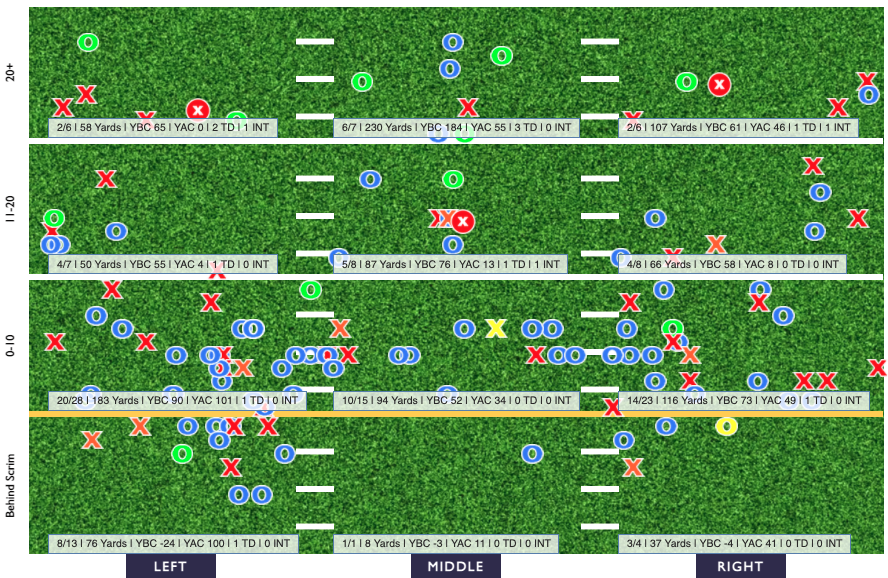
Max Johnson's 2020 Pass Chart Myles Brennan's 2020 Pass Chart
LSU Rushers

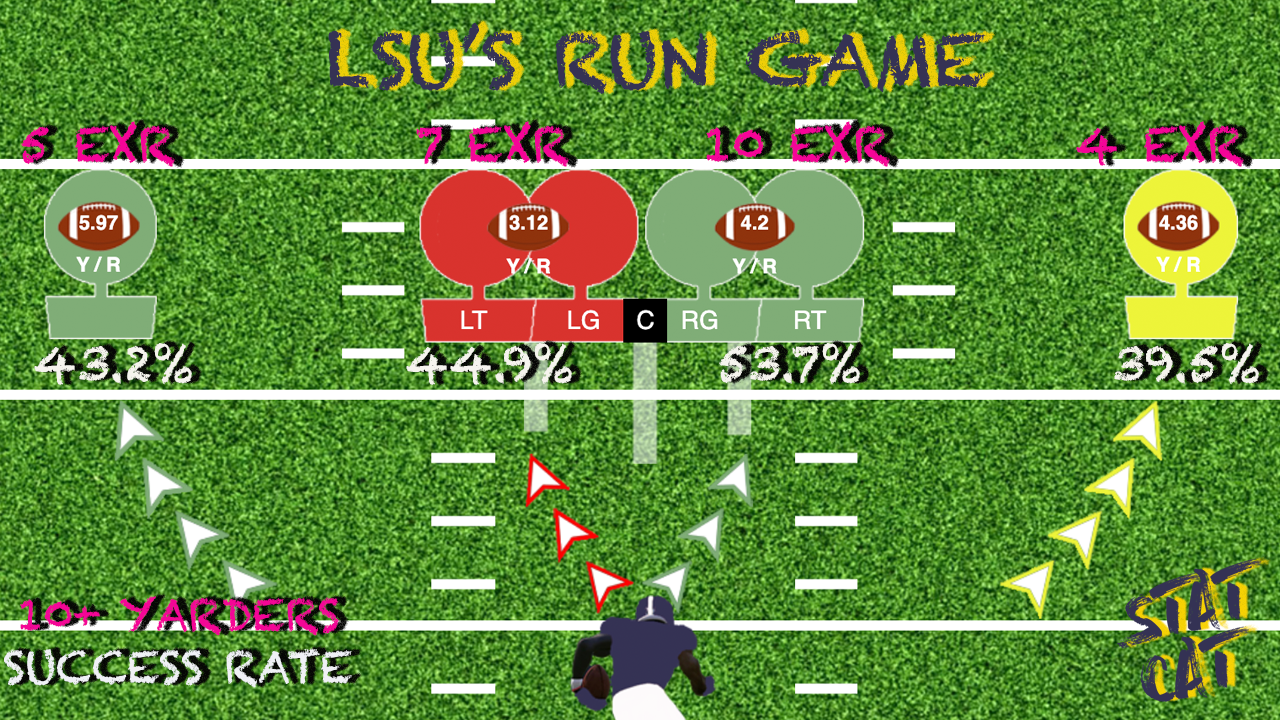
LSU’s rushing attack suffered a tremendous drop-off in execution in 2020. After seeing the team’s rush yards before contact average sliced in half year-over-year against conference foes in meaningful minutes, LSU’s Yards/Carry went from an SEC-high to an SEC-low while its Rushing Success Rate dipped nearly eight percentage points. No Tiger ball carrier with at least a dozen touches averaged over 2 YBC. The early contact minimized splash runs as the team’s 8.5% Explosive Run Rate was practically a third of its figure from LSU’s championship campaign. Considering all that, the end result could be categorized as what we in the football information industry refer to as "f***ing terrible". Though the Bayou Bengals sought to play small with their efforts on the ground, I’m sure they didn’t strive to shrink their returns.
Since Tyrion-Davis Price logged the most yards and attempts last season, let’s treat him as the Bayou Bengals’ lead back to kick off the positional preview. His profile entering 2021 is hardly one to drum up much excitement. Sure, his 52.9% Success Rate placed 7th within the conference last fall. But when you dig deeper on how that metric came to be, the numbers scream TDP wasn’t special in the slightest. Of course as aforementioned, he wasn’t immune from suffering from poor cushion upfront. Still, he was hit behind the line on less than 10% of his carries — the second lowest figure among the volume guys in this conference — and his 4.8% Negative Run Rate placed 6th within the SEC. At the end of the day, Davis-Price lacked fire. He failed to crack the top14 in YAC average, Broken Tackle Rate and Gumption Rate — stable metrics designed to measure how a ball carrier manages things he can control and how he responds to adversity. With such a sluggish showing, optimism around TDP’s output is tempered. His result-based metrics like Y/C, First Down+TD Rate, and Explosive Run Rate all failed to finish better than 22nd among his peers.
Situationally, he delivered his best returns when opponents were distracted by other elements of LSU’s offense: on first downs and when behind the chains; both spots where the Tigers’ pass-first ways were generally the course of action. With defenses eying the outside or anticipating a dropback, Davis-Price secured a top3 Success Rate in each context amongst returning SECers ahead of this fall. That said --as you might suspect with LSU's modus operandi at work -- he rocked the conference’s 4th-highest short yardage makeup. With over a fifth of his tries occurring with three yards or less to gain, his near 70% Success Rate in these instances inflated much of his production even if his play was relatively whatever. Schematically, TDP found most of his efficiency via power looks. In LSU’s streamlined ground game, that translated to leaning on the north-south gap design Duo Dive. Compared to his attempts off zones, Davis-Price’s Success Rate and First Down+TD Rate were 17 and 21 percentage points better, respectively. For what it’s worth, these carries benefited from 0.7 more rush yards before contact on average, and the Tigers’ stable metrics appeared to be slightly better in the other facet.
Ignoring the pass game, John Emery has typically been utilized in the same fashion as Davis-Price. But despite functioning as the Tigers’ beta back, he secured a team-high Broken Tackle Rate, YAC average, Yards/Carry, Explosive Run Rate and Gumption Rate — or percentage of runs where contact occurs behind the line of scrimmage and a positive gain is made. His figures of the first two stats mentioned sit as the conference’s 3rd-best and 4th-best clips ahead of this fall. If Coach O or his new offensive braintrust value stable metrics, Emery could be the guy to trot out with the ones despite donning a snooze-worthy resume on the surface. TDP’s stables have looked up to Emery’s each of the last two seasons even though the latter has experienced much less volume in comparison. This past year, only Alabama’s Brian Robinson saw a higher percentage of his output occur after contact than his 67.5% makeup within the SEC. If the question is: Who runs with more fight and zeal, Emery appears to be that guy despite possessing a less domineering physical build.
With Tre Braford transferring to Norman, LSU’s tertiary option will either be former walk-on Josh Williams or one of its incoming four-stars in Armoni Goodwin and Corey Kiner. A strong pass game and multiple weapons on the outside hopefully won’t necessitate a need for the Tigers to shoehorn anyone into the lineup or use a deep RB rotation. But if the production from this position group is again anemic, the possibility of throwing more bodies into the fold can’t be dismissed.
LSU Catchers
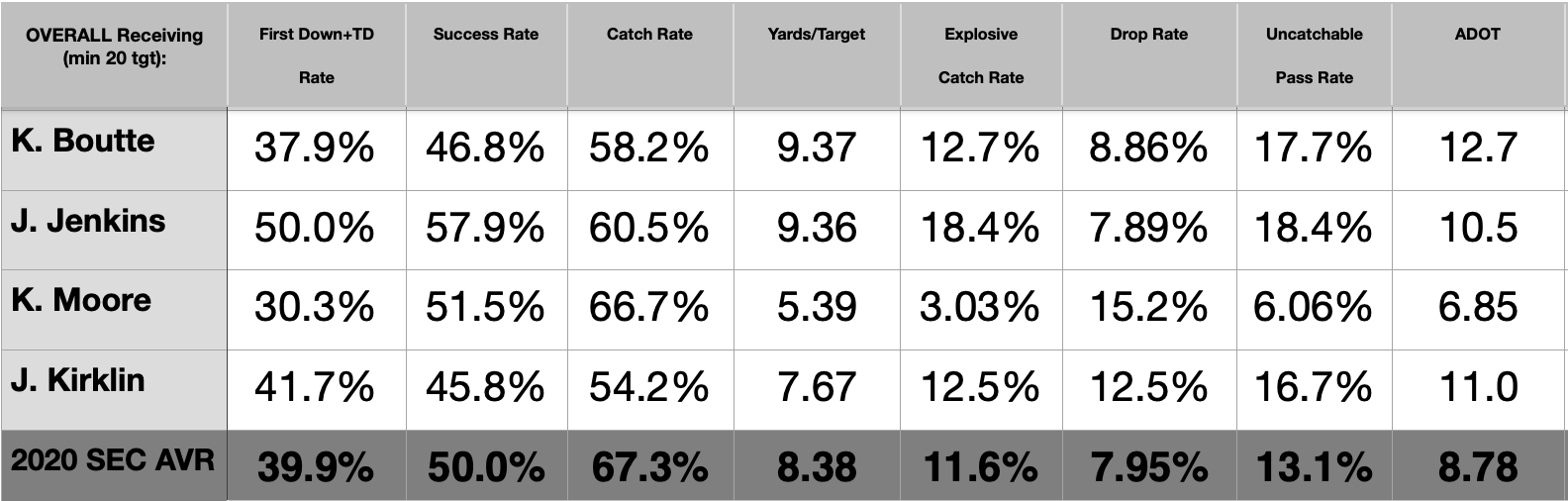
No. 1 in LSU’s roster is poised to be its primary pass catcher in 2021 after a furious and fantastic close to last season. He more than doubled the next-closest Tiger in targets and catches while quintupling the runner-up in receiving yards. With over a fifth of his chances resulting in a gain of at least 20 yards or more in those three games, his 12.3 yards/target and 55.8% Success Rate trumped his respective cumulative figures by over three yards and nine percentage points. Plus, a seventh of his catches resulted in a TD. Though four drops during that stint sours his resume some, Kayshon Boutte clearly kicked butt down the stretch; and because of that is the Tigers most voluminous receiving option for this fall. At the end of the year, he accumulated more targets, catches, and yards than the Bayou Bengals’ next two receivers combined. Since I know you’re curious, the plurality of Boutte’s production was generated off midrange opportunities. No returning SECer totals more than his 330 such yards on attempts between 11-20 yards downfield.
There’s no getting around the awesome effect the final three matches had on his bottomline and his outlook. But if we were to include his entire play over the course of 2020, a good deal of his efficiency metrics fail to excite. His Success Rate, First Down+TD Rate, and Depth Adjusted Catch Rate all fell under the SEC mean. A major source for his statistical shortcomings came from targets outside the numbers. There, he only corralled 14/33 chances (compared to 35/46 of his remaining opportunities). As a result, his comparative Yards/Target was practically half of its counterpart. Generally speaking, these faults were out of Boutte’s hands. Despite dropping a pair of passes, a dozen of his targets outside the numbers weren’t catchable. I’m sure you can do the quick math on how those throws deteriorated the Tiger’s outlook. Outside of sharing a jersey number, it’s easy to get Ja’Marr Chase vibes. Boutte’s targeted route tree had a striking resemblance to Chase’s from 2019. Slants, goes, comebacks, and screens made up over half of his chances. Plus, the common potency coming from the X-spot is apparent. While there’s evidence his overall figures should improve, the Good, Ole-Fashioned Eye Test is firmly in Boutte’s corner ahead of this season.
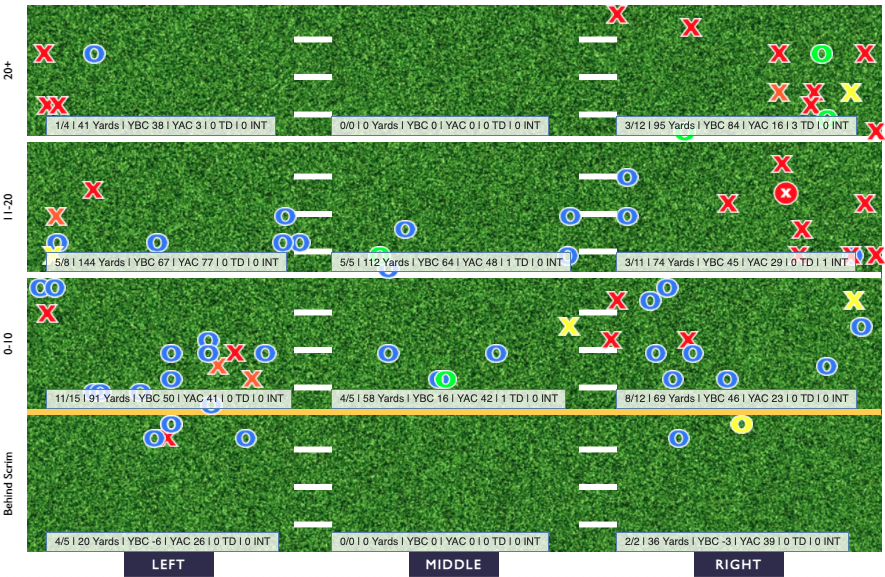
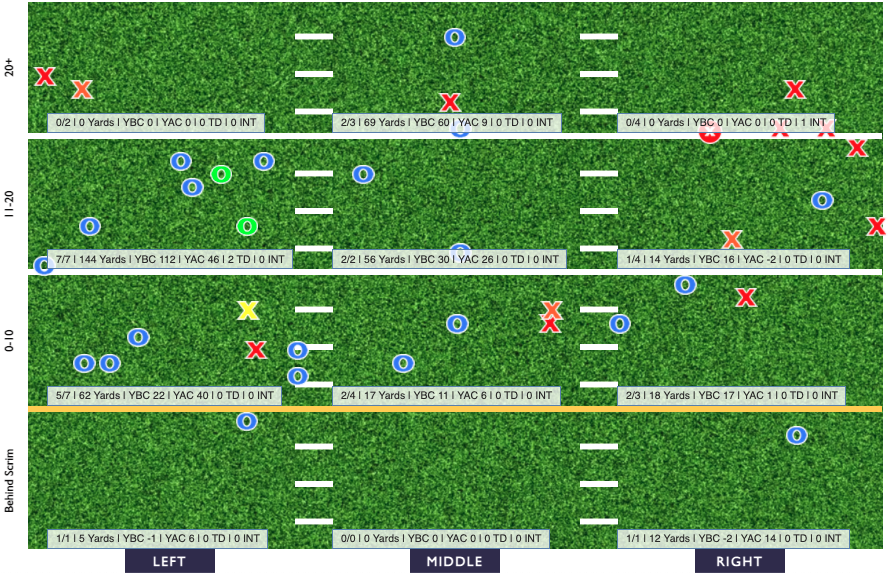
Kayshon Boutte's 2020 Target Chart Jaray Jenkins' 2020 Target Chart
Presumed to operate as LSU’s Z-receiver, Jaray Jenkins is this offense’s 2nd-most productive returner for this fall. That said, his counting stats are rather unassuming. In his tenure as a Tiger, Jenkins has yet to amass more than five catches or 90 yards in a game. Despite a snooze-worthy profile on the surface, he dons serviceable efficiency and stands to be among the conference’s top performers in a couple of categories. Along with logging a team-high 10.5 Yards/Target, 57.9% Success Rate, and 18.4% Explosive Catch Rate, only Racey McMath suffered from a worse Uncatchable Target Rate than his 18.4% clip. Jenkins was his best self on early downs. No returning SECer boasts a preferable Yards/Target, Success Rate, or First Down+TD Rate in these spots. In fact, his two clips of the latter each have a buffer of about ten percentage points over the next man in line. Every single one of his first and second down catches resulted in success as his 91.8% Depth Adjusted Catch Rate holds the bronze medal. While Boutte’s volume figures were held up by his midrange production, Jenkins’ showings in that area of the field buoyed his efficiencies. Excluding tight ends, his such Yards/Target and Depth Adjusted Catch Rate remain in the top spot while a fifth of these attempts resulted in points. Though inconsistent usage kept his traditional metrics down, he’s an easy complimentary option to like ahead of 2021.
Koy Moore, Jontre Kirklin, and Trey Palmer will round out the position group and likely fight for the honor of LSU’s slot. Based on his previous workload, Moore is the current frontrunner. Logging a team-high Catch Rate is satisfactory on the surface, but no Tiger put up a lower average depth of target or a higher Drop Rate. Yes, over half of his chances resulted in situational success. But, Moore’s muted M.O. should create some pause. Of his 33 targets, 25 occurred less than ten yards downfield. And since he rarely put up much effort after the catch, only one of his receptions topped 20 yards. While Joe Brady’s philosophy asks inside guys to work underneath ala slants, drags, ins, and hitches, this offense cannot have its main threat inside logging the worst Yards/Target on the team (5.39). With that, opportunity exists for Kirkin and Palmer to steal some snaps even if their own samples hardly instill great excitement.
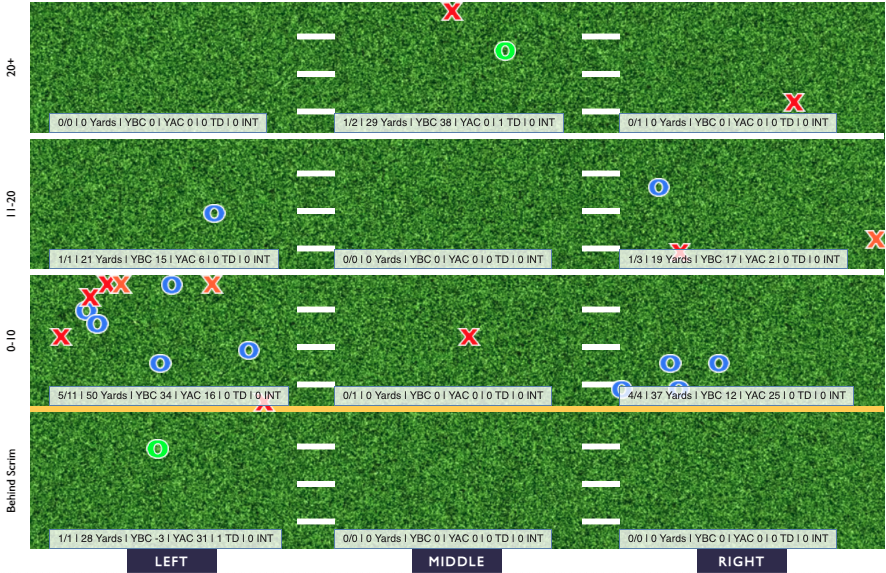
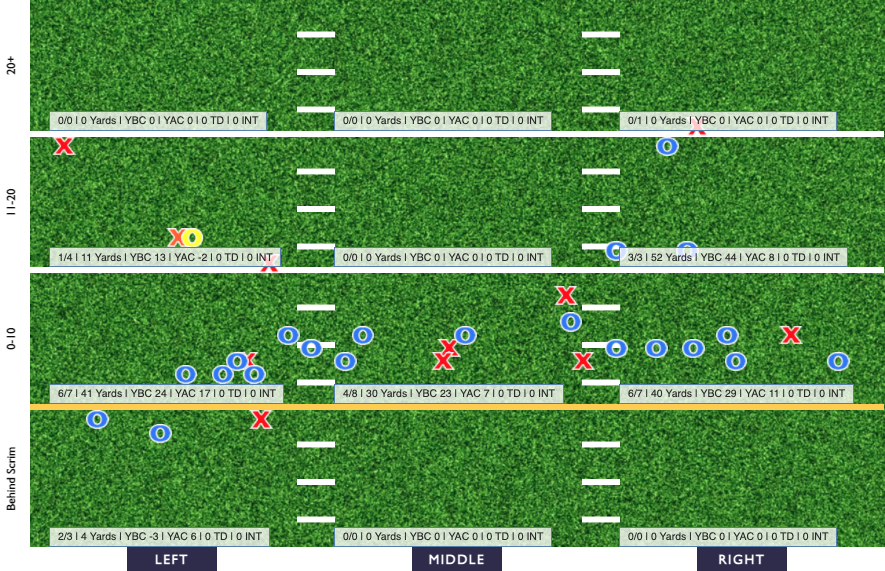
Jontre Kirklin's 2020 Target Chart Koy Moore's 2020 Target Chart
Arik Gilbert’s transfer was undeniably impactful. But thanks to how LSU utilizes its tight ends, his loss can be managed even if there’s no clear option to provide solace for the passing game. Though Gilbert appears capable of shooting down the seam or testing secondaries beyond ten yards downfield, he overly operated as a safety valve, check down, or supplementary pass blocker. Sure, his own makeup doubled Thaddeus Moss’s rate of chances past the sticks, but 70% of his targets came 11 yards inward. No doubt, that style had a hand in Gilbert growing disgruntled and taking his talents to Athens. Kole Taylor is presumed to be the next man up. Without much sample or tape, his best selling point comes via his 6’7 frame. That surface area could be nearly impossible to miss if LSU’s previous methodology with this position group continues. And while its far from a sexy ask, operating as an occasional sixth offensive lineman will help LSU’s vertical passing game take flight. Taylor could play himself into an important role like Moss before him. But for now, StatCat refuses to set any lofty expectations ahead of 2021.
Glancing at LSU’s Offensive Line
LSU’s offensive line was a mixed bag in 2020. To reiterate, the pass game transformed from an all-time great to glaringly mediocre product in the span of a season. Consequentially, box defenders re-dedicated their efforts to clogging LSU’s ground game. Year-over year in league play, LSU went from first in rush yards before contact average and Explosive Run Rate to dead last. The Tigers’ clip of the latter was sliced by roughly two-thirds. But despite the early contact, the line reduced their Run Havoc Rate by seven percentage points. While they ranked 2nd-to-last within the SEC in 2019, the Tigers were at least mediocre in that respect last year. Still, the early contact and uninspiring effort paving run paths without the aid of a strong pass game is worrisome. This battle-tested bunch needs to muster some zeal and rediscover its confidence pushing guys around. Despite the blah efficiency through the air, LSU’s veteran-laden line was pretty sturdy in pass protection. With less empty usage, their line operated on an island far less than the year prior. As a result, the Bayou Bengals’ big boys produced a top3 Pressure Rate and top5 Sack Rate in league play. Reincorporating Joe Brady’s philosophy will likely see five-wide sets return to the field; so don’t be surprised if those clips slip a bit moving forward. Outside of Dare Rosenthal transferring to Kentucky, LSU returns its entire front. Replacing the former left tackle is Cameron Wire. Chase Hines and Ed Ingram return at guard, Liam Shanahan at center, and Austin Deculus at the other bookend. Again, pass pro looks to be this unit’s strength. With an aerially-inclined offense, that’s never a bad thing. But for the Tigers to reclaim overall eye-popping efficiency, they have to rediscover some fight in the trenches behind improved run blocking.
Key Offensive Metrics in SEC Play
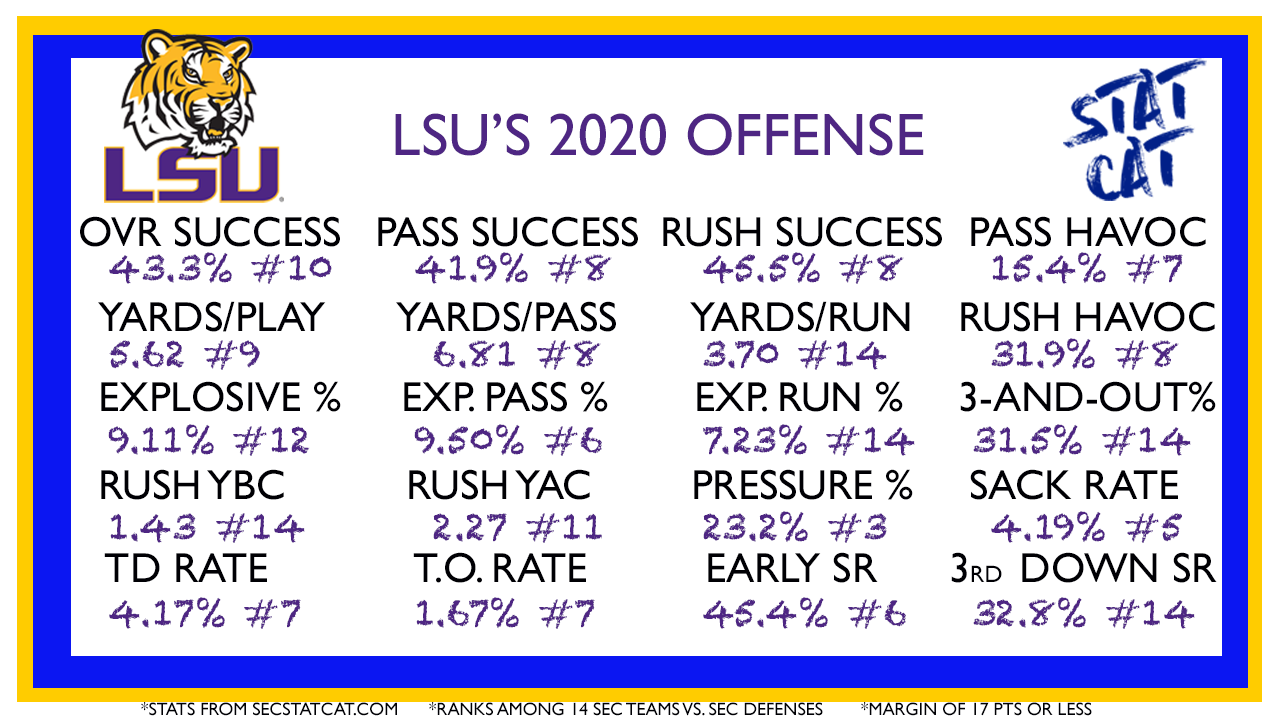
Outside of their Run Havoc Rate that finished second-to-last in league play, LSU finished inside the SEC’s top5 across the board in most major metrics in 2019. Fielding one of the best offenses of all time, the Tigers were either first or second in Success Rate (overall, run, and pass), Yards/Play (overall, run, pass), Explosive Play Rate (overall, run, pass), TD Rate, TO Rate, Sack Rate, and 3-and-out-Rate. Both of the Tigers’ early down and 3rd down Success Rates also reached that threshold with the pair each sporting marks north of 53%. No matter the situation, Steven Ensminger and Joe Brady had their troops prepared to execute. A year later, only two of the Bayou Bengals’ offensive stats cracked the conference’s top5. As most of their shine rusted over, more metrics finished dead last than met that criteria this past fall.
Their biggest faults fell with their hapless ground game and inability to create consistent cushion — LSU finished 14th in YBC, Yards/Carry, and Explosive Run Rate. No doubt, those metrics transforming from elite to egregious in the span of a season truly clipped this unit’s output. Running back that level of toothlessness likely will prevent LSU from finishing among the conference’s best offenses. Granted, the Tigers will still lean heavily into the pass. But when this run game is set up to be advantageous with reduced box counts or short yardage situations, it has to bring about value even if splash carries might be infrequent. Moreover, this offense must recover some dependability on the money down. Going from mighty to middling down-to-down is one thing. But it’s another seeing your 3rd Down Success Rate plummet over 20 percentage points in league play (!!!). Overall, less than a third of these tries resulted in success. Within structure and on schedule, LSU’s pass game was fine. But it completely fell apart in these spots. Both Brennan and Johnson ranked inside the conference’s bottom3 in such Completion%, Success Rate, Yards/Attempt. Though an offense should never set themselves up for extended opportunities on thirds, we all know the better winning recipe is to do rather than die more often than not. Plus, the abundant money down miscues fueled the SEC’s worst 3-and-Out Rate. Asking the Tigers to boost their performance in these spots is trite and basic. But that doesn’t mean this plea lacks gravitas. Savvy, experience, and better looks should boost their bottomlines. Plus, LSU doesn’t need to light the world on fire and jump up back to the top of the SEC rankings; just don’t be God-awful. This offense is too talented to represent the conference floor in a handful of worthwhile figures for the second-straight year.
Key Defensive Metrics in SEC Play
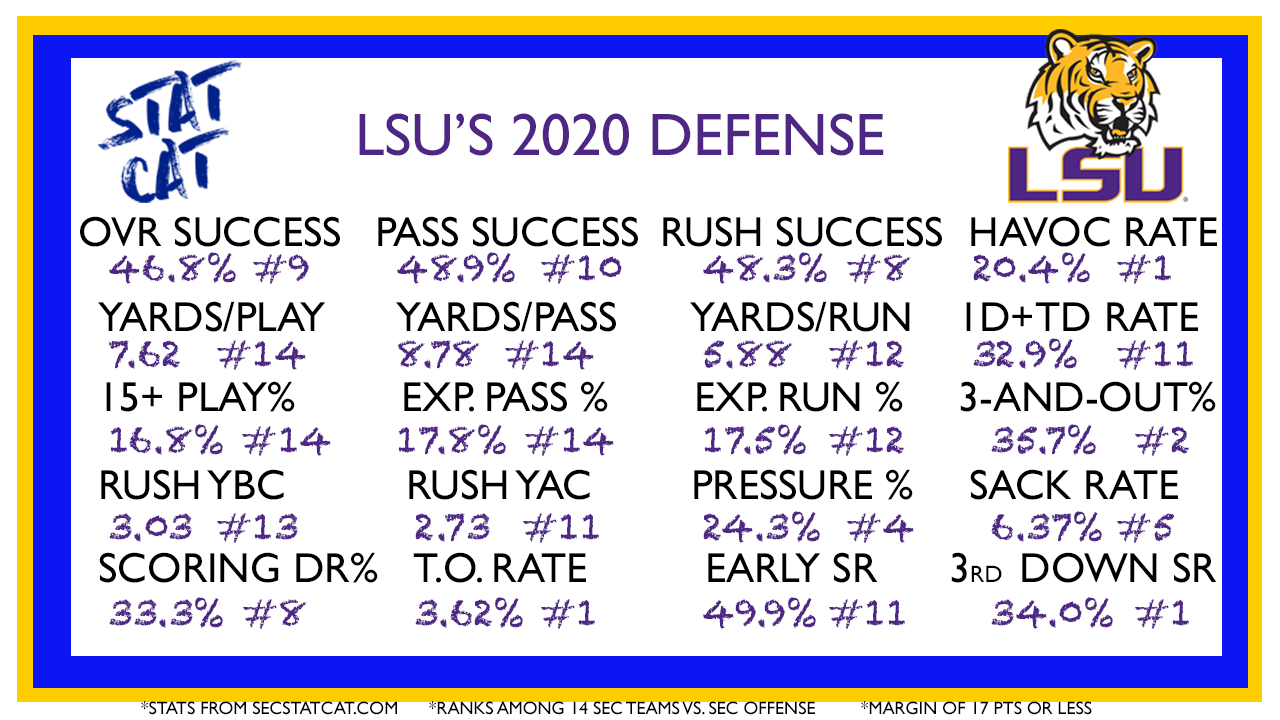
As an offensive guy, I generally gloss over defensive previews. Not that I don’t think individual defensive players aren’t valuable or dislike a blindside sack or athletic INT every once in awhile, but I typically treat that side of the ball as a collective unit. As only one guy, I can only track so much, yanno? You won’t get many fun defensive nuggets from me. Plus, you don’t really need StatCat to inform you that LSU’s 2020 defense was misguided and mind-numbing. This defense will go down as a cautionary tale to braintrusts honing in on generating havoc above all else. The aggressive tactics did exactly what they were designed to do: create disruption and generate opportunities for this defense to make plays; but they also left the Tigers extremely vulnerable to surrendering splash gains. LSU led conference play in Havoc Rate, Takeaway Rate, and 3rd Down Success Rate, but Bo Pelini’s defense donned a league-high Yards/Play and 15+ Play Rate while finishing comfortably in the back half of the SEC in most down-to-down metrics. With the third play caller in just as many years, Coach O is banking on a base cover-4 approach to better cap big gainers. In addition to 2-deep coverages' edge against the pass, the symmetrical quarters has become increasingly popular to deal with RPOs. Despite the change in philosophy, the Tigers return all of their starters minus safety JaCoby Stevens and backer Jabril Cox. Continuity on that side of the ball is golden as is rocking the nation's premiere coverage duo in Derek Stingley and Eli Ricks. With talent and new direction, optimism is high in the Bayou Bengals to re-establish a quality unit.
StatCat is still a believer in havoc. While there’s something to be said about passive approaches, units just can’t sit back and hope their opponents mess up a lot.
As defenses have steadily become more bend-don’t-break, situational execution is paramount. Getting an offense off-rhythm and uncomfortable consistently is bound to affect their operation, get them out of their routine, and occasionally force them to press. Again, LSU was quite good at delivering wins on 3rd downs and manufacturing 3-and-outs. Though undeniably a hard ask with the philosophy adjustment, maintaining those elements would be a miraculous accomplishment. Still, that schematic shift tips Orgeron’s hand into what he believes is the most important aspect for this defense to address: explosive gains. In this conference over the last three years, winners of the big play battle have won 62% of games — that’s a higher figure than those who logged more time of possession, preferable production the middle8 and more takeaways. Havoc still matters; not just as much as limiting field flipping gains that often result in scoring opportunities. Again since both the Tigers’ Explosive Pass and Run Rate finished inside the SEC’s bottom3, LSU needs to address that glaring shortcoming before all else this fall.
Glancing at LSU Schedule
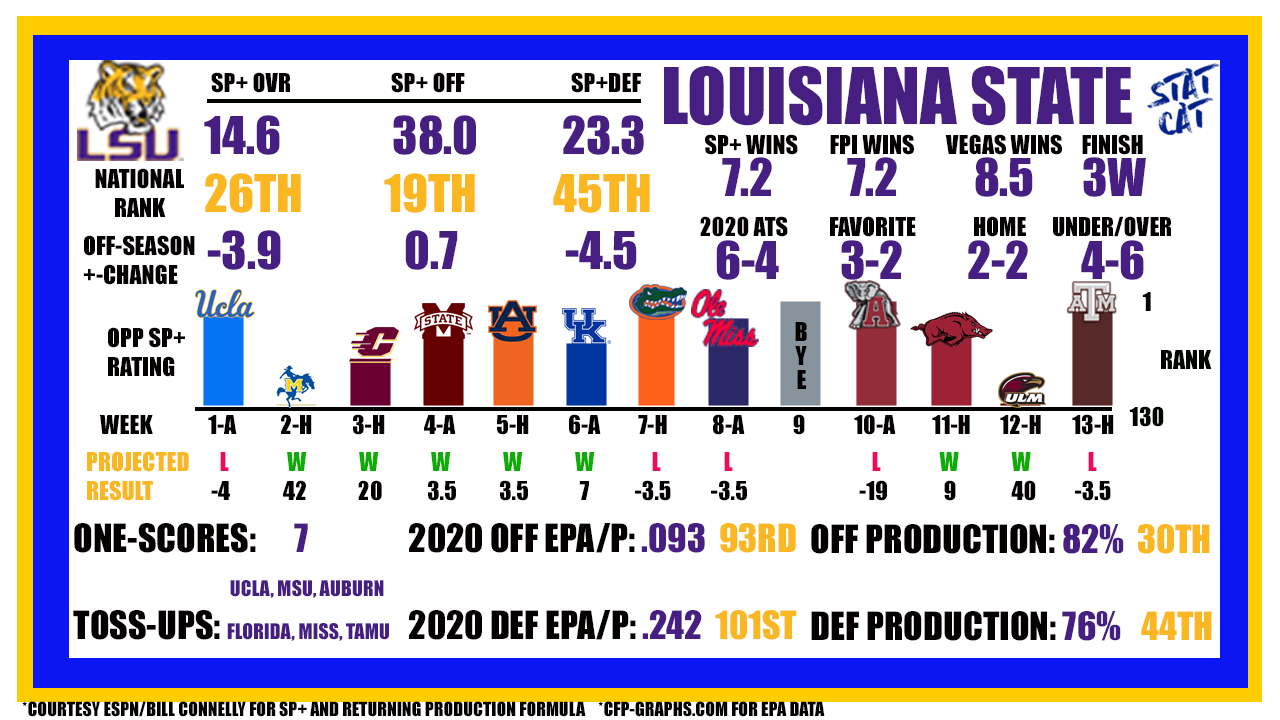
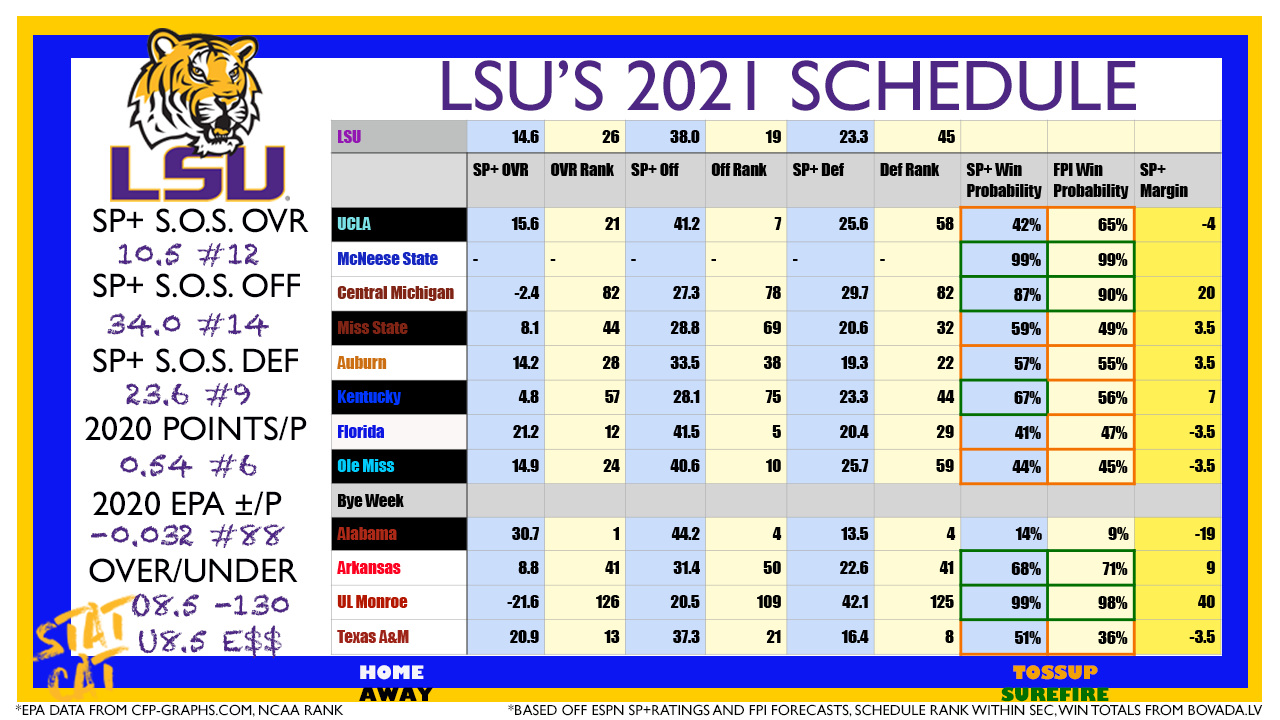
While a lot of Bayou Bengal backers are certainly yearning for things to stabilize on the gridiron, the Tigers have one of the trickiest schedules in the conference. Already with the SEC’s 3rd-hardest strength of schedule, over half of their games project to be decided by one score or less according to ESPN’s SP+. As a victim of the randomness of college football last year, one can’t rule out lighting from striking twice in this context due to the shear volume of close contests in the forecast. Sometimes that oblong ball bounces strange ways, man. In fact, LSU’s bombarded defense will have to rebound from last year’s unsatisfactory performance versus the conference’s most challenging offensive slate. With so many iffy games, that’s a rather inauspicious fact looming over the Tigers' fall. If their OFF opponent’s SP+ ratings were averaged out, their weekly opponent would be akin to Auburn’s unit. Though on the surface that might not seem too daunting, expecting a winning margin of a FG each week highlights the presumed volatility from these Tigers. If Max Johnson plateaus and the defense remains porous, LSU very well could serve up its second-consecutive five win season. But on the other hand, LSU could immediately vault back into the college football zeitgeist with another meteoric campaign by TCOB in their tossups.
That potential starts in Week 1 against Chip Kelly’s UCLA Bruins. Coming in as four-point dogs, the Tigers will face their 2nd-easiest Power5 defense of the year. If the rejuvenated offense struggles in the opener, LSU could be in for another rough outing. But say they can hold on in a shootout or otherwise blow the doors off the Bruins, entering conference play 3-0 will never be a bad thing. After that, however, the real trials begin. LSU has five straight conference games forecasted to be decided by a touchdown or less before it can limp into its bye. Without question, this string of games is the most important stretch on their schedule. Though stumbling through with a 3-2 record isn’t the worst thing, that performance would most likely keep the Tigers on the outside looking in of the CFP, which is the ultimate goal. Traveling to Tuscaloosa unscathed after a bye, on the other hand, hits different and would be must-watch TV (or streaming experience or whatever). No doubt if the Joe Brady philosophy reemerges, that 19-point predicted margin will shrink considerably. Inversely, the Tigers odds in its remaining three games will enhance. But at this point, both ESPN’ SP+ and its Football Power Index are pessimistic LSU return’s to 2019’s form…or even 2018’s or 2017’s. Talent and optimism has placed the Tigers under/over win total at 8.5, but both metics think a 7-win fall is the most likely scenario. Ultimately, the numbers just can’t ignore the slim margins across their schedule and concur slip-ups are pretty plausible. But, you sure as hell still can when betting on LSU’s upside!