2021 Vision: Previewing Auburn
2021 Vision: Previewing Auburn
With talking season winding down, preview season is among us! I'm sure this isn't the first preseason article you've viewed. You should know the drill by now with these bad boys. But if this is your first experience with StatCat, be ready to learn a thing or two about the Auburn's QB1, receiver room, rushers, OL, its most important stats to maintain and/or improve on both sides of the ball, and how the Tigers' schedule breaks down with help of ESPN's SP+ Rating!
Auburn Passers

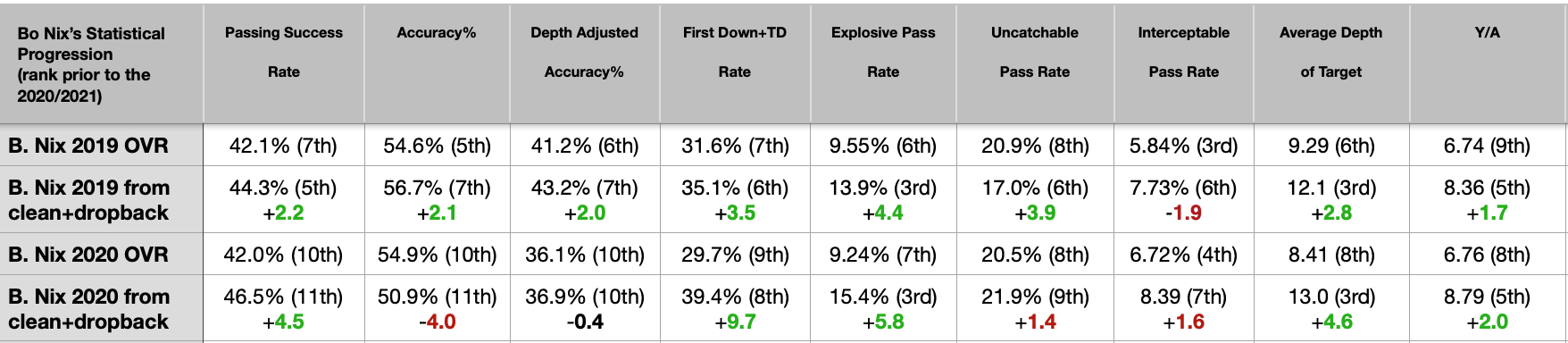
Spoiler alert: Bo Nix did not have a good sophomore season. Despite “QB Whisper” Chad Morris’s intentions, the Tiger regressed and was noticeably shellshocked by 2020’s end. Even with Morris calling plays, the offense maintained its previous affinity for RPOs in a futile attempt to squeeze any bit of efficiency out of Auburn’s pass game. For the second straight year, Nix’s RPO Throw Rate cracked 25%. Sure, part of that was fueled by the braintrust’s shared belief in those designs' capabilities to wear down opponents. But, the biggest catalyst was Nix’s stagnation executing pure dropbacks. Either from lack of trust in his green blockers or due to his own jumpiness in the pocket, he constantly broke rank, which heightened his degree of difficulty. With numerous chances from inconsistent platforms, his accuracy and ball placement never stabilized. The Plainsman moved backwards year-over-year in Success Rate, First Down+TD Rate, Depth Adjusted Accuracy%, Explosive Pass Rate, and Uncatchable Pass Rate. Both his raw Accuracy% and Y/A only marginally improved. Behind the mentioned regressions, Nix enters this fall inside the conference’s bottom2 in overall Success Rate, Accuracy%, and Depth Adjusted Accuracy% amongst returners.
Those figures are pretty damning and mind-numbing even for a neutral observer like myself. God bless you Auburn fans ready, willing, and able to make excuses for those deplorable returns. Even if you wanted to evaluate Nix’s 2020 campaign through a standardized lens geared toward determining one’s true “floor” as a passer, Nix numbers failed to provide any bit of silver lining. I wrote about this underlying flaw of his earlier this off-season, but the major takeaway is that no returning SECer presents a lower such floor than the Tiger. With that, some are questioning if he’s beyond repair. Maybe a new offensive scheme will be his saving grace, but I’d be awfully concerned if I rocked navy and orange. Of all the one-year jumps in passing acumen within the conference as of late, none represented the conference's floor in this regard entering a season. Still, Nix's pedigree, physical tools, and moxie at least give War Eagle hope his game can finally take flight.
Ignoring Nix’s recent trajectory and lack of progression would be totally moronic. Though his experience and toolkit should at least allow him to start the year with the ones, LSU-transfer TJ Finely should push hard for QB1 honors. The former Bayou Bengal isn’t as mobile in comparison and he himself is a fairly raw passer, but talent is there. Despite posting the worst down-to-down Success Rate amongst returning SEC QBs, Finley bested Nix in overall Depth Adjusted Accuracy% and First Down+TD Rate. Moreover, the sophomore was more accurate, consistent, and effective from clean+dropback attempts — hinting his passing floor is preferable to the struggling former conference Freshman of the Year — even if he was lousy against pressure and crumbled later downs.
Plus with more pro-style tactics on the horizon, Finley might be more impactful. Expected to ride and die on the back of Tank Bigsby, Auburn will need a passer to compliment such an old-school approach; or in other words, someone who can be lethal as a midrange and true play action passer. On throws 11-20 yards downfield, Finely rocked the SEC’s silver medal in Adjusted Completion%, Accuracy%, Interceptable Pass Rate, and Yards/Attempt in 2020. No conference contemporary posted a preferable such Depth Adjusted Accuracy% than his 69.3% clip. On play fakes, all crack the top3 ahead of this fall with the exception to his 10.7 Yards/Attempt that holds down the 5-spot. In case you were curious, Nix’s numbers in both spots disappoint and literally aren’t worth writing about. Another aspect to consider is how Finley showed further promise when "behind the chains". When disadvantaged by down and distance, he sits inside the SEC’s top3 in Success Rate, 1D+TD Rate, and Depth Adjusted Accuracy ahead of this fall, which gives credibility to the notion he can keep an offense plugging along after a failed play or two. But for what it's worth, his overall sample could be misleading due to its size and switching schemes and teams. There's no guarantee Finley figures out his new environment right away.
Auburn’s escape from mediocrity will certainly be more difficult if its aerial assault once again finishes comfortably in the back half of the SEC — a feat that has occurred every season since I started charting conference offenses in 2018. Though it remains to be seen whether either option will fully reach their potential on The Plains, the Tigers at least have options and an environment to fuel competition and create a dire sense of urgency.
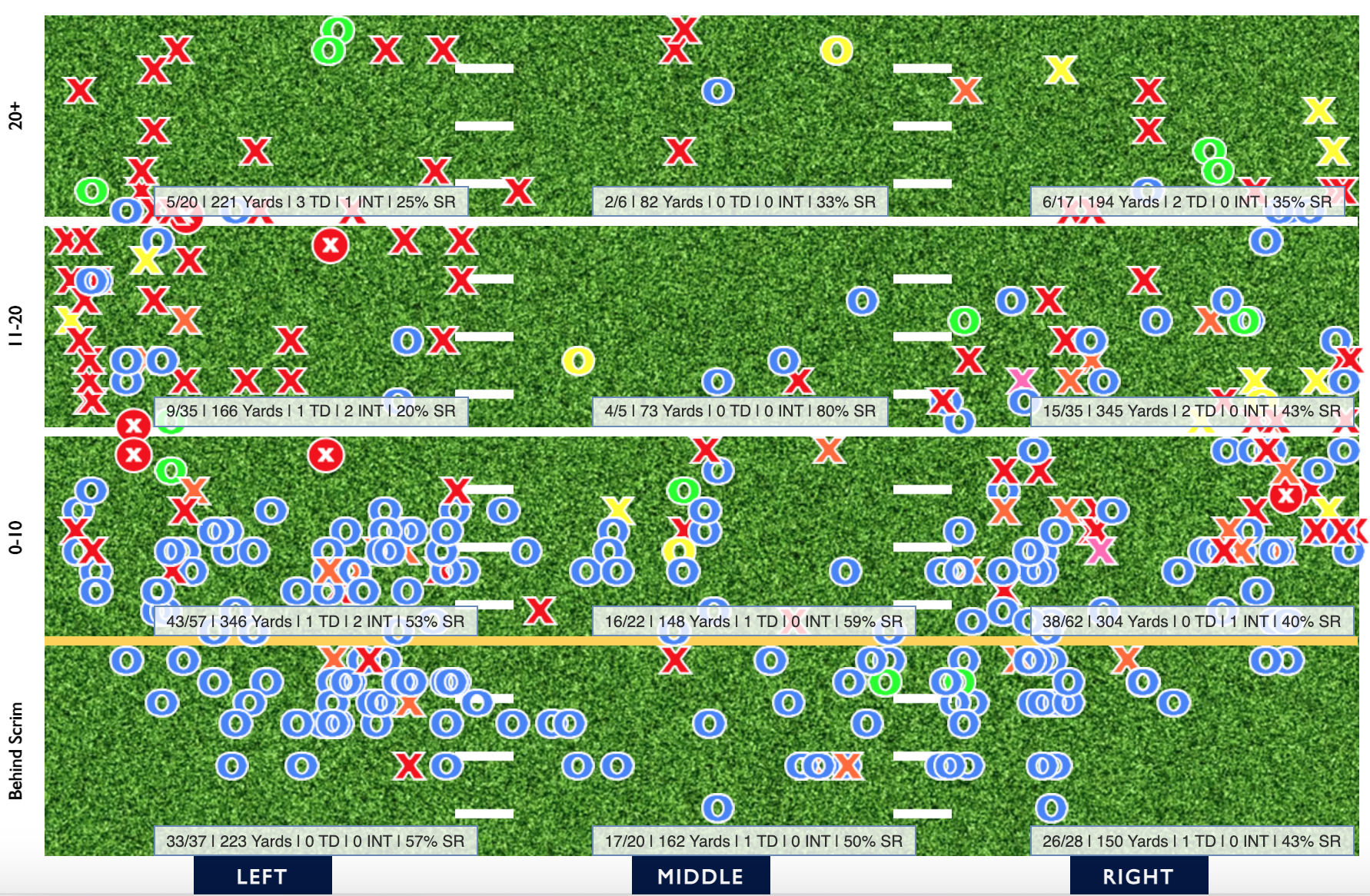
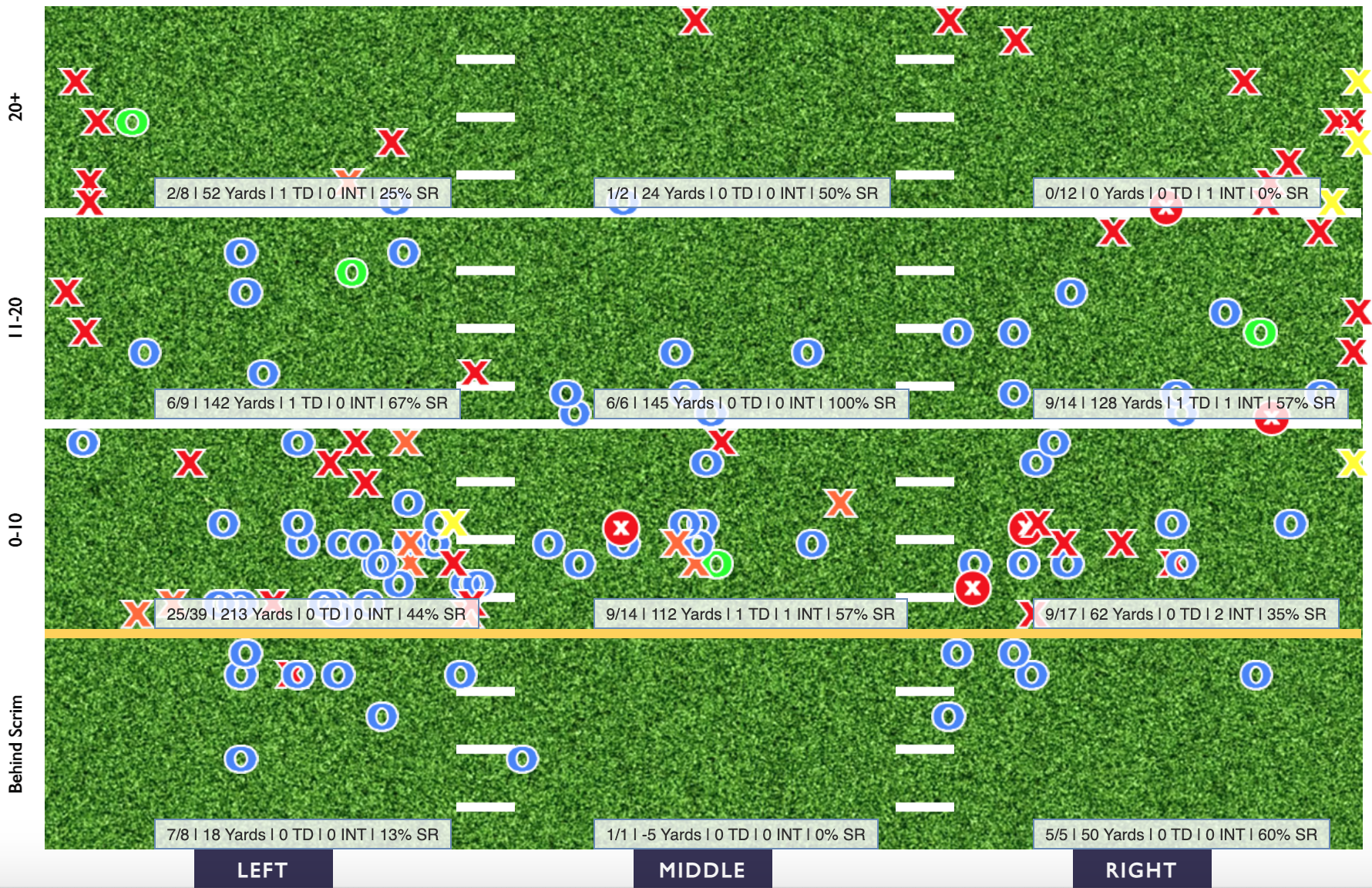
Bo Nix's 2020 Pass Chart TJ Finley's 2020 Pass Chart
Auburn Rushers

With Nix on shaky footing, it’s a pretty safe bet Tank Bigsby will shoulder much of Auburn’s offensive efforts. The legacy passer will absolutely find wins with his legs on occasion, but his arm’s inconsistencies will put a lot of pressure on the Tiger ball carrier to pick up where he left off after a fantastic freshman outing. Depending who you ask, Bigsby is college football’s best running back. While my lot is cast with Kentucky’s Chris Rodriguez, Auburn’s ramrod is directly behind him in StatCat’s RB rankings. Splitting hairs aside, Bigsby lived up to his namesake being a mighty and ferocious ball carrier in his debut season on the Plains. His 42.0% Broken Tackle Rate led the conference, and his 3.51 yards after contact average cracked the top4. Both of those figures are known as stable metrics, which are meant to help reflect how a ball carrier provides. Anyone can run to space, but not all are cut out to deal with consistent defensive engagement. In other words, how a rusher deals with obstacles helps unearth one's potential. As a capper for his desirable output, the Tiger’s First Down+TD Rate finished as the SEC’s 3rd-best figure last year.
While Bigsby possessed a laudable overall profile, his performance on 3rd down, short yardage, and red zone attempts helped him capture Pro Football Focus’ 5th-best Wins Above Average figure among non-QBs in 2020. In all three situations, he finished third or better in Success Rate, YAC average, and Broken Tackle Rate. Like you would expect from his aforementioned output, his clip of the latter led all returners under each condition. But since the Tiger was targeted by defenses in these spots, he suffered early engagement plenty in each of these situations. None of his respective rush yards before contact clips ranked better than 10th within the conference. For the most part, that didn’t matter. And, Bigsby did his thing. Taking care of business in this burly fashion makes him an easy player to like and certainly is a factor in all the hype he's been receiving ahead of this fall.
Plus, he’s due to be one of the most voluminous rushers around. Mike Bobo is on Team Establish It. And if his stint at South Carolina is any indication, Auburn is about to go H.A.M. with traditional I-formation usage. Over 8% of the Gamecocks’s plays and 12% of their yards came from that set last year. Moreover, only Larry Rountree logged a higher percentage of his team’s overall carries than South Carolina’s bellcow Kevin Harris. The stage is set for Bigsby to have a special season and even be a Heisman dark horse. But, getting away from the zone-heavy approach might see him be slightly more inconsistent. No doubt, next year’s scheme will have a blend of multiple philosophies as the unit searches for a new identity. I’m sure many a War Eagle supporter is okay moving away from inside zones and bubble screens. For what it’s worth, only Alabama dedicated more carries towards power concepts than Bobo’s bunch within the conference. So while most love Bigsby’s prospects at producing praise-worthy figures this fall, the tweak in schematics might impede his accession. Though a solid rusher on zone looks, the Tiger finished ranked no better than 12th in Success, First Down+TD, Explosive Run, and Broken Tackle Rate with an unassuming 4.77 Yards/Carry among conference backs on power/gap designs in 2020.
Veteran Shawn Shivers, on the other hand, has traditionally thrived when operating on gap schemes or jets attacking the edge. While seeing half of his such carries satisfy situational goals, his First Down+TD Rate is the conference’s 4th-best ahead of this season, and no SECer bested his robust 27.3% Explosive Run Rate on power looks. Though Bigsby’s reputation as a hard runner fits these design’s mentality, Shivers might be better suited to deliver preferable returns. Of course, Bigsby could develop more versatility and leave the old man on the bench. But, Shivers’ track record supports the notion that he could carve out a niche when Bobo is in the mood to pull some dudes. Unquestionably, Bigsby will get — and deserves — the lion’s share of the Tigers’ touches. Shivers, however, will still play a crucial role. I mean, it's not like Bigsby can play every snap. Plus with the massive drop-off in quality rushers after those two, the duo at the top of the rotation both must stay healthy and produce for War Eagle to best their set expectations.
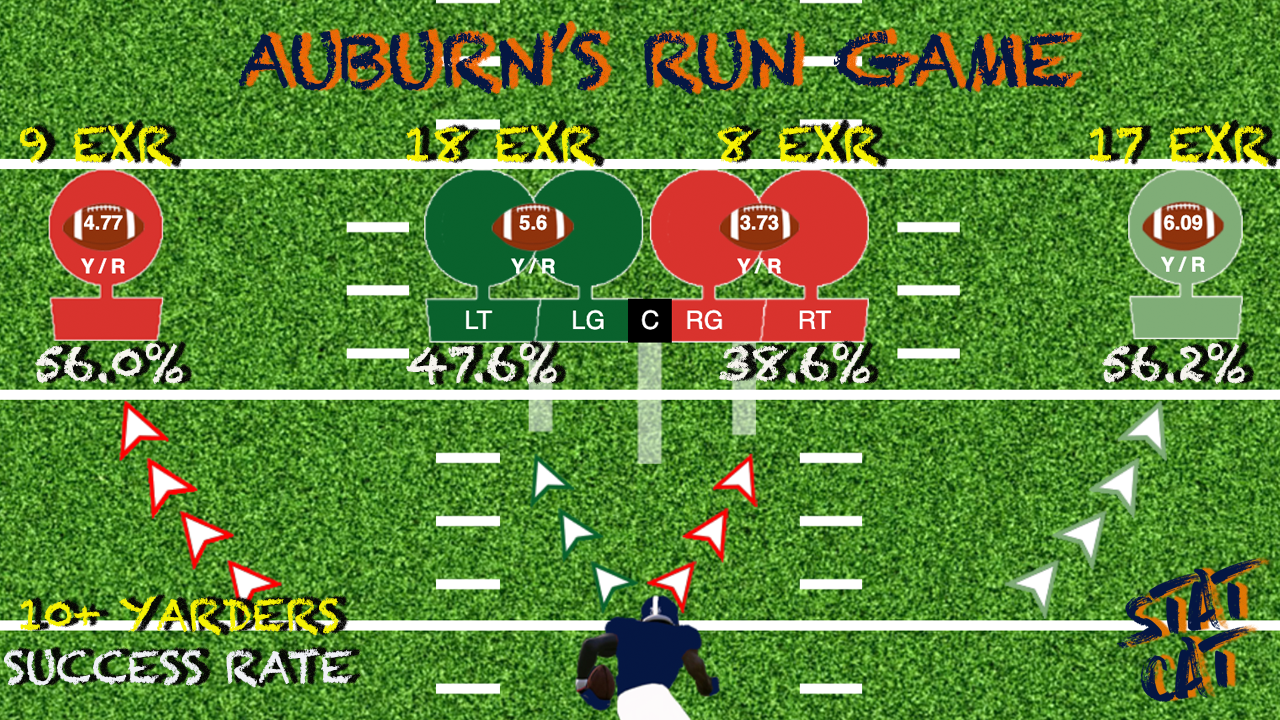
Auburn Pass Catchers
To the chagrin of a new staff looking to fix Bo Nix and Auburn’s previous failures in the pass game, the Tigers enter 2021 with a bottom3 receiving room within the conference. Though a new scheme can do wonders ameliorating a guy’s output, having a talented supporting cast is the best element a QB can have to boost his efficiencies. It’s one thing having a dude who can complete 12-yard passes consistently, and it’s another having that plus a guy who can take said 12-yard route to the house. Unfortunately for Nix, his dismal returns are likely sour further without proven weapons unless some magic happens on the Plains. None of their main options logged more than 15 targets last year. Only one managed to see at least half of those chances result in situational success.
Even UGA transfer Demetris Robertson failed to meet that criteria. Though considered this bunch’s most veteran option, he’s yet to exhibit efficiency. Adjusting for uncatchable passes, the two-time transfer has put up a 67% Catch Rate, 7.38 Yards/Target, and 49% Success Rate as an SEC pass catcher, which is solidly bland. And logging more career drops than 20+ yard receptions certainly doesn’t rose-scent his outlook. In 2019 where he experienced his most volume, his unadjusted 6.04 Yards/Target and 40% Success Rate finished inside the SEC’s bottom10. I don’t mean to pile on, but I want to set the proper expectations despite Robertson formerly being considered 247 Sports best WR prospect once upon a time. Though War Eagle should aspire for for his lofty potential and better returns, StatCat just wants to let you he’s yet to be a meaningful pass catcher in this conference. But perhaps like his QB, maybe the new environment and scheme will accentuate his strengths and generate production that’s worth a damn. It’s presumed he’ll operate as an outside receiver for Mike Bobo.
Elijah Canion, Kobe Hudson, Shedrick Jackson, Ze’Vian Capers and Ja’Varrius Johnson are the favorites to round out this position group. But again, trying to forecast this inexperienced bunch is overly a crapshoot — a phrase that has generally described Auburn’s aerial efforts in recent years. With such small sample sizes and inconsistent production, digging through the numbers for silver linings would be pointless. Plus, the dialog around them quickly becomes cliche-filled and akin to coach talk when discussing their attributes in generalities. Though StatCat is pessimistic in to what this gang collectively offers, Auburn peeps absolutely can cling to their group’s untapped upside especially if their golden boy ever starts to shine.
Glancing at Auburn’s Offensive Line
While Bo Nix is often the source of blame for Auburn’s offensive inconsistency, the Tigers’ offensive line has undeniably been volatile itself. Behind inexperience and injury, over a half dozen different combinations were tried upfront in 2020. No doubt helping the team’s Rushing Success Rate improve six percentage points, Explosive Run Rate balloon seven percentage points, and rush yards before contact by enhance by a tenth of a yard was a praiseworthy accomplishment. But they allowed a defensive havoc play on about a third of their rush attempts. Year over year, Auburn’s such rate increased from 21.4% to 32.1% (2nd to 9th in the conference rankings). Moreover, Nix’s skittishness operating in the pocket was somewhat justified behind the Tigers’ 29.6% Pressure Rate, which finished inside the SECs bottom5 last year. Even though the group improved its Sack Rate, Auburn’s OL is far from a dependable unit entering 2021. Still as a group mostly baptized by fire, they at least have logged snaps versus some of the best defenses around. Eight guys started at least a game. Nick Brahms appears to be the big toe in the middle as one of this unit’s best PFF run blockers. But, questions remain on which fellows earn the starting nods at guard and tackle. Tashawn Manning, Brandon Council, and Keiondre Jones are the names up to flank Brahms in the middle. This could come down to age and coaching preference. Manning and Council are both seniors and were two of the team’s best pass blockers. On the other hand, the underclassman Jones graded highly as a mauler. Choosing two quality tackles might prove to be more difficult for new OL Coach Will Friend. The candidates to fill out the bookends are Alec Jackson, Brodarious Hamm, Austin Troxell, Brenden Coffey, and former JUCO standout Kilian Zierer. With fresh eyes and little sample size, it’s anyone’s best guess at this point who Friend fancies. Either way, Bryan Harsin’s first season will have a hard time hitting the ground running if it cannot find consistent footing.
Key Offensive Metrics in SEC Play
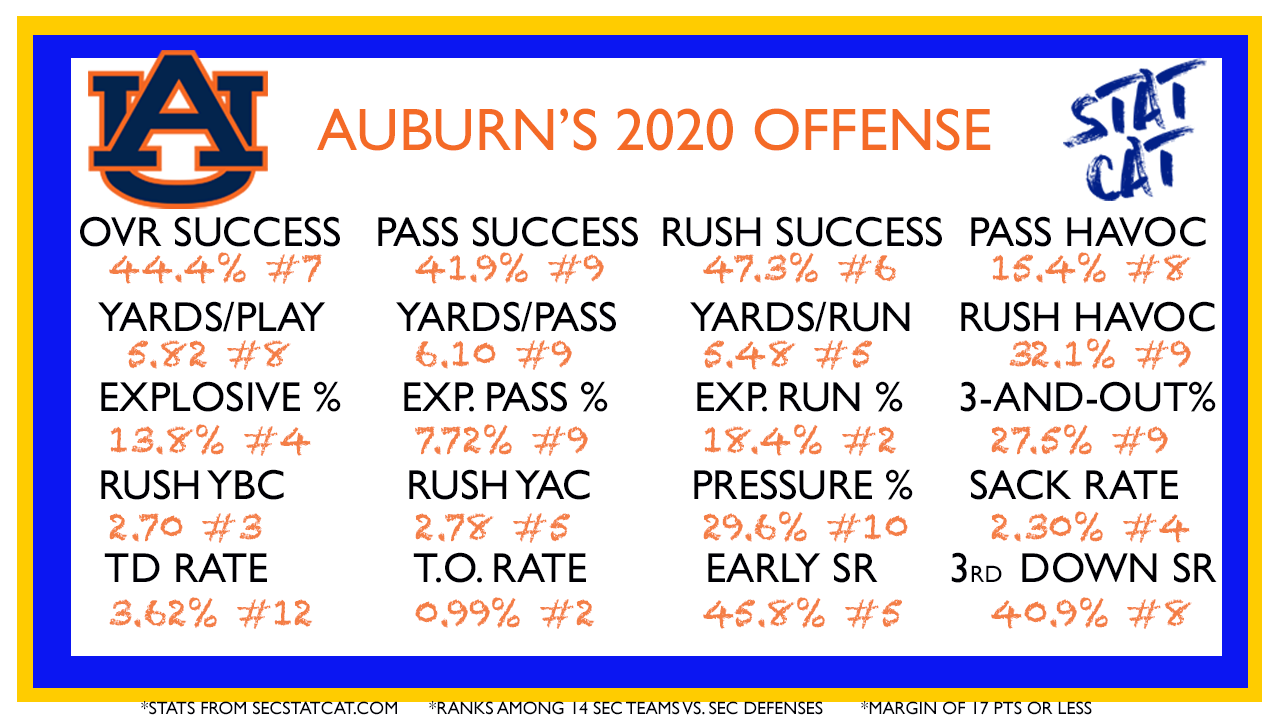
Year-over-year in SEC play, the Tigers passed more, used significantly more at-the-snap motion, sported a preferable overall Success Rate, increased its reliance on RPOs, delivered more explosive gains per snap, and experienced a modest improvement in average rush yards before contact. That said, Auburn’s TD Rate worsened, its Points/Play was cut in half, and a quarter of the Tigers’ offensive snaps experienced a form a Havoc. Auburn enters 2021 sporting the SEC’s 2nd-worst Broken Play Rate with a 12.6% clip. Despite moving the needle positively in some areas, War Eagle was less prone to score points and more likely to display misfires. Obviously, those elements played a huge role in the university’s braintrust opting to take this program in another direction. Frankly, this offense needs to start being effective through the air. Too long have the Tigers sat in the back half of the SEC ranking in Passing Success Rate and Explosive Pass Rate in league play. Tank Bigsby should be able to shoulder the offense; but if Nix (or Finley) doesn’t cumulatively bring above-average play at the position, StatCat is pessimistic Auburn will have a hearty season. For what it’s worth, both of those metrics were improvements from 2019. So glass half full, War Early certainly can talk themselves into fielding a competent passing game despite the thin receiving corps and questionable quarterback room.
Though Auburn’s front was overly iffy, maintaining a top3 rush yards before contact versus SEC play will be crucial to facilitate Bigsby’s workload. Giving him consistent daylight will surely result in great things and hopefully help the Tigers replicate last year’s brawny 18.4% Explosive Run Rate. Bigsby’s bound to generate some big gainers on his own merit being a burly tackle breaker; but those splash runs certainly will come more frequently if he doesn’t have to dodge, dip, duck, dive, or dodge out of the way of a defender as soon as he gets the handoff. Again, nearly a third of the Tigers' runs suffered from a form a havoc in league play. This offense’s run blocking must become more dependable or else it could be a long season. This unit doesn’t have many candidates to take the spotlight off of Bigsby. So no doubt, opponents will be keying on him. The challenge is on this OL to keep up the cushion and maximize their main back’s opportunities in the open field beyond the point of attack while minimizing engagement at or behind the line of scrimmage.
Key Defensive Metrics in SEC Play
As an offensive guy, I generally gloss over defensive previews. Not that I don’t think individual defensive players aren’t valuable or dislike a blindside sack or athletic INT every once in awhile, but I typically treat that side of the ball as a collective unit. As only one guy, I can only track so much, yanno? You won’t get many fun defensive nuggets from me. That said, Auburn will be switching to a 3-4 from it’s previous 4-2-5 under Kevin Steele. Colby Wooden, Tyrone Truesdale, and Derrick Hall return along the d-line. Jacoby McClain and Owen Papoe are back at backer, And Smoke Monday and Roger McCreary will look to anchor the secondary.
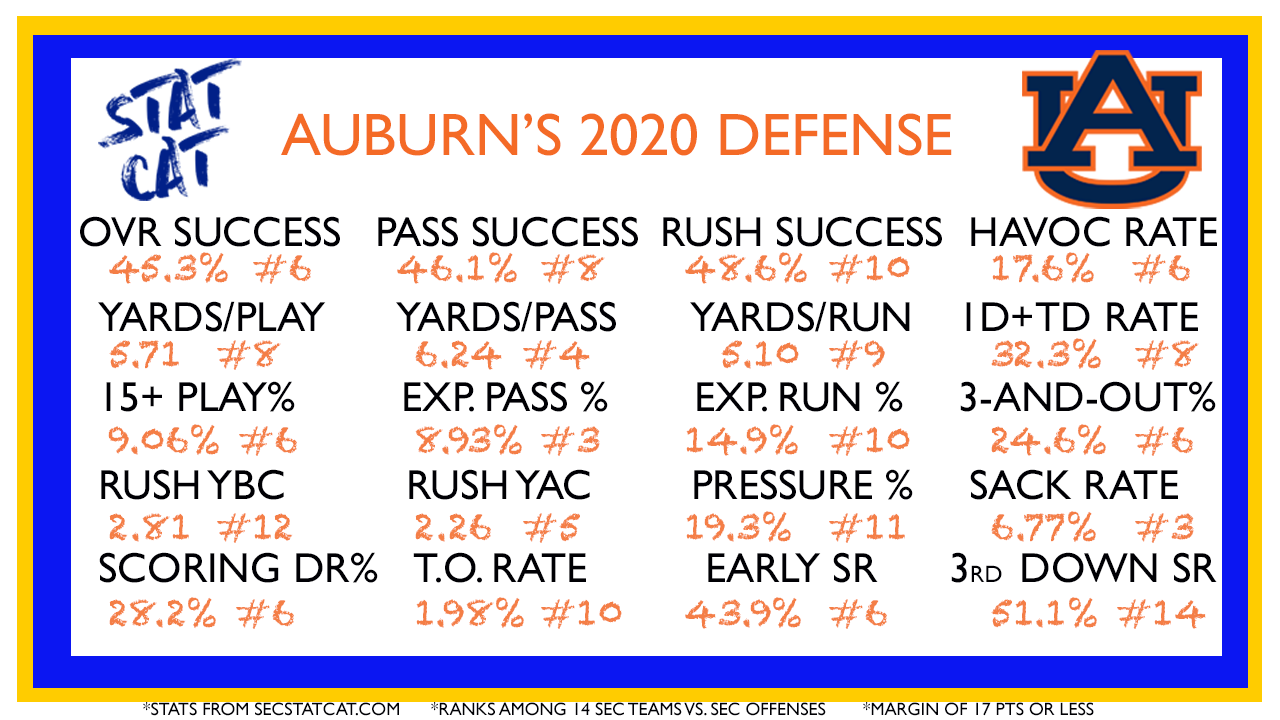
Auburn’s defense regressed hard last year. Frankly, the Tigers stats deteriorated across the board. Only Missouri’s First Down+TD Rate rose more year-over-year than their seven percentage points. Other than South Carolina and Mizzou, no other unit in SEC play saw their down-to-down Success Rate worsen by a larger amount. But as many people on the Plains can attest, the Tigers' frequent and frustrating failures on the money down were the most maddening defensive shortcomings. Allowing a stunning 51.1% 3rd Down Success Rate in league play, opponents sustained more drives and have more scoring opportunities. By year’s end, both Auburn’s 3-and-Out and Scoring Drive Rates went from being top3 clips to being average joes. For the most part, War Eagle’s defense was overly unexceptional. Still since defenses predominately strive to create 3rd downs situations, this unit cannot keep faltering in those spots. It’s called the Do or Die Down for a reason. Defenses live to force one-offs, but continuously breathing life into opponents is a nasty habit. Derek Mason should be able to get cute on occasion — as he’s rarely had fun things to play with while helming Vanderbilt’s program. But hopefully his recent results on thirds don’t travel with him from Nashville. Two of the last three years, Vandy finished dead last within the SEC in 3rd Down Success Rate. Plus, I’m sure you all can think of many a game decided by a team’s 3rd down execution — or lack there of.
Though reproducing the conference’s 3rd-best Sack Rate would be nice, Mason’s defense should focus its efforts into maintaining Auburn’s recent run of serving up stifling Explosive Pass Rates. For the past three years, they’ve held conference foes to a clip in the single-digits. And while the Tigers’ 8.93% clip didn’t lead the conference last year, it was still a strong top3 figure. Yes, there are some unknowns with this unit’s backend. But if the Tigers earn the SEC’s bronze medal or better, they should feel assured. No factor has a higher correlation to winning SEC games the last few years than reigning supreme in the explosive play battle. You can still strive to win the Middle 8, log a higher time of possession, or generate more takeaways, but the victor in splash plays has come out on top in 63% of games since 2018. And since big gainers through the air typically gain more than their counterparts on the ground, focusing on curbing those occurrences makes all the sense in the world for a defense looking to reclaim its mojo under new direction.
Glancing at Auburn’s Schedule
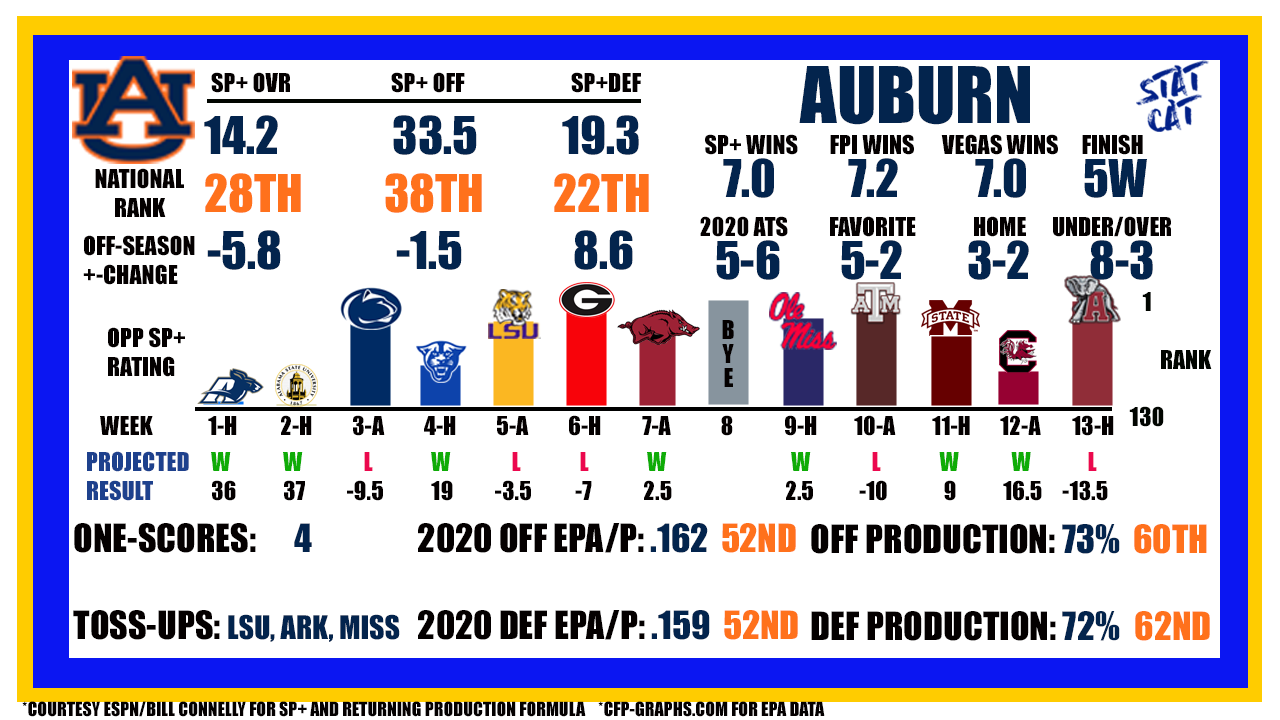
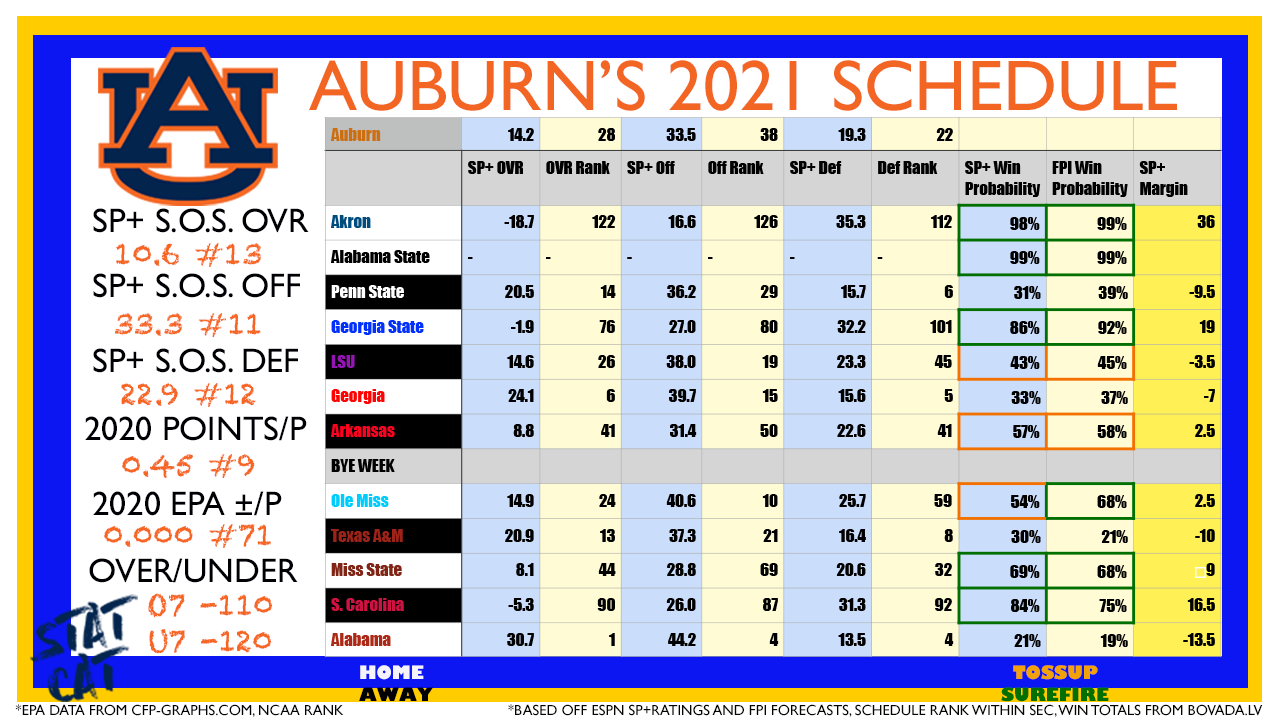
No matter how rich a program is with resources and talent, being picked to finish 5th in a division inherently translates to lowering one’s expectations. Playing in the rigorous SEC West once again has War Eagle flying through one of the conference’s hardest slates. Only Arkansas has a more trying schedule per ESPN’s SP+ Ratings. If one were to average out their opponent’s such scores, Auburn would play a team akin to Coastal Carolina each week. Just saying that meteoric mid-major’s name should hint a hazardous season is ahead for the Tigers. Six of their opponents sit inside the top30 with four of their foes on the other side of the ball following suite. Despite the tumultuousness as of late, ESPN’s Football Power Index, SP+, and Vegas oddsmakers agree, seven wins is the very likely outcome for Bryan Harsin’s debut on the Plains. The Tigers have zero instances of playing consecutive games way from home and start the season with two creampuffs. But after that, things immediately get turned up to 11. From Week3 until Auburn’s Week13 matchup with South Carolina (who upended War Early in Columbia last year), the SP+figures each game will be decided by ten points or less. Naturally, the cookie could crumble numerous ways in those spots.
Honestly if things get shored up during the first two exhibitions, no one should count out the Tigers against a Big Ten team. Upsetting Penn State occurred in around of a third of the SP+'s and FPI's season simulations. How the Tigers perform in that matchup, however, will reveal how much work is left in order to craft this team back to relevancy. Auburn is also an underdog in its first two conference games. Considering how Georgia gobsmacked the Tigers last year, it’s curious why the projected margin in that matchup isn’t larger. Still in the tilt with LSU, the only thing giving the Bayou Bengals an advantage is its home field. If the Tiger Bowl was played at a neutral site, ESPN’s metric says it would be a true pick ‘em. Additionally, the SP+ favors Auburn in its two remaining tossup games between Arkansas and Ole Miss on opposite ends of its bye week. This three-game stretch will be crucial to bettors eying Auburn’s 7.0 under-over total. With a tie being no better than a soccer game, maintaining those wins and edging out Ed Orgeron’s and dem’ boys would get them past that mark. But in addition to those forecasted lines, their margin of error is slim. The probability of winning in College Station is about the same in Happy Valley per the SP+. However, the FPI is far less optimistic in their chances against the Aggies despite really liking their odds against Lane Kiffin’s Rebels. After facing two of the SECers projected to finish near the bottom of their respective divisions in Mississippi State and South Carolina, the Tigers are predicted to be a two-TD stooge in the Iron Bowl. An unsuspected stumble is more likely than rising another echelon within the conference. But maybe — just maybe — this is the year Auburn can return to moderate relevance nationally.