2021 Vision: Previewing Arkansas
2021 Vision: Previewing Arkansas
With talking season winding down, preview season is among us! I'm sure this isn't the first preseason article you've viewed. You should know the drill by now with these bad boys. But if this is your first experience with StatCat, be ready to learn a thing or two about the Razorbacks' QB1, receiver room, rushers, OL, its most important stats to maintain and/or improve on both sides of the ball, and how Arkansas' schedule breaks down with help of ESPN's SP+ Rating!
Arkansas Passers

Malik Hornsby could challenge for spot snaps thanks to his discernible speed; especially in short yardage packages or within the red zone. But fueled his passing upside, KJ Jefferson has been anointed by Sam Pittman to be QB1. Though his past sample has been wonky, Jefferson exhibits a nice mix of both zing and touch as a downfield throw. Behind a natural ability to sling it ala his four-star background, he’s an easy buy-low candidate ahead of this fall in a conference full of questionable quarterbacks even if his stats fail to excite. His career Completion% is well-below 50%, his Uncatchable Pass Rate cracks 23%, and by no means does the Razorback sport any traditional metrics worthy of acclaim. Despite rose-scenting the hog shit that was the 2019 season with some efficient numbers as a ball carrier, Jefferson finished with a Rushing Success Rate under 28% last year. With those dismal returns by land and by sky, you might be thinking he’s more of a junk bond than a bargain.
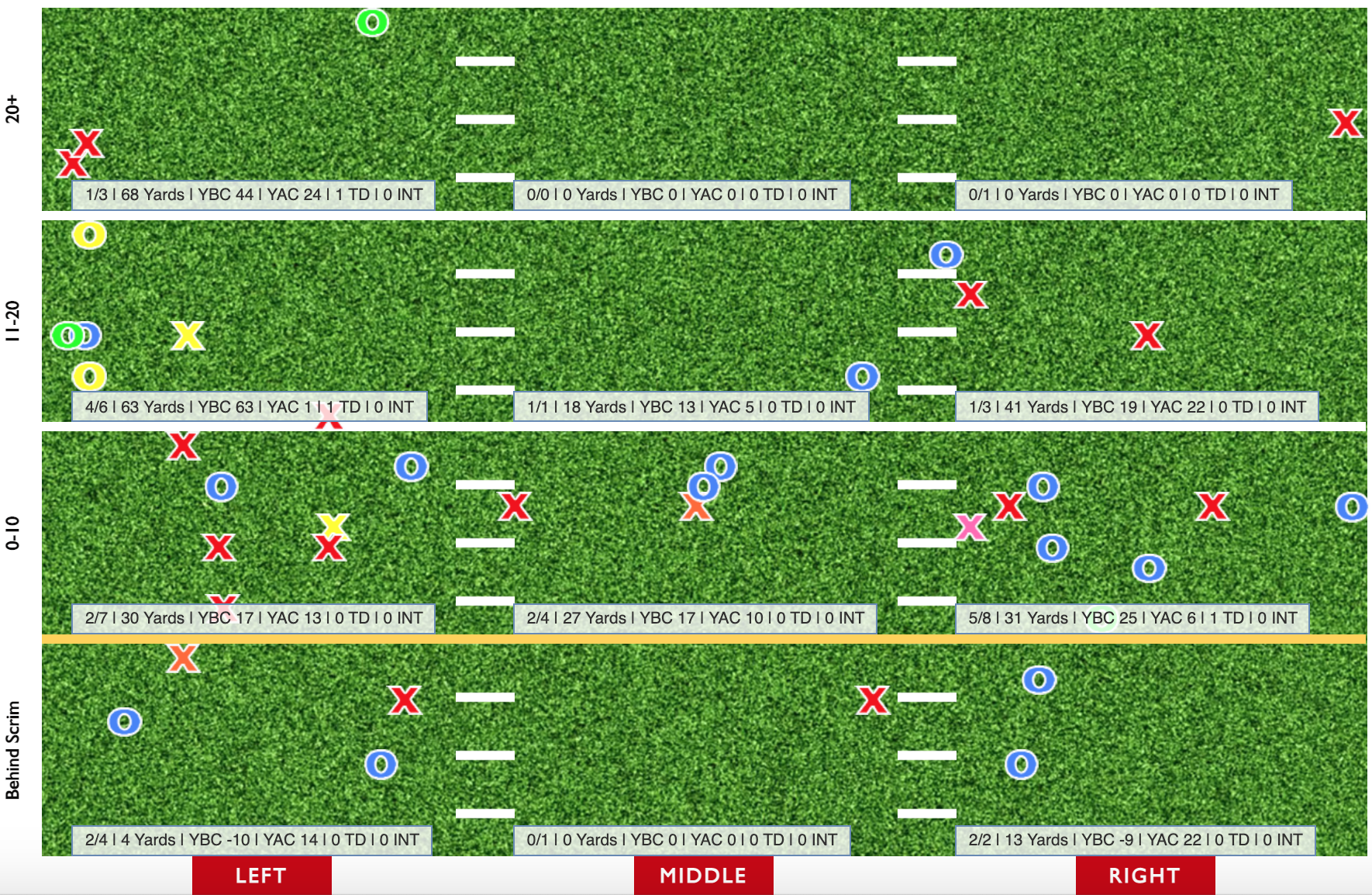
Nonetheless, I am a believer based on his showing in Arkansas’ spring game paired with his performance in worthwhile situations last fall. Jefferson’s final results would unequivocally have been better if his teammates didn’t drop a seventh of his targets. Despite the sloppy pass catching, the Hog hints to be a valuable dropback dimer. While screens and RPOs are great at helping a QB buoy his bottomline, those designs don’t require enhanced passing skill to execute. With those tactics taken out of the equation, the Razorback dons the SEC’s 2nd-best Depth Adjusted Accuracy%, the 3rd-best Yards/Attempt, and 4th-best Success Rate on such attempts over ten yards downfield ahead of September. Moreover, no conference returner can best his 3.23% dropback Interceptable Pass Rate. Again, Jefferson’s cumulative output was rather forgettable, and his scope is on the small side. But after doing some digging, it wasn’t too difficult to find some gems in his stat sheet. Arkansas relied heavily on RPOs down-to-down last year and was one of the most-averse vertical passing offenses within the conference. It bears mentioning, however, Jefferson’s personal RPO Throw Rate was 20 percentage points less than Feleipe Frank’s clip. If Kendall Briles prefers to change course and lean more into dropback designs, the Razorbacks could become more dangerous as a unit assuming KJJ can continue that aforementioned consistency.
Plus, Jefferson’s commendable ball placement remained firm when the Hogs were put behind the chains. It’s one things to dink and dunk when ahead of schedule. On the other hand, it’s another thing entirely to negate a previously failed rep or two in order to sustain a drive with solid passing. On attempts when disadvantaged by down and distance, Jefferson commands the SEC’s top Depth Adjusted Accuracy and Interceptable Pass Rate, the 3rd highest such average depth of target and Explosive Pass Rate, and a top5 First Down+TD Rate for this fall. Besides Vanderbilt’s Ken Seals and South Carolina’s Luke Doty, no conference returner logged a higher rate of their attempts behind the chains than Jefferson’s 51.2% figure. Production in these spots may not be entirely stable, but at least the Hog has experience bailing out his unit in these spots. After all, the Razorbacks have the SEC's hardest schedule (again) and are likely to be smacked with plenty of adversity in 2021. The Hogs might be predestined to slaughter. And because of that, Jefferson will be under a fair amount of pressure to take care of business.
KJ Jefferson's 2020 Pass Chart
Arkansas Rushers

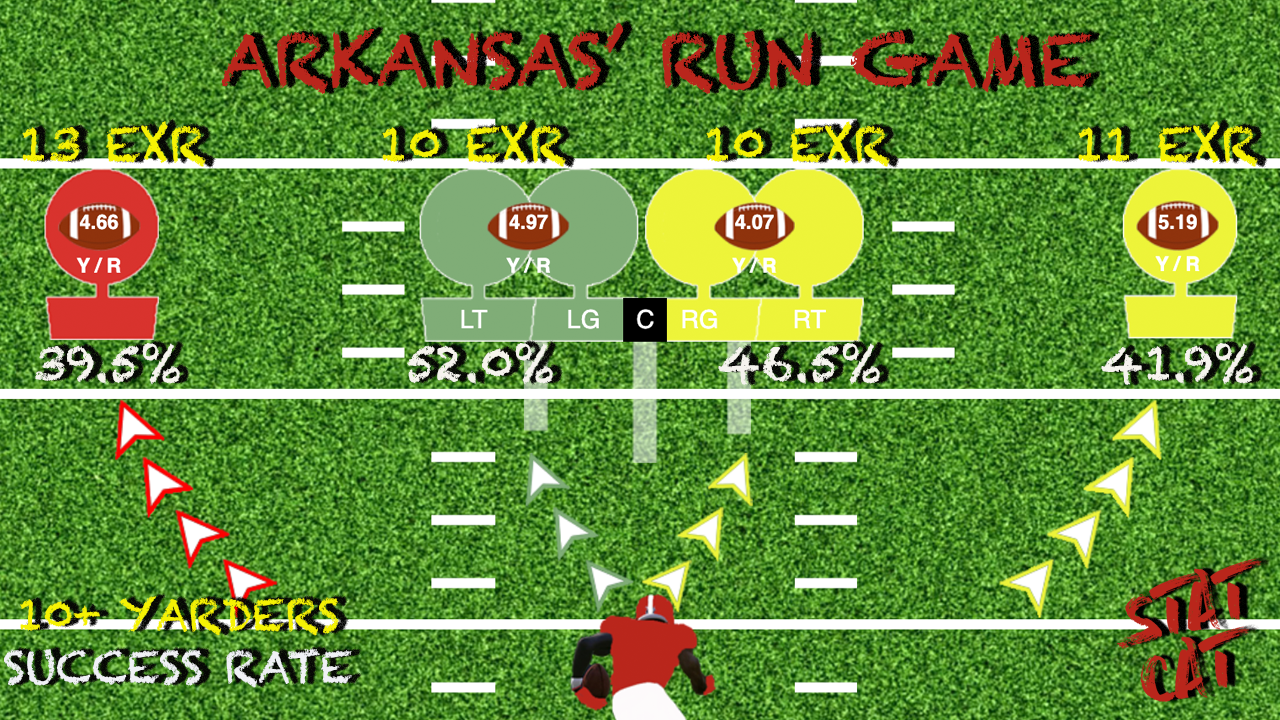
Believe it or not, but Trelon Smith’s 2020 campaign was the most rushing effective effort in Arkansas’ last three seasons. Despite veteran Rakeem Boyd’s mustering 1,000+ yards and logging firm traditional stats in 2019, his advanced efficiencies were sour. Smith’s Success Rate, First Down+TD Rate, and Explosive Run Rate all were the best outputs among guys with at least 20 touches in a year since Bret Bielema's time in Fayetteville. With him back in the fold, I understand why some Razorbackers are anxious on how he progresses as a ball carrier. After all, his Yards/Carry cracked the SEC’s top10. But despite setting a new team standard with most of his figures, Smith’s bottomline was generally forgettable relative to his conference contemporaries. Heck, you can make a very strong case his environment was more responsible for the uptick in gains rather than Smith’s individual performance. Just over a tenth of his attempts experienced contact behind the line of scrimmage, which is certainly one of the lower figures amongst his peers. That lack of adversity is highlighted by his brawny 3.17 rush yards before contact average, which was the SEC’s 3rd-highest figure last fall. Cushion or no, he finished ranked in the 20’s within the conference in First Down+TD Rate, Broken Tackle Rate, and YAC average and his Success Rate and Explosive Run Rate finished comfortably in the mid-teens. Smith’s showings behind the chains, in short yardage, on 3rd Down and in the red zone were depressing. Basically in the situations where a back is looked upon to make a play when handed the rock, the Razorback faltered.
Smith’s best returns came to start a set of downs. With Briles’ affinity for RPOs, defenses had to respect his Baylor Spread Offense’s quick underneath game of hitches and slants, which created room for the ground game to scoot on occasion. No SECer average more rush yards before contact on first downs last year than Smith’s 4.66 clip. Obviously with that kind of barrier between him and defenders, he was able to beat his situational goal of snatching at least half of the yards to gain more often than not. Both his Y/C, Success Rate, and Explosive Run Rate in these spots hold down the five-spot ahead of 2021 within the conference. But like his overall metrics suggest, his stable metrics — aka his Broken Tackle Rate and YAC average — remained deflated. If the blocking upfront suffers more missteps or is less keen at carving run lanes this season, Smith has yet to show the ability to top trials in his path. Good fricken thing all of the Hogs’ starting hog mollies are back and ready to continue the positive momentum. Still in order for him to earn acclaim, Smith has to increase his dynamism, tackle breaking, and value on a per carry basis.
TJ Hammonds should be the change-fo-pace back and see an increased usage with Boyd’s departure. He only logged 14 designed runs last year, so his returns don’t carry a lot of weight. Still his Y/C, Success Rate, and Explosive Run Rate were team highs. But, fat chance Hammonds 5.0 rush yards before contact average holds steady with increased volume. The skat back-esque approach wasn’t the most burly M.O. However, Hammond in his limited sample donned the team’s best YAC average. For what it’s worth, his skill set could certainly stress defenders when their legs start to turn to jelly after the initial rushing of Smith. Other than him, there aren't many trusty ball carriers. But, someone needs to step up as a physical presence for this run game. Again with Arkansas' challenging schedule, running soft likely won't begat many victories.
Arkansas Catchers
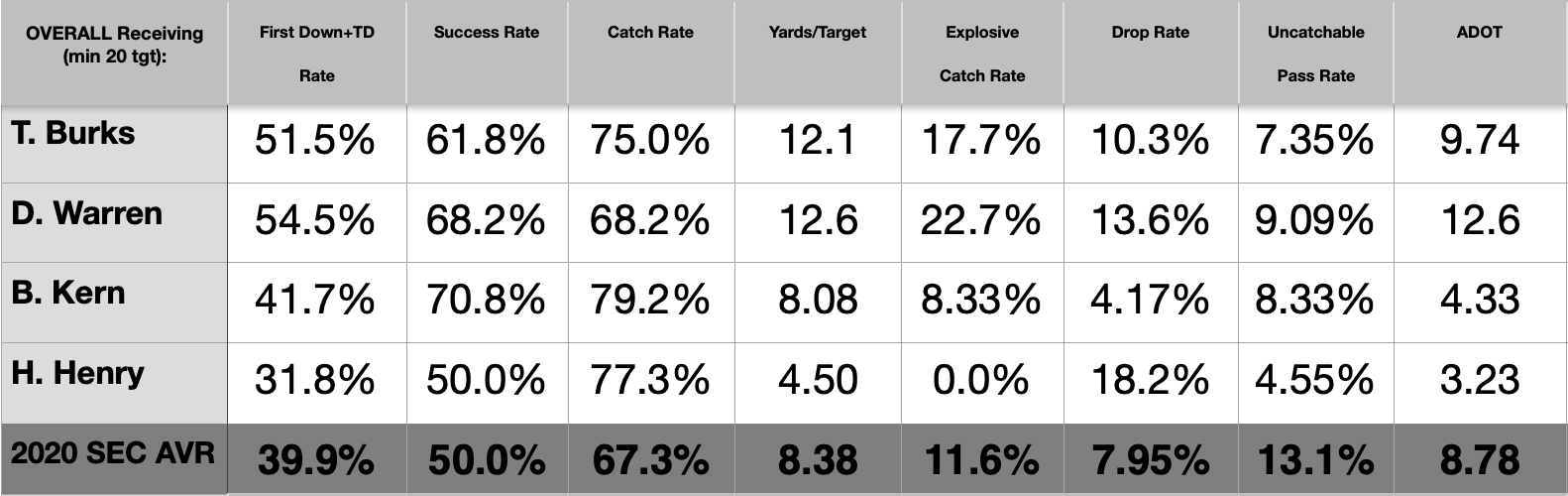
Treylon Burks is the SEC’s best receiver entering 2021. None of his returning conference contemporaries can present such a complete resume. Burks’ contextual profiles on deep, intermediate, early down, and overall dropback targets sit among the SEC’s best. Plus as far as the counting stats go, he gained the 2nd-most yards, generated the 2nd-most explosive receptions, caught the 5th-most passes, secured the 3rd-most first downs, and scored the most TDs amongst conference returners. So the Razorback checks plenty of boxes for the old-timers and folks still apprehensive of advanced metrics. But, you’re reading a StatCat article for a reason. Between his peers who fielded at least 30 attempts, Burks’ overall bottomline presents the premier Yards/Target (12.1), Success Rate (61.8%), First Down+TD Rate (51.5%), 3rd-best YAC average (7.73), 4th-best Creation Rate, and 5th-best Catch Rate. Granted, he benefited from the league’s 2nd-lowest Uncatchable Pass Rate amongst receivers. Assuming he sees more wasted chances with a new QB, his numbers might move backwards. Still, one can’t rule out Burks progressing and boosting his on-field output either. After all, his 17.7% Explosive Catch Rate is the league’s highest among players with an average depth of target in the single digits. Burks accounted for over a quarter of this offense’s targets last year. With Mike Woods taking his talents to Texas, it’s presumed his usage will further increase. Either way, Burks is poised to make some noise this season.
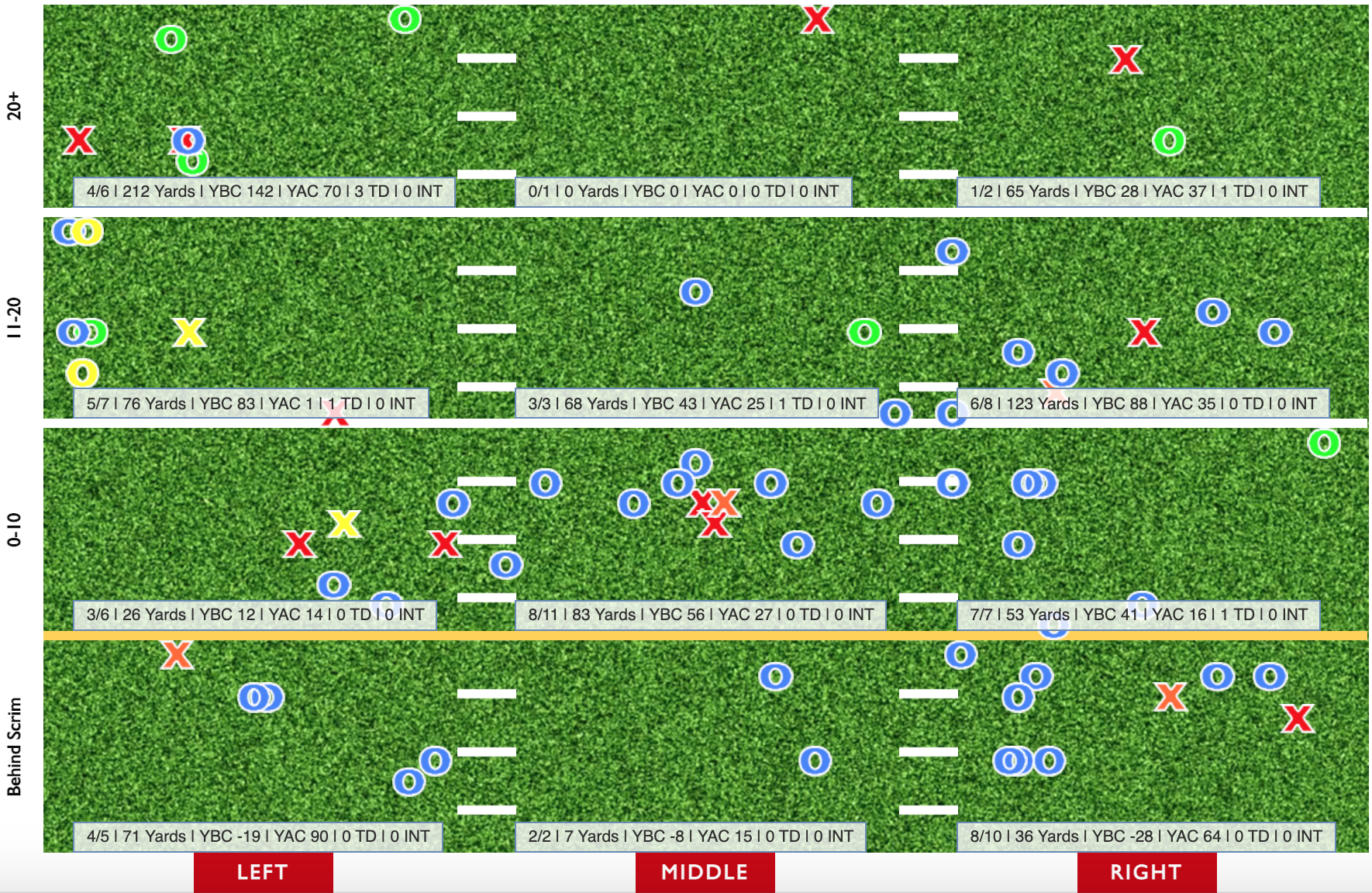
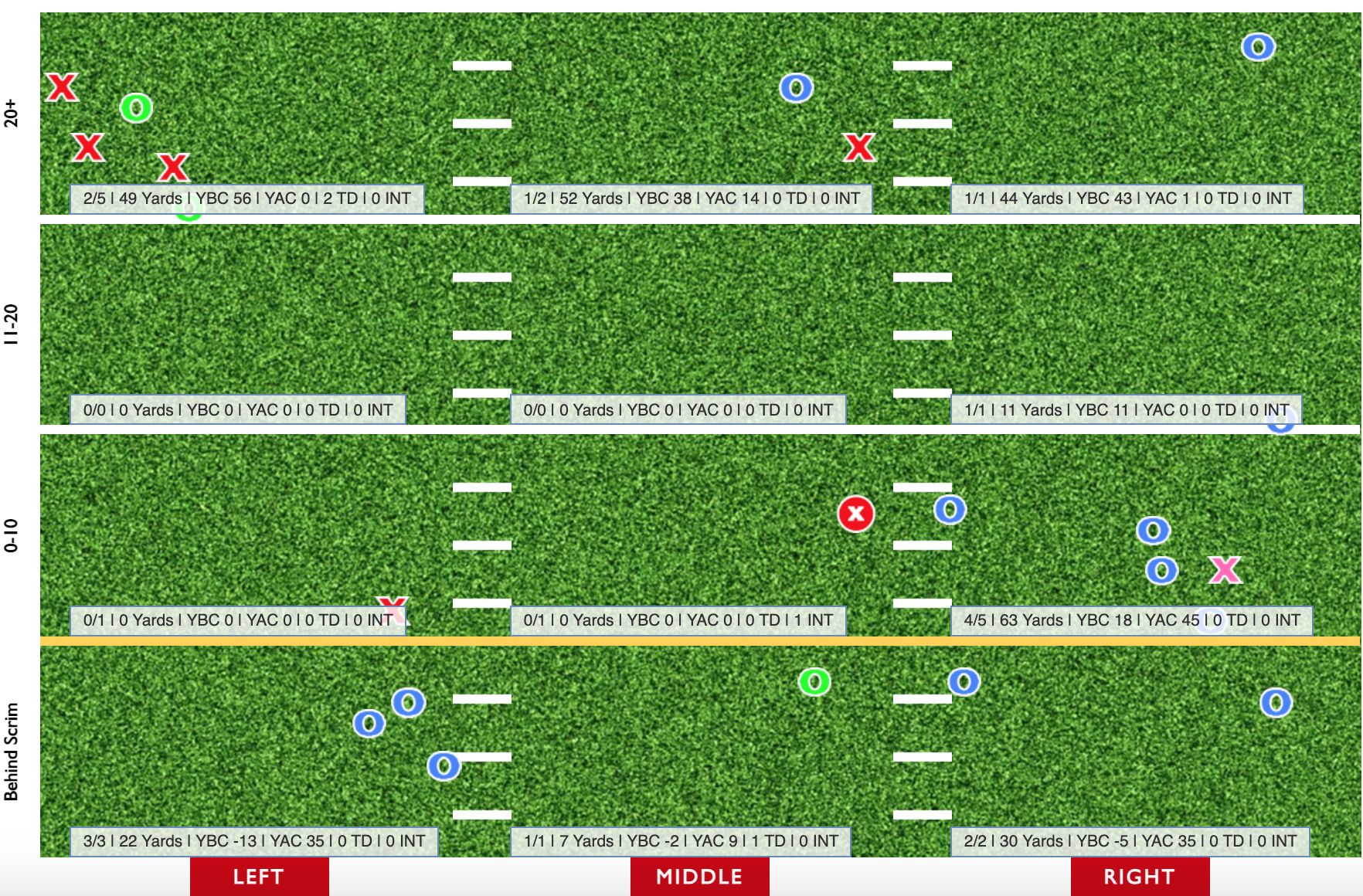
Treylon Burks' 2020 Target Chart De'Vion Warren's 2020 Target Chart
De’Vion Warren hadn’t really made an impact as a receiver before last season. Hell, you can even make a point by a volume standpoint he’s still yet to prove overt value for Arkansas’ pass game. While perhaps a bit gung-ho or overly optimistic, Warren popped off the screen in his limited action in 2020. Known for his spurt on special teams, he dazzled in the open field and logged some of the conference’s most incendiary figures before his year was lost to injury. Among SEC receivers with at least 20 targets, non averaged more after the catch than his 9.27 clip, his 15.4% Explosive Catch Rate on throws less than ten yards downfield was an SEC-high, and no returner can top his 12.6 Yards/Target or burly 54.6% First Down+TD Rate. Warren’s 22.7% overall Explosive Catch Rate only trails Crimson Tider John Metchie amongst conference returners. Warren has the sizzle to fill the void left by Woods. And while I might be presumptuous his efficiency continues without the SEC’s most accurate passer throwing him balls, his game-changing speed should be a nice elevator pitch for his doubters on whether or not he can be a valuable part of this super spread attack. Still, his lack of sample size will prevent many from outright labeling him as the de facto No. 2 guy for the Hogs.
That said, it’s not like there’s a bunch of other guys with experience to shove him out of the way. Trey Knox all but disappeared in the first year of the Pittman Era only logging a mere 13 targets. Other than chalking up his low usage to the standard “sophomore slump”, Knox was coming off a season where he was a bad offense’s worst target in SEC play ala a lousy 31.3% Success Rate. With other guys more worthy, it didn’t make sense for the braintrust to shoehorn him into the operation. But that was last year, and now is the time for Knox to step up and provide some value. If not, Oklahoma transfer and former-four star Jaqualyn Crawford will attempt to be opportunistic. His strengths seem suited for after the catch designs and plays where he can make plays in space. But, sometimes the Baylor Spread doesn’t need the best route runners to squeeze downfield success out of its pass game as long as dudes can leave DBs in the dust. Tyson Morris is also a name that could round out this group in addition to freshman Ketron Jackson and Jaedon Wilson.
Arkansas’ tight ends generally function as blockers. And when they do get targets, they are often cute designs with a fair amount of gadgetry. But Hudson Henry and Blake Kern combined to total 46 chances through the air last year, which would have been the team’s 3rd-most if that figure was produced by a single person. Outside of Trelon Smith, Henry was the Hogs least efficient pass catcher with at least 20 targets. Not that a 50% Success Rate is bad, but he dropped four balls and failed to log a single explosive catch. Kern, on the other hand, was incredibly bang-for-buck. His 70.8% Success Rate was a team-high as was his 79.2% Catch Rate. But as aforementioned, both of these guys usage was highly tied to things like RPOs. Scheme was the predominant catalyst for their production. But with that in mind, Razorbackers should feel assured with this position group’s ability to execute the offense at hand whether that is helping clear paths on the ground or provide a quick outlet versus an underneath read defender. Not to mention, the deception is awfully deadly in the low red zone where points are at a premium. For what it's worth, Kern turned all of his red zone targets into situational success with a league-best 83.3% First Down+TD Rate.
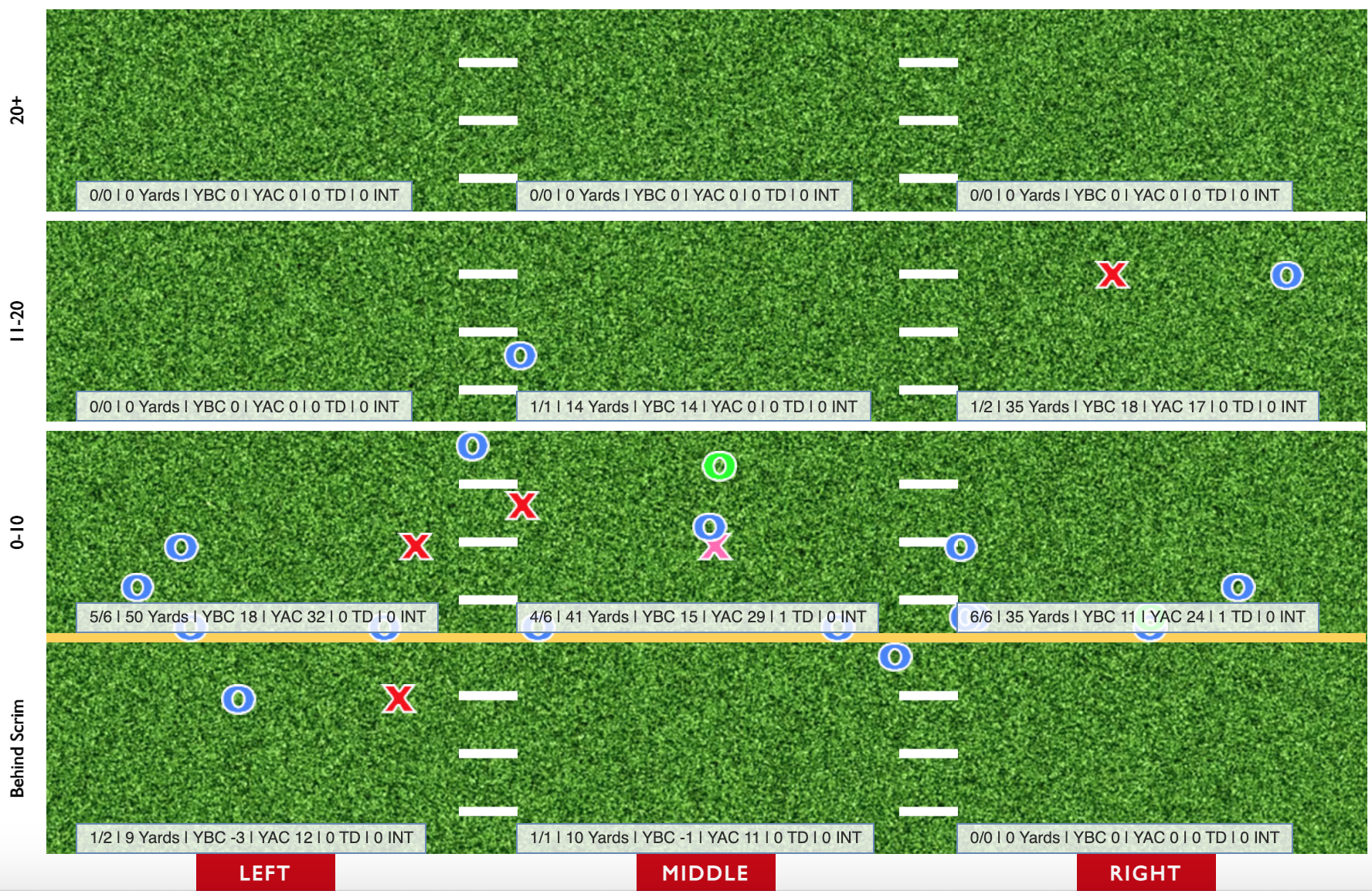
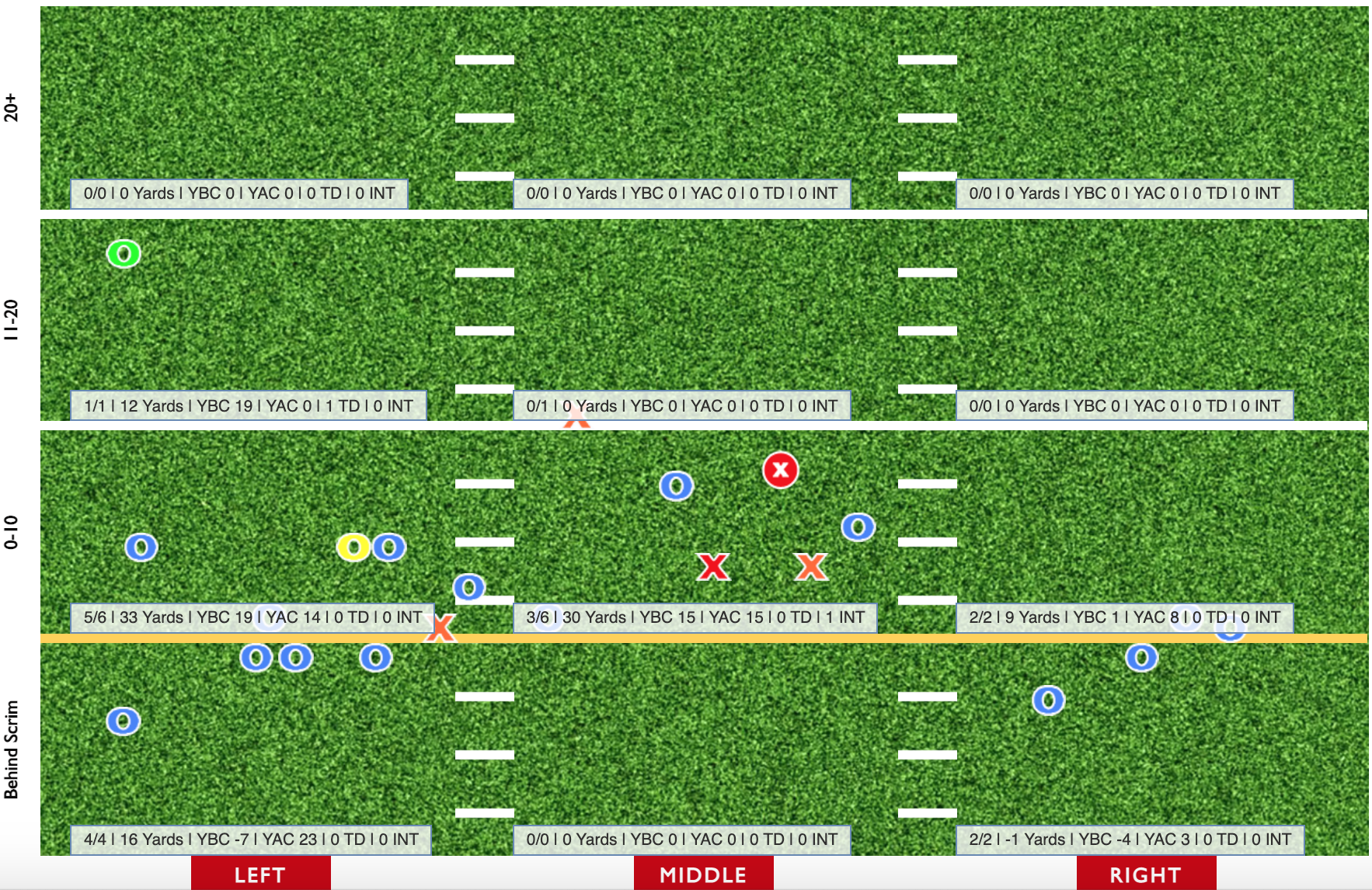
Blake Kern's 2020 Target Chart Hudson Henry's 2020 Target Chart
Glancing at Arkansas’ Offensive Line
The stewardship of Sam Pittman and Brad Davis failed to overly boost Arkansas’ offensive line play in 2020. Sure, the scheme change helped generate better overall returns; but the Hogs’ hogmollies birthed humble figures. Despite the team’s rush yards before contact improving from 2.24 to 2.55 against SEC foes in meaningful minutes, the Razorbacks’ Rush Havoc Rate worsened by 13 percentage points. Year over year, the team’s Yards/Carry dipped by a tenth of a yard. With more obstacles in their runners’ path more often, splash gains on the ground were slightly less prevalent than in Chad Morris’ final stand. The showings in the pass game were just as uninspiring; if not more so. Though their Pressure Rate improved by four points, only Vandy posted a less preferable clip within the conference last year than Arkansas’ 35% figure. Moreover, the Razorbacks’ 9.12% Sack Rate represented the SEC’s floor. Surrendering a sack on nearly tenth attempt is just plain unacceptable. Obviously, Jefferson would prefer to not be restricted by that level of dysfunction. With all five starters back in the fold, modest optimism exists things are on an upswing. Newly-assigned OL coach Cody Kennedy must cultivate consistency but especially help Jefferson develop comfortability and trust with his pass protectors. Left to right, the presumed returning starters are Myron Cunningham, Brady Latham, Ricky Stromberg, Ty Clary, and Dalton Wagner.
Key Offensive Metrics in SEC Play
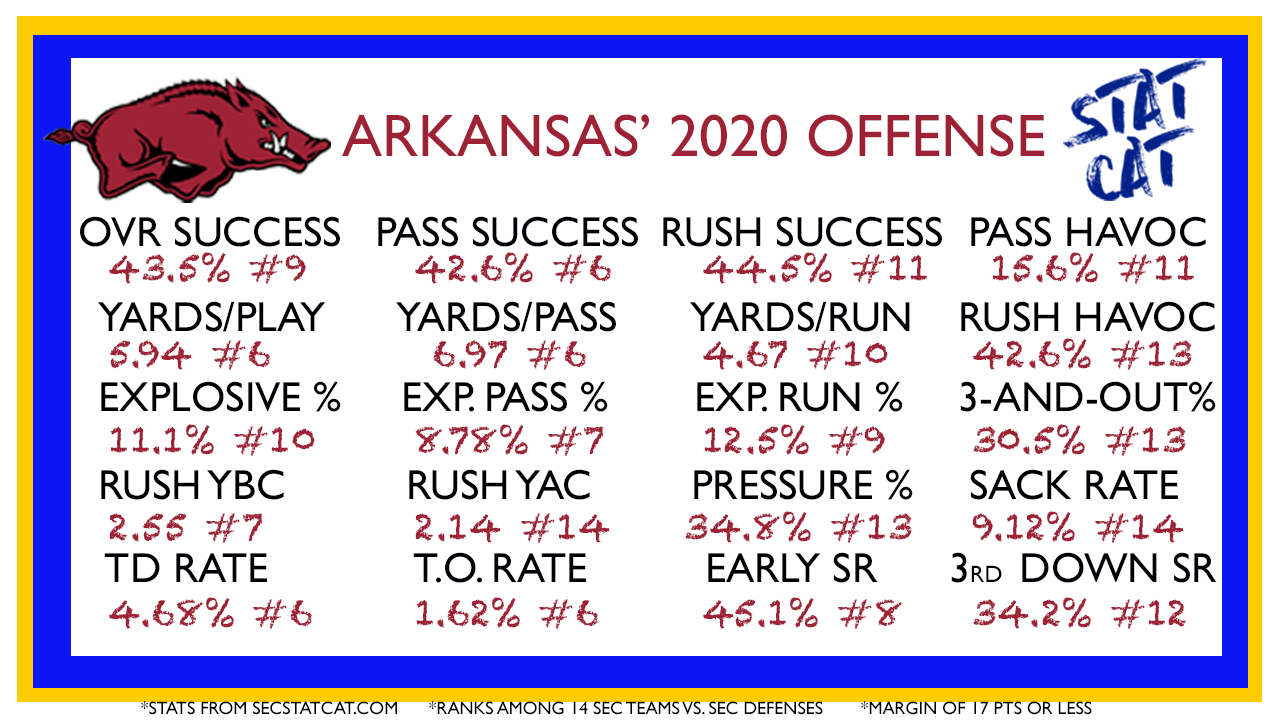
Kendal Briles’ first effort guiding the Hogs was decent. Arkansas didn’t excel in any one area statistically, but this offense improved its down-to-down Success Rate by over ten percentage points year-over-year in league play. Only the national champions improved by a larger figure within this conference. Behind more consistency, the Razorbacks overly improved across the board. Still, not one major metric cracked the top5. On the flip side, the plurality of their stats finished inside the SEC’s bottom5. With that knowledge cracked on our skulls, zeroing-in on a couple of stats to maintain seems misguided on the surface. But despite Arkansas’ 6th-ranked TD Rate, it was easily the SEC’s highest such figure by a team with a losing record the last two years. While Briles should be commended for bringing about consistency, his job at the end of the day is to score points. Improving upon the conference’s 4th-lowest Scoring Drive Rate should be on his to-do list for 2021. But if the Razorbacks are among the SEC’s best to score on any given down, they’re bound to have a shot to upend someone on their slate; especially if Barry Odom and dem boys surrender a lower counterpart clip.
Again, broad portions of this offense’s statistical profile need improvement. Despite the gains ditching Chad Morris, the Razorbacks finished with a bottom5 Yards/Carry, Rushing Success Rate, Explosive Play Rate, YAC average, Run and Pass Havoc Rate, 3rd Down Success Rate, 3-and-Out Rate, Pressure Rate, and Sack Rate in league play. But for the sake of KJ Jefferson, I want to reiterate the importance of the Razorbacks enhancing their pass protection this season. Dropping a sack on about one out of every nine dropbacks is simply horrendous and an abject recipe for failure. Since the Bielema Era, Arkansas’ Pressure Rate has exceeded 33% versus SEC defenses every year. But to the Hogs’ credit it’s also dropped each subsequent season (44% to 38.3% to 34.8%). That trajectory better damn well continue. Unequivocally, this passing game stands to be a far better product if it faces less duress. Targets should be more precise, designs executed more cleanly, explosive gains more frequent, and notably negative plays more seldom. As we saw last year, steadily moving forward was a trait of this offense. Time and time again, however, the Hogs had difficulty negating a misstep. No team sets themselves up to play behind the chains. So if things don’t change upfront, there’s no way Arkansas builds decent momentum this fall.
Key Defensive Metrics in SEC Play
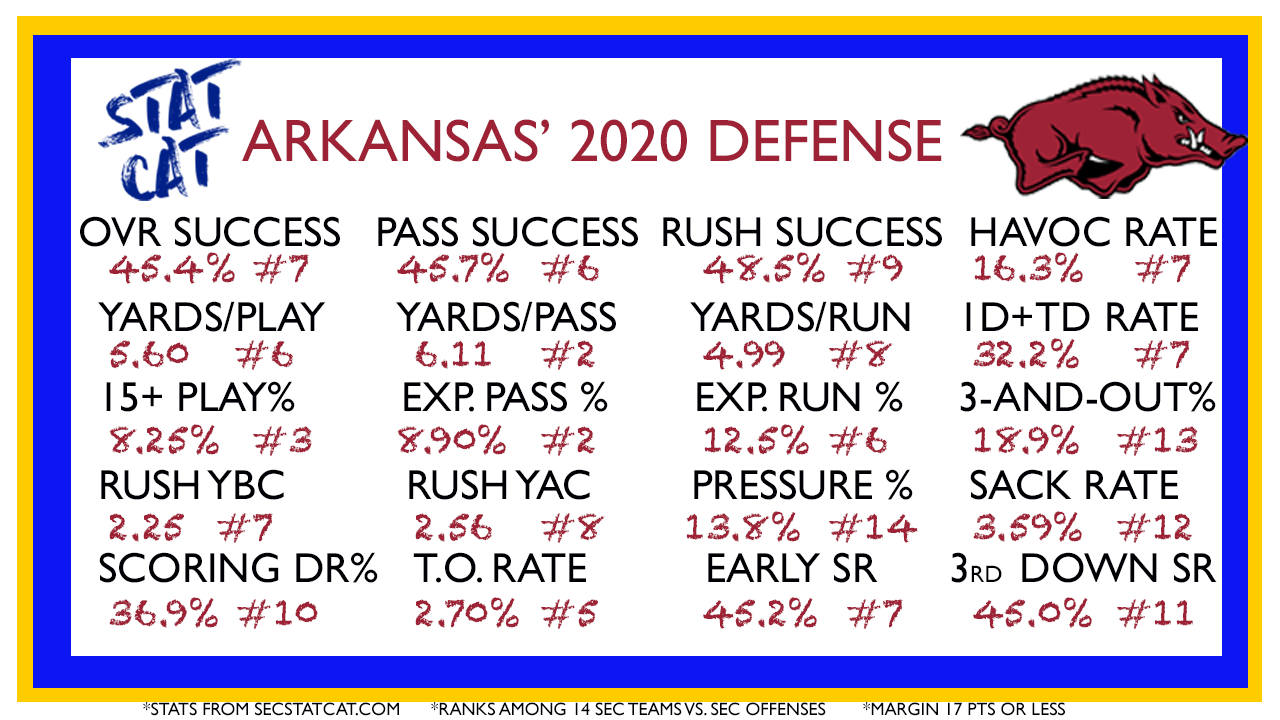
As an offensive guy, I generally gloss over defensive previews. Not that I don’t think individual defensive players aren’t valuable or dislike a blindside sack or athletic INT every once in awhile, but I typically treat that side of the ball as a collective unit. As only one guy, I can only track so much, yanno? You won’t get many fun defensive nuggets from me. That said, the Razorbacks return ten starters on that side of the ball. And even though Barry Odom’s defense looks toothless in the eyes of the traditional metrics, he whipped his guys into shape. In a year where defenses across the conference ceded ground to their adversaries, Arkansas improved across the board with the exception to its Rushing Success Rate. Consequentially, the majority of their figures crawled out of the conference’s cellar to the middle of the pack.
Odom was somewhat handcuffed by personnel. Though a coach that desires to have four down lineman, he sat back and played a bend-don’t-break style often from a tight, dime package (“Mint” for the laymen). This resulted in the aforementioned slippage in run defense. But by dedicating resources to hinder opponent’s passing games and keeping everything in front of them, the Razorback’s finished as one of the SEC’s best units limiting chunk gains. Arkansas’ approach can be considered lifeless and stagnant with the lack of exotic pressures. But it’s a hard ask to continually finish off double-digit play drives by nickel and diming. No element has had a greater correlation to victory within this conference the last several years than winning the explosive play battle; not turnovers, time of possession, or the Middle8. With an immense level of continuity in their corner, the odds are strong that this stinginess lingers. And If this bunch can keep capping their SEC brethren’s splash plays, Arkansas can play small, win in the margins, and steal a game or two.
But a drawback to that passive style is generating inadequate havoc. Sitting back and only sending three often creates situations where the backfield faces little adversity. And as a result, teams can scootch their way up the field. As Razorbackers found out last year, a lot of these sustained drives tended to result in points. Despite the down-to-down boost in regularity, the Razorbacks turned in the league’s 2nd-worst 3-and-Out Rate with a bottom5 Scoring Drive Rate. Slow burns only work when the fire eventually goes out. Moreover, it doesn’t matter how many early down victories you snatch if you always fold on the money down. Though Odom isn’t likely to switch up his philosophies too much, Arkansas’ box defenders simply can’t allow opponents to play seven-on-seven again by owning the SEC’s lowest Pressure Rate for the third consecutive year. Averaging 80 defensive snaps just isn’t wise for a group as thin as Arkansas. Stifling big gainers should be priority one for this unit, but logging a few more sacks and TFLs absolutely would elevate this unit’s margin of error.
Glancing at Arkansas’ Schedule
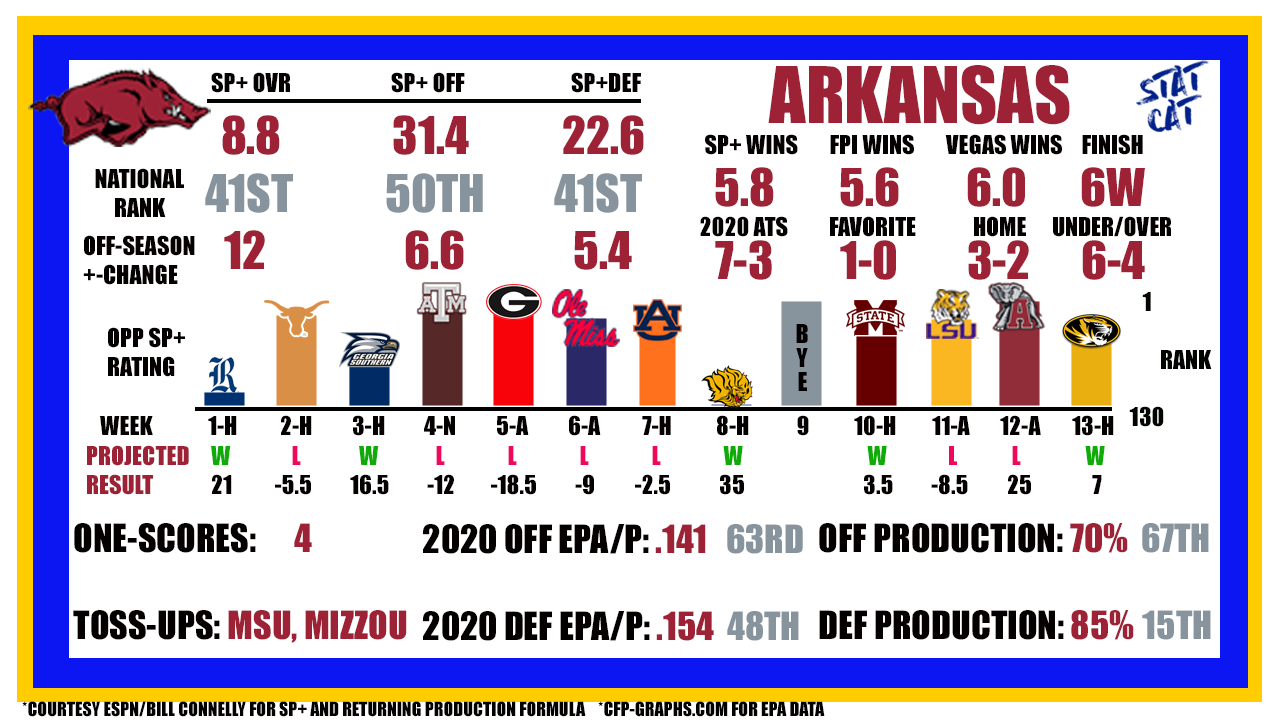
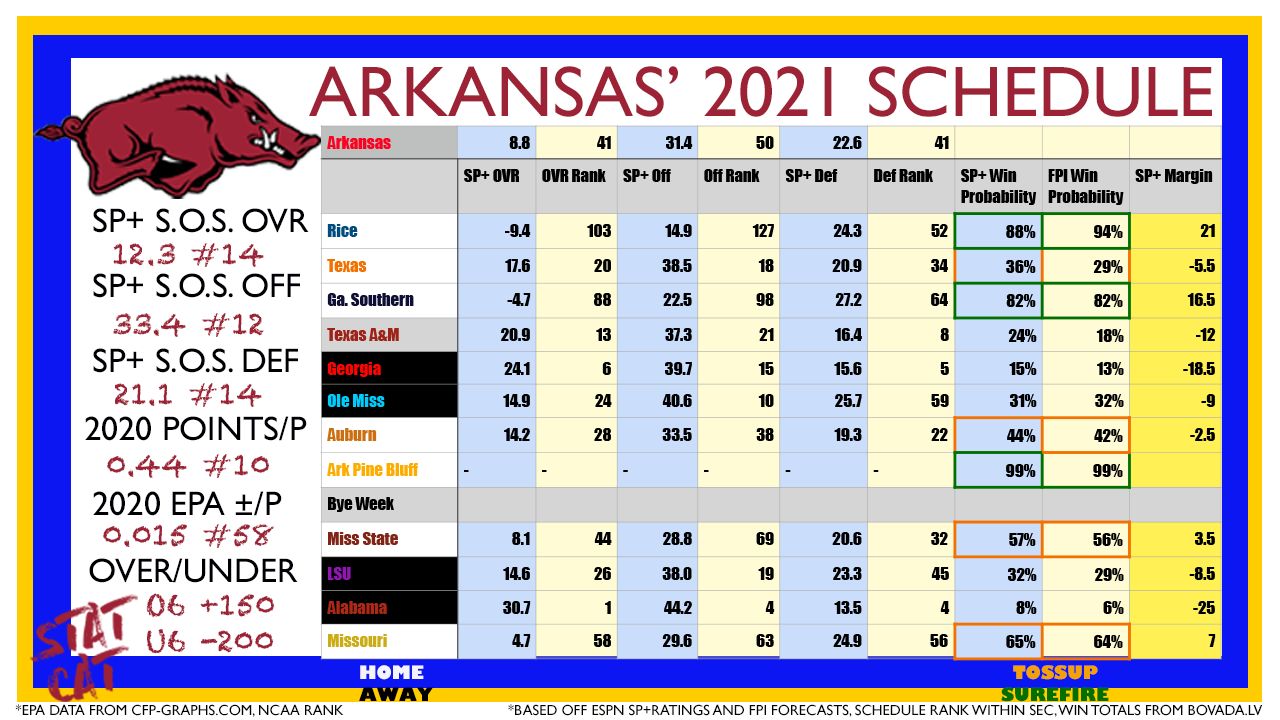
Another year, another season where Arkansas enters with the SEC’s hardest schedule. Over half of their offensive opponents sit inside the top30 of ESPN’s SP+ Ratings. On the other side of the ball, five foes meet that criteria. Among conference teams, only Alabama is set to face as many such defensive units. If the average opponent score from their slate manifested into a single adversary, they’d face a team akin to BYU each Saturday. Though not overly formidable on the surface, the Hogs would set up to be about a four-point underdog on a neutral field, which isn’t an ideal weekly scenario. Despite beating expectations with a few SEC wins last year, the challenging slate expectedly mutes Arkansas’ 2021 outlook. The Hogs are presumed to drop five games by multiple scores. For what it’s worth, Arkansas only lost four such games last year despite combing for a baker’s dozen during the Chad Morris Era. Wins exist on the schedule, but both ESPN’s SP+ and Football Power Index are bearish on the Razorbacks’ prospects of topping their 6.0 under/over win total mark. Each metric only predicts Pittman’s bunch to outright win three games with four others being tossups. Of those four, however, half favor the Hogs. And when simulating out the season, both forecasts hold firm with those probabilities.
Despite the recent rockiness from the Razorbacks, they should be able to comfortably handle the likes or Rice, Georgia Southern and their FCS foe. Though clear underdogs, they can be competitive against divisional opponents Texas A&M, Ole Miss, and LSU. While each of those games will occur outside of Fayetteville, the Hogs were 4-1 against the spread in such games last year— one of the best records in the SEC. With all of Arkansas’ road games setting up to be the team’s most challenging contests, they could be a sexy bet in those spots as the season progresses. While clipping one of those opponents would drastically boost Arkansas’ chances of beating expectations, the crux of their 2021 will hinge on taking care of business in its one-score matchups. Presuming the multi-score games go as planned, the Hogs will need to win all four of their tossups to beat their under/over win total. Again, Arkansas’ schedule is a gridiron gauntlet. But, their slate delivered a small bit of fortune: all of its 50/50 games will be at home. After a year of playing in front of little to no fans, having a stadium packed and full-throat with extra zeal certainly could fuel the Hogs; especially with two of these needed victories taking place the last month of the season after Arkansas’ bye week. One can’t rule out the possibility of these guys going o’fer in their own backyard, nor the notion their grueling schedule can create extra bumps and bruises. Still, this program’s momentum and personnel makeup hint this is a bowl-worthy team in 2021.