2020 Review: SEC RPO Analysis
SEC RPO Analysis
Run-Pass Options have engrained themselves in basically every offensive scheme across the country the last half decade. Building upon preexisting spread read plays, these designs are de facto modern day triple options. But instead of the "pitch" man working laterally from the backfield, he is now a receiver on the perimeter. With that tweak, the variations and forms RPOs can take are much more versatile than option looks from split back, wing-T, or flexbone formations. Plus, the offense isn’t limited to just one pitchman or landlocked behind the line of scrimmage. And despite the seemingly endless wrinkles these looks provide, they don't make a QB's job more difficult or bog him down with tertiary responsibilities. Defenses, on the other hand, certainly can be stressed out by these designs.
Every story you'll read about RPOs' invention follows the same arc: they came by an accident. As several innovators stumbled onto something revolutionary, it was quickly adopted by their contemporaries. Outside of being easy tweaks, RPOs offer designs that allow offenses who might be undersized, less skilled, or slower-footed to find success against stalwart defensive opponents. Though the end results might not be totally incendiary, seeing modest improvements on a per snap basis while incessantly pressuring linebackers and safeties is enough for many to be full believers in the tactic.
For passers, the upsides RPOs present are obvious. They allow offenses to always have an out depending on the defensive alignment, which frequently presents easy targets to space on the outside. With shorter throws and less obstacles, RPOs help quarterbacks manage down and distance quite well. The last two seasons has seen the average conference Completion% and Success Rate increase 12 and six percentage points, respectively. But, this approach trades modest and safe gains for value and potency. In 2020, the average Explosive Pass Rate, or percentage of throws that go for 20 or more yards, was sliced in half and the cumulative SEC Y/A dipped a yard. Though clearly buoyed by some teams, a league-wide 53.1% Passing Success Rate dwarfed the conference’s 44.7% overall clip when the scoring margin was either 18 points or less.
While playing the numbers game definitely aids passers, run games haven’t experienced the same benefits like you'd expect the past two seasons. Sure, some offense saw major improvements when routes were tagged onto read options. But overall, teams only experienced a marginal increase in Yards/Carry with their Success Rates noticeably souring. Back-to-back seasons, the former has increased by about a quarter of a yard thanks to the threat on the perimeter subsequently creating more room to run on average. Yet, the SEC-wide Success Rate shrunk about 2-3 percentage points. Along with teams being less consistent, offenses have seen their combined Explosive Run Rate worsen on these designs in comparison to the overall clip. You’d think more cushion and a higher per carry average would lead to a higher clip of snatching sizable runs, but not in this case. All in all, this trend is rather curious since RPOs are generally set up to be advantageous no matter the facet.
One of the greats thinks he might know why some offenses RPO efforts have stagnated. Nick Saban recently commented zone RPOs present less challenges for defenses compared to gap/power scheme designs. Pullers naturally trigger second and third-level defenders better than a coordinated flow like you would see on zones. And thanks to influencers like Gus Malzahn, zone RPOs are much more commonplace across the conference than other varieties. Within the SEC, two-thirds of these plays have been categorized as such the last two seasons while power designs only account for about a quarter; draws fill out the rest. With defenses being largely inoculated defending zones and apparently having better answers to curb them, it’s thought those should lose play share in lieu of more gap RPOs.
As Saban explains in the video, pulling action calls for the defense to engage and replace or to shift horizontally to trade off the gap exchange with the puller moving his potential run lane towards the other side of the center. Doing so obviously generates much more of a displacement factor in comparison. At least looking at his team in a vacuum, the Tider’s theory holds true. The past two seasons, Alabama has allowed a mere 40.6% Success Rate versus all zone RPO plays. This year, the Crimson Tide held conference opponents to a 4.19 Y/A (only UGA bested both of their metrics in SEC play). But breaking power designs have been a bit of a pain. In 2019 when the unit was relatively inexperienced, they surrendered a 58.6% Success Rate that only bested Vanderbilt despite owning a middle-of-the-road 5.21 Y/A allowed. This past fall, the Tide improved its Defensive Success Rate; but they still ended up being pretty mediocre against power RPOs.
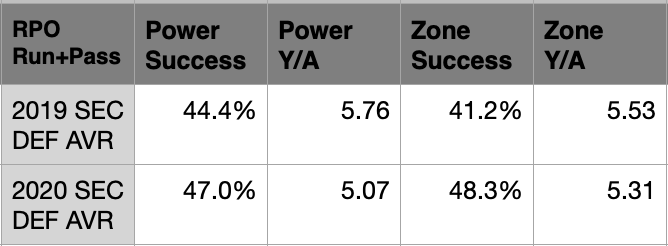
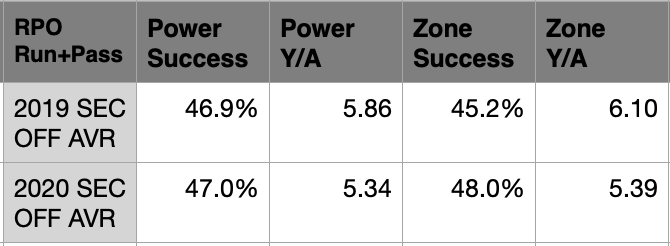
Though the notion is sound, the rest of the conference has mostly debunked Saban's proclamation the last two seasons. When the scoring deficit was 18 points or less, the two blueprints both begat a 5.07 Yards/Carry and 44.9% Rushing Success Rate in 2020. The year before, it was a wash with zones having the edge in Y/C with powers being a bit more successful. Through the air, neither principle out-dueled the other in this span in terms of Success Rate; but power RPOs have delivered a preferable Yards/Pass each of the last two seasons. In fact in 2019, SEC passers put up a cumulative 6.75 Y/P on these designed compared to their 6.69 overall clip in our parameter. Thanks to the likes of Alabama, Slant Variations in this context were undeniably responsible for ballooning that mark. Slants off power RPOs posted a 8.56 Y/A compared to zone’s 6.41 figure this past fall.
On the other side of the ball, our findings do little to back up The Man with Six Rings’ theory. Though defenses in SEC play limited offenses to a 41.2% Success Rate in 2019, zone RPOs bested powers this past fall in both Rushing and Passing Success Rate as well as Y/C and Y/A. So while Saban definitely has a point based on how his team has performed, it’s far from a slam dunk case looking at the recent returns across the SEC.
Again on a macro level, RPOs tend to benefit the pass game more than the run regardless of whether its zone, power, or a draw design. While SECers can absolutely have takeaways from those trends the whole, each situation within this conference needs to be examined to determine whether these tactics should be maximized or faded moving forward. Well, I guess they don’t have to be looked at. But, retroactive scouting can be quite illuminating. Without digging through the weeds too much, here’s a team-by-team glimpse how each utilized RPOs in 2020 in meaningful minutes.
Alabama

As most know, Alabama has donned one of the best RPO offenses the past few seasons. Back-to-back years, the Crimson Tide has rocked a double-digit Yards/Play while featuring them on about a quarter of their snaps. Usage dipped year-over-year, but they still were major aspects to Steve Sarkisian's attack. To reiterate, Alabama overly was a power RPO offense. Besides Florida, no SEC team saw gap schemes account for a higher percentage of their RPO runs than the Tide's 51.7%. Both blueprints delivered a less preferable Success Rate compared to the offense's overall clip, staying consistent with the conference-wide trend. Likewise, both Y/C clips improved. Powers especially helped balloon Alabama's output in this context with a 6.84 clip. These gains came despite the Tide's rush yards before contact average souring by a third of yard. Despite the aggressive rally towards the ball and the lackluster cushion, Najee Harris and Brian Robinson more than made up the difference being great tackle breakers. And with eyes darting towards the perimeter, less immediate support was the in vicinity. Like the offense as a whole, the Tide were pretty well-distributed in terms of concepts. Outside Zone Read, Y-Insert, and Inside Zone Bluff Read all logged a dozen reps in meaningful minutes. Counter, Slam Read, and Pin/Pull weren't too far behind. Though the Tide kicked straight ass on Inside Zone Reads and Y-Insert with Success Rates over 75%, every other of their favorite RPO runs finished under 42%.

Throws off zone RPOs also proved to be more fruitful than their gap scheme counterparts. The Tide averaged a just under 13 yards per pop and a 86% Success Rate. Mac Jones was money in this context hardly being off-target and almost never throwing an incomplete pass. Of course, his outlets did most of the heavy lifting; particularly the Heisman. While being on the receiving end of 58% of Alabama's RPO targets in our parameter, DeVonta Smith sported a 15.7 Yards/Target, 85.7% Success Rate, and 28.6% Explosive Catch Rate. Not every team can boast such a mismatch advantage in space. Outside of Kentucky, Tennessee, and Vanderbilt -- overly underwhelming passing games -- the Tide were the only SEC offense to see a rise in Y/A. After all, they averaged more yards after the catch (10.3) than the typical SEC offense's Y/A. Their beloved and productive slants led the way with a sizzling 15.8 figure followed up by bubble screen's 12.4 clip. The two outlets combined for to account for nearly a quarter of Alabama's RPO output in our parameter. All in all, slants commanded a fifth of the Tide's RPO reps with passes behind the line rocking about a 60% play share.
Arkansas

To orchestrate manageable wins, limit risk, and keep the Hogs in ball games, Kendall Briles first SEC offense used RPOs at the conference's second-highest rate. In meaningful minutes, over a third of Arkansas' plays fell into this box. Despite their proclivity to feature these designs, they didn't really help the Razorbacks find sustained glory on the ground. The operation certainly provided more room to run as the team's 2.61 overall rush yards before contact clip jumped up to over three yards, which coaxed nearly a two point increase in Explosive Run Rate. Yet, zone and power RPO runs delivered subpar returns and obviously worsened in these spots. Not too many teams considerably dabbled with Draw RPOs, but Arkansas definitely found a gem in its playbook with these designs. While being one of two SEC offenses to dedicate over a seventh of their RPO carries to delayed handoffs, these plays buoyed the team's output in this context with a 7.44 Y/A and 55.6% Success Rate; no one in the SEC topped the latter. Sprint Draws were unquestionably Arkansas' best RPO run look with clips of 9.08 and 66.7%, respectively. Zones, however, anchored this Hogs' approach with the Off-Tackle Read (13.2%), IZ Slam Read (10.0%), and IZ Bluff Read (7.9%) leading the way in play share.

Feleipe Franks was a pretty frustrating passer during his time at Florida. Despite having natural boogy to him, he constantly displayed hesitancy, weariness, and risk aversion. To goad him into making throws on time, Briles predominately featured short patterns and RPOs, which brought out sustained efficiency. KJ Jefferson's six such attempts hurt the team's passing profile in this context, but Franks personally rocked a 7.45 Y/A, 60.2% Success Rate, and 77.1% Completion% on RPO targets in the field of play. In case you were curious, six throwaways and five sacks further tainted the team's bottom line. Arkansas was a frontrunner this past season featuring slide and flat routes behind the line of scrimmage. Their 25 targets and 56% Success Rate were team-bests in meaningful minutes. Only 14 other RPO throws went towards outlets behind the line of scrimmage. Though solo curls, Y pop passes, and quick outs showed up on its script, Arkansas go-to downfield route tag were Slant Variations. Despite only averaging 3.1 Y/A on these throws, the concept group managed to see half of its chances win situationally. Excluding backward passes, every route tag that fielded at least two targets also met that criteria when the Hogs were either up or down 18 points or less.
Auburn

By now, it's common knowledge Gus Malzhan was all about RPOs. Paired with his hurry up, no huddle mentality that aimed to play as fast a possible, an Inside Zone Read coupled with a bubble screen was synonymous with his offense. And while it helped the Tigers boast a nice competitive advantage early in his tenure, that has long since dissipated as rule changes and opponents evolved. Despite the waning effectiveness of these designs, playcaller Chad Morris increased Auburn's already high 32.5% RPO Rate in 2019 to a 37.6% clip that led the SEC this past fall. Plus, he faded power usage year-over-year in this context. Zone runs accounted for 72% of the team's RPO carries compared to 63% in 2019. On the surface, that was a wise move as Auburn's Y/A and Success Rate on zones bested the conference average and propped up the team's output. The end results, however, saw the Tigers finish as pretty damn average RPO squad on the ground. Hinted by its dip in rush yards before contact, Auburn experienced more elements of Havoc, which actively affected its league-best 20.4% Explosive Run Rate. On RPOs, that mark dropped to 14%, which is -- you guessed it -- right at the conference average in our parameter. The Slam Read continued to dominate the play share (35.8%) especially with zone reps ramping up. In addition to that, its brother concept, the IZ Bluff Read, (7.1%) and Tackle Counter Read (7.5%) rounded out Auburn's three favorite RPO runs.

Bo Nix failed to progress as a dropback passer in Chad Morris' lone season of guidance. Because of that, Auburn was somewhat handcuffed calling plays, which forced the former Arkansas head coach to aggressively lean into these designs in order to get something out of his struggling pass game. With an overall Completion and Accuracy% well below the SEC average, RPOs at least accomplished their intended purpose for the Plainsman. Sure, Nix finished on the wrong side of the conference mean in terms of Y/A; but he tremendously improved his ball placement figures in this context. While being twice as likely as the strawman SEC passer to target an RPO route, his 56.6% Success Rate finished inside the top5 thanks to his 15 percentage point increase on top of his overall clip. Only four other SECers experienced a higher increase in these spots last season. Morris tinkered with more variety in his outlets including slide/flat routes, Stick, quick outs, and solo fades outside the numbers. But, tunnel and bubble screens remained this offense's most targeted route tags. While rocking a combined 57.1% Success Rate, the two accounted for over 15% of Auburn's RPOs in meaningful minutes.
LSU

Besides flipping its script and focusing on the pass, including more RPOs has been a noticeable feature for the Tigers' offense the past two seasons. In 2019, over a fifth of the Bayou Bengals' snaps turned to these designs in meaningful minutes. Thanks to injuries and a plateaued attack, Steve Ensminger further took it up a notch in 2020 as the team's RPO Rate reached 25.8% and cracked the conference's top5. Though LSU's ground game was overly used in the same fashion as the year prior, it simply was less dangerous and easier to curb. Part of this was the pass game commanded less attention from second and third-level defenders, but the Tigers' toothless execution was pretty damning. Overall, no SEC offense averaged less rush yards before contact. But despite the lack of cushion, LSU was one of the best at limiting defensive Havoc on the ground. Their 16.6% overall clip clawed into conference's top5 this past fall. Plus, that stat was enhanced on RPOs, which led to the Tigers generally being better carving out run lanes. No one should jump up and down over a 1.84 YBC clip, but at least it didn't represent the SEC's floor. Despite the improvement in these spots, the early contact did a fantastic job bottling up LSU's ball carriers. Along with the conference's 3rd-lowest Explosive Run Rate, the Tigers sported dismissible Y/C that hurt their bottomline. While all this spells a pretty bad product, LSU managed to at least don a middling Success Rate. The IZ Slam Read and Duo Dive anchored their efforts with a combined 60% play share, but both finished with Success Rates under 45%. For the second-straight year, Y-Insert proved to be this offense's most efficient run concept. In meaningful minutes via RPOs, that power play delivered a team-high 73.3% clip.

While usage increased, LSU's passers still overly avoided taking advantage of these throws. Myles Brennan, TJ Finley, and Max Johnson only totaled 23 such attempts in our sample with 12 completions. On the surface, that screams inefficiency since RPOs are especially designed to help pad a QB's figures and provide easy connections with receivers. Ole Miss and South Carolina were the only other SEC offenses to experience a dip in Completion%. The former also joined the Tigers seeing its team Accuracy% follow suit in these spots. Either way, none proved worse in that regard than the Bayou Bengals within the conference. This ineptitude was so beyond the pale that the Tigers were almost as likely to log an uncatchable RPO throw as a first down. Slant Variations were the only route tag that fielded more than three targets when LSU was either up or down 18 points; only one of them resulted in success. While RPOs had a decent effect on helping the run game bring fourth more value, it's a hard sell to keep them in the fold unless LSU's passers can start to capitalize.
Ole Miss

Behind Rich Rodriguez's spread-run approach, no SEC offense topped Ole Miss's 34.9% RPO Rate in 2019. While there's no doubt these designs still gobbled up plenty of reps for the Rebels this past fall, Lane Kiffen and Leff Lebby decreased that figure by seven percentage points in their first season in Oxford. Though a common early down apparatus that enabled Ole Miss to stress pace and provide quick throws, it hardly generated substantial value for its run game. Both the team's rush yards before contact average and Y/C remained basically the same. Plus, the Rebels Explosive Run Rate and Run Havoc Rate both soured in these spots. Draw RPOs helped to slightly rose-scent their bottom line. But considering they accounted for a mere 6% of Ole Miss's rush attempts in this context, they simply carried less weight. Powers too helped boost the team's RPO Y/C, but it finished on the bad side of the SEC average. In addition to that, the Rebels' 40.4% Success Rate on said designs fell into the conference's bottom five in our parameter. Considering Ole Miss logged the SEC's 5th-highest play share involving RPO powers, that's awfully concerning. At least, Counters produced a 52.9% Success Rate to ease the pain. Only QB Draws put up a preferable clip. IZ Slam and Bluff Reads (33.7%) and Outside Zone Read (10.9%) were far and away this offense's favorite ground concepts for RPOs despite all rocking a Y/C under 4.2.

In addition to RPOs leaving plenty to be desired on the ground, they really didn't help this offense win situationally or manifest gimme throws at an acceptable level. Matt Corral's otherwise sturdy 9.43 Y/A was almost cut in half to 5.23. And while he managed to see over half of his passes find success overall, his clip on RPOs was ten percentage points below the SEC mean and fell into the bottom5. Hammering home the lack of consistency on these designs, both his Completion and Accuracy% worsened. Ole Miss's two favorite route tags, Slant Variations and tunnel screens, were the only RPO outlets to boast at least a 50% Success Rate when the Rebels were either up or down 18 points. No matter how he was targeted, Elijah Moore was obviously the team's top target in this context. While fielding 42% of the Rebels such attempts, he rocked a team-best 6.21 Y/T, 57.9% Success Rate, and 17 catches. Both of his failed connections occurred due to his chances being deemed uncatchable. With him gone and Corral's aforementioned backsteps, it fair to wonder if other tactics will take play share from RPOs moving forward.
Mississippi State

The Air Raid barely had any use for RPOs. As the most pass-happy team in the land, running the ball in general was seldom. If this offense wanted an easy completion to space, Mike Leach would gladly dial up a Convoy Screen on the perimeter. Yet, even the Magnolia State Madman turned to RPOs this past season as an effort to toy with opponents. Roughly a fifth of the team's overall rush yards and attempts came off these designs -- good for the SEC's 3rd-lowest clips in meaningful minutes. RPOs begat an ugly 3.71 Y/C, which only bested the Gamecocks within the SEC, and hurt the team's Rushing Success Rate by about ten percentage points compared to its overall figure. The Bulldogs' 37.5% only topped Tennessee. As fantastic as the team's 4.65% Run Havoc Rate in this context was, seeing it match MSU's Explosive Run Rate is quite appalling. Much like their run game in general, the Inside Zone Slam Read anchored the vast majority of the Bulldogs' efforts as the concept accounted for nearly two-thirds of this offense's RPO snaps in our parameter.

Again, I am not going to pretend these throws carried any value for this offense. Only about two attempts out of 100 were classified as RPO throws in meaningful minutes. But when the Air Raid tried its hand targeted these route tags, the results undeniably sucked. As muted as the returns on the ground in these spots were, the Bulldogs still managed to average more yards per pop running than throwing. Yes, MSU's passers improved their ball placement figures. But, the team's 30% Success Rate just missed out on being the worst the conference had to offer. Fat chance these designs take more play share from Leach's staples in 2021 based on these returns.
Texas A&M

Behind its Maroon Goons upfront, TAMU owned arguably the best run game in the SEC. While sporting the top raw Y/C and rush yards before contact, no conference offense matched its gaudy 22.2% Explosive Run Rate in meaningful minutes. In all honestly, this run attack really didn't need to feature pass outlets, but RPOs at least generated more cushion on average for its ball carriers. Like its 3.04 overall clip, the Aggies remained dominant in carving out run lates putting up a 3.33 rush yards before contact average on RPOs. Yet, both the team's Run Havoc and Explosive Run Rates dipped in these spots. Being more prone to defensive chaos allowed TAMU's Y/C and Success Rate to undergo a similar effect. Though over half of the Aggies overall runs bested situational goals, under 47% of their RPO carries met that criteria in 2020. Like much of its ground game, TAMU overly stuck with zones in thieve spots as they accounted for two-thirds of this offense's runs. The tried and true IZ Slam Read accounted for over 31% of the team's RPO output. Despite not being entirely incidiary, its consistency was the major foundation for TAMU's bottom line. Though wonky and secondary, the Tackle Counter was single-handily responsible for ballooning this offense's 6.83 Y/C on power RPOs.

Jimbo Fisher's pro-style approach usually leaves little room for RPOs to run rampant on his call sheet. But, at least a seventh of the Aggies' plays the last few seasons have been categorized as such. And though only a twelfth of Mond's passes were directed their way, these dinks and dunks had a considerable effect helping his ball placement figures. Outside of Vanderbilt's Ken Seals, no SECer experienced such a stark uptick in Completion% on RPOs. And even though only a quarter of his RPO throws traveled past the line of scrimmage, half of them worked situationally. In our parameter, only Alabama topped TAMU's 66.7% team Passing Success Rate targeting power designs. However, one of the major knocks on this offense was its lack of potency through the air. That shortcoming was accentuated as Monds Y/A slipped the 5th-most within the SEC in this context. Likewise, the Aggies were one of five conference offenses in these spots to not log a single RPO completion that generated at least 20 yards. With a new passer set to lead his offense in 2021, there's a chance RPOs could see increased usage. But surely, Jimbo won't overlook his team's soured yards per play compared to its overall numbers.
Florida

Florida's ground game needed all the help it could get in 2020. Though on the surface the team's cumulative 46.6% clip appeared average, Florida was one of the least potent rushing attack in the SEC. Overall when either up or down 18 points, only LSU and Vanderbilt produced a lower Explosive Run Rate than the Gators' 11.5% clip. Thanks to Q-Runs and short porches, they traded sure-things for homeruns. A good deal of the former featured hot receivers towards the flat with the back often operating as a lead blocker. Florida also wasn't above using "alert" RPOs under center with Duos, Power, and Counter. In the end, no other SEC offense dared match the Swamp Dwellers affinity for power RPOs; 61% of their carries were of the gap variety. Again, Alabama was the only other conference offense to tip the scales in favor of those designs in lieu of zones. And looking at the results, Mullen's play calling was justified. The Gators bested the SEC mean in Y/C and Success Rate, which certainly were bright spots for this iffy ground game. Zones were basically a wasted rep every time they were tried. Only about a third found success while averaging less than four yards per pop. Their pathetic 35.4% Success Rate was almost ten percentage points below average. But draw RPOs provided a little bit of pizzazz in their limited snaps. With a mere 3% share, take what you will about their output, but no SECer topped Florida's such 11.8 Y/C last year. Like in general, creating cushion was a bit of a challenge. But, at least the Gators did improve and climb outside the conference's bottom4 into middle of the pack in terms of rush yards before contact.

Despite the gains these designs provided for the Gators' ball carriers, RPOs failed to provide the same value as dropbacks for Mullen's offense. Overall, Florida's pass attack was one of the mightiest aerial assaults in all of college football. So on its face, that's a hard standard to top. But once you take into account the Gators also finished under the SEC average in Y/A and Success Rate, it's a dead giveaway these plays were relatively inefficient for this offense. It didn't matter that their passers' ball placement improved, the returns were plain bland. Almost all of Florida's RPO outlets were directed behind the line of scrimmage, which certainly heightened the degree of difficulty. Bubble screens proved to be a bust with a 22.2% clip; but the rest of the variants like flats, tunnels, and swings all posted at least a 50% clip. Unless Emory Jones' accuracy has improved massively behind the scenes, fully expect Mullen to feed his gunner RPOs early and often to both provide him easy targets and get the juices flowing in the ground game. If the Gators do go that route, however, it is imperative at least half of their RPO throws work in meaningful minutes.
Georgia

Todd Monken brought some nice touches to Georgia offense. Along with increasing the verticality of its base pass patterns, he injected more RPOs into the Bulldogs' script. In 2019, UGA logged the conference's 2nd-lowest RPO Rate. And while they still finished in the bottom5 this past fall, Monken's influence saw that clip tick up five percentage points. Over a fifth of Georgia's offense constituted as an RPO. Like most teams, zones led the way with a 75% carry share and overly buoyed the team's bottom line. Only Kentucky topped the Bulldogs' such 5.97 Y/C. Powers put up putrid returns and draw RPOs didn't carry too much sway in the numbers. So Georgia's zone output very much was its best self in the run game. All in all, UGA was more apt at creating cushion for its rushers and limiting defensive Havoc plays on RPOs. In turn, this offense's Explosive Run Rate inched upward and remained on the good side of the SEC's average. If not for the poor production from its power plays, Georgia would have finished among the top RPO teams in the conference last year.

Despite finishing well below the SEC average, Georgia's 42.9% Success Rate on RPO throws was a modest down-to-down improvement to its overall clip. Already one of the three worst in the conference in that regard, the Bulldogs still finished inside the bottom5 even with the slight increase. Like their counterparts on the ground, Georgia's execution on zones delivered the most value. Bulldog passers failed to log a single successful power RPO attempt in our parameter while zones finished with a respectable 48.2% clip. Thanks to Monken's desire to push the ball downfield, Georgia was one of the most vertically-oriented RPO attacks in the SEC. In addition to calling outlets past the line of scrimmage like curls, slants, and quick outs, this offense targeted solo fades a half a dozen times in meaningful minutes with three of them resulting in a catch. With UGA's best deep threat done for the year, there's a pretty good argument to provide one of the SEC's worst performers in Depth Adjusted Accuracy with some more gimme completions on the perimeter in order to keep its pass game afloat.
Kentucky

For the second-straight season, UK was undisputedly the most ground-oriented offense the SEC had to offer. When up or down 18 points or less, the Cats rocked a 41.7% Pass Rate that was over six points less than the next team in line. The reasons, as the BBN can attest, were obvious. Along with Mark Stoops old school background that yearns for low-scoring rock fights and physical, ball control offenses, UK's pass attack has been downright dreadful as of late. Plus, his best offensive players just so happen to either play on the line or run the ball. With that makeup, the Cats rock steady run game was as good as anyone's. But the straightforward and deliberate Inside Zone scheme made Kentucky rather predictable. To deviate attention from the box and to help his laboring quarterbacks log completions, UK utilized RPOs at the SEC's 3rd-highest rate in meaningful minutes. Looking at the numbers, there's a strong case these designs could have been further maximized. Essentially, the Cats' already strong run game further increased its might. Behind a top5 rush yards before contact average and the 3rd-lowest Run Havoc Rate allowed, UK's 16.9% Explosive Run Rate finished inside the conference's top4. No team topped its illustrious 7.11 Y/C, which happened to dwarf the SEC mean by two whole yards. Outside of QB Draws, every run concept that logged at least four reps sported a 50% Success Rate or better. The Cats two bread and butter concepts, IZ Slam and Bluff Reads, each produced clips over 53% with both donning a 7.4 Y/C. Counters were particularly effective at winning situational battles with a 72.7% Success Rate. Since it was this offense's favorite power RPO, it was a major catalyst for Kentucky's SEC-high 63.2% such clip.

In addition to the substantial effect RPOs had on UK's run game, Eddie Gran's downtrodden pass attack was unequivocally its best self targeting these designs. Thanks to the very low bar the Cats' dropback game presented, it wouldn't have taken much for Kentucky's passers to exhibit positivity. But, they were one of four SEC offenses to experience an increase in Y/A on RPOs compared to its overall clip. And in terms of Success Rate, no conference offense could match the Cats' nearly 30 percentage point increase. Only Alabama thwarted UK's 63.6% Success Rate and 7.05 Y/A targeted RPOs within the SEC this past season. Without digging thru the tape line by line, it appears UK was well-coached and capitalized plenty in both facets. Slant Variations and Bubble Screens were the Cats' two favorite outlets with each delivering a 66.7% and 80% Success Rate, respectively. Though tagged plenty, Stick and Curls only combined for a few targets in meaningful minutes. Power RPO outlets brought forth a marvelous 7.88 Y/A and 60% Success Rate. Though zones looked up to the former, no question its 68.8% figure of the latter helped ballon Big Blue's bottom line in these spots.
Missouri

Outside of Mississippi State's Air Raid, Eli Drinkwitz's offense was the most RPO-averse schemes in the conference. By volume, the Tigers only logged 58 in our parameter. While fading the modern day triple option, Mizzou noticeably featured the spread-version of the old-school three-headed design more than any other SEC offense by a considerable margin. While the Tigers run game was predominately plug and chug with below-average potency, their occasionally RPO carries were even more toothless. With the team's rush yards before contact average more than sliced in half, the lack of room put more strain on its ball carriers, who weren't exactly the most gifted backs operating in a phone booth. All else considered, the Tigers performed adequately situationally albeit the sour YBC. Zone RPOs were undeniably the engine that drove decent numbers. While accounting for 90% of Mizzou such runs, zones bested the conference mean via a 48.5% Success Rate. IZ Slam and Bluff Reads from the gun in addition to under center "alert" RPOs from Off-Tackles were this offense's three favorite concepts to feature in these spots. Both of the latter two found success on two-thirds of their tries.

Missouri's passers generally experienced the same trends the conference's macro trends laid out. The team's Y/A and Explosive Pass Rate noticeably shrank, but ball placement figures and Success Rate showed sizable gains compared to its overall numbers. And when looking at Connor Bazelak's 94.4% Adjusted Completion%, it's clear he had no problem finding his targets in these spots. Jalen Knox, Keke Chism, and Tauskie Dove each received between 4-5 chances in meaningful minutes. But, each displayed varying results. Despite dropping an attempt, Chism found success on his remaining three tries; all of which resulted in a fresh set of downs. Because of that his 9.0 Y/T finished as the team's best. Knox was middling with a so-so 5.40 Y/T and 25% First Down Rate. But, his 80% Success Rate was tops. Dove was easily the worst outlet securing only six yards across his four targets. Just over half of Mizzou's RPO throws were directed behind the line, but Slant Variations emerged as this offense's favorite tag to target. While a 57.1% Success Rate is nice, a 3.86 Y/A is what the experts refer to as blah.
South Carolina

With Mike Bobo's inclination for I-formations and rigid dropback schemes, South Carolina's RPO Rate dropped about eight percentage point year-over-year and fell into the SEC's bottom3. Less than a fifth of this offense's ground game production in our sample came off RPOs. Like their run overall run game, the Gamecocks were inconsistent AF executing RPOs last year. Even though South Carolina saw one of the conference's highest increases in terms of rush yards before contact in these spots, their Y/C slightly dipped along with their Success Rate significantly shrinking. Though power RPOs bested the SEC mean, zone and draw designs provided negative value across the board. In general, South Carolina was one of the few conference offense that dedicated a higher play share to power compared to zones. But zones received the most tries in this context. That said, Bobo's bunch was pretty balanced with a 44/42/16 split between the three principles. Outside Power Reads like the Buck Sweep and Pin/Pull were their most successful and productive ground looks. But as you might guess, the IZ Slam Read totaled the most tries. Sticking with the theme of inconsistency, RPOs invited more instances of Havoc regularly, but generated an Explosive Run Rate five points over the conference average at 18.8%.

Along with its ground game failing to find its footing, RPOs rarely birthed value for South Carolina's passing attack. Other than Ole Miss and LSU, they were the only ones to experience a dip in Completion%. Outside of the Bayou Bengals, none donned a less preferable Y/A than their 3.35 figure. But worst of all, the Gamecocks represented the SEC's floor in terms of Success Rate with a measly 29.4% clip. Shi Smith was clearly a beacon of hope within this dreary dropback game, and his prowess continued as an RPO outlet. While catching all eight of his such tries in our parameter, he totaled 74 yards, a 62.5% Success Rate, and a 9.25 Y/T. For good measure, Smith logged the only three first downs and this offense's lone explosive catch in our parameter. No other Gamecock caught more than two balls or racked up more than seven yards in meaningful minutes off RPOs. Tunnel Screens, solo fades, and Slant Variations were the only route tags that finished with multiple targets. The former was the only look to see at least half of its attempts work.
Tennessee

Thanks to a lumbering style of play, a slow-processing passer, and the SEC's worst such Success Rate, Tennessee sported the conference's lowest RPO Rate in 2019. But in an effort to kickstart its scheme and as a late-year method to build confidence in its inexperienced QBs, the Vols saw its clip more than double year-over-year in meaningful minutes. Their returns were much better than in year's past, but they still finished inside the SEC's bottom3 in terms of Success Rate. Looking at the Vols woeful returns, both zone and power RPOs finished substantially under the league average. Plus, the team's Y/C moved the wrong way despite its rush yards before contact average, Explosive Run Rate, and Havoc Rate bettering. All in all, about a third of Tennessee's run game production came off the backs of RPOs with 84% of them being repped via zone looks. Exactly half of Big Orange's such snaps repped the IZ Slam Read. But thanks to high volume and immensely underperforming results, this concept played a major part in curbing this offense's zone RPO output. Though shoved down the script, power plays Counter and Duo Dive each rocked a 50% Success Rate. Along with their consistency, the Vols rode these concepts to serviceable 5.33 Y/C, which was the only one of their such stats to beat the SEC average.

Though Jarrett Guarantano proved to be an iffy RPO thrower in the past, he was more than fine in meaningful minutes in 2020. Over half of his attempts resulted in a fresh set of downs, he rocked a 60% Success Rate, and was accurate on each of his completions. His only downfield misses were on a fade and a hitch outlet. And though all five of his swing screens failed to work, all six of his targeted Slant Variations found success in our parameter. Only Alabama topped Tennessee's 12.8 Y/A in these spots. While its ground counterpart largely stunk, the Vols were pretty effective on zone RPO throws. Powers only rocked a 25% Success Rate and 4.0 Y/A, but the others boasted respective clips of 62.5% and 7.50; both of which cracked the conference's top3. The Baylor Spread lends itself to a fast pace in which RPOs generally flourish. Considering the traits Hendon Hooker possesses, it's not out of the question for these designs to make up a fifth of Tennessee's offensive snaps in 2021.
Vanderbilt

You shouldn't need me to tell you that Vanderbilt's 2020 offense wasn't very good. And while most teams would throw away the returns the Commodores produced on RPOs, the numbers say they provided value for this run game. Transitioning away from the pro-style principles the team deployed when Kyle Shurmur was in town in favor of more RPOs, Vandy's RPO Rate has topped 21% the past two years; its 23.7% clip from 2020 equaled Florida's clip. Though the 'Dores dropped the ball when it came to executing power looks like Counter, Duo, and Y-Insert, Vandy mostly focused their efforts in these spots towards zones. In fact, they were rather basic honing in on IZ Slam Reads coupled with bubble screens. Those concepts composed nearly two-thirds of Vandy's RPO offense in our parameter. While the lead ground look reached 249 yards, no other run gained more than 32 yards. Though their rush yards before contact average didn't generate a major uptick in Y/C and RPOs birthed a dip in Explosive Run Rate, the Dore stood out limiting Havoc in this context. Though the team's overall 21.7% was one of the 5th-highest in the SEC, that clip plummeted to 6.58% on RPOs, which was good enough for the conference's silver medal. Though its a bit of a stretch, this is an offense in search of silver lining with a new staff in town building on positives.

With teams hardly respecting its dropback ability, Vanderbilt at least managed to mine occasional gold with its RPO game through the air. Along with Alabama, Kentucky, and Tennessee, this offense experienced an uptick in Y/A in these spots compared to its overall clip. Seals was as accurate as they come with a sterling 96.9% clip. With his passes finding their intended target frequently and with opponents selling out to stifle the Dores' ball carriers, plenty of room and opportunities manifested on the perimeter. As aforementioned, bubble screens were their go-to route tag. Though the run concepts with which it was commonly coupled predominately failed, bubbles produced a 64.7% Success Rate and 7.24 Y/A. Behind their volume and more-than-serviceable marks, Vanderbilt finished with the 3rd-best clip of the former within SEC play. Though explosive gains off RPOs are full of variables, one cannot dismiss the Dores 9.38% such rate that only trailed Alabama within the SEC. As an underdog constantly searching for an edge, I'd like to see more creativity from this offense as an analyst. But if such a simple design can generate value once again for this overly green unit, more power to them.