Who's Got the Highest Passing Floor for 2021?
Who's Got the Highest Passing Floor for 2021?
Everyone loves quarterback talk. Since it's the most important position in the sport and a passer's ability often can be the difference between a victory or defeat, extra weight is put into analyzing these fellows. While most fans are content with volume stats like completions, yards, and touchdowns scored, the archaic metrics do little to tell the story of how a passer actually operates.
Naturally, a passer's overall figures will reflect his entire body of work. Pressured, clean, screen, RPO, dropback, deep, 3rd Down attempts and others criteria are all merged together to form cumulative stats. But because no passer's style of play or scheme is exactly the same as another's, varying factors can help skew a quarterback's perception based on his final output. What if a passer leaned more on screens or lived on the wild side by pressing downfield more often or benefited from being a game manager?
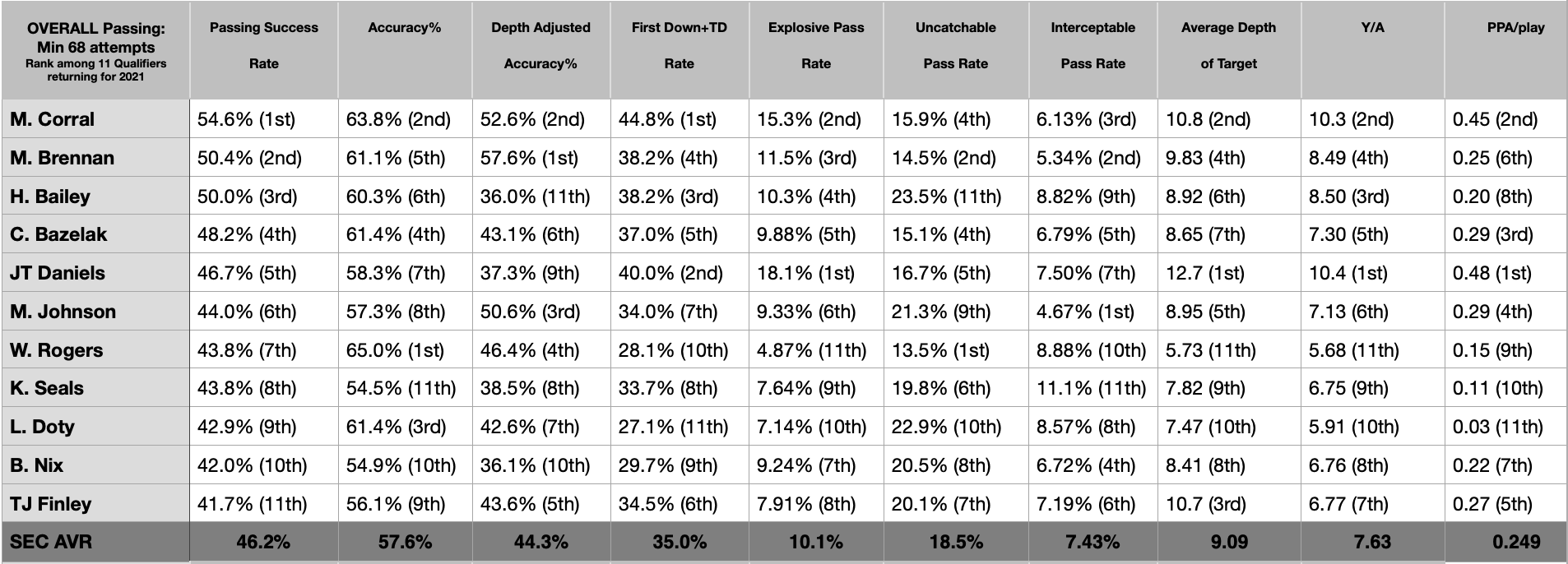
In order to determine which passers are actually good, we need to break off these extra elements that could in theory help boost a quarterback's output. As eager as I know some of you are to strip superfluous elements away from a passer's profile, we first need to measure one's base line entering next season. To start our discussion, let's first see which returning quarterback had the best overall season in 2020 throwing the football among our 11 qualifiers returning within the conference. Our qualifiers had to throw at least 68 overall pass attempts this past season and hold a start. With all due respect to Alabama (Bryce Young), Arkansas (KJ Jefferson), Florida (Emory Jones), Kentucky (Beau Allen, Joey Gatewood, and Will Levis), and Texas A&M (Haynes King), I felt your passer's sample size was too small to make any substantive statement on their abilities for next season. Heck, you could even argue it's stretch to include former freshmen Harrison Bailey and Luke Doty in this analysis. But in my opinion, both did just enough where we can gauge their future floor.
Matt Corral

Matt Corral had a rocky 2019. Despite beginning the season as Ole Miss’s starter, injury and lackluster play soon put him in a position battle. As Rich Rodriguez eagerly steered the Rebels toward a more ground-oriented attack, Corral’s passing prowess was overly shelved until they fell behind or needed a spark, which forced him to press more often than not. By the old way of measuring guys, he hardly popped off the page. Hell this time last year, most wanted to ride or die with John Rhys Plumlee and his electric legs. Despite the dissenters, Corral’s passing floor numbers projected a top5 QB for 2020. With that strong foundation, Lane Kiffen and Jeff Lebby further maximized Corral’s talents through the air. While his average depth of target remained steady year-over-year, both of his accuracy figures experienced double-digit jumps. He took more deep shots, but he also targeted more RPOs on average. Most of his numbers exceeded expectations and placed him inside the SEC’s top3 despite the deviation in scheme. While the offense still tried to force feed Elijah Moore, the new braintrust was far more-suited for getting their best player open and presenting their young passer more successful completions. With Moore’s production buoying his own, Corral enters 2021 with the best overall Success Rate and First Down+TD Rate in the conference.
Myles Brennan

Despite the optimism last off-season, LSU failed to have an adequate encore. Sure, no one should’ve expected this offense to keep rewriting record books. But the end results saw the Tigers as nothing more than average. Myles Brennan had the hard task of being The Man After The Man down in the bayou. Of course, the ante was upped dealing with last year’s environment in addition to a new passing game coordinator. Behind the SEC’s 5th-highest Deep Pass Rate, the Blonde Bomber exhibited nice verticality in his game, but it was clear he was still raw managing the offense. It’s really easy to crap on his poor 3rd down stats — he was the only SECer to finish with a such Success Rate below 20%. Plus, Terry Wilson and Bo Nix were the only passers with an Accuracy% under 51%. But those situations are one-offs and aren’t good prognosticators for future endeavors. As far as returners within the conference go, he’s resume is pretty sturdy. Brennan is top3 in Success Rate, Explosive Pass Rate, Uncatchable Pass Rate, and Interceptable Pass Rate while rocking the conference’s top Depth Adjusted Accuracy entering 2021. Though he should enter this year as QB1 for LSU, the two soon-to-be sophomores could steal snaps if Brennan continues to buffer. According to the buzz around the Tigers’ spring practices, Brennan is currently being treated as a backup.
Harrison Bailey

Tennessee’s pass attack has been anything but stable in recent years. Though it found occasional splashes, dropbacks have overly been duds for this offense. Part of that is in the failure to cultivate a passer and some of it is on the bland play calling; but the results left plenty to be desired in 2020. Since veteran Jarrett Guarantano once again flamed-out under center, freshman Harrison Bailey was given some snaps to show what he can do. Unsurprisingly, he looked his age particularly with his ball placement. Along with the 3rd-worst returning Interceptable Pass Rate, no qualifying SEC passer coming back dons a lower Depth Adjusted Accuracy% or higher Uncatchable Pass Rate. Juxtaposed against the conference’s top Checkdown Rate at 17.7%, that’s not a particularly good look. That said, his output was better-than-most despite the wonky process. Corral and Brennan were the only other SECers to see at least half of their passes find success. Plus amongst returners, Bailey sports a top4 First Down+TD Rate, Y/A, and Explosive Pass Rate. His sample size is small and he’s young, so it’s best of focus on the positives. But, that awful accuracy can’t be shoved under the rug.
Connor Bazelak

I hate to throw around the GM word. But in his redshirt-freshman season under his new head coach, Connor Bazelak was overly a game manager. Case in point, no offense featured as many Curl+Flat patterns than the Tigers. For the uninitiated, those designs are the poster children for conservative pass concepts. Still, that’s okay. He’s young and is still finding his footing. But most importantly, Bazelak is delivering value so far. Per collegefootballdata.com only JT Daniels and Matt Corral have higher Predicted Points Added per play amongst conference returners. Despite rocking the 5th-lowest ADOT, Bazelak owns the 5th-highest Y/A entering 2021. Plus, the former four-star is top5 in Success Rate, Accuracy%, First Down+TD Rate, Explosive Pass Rate, Uncatchable, and Interceptable Pass Rate. Only Mac Jones, Kyle Trask, and Matt Corral topped his clip of passes that resulted in a first down within the SEC. He provided modest chunks here and there, which minimized his risks. It’s not that the Tigers didn’t get tricky or take shots, but they overly feasted on the short stuff. Though Mizzou focused on patterns ten yards downfield or less, his floor numbers won’t be altered too much from screen or RPO attempts. Bazelak was one of the few SECers to don single-digit rates in both facets.
JT Daniels

When I charted JT Daniels last spring, I chose to only watch him against his five hardest defensive opponents over his tenure at USC. Along with not bothering with games against cupcakes where he could pad his metrics, the collection in opponents translated to an average SEC slate that would better help forecast his play where “it just means more”. He projected to be a nickel and dimer more than someone who wanted to break the bank. Though Daniels wasn’t that shy of trying his luck deep as a Trojan, his production was overly beefed up by his underneath completions. Even before his injury, his shots arced high in the air and fell to the turf hard and fast like a dead duck. Though hunting season apparently continued in Athens, he at least gave his guys a stab at those passes unlike his predecessors. Stetson Bennet’s and D’Wan Mathis’ each had Uncatchable Pass Rates of 23.5% and 40.0%, respectively. JTD’s was only 16.7% by comparison. Over the last month or so of the season, Daniels’ homeruns positioned him as one of the most potent passers in college football. He leads the SEC returners in Predictive Points Added/play, Y/A, Explosive Pass Rate, and ADOT. But, the increased focus on the vertical passing game soured his accuracy figures, which allows questions to linger on whether the fireworks are sustainable.
Max Johnson

When Myles Brennan was healthy, LSU’s play callers played to his strengths maximizing a vertical element in the passing game. But under the freshmen, horizontal and underneath patters like Floods and Sticks shot up the script. Thanks to his unassuming arm talent, Max Johnson ultimately was this offense’s 3rd option. Though he had some boogie to him, he was noticeably limited dropping back. Despite not being the strongest passer, LSU mined a decent amount of value out of Johnson and did more than just dinking and dunking. Even though his receivers had no shot at hauling in half of his deep passes, his overall Predictive Points Added/play and Depth Adjusted Accuracy are top4 clips within the SEC entering this season. Plus, he’s the only remaining underclassmen outside the conference’s bottom5 in Success Rate, Explosive Pass Rate, Y/A and ADOT. No doubt he has showed off iffy down-to-down accuracy. But despite over a fifth of his attempts being Uncatchable, no conference returner boasts a lower Interceptable Pass Rate than his 4.67% clip. Moreover, no QB sported a preferable Defender Breakup Rate than his 6.00% mark. Johnson will probably be a reserve for the foreseeable future; but at least to start spring ball, he’s running with the ones.
Will Rogers

Despite beginning the season with a bang, Mississippi State’s Air Raid was forced to become more and more methodical as 2020 progressed. Some of that was due to defenses dropping eight men into coverage, some of it was because of the passers being unfamiliar with the system, but the biggest culprit was freshman Will Rogers’ lack of ability to rifle a ball downfield with gusto. Once he replaced KJ Costello behind center, down-to-down consistency improved but at the expense of the offense's potency. No SEC passer donned a lower average depth of target, 4.87% Explosive Pass Rate, or 5.68 Y/A. Overly passing short, the Bulldogs padded plenty of completions. No returner tops Rogers Accuracy%. He threw so many gimmes on the money that his putrid deep passing stats are mostly off-set. His Depth Adjusted Accuracy% is still good enough to be a top4 clip entering 2021. Despite the modest decision making and good precision, Rogers showed his age logging plenty of dangerous plays. The fact that his ADOT was two yards smaller than the next guy in line didn’t prevent Rogers from rocking the 2nd-worst Interceptable Pass Rate amongst returners.
Ken Seals

Vanderbilt’s program was definitely handcuffed this past season. The Commodores lost all their play makers, lacked brawn up front, and were forced to settle on a true freshman to lead a damned effort against an all-SEC slate. Ken Seals was serviceable in some spots, but his environment predominately prevented him from rising above his circumstances. The offensive braintrust tried to get him on the move and away from his disappointing blockers while leaning more on RPOs, but he ‘Dores just couldn’t uncover a consistent advantage. Compared to his contemporaries, Seals is by no means one of the stronger candidates returning to the fold. His “best” metric is his 6th-ranked Uncatchable Pass Rate. Seals falls inside the bottom4 in every other key metric. Despite having one of the lower average depths of target in the conference, almost a ninth of his attempts had turnover-worthy potential last season. Only Mississippi State’s KJ Costello was more prone to these throws within the SEC last year. Honestly if this was any other situation, this would be grounds for immediate replacement. But, the new coaching staff hopes in the short term that they can make it work and that Seals has a workable foundation.
Luke Doty

Along with Harrison Bailey, Luke Doty has an irregular sample compared to the other guys. Mostly thrown into garbage time spots with only one start to his name, Doty’s numbers — like his play — were largely raw and unrefined. You are free to completely disregard his output from his freshman season. Still, South Carolina fans would be wise to at least know what he brings to the table even if his situation is bound to change with a new staff in place. Spry and skittish, Doty was no stranger to playing backyard ball extending the play and trying to manufacture a completion on the move. No SEC passer averaged a higher average time to throw despite the Gamecock donning the 2nd-lowest average depth of target and 2nd-highest Checkdown Rate. Constant duress paired with a “deer in the highlights” style of play begat an overly dismissible stat line. These breakdowns also invited a very high Screen Rate. Sure those short throws allowed Doty to pad his Accuracy%. But, he finished in the bottom2 amongst qualifiers in Y/A, First Down+TD Rate, and Uncatchable Pass Rate. No one commands a lower Predictive Points Added/play.
Bo Nix

Spoiler alert: Bo Nix did not have a good sophomore season. The Plainsman moved backwards year-over-year in Success Rate, First Down+TD Rate, Depth Adjusted Accuracy, Explosive Pass Rate, and Uncatchable Pass Rate. Both his raw Accuracy and Y/A only improved by the slightest of margins. Nix’s old habits have yet to suffer that hard death. Either from lack of trust in his green blockers or due to his own jumpiness in the pocket, he constantly broke rank, which heightened his degree of difficulty. With inconsistent platforms, his accuracy and ball placement have yet to stabilize. Despite being brought on to help curb these detriments to Nix’s game, Chad Morris seemingly made them worse. Though the former SMU and Arkansas coach had some interesting tweaks to Gus Malzahn’s offense, the results simply didn’t cut it. Along with the mentioned regressions, Nix enters 2021 inside the conference’s bottom2 in Success Rate, Accuracy%, Depth Adjusted Accuracy%. Being less sound from the pocket made Auburn more reliant on RPOs. For the second straight year, over a quarter of Nix’s attempts targeted those route tags on top of read options. Though War Eagle is accustomed to these plays being the foundation for the its early down offense, the lack of a consistent dropback game was frustrating. Some are questioning if he’s beyond repair, but maybe a new offensive direction can be his saving grace.
TJ Finley

Like most of the freshman passers that log a considerable amount of reps in this conference, TJ Finley took his lumps. Despite donning a mini-bazooka for a right arm, decision-making wasn’t the former three-star’s strong suit. No returning qualifier sports a less preferable Success Rate, and his Accuracy% falls inside the SEC’s bottom3. With a tendency to push the ball more vertically, LSU receivers were less prone to catch and run after his targets. Only Myles Brennan and UGA’s JT Daniels produced a higher Air Yard Makeup than his 58.9% clip within the SEC. But, Finley’s talent shined through the muddy metrics. While logging the 3rd-highest average depth of target, he reps a top5 Depth Adjusted Accuracy% and PPA/play amongst conference returners. Plus, his Interceptable Pass Rate from this past season is on the good side of the adjusted mean. Still, his clip was the highest on the team. Though Finely’s figures are serviceable for a freshmen, he also finished behind his teammates in Depth Adjusted Accuracy, Explosive Pass Rate, and Y/A.
Setting our “Floor”
Again, glancing at a passer's overall production doesn't necessarily reflect how they operated or what aspects helped see them elevate their outputs. Two passers could be asked to complete the same RPO read, but one could be gifted a potential first round pick while the other is dumping it off to a future salesperson. One passer could be more apt at playing backyard ball and extending plays outside of structure and make up for his lack of passing acumen. The point is, there are plenty of superfluous aspects to the game that can make evaluating a true passer's ability more murky.
While play versus pressure might set a quarterback's ceiling, play from pristine pockets often sets their floor. You want a high floor. Because after all, if you cannot produce when everything goes as designed consistently, when exactly can you? Being able to make a play when a design breaks down will always be a desirable trait for quarterbacks, but that ability rarely reflects one's down-to-down trajectory. Since unpressured attempts present far less variables, and hence excuses, they are better reflections of one’s down-to-down floor. Plus, they are more common. The average SEC passer logged a 23% Pressure Rate this past season.
Like pressures, RPOs and screen snaps are omitted from this parameter. Since RPOs are modern day triple options, their usage are dependent on micro situations; and again, not every team fancies them the same. These throws hardly help project a passer’s ability to operate from the pocket. Screens as de facto extensions of the run game, make the passer’s decision for him. Either way, production on these snaps are mostly outside of the QB’s control. Meaning, any schmo could slide in and execute those concepts. In order for a passer to standout, he’s got to set a decent bar on dropback attempts with pristine pockets.
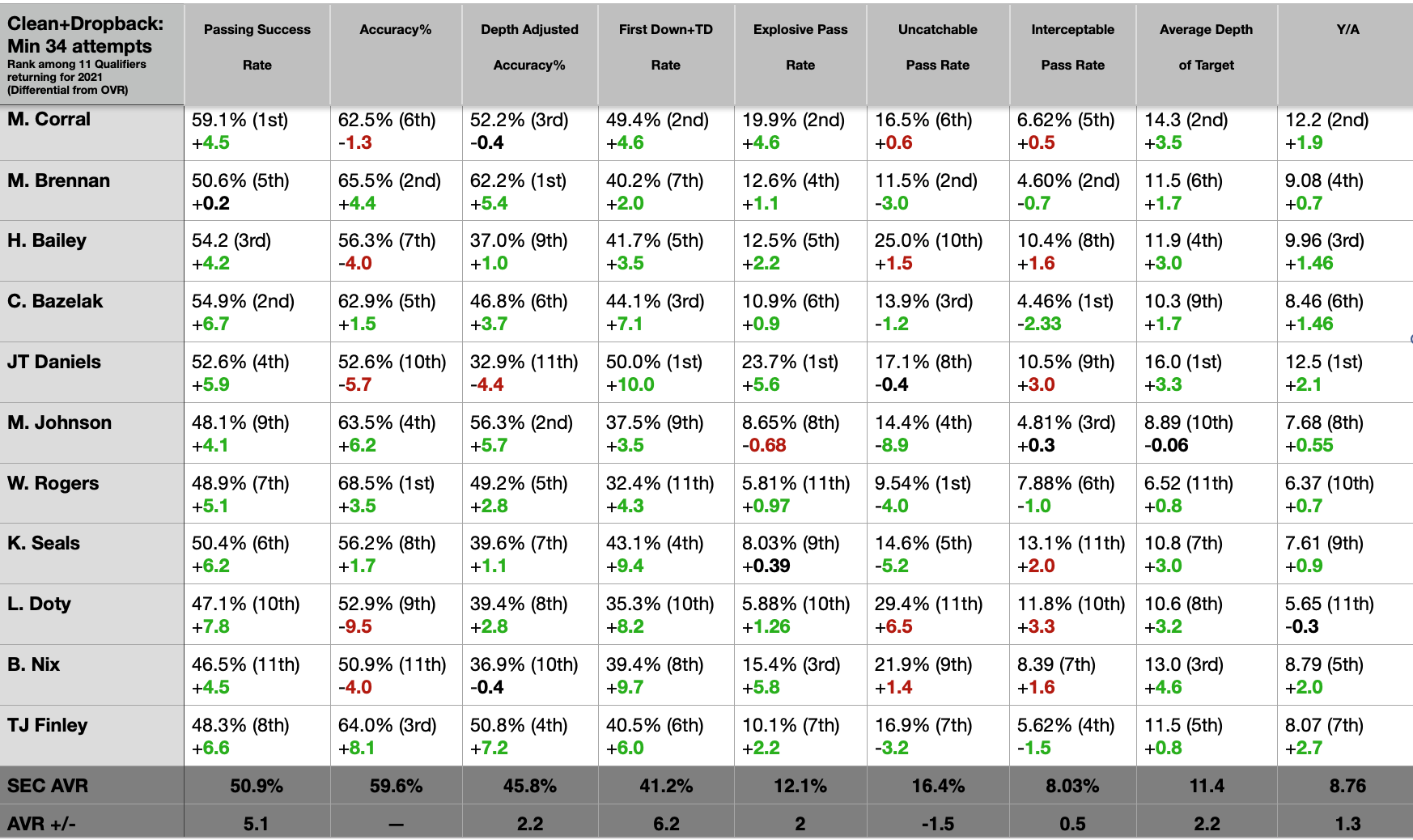
Our conditions largely helped passers find gains across the board, but the results differed from last year’s sample. All three of the SEC’s worst passers in this context were prevented from logging significant snaps in 2020. Though Ryan Hilinski and John Rhys Plumlee rode the pine, Garrett Shrader soon left Starkville not long after the season started. But, that angle cuts both ways. Since Mac Jones, Kyle Trask, and Kellen Mond are all taking their talents to the pros and/or are graduating, the three most accurate floor passers are obvious left off this these findings for 2021. In the end, the conference experienced an uptick in “result stats” like Success Rate, First Down+TD Rate, and Y/A year-over-year. The later two metrics experienced a bump over five percentage points better in comparison to last year’s figures. Only three qualifying SECers cracked a 46% Success Rate entering last season. None of our 11 QBs finished below that threshold. But on the other side of the coin, ball placement figures moved the opposite way. Passers were 2-3 points worse on average with their accuracy stats and saw the cumulative Interceptable Pass Rate worsen.
Matt Corral

With the new offensive guidance, Corral’s rise in efficiency remained firm from clean+dropback situations. The Rebel was pretty good under duress and finished among the conference’s top performers even if his Pressure Rate was on the lower side. But as good as Corral was in those spots, those returns were still a drag on his resume. Outside of his Uncatchable Pass Rate, each floor category experienced nice year-over-year gains. His figures overly reflected the trends across the conference as his Success Rate, First Down+TD Rate, and Explosive Pass Rate all improved by about 4.5 points in these spots, but his precision stats worsened compared to his overall marks. Corral was one of the conference’s most RPO reliant passers. Only Feleipe Franks and Bo Nix dedicated a higher percentage of their attempts towards those designs than his 18.1% within the SEC last season. With those taken out, Corral’s ADOT climbed by 3.5 yards, which was the conference’s second highest increase behind Bo Nix. Though the verticality no doubt produced value, longer dropback attempts without the access to easy completions underneath via RPOs saw Corral’s raw Accuracy% fall outside the top5.
Still, Corral was a great downfield thrower with Kiffin and Lebby setting him up to prosper. Along with the 3rd-best Depth Adjusted Accuracy%, the Rebel was either first or second in Success Rate, First Down+TD Rate, Explosive Pass Rate and Y/A in this context amongst returners. For the record, only Kellen Mond would have trumped his 52.2% such DAA% in last year’s sample. This should be something to certainly keep an eye on without Elijah Moore out-wide anymore. As the Rebels favorite receiver, he fielded a top5 volume of chances within the conference. In our parameter, he sported a 69.2% Success Rate and 61.5% First Down+TD Rate with a 14.1 Y/T that was good for the SEC’s 4th-best clip. The basis of the scheme should remain in tact, but dissenters will be quick to knock a back step in play without Moore to lean on. Corral’s dependence on play action should also be monitored. Overall, both his Total Action and PA Rates each cracked the conference’s top3. But on clean+dropback snaps, he was the only SECer with clips north of 40%.
Conner Bazelak

As a passer that was constantly asked not to do too much, Bazelak gladly took easy completions and padded his floor metrics. Again, targeting short really helped minimize his risk and maximize his value. No one bested his 4.46% Interceptable Pass Rate, and his Uncatchable Rate was one of the conference’s three best clips. Despite his ADOT falling inside the bottom3, Bazelak’s First Down+TD Rate also cracked the top3. In addition to seeing his Success Rate improve by the 2nd-highest point increase in this context, all of his stats showed gains. While consistent gains through the air were okay on average, splash plays came at a below average clip. Behind Bazelak’s middling accuracy targeting downfield, his Depth Adjusted Accuracy, Explosive Pass Rate, and Y/A all finished sixth in our sample. For a freshman, this is a strong starting point. But eventually, he has to show he can regularly deliver accurately balls ten yards or more downfield.
Despite the fun wrinkles, Missouri’s passing game was mostly dropback-oriented. Screens and RPOs really weren’t major cogs in Missouri’s offense. Only about a tenth of the Tiger’s attempts were utilized on those designs. But while those plays didn’t affect his bottom line too much, His ceiling could certainly improve with more poise when facing duress. Overall, Bazelak experienced about an average amount of pressure relative to the rest of the conference. Like a lot of youngsters, he wasn’t particularly strong under the gun. His 23.9% Success Rate and 26.4% Depth Adjusted Accuracy finished bottom3 in 2020. Over a sixth of his pressured throws were altered in some way by the defense. So, losing those bad eggs from this sample did nothing but good. That level of play versus pressure probably won’t be overlooked by opponents, nor his 11 turnover-worthy throws, which totaled the 2nd-most in the SEC this past season. Only the Air Raid’s QBs put up a higher such clip than Bazelak’s 15.5% Interceptable Pass Rate. But as concerning as that stuff is, pressured stats carry less weight with guys seeing their first starts. There’s plenty of room to grow, and at least for 2021, there’s no need to be overly worried.
Harrison Bailey

No passer in the conference saw a higher percentage of their pass attempts occur from clean+dropback situations last year than Harrison Bailey. So in a vacuum, you could say this reflects his best self more than any other passer in this article. That said, his sample occurred over wonky circumstances and Tennessee’s offense is about to undergo some renovations. However, I’m sure Rocky Top would like a take on their heir apparent under center. Bailey presents a mixed bag that’s not necessarily sustainable. While seeing his ADOT tick up three yards, both his Success Rate and Y/A are the 3rd-best clips ahead of 2021. Other result stats like his First Down+TD and Explosive Pass Rates each crack the conference's top5. So far so good, right? But, his accuracy remains a big concern. The verticality in the Vols offense should remain, so we know Bailey must improve his deep ball. His Depth Adjusted Accuracy was eight points below the adjusted mean and a quarter of his clean+dropback attempts were deemed uncatchable. That level of halfcocked accuracy will kill any kind of offense as would a double-digit Interceptable Pass Rate.
Bailey only finished with eight attempts under pressure. Already a volatile category, the lack of tries makes these stats somewhat worthless. He might have been a Checkdown Charlie situationally, but his confidence is due to grow this off-season. Still, he was unequivocally given more RPO patterns compared to the Vols' other two QBs this past season. His personal 12.5% RPO Throw Rate more than doubled Jarrett Guarantano’s (JT Shrout didn’t log a single such attempt). Not that these snaps amounted to much either, but it just shows Bailey is suited for the up-tempo, vertical attack Josh Heuple is aiming to install. Again, his floor metrics overly presented the kind of passer he is. The results are fine, but his ball placement must improve.
JT Daniels

Screens and RPOs composed about a fifth of Daniels’ attempts. Even though these plays helped secure plenty of completions, their 29.2% combined Success Rate was truly awful. Without them pulling down his passing profile, Daniels already sterling result-based stats entered another stratosphere in our parameter. With only 15% of his attempts occurring under duress, the Bulldog was one of the SEC’s least-pressured passers. Keeping Daniels upright was vital to the downfield passing game. Frequently aided by a sound shield — JTD averaged the SEC’s 3rd-most blockers/clean dropback — the Californian was further goaded into executing Georgia’s deep aerial scheme. His 16.0 ADOT was almost two yards more than the next passer’s in line. Behind that gumption to go deep, Daniels leads the way in Y/A, Explosive Pass Rate, and First Down+TD Rate. The later increased by an insane ten percentage points compared to his overall figure.
Due to his muted play and USC’s way of doing things, Daniels didn’t project to be a potent passer. He overly stuck to modest completions, taking what the defense gave him, and padding his ball placement stats. Ironically based on his five game sample against his most-challenging opponents from his time as a Trojan, he projected the SEC’s top Accuracy% and one of the lowest Explosive Pass Rates. Funny what a change in environment and a chip on your shoulder (and very, very talented pass catchers) can do for a one’s modus operandi through the air. His bottom line was truly fantastic, but you’d have to be a fool to ignore Daniels’ rotten accuracy numbers. Both his raw Accuracy and Depth Adjusted Accuracy clips soured by over four points; Daniels was the only SECer to suffer from such a thing. His backers will surely point to his degree of difficulty as to why his precision faltered. And, they might have a case. Even for someone like me who doesn’t think much of his ability to drive the ball downfield, Daniels finished inside the SEC’s top5 in Depth Adjusted Accuracy (with a top7 raw clip) on clean+dropback attempts with a depth of target under 15 yards last season. But, I don’t care what anyone tells me. Daniels' accuracy stats and Interceptable Pass Rate, which fall inside the bottom3 amongst qualifiers, from our parameter all would have represented the conference’s floor in last year’s sample.
Myles Brennan

Within structure, Myles Brennan presents a pretty decent floor for 2021. He puts the ball in play without pressing or being overly careless. Though his ADOT was whatever, Brennan hardly ever checked down. In fact, one of his best concepts prior to his injury was All Verts. In our parameter, the Tiger donned a top2 Accuracy, Uncatchable, and Interceptable Pass Rate in clean+dropback situations. No SEC QB in last year’s sample topped Brennan’s 62.2% Depth Adjusted Accuracy and his raw Accuracy figure would’ve only trailed Mac Jones and Kellen Mond. Despite the precision, he was mediocre managing the situation. While experiencing the smallest increase in Success Rate under our parameter, his 40.2% First Down+TD Rate finished inside the bottom5 of the SEC qualifiers. But despite a below-average ADOT, his Y/A and Explosive Pass Rate cracked the top4. Not that he didn’t have his fair share of broken snaps or misreads, but the Bayou Bengal is poised to enter the season as one of the conference’s most consistent passers when kept clean. That said, he must get more comfortably steering the ship.
Despite his line doing a great job at curbing pressure, Brennan consistently crumbled under duress and struggled replicating Joe Burrow’s backyard ball magic. Though his 44.4% Pressured Success Rate finished as the SEC’s 2nd-best, no conference passer delivered a worst such Accuracy% than his 27.8% clip. Based on that figure, the Tigers were very fortunate to finish above the expectation. But since Brennan rocked one of the lowest Pressure Rates in the SEC, these snaps carried less weight than his production targeting screens and RPOs. About a fifth of Brennan’s attempts targeted those designs, which was a decent uptick year-over-year within LSU's offense. Outside of South Carolina’s QBs, no conference passer logged a higher Screen Rate than Brennan’s 9.92% clip. As extensions of the run game, Brennan didn’t have to do too much as his stats improved. Only three other passers experienced a more preferable Success Rate and Y/A on screen+RPO targets within the conference last year.
Ken Seals

Though some worries remain, Ken Seals’ floor has some bright spots. When his passes get home, he’s a serviceable facilitator donning top4 First Down+TD Rate. Plus, half of his attempts found situational success. Without buzzsaws slicing through his pocket, both his accuracy figures improved. Though still dreadfully forgettable, his Uncatchable Pass Rate dwindled by five points and fell into the top5 amongst qualifiers. Unfortunately, the Commodores weren’t the only ones able to haul in Seals’ passes. As one of the six SECers to see their Interceptable Pass Rate worsen in our parameter, Seals’ 13.1% clip is truly inexcusable. Outside of South Carolina’s late year stopgap and UGA's Stetson Bennett, no one put up a higher true Interception Rate than his 5.11% figure. Against ho-hum situational stats and bothersome ball placement metrics, the risk significantly outweighs his reward. It would be one thing if Seals was headhunting for deep passes. But, his ADOT was below average. Plus, his Explosive Pass Rate remained virtually the same compared to his overall figure. Despite the improvement to his stats, Seals’ floor remains relatively low.
Seals wasn’t much of a threat based off his overall numbers. As one of the conference most pressured passers, his resume was riddled with errors and wayward attempts. Plus, it’s not like the freshman was able to overcome his blockers’ miscues consistently. A third of his attempts suffered from pressure, and his 23.9% such Success Rate finished in the bottom4 in 2020. No SECer sported a worse Depth Adjusted Accuracy than his 22% clip. While most passers’ profiles are negatively affected by performance under duress, high volume along with the poor output created a massive black hole on Seals’ bottom line. To try and compensate for the talent and size disadvantage, the Commodores attempted to heighten plays to playmakers in space. Another quarter of his throws targeted screens and RPOs. Collectively, these snaps delivered a 55.2% Success Rate for Seals. Only Mac Jones and Feleipe Franks saw better marks last year within the conference. Besides McCorkle and the Tide, Seals and Vandy were the only other SECers to don a double-digit Y/A and Success Rate in the 70’s targeting RPOs specifically. Thanks to pressure and the like, only Bo Nix and Feleipe Franks logged a lower percentage of throws that qualified as clean+dropback attempts than the 'Dore.
Will Rogers

Will Rogers floor presents an incredibly toothless passer. With limited arm talent and opponents frequently dropping eight men into coverage, the Air Raider obliged working short. His paltry 5.73 ADOT and 4.87% Explosive Pass Rate were some of the lowest such clips within the SEC the past three seasons. Those figures hardly budged in our parameter as did his Y/A. To his credit, focusing on the short stuff has generated a good amount of gimmes, which has allowed Rogers to rep the SEC’s top Accuracy% in this context. But when breaking out his clean+dropback attempts into short (0-10), intermediate (11-19), and long (20+), the Bulldog only displayed average accuracy in the areas under 20 yards. Since raw Accuracy% — like Completion% — doesn’t account for depth, the freshman frequently hammered short throws, which helped him compile “accurate” completions. Though being eight points below average targeting deep hurt his final figure, being at least mediocre in other spots allowed Rogers to sport a top5 floor Depth Adjusted Accuracy% entering 2021.
Though Rogers was the 5th-least pressured SEC passer by a rate basis, he logged the 7th-most attempts under duress by volume. If you thought he was colorless when kept clean, he was almost a blank sheet of paper when under the gun. His Accuracy% dropped into the bottom5, his 3.62 Y/A was dead last, and only his dejected teammate KJ Costello trumped his gaudy 18% Interceptable Pass Rate. Plus, he wasn’t one to escape the jailbreak. Rogers was one of seven SECers who suffered a sack on at least every third pressured attempt. The Air Raid has yet to go all-in on RPOs, but True Screens are still alive and well within this scheme. Only five passers in the conference this past season bested Rogers' 8.88% Screen Rate. Talk about being able to pad your profile with easy throws. Behind the SEC’s second most screen targets by volume, he boasted a top5 Accuracy%. And since Mississippi State tended to use True Screens to manage down and distance rather than bail the offense out from behind the chains, the Bulldogs were one of the few conference offenses to see over half of their such attempts work situationally. While Rogers will get a pat on the back for operating as a facilitator, he’s overly dismissible (and replaceable) as a passer at this point in time.
TJ Finley

Despite Brennan not being pressured much at all, both freshman experienced duress on about a quarter of their attempts. While the other two Tiger QBs were at least average relative to producing results, TJ Finley was easily rattled and one of the conference’s worst pressured passers in 2020. No one posted a worse Success Rate and both of his accuracy stats were second-to-last. All the while, his Pressured Interceptable Pass Rate was the 3rd-highest with his Explosive Pass Rate being bottom5. As a strong armed thrower with a kinda long windup, his ball placement suffers once his base is compromised. Moreover, his precision just isn't the same when he’s sped up like on screen or RPO attempts. No SECer was less accurate targeting such designs. As it were, his Success Rate and Y/A from those attempts finished inside the SEC’s bottom5.
With those faults erased from his profile, Finley displayed promise particularly with his ball placement. His Accuracy, Depth Adjusted Accuracy, and Interceptable Pass Rate on clean+dropback attempts all cracked the top4 entering this fall. Speaking of his accuracy stats, no other SECer experienced higher increases in our parameter than Finley. No doubt his result-based metrics are kinda dismissible. But, you have to give the Tiger props on his precision paired with a top5 average depth of target. In fact, Finley’s 50.8% Depth Adjusted Accuracy% even bested Mac Jones’ clip from 2019 despite the two having nearly identical ADOTs. Finley is in the mold of a true pocket passer. Though he presents a serviceable floor thanks to his accuracy, his play versus pressure has this staff hesitant on giving him more PT.
Max Johnson

By the time LSU settled on Max Johnson, the offensive braintrust opted to let the lefty operate in a very straightforward manner. No SEC passer logged a lower Screen Rate and only the Air Raiders targeted RPOs less on average. But, Johnson was one of the highest pressured conference passers. Though these snaps curbed his bottom line, the Tiger was relatively okay under duress. Johnson was essentially middle-of-the-road across the board but fantastic at keeping the ball out of harm’s way. Both his Defender Breakup Rate and Interceptable Pass Rate were top5 marks. If his guy couldn’t bring it in cleanly, no body would. Only Terry Wilson finished with a higher Uncatchable Pass Rate than Johnson’s 40.5% clip when pressured.
Since his profile largely ignored screens and RPOs, a good deal of his floor metrics remained firm compared to Johnson’s overall figures. That said, he’s the only SECer to see his average depth of target and Explosive Pass Rate move backwards in our parameter. Though it’s nice his consistency improved and his accuracy was sound, it doesn’t mean much when significant gains are hard to come by. Despite rocking the 2nd-best Depth Adjusted Accuracy, Johnson’s Success Rate and First Down+TD Rate from clean+dropback situations fall into the bottom3 ahead of next season. I do find it interesting that all three of LSU’s potential passers for 2021 finished one, two, three in our parameter in terms of Depth Adjusted Accuracy. While there’s no knocking his results on the surface, Johnson’s output —like his initial arm talent —was certainly the weakest among LSU’s trio of throwers.
Luke Doty

Again, I won’t take much offense if you want to disregard Luke Doty’s figures. His sample was the smallest among our 11 passers, and his attempts were logged when all hope was lost for the Gamecocks’ season. Despite his snaps being glorified practice sessions, no other returning conference passer saw their Success Rate rise by as much in our parameter than his 7.8 point increase. That was the lone positive takeaway. As a ground-oriented passer, Doty still needs plenty of refinement operating from the pocket. His raw Accuracy% plummeted almost ten points, and no other SECer’s Uncatchable Pass Rate and Interceptable Pass Rate worsened by higher marks. A new staff and approach should do him nothing but good; projecting as a bottom4 passer certainly didn’t result in Ryan Hilinski getting too many chances after a rocky first season. To that, it will be nearly impossible to justify giving Doty more pass attempts if he continues to be twice as likely to throw a turnover-worthy attempt as an explosive gain. Per collegefootballdata.com, Doty is the only qualifier who sported a negative Predictive Points Added/play.
Since Doty was a late season janitor, OC Mike Bobo was averse to getting too cute with his young passer. Though screens were seen on about one out of every seventh attempt, Doty’s RPO Throw Rate was the SEC’s 4th-lowest. Either way, these plays combined for a 50% Success Rate, making the Gamecock one of nine conference QBs to be blessed with such a feat. Pressure was the more trying element that affected his profile. Due to a lackluster scheme, pathetic blocking, and his own inexperience, Doty logged the SEC’s highest Pressure Rate in 2020. A mind-numbing 37.1% of his passes qualified for this form of havoc. Either suffering from cognitive dissonance or trying to extend plays, the soon-to-be sophomore finished with the highest overall average time to throw in the SEC and the 4th-highest under duress. As the presumed starter for 2021, his limited sample from last year has him as a bargain bin candidate ahead of this fall.
Bo Nix

Though Bo Nix’s result-based metrics sold his upside ahead of last season, his subpar ball placement figures hinted he was still very much a work in progress. And looking at his overall regression in 2020, it’s safe to say he’s closer to falling completely apart than putting it all together. Despite most expecting Nix to progress his dropback game, his piss-poor precision prevented War Eagle from deviating much from its RPO-laden scheme. Like last year, the Plainsman exited the season with one of the highest Screen+RPO Makeups in the conference. Nearly a third of his throws were categorized as such this past fall. While Auburn’s True Screen execution was middling, these designed combined for a 50% Success Rate, which buoyed Nix’s overall output. Another quarter of his passes came under duress. By volume, no SECer topped his 116 such attempts. To reiterate, part of the blame to these breakdowns fall on the Tigers’ OLine and some of it falls squarely on Nix. Either way, that number of pressures is certainly hard to overcome.
While that level of adversity understandably can skew one’s output, Nix was left with less excuses due to his poor floor metrics. Sure, things like his Success Rate, First Down+TD Rate, and Explosive Pass rate improved from last year’s sample. But, his Uncatchable and Interceptable Pass Rates worsened. With over a fifth of his attempts having no shot at being completed, no SECer sported a worse Accuracy%. When weight was applied the further his pass traveled downfield, his figure also moved the wrong way compared to his overall mark. Though occasional splash gains kept his Y/A respectable, his deplorable accuracy stats will provide plenty of ammunition to question Nix’s sustainability. The Tiger can spout philosophical quotes all offseason if he wants to. But, everyone (including Nix) is well-aware he cannot afford to fart around too much longer on the gridiron.