Sideline to Sideline: 2020 SEC Championship Game
Sideline to Sideline: 2020 SEC Championship Game
Good morning and happy Championship Saturday!
Perhaps you have heard there's some fine-lookin' football games on today. If you did, you have some damn-good sources. In the world of Power5, two top15 teams in Northwestern and Ohio State will duke it out for the Big Ten crown, a pair of top10 teams in Iowa State and Oklahoma will square off to determine who's the King of theThe Big 12, and The ACC title consists of blue bloods Notre Dame and Clemson, both of whom are ranked in the top3. Oh -- and there's another game in Atlanta featuring the No. 1 team in the land and two exciting offenses.
Look, we have a lot to discuss and dissect. So enough with the small talk and frivolities. Now, there's a pretty good chance you have already checked out a preview for the SEC Championship game. You might know how many yards each offense throws for each game or how many points each defense usually allows. Cool.
Allow me to take it a little further and lead you on a dive deep through the weeds. In this sideline to sideline piece, I will show you each offense's go-to concepts, whether or not their opponent have had success stopping those looks, where each quarterback does the majority of their damage, general strengths and weaknesses of our two title contenders, plus loads of unique stats you can't just Google. So, let's get rockin'!
Since our two juggernaut offenses are driving the headlines, I say we start there. As the two best in the conference (and arguably the nation), they rank either first or second in TD Rate, Scoring Drive Rate, Points/Play, First Down/Play, and Early Down Conversion Rate. In plenty of areas, there’s not much of a differential between the Tide and Gators. But these are taking into account all plays; not just the ones when the game is close, effort is at a maximum, and all starters in the game. To account for that, all referenced data moving forward (including our fun X’s and O’s discussion later) will be from snaps where our teams either trailed or led by a margin of 21 points. So, keep that mind mind!
You can find the boring traditional stats elsewhere. We’ll be looking at things a little more advanced. If you stick around, I promise you will learn a few things about the best the SEC has to offer.
Alabama Offense at a Glance
After that little tweak, Alabama’s already stellar stats jumped off the screen. After I returned from the optometrist, I noticed how substantial the Tide’s gap over the rest of the conference actually is when our parameter was applied. I mean, considering Alabama enters Saturday as the nation’s best offense in ESPN’s SP+ along with their glowing traditional stats, it’s not much of a shock these dudes are really good and superior to their contemporaries.
Still, these findings are just too crunchy not to share. On snaps with our designated margin, Alabama averages 6.15 points/drive and 1.11 points/play. Their overall 8.53% TD Rate ticks up to 10.1%. All the more impressive from a unit that averages a tuddy on every 10th snap, their Turnover Rate improves from 1.47% to a league-leading 0.67%. The Tide have only had five three-and-outs all season when either up or down 3 touchdowns. In addition to that, Alabama holds the conference’s gold medal in overall (59.8%), pass (63.4%), and run Success Rate (55.8%), 3rd Down Success Rate (60.3%), and Yards/Play (9.15).
If the sterling Success Rate and enviable Yards/Play weren’t enough evidence of that, Alabama also leads the SEC in percentage of plays that gain at least 15 yards, Negative Play Rate, Explosive Play Rate, Explosive Pass Rate, Yards After the Catch average, and Havoc Rate allowed. Sarkisian’s squad is also top3 in average rush yards after contact, Pressure Rate, and Sack Rate.
The Tide is efficient and potent. They rarely are altered and often move in chunk gains at will downfield. Despite losing one of the most impressive SEC receivers our analytics have tracked to injury, they’ve hardly had a hiccup offensively this season. Devonta Smith has taken his game to the next level and put up stupid numbers while being very efficient. John Metchie has emerged as another top-tier vertical option. Even Brian Robinson has put up fantastic figures in his stints giving workhorse Najee Harris a breather. Forgive the cliche, but defenses often have to pick their poison.
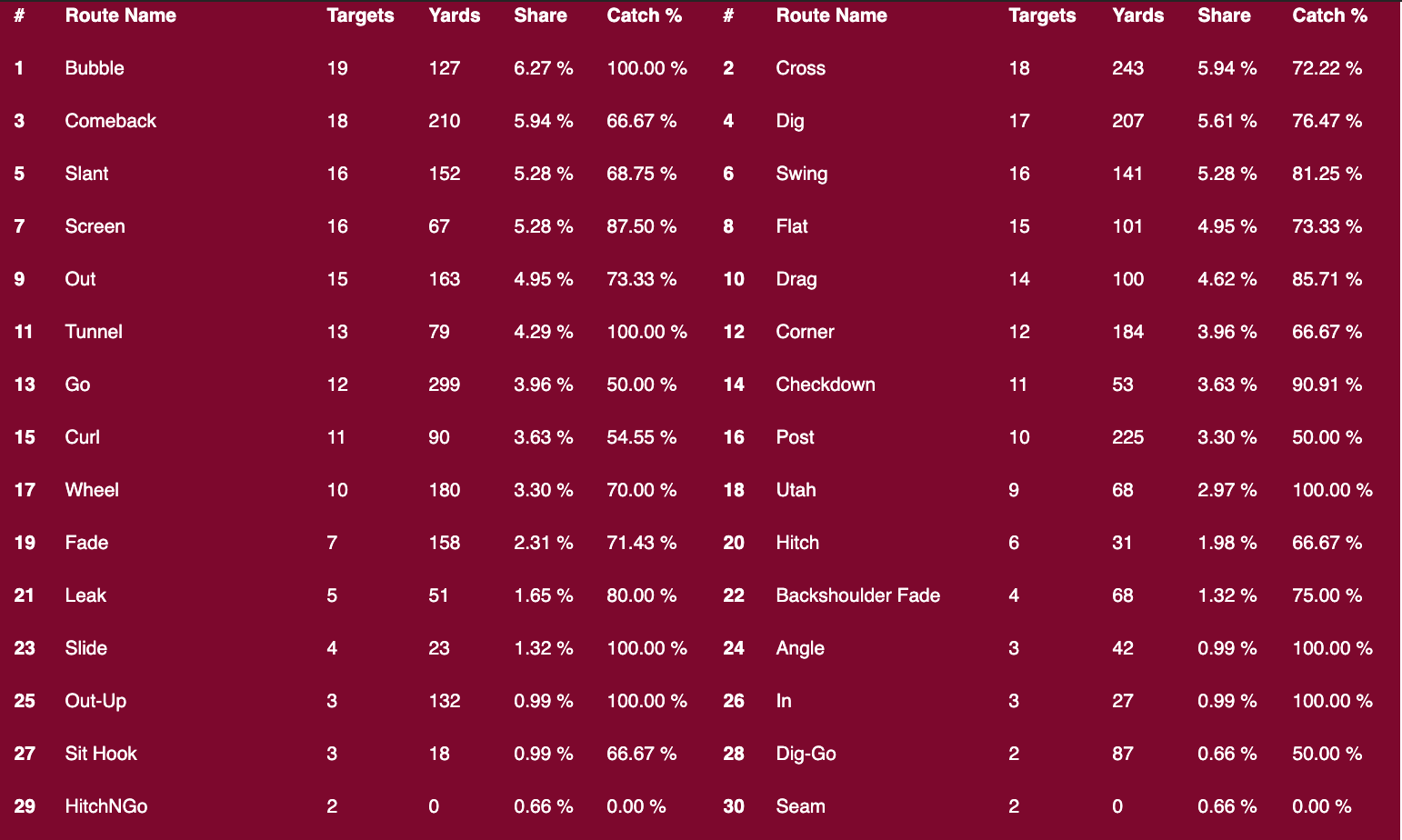
Though awesome last year, the Tide have put up even better numbers this year. Part of that has come thanks to more verticality in the pass game. Tua Tagovailoa was an excellent passer, but his major strength was delivering accurate, well-timed balls underneath. Case and point came from Alabama’s affinity for slant patterns on top of their RPOs and dropback designs. Slants were an easily identifiable characteristic of Alabama’s 2019 offense. That route accounted for 9.34% of Alabama’s targets last year compared to just 5.28% this fall.
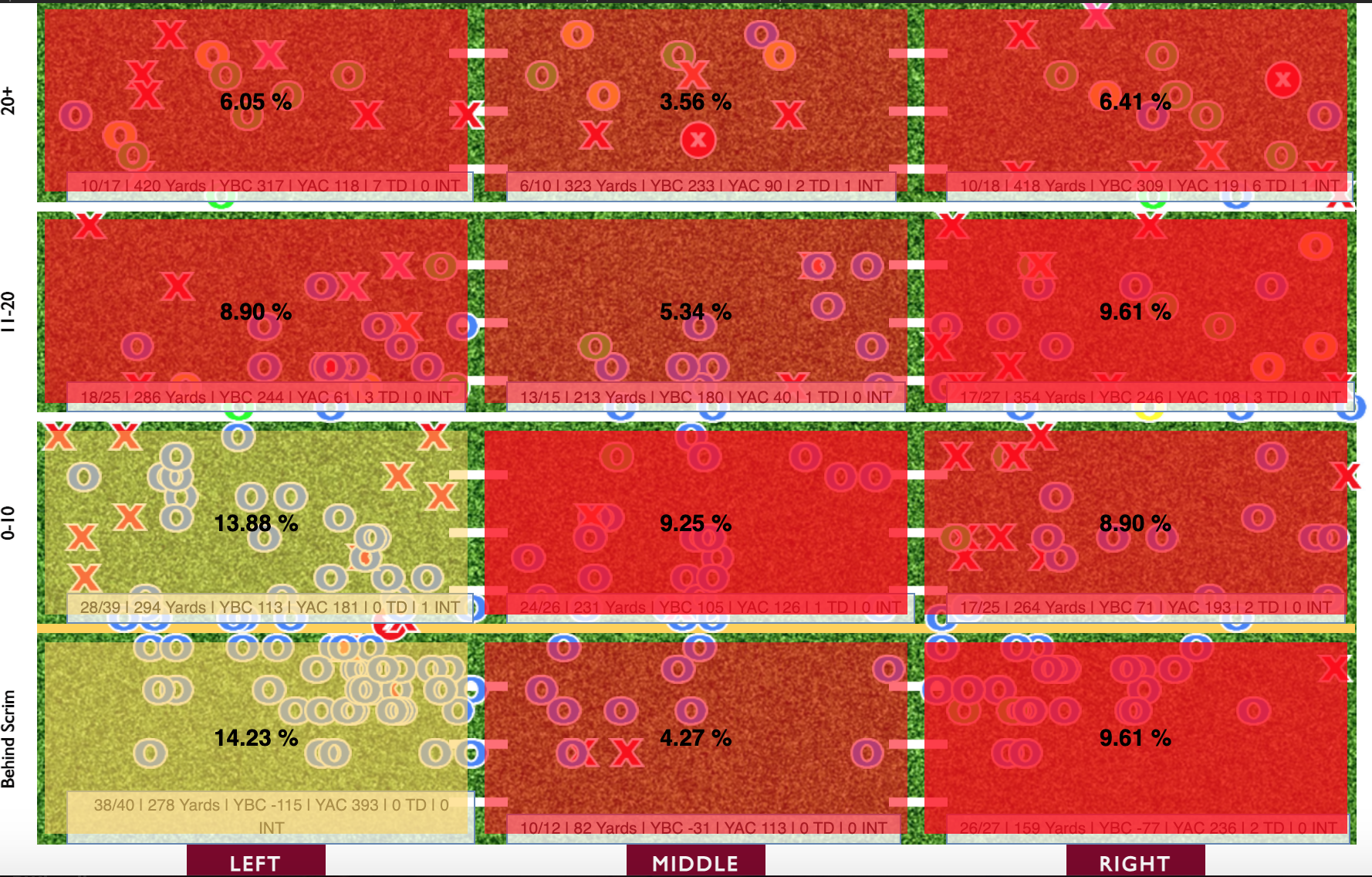
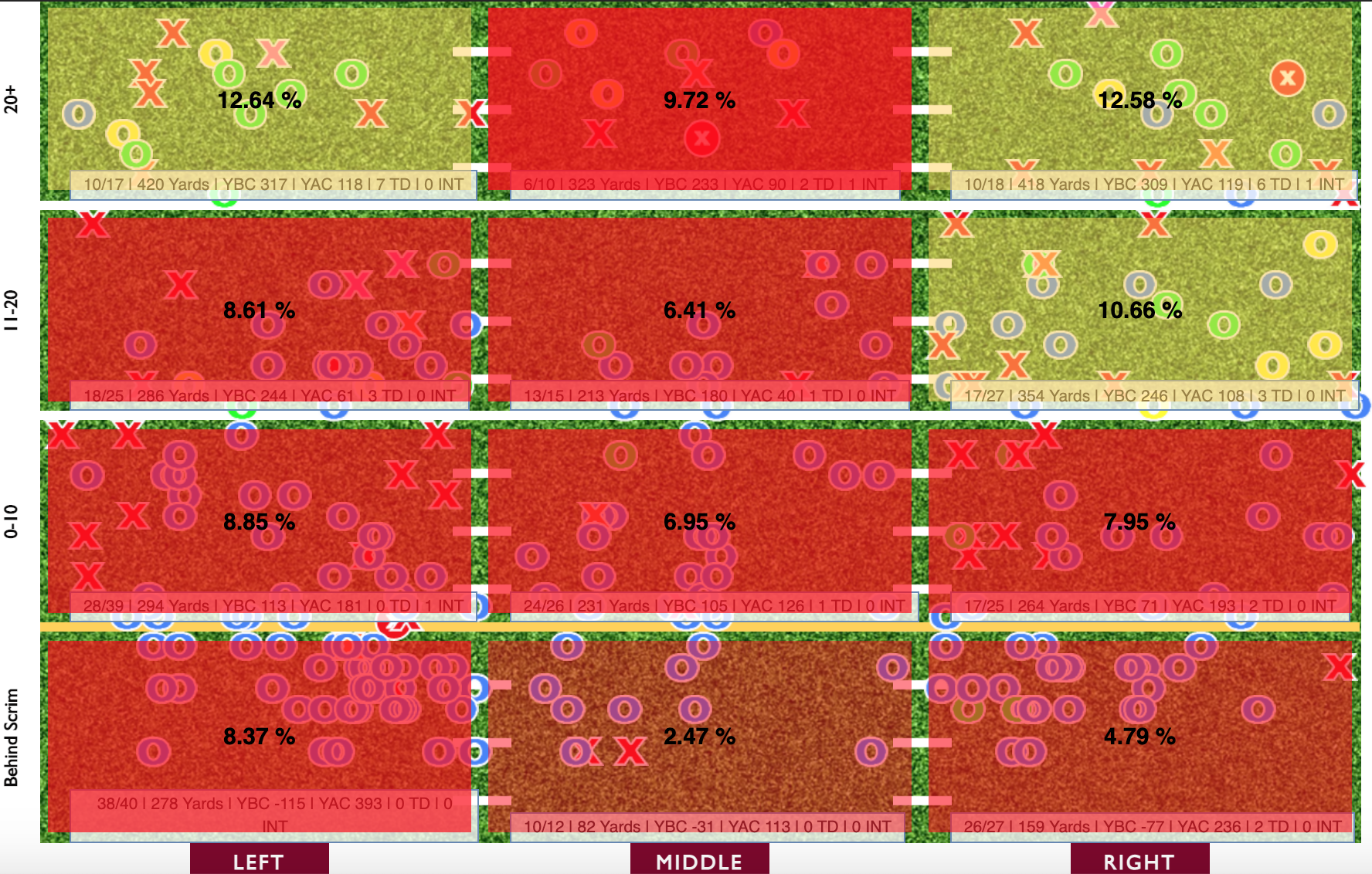
Mac Jones' Yardage Heat Map. Over a third of his yards have come off deep throws. Mac Jones' Target Heat Map. Though he goes deep plenty, Jones loves targeting short throws to the left
This helped them lean into their passer’s precision and give their electric YAC monsters opportunities to gallop down the gridiron. Within our margin, 60% of Tagovailoa’s yards came after the catch compared to 50% of Jones’. Routes like outs and screens have been replaced by crosses and deep hooks. Jones’ average depth of target is nearly a whole yard higher than Tagovailoa’s from last season. But as you can see from his target distribution, over a quarter of his throws still fail to travel beyond the line of scrimmage.
While Tagovailoa was more prone to throw off an RPO, play action has remained an important tactic for Sark’s offense. Playing into the aspect of effective balance, he has always attempted to have a marriage between the run and pass. But in addition to that, he doesn’t lean on any particular concept too much. In every sense, he aims to keep the defense guessing.
Jones has utilized action either from a true play fake, RPO mesh, or pretend motion on half of his pass attempts this season, the 2nd-most behind Feleipe Franks’ 58.6% clip within the conference. On these snaps with our applied points differential, Jones is the only SEC passer with a Success Rate north of 60% and Explosive Pass Rate over 26%. More than two-thirds of this action passes end in success and 30% have gained at least 20 yards. Like his overall clip, Jones’ 15.6 Y/A is tops within the SEC.
The vast majority are on traditional play action. On these, his fantastic figures hardly worsen. Across his league-high 70 dropback play fake attempts, Jones sports the SEC’s best Completion% (74.3%), Success Rate (64.3%), Explosive Pass Rate (42.9%), First Down+Touchdown Rate (62.9%) and Yards/Attempt (18.4). No SECer has thrown for more yards (1,286) or first downs (33). Tagovailoa’s ADOT was similar to Jones’ 17.5 clip, but Alabama is simply turning to this tactic far more often than last year.
But why does the play fake work in the first place? Well, duh! The Tide’s gnarly and bruising run game. I kinda brushed past the fact Alabama rocks the conference’s most successful run game in addition to its platinum pass attack. 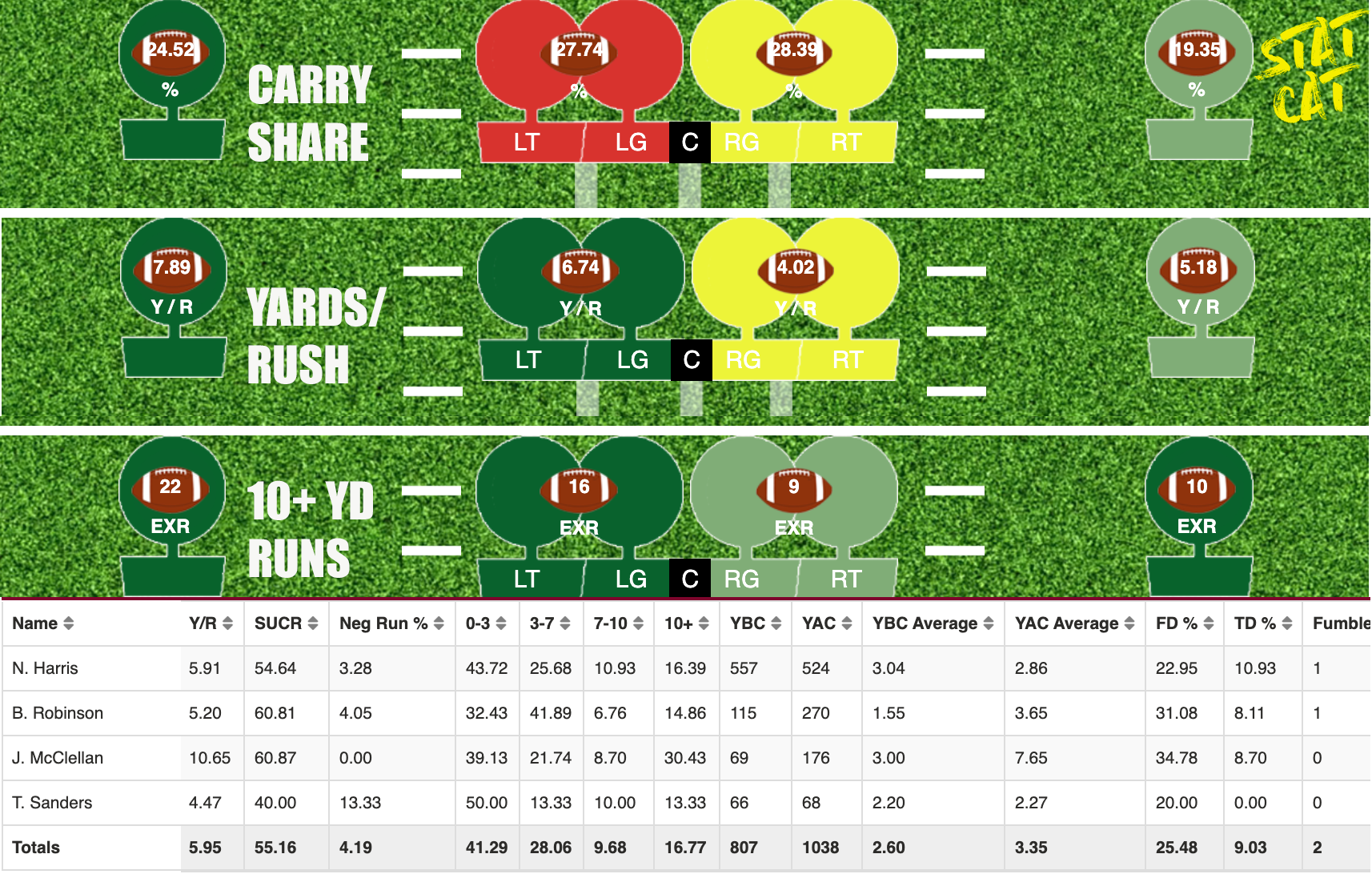
Najee Harris, the conference’s two-time reigning leader in Rushing Success Rate and Expected Points Added, is a ball carrier no defense can afford to disregard. He’s physical, breaks tackles, and can score any time he touches the ball. And that’s excluding his capabilities in the pass game. Among SECers with at least 30 carries in our parameter, Harris is the only conference runner top8 in Success Rate, Broken Tackle Rate, Explosive Run Rate, and Yards/Carry. And again, Robinson keeps the run game humming when it's his turn to carry to rock.
Naturally to make his job a little more challenging, defenses often put another body in the box to narrow his run lanes. While covering all the gaps helps limit Alabama’s rush attack, it leaves defenses vulnerable on the back end.
Despite the old way of thinking, play action can be quite effective even if the run hasn’t been established. You don’t need to average five yards per pop in order to trick linebackers or manipulate coveragemen off their marks. But it helps. There’s only so many coverages a defense can call if it has to dedicate an extra man to focus on the run. So if an offense can put its opponents into those situations more, play action is bound to be all the more potent. And I’ve already mentioned how incendiary the Tide has been in that regard.
Like his overall script, Sarkisian does a premier job mixing up the variety of play fakes. He does heavy set one from under center or pistol, he does bootlegs and waggles, he does split zone/bluff action, half roll-outs, and power play actions. The last two really stick it to backers as they call for pullers to help sell the fake.
Alabama sports effective balance better than any offense in America. The play action usage certainly helps exploit that, but Alabama’s crazy use of motions facilitates it. Instead of waiting until the ball is snapped to create conflict for defenders, Alabama itches to instigate as soon as it breaks the huddle.
No SEC offense deploys more total motion than Alabama, and it’s not even close. While their Jet Motion usage (10.7%) is only the fifth-most in the conference, their Orbit (8.86%) and pre-snap motion (33.6%) easily sit atop the SEC. In fact, the latter is ten percentage points more than the next team in line.
With the movement, defenses often tip what coverages they are in based on how they react. Zones typically remain in place versus motions. Since defenders are assigned certain areas, there’s no need to follow a player across the formation. That isn’t the case on man-to-man coverages. When their man moves, defenders must oblige or at least exchange their responsibility with someone else. It’s an obvious key for the QB it that takes place.
Outside of that, each motion type plays a certain role within Alabama’s offense. Pre-snap motion helps change the strength of the formation and create new angles the defense has to realign to. While it can seem pointless at times to constantly do that, it makes the defense dedicate more brain power to adjustments before the ball is snapped.
Jet motion threatens the edge with speed off an action, handoff or tap pass. For man, its obviously easier to win or preoccupy a defender with a full head of steam. Versus zones, the burst forces defenders to widen, which in turn potentially magnifies run lanes inside. Plus, Alabama is one of the innovators in having Jets morph into bubble screens in their RPO designs. Even if these motioners don’t get the ball initially, there’s an underlying chance they will.
Orbit motions are also used in that manner but create easier throws for passers on the “pitch” portion of those plays. Either looping all the way around the backfield or reversing course once they reach the center, these especially help their outlet receivers find extra momentum to get north and south. If a team lives in man coverage, the added milage containing motions can really add up over the course of the game. It’s hard enough to thwart Alabama’s thoroughbreds; much more so when dead legs start to kick in or when they’re already accelerating at the snap.
Whether a bubble, swing, sweep or tap pass, the quick hitters around the edge often make safeties extra impetuous. But like I hinted, their aggression is frequently turned against them with help of the pass game. Unlike other SEC offenses that primary use motion eye candy to open up things in the run, Alabama’s motion usage hardly changes when taking to the skies.
Alabama is out to create conflicts for defenders. They want to bash inside with their run, threaten the edge with their speed, and stretch the field with their dropback passing game. Boy, football is an easy game when you’re blessed with abundant talent.
Florida’s Offense at A Glance
When our parameter is applied, the Gators fail to see the same kind of jump Alabama experienced; but Florida still displayed some gains.
Upticking from 3.31 to 3.51 and 0.58 to 0.61 in points/drive and points/play, respectively, the Swamp Dwellers still look up to the Tide in many respects. (Remember Alabama’s PPD rose to 6.15 and PPP to 1.11). In case those numbers somehow don’t register, the Tide is twice as efficient in these instances than the Gators offensively. When points are the name of the game, its awfully hard to win a shootout when you average half of the points your opponent does per possession.
Likewise, they trail the Sabanites in all the major stat areas minus those pesky traditional volume metrics. Though second in Success Rate and TD Rate, they trail the Tide by nine and three percentage points, respectively. There is a major gap between numbers one and two if you haven’t noticed by now.
Florida checks a lot of boxes you’d want in an offense, but past flaws have resurfaced the last month plus. While Kyle Trask’s emergence last season forced people to take notice, the Gators’ ground game was pathetic. No SEC offense averaged less rush yards before contact in league play and only one other put up a worse Rushing Success Rate. Despite that, Trask’s passing fueled Florida to moderate relevance and high expectations for this fall.
For the first six weeks of the season, it appeared Dan Mullen and dem boys found a recipe for effective balance. During that span, they ranked third within the SEC in Rushing Success Rate (52.2%), Yards/Carry (5.57), and 15+ Rate (6.67%) while leading the way in yards after contact average (3.71). Florida was still passing 62% of the time; but when they turned to the ground, they found value.
That changed after the Georgia game. The Gators embarrassed the Bulldogs with wheels, switches, and rubs. Match-pattern took a big L, but Florida’s run game has yet to really recover from the 22.2% Success Rate from that day. UGA is still one of the top defenses in the land as far as the SP+ is concerned. Stopping the run is that defense’s specialty. So at the time, there was no need for a major overreaction in the Swamp as far as the ground game’s shortcomings that Saturday. 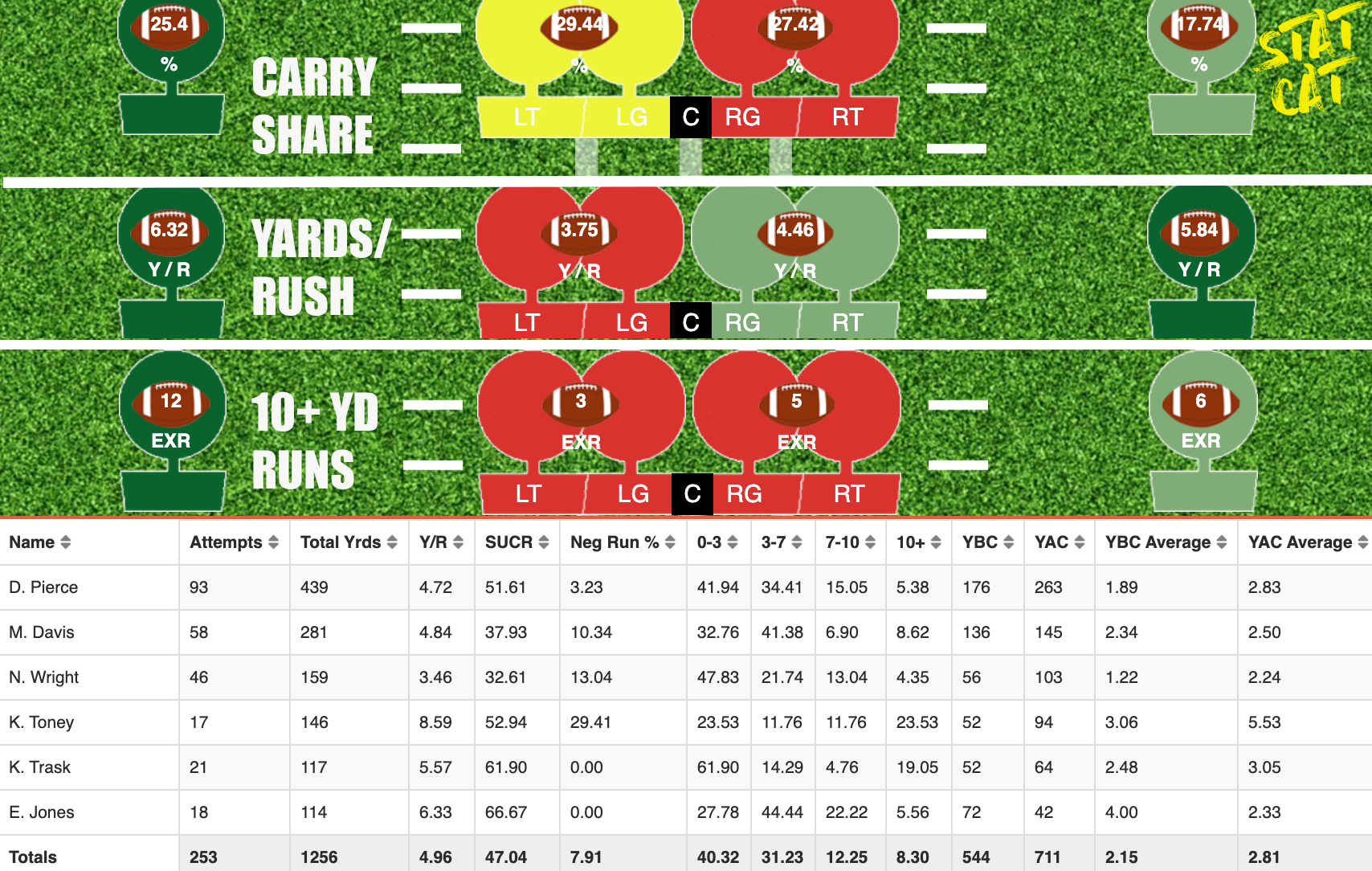
Flash forward to today and Florida ranks bottom5 within the SEC in Rushing Success Rate (43.1%), Yards/Cary (4.63), and 15+ Rate (4.43%). The Gator’s ball carriers simply have not been effective tackle breakers in the backend of the schedule. Florida’s league-leading 3.71 YAC average has sense plummeted to 2.31 — good for 12th in the SEC. For what it’s worth, Florida’s rush yards before contact average increased to 2.32 despite the souring of the other run stats.
Used to having to shoulder the load of a flailing run game, Trask kept slinging and compiling laudable box scores. Yet, Mullen’s quest for effective balance has hence been lost. Even last week when the Gators had one of their best days on the ground analytically, Florida passed the ball 70% of the time. Point blank, the good run defenses in the SEC East (Georgia, Kentucky, and Tennessee) kept them under a 35% Success Rate and 5 yards/carry. Knowing he can’t move the ball efficiently against the better fronts in the conference, Mullen’s mistrust in that facet is understandable. Only the Air Raid in Starkville is more pass-happy than the Gators (61.4%).
Passing is Florida’s strength. So it makes all the sense in the world for Mullen and Co. to dropback. And yet, they trail the Tide by ten percentage points in Success Rate and 1.5 yards in Y/P. Though one of the best in college football, Florida's passing game can best be described by paraphrasing the character Proximo in the movie "Gladiator": The Gators are good, but not that good.
While Florida has been relegated to taking on last year’s modus operandi, some of their tactics are different. Florida was a major screen team last year. While all three of their passers saw similar usage of these plays, Trask ran these plays at volume no other SEC passer could match. He tossed a conference high 49 attempts, 339 yards, and 17 First Downs+TDs on a 46.9% Success Rate. A good amount of his production was literally out of his hand, which brought on plenty of criticism in him being a product of his system.
This year, his Screen Rate has shrunk from 14.1% to 9.21% — good for 7th highest in the SEC. But he is still the SEC’s leader by volume in attempts (32), yards (183), and First Down+TDs (9). Screens are still very much healthy in Mullen’s offense; but he’s preferring to put the ball in Trask’s hands rather than an outlet’s in space.
Trask is also using considerably less play action than in 2019. Despite using the SEC’s 4th most last year, Trask turns to that tactic at an average clip relative to the rest of the conference. Year-over-year, his usage is down ten percentage points.
Again, play action effectiveness isn’t necessarily reliant on the run game’s success. An offense can sport a great play action passing attack even if its toothless between the tackles. Florida found pretty good gains off play fakes last year despite being a lackluster rushing unit. But despite similar circumstances, Trask has been performing more straight drops this fall.
The reason is simple. Trask just hasn’t been as sharp off play fakes as he was last year. In 2019, both his Success Rate and Depth Adjusted Accuracy% cracked the 52% plateau. Entering Saturday, his clips this year both fail to break 48%. 51% is the SEC average for both clips.
Even as a decoy element, Florida’s ground game hasn’t helped its offense reach the next level. In turn that has invited the Gators to lean into five wide formations. No SEC team lines up in empty as much as Florida. Per my charting, the Gators use these formations 11.2% of their snaps entering Saturday. They are the only offense in the conference with a usage rate in the double digits. Of offenses that have dedicated at least 4.5% of their plays to empty, the Gators led the SEC in Success Rate (54.7%), Yards/Play (9.19), and Explosive Passes (11). For the latter, they again are the only offense in the conference in the double digits.
Stressing the defense sideline-to-sideline with five wide, Trask’s two favorite weapons are put into more one-on-one situations. Seth Galina of Pro Football Focus covered the gist of that earlier this week. You can read more about that HERE. I’ll circle back and tackle the patterns Florida likes to call from empty later on, but the crux is the shifty Kadarius Toney is unleashed versus slow-footed backers and Kyle Pitts posts up smaller DBs on the outside or downfield. Pitts sports the single-best PFF grade versus single coverage in the country and Toney has hauled in 13/15 targets with four scores when Florida lines up in empty.
Despite the inconsistencies of the run game, Florida is one of the better teams eliminating negative plays. The Gators are top5 in SEC play in Sack, Run Havoc, and Pass Havoc Rate. Their 17.9% overall Havoc Rate only trails Alabama and Texas A&M. But they do surrender a decent amount of pressure.
Havoc plays or not, Florida suffers from its fair share of lapses. Within our applied parameter, their 12 turnovers are the SEC’s 2nd-most by volume and 6th-worst Rate (1.84%). But despite this black mark, Florida is very lucky this figure isn’t worse.
Last season, Trask finished the year with 32 turnover-worthy plays (27 interceptable passes, 5 fumbles). That translated to roughly 8% of his touches. No offense can overcome the Murphy’s Law of that stat. Yet, only a quarter of Trask’s interceptable attempts resulted in picks.
Florida’s fortunes on that front have mostly carried over to 2020. Entering Saturday, Trask has tossed 28 interceptable attempts with two fumbles. Despite more INTAs by volume year-over-year, both his Interceptable Pass Rate and Turnover-Worthy Play Rate have marginally improved. Plus, only about 1/6 INTAs have ended up as a pick compared to 1/4 in 2019. Luck has been on Florida’s side.
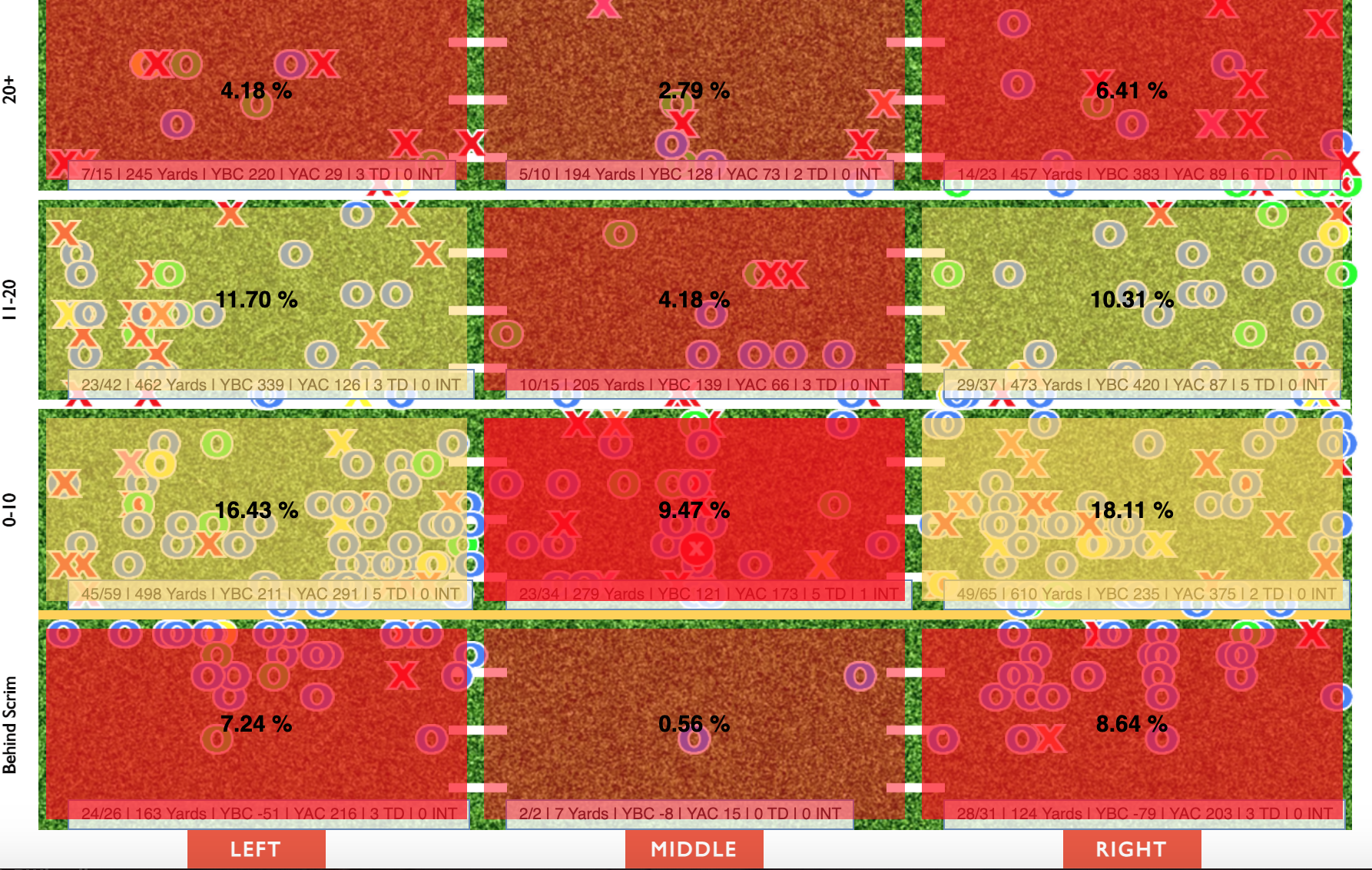
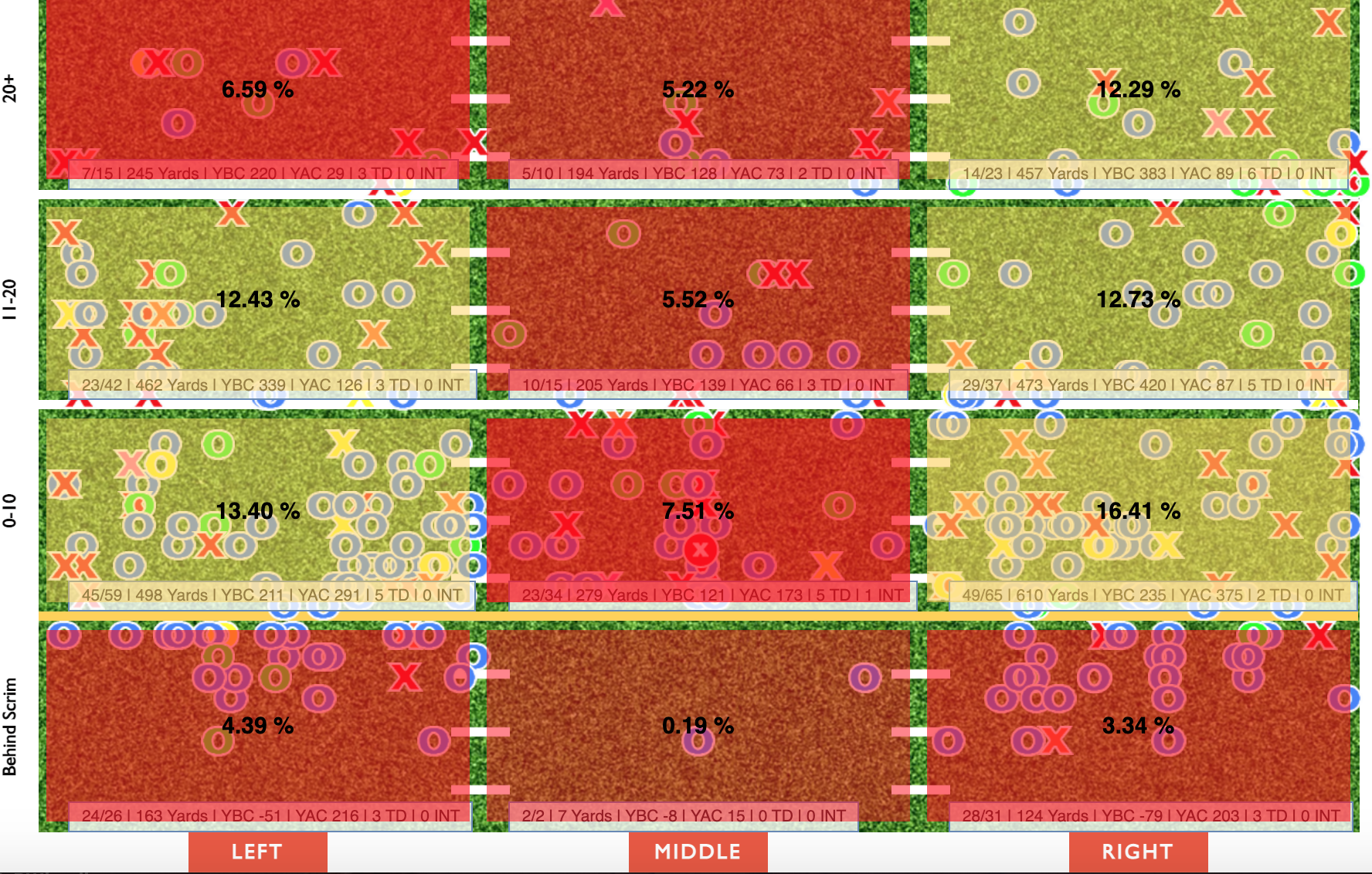
That said, Florida is just as likely to score a touchdown (7.25%) as Trask is to give the defense a stab at a turnover (7.22%). Coming in as the underdog, Florida will need Trask to make some big time throws. But those won’t come five yards downfield or in the flat. Though his aggression might sink the Gators’ chances to upset, odds are he won’t have the luxury of playing conservatively considering the hot starts Alabama is accustomed to.
Alabama Defense at a Glance
Though Alabama’s defense started the year with mediocre returns, they enter Saturday as the conference’s premier defense in many advanced stats. Georgia’s D still has the honor of being the best defense in college football according to the SP+. But the Tide are the top dawgs in SEC play. For what it’s worth, Saban’s bunch ranks 7th in the updated SP+ Ratings.
With our parameter applied, Alabama leads the conference in defensive Success Rate (63.2%), 3-and-Out Rate forced (27.2%), Opponent Score Rate (19.7%), TD Rate allowed (3.05%), and Takeaway Rate (3.05%). What more could you freakin’ want from a unit heading into a conference championship? It’s a testament to their ball hawk skills that they are just as likely to create a turnover as allow a touchdown.The other stuff they do well is icing on the cake. Like having a top3 Pressure and Havoc Rate and the 2nd-best Success Rate on 3rd Down.
Alabama is as good as anyone in the country defending both facets. They rock a league-leading 60.9% Success Rate versus the pass with a 63.4% clip against the run, which is the conference’s 2nd-best. I hate to feed Alabammers rat poison, but this unit doesn’t have many warts.
They could be better limiting chunk gains at times. I mean gosh almighty, Alabama’s 8.64% clip of defensive snaps that have allowed a gain of at least 15 yards is only the 5th-best in the conference. And they rank 9th in rush yards after contactCan’t be havin’ that Nicky.
But in all seriousness, this is a classic Saban defense that is stout against the run and stingy versus the pass. You’ll see their typical match-pattern stuff and single-high stunts. Fat chance the Tide will let Trask operate cleanly. Alabama’s defense like to be the aggressor anyways. But considering Trask’s high number of risky passes and the Tide’s aforementioned proficiency producing takeaways, you know Saban will be looking to make the Gator uncomfortable and throw off-kilter. Either way, Alabama is cool putting Florida behind the chains further increasing their likelihood to press or killing a drive outright with a sack. The Tide’s 7.14% Sack Rate is the SEC’s 3rd-best — but the margin between them and 1st-place Florida isn’t much (7.85%).
This could be something to watch on the all important money down. Florida’s 3rd Down Sack Rate of 2.73% is the best in the conference under our parameters. The Gators have only surrendered 3 sacks in these instances all season tied for fewest within the SEC with TAMU. Alabama’s Sack Rate on the do or die down puffs up to 12.3%.
Before moving on, we need to check out how Alabama fairs against empty formations. To reiterate, Florida frequently turns to those sets to help accentuate their matchup advantages with Pitts and Toney. This is not a drill: you will see it in Atlanta.
Besides being a tendency that’s helped the Gators move the ball, the Tiders themselves are pedestrian against five wide sets. Across the 32 snaps versus these formations, Alabama has allowed a 40% Success Rate and 8.53 Y/P. FYI: the average SEC offense sports a 44.1% Success Rate and 6.46 Y/P from empty.
The Georgia game in particular hurt the Tide’s numbers in these spots. All four of UGA’s plays from empty went for either a first down or touchdown. Their highlight play was a 82-yard tuddy to James Cook. Each time the Dawgs tried a different concept and each time they found success accumulating 138 yards in the process. If you’re keeping track at home, that’s more than half of the total yards from empty Alabama has allowed all year. And again of those 138 yards, 82 came on one play.
Take away the Georgia game and the Crimson Tide are holding opponents to a 32.1% Success Rate on a 4.66 Y/P. The last three games they’ve been even better with 16.7% and 3.44 clips. Not too shabby. Despite the recent trends in the Tide’s favor, Mullen will undoubtedly try his luck from five-wide considering his unit’s own track record of success. With Alabama not presenting many weaknesses to exploit, the Gators should hone in on what they do best.
Florida’s Defense at a Glance
Todd Grantham’s unit is about disruption. While his aggressive style occasionally bites him in the ass, Grantham’s defenses tend seek ways to create game-altering plays. Those are the kind of elements an underdog Florida unit will need in order to slow down one of the hottest offenses in America.
While not particularly gifted at getting opponents off the field with a bottom4 3-and-Out Rate forced and Takeaway Rate in SEC play, the Gators are the premier defense in the conference generating Havoc plays, sacks, and tackles for a loss. But causing a form of Havoc on one out of every five snaps on average or logging one TFL every ten might not be enough to upend Alabama’s dazzling scoring machine.
Especially considering Florida doesn’t pester opponent’s passing games too well. While their 20.3% overall Havoc Rate is tops in the SEC, their 10.5% clip against the pass falls into the conference’s bottom5. In any given matchup that might not matter. When you are going toe-to-toe with the nation’s leader in Expected Points Added through the air, however, letting him play pitch and catch with little duress isn’t the best recipe for success on paper.
In between their splash plays, Florida is nothing special defensively. Outside of their aforementioned struggle creating extra possession for themselves, the Gators are mostly an above average defense relative to the rest of the conference. Nationally, Florida is barely top50 in total and scoring defense; but in the eyes of the SP+, the Gators are ranked 22nd.
They hold their own in a few spots within the SEC. Grantham’s defense is top4 with our parameters applied in Success Rate (58.9%), TD Rate allowed (4.03%), and percentage of snaps that allow a gain of at least 15 yards (8.55%). While the Gators remain to be puzzlingly bad on 3rd and long, they still are a top5 unit within the conference in regards to money down Success Rate.
Perhaps only I will find this interesting, but Florida’s percentage of defensive snaps against pre-snap motion is the 2nd-lowest in SEC play. Along with that 11.5% clip, the Gators 8.87% play rate versus Jet Motion is a bottom5 mark. If you recall, I pointed out no conference offense utilizes more total motion than the Tide. Again, Alabama’s presnap and Jet motion usage rate significantly lead the SEC. You would have to think this would be a major advantage for Sark’s squad, right?
In addition to manipulating defenders, the Tide’s habit of creating extra inertia could lead to tackling problems for the Gators. I mentioned how each of Alabama’s motions serves a purpose. Whether it’s helping tip if the defense is in zone or man, widening or freezing second-level defenders, or helping their speedster’s accelerate at the point of attack, Alabama will try and put Florida’s aggressive defense on its heels. Motions help the Tide isolate their playmakers in vulnerable spots for their opponents.
While Florida has showed improvement over the course of the season, they still are middling preventing yards after apex. Grantham’s goons currently allow 2.28 rush yards after contact and 3.52 yards after the catch. Both are top5 clips within the SEC, but they’re are closer to the league mean than the top. Remember, Alabama’s offense comfortably leads the conference in yards after catch average and is top3 in rush yards after contact. All season the Gators have sported the SEC’s worst Missed Tackle Rate against the run. It’s better than what it was even last month, but Florida misses about 30% of their tackles versus the run ahead of Saturday.
Considering Najee Harris has accumulated the most broken tackles (68) and YAC yards (524), Florida could be out of sorts in a hurry if it can’t competently corral the Tide’s efforts on the ground. Again, refer to Alabama’s offensive section on how is effective balance often turns opponent’s sideways.
Florida is adequate in each facet but nowhere close to being dominant. Entering Saturday, the Gators’ defense have the SEC’s 5th-best Success Rate vs. the pass (55.2%) and the 6th-best clip against the run (54.9%). Down-to-down, the aggressive yet bend-don’t-break methodology on defense should allow plenty of wins for Alabama’s eclectic attack. They will not completely stop the Tide, but they could be able to contain them. A well-timed TFL or sack to force Alabama behind the chains or prevent a scoring chance is their best bet for hanging close. If the Tide have to continuously have to settle for field goals, Florida’s offense might be able to produce enough points. Still, it’s a hard ask.
Alabama’s Offensive Schemes
As I mentioned, Alabama’s offense wants to keep opponents guessing. That goes far beyond just anticipating whether the Tide will run or pass. Their facets compliment each other very well and naturally look to counter over-anxious defenders keying on one look.
Alabama’s Pass Rate when up or down 21 points represents the SEC’s median at 52.7%. Though not a true 50:50 split, that’s still very balanced. Furthermore, 14 concepts have received between 9 and 32 tries with none owning more than an 8% Play Share.
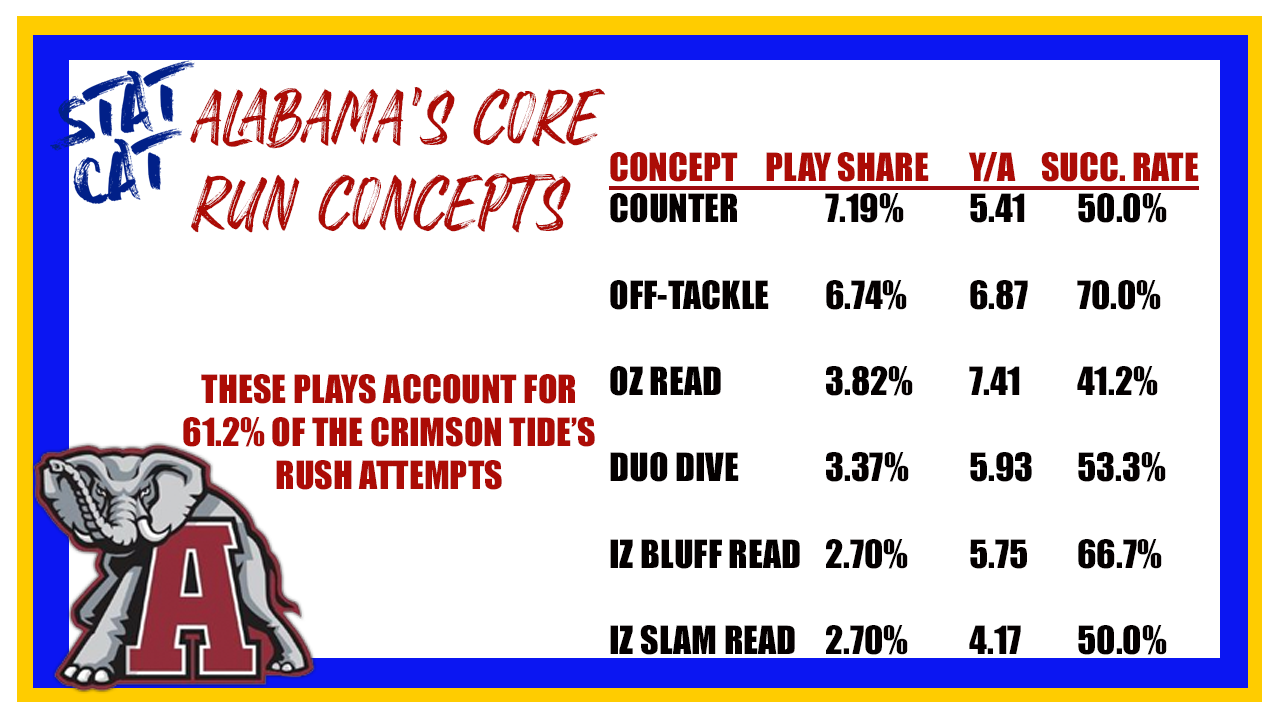
Across Alabama’s six favorite passes by targets, only 30% of its aerial attack is represented. Predicting what this pass game will do is nearly impossible due to its diverse play sheet. The Tide certainly have patterns they lean on more than others and dropback more often than they hand it off, but Alabama’s two most-repped plays are both runs. Thanks to that, over 60% of the Tide’s ground game is composed of their seven most-called run concepts. Like you’d expect from on offense wanting to prevent opponents from getting comfortable, Alabama’s two favorite runs are standard counterparts to one another.
Though it is second on the call sheet in number of reps, Off-Tackle zones hinge Alabama’s offense. Since its offense is full of athletes, it only makes sense to try and get those difference makers on the edge of the formation and away from the defensive mass in the middle of the field. With the flat zone blocking path, getting a step on an edge defender can sometimes be all that is needed for a rusher to find an alley to do damage. Over time as fronts become sensitive to losing outside integrity, they might widen their alignment and become vulnerable to hard-nosed inside designs. You will typically see two kinds of Off-Tackles from the Tide: straight and split zone. On the former the entire line will work playside. But on split zones, you’ll see the offset tight end fire against the zone flow to seal the edge backside creating a cut back lane in the process.
Alabama’s most-featured inside run, Counter, is also the leading overall concept on its play sheet. Functioning as a misdirection to outside runs, pullers flow away from where the defense initially anticipates the ball to go before creating a new hole on the opposite side of the center. There a many forms of counters, but Alabama’s most-featured is the basic version. The backside guard acts as a trapper and sets the hard edge creating the run lane. The offset tight end or fullback acts as the wrapper and becomes the lead blocker through said whole.
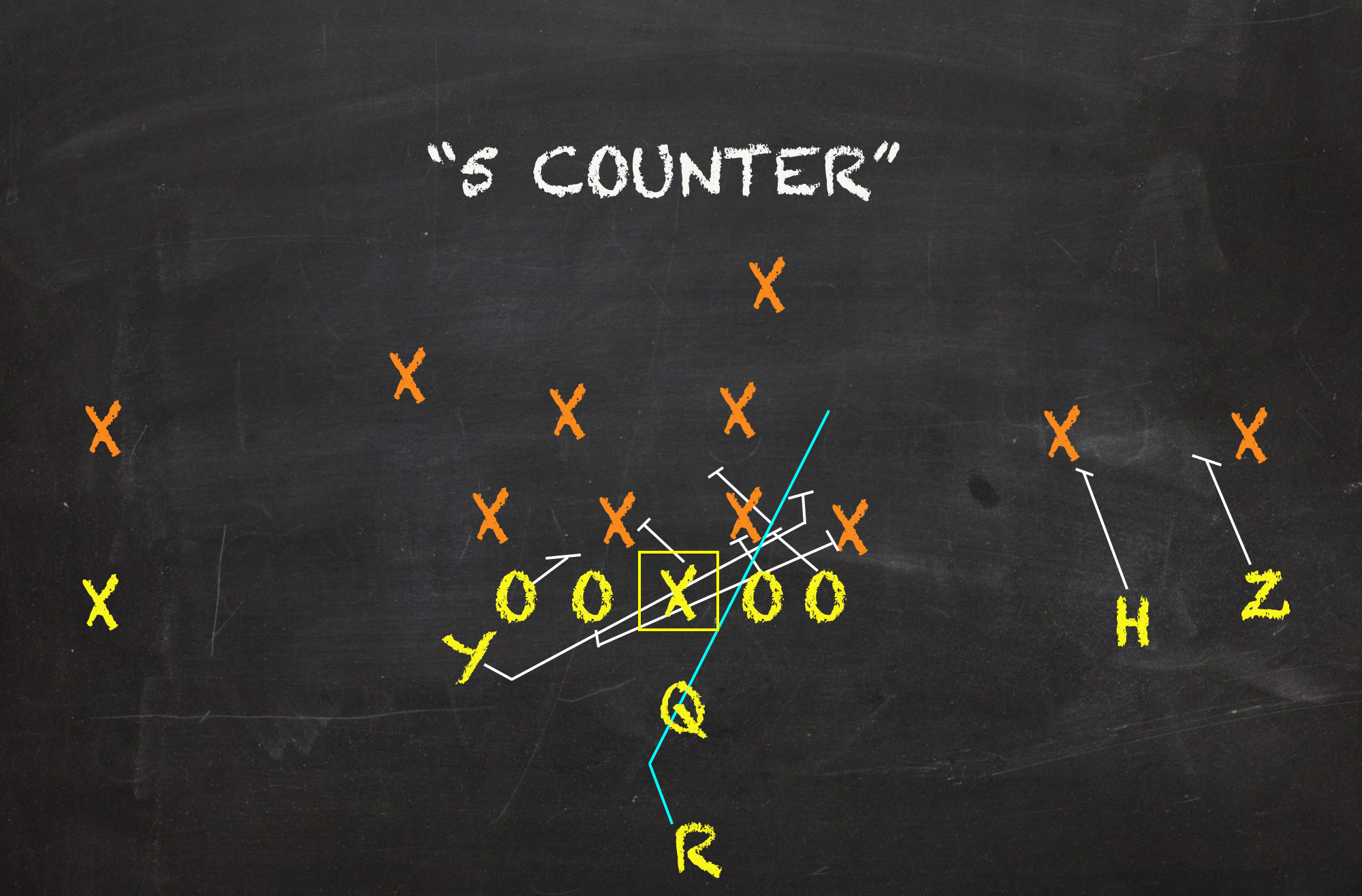
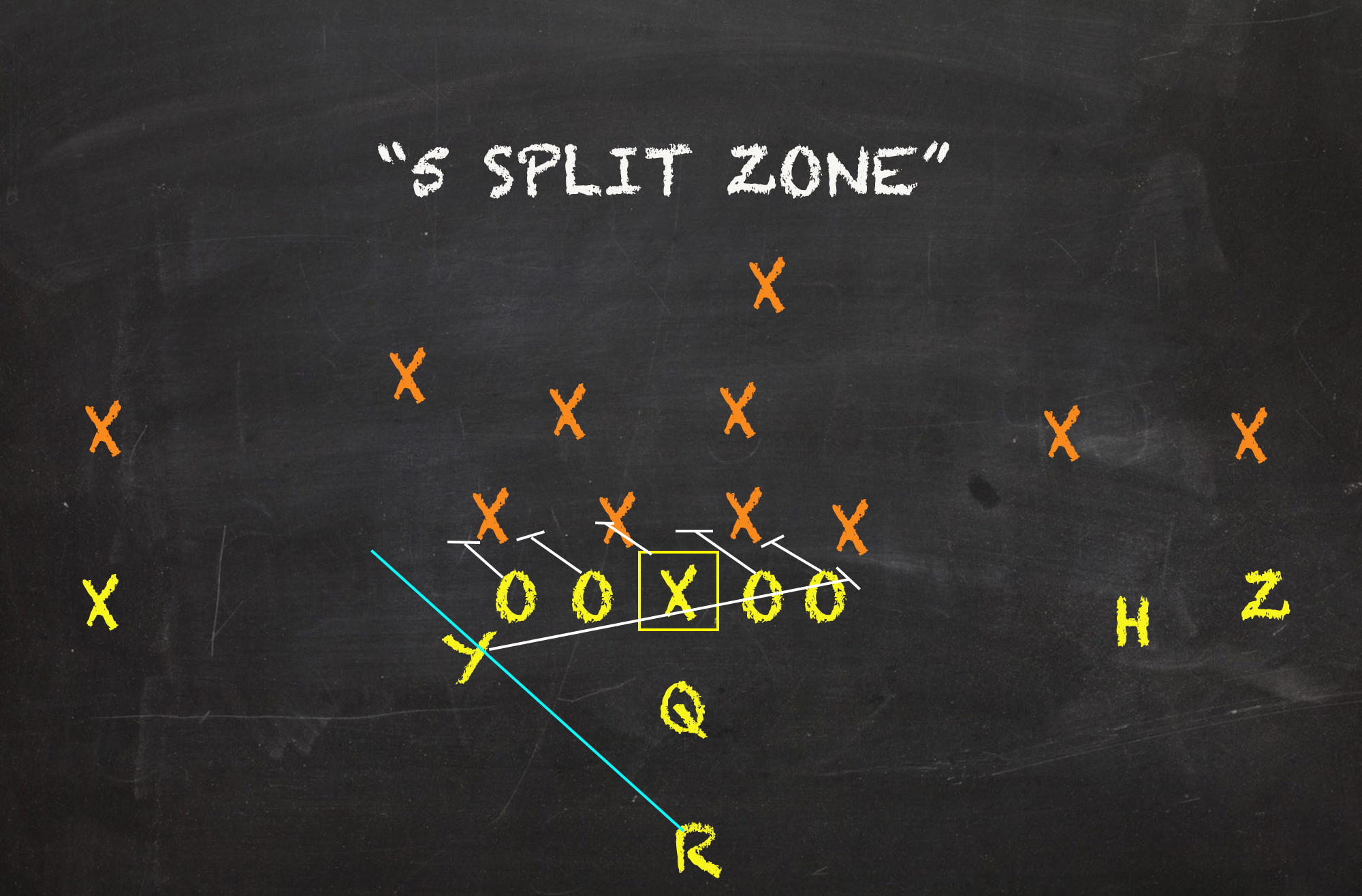
Like Off-tackles, the vast majority come from pistol or under center. This prevents defenses from keying on the orientation of the run with the balanced backfield presentation. Runs from the shotgun tend to exhibit less ambiguity and hence are quicker to diagnose.
These two run looks make up about 29% of Alabama’s rushing plays and a third of their ground yards. Conceptually complimenting each other on a blackboard only goes so far. That said ,Tide has kicked ass executing their bread-and-butter run looks. While Off-Tackle remains to be the offense’s best run play with a 6.87 Y/A and 70% Success Rate, Counter is no slouch either with 5.71 and 50% clips, respectively.
As the Tide’s favorite plays, it shouldn’t be a major shock the lion’s share of these concept’s reps occur on 1st Downs where their output closely remembers their overall figures. Being able to start a set of downs consistently with a six or seven yard gain obviously makes the Tide a difficult combatant to get off track.
Inside and Outside Zone Reads, Duo Dives, and Y-Insert round out Alabama’s most-featured run concepts. These looks have logged between 12 and 17 reps and are a healthy mix of inside and outside runs along with gap and zone schemes.
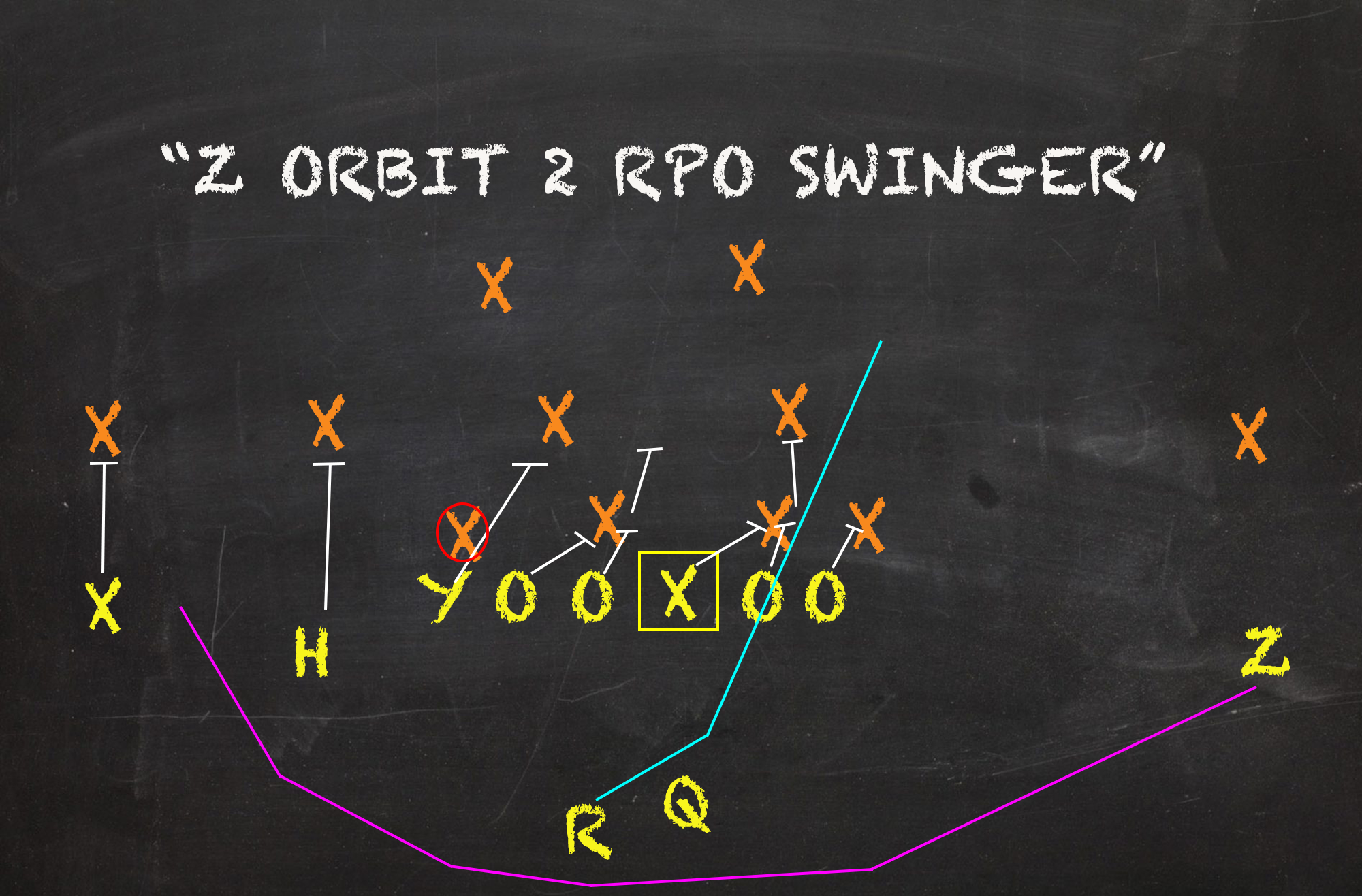
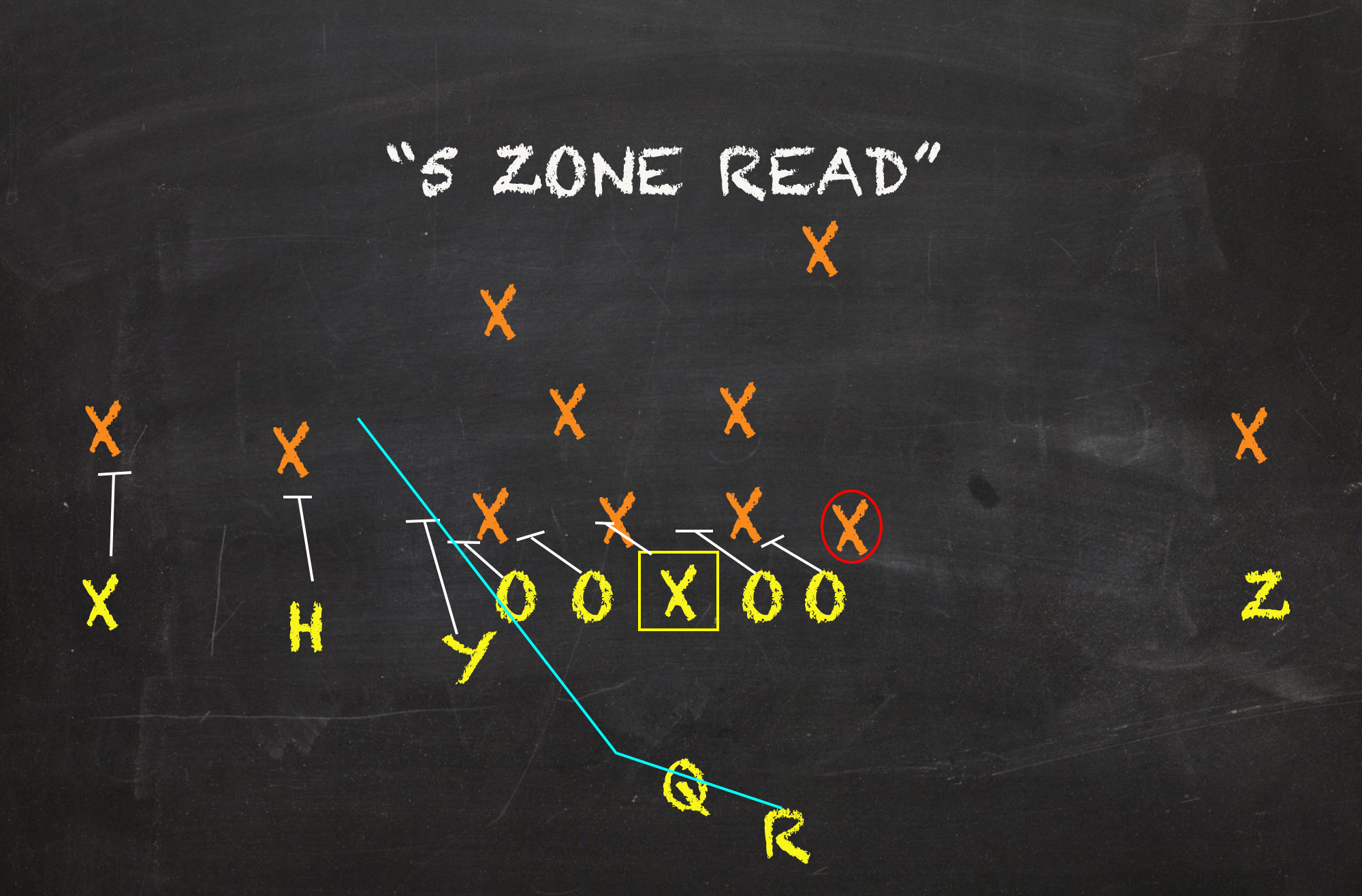 Zone reads frequently feature RPO route tags like outlet screens, slants, or hitches. With that extra element, most take place from the gun to facilitate the QB’s vision and throwing angle. Alabama has given equal weight to the two primary IZ Reads: Slam and Bluff. Slams are standard inside zones; Bluff is our terminology for split zone reads where an offset TE or fullback arcs around the backside sealing the edge and, at times, becoming a personal protector for the QB should they keep the ball post mesh.
Slam Read get most of its tries on 1st down (9 of the 12 have been called in those spots). But despite rocking a 50% Success Rate overall, this look puts up its worst returns to start a set of downs.
Much of the same is true for Outside Zone Read. That look also sees most of its milage on firsts (12 of its 15 calls) and has produced its lowest Success Rate (33.3%). Thanks to dissatisfactory results to kick series off, OZ Read is the only one of Alabama’s favorite run concepts to sport a Success Rate under 50%. While inconsistent, a few big gainers have helped the look post the best Y/A among their most-featured ground looks (7.41).
Before moving onto the pass game, let’s see how Florida has faired against these looks so far within SEC play. Temporarily, let’s disregard our point differential parameter.
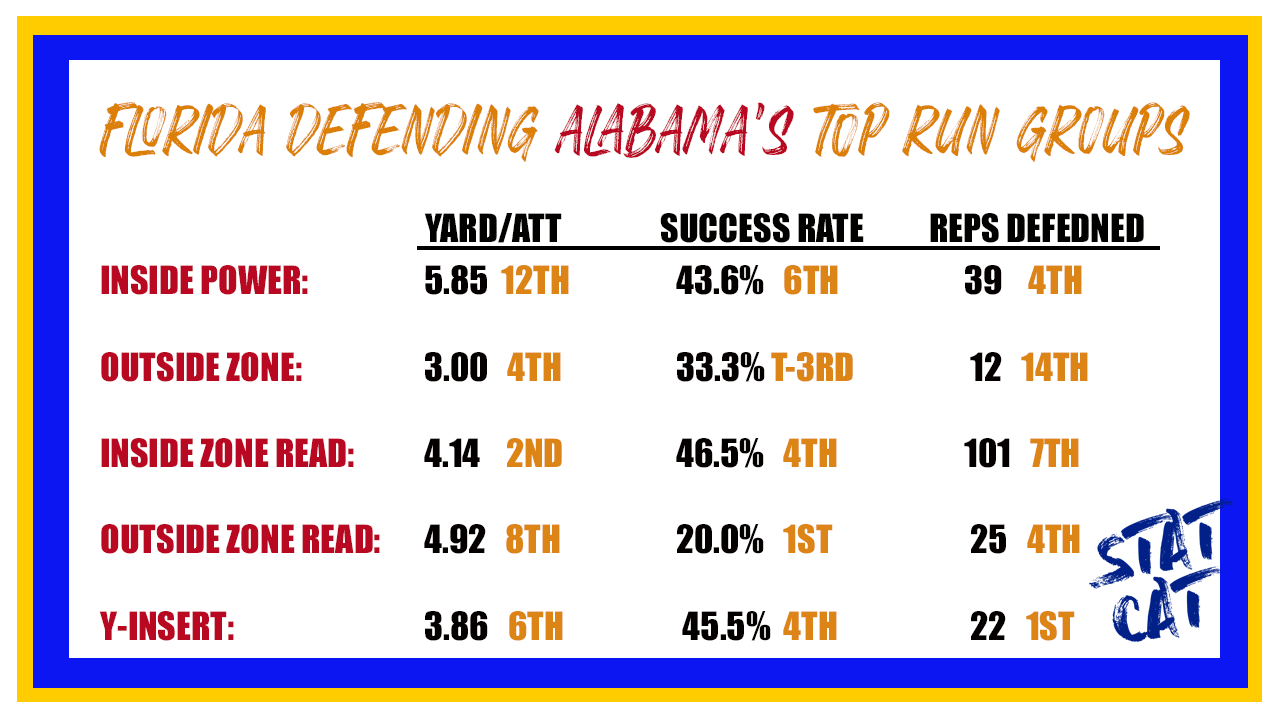
Florida has defended the SEC’s fourth most snaps against Inside Powers (Counter, Power, Iso, Duos, Wham/Trap). Despite the Gators’ experience defending two of the Tide’s most-featured runs, Grantham’s unit has been rather mediocre versus these looks. Averaging nearly six yards per pop, they also fall outside the conference’s top5 in Success Rate allowed (43.6%). Inside Powers aren’t meant to be sources for explosive gains for Alabama’s offense but instead consistent concepts that force the defense to change its setup. Based on these numbers, Inside Powers should be able to help Alabama’s offense dictate its script.
Sticking with the theme of inside runs, Florida has proven to be much more sound stopping Slam and Bluff Reads. Only Georgia defense has posted a lowed Y/A allowed on this group than the Gators. That’s certainly impressive on its face as is the fact Florida’s Success Rate allowed is the conference’s 4th-best. Still, it’s hard to overlook that 46.5% clip is easily the highest among the five rush concept groups in question that Alabama adorns.
Florida’s relative success stopping basic zone looks doesn’t stop between the bookends. Outside Zones (Off-Tackle, Stretch, Toss/Sweep) have hardly worked against Grantham’s active front. They are a difficult unit to reach and flank. Considering Alabama’s offense aims to do just that, this is a battle I’m especially interested in. Florida has held opponents’ Success Rate on Outside Zones, either with a read or straight up, under 33.3%. Without reads, foes are only averaging a mere 3 Y/C. Plus if we take out Zamir White’s 75-yard untouched scamper off an Outside Zone Read, the Gators Y/A allowed plummets to 1.25.
Teams have learned to not test Florida with non-read Outside Zone much. UF has only defended 12 all year for the fewest within the SEC. But teams keep trying reads based on White’s long carry going the distance. Florida has seen the conference’s 4th-most OZ Reads despite leading the way in Success Rate allowed (20%). Again, Outside Zones are important cogs in of Alabama’s offense. Only Missouri has logged more on the year within the SEC. If Florida can maintain its edge integrity, that will be a good start to preventing Alabama from staying ahead of the chains.
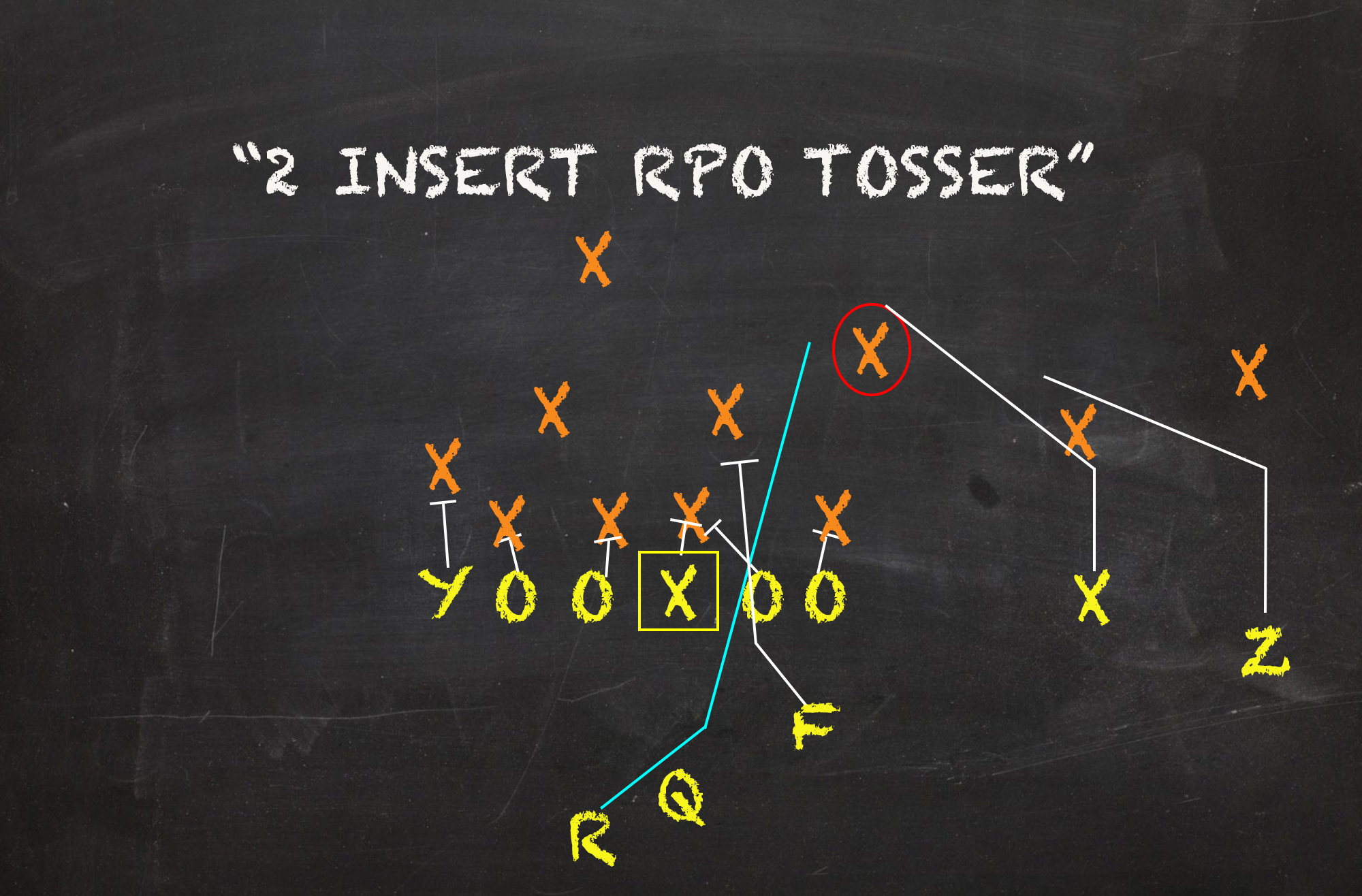
Y-Insert is a run look that’s starting to gain more traction, but it’s still far from one a common concept. Entering Saturday, Inserts have only accounted for about 1% of all SEC plays but stand among the handful or plays with a Success Rate north of 50%. Alabama turns to Y-Insert occasionally as a nice chance up action from it’s Bluff Reads. This gap play also helps the Tide find physical yards when opponents are spread out. Of the 12 Inserts on the year, seven have occurred on 1st Down. There, it’s been the Tides best run in terms of Y/A (7.43) and Success Rate (71.4%). Overall, the Tide have been about average with a 50% clip.
For whatever reason, Florida has seen more Y-Inserts than any other SEC defense this season. Though their allowed metrics are good and not great, those figures a lower than Alabama’s averages hinting the Gators have a solid plan in place should Sark feel inclined to try out this changeup.
Since only about 30% of Alabama’s pass reps are made up by their six favorite passes, you can determine that they spread the wealth around in that facet. Only five targets separate the Tide’s most-featured pass pattern from their sixth. With the vertically-oriented passing game overtaking share from West Coast staples, check downs have occurred more year-over-year.
These plays only combined to total 11 targets and 1.87% Play Share in 2019 but have seen those marks increase to 20 and 4.49%, respectively. In fact if we were to group all those as one pass concept, it would be considered Alabama’s favorite pass concept. Throw them along with the 15 true screens and their six most-called passes and 45% of Alabama’s air attack is represented. But because check down completions and screens are a collection of various subconcepts, they don’t provide much weight in terms of analysis.
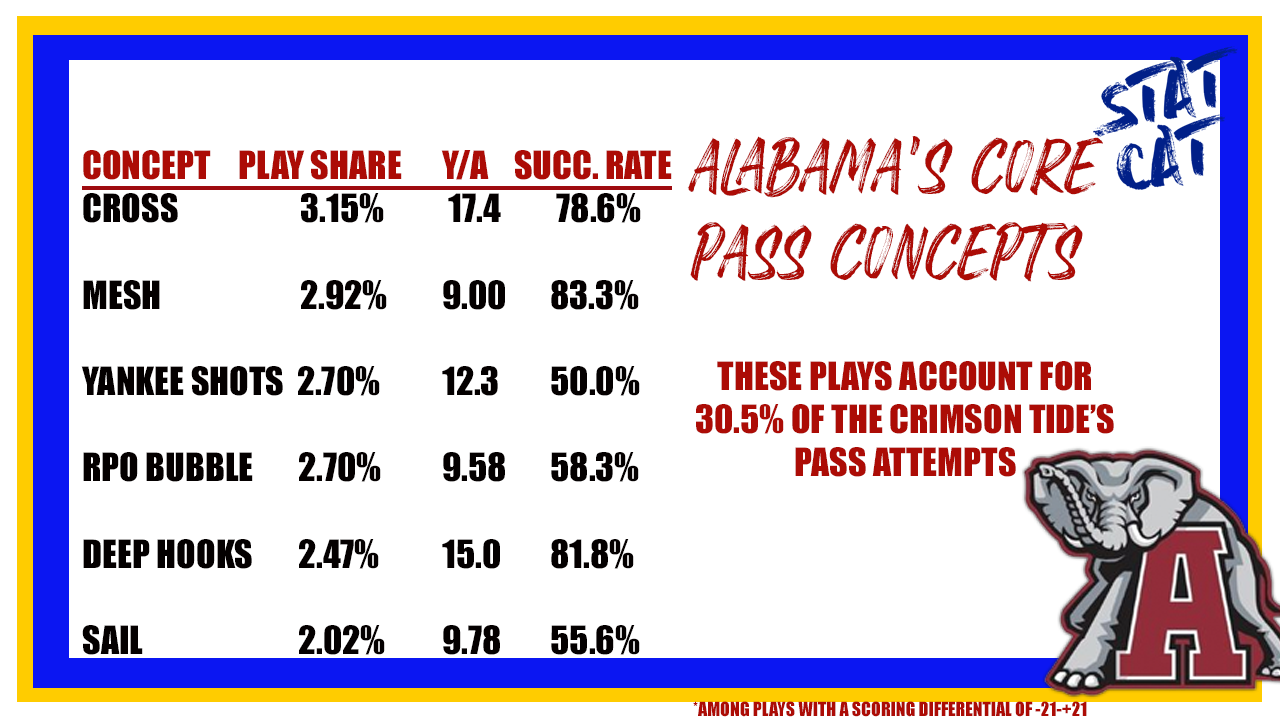
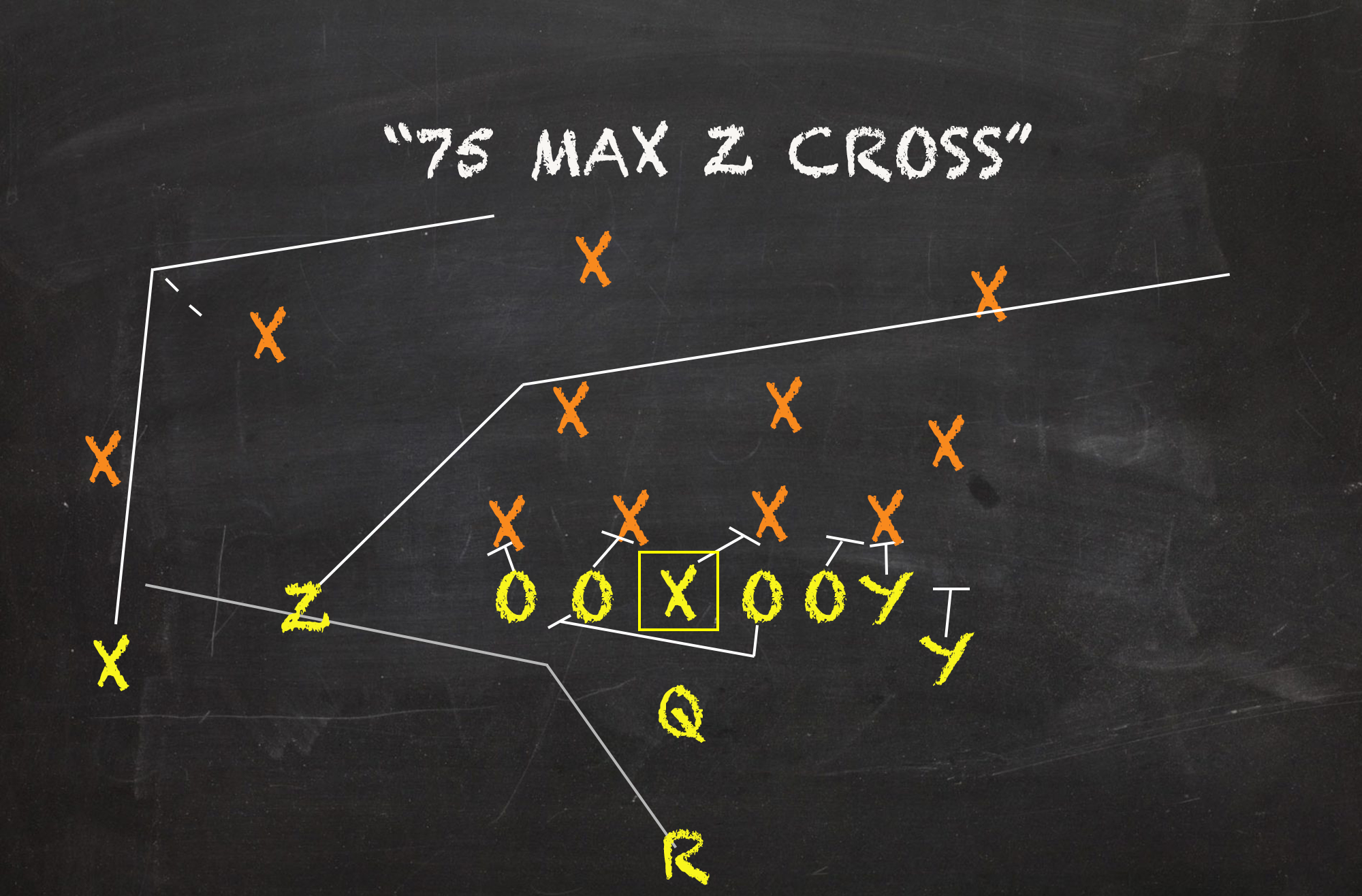
In the dropback game, Cross is Alabama’s go-to pass pattern. Named for the titular cross route over the middle of the field, this weak side flood design is served up a number of different ways by this offense. Taking a cue from the old New England offenses, Alabama commonly pairs Cross with power play action. With pullers helping sucker backers towards the line of scrimmage, the cross route flows through the area that they vacated in the passer’s line of vision. Alabama will also run it straight, without or without max protection, and from heavy sets.
Cross is the only pass pattern that has seen double digit targets on 1st down with our parameter applied. Of the look’s 14 tries, ten have happened to start a series. Whenever targeted, Cross has delivered. While compiling the 3rd-most yards of any look with 243, the Tide have posted a 17.4 Y/A on a 78.6% Success Rate.
Alabama’s usage of cross routes hardly stops with its affinity for that flood pattern. Every offense has its own preference for shot plays. Some go all-in on All Verts, others love slot fades, and others are cool isolating a solo deep route.
Ever since Lane Kiffin modernized this offense a half-decade ago, Yankee/Portland Variations have filled that role for Alabama. These patterns feature a deep cross or dig off a play fake towards the middle of the field. Depending on what the other routes do determines what kind of variant they play is ultimately labeled as.
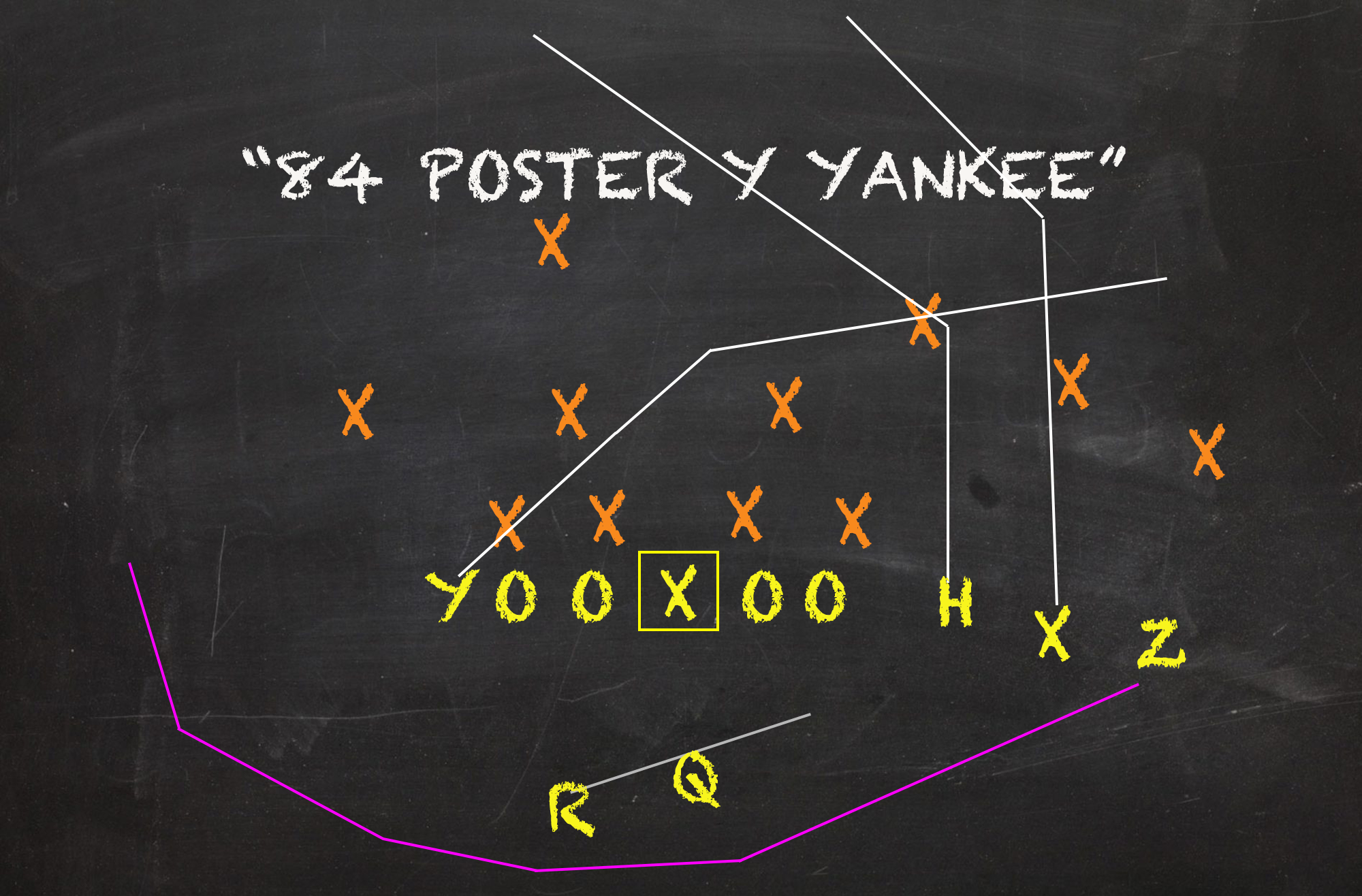
Despite their downfield nature, six of the 12 targeted Yankee Shots have found success. Like a good deal of Alabama’s aggressive patterns off play action, they are mostly found on early downs. These plays have combined to total 147 yards, which 7th highest figure by this offense. Outside of being able to test 3rd-level defenders, the Tide has tried a version of concept out twice in the red zone the last 3 games with both resulting in points. Because I know you’re curious; no, I don’t chart Leak designs under this umbrella.
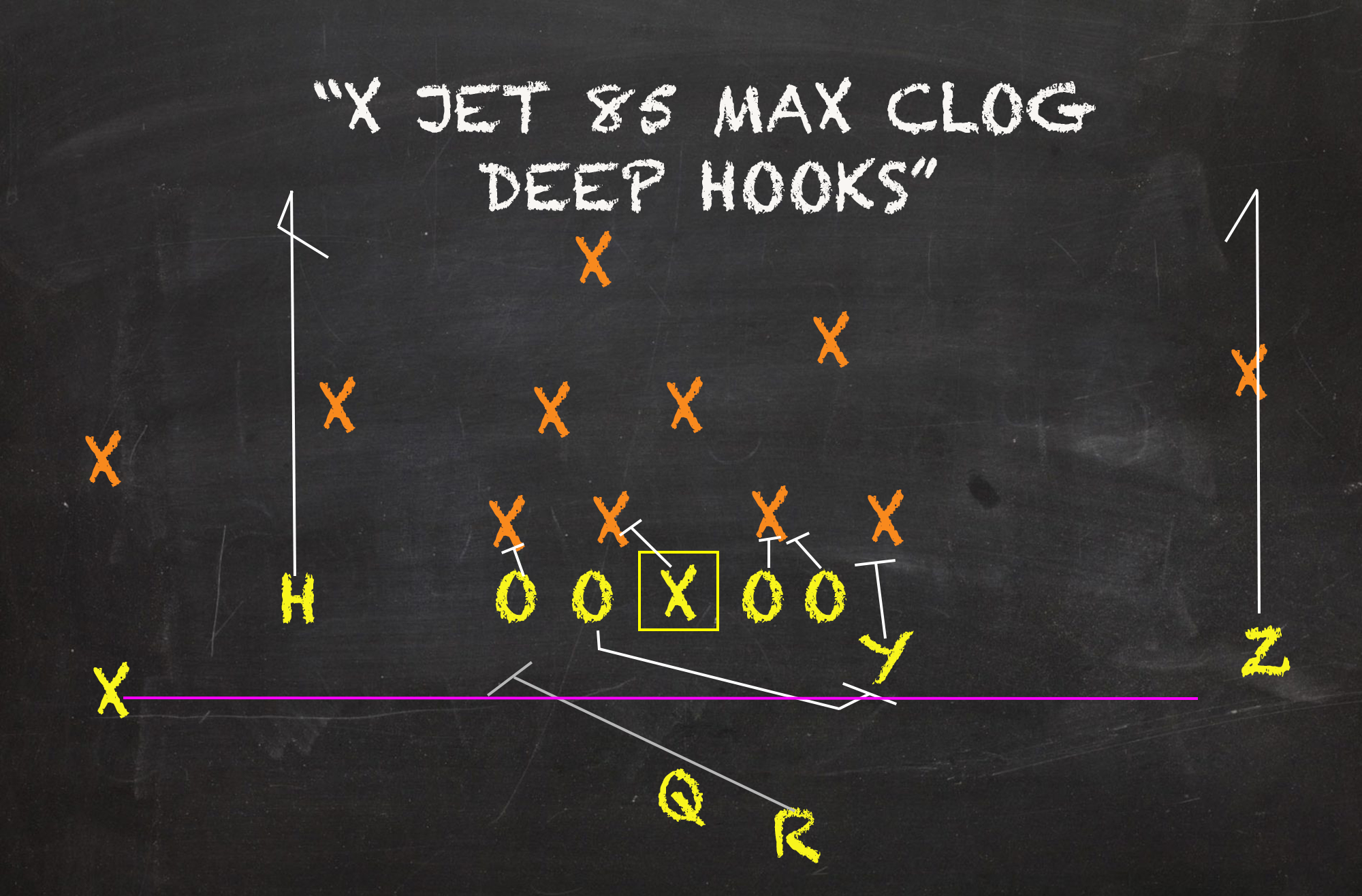
Playing off of that idea when opponents are expecting deep crossers, Alabama has incorporated a good amount of deep hook patterns. Instead of working across the field, Alabama’s pass catchers will hook up 17-22 yards downfield off a comeback. The Tide typically only sends two receivers down field. They’ve window dressed these designs with a variety of play actions like the vast majority of their other dropback concepts. Since these orchestrate an easy pitch and case — albeit at a longer distance — Alabama sports a 15.0 Y/A across an 81.2% Success Rate on 11 targets.
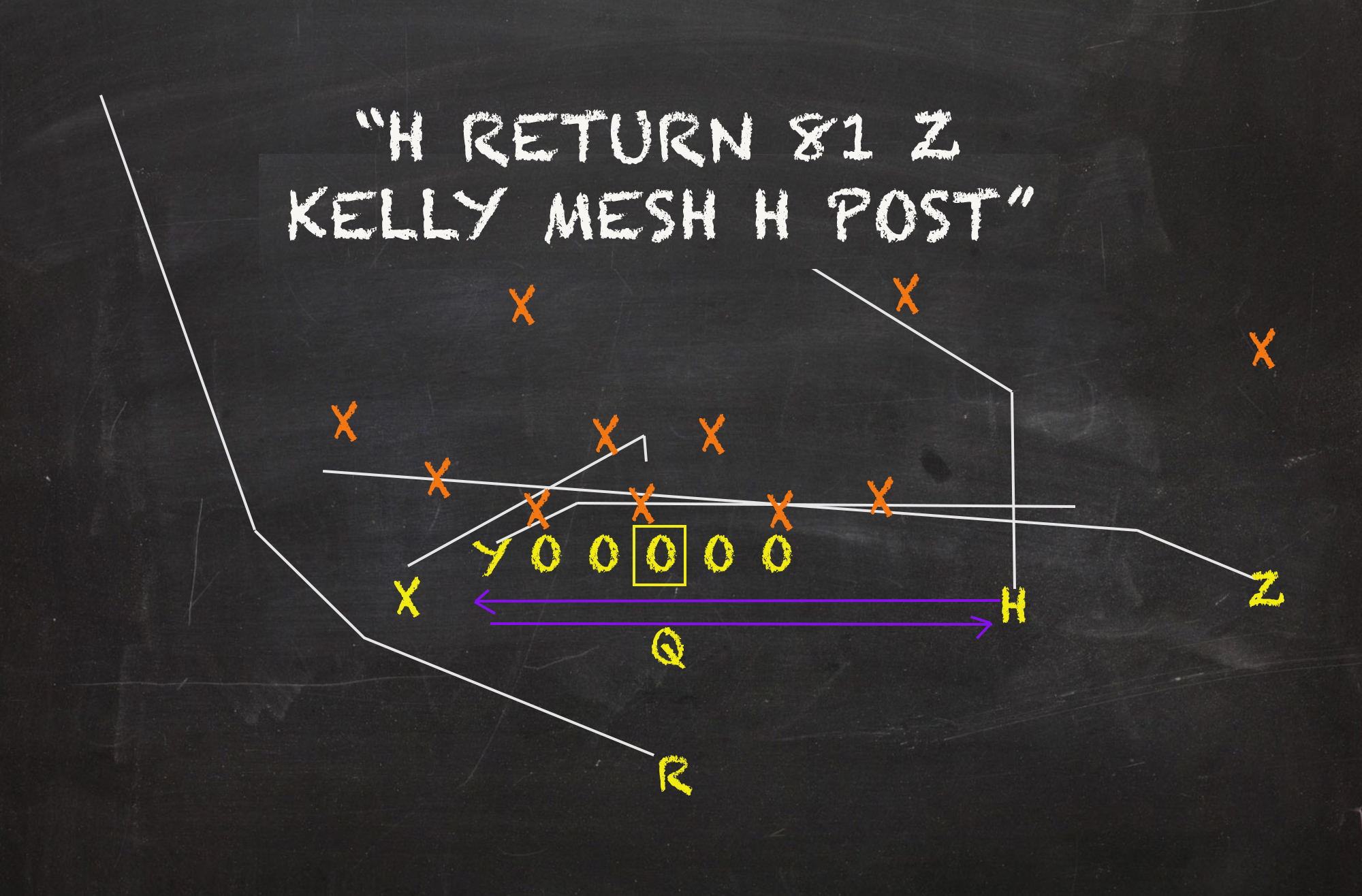
Mesh rounds out Alabama’s core pass plays. Along with Deep Double Moves, Mesh is among the few West Coast staples that has a major role in this scheme. Along with the Rub Variations, Meshes are the Tide’s go-to on 3rd Down where they account for a sixth of their plays. Rubs are out to create friction and separation from tight man coverage. While close to Switches, Rubs are generally shorter patterns. Outside of drag/pick screens, each subconcept of Rubs sports at least a 50% Success Rate on the do or die down.
While RB Wheels and Slant+Fade combos see occasional targets, Mesh is this offense’s clear favorite among that grouping.
Most reps of Mesh have occurred on the money down, but Alabama has executed the pattern to perfection on its five 1st down chances. On a perfect 100% Success Rate, Mesh averages 13.4 Y/A in those spots. Along with Deep Hooks/Comebacks, its the only look with at least 5 tries to post a pristine clip.
Sail has only logged nine attempts but it’s just as successful as its brother concept Cross. Sail too has produced a 17.4 Y/A on a 78.6% Success Rate. While Cross is a weak side flood, Sail is of the strong side variety. The basic Sail combo is a three-man high low read outside the numbers consisting of a vertical, out/corner, and flat route. Alabama can swap their dude’s orientations around or deploy two-man rendition. They’ve been bold enough to try “Skipper” — a pattern that initially presents itself to be Cross before the primary receiver morphs his route into a long, looping corner route. That is particularly killer versus single-high coverages.
As aforementioned, targeting slants is on the downswing. Still, Alabama utilized RPOs at an average rate relative to the rest of the SEC. Bubble screens have garnered the most attention among their outlet options with 12 targets. As an extension of the run game and a de facto member of the Tide’s top concepts, RPO Bubble Screens average more Y/A (9.58) than any of their most-called runs and only trail Off-Tackles and Bluff Reads in Success Rate (58.3%).
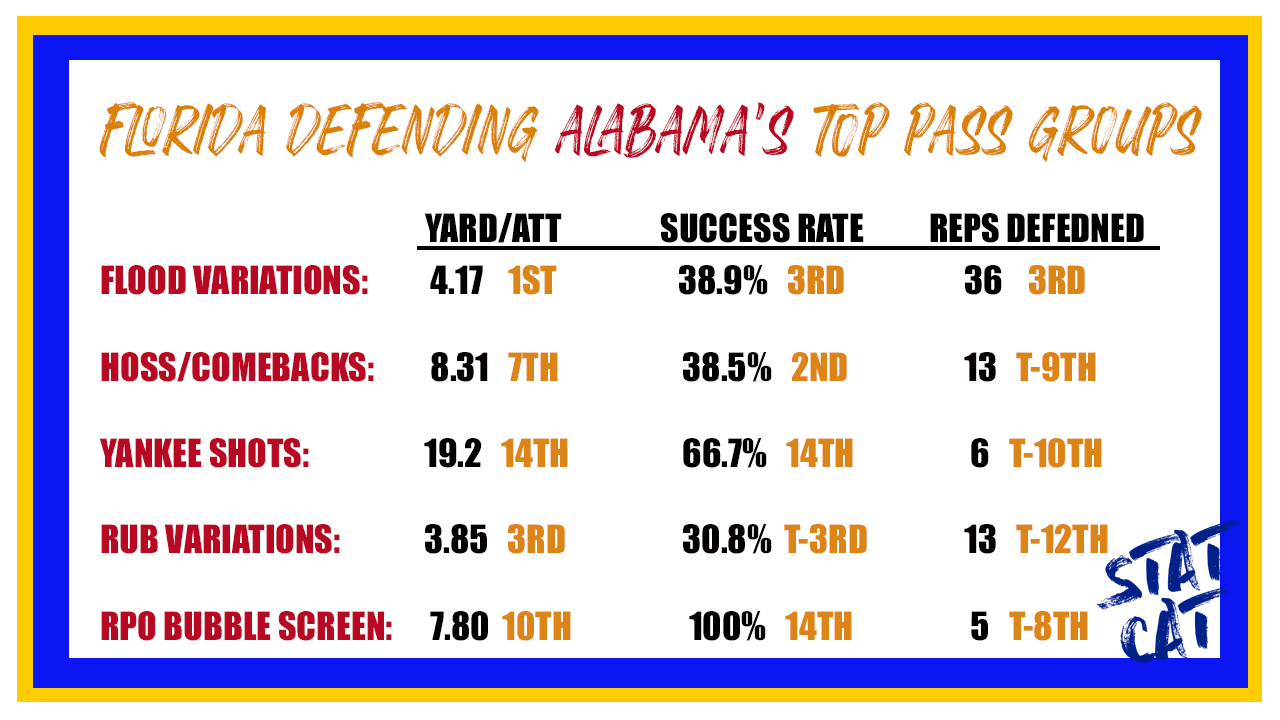
Florida’s defense has handled Floods (Cross, Sail, Play Action Bootlegs) quite well in comparison to their conference contemporaries. No SEC defenses sports a lower Y/A allowed on these passes than the Gators. They are among the three in the conference to hold their opponents under a 40% Success Rate despite facing the look 36 times — good for 3rd-most whiten the SEC. I’m no Nostradamus, but I would expect Alabama to really play around with how it presents Cross and Sail to the Gators. They might swap orientations, come from stack or bunch sets, or be brave and try the long-developing “Skipper” wrinkle. Like the two in regards to Outside Zones, seeing who gets the upper-hand when Floods are dialed up could help determine the conference champion.
Since Alabama’s version of Deep Hooks/Comebacks is more rigid than the rest of the conference, this section perhaps might lack weight. But versus Curl+Seam patterns and the like, the Gators are among the most consistent defenses in the conference. Though mediocre AF by their 8.31 Y/A allowed, only one SEC defense has a preferable Success Rate allowed than its 38.5% clip. Alabama is a perfect 6/6 targeting this concept on 1st down. Florida has only surrendered a single successful try in such spots.
The Gators are also apt at preventing Rubs from doing much damage. Florida is top3 among SEC defenses in terms of Y/A and Success Rate allowed. Plus, there’s not much separation between them and the other two top teams defending these patterns. Despite being potentially tricky passes to stop, Florida has held foes to figures that are no where close to efficient. Most have taken notice, hence Grantham’s unit facing only 13 Rubs all year — tied for the 2nd-fewest in the SEC. But while the Gators have done well versus Rubs on early downs, they have allowed 2/3 targeted on 3rd Down to result in a conversion. Remember, Rubs are Alabama’s overwhelmingly favorite look in those spots.
Against four of Alabama’s six most-featured pass plays, the Gators enter Saturday with a solid track record. But versus Yankee Shot plays and RPO Bubble Screens, the Gators have been awful.
Florida has defended six Yankees and four have wound up as deep completions. Their 19.2 Y/A and 66.7% Success Rate allowed are the worst clips in the conference. If there’s any area of the field where you don’t want to completely suck ass, it’s deep. Explosive plays are the element that is the most correlated to wins and losses. Win the explosive play battle, and there’s a good shot you’ll be in it or on the cusp of victory. Though these shot plays aren’t overly common by volume, you have to think Sark will scheme up a nice deep cross shot looking at Florida’s metrics.
Florida has only faced five RPO Bubble Screens all year. While their usage is reliant on how Florida aligns to the offense’s formation and the QB’s read, that’s certainly not a whole lot entering Saturday. Still, Florida has allowed a successful rep each time their alignment has goaded opposing passers to target them in the flat. I’m sure Sark won’t go out of his way to tell Jones to look towards the flat on read options, but Alabama averages more yards on Bubble Screens than the poor Gators allow. Thinking how the Tide utilizes motions, Sark might not have to try too hard in order for these puppies to present themselves.
Florida’s Offensive Schemes
Since Florida’s offense hasn’t blown the doors off folks quite like Alabama’s, they have logged more plays in our parameter than the Tide. And despite their perception as a one-dimensional offense, the Gators currently sport a more balanced script. Both of Alabama’s two favorite runs account for more play share than any look in Florida’s offense. No UF concept enters Saturday with a usage rate north of 6.6%. Mullen mixes his patterns up as good as anyone in the country. Still, he obviously has his favorites. Five concepts have received at least a 4% Play Share entering Saturday. For the Tide, only Counter and Off-Tackle reach that threshold.
If Alabama’s offense strives to disorient, Florida’s aims to create favorable matchups. Against most teams, that comes easy thanks to the quickness of Toney and the physicality of Pitts. If teams go out of their way to double-bracket that duo, Trevon Grimes, Jacob Copeland, and Justin Shorter are there to provide value. All sport at least a 50% Success Rate and 8.26 Yards/Target (the SEC average is 7.98).
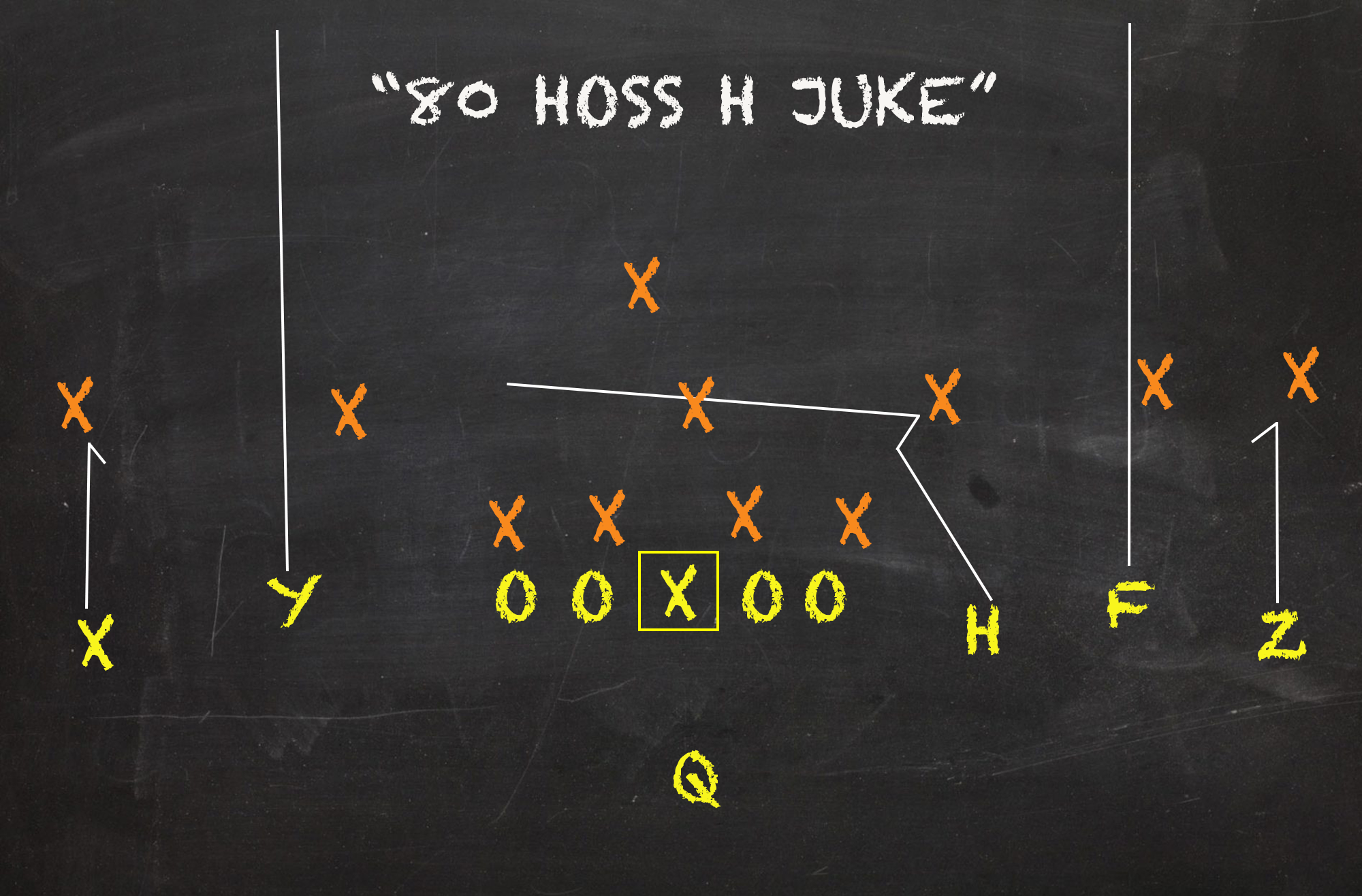
Mullen has leaned into an old Patriots staple to maximize his two play makers. Many words ago, I told you Florida has donned empty formations more than any other SEC offense. Well, their favorite play from that set — and overall — is a Hoss concept with a slot juke route (“Hoss” is a common term for a curl and seam/fade combo). Looking at the diagram, the pattern is nothing special. But when you plug in the electric Toney to run the multi-breaking route on a linebacker IRL - you get a 63.6% Success Rate on a 14.0 Y/A. That’s special in my book. I should clarify that’s not all Toney. Trask has hit all three routes and really toyed with defenses with this pattern. Pitts on the perimeter or streaking downfield is just a scary mismatch for defenses. That said, Trask gets Toney-vision on the money down more often than not when this play is dialed up.
Expect to see this look a lot when Alabama tips it’s in single-high coverage. It’s this offense’s go to. And for good reason. It’s delivered at least a 57.1% Success Rate and double-digit Y/A across all three downs. Hoss+Slot Juke is Florida’s most targeted pass pattern overall, on first and on 3rd downs. I mean, they ran a version of this 11 times versus LSU last week.
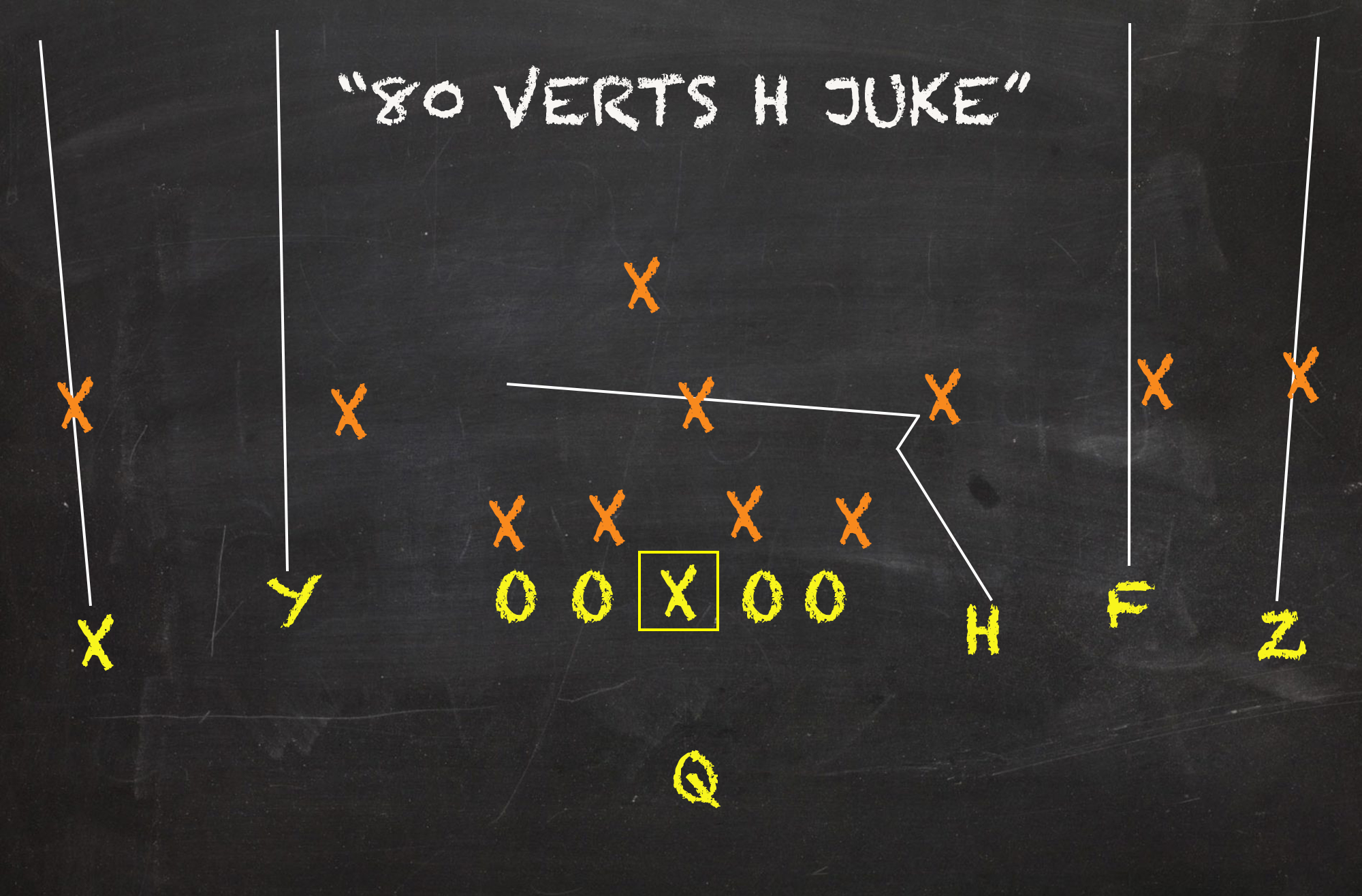
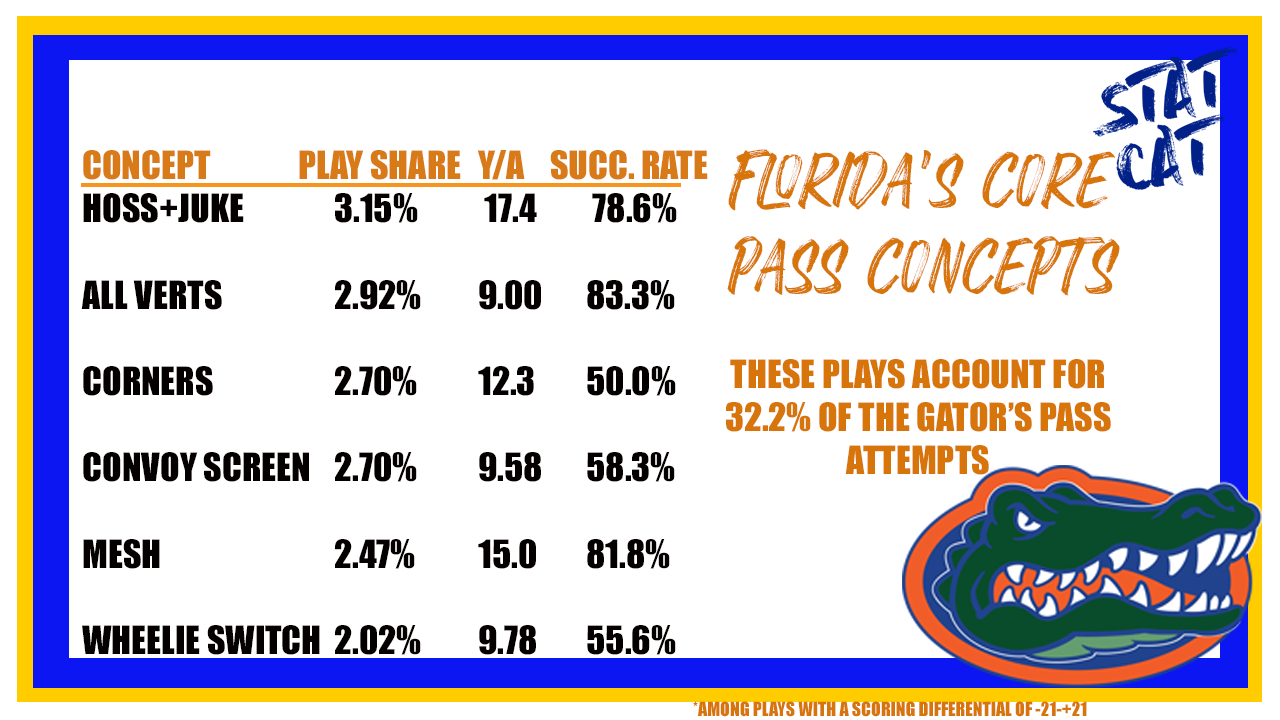
Florida occasionally incorporates the little juke route on All Verts; but from empty, it's almost always a given. The underneath juke provides a better hot route and safety valve if the verts don’t come open. Because of that element, Florida is among the most efficient teams in terms of Success Rate targeted this concept with a 43.3% clip. That’s about how good LSU was on this look last season. Entering Saturday Hoss patterns have accounted for over a third of Florida’s total offense with 462 yards.
Meant to overload the backend of any zone coverage or test defenders one-on-one, All Verts is seen in every offense these days. A lot of the times, particularly on 3rd downs, defenses are well-aware of what’s coming. It’s a pattern where play makers need to shine. And that’s where our collection of pass catchers come in. All Verts has fielded as many 1st down targets as Hoss and is the second most-called pattern on the money down. Due to its big play potential, this concept has delivered 245 yards — 4th-most of any look.
Smashes have healthy roles in Mullen’s scheme. Lot’s of passing games like to provide high-low reads along the sideline where there are typically less defenders. With less mess, it’s generally a quicker read and throw. Though other variants are featured, Florida has targeted the Corners wrinkle the most. It’s an inversion of the traditional Smash combo of an outside hitch and inside corner. The outside man will run a “C” or “circus” corner with the inside man running a quick out or a flat. Since Smash is old AF, offenses have had to change how to run it over the years versus different alignments.
Half of Corners targets have occurred on 1st Down where it’s only received three less reps than Hoss and All Verts. Overall, it’s sported an even better Success Rate than either of them with a 68.2% clip. Thanks to it’s efficiency and volume of tries, Florida has gained 263 yards off targeting Corners. The only spot where it’s faltered is 3rd Downs. There, this Smash variant has only moved the chains on 3/8 tries.
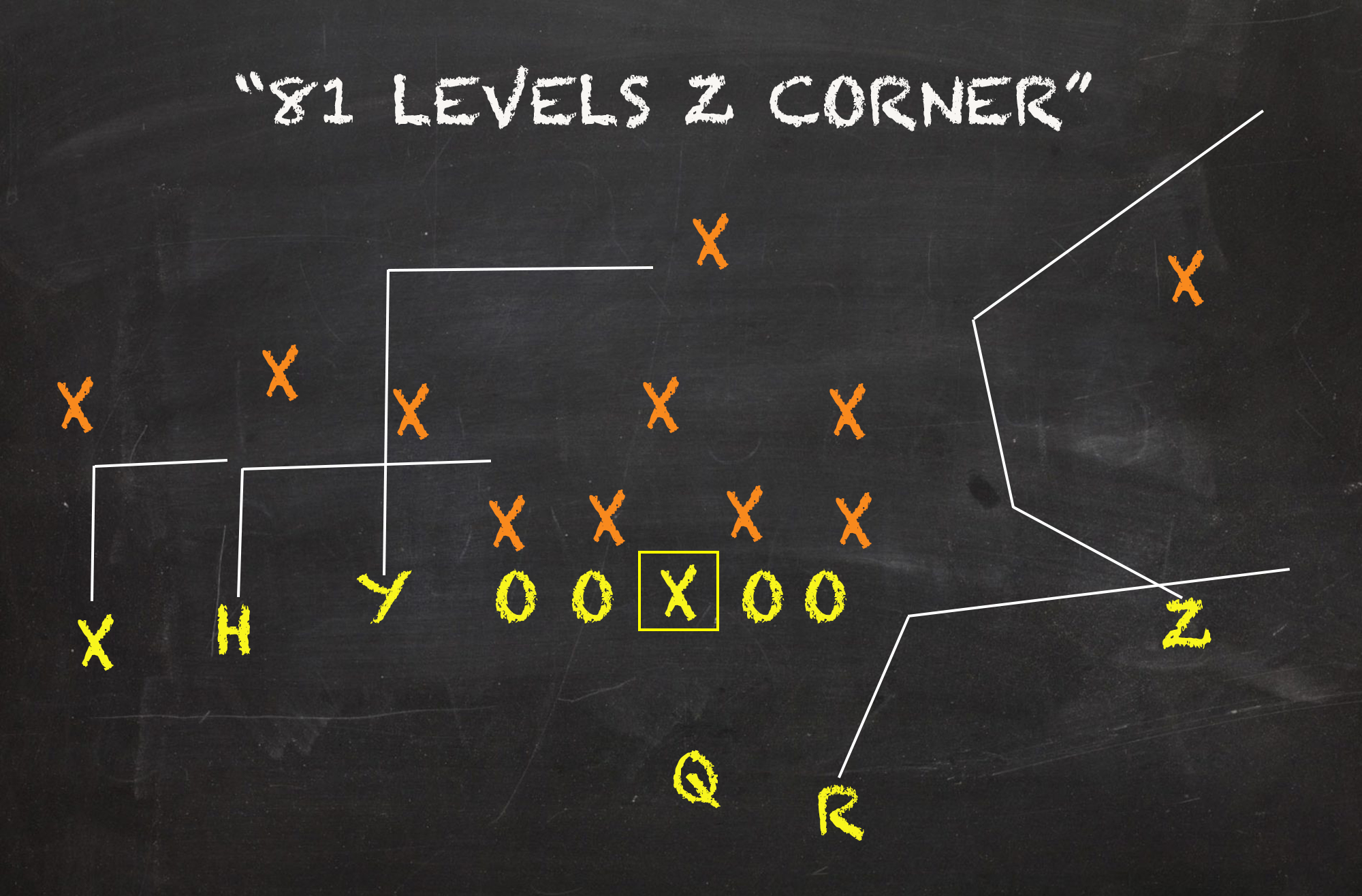
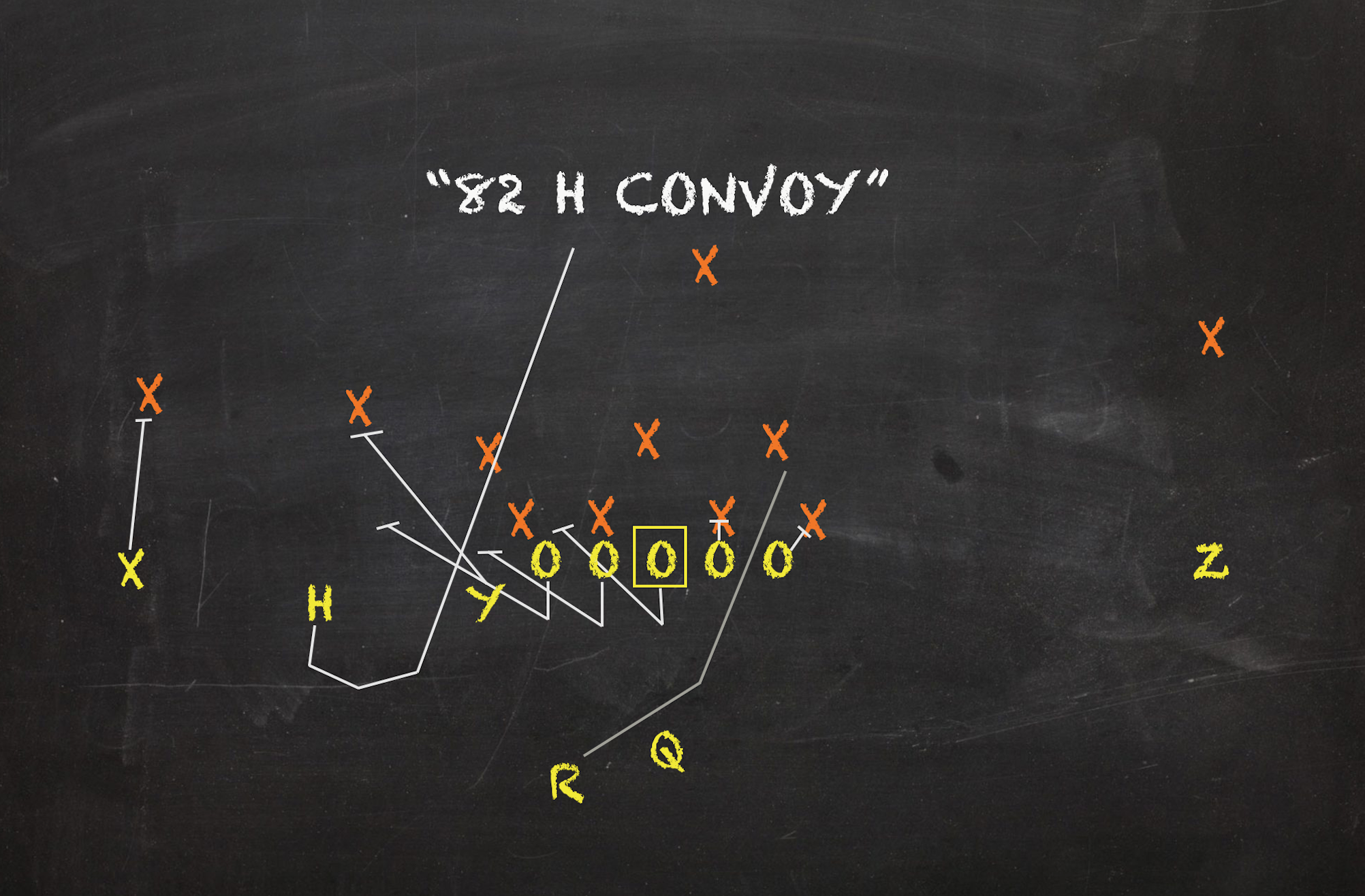
After those three core pass patterns, there’s a decent drop-off in usage to the next concepts. Mullen has always been a believer in screens. And even though reps are down on those looks, Convoy Screens have logged the 4th-most targets in this offense with 16. When the ground game is floundering, most coaches look upon the screen game to be an extension of the run and as a way for a playmaker to get the ball in space. With the up-and-down route patterns, screens can create easy pickens on the perimeter. Jailbreaks have put up a decent 43.8% Success Rate and 8.25 Y/A.
Like Alabama, Florida is a fan of Mesh. Both offense overwhelmingly feature a version Chip Kelly helped popularize. Some may call it a “Spot Mesh” but it consists of a our primary intersecting drags with a playside sit hook and halfback wheel combo. Half of the targeted Mesh patterns have found success but the play’s 8.06 Y/A is the lowest among their favorite pass concepts. Florida loves to use various Rubs to get it’s backs involved in the pass game. And with this design having a built-in wheel as a hot route for the back, it’s an easy one to dial up often.
Speaking of wheels, Switches have delivered a number of splash plays for this offense. Wheelie Switches — consisting of an inside wheel and outside dig or post — have gained the 5th most yards of any Gator Concept on just 11 targets. In most people’s minds, there’s never a bad time to call a wheel route. Florida is the poster child as to why. Wheelie leads the all of the Gators’ favorite looks in Y/A (18.7) and Success Rate (81.8%). Florida isn’t afraid to deploy different kinds of Switches, but these are unequivocally its favorite.
Though no one subconcept commands a hefty play share, a number of other passes round out this offense. Slants — either as standalone routes, RPO outlets, or backside man-beaters — have accounted for 29 targets. Floods have added 25 more. Vertical Shots like fades, solos, and vertical+curl combos as well as check downs combined for 30 plays. With their six favorite pass patterns the the bargain bin concepts, 53% of Florida’s pass offense is represented. All that, and it’s only half of their calls. Told ya Mullen likes to diversify.
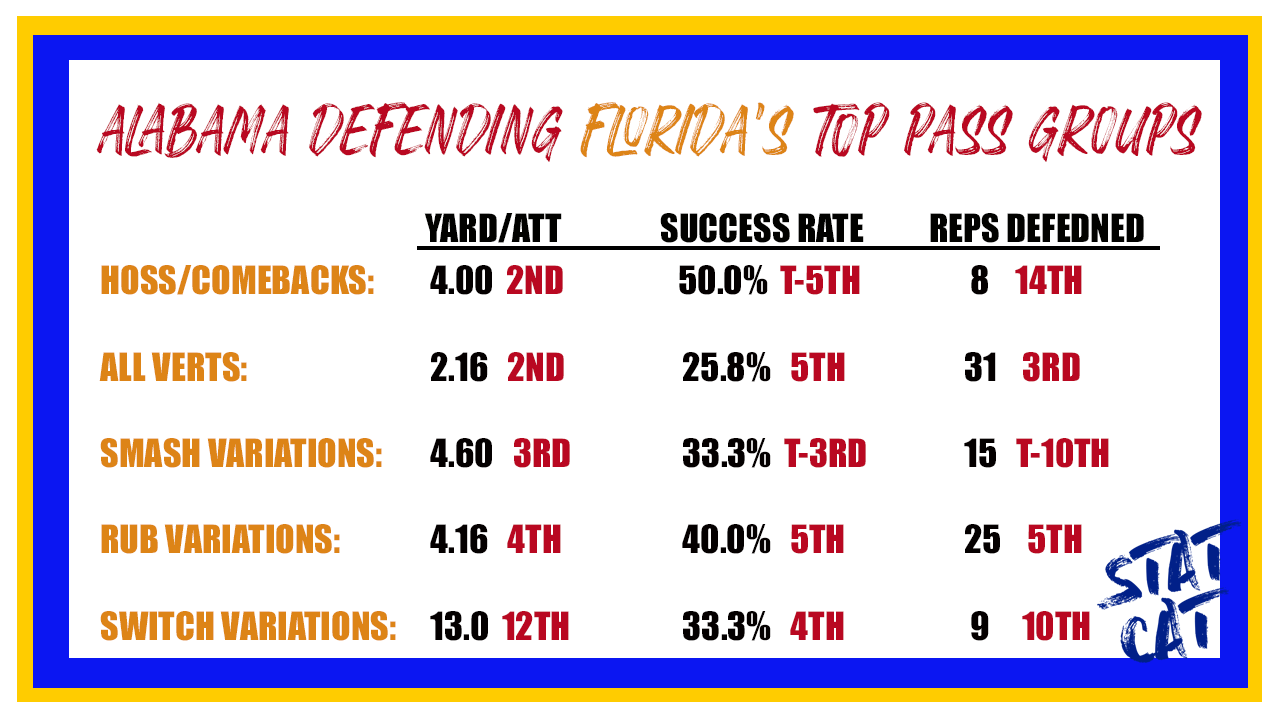
Okay now before talking about Florida’s forgettable run game, let’s take a break and see if Alabama has had issues stopping any of the Gators’ core pass plays. Starting with Hoss, not too many teams have challenged Alabama on this front. Though Florida’s receivers have a few playmakers in its ranks, far less have dudes on the level its duo. Since Alabama loves to roll with man coverage most of the time, their talent has won out. SEC opponents have only called Curl+Seam combos eight times versus the Tide for a 4.00 Y/A
There’s a very good chance Florida doubles up Alabama’s experience defending Hoss. Due to their own boner for the concept and the Tide’s 50% Success Rate allowed, Florida should certainly give this pattern a go. This is the ultimate matchup play with Toney underneath on a backer and Pitts working up-and-down.
For much of the same reasons, Alabama has been able to lock down All Verts. But thanks to this commonly being a behind the chains pattern in addition to a first down shot play, Alabama has defended the SEC’s 3rd-most with 31. Though about a quarter of those reps ended in success — still pretty good and the SEC’s 5th-best mark — Alabama is only allowing a 2.16 Y/A on this deep passing concept.
Though Alabama has had trifles with the inverse nature of the Corners concept, Smashes usually don’t cause the Tide too much harm. Only 5/15 defended Smashes have resulted in success for opponents. Outside of Mississippi State, no SEC defense rocks a lower clip allowed. All the while, they’ve held foes to a 4.6 Y/A — good for the SEC’s bronze medal.
Since teams turn to Rub Variations to beat man coverage, Alabama’s defense is no stranger to these concepts. They’ve defended the conference’s 5th-most with 25 entering Saturday. Even though Rubs are supposed to help with man, the Sabanites are top5 within the conference in Y/A (4.16) and Success Rate allowed (40%).
Defending Switches has been a mixed bag for Alabama this season. On one hand, only 3/9 have worked out for the offense. Only the other, the Tide averages allowing 13.0 per pop. Only two other SEC teams average more than that: LSU and Georgia. One of those defenses, which was eviscerated by Wheelie and Rubs of the like, happen to operate an awful lot like Saban’s. While the Tide have managed to hold opponents to a 33.3% Success Rate, I’m sure Mullen is curious if that match-pattern is ready for his Switches. Florida has hit on six of its seven 1st Down Wheelie targets entering Saturday.
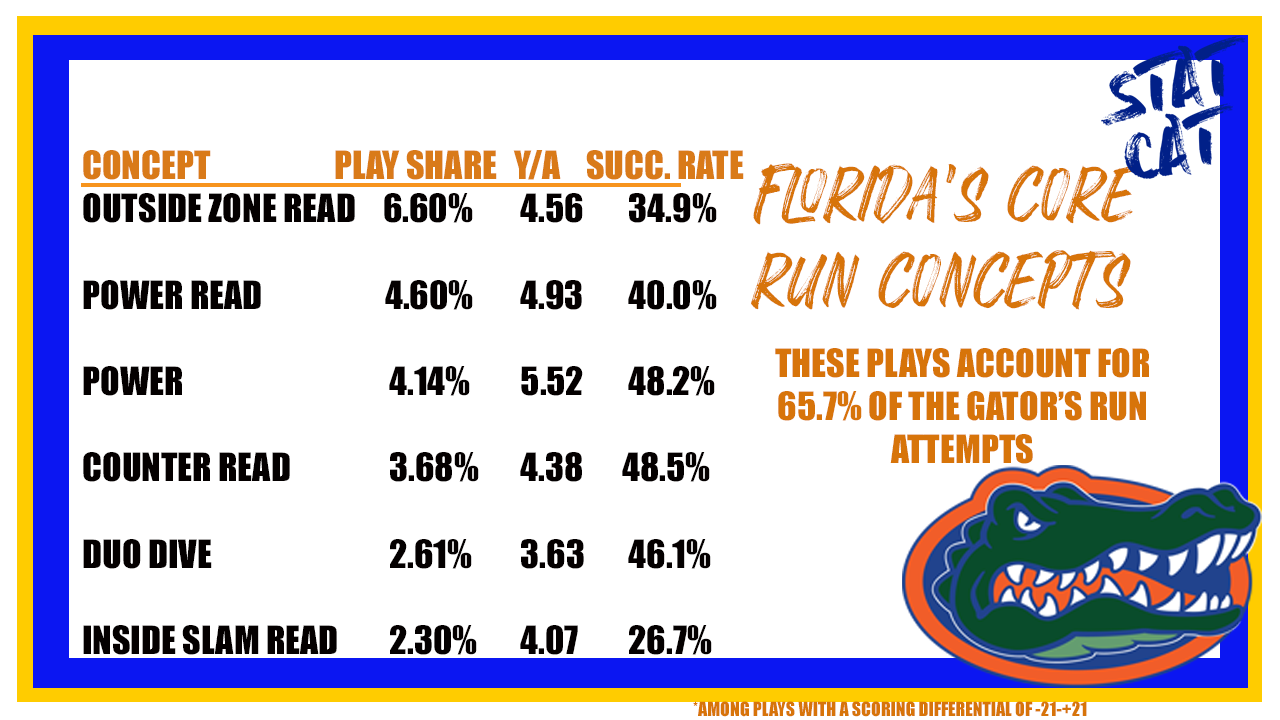
Moving on to the run game, Florida has shifted its schematics year-over-year. Last year, Inside Zone Slam Reads were far and away its go-to run play. No other ground concept topped a 3.3% Play Share, and Slam Reads almost reached 10%. Though Slams Reads are still among the Gators’ favorite run looks, they now compose the sixth highest usage at 2.3%. Last year’s 5th-most called run , Outside Zone Reads, now leads the script with a 6.6% share. A Duo look went from 2nd to 4th with read and non-read Powers almost doubling in usage.
Outside Zone Reads are exclusively an early down play. About 58% of its reps are on 1st down alone. Florida typically attaches a backside slant or curl when in the mood to tag routes. But you get the idea. This run attempts to flank the defensive front and get speed outside. Clearly, that’s a priority for Mullen. Otherwise, it’s hard to justify dedicating the team’s highest play share towards a concept that’s delivering a 34.9% Success Rate and 4.56 Y/A. Mullen seems to be an agent of chaos occasionally.
Plan B for Florida’s run game entails bashing defenses between the tackles with power wrinkles. With opponents expecting a decent dose of outside carries, they might naturally widen over time or completely overreact to the action completely. Incorporating pullers to further help with the tenderizing has helped Florida find better numbers but none of its power concepts top a 49% Success Rate. Non-read Power, Power Read, and Counter Read combine roughly for a 12% Success Rate. So while Outside Zone Reads on the surface might seem like Florida’s main approach, it’s only the counterpunch for its overall Inside Power favoritism.
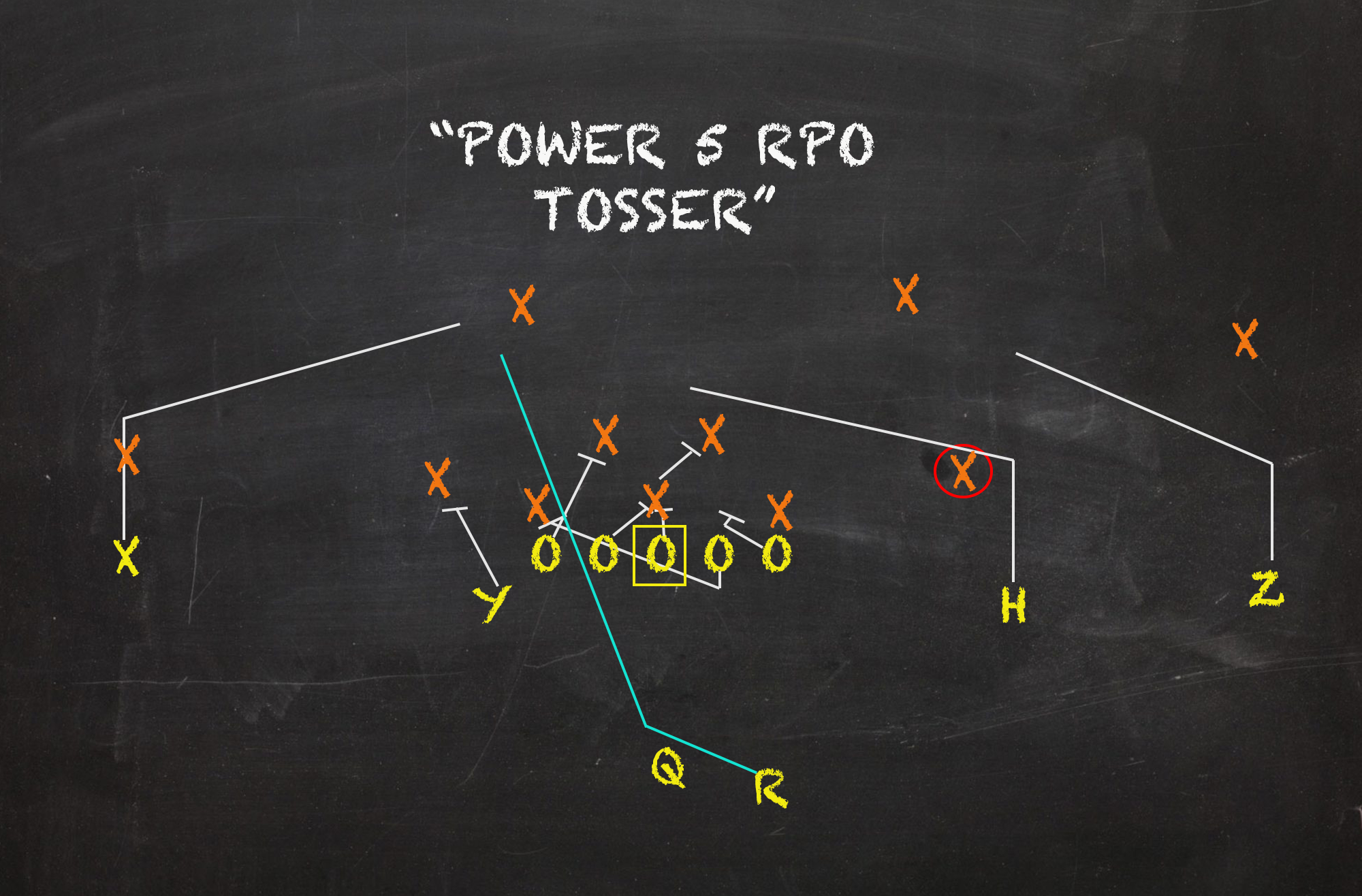
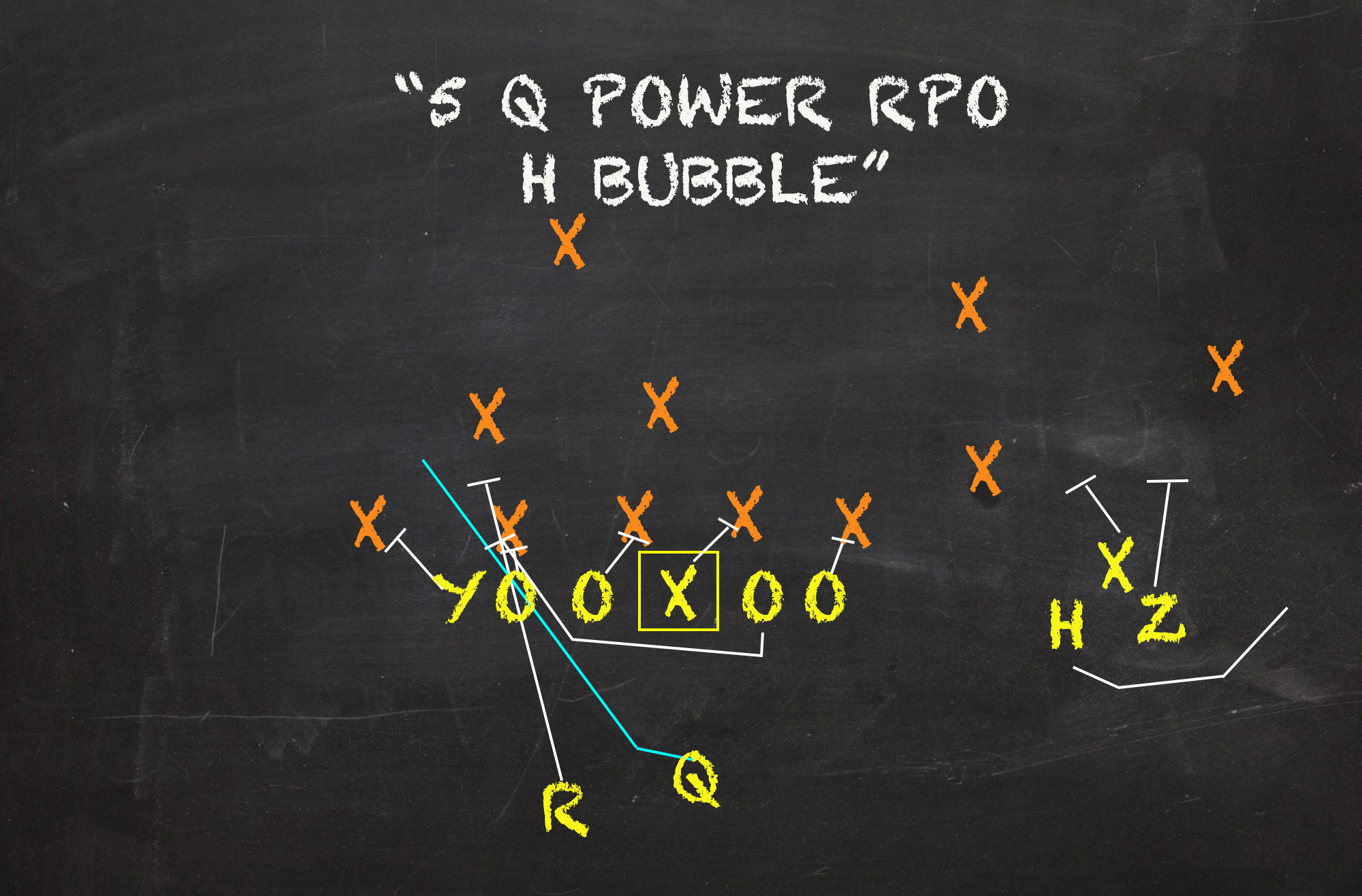
One-guard puller designs compose 8.7% of Florida’s plays alone. Together they account for 297 yards, which only trails Hoss. But for our purposes I broke them out into two parts. Let’s start with the non-read version. These are mostly from undercenter or the Q-Power designs where the running back joins the puller as a lead blocker. This no-nonsense design sports the best Success Rate (48.2%) and Y/A (5.52) of any of their sixth most-called runs. Florida never looks to rip off a big gainer with these. It’s a high floor play that helps the Gators win with numbers in the box.
The read counterpart have received the 2nd-most calls being Outside Zone Reads overall and does its best work to start a set of downs. There the look has received as many tries as the Gators’ bread-and-butter Hoss with a solid 6.36 Y/A. The consistency for this look, however, is lacking. On the year, Power Reads only have a 40% Success Rate.
Now talking about all these similar looks can be confusing. So let’s slow down for a slight second. Powers are gap scheme plays that looks to set hard edges playside with down blocks and double teams and pull a backside guard as a lead blocker through the hole. When a read element is attached — in Florida’s case usually in the form of an RPO outlet, the QB has the option to not give the ball to the back following the blocker and execute the other side of the play whether that be keeping the ball for himself or dishing it out to an outlet. Counter Reads are a misdirection play that use those very same read aspects but use a slightly different blocking scheme. In addition to the backside guard, an offset tight end or fullback comes along. But he takes on the roll of lead blocker with the guard setting the hard edge next to the down blocks.
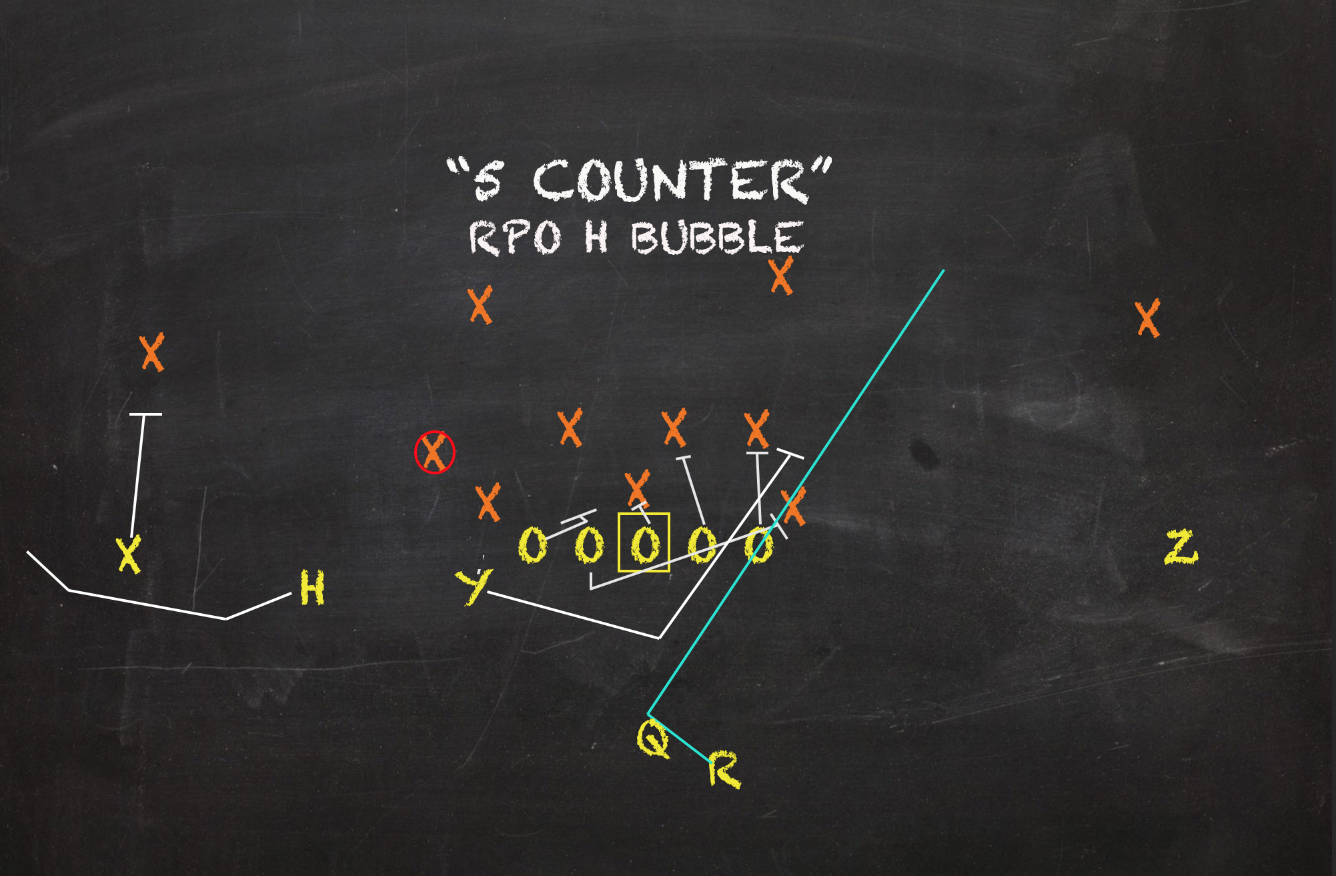
Counter Reads produce middling returns. A 45.8% Success Rate and 4.38 Y/A excite exactly no one even if it’s far from Florida’s worst play. This look has received the 2nd-most reps on first downs in our parameter. There, it’s one of Florida’s best run concepts. but like it’s overall clip, Counter Read fails to surpass a 50% Success Rate.
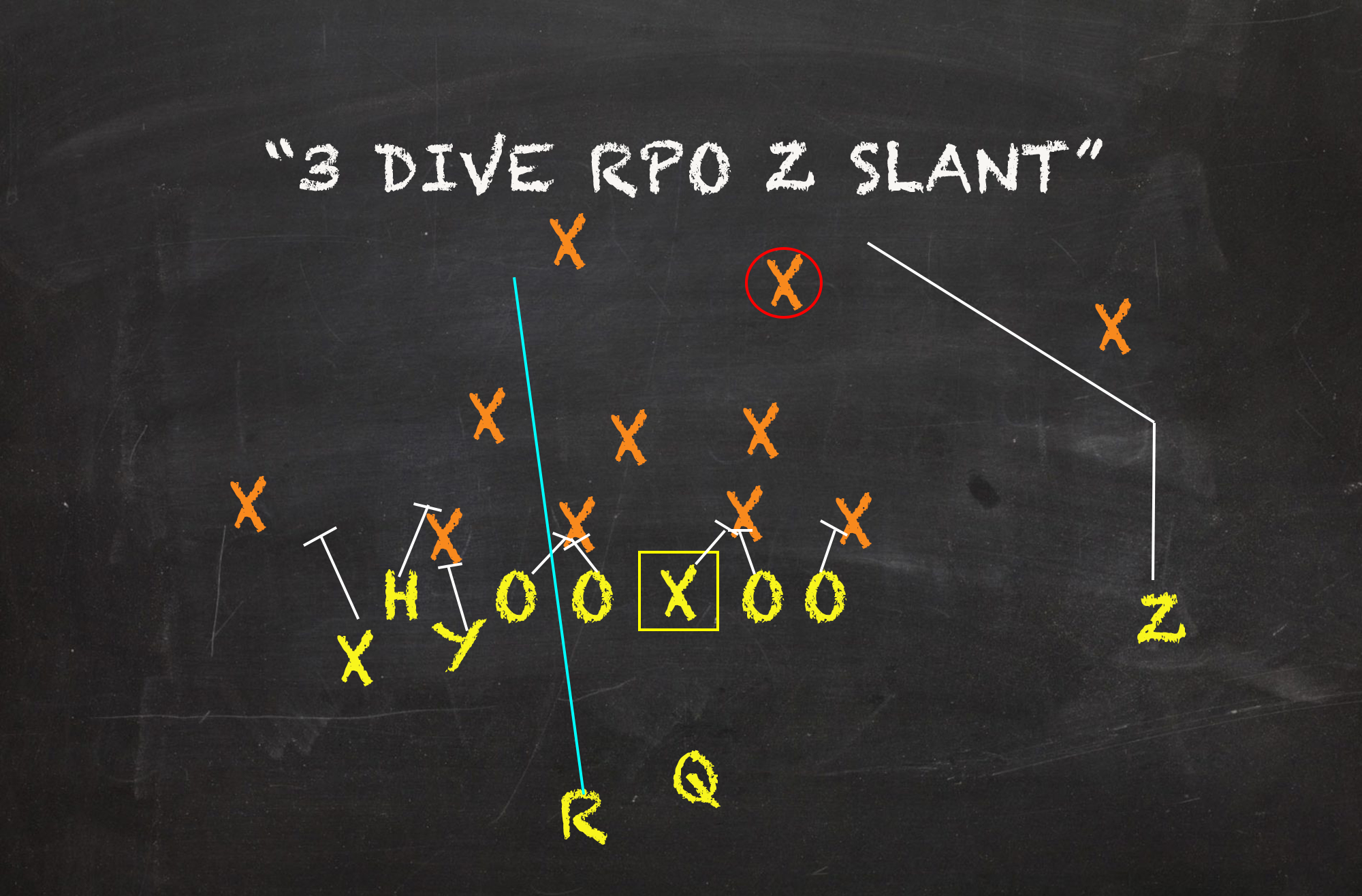
Duo Dive plays are meant to get hard yards in short down and distance situations. From 12 personnel or bunch sets, Duo Dive has seen a big uptick this season in SEC play. Thank you, Joe Brady. For Florida, the north-and-south Dive design has usurped Duo Jab, or Counter Duo, as the preferable non-puller power play with a 2.61% usage rate. The returns like most of Florida’s ground game is just okay. Since it’s a short yardage plays, few Duo Dives produce gobbles of yards. On a 46.1% Success Rate, the look averages 3.65 yards per pop. Florida has been among the handful of offenses that call duo from trey sets and use Duos in its RPO game.
Inside Zone Slam Reads cap off UF’s most-featured runs. Like last year, the Gators completely suck getting results on this concept. Barely averaging over 4 yards/attempt, Florida has posted a 26.7% Success Rate. It’s easy to see why Mullen has started calling other concepts in its stead. A mere 15 have been called in our applied margin all season.
Florida is also known to incorporate Jet Handoffs to their playmakers. Though they only use an average amount of total motion relative to the rest of the conference, the Gators will keep folks honest with an occasional jet sweep. Across the 11 they’ve dialed up this season, six have found success averaging over 8 yards in the process. Almost all come from undercenter and tight formations.
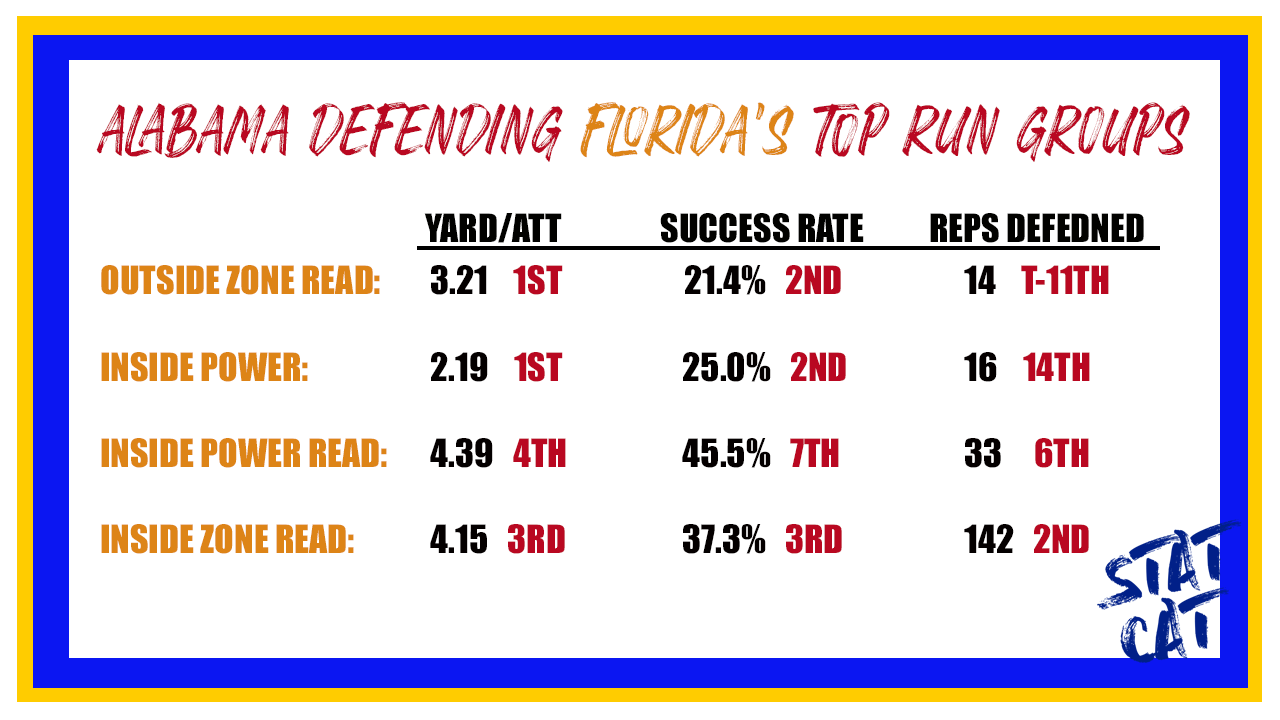
Not that Florida’s rush attack had much optimism entering Saturday, but facing the SEC’s 2nd-most successful run defense is a sobering reality. Starting with Florida’s best ground looks non-read Powers and Duo Dives, members of the Inside Power group, Alabama has held opponents to an league-leading 2.19 Y/A. Only a 4/16 Inside Powers have resulted in success against the Tide. Opponents have overly avoided testing them with these designs. No SEC defenses had experienced fewer Inside Power attempts than Alabama’s 16 reps.
Florida’s most-repped concept provides just as inauspicious outlook. The Gators already disappoint on Outside Zone Reads. Odds are they’re bound to if they call them against Alabama. Like leading the conference in the Y/A allowed with Inside Powers, the Tide is tops in terms of limiting offenses to a 3.21 average on Outside Zone Reads. Barely a fifth of their attempts have found success. And like Inside Powers, opponents have learned to avoid running them against Saban’s squad. Alabama has only had to defend 14 all year — a bottom4 number within the conference.
The Gators might be able to squeak out some situational wins with Inside Power Reads. Though the Gators themselves are rather blah on these looks, Alabama’s defense hasn’t really been lights out defending them. The Tide’s 45.5% Success Rate allowed is more than Florida’s combined clip on Power and Counter Reads, and the Gators already beat what the Bammers allow on average per play.
Considering how crappy Florida has been executing Inside Zone Reads and Alabama’s prowess holding foes to the 3rd-lowest Y/A and Success Rate in SEC play, Power Reads provide their run game with the best avenue on paper. Florida will be banking on its passing game to deliver the bulk of its offensive production, but there will be times when the Gators need to steal easy yards on the ground. The Power Reads might not help the run game, but perhaps the action occupies defenders on a chance play where a route tag can do damage.
Mac Jones vs. Kyle Trask

After a season-long statistical battle, the conference's two premier passers are set to duel in Atlanta. Fueled by Florida's pass-first approach, no other collegiate quarterback has more yards or touchdowns than Trask. Conducting the nation's best offense, Jones owns the best QBR and EPA/play. Trask's volume numbers trump Jones'; but the Tider's efficiency figures best the Gator's.

Jones' standard passing analytics are better than Trask's across the board. He sports the SEC's best Success Rate, First Down+TD Rate, and Accuracy%. With him excelling in those areas, it's no wonder why his value metrics are en fuego. Though the two have displayed similar downfield ball placement per Depth Adjusted Accuracy%, Jones has been better directing attempts away from defenders. Again, turnover-worthy throws remain to be a flaw in Trask's game.

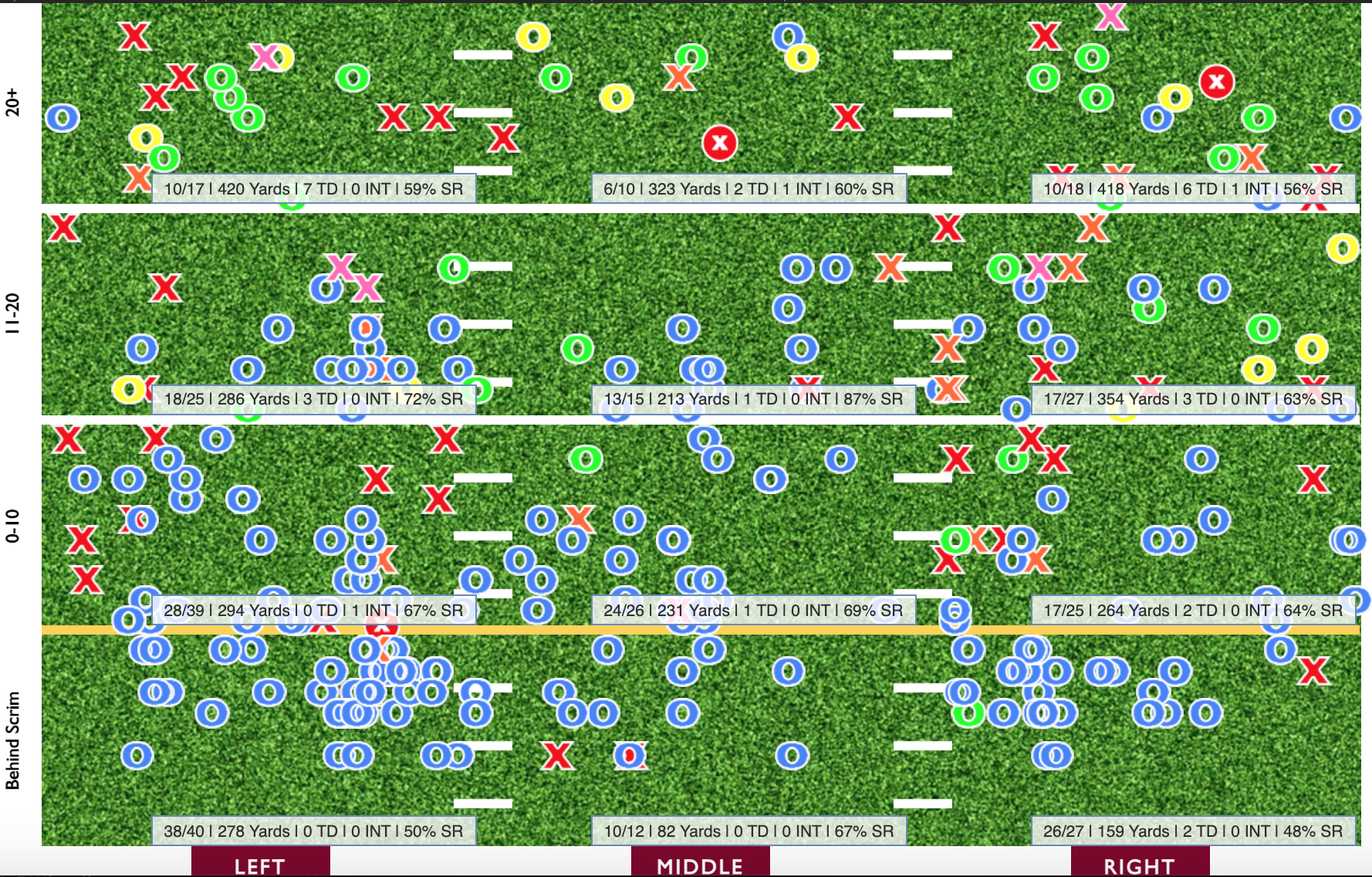
While it's faded a bit the last few weeks, Trask has improved his Deep Accuracy% from 32.1% to 44.9% in SEC play year-over-year. But outside of that stat, Jones has proven to be a better downfield passer. Thanks to replicating his superb intermediate numbers from last year, both the Tider's Completion% and Depth Adjusted Accuracy% on throws 10+ yards downfield easily top Trask's.
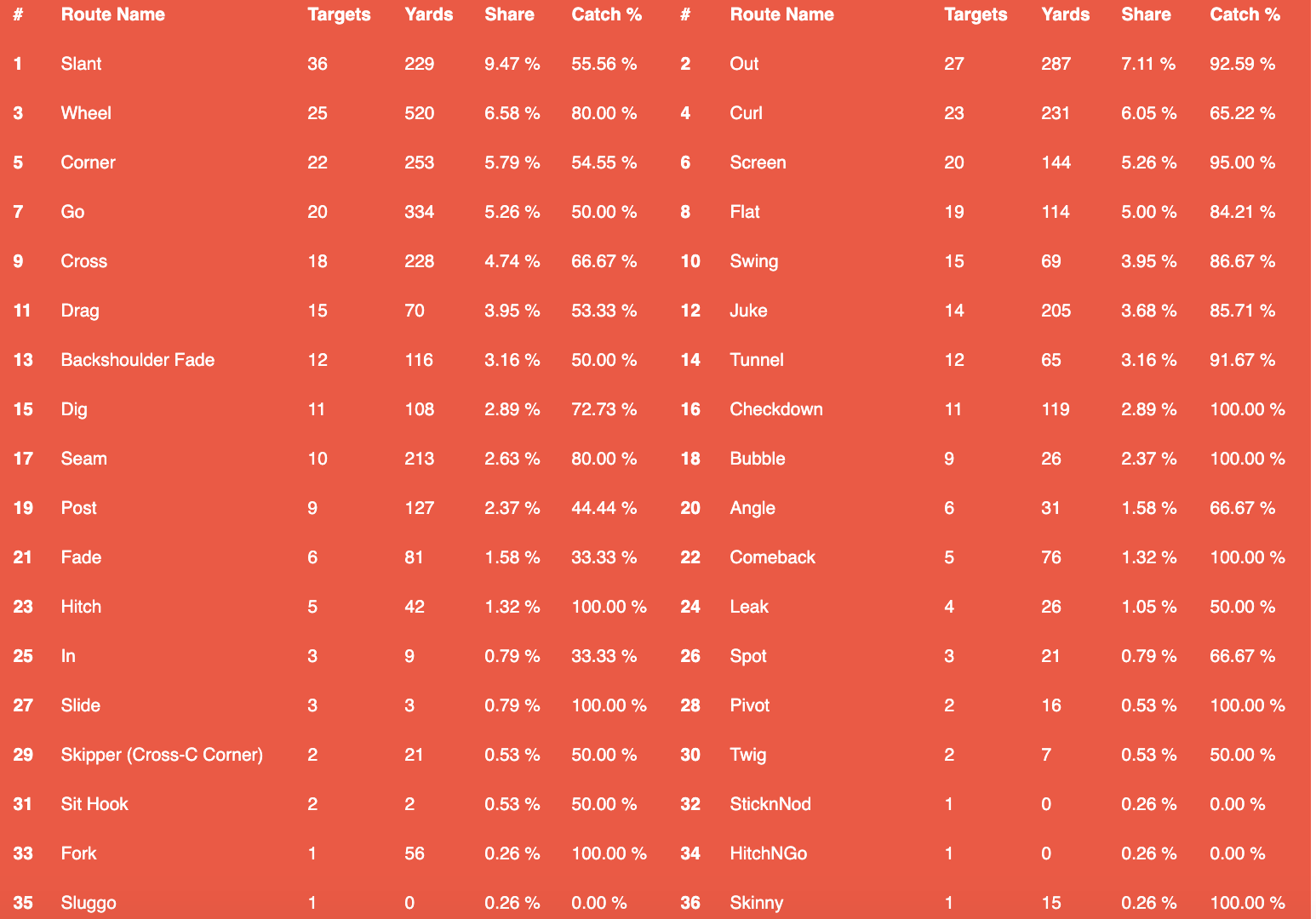
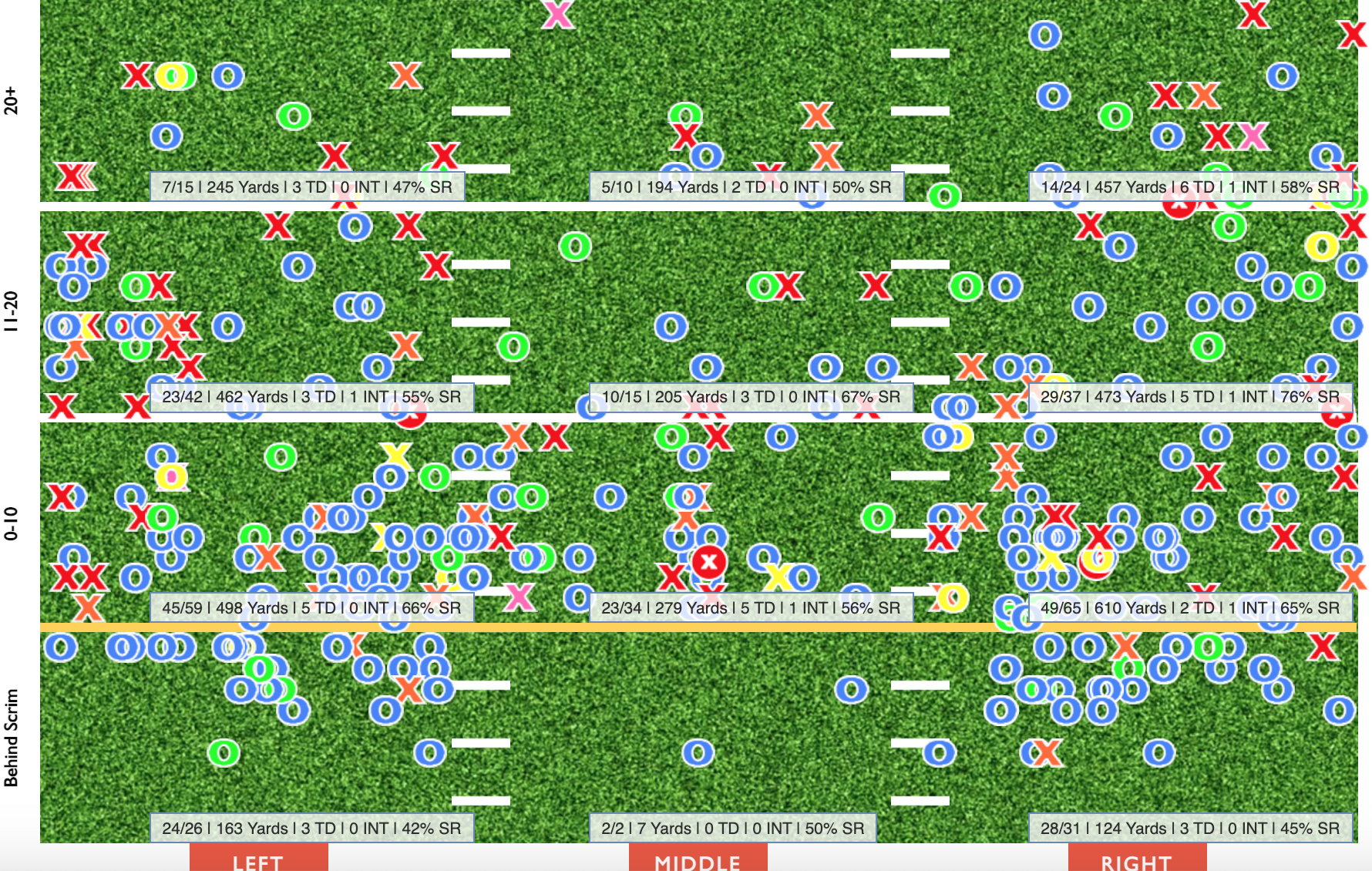
Despite being more vertically-inclined, Jones directs significantly more attempts behind the line of scrimmage compared to Trask. In fact, only two other SECers have dedicated a higher percentage of their throws there than his 27.9% clip. While Jones is no game manager, it's clear Sark puts him in positions to win. Over a fifth of his attempts are either a screen or RPO throw. Again, no conference passer can match his 35.7% Play Action Rate.

Trask attacks underneath areas of the field the most often. Though he targets behind the line of scrimmage at the SEC's sixth-lowest rate, nearly 43% of his throws travel between zero and ten yards. The Gators go deep often by volume; but by a rate basis, they are average relative to the rest of the conference. Instead, Trask has focused on midrange targets by sending over a quarter of his passes between 11 and 19 yards downfield.

Like you might suspect from someone putting up video game like efficiency, Jones has been elite when kept clean. From a pristine pocket, essentially two-thirds of his attempts have met situational goals. In those spots, Jones' Success Rate and Depth Adjusted Accuracy% trumps Trask's by about four percentage points. And since Jones faces less pressure on average -- and volume -- his cumulative figures are less altered by duressed dropbacks.
But when under the gun, Trask has displayed preferable precision while producing a similar Success Rate. While his weighted accuracy under pressure is considerably better than Jones' entering Saturday, Trask doesn't even crack the conference's top5 in that regard. Still, odds are Saban will have a plan for getting Trask off his mark and disrupt the timing of Florida's offense. At least he's showed up until this point he's more than capable to make a big time throw when a defender is barreling towards him.
Both passers have seen at least half of their 3rd Down attempts result in a conversion or score. Though Jones has benefited from more situational success, his and Trask's downfield accuracy practically match. From a coaching standpoint, it's never wise to bank on 3rd Downs on the way to victory. The best 3rd Down offense is the offense that avoids 3rd Downs the best. That said, victory often comes easier for the team that can win these battles.
I think they win if...
Alabama is favorited by about 17.5 points depending on where you look. Even outside of Vegas, most folks think the Tide will capture the SEC crown and look good doing it. Their recipe for victory isn't complicated as three-score favorites. Florida's defense is flawed and presents many potential avenues for Sarkisian to exploit. Keeping it simple, the tide should win comfortably if they can stay ahead of the chains and prevent the Gators from logging a well-timed havoc play that kills a drive or prevents points. Alabama nearly doubles Florida's offensive points/drive. So as long as they don't self-destruct, the Tide should be well on their way to the playoff.
Florida's path to victory is murky and convoluted. First and foremost, they have got to score points. Alabama should be good for at least 35, which puts pressure on the Gators to not settle for field goals. Trask will have to hit on at least four deep throws and not log a turnover. The run game doesn't have to be otherworldly, but is can't be worthless either. Making the game small by utilizing a methodical pace could be in the cards. Though doing so would decrease the Gators' margin of error, if successful, a conservative approach could keep Jones and Co. off the field and limit Alabama's scoring chances. Florida's offense is accustomed to having to nickel and dime down the field. But it's pretty hard to win a boat race not making waves. Plus if Alabama scores quickly, that gameplan becomes moot. Grantham's bend-don't-break defense must do all it can to hold the Tide to mediocre or worse returns in crunch spots. If Florida is to win, they've got to top 40 points and force five or more empty possessions defensively.