Stepping out of the Heisman's Shadow
Bettors are always out for value. Balancing sure-things between adequate rates of return will always be a never-ending battle for gamblers. Take the easy money and bank less or go against the odds for a larger payday.
Looking at the current trends, I certainly hoped you placed you Kyle Trask and Mac Jones Heisman futures bets way back when and not today. Thanks to the incendiary passing our two SEC QBs have displayed entering Week 12 of the college football season, both now own two of the four best odds to capture the most illustrious individual award in college sports.
Originally set at +3300 and +2200, Trask and Jones have seen their odds improve to +500 and +200, respectively. Only the preseason favorites Justin Fields and Trevor Lawrence have better odds per the Action Network.
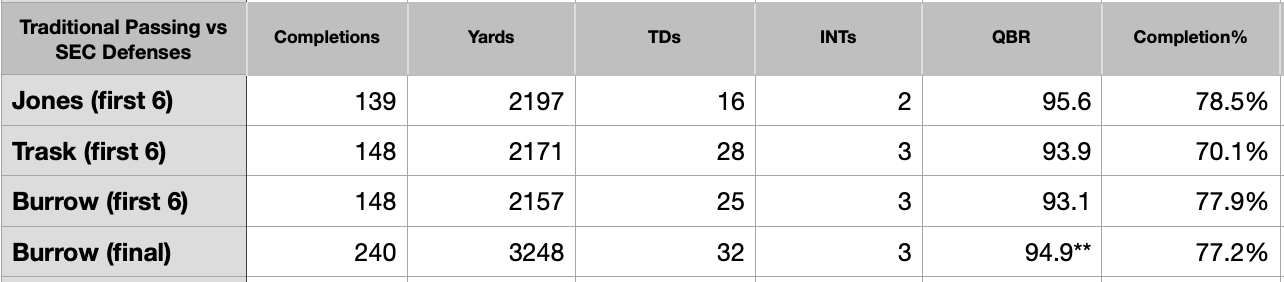
With their rise into Heisman talks, it’s only natural to start comparing these two to last year’s winner, Joe Burrow. Traditional stats like yards, touchdowns, and Completion% are where most folks begin and end when whipping out and measuring passers’ proficiency. But unfortunately, those basic bitches don’t tell the whole story.
So with help of some advanced figures, let’s see if Trask and Jones have indeed entered Joe Burrow Territory throwing the football. After all, Jones and Trask are set to play less total games across a very different landscape than last year's Heisman. Judging these premier passers by traditional stats alone won't tell us much anyhow.
Baseline

Jones is the conductor of the nation’s best offense. Sure Najee Harris and the Tide’s ability to run the ball plays into that. But Jones’ efficiency is the biggest source of Alabama's potency. In Steve Sarkisian’s offense, Jones is aided by a bevy of motions. No SEC offense uses more pre-snap or total motion, in fact. It's already a chore to contain their dangerous downfield threats, but when a couple of them reposition or have positive inertia before the ball is snapped, the ante gets upped. Plus, that aforementioned run game certainly facilitates suckering in defenders via play action — a tactic that a generated many an Alabama deep ball.
Last year in his spot starts, Jones was the SEC’s best intermediate passer posting a sizzling 78.9% Accuracy%, 84.2% Success Rate, and 19.8 Yards/Attempt. For an inexperienced passer, he was put into positions to keep the offense flowing but still made plenty of nice throws. Of course, having four future professional pass catchers at your flanks always helps.
Jones’ passing ceiling presented itself to be perfectly fine. I mean, we are kinda are experiencing some of his potential right now. His play has been a nice progression year-over-year. Jones’ passing floor, however, was concerning exiting last season. Looking at snaps where he wasn’t pressured on pure dropback passes (ie no screens or RPOs), he was much closer to the pack having worsened (albeit slightly in some spots) across the board in our key metrics. When conditions are perfect, a passer doesn’t have any excuses for missing his throws unless he just sucks. If a QB can’t get it done consistently from these spots, it’s hard to back him. **cough cough Jarrett Guarantano**. Plus, Jones was entirely dissatisfactory on later downs relative to the other SECers. Amongst returners, his 2019 3rd Down Success Rate and Y/A were the conference’s 2nd-worst. While there was enough positive things on his profile to get excited about, he hardly won over his haters entering the season without a spring to shut them up.
Through the first six games, he’s scorching the stat sheet. Behind the nation’s 2nd-best QBR (95.6) and 3rd-best EPA-play (0.7), a good deal of his numbers trump Burrow’s output last year in league play. An incredible 62.5% of his passes have been successful with one in six on average going 20 yards or more. And it’s not like his dinking and dunking towards the flat - well he is - but Jones’ average depth of target is in the double digits and higher than both Trask’s and the 2019 Heisman’s. Burrow’s accuracy and ability to avoid putting the ball into harm’s way stand out in this comparison. Jones’s results, however, are one of if not the most efficient numbers in 2020.
You can say Jones operates quite like Ryan Tannehill of the Tennessee Titans if you wanted a professional comp. Excellent numbers in advanced things like Completion Percentage Over Expectation (CPOE) and Expected Points Added (EPA), but the high use of play action makes shaking the game manager label a hard task. But If Jones can continue on this trajectory, he’ll be latest to bring some hardware back to Tuscaloosa.
Trask is a blossoming quarterback product. Like last year, Florida is operating in a pass-first manner. Obviously, they wouldn’t be taking to the skies so much unless their lug of a launcher wasn’t so darn good at slinging the pill. If not for Burrow’s ascension, Trask’s coming-out party last fall would have been the story of the season. Among the nine returning SEC passers, he was first in Success Rate, Accuracy%, First Down+TD Rate and Uncatchable Pass Rate. Despite not starting a game in six years, he fast-tracked Florida’s case for title contender last year.
He isn’t without his haters; though. Coming in to this fall, Trask’s arm strength and ability to push the ball downfield were questioned by Pro Football Focus; and many who felt the Gators’ were bound to sour. I must admit, I thought some regression was on the horizon due to the offensive departures and an all-SEC slate. Dan Mullen has always limited asking Trask to make too many difficult throws. Last year, Trask used screens the most of any one else in the SEC and his Play Action Rate was the 4th-highest. Plus, the majority of his yards came after the catch, not before. With most of his production literally out of his hands, you can see why there was an element of skepticism. Escaping the coddling claim is always tough. Again, Jones is fighting his own crusade on that front.
My biggest concern with Trask entering this season, however, was curbing his interceptable passes. While average last year among SECers, numerous green passers inflated the conference mean. His clip was in the danger zone over 7.5%. By volume, his 27 interceptable passes were the most in the conference. Imagine if five or six of those bad boys resulted in turnovers; changes things a bit, eh?
Well, Trask picked up right where he left off and has improved essentially across the board in our key metrics. Though his Success Rate and Accuracy figures look up to both Jones’ and Burrow’s from last year, Trask is the most explosive of the bunch; at least so far. His traditional stats are nearly identical to Burrow’s at this point through six SEC games. But the Gator sports a preferable First Down+TD Rate in addition to Explosive Pass Rate compared to last year’s Heisman. Speaking of touchdowns, his 28 are the most in college football. Even with the continued high usage, Trask’s efficiency has improved. Either he really has started to figure this thing out or Mullen is a masterful puppeteer.
You can say Trask operates like a late-career Ben Roethlisberger. The engine of his unit, he makes the whole thing work even if he’s not necessarily a physical dynamo. He’s a slow mover, but can reposition and handle himself very well in the pocket. His extra mass makes him durable but I’d be lying if I said he arm is prototypical. It can accomplish the cliche and make all the throws per se. But, too many contested and risky passes are bound to occur. Despite his improved play, interceptable passes remain to be a problem. Like last year, his clip falls well into the undesirable range.
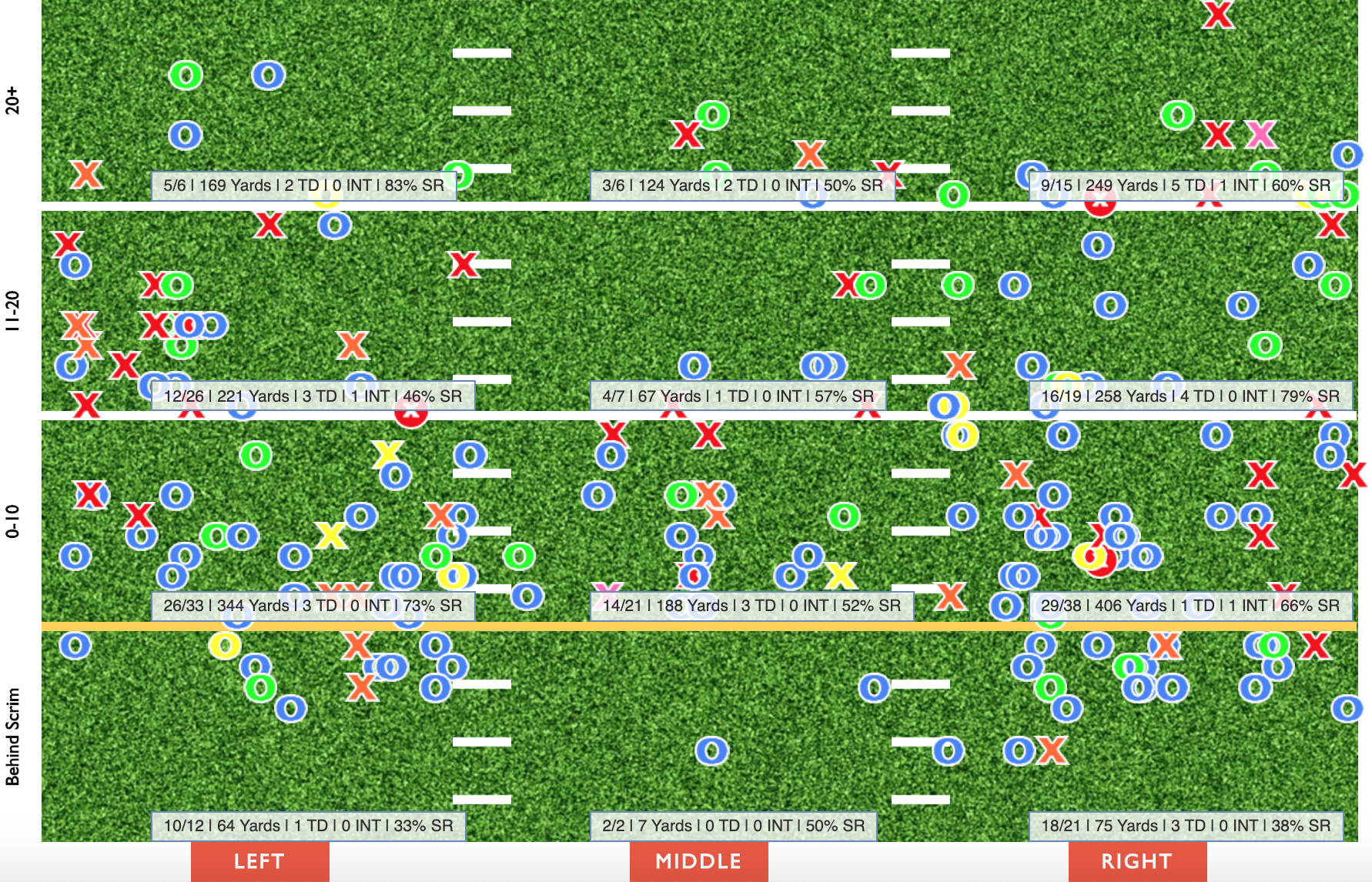
Burrow was an incredibly accurate passer who rarely put the ball into harm’s way. Neither Trask or Jones are on pace to touch Burrow’s Accuracy figures even if their Success Rates are in the same ballpark. Both his Interceptable and Uncatchable Pass Rates improved as the SEC schedule progressed as did his explosiveness, aggressiveness, and First Down+TD Rate. But the knock on Burrow was that he overly targeted short. Defenders of his will say he was just executing the offense. Haters will say he lacks an elite arm. Some are still beating the drums on that note. From where I sit, I saw more than enough passes to give him a passing grade on his homerun ball. Regardless on how you view his traits, that dude balled last fall.
Burrow’s production was historic both in terms of volume and efficiency. Those types of seasons used to not happen every year. But now, they might becoming more and more common. If you only care about overall figures, I guess you can stop reading now. But I’d recommend soldiering on (not because I spent a day working on this) since it’s important to put these figures into proper context. While our baseline is set, style of play can distort our findings. Plus, we can’t overlook opponents faced.
Opponent Strength
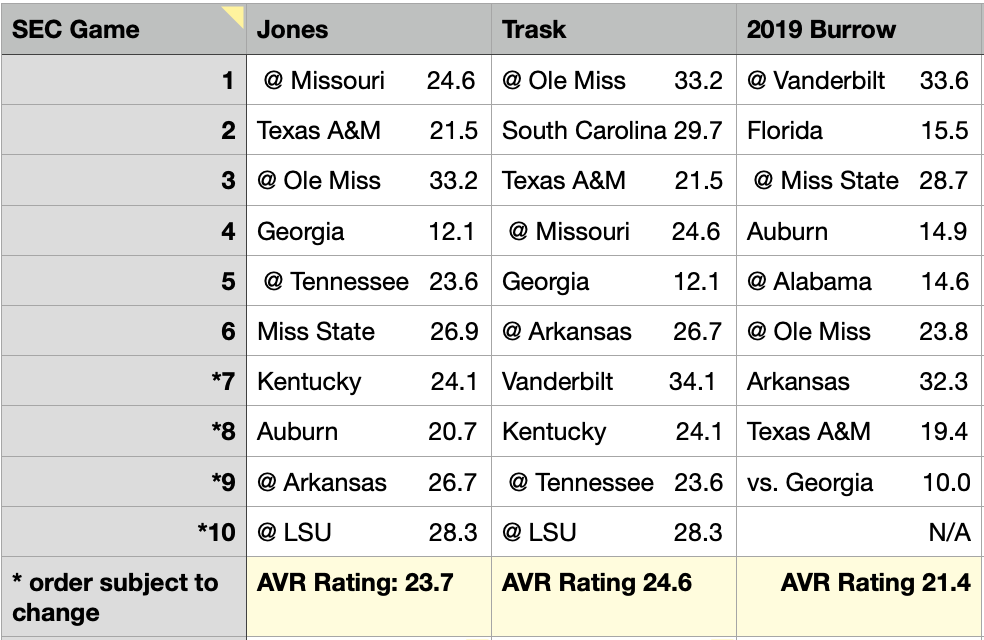
Before we continue, let’s take a quick aside and go over each quarterback’s strength of schedule. It should go without saying, it’s much easier to put up video game numbers against poo poo defenses than stingy stalwarts. Thwarting a defensive titan certainly carriers more weight than crushing a cupcake. Let’s use ESPN’s SP+ Ratings to standardize each passer’s slates. The lower a defense's rating is, the better they are.
Since Trask and Jones have had four common opponents across their six games, both QB’s average rating faced are naturally going to be similar at this point in time. Both have had the pleasure defeating the top-rated defense in the land as well as roughing up Ole Miss’s unit that places near the triple-digits. Top40 defenses Texas A&M and Missouri round out their shared opponents.
While Arkansas’ and Mississippi State’s defenses are currently ranked about the same in the SP+, Tennessee (32nd) is far more formidable in that metric’s eyes than South Carolina (76th). Because of that, the SP+ gives Jones a slightly more challenging slate than Trask. Using their average opponent faced score, Jones plays a defense akin to Arizona State (41st) each week with Trask facing a team like North Carolina (44th).
LSU’s 2019 slate proved to be much harder than what Trask and Jones have had to go up against thus far in 2020. In SEC play alone, the Tigers faced four top10 defenses. So on the surface, that’s enough to convince most people Burrow’s opponents were better. LSU’s easiest opponent came first in Vanderbilt and their hardest opponent came last in Georgia. All in all, Burrow’s average opponent faced rating was 21.4 in SEC play last year — about two points less than the 2020 Heisman frontrunners. In case you didn’t hear me, Burrow had a much harder schedule.
Due to how Jones’ and Trask’s schedules unfold, excellent opportunities exist for the pair to improve upon their already sterling statistical starts. Trask and Jones will have three more common opponents over the final month of play. While Kentucky and LSU are each yet to be faced by both passers, Alabama has already faced Tennessee with Florida already defeating Arkansas. Compared to the first six games, the duo’s slates get easier. With Vandy on the horizon, the Gators will have the easier go of it to close out the year even with two top35 defensive opponents.
While Burrow closed his 2019 SEC slate with two top25 foes, it appears Trask and Jones won’t see the same trials, which is fantastic news for their future stat lines and folks with enough foresight to place their Heisman bets on these two over the summer. But in order to see if their output from the first six weeks is sustainable, we need to evaluate how they’ve performed on clean+dropback snaps.
Passing Floor

Since all of these guys played in different offensive schemes, we need to standardize their numbers somewhat. Remember when I talked about setting a passer’s floor by eliminating pressured, screen, and RPO attempts? That also helps normalize our outputs by scrapping away certain schematical elements some passers see more or less of. You might be thinking this is a little out there. And, you might be kinda right. Still, examining clean+dropback attempts will also help us determine if the current level of success can continue.
So far this season when conditions are perfect, both Jones and Trask have been extraordinary. I’m not being hyperbolic. The duo’s figures in these spots best Burrow’s excellent production from last fall in Success Rate, First Down+TD Rate, Explosive Pass Rate, ADOT, and Yards/Attempt. The only areas where the Cincinnati Bengal holds the edge is in Interceptable Pass Rate and Accuracy%. But while Burrow’s raw Accuracy remained relatively the same through SEC play, his Depth-Adjusted clip plunged 9 points thanks to closing against 2 Top25 defenses in ESPN SP+.
Thanks to his advantageous environment, Jones especially has been stellar. His Success Rate and Depth Adjusted Accuracy are 8 and 6 percentage points better than where Burrow’s at the end of SEC play last year. The Tider’s First Down+TD Rate on clean+dropback throws is about 20 points better. Just crazy. I would like to see a lower Interceptable Pass Rate, but it’s still better than the Gator’s and his overall clip.
That’s mostly a result of Jones aiming to attacking downfield on pure pass plays. While the razzmatazz with motions and RPOs is a nuisance to corral in the short game, their top pass concepts are Floods (like Cross and Sail but they can get crafty in how they’ll look), the “Kelly” Mesh, Deep Hooks/Comebacks, Portland/Yankee Shot plays, Deep Double Moves (like Sluggo, Diggo, OutNUp), and check downs off said patterns. With the exception of Meshes, all are intermediate to deep pass plays. This explains Jones’ 14.2 ADOT, which is about 4.5 yards more than Burrow’s through six SEC games last year. This is nothing new and stays consistent with how Alabama operated on dropbacks last year. While RPOs were leaned on more in 2019, all of these have been seen out of Sark’s offense before.
Cross has been Alabama’s best play. This concept is often paired with power play action and has delivered an eye-popping 91.7% Success Rate and 19.9 Y/A across 12 targets. No other look has compiled as much yards in dropback situations for the Tide. Portland/Yankee Shots, or hard play fakes that utilize a deep crosser, are the only one of their favorite dropback pass concepts fail to break the 50% Success Rate barrier. With these looks, Jones has popped the top off of secondaries as if they were a can of Pringles.
Like Jones, Trask sees his Success Rate improve by 9 points in these conditions. His Y/A was a yard and a half better and has been more vertical. While his overall Accuracy% is significantly worse in comparison, he’s much more competitive in terms of ball placement to Jones and Burrow on clean+dropback attempts. When more weight is applied and passes behind the line of scrimmage are omitted, his 63.9% Depth Adjusted Accuracy is 7 points better than where Burrow’s finished in league play. A red flag for me, Trask’s Interceptable Pass Rate worsens in these spots. Perhaps hinting he’s a bit of a gun slinger and confident in his arm; or that he doesn’t trust his defense to provide a safe cushion. Either way, presenting potential for turnovers is bound to rear its ugly head at some point. This area remains to be Trask’s largest flaw.
Each week, Florida presents interesting wrinkles in the dropback pass game. Deciphering exactly what is going on is fun. But inevitably one or two plays can be a headache, which means it’s all the more difficult for opponents reacting to it in real time. Sure, the Gators run pass staples and ho-hum patterns, but Mullen certainly isn’t overly manilla in the slightest. Smash Variations (and isolated corners) are their favorite, most productive, and most efficient pass family. Roughly 10.5% of Florida’s pass yards come off these plays on a 60.9% Success Rate and 11.5 Y/A.
They also lean heavily on Hoss Y Juke, a favorite of the classic Tom Brady Patriots. Often from empty formations, the outside men run hitches, the inside men run seams/fades, and the innermost man runs a juke/slant route. That route is especially killer against man coverage. It’s also not out of the question for them to feature the juke on All Verts. Also, spoiler alert, patterns utilizing wheel routes have seen a good amount of usage since Florida’s last off week. Excluding the Kelly Mesh, these plays are rocking a 73.7% across their 19 targets.
While Alabama’s and Florida’s offenses favor different looks in the dropback game, both Trask and Jones are equally explosive and precise throwing downfield in our applied conditions, which holds true from their overall numbers. Likewise, Jones’ situational marks have simply been preferable. Having speedsters can facilitate things, but Jones still has to make the throws. Both Jones’ and Trask’s passing floor appears awfully high ahead of their final four matchups. Certainly having an easier SEC slate than Burrow’s plays a part. Still, both should be lauded for presenting a high floor to close out 2020.
Against Pressure

Before looking at these guys’ downfield passing, let’s see how they have faired under duress. While it’s great to have a high passing floor, games are often decided by dudes with high upside. Play versus pressure is volatile and unpredictable but can reveal a passer’s true colors. If a quarterback can limit how it affects them, he’s certainly more much more valuable than a statue in the pocket. Plus if they can make plays when everything breaks down or when the defense is vulnerable, they’re all the more difficult to prepare for.
Burrow was a Houdini against havoc last year. Whether he was reverse pirouetting away from a blindside rusher or bolting against the blitz, Burrow was better against pressure in SEC play last year than most quarterbacks are better overall. While his down-to-down Success Rate was only 54.1% at season’s end, his Depth-Adjusted Accuracy reached an otherworldly 75.2%. The backyard element presented Ja’Marr Chase, Terrance Marshall Jr and the rest of LSU’s pass catchers plenty of chances to win targets and gain yards after the catch. Burrow’s ADOT shrunk when pressured but his First Down+TD Rate, Explosive Pass Rate, and Yards/Attempt all improved compared to his overall and passing floor figures. That isn’t normal.
Trask was the conference’s next man in terms of pressured Success Rate after Burrow. That said, only his Interceptable Pass Rate has improved year-over-year. Passing under duress is more of a one-off and can change season-to-season so there’s no reason to read too much in to these findings. Still, the Gator is trending the wrong way.
Despite the downturn, Trask has been far from terrible against pressure even if his numbers are the worst of the bunch. While still relatively good in comparison to what other SECers do in these spots, Trask’s pressured passing stats are a dent on his profile. Since he faces duress more than Jones, these snaps have a greater influence on his output. Entering the SEC's Week 9, Trask’s Pressure Rate is 26.5% compared to just 18.2% for the Alabammer.
Like overall and in clean+dropback situations, Trask has a less-favorable Success Rate, First Down+TD Rate, ADOT, and Yards/Attempt than Jones. When pressured, Trask’s below-average lower body mechanics don’t respond well causing passes to be off the mark. Both of the Gator’s Accuracy figures plunge about 10 percentage points under duress. Roughly only one out of ten passes on average goes for 20+ as opposed to one out of six overall. With less precision generating less big gainers, Trask’s Yards/Attempt dips over 2 yards.
Jones’ pressured Depth Adjusted Accuracy only trailed Burrow’s in 2019. But the Tider finished with a better Yards/Attempt, Interceptable Pass Rate, and Explosive Pass Rate than the Heisman. For what it’s worth, his 44% Success Rate was the conference’s 4th-best.
So far in 2020, Jones has seen a slight increase in down-to-down Success Rate and moderate gains in First Down+TD Rate but has displayed worse accuracy, potency, and decision-making. Jones’ Interceptable Pass Rate has ballooned from 4% to 9.38% and his Depth Adjusted Accuracy is over 20 points worse year-over-year. He has been bailed out a handful of times by his premier pass catchers on tight window chances that rose-scent his resume despite the drop-off in ball placement. But his line does a great job at limiting duress. Jones is one of the SEC’s least-pressured passers. So even though his Success Rate and DAA% drop double-digits in these spots, his production is still better than Trask’s and faces pressure considerably less often. Again there’s a lot of moving parts on these snaps. So while glancing at the current numbers can be illuminating, they’re far less dependable than our passing floor figures above.
Downfield Passing

Not to dismiss the short game and simple yards-after-the-catch inducing strategies, but most people want passers who can take care of business throwing downfield. If a team has a quarterback that can paint the sideline, rip it down the seam, and master midrange throws, it opens so many possibilities for play callers to maximize their pass games.
So like our exercise to set our passers’ floors, we will be looking mostly at dropback passing in this section without narrow or predetermined RPO throws or screens contaminating the data. While this section will lead more leeway talking about traits, I will try to stick to numbers and talk about results thus far.
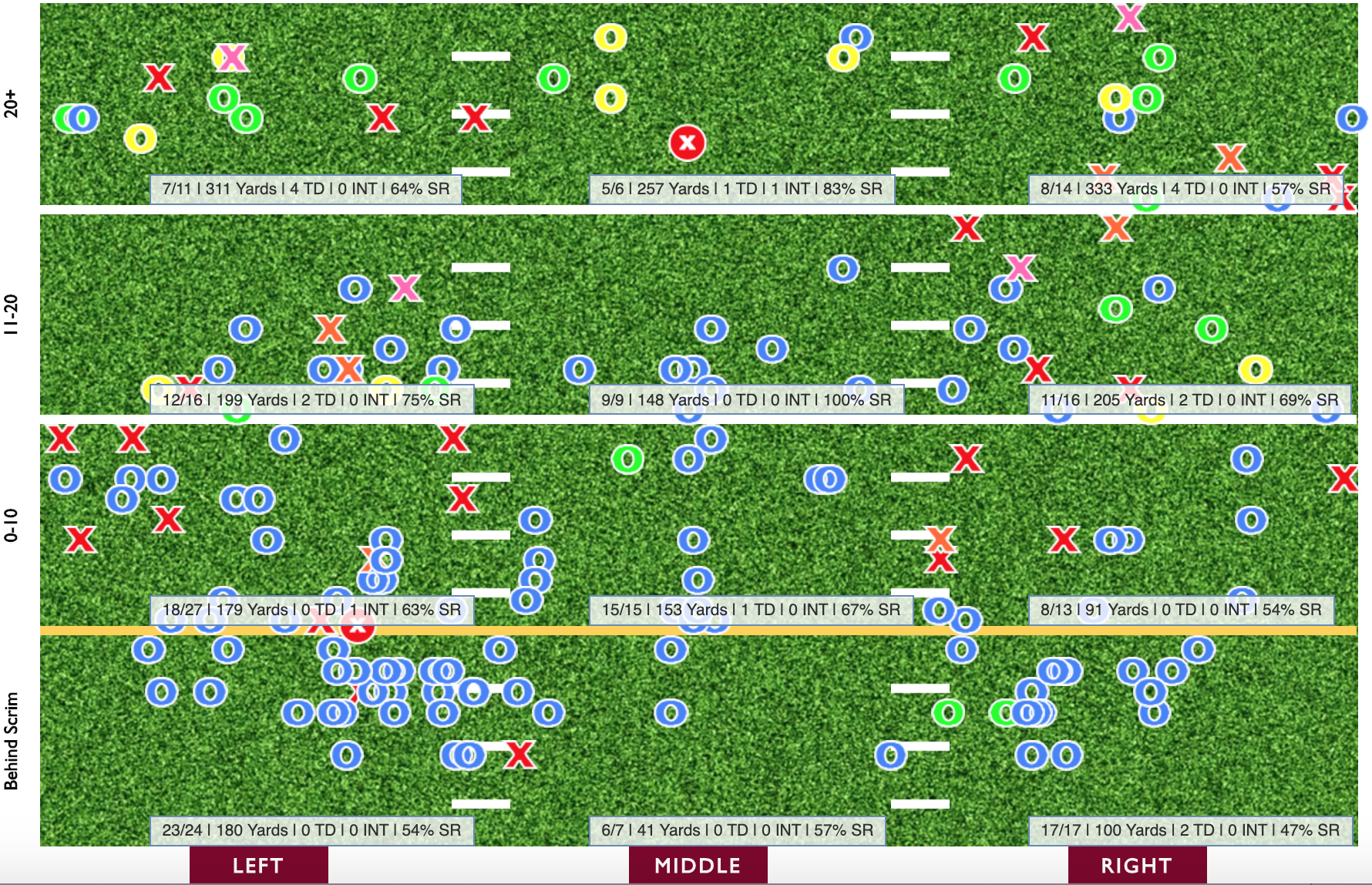
While the second stat table is pretty straight forward displaying all passes on targets 10+ yards downfield, the first is a little more convoluted. That table is only showing dropback pass attempts that have traveled at least six yards.Sure, they both reflect similar things, but it’s important to know the differences and not cross the streams. Any way, onward!
Both Jones and Trask boast better Passing Success Rates in dropback situations than their overall clip. When not having to rely on a screen to get the job done or make the right read on an RPO, the duo remains on the Tiger's trajectory even if their sprays differ from the Heisman’s. While the graphs below show Burrow's overall pass sprays in SEC, you generally can see where he liked to direct his passes. (Left = Yard Share, Right = Target Share)
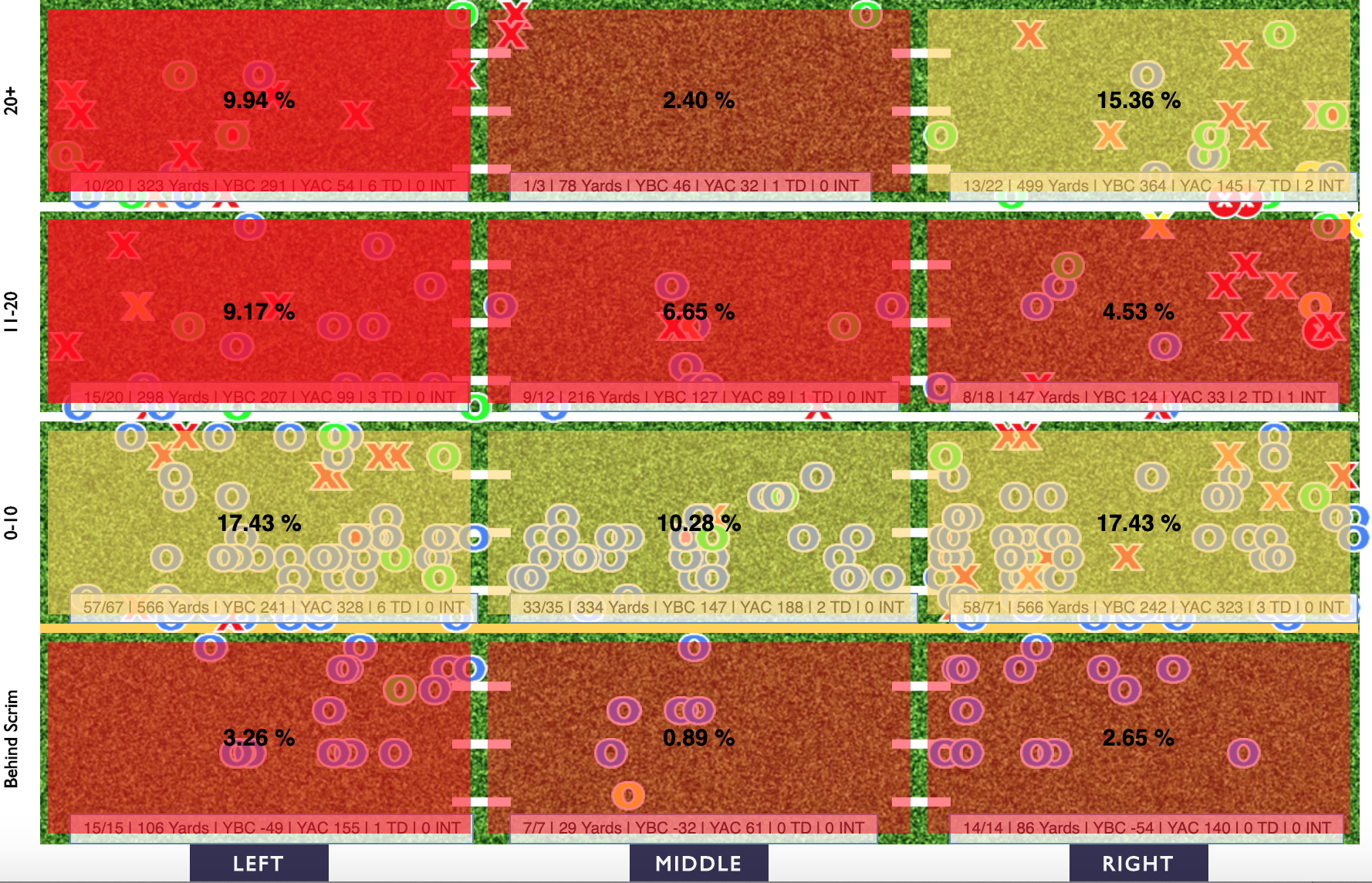
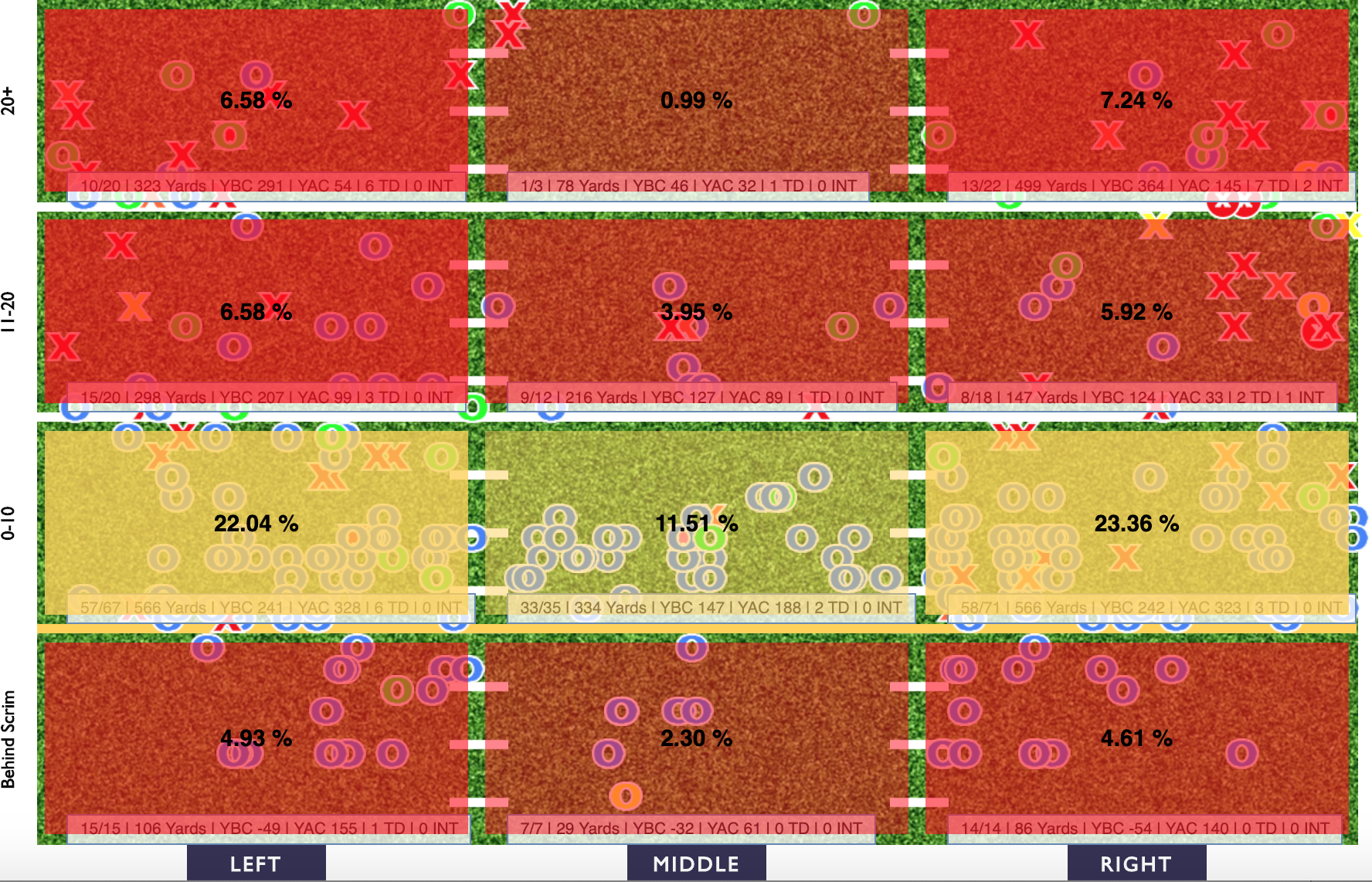
Like I mentioned before, Burrow found no shame getting the most out of completions towards the flat. Lead back Clyde Edwards-Helaire saw more volume through the air than most conference receivers last year. And with LSU’s empty protection philosophy sending five pass catchers out on the majority of dropbacks, Burrow also played hot potato to beat pressure. The results were fantastic as we know, but it still didn’t curb the laymen or lazy take makers in calling him a game manger. Overall, the Heisman targeted five yards or less on 47% of his attempts. In SEC play, however, only about 40% of his dropbacks traveled beyond six or more yards the first six games.
Both Jones and Trask have dedicated a similar percentage beyond that threshold and have targeted those areas far more than Burrow. Still, it’s clear Jones wants to press on dropbacks and not target short. Just under 50% of his dropbacks travel more than five yards compared to 47% of Trask’s attempts. But again, the pair have depended far less on short throws than Burrow did last year. With way more short throws, it’s only natural to assume Burrow compiled a healthy YAC%. But as you can see, his Air Yard Makeup is comparable to our two passers indicating each has more potent weapons after the catch statistically. Entering Week 9, Alabama and Florida are the SEC’s top2 team in YAC average at 5.33 and 4.60 yards, respectively. For what it’s worth, LSU matched the Gators’ clip in conference play last year.
This is another area where Jones’ production stands out. In both of our dropback tables, he’s more successful and prone to complete a key pass. Jones’ accuracy holds up for comparison’s sake, but the Tider’s Completion% on throws 10+ downfield trumps his Accuracy% by 11 percentage points. With such a wide differential, it’s clear his pass catchers have been doing him a solid. All 12 of Alabama’s “created receptions” have been in this area of the field. Cut that in half and Jones’ efficiency probably takes a haymaker to the face. But until his guys let him down, he will presume to be one of the most potent passers around. (Left = Yard Share, Right = Target Share. These graphs display all throws, not just dropback attempts)
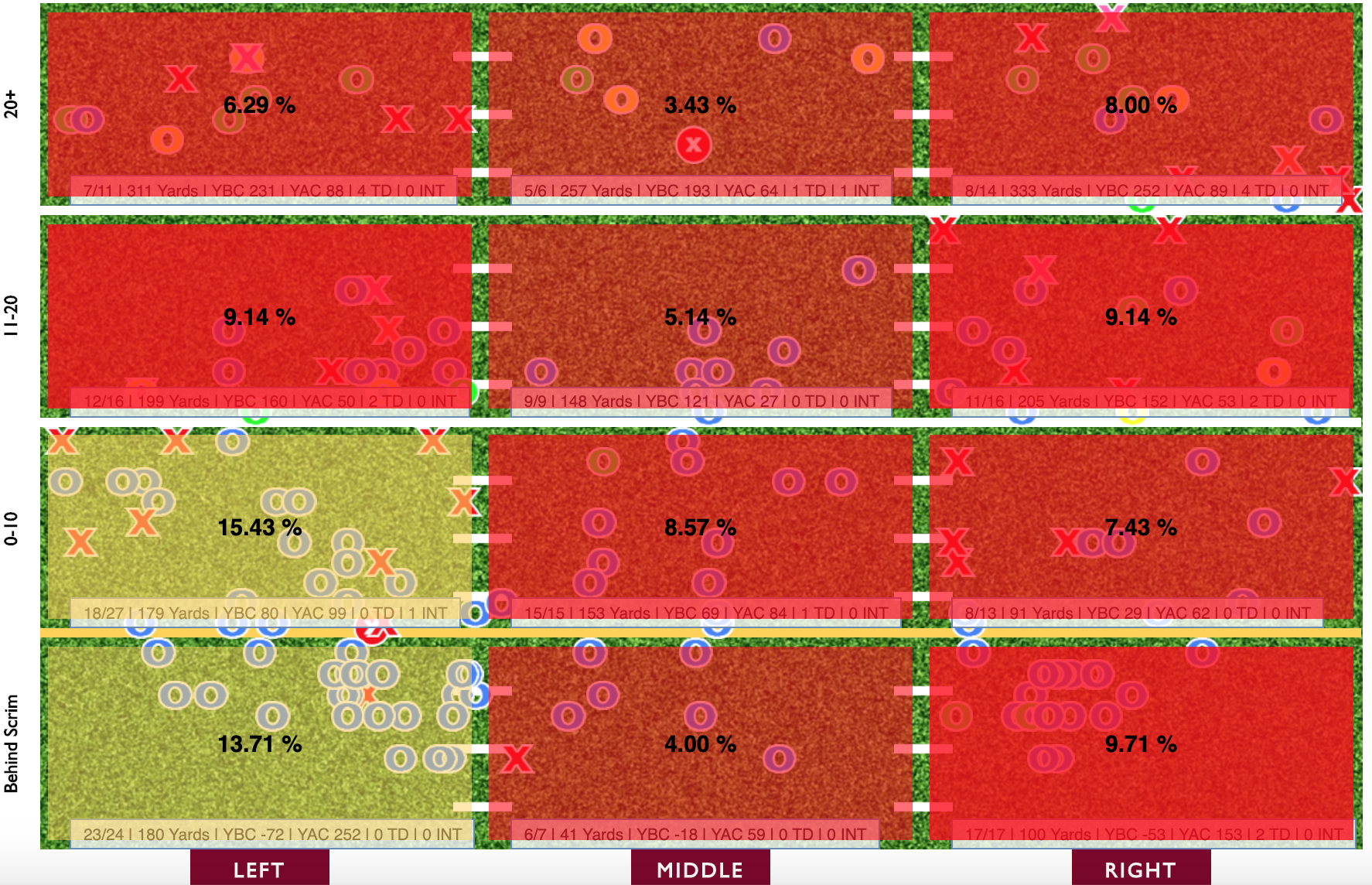
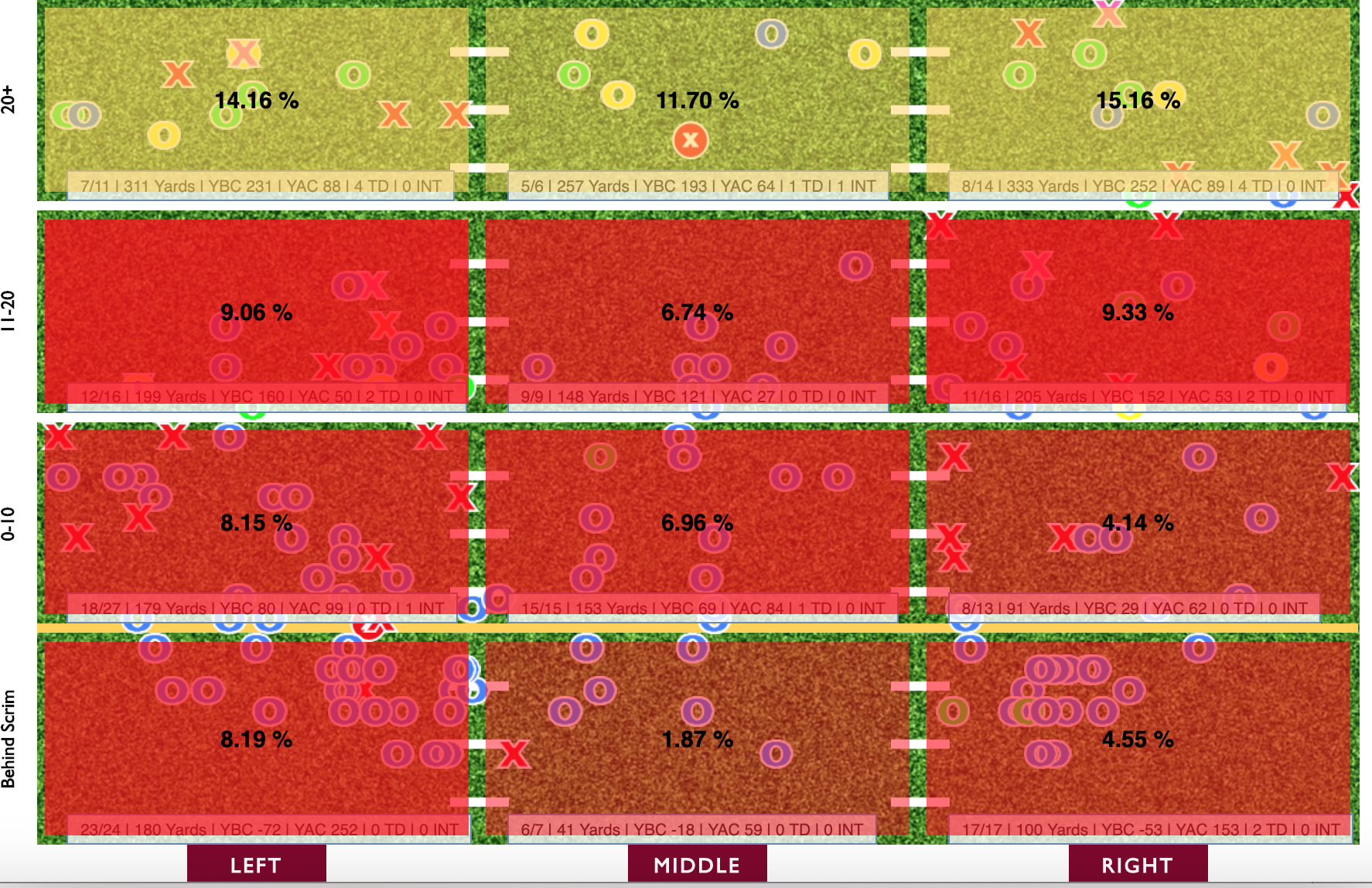
That notion is really apparent looking at his deep passing. You can see his Deep Completion% so far has been magnificent, but his Deep Accuracy% is over 22 points worse. Sure, both figures are major, major improvements year-over-year (Jones only sported a 33.3% Deep Completion% and 16.7% Accuracy% in league play in 2019). But, his 41.7% such clip is currently ranked 6th in the SEC. Though not the case on all of his deep throws, Sark has tended to give his passer max protection and only send a couple of guys deep, which simplifies Jones’ read. With less to process, the results speak for themselves. On the surface, Jones’s 9.72% INTA Pass Rate looks bad next to Burrows. But only four SEC passers currently rock a single-digit clip in 2020.
While Burrow’s 10+ Completion% and Accuracy% were the same, Trask’s stats are experiencing a similar elevation like Jones’. Though the margin between his two metrics isn’t as predominant, an eight point gap can’t be ignored. Trask’s 54.4% Accuracy is still top3 within the SEC this year but significantly lower than Burrow’s clip from 2019. The Gator gains ground when weight is added to the distance of his throws in this context. Both of his Depth Adjusted Accuracy clips in our tables top Burrow’s year-end figures.

Despite not having a howitzer for an arm, Burrow finished 2019 as PFF’s highest graded deep ball passer. He was accurate on 51% of such chances with 53% of them ending up as completions. Though prolific, the Tigers didn’t submit launch codes as much as other offenses. Burrow only went deep on 12.2% of his attempts, which was rather average to below-average within the conference.
Despite Burrow’s acumen for finding a man 20+ yard downfield, both Jones and Trask are putting up preferable Deep Completion% through the first six games. I touched on Alabama’s receivers creating opportunities, but the Gators aren’t too far off in those respects themselves. By a rate basis, no SECer is better at that than Kyle Pitts. And by volume, Florida has compiled 11 creations with seven occurring beyond 10 yards downfield.
With that in mind, Trask has still drastically improved his deep accuracy year-over-year. Less than a third of his deep attempts in SEC play last year were deemed accurate. To reiterate, failing to have a top-end arm along with this shortcoming was one of the biggest rallying cries for his dissenters this offseason. But through six games, his clip has improved by over 23 points and beats out Burrow. Going deep isn’t something Florida does a whole lot. Interestingly enough, Trask’s Deep Pass Rate is comparable with Burrow’s through the first half dozen of SEC games. Besides working on his placement, his guys are having more opportunities it to make plays even when the pass isn’t perfect. Trask has only tossed three uncatchable deep attempts (11.1%) not including throwaways. Last year in SEC play, his Deep Uncatchable Pass Rate was 17.9%. (Left = Yard Share, Right = Target Share. These graphs display all throws, not just dropback attempts)
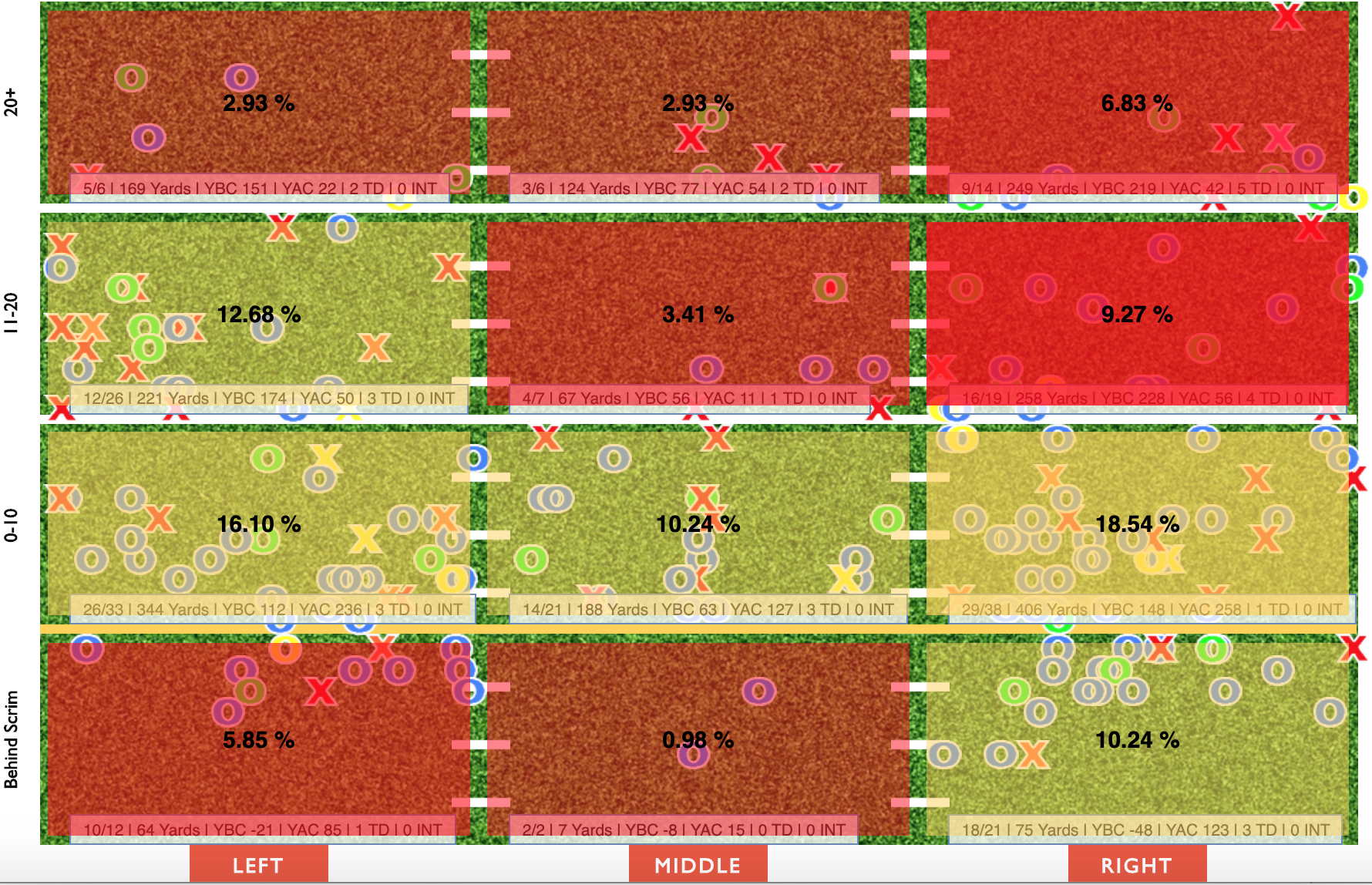
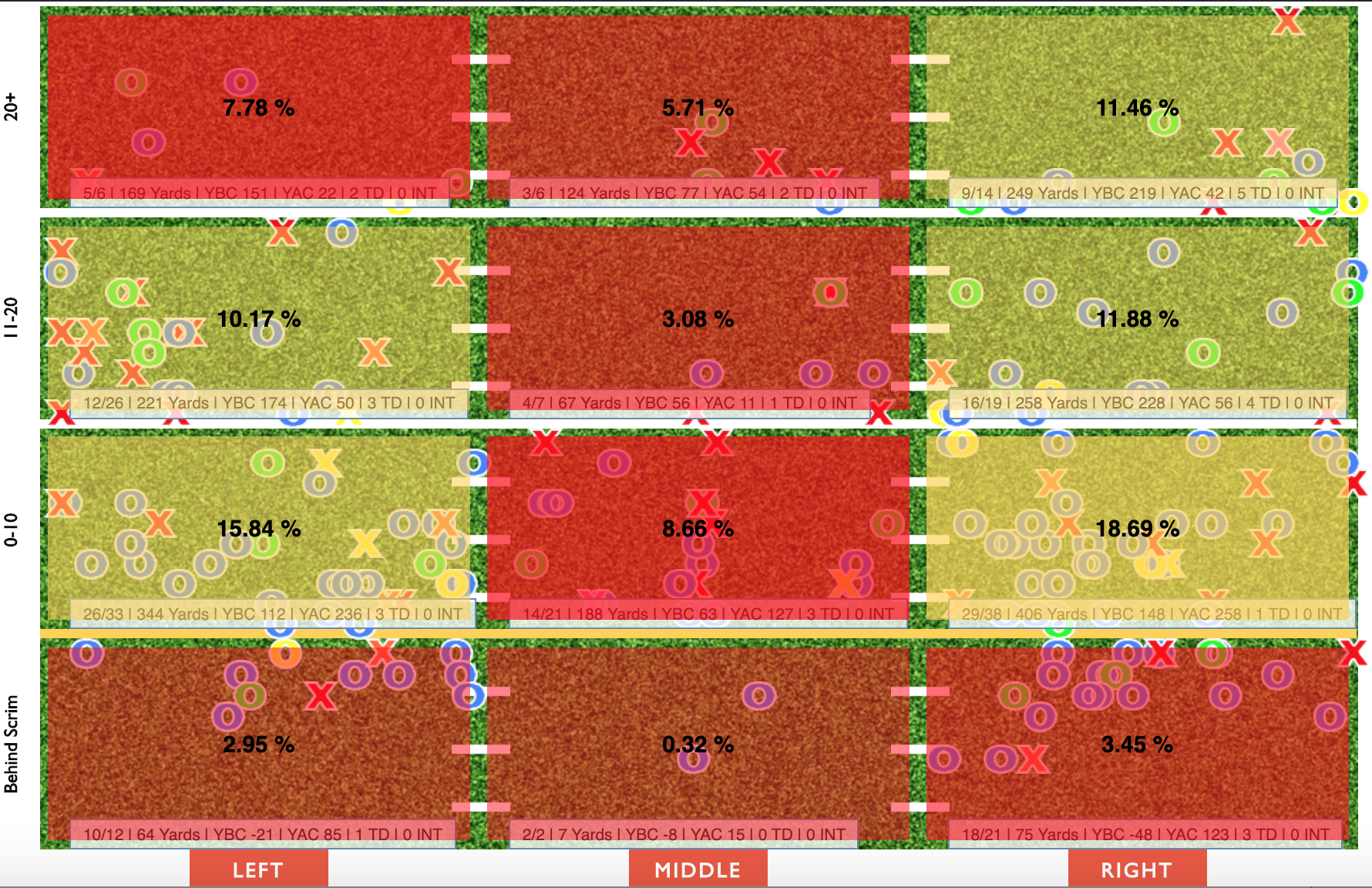
Simply, the Gators didn’t have this element to round out their offense last year. Florida had to call more screens than anyone in order to make sure their play makers got the ball in space. Flash forward to today, Florida is far more comfortable targeting someone 15 yards downfield as opposed to behind the line of scrimmage. While most of their explosive passes used to come after the catch, the Gators are now much more balanced thanks to Trask’s improved ball placement deep even if his traits still might not be elite.
Trask’s biggest blemish is accentuated on 10+ throws: his inability to curb turnover-worthy throws. Four have come on deep attempts with five others occurring on midrange targets. By volume, only Ken Seals, Matt Corral, and Stetson Bennett have more in SEC play. His 11.4% clip practically doubles Burrow’s from last season. Again, it’s easy to ignore these throws and focus on the results (especially when it’s a highlight play). Still, the evidence is mounting he could be bound for a blowup despite generally taking a large leap in his passing.
Burrow’s stats hold firm in a number of spots, but our two Heisman hopefuls cannot be dismissed based on their showings through the first six games. Some regression in the dropback game is possible due to Jones’s average deep accuracy or Trask’s risky passes. That said, both are relatively in good spots considering each’s schedule lightens up.
Situational

Along with measuring floors, pressured passing, and dropback passing, we need to examine how these guys are doing situationally. Early down passing is more closely tied to one’s down-to-down performance than instances behind the chains or on third downs. It’s kinda like measuring a QB’s play versus pressure and under clean conditions. Early downs help set baselines for passers because they’re more standard and frequent. Far more 1st and 10’s and 2nd and 6’s occur than 3rd and 4’s. Plus since 3rd Downs are truly situational, play calling and execution is more turbulent. Early down passing often helps set a baseline, while 3rd Down passing provides a stage for the difference-makers to shine.
Besides updating its offensive X’s and O’s, LSU famously “flipped the script” by going from one of the most run-heavy units towards one of the most pass-happy. LSU was terrible on early downs in 2018 and turned to the ground the majority of the time in those spots. With terrible returns, they became well acquainted with 3rd Downs. But when they started to pass to set up the run… well, you know.
Burrow did most of his damage on early downs last year. With the Tigers coming out throwing, he was on the attack even if he didn’t always aim to go deep. Nearly two-thirds of Burrow’s 1st or 2nd down attempts were successful through the first six SEC games in 2019 and his Depth Adjusted Accuracy was an absurd 69.9%.
The Heisman couldn’t maintain that level of play on the money down. His Success Rate fell nearly 30 percentage points. Though Burrow was able to close the year out strong in these spots, Trask and Jones are currently outdoing him on 3rd Downs so far.
Our two passers have been twins on the do-or-die down entering Week 9. Glancing at the table, there’s not much separation between them. But to reiterate, 3rd Down passing is volatile and has a lot of factors at work. Burrow didn’t need to be golden on the money down consistently in order for his team to win because he was elite on early downs and largely avoided those situations.
Jones on early downs has been as successful as Burrow through the first half dozen conference games, but his Depth Adjusted Accuracy is lacking. Alabama certainly follows a more balanced approach than LSU and Florida, so there are more elements that make the Tide’s early down offense more difficult to pin down for opposing defenses. I can’t fault Jones for taking advantage of his situations but it’s not exactly like he’s carrying the weight of the offense in those spots.
Trask, on the other hand, has to shoulder the load. Only Mississippi State and LSU pass more on early downs than Florida. And while the Gators’ ground game has started to exhibit success, Trask’s passing is the main ingredient. His early down Success Rate and Depth Adjusted Accuracy are each roughly seven points better year-over-year in SEC play.
Jones and Trask TCOB on early downs shouldn’t come as major surprises. The pair sat in the top3 amongst SEC returners in Success Rate, Depth Adjusted Accuracy, First Down+TD Rate, and Yards/Attempt entering the season. Still, to see both improve upon their already great numbers is a great sign that what they’ve done is sustainable even if their money down outputs sours some.
On Passing Downs (2nd and 8+, 3rd/4th and 5+), both are more successful and just as accurate downfield throwers compared to where Burrow wound up at the end of SEC play. So even when following a botched first down play or are behind the chains somewhat, the duo have held their own against their easier slates. While Jones has the better Success Rate, Trask’s Depth Adjusted Accuracy% is more preferable even if just barely.
Since Jones’ throws have been more vertical in nature, he’s been more valuable despite throwing 12 less TDs. In fact, Jones’ red-hot 0.7 Expected Points Added/play is outpacing Burrow’s (along with his QBR). Nationally, the Tider only trails Ohio State’s Justin Fields among QBs with a usage over 20%. Keep in mind Burrow’s 0.66 EPA/play is across his entire schedule, not just the first six SEC games. Trask’s 0.53 clip just misses cracking the top10. Trask’s volume numbers topple Jones’; but in basically every facet, Jones has proven to be far more efficient.
Conclusion
If you made it this far, you know we split a lot of hairs stacking up 2020’s Heisman hopefuls next to Cool Joe. Entering this exercise, I was bearish either could put up numbers as sterling as Burrow’s historic 2019 campaign. But I am glad to admit, I didn’t waste my time writing this. Sure, Jones and Trask don’t face the same level of opponents the Tiger did last year. But I sincerely doubt history will reflect on their numbers that way against an all-SEC slate.
Jones could slip up without Waddle’s presence or if Alabama’s run game is stifled. Trask’s interceptions could pile up and his play against pressure could stain his production. That all speculation and anti-wishful thinking at this point. There’s hardly denying these dudes have kicked ass thus far. All else considered, both are officially in Joe Burrow territory.