2020 Vision: Georgia
2020 Vision: Georgia
Georgia's reign over the SEC East has a good chance to continue if Kirby Smart's short-term investment is a hit. Despite donning a defense as good as they come, Georgia's offense has been a relative liability due to its mundane modus operandi. Sure, the Bulldogs have been able to push around most SEC teams. But when they have gone toe-to-toe with other top-ranked teams who have been just as strong as them, UGA has yet been able to break through. In this preview, you'll see where Georgia's key offensive players stand relative to other SECers, important stats for the Dawgs to maintain and improve on both sides of the ball, and how UGA's schedule shakes out with help of ESPN's SP+ Rating.
Passers:
Georgia’s staff previously had a decision on whether to go with the strong-armed Jamie Newman or West Coast passer JT Daniels. Newman's recent opt out made the decision for them. While the timing is odd and circumstances around his move remain murky, Newman stood to greatly benefit from reps in Georgia's offense under Todd Monken. Newman is an athletic passer who lived and died based on the production of his deep ball. Though his highlights certainly pop, he had yet display down-to-down dependability or accuracy attacking all areas of the field. By UGA’s old ways of doing things, Daniels checks a lot of boxes. He’s likely to be a moderate down-to-down option who's potency is reliant on other facets opening up avenues. The overall assumption is that the Dawgs will modernize their scheme and ask their quarterback to be more of a multi-purposed threat and push the ball downfield more. With Daniels likely starting, I'm not sure how much the schematics actually evolve year-over-year. I charted each over a five game slate versus their five hardest defensive opponents that would simulate a typical SEC slate per ESPN’s SP+ rating.
Daniels operates like a typical West Coast Offense passer. His throws come out quick and commonly target receivers to space underneath. He has predominately functioned a game manager. Down-to-down, he’s relatively safe because of that. His 43.2% Success Rate across his sample projects to be 6th of 13 SEC qualifiers (which includes the two other transfer passers). His 41.9% Depth Adjusted Accuracy% was just as middling. But unlike Newman, Daniels found immense difficulty going long versus his hardest opponents. His 29.6% First Down+TD Rate and 7.69% Explosive Pass Rate look to be 2nd-worst amongst SECers. As tantalizing as as it is to unlock more big plays, the Dawgs are well-constructed to play methodically behind its stout defense as long as its offense can take care of the ball. But, Daniels was more prone to bad decisions than Newman across his sample. His 9.47% Interceptable Pass Rate projects to be bottom4 despite his overly muted passing style and average depth of target on the lower end. But, the most damning about his outlook come from Pro Football Focus. His 2018 passing grade and Wins Above Replacement figures were damn near the bottom of college quarterbacks ranking 118th and 129, respectively. (Reminder: there are only 130 D1 schools). Plus his lone half versus a very bad Fresno State defense saw him sport three turnover-worthy plays.
Newman was very vertical at Wake Forest. From his sample, no returning SEC qualifier could challenge his average depth of target or Deep Pass Rate. But with longer throws, so were his odds of finding consistency. After all, it’s much easier to lean on five-yard hitches than 30-yard streaks. Overall across his sample, he posted a 42.8% Depth Adjusted Accuracy%, 33.3% Success Rate, and 29.4% First Down+TD Rate. While the former projects to be a top5 figure ahead of 2020 within the SEC, the later two are the conference’s worst as is his 23.8% Uncatchable Pass Rate. A more talented supporting cast and a less strenuous work load should help his efficiency numbers improve. Being ranked as PFF's 3rd-best college passer might have had a big role in Newman opting out. Though he has natural tools and a big-time arm, he had loads to prove from where I sit in order to become a pro-level passer.
With hiccups preventing Daniels from getting the green light medically, D'Wan Mathis has a great chance to be the Bulldogs Week 1 starter. At 6'6, Mathis has athleticism and could offer this offense an additional rushing threat. His arm doesn't wow me from his tape, but that doesn't mean he can't be effective. Spread-run packages and prudent shots can be on the horizon in the short term if Daniels can't go. If it's a hit, Mathis might be a Made Man moving forward. Time will tell.
Rushers:
After a year of solid spot work, Zamir White will be Georgia’s lead back. Overall, he is one of the handful of SEC rushers returning for 2020 to sport at least a 50% Rushing Success Rate. Plus, his 45% clip in SEC play last year is the 3rd-best amongst returners. His 17.5% Explosive Run Rate, which is 4th-best, helped pad his top8 3.13 yards after contact average. That said, White looks to be one of the best at busting out of tackles. His 35% Broken Tackle Rate against conference defenses is the 4th-best ahead of 2020. And he did all this despite his average rush yards before contact falling below 1.8. White is one of my guys this fall. He’s well-positioned to be the next great ball carrier out of Georgia’s backfield. But admittedly, he needs to show some more pop even if his situational running is sound. Only seven SEC backs with at least 30 touches last year sported a lower Expected Points Added per rush attempt.
White's Carry Share obviously remains to be seen. If he’s not a bell cow back, James Cook should finally see his role within the Bulldogs’ offense increase. Overly a gadget player off motions or two-back sets, Cook helps Georgia win laterally. Maybe Monken sticks with the status quo that he’s more valuable as a decoy. As a rusher, Cook was middle-of-the road in terms of Success Rate in 2018 but put up a putrid 35.5% clip last year, which ranks 34th out of 39 returning qualifiers with at least 15 carries. In league play, it was even more repugnant at 17.7%. With that in mind, he’s averaged at least 6 Yards/Carry each of the last two years. Those big runs immensely made his profile look better as far as EPA is concerned. While White was in the SEC's bottom8 in that regard, Cook finished in the top6.
The other option is Kenny McIntosh. Though he logged exactly zero carries in SEC play last year, Georgia will need another between-the-tackles runner in its ranks. Across his 25 carries against non-cons, he feasted. McIntosh averaged 6.96 Yards/Carry on a 52% Success Rate. But I should mention, he averaged 5.20 rush yards before contact. Hard chance he’ll see a clip half of that with the all-SEC schedule.
Catchers:
George Pickens will headline a fairly solid receiving group for the Dawgs. Even last year, he commanded 25 more targets and hauled in 20 more catches than the next man in line. He is, for all intents and purposes, Georgia's top dog. His 54.3% Success Rate just missed being inside the top10 amongst SEC returners in league play. He’s one of the most prolific deep receivers and most efficient midrange options coming back to the conference. Overall, Pickens’ 263 yards and 7 catches are the 4th-most from deep targets, and his 70% Success Rate and 35.7% Touchdown Rate on intermediate attempts hold the silver medal. With the 6th-highest average depth of target, it remains if that verticality remains with Daniels behind center. Still, his presence on the outside might goad his passer into being more aggressive downfield. If he posts a 8.70% Explosive Catch Rate in SEC play again, however, UGA probably won’t be too hot offensively.
Demetris Robertson is also pegged to lineup on the outside. He was a lackluster target for the Dawgs but won the team’s Most Improved Player award implying he’s killing behind the scenes. However, his 40% Catching Success Rate, 5.45% Explosive Catch Rate, and 6.04 Yards/Target from 2019 don’t exactly inspire optimism. But, over 18% of his targets were deemed uncatchable. Most of his damage was done on his short routes like screens, drags, and outs. If he's used in a similar fashion, Daniels could help Robertson find much better numbers since he's more prone to find success closer to the line of scrimmage. Matt Landers is also in the mix on the outside. But his numbers across his 22 targets are even less preferable than Robertson’s.
Dominique Blaylock was originally set to be Georgia’s primary slot. But reinsuring his knee during training camp nixed that notion. With him being sidelined, Georgia lost one of its best players after the catch. Of the 35 SEC returners with at least 25 targets last year, Blaylock sports the conference’s 3rd best yard after catch average with a 11.1 clip. That figure also matched his Yards/Target. In general, 64.5% of Blaylock’s yards came after the catch; nearly a third of his targets occurred via a screen or an RPO. But in SEC play, he was well-contained. Across his 15 targets in those spots, his 53.7% Success Rate and Yards/Target shrunk to 40% and 6.80, respectively. Thanks to the aforementioned conservative approach Daniels is likely to follow, Blaylock could have been in store for a big year. With him out of the picture, Kearis Jackson is in play to get major reps on the inside. With a 14.3 average depth of target, he could be pushed more downfield than Blaylock. But, it's hard to put much weight into production off just 15 targets.
At tight end, UGA will bank on so-so FSU-transfer Tre’ McKitty to replace Charlie Woerner and Eli Wolf. His numbers don't jump off the page and are typical for a TE. His blocking will certainly be needed to anchor the end of the line, but his downfield route running will be his biggest addition to Monken's scheme. Despite whatever stats, he was frequently sent down the seam and showed good play making skills after the catch. Daniels will need all the help he can get to maximize his first year in Athens.
Glancing at the O-Line:
Once the motor of his offense, Georgia’s line stalled midway through last season. With a presumed new scheme and mostly new line, this once mighty unit has plenty of question marks. Relative to the rest of the conference, they still performed fine; but the standards that had been previously set were not met. They still did a pretty good job at curbing pressure and keeping Jake Fromm clean. Both UGA’s Pressure and Sack Rate were top4 in SEC play. But with an unintimidating passing attack and overly mundane playing style, opponents zeroed in on Georgia’s backs. Georgia ranked 8th in rush yards before contact versus conference defenses. Despite their Yards/Carry ranking 7th, they still managed to put up a top5 Success Rate. Owning the SEC’s 3rd-easiest schedule might help those run lanes come easier in 2020. If Georgia is mediocre creating holes, however, they're bound to drop more than a game across their schedule. From left to right, their starters project to be Xavier Truss, Justin Shaffer, Trey Hill, Ben Cleveland, and Jamaree Salyer.
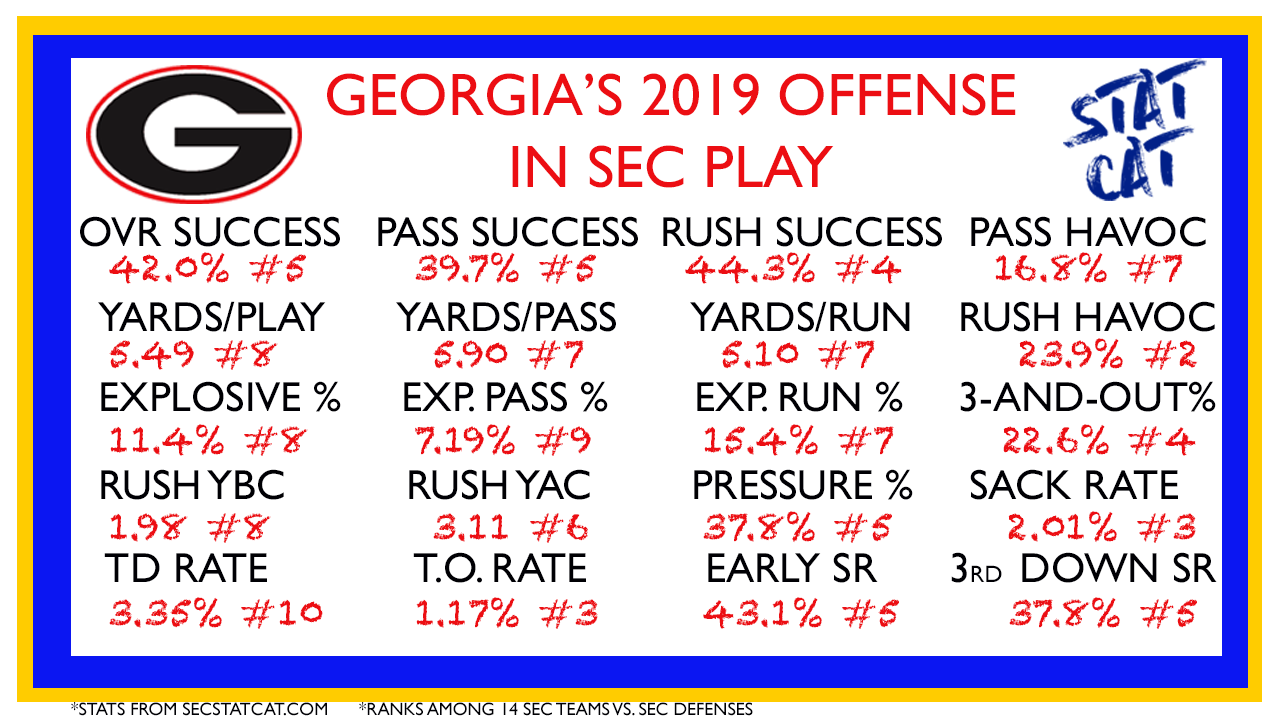
Key Offensive Team Stats in SEC Play:
The most important stats for Georgia to maintain against SEC defenses are its Sack Rate and Run Havoc Rate. Despite their reputation, Georgia’s offense was more mediocre than good in SEC play last year. But they still protected their quarterback phenomenally and didn’t let fronts affect their ground game too often. Both were crucial for their conservative offense to plod along. But even if UGA leans into being more aggressive and modernizes its scheme moving forward, the Dawgs will still have to keep their passer clean and provide a good amount of room for their backs to operate. Staying ahead of the chains and avoiding drive-killing plays is a good place for this offense to start to get back on track.
The most important stats for Georgia to improve against conference defenses are its Passing Success Rate and Touchdown Rate. Though UGA posted a top5 Passing Success Rate in league play last year, their clip failed to crack 40%. In order to be a title contender that needs to drastically improve. Being good relative to your conference is one thing, being one of the best around is another. Georgia’s muted offense only generated a 3.35% Touchdown Rate, which was a bottom5 figure. Sure they managed to get by thanks to an elite defense. But again, this offense needs to display more potency and potential to put points on the scoreboard looking at the big picture. Newman's downfield throwing ability could have been the answer to that, but I have much more concerns with Daniels' play making. Daniels could very well be Jake Fromm-lite, which is both a blessing and a curse for Georgia. He certainly could help the Dawgs find down-to-down consistency, but I'm sure as hell not expecting him to set the world on fire or pose as a major threat to a good defense.
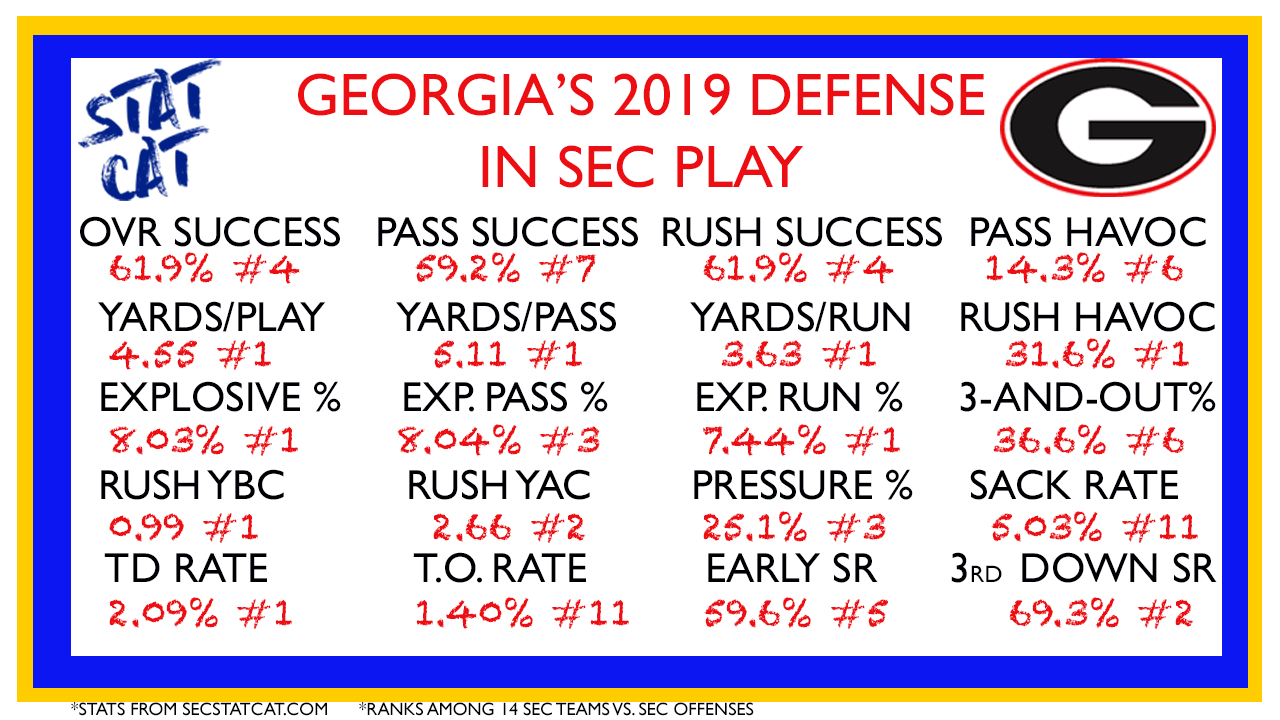
Key Defensive Team Stats in SEC Play:
Per ESPN’s SP+, no team in all of college football has a defense superior to Georgia’s entering this season. While the Worldwide Leader's metric overly lauds this unit, UGA only sported the 4th-best Success Rate versus conference offenses last year. Still like their SP+ Rating suggests, they held the best Yards/Play, Explosive Play Rate, Touchdown Rate, and rush yards before contact average. UGA was a stifling bunch, and there’s plenty of reasons to believe the Dawgs will get back to doing that to opponents in 2020. Of course, maintaining all those elements will certainly help. But this unit still could shore up a few of its weaker traits.
Though this unit doesn’t have to change too much to keep up their dominance, Georgia must improve its Sack and Takeaway Rates to help create a preferable cushion for its fairly green offense. Last season, both clips finished inside the SECs bottom4 in league play. The best defense in the land perhaps can become the best offense in the land if these two aspects can see significant gains year-over-year. Down-to-down prowess is great. Sometimes, a truly great defense needs to be more apt at executing game-altering plays and creating their own luck.
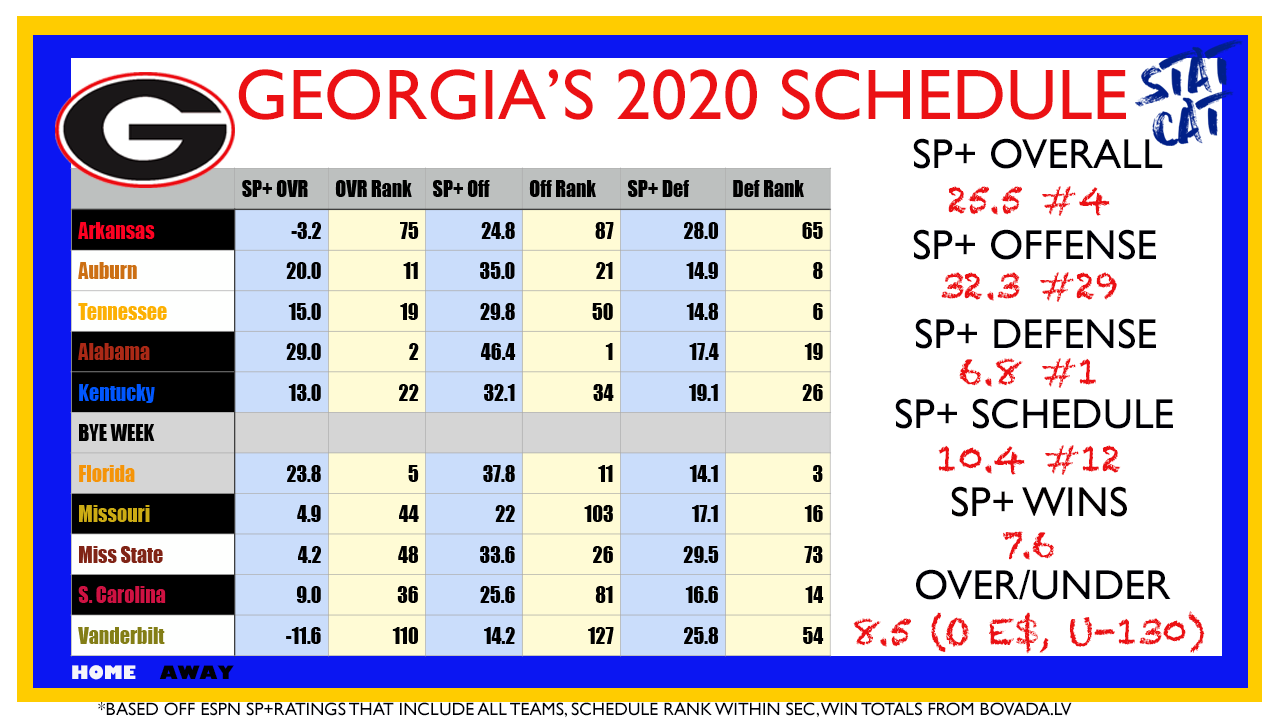
Georgia's 2020 Schedule:
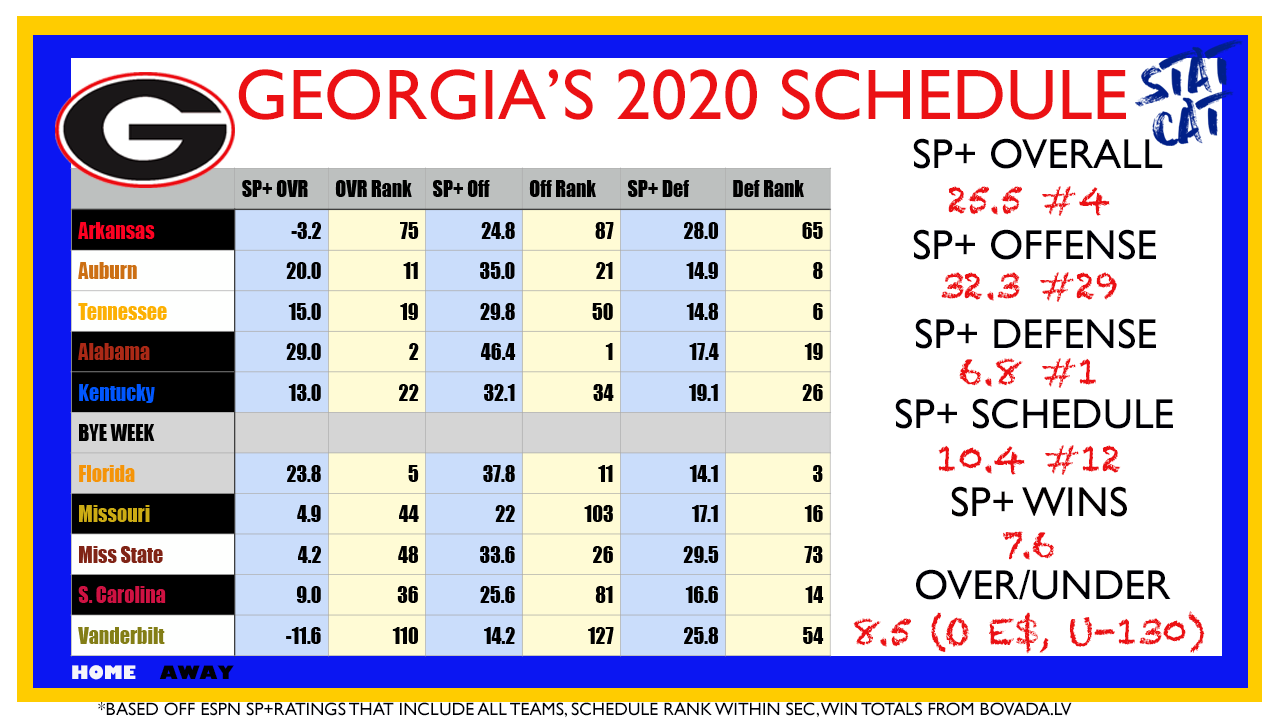
According to ESPN's SP+ Ratings, Georgia enters 2020 with one of the weaker schedules in the SEC. Though Alabama dons the top spot overall, Georgia is right behind them and rocks the No. 1 ranked defense by the SP+. While Newman's departure might cause their offensive rating to dip slightly, the offense will still be in position to make noise. In terms of Success Rate, the Bulldogs were one of the few teams to be top5 in conference play on both sides of the ball. Georgia's most trying part of the schedule is from Week 2 until after their bye when they take on the Gators. All five of UGA's opponents are ranked in the top30 to start the year. All have top26 defenses with four being top8. Not to mention, the Dawgs travel to Tuscaloosa in Week 4. For a team sporting a rather inexperienced offense, it's easy to see the Dawgs dropping a game before their bye. Florida no doubt will be formidable after UGA's off week. But from Week 8 on, its all downhill. Over that span, the SP+ projects their average margin of victory to be over 20 points in each contest. All in all, the metric favors them in nine games, which indicates the over to hit on their win total line.
Georgia's defense is set to face two top20 offenses in Alabama and Florida. Though certainly difficult, the Bulldogs don't look to be tested too much defensively outside of those two games. Five of their opponents fall outside the top45 in the initial SP+. Those five also happen to be the conference's worst offenses. Kirby Smart's defense is expected to be just dandy. The question, again, is whether a mostly new group can produce right away. While Week 1 will be a decent tune-up game, there's not a whole lot of time for this unit to gel before shit gets real. With seven defensive foes ranked in the SP+ top30, a few teams could upend them on any given Saturday. Still, let's not pretend this isn't one of the best overall teams in the nation.
Before I soldier on, I probably should explain what the SP+ Ratings are a little bit. Defining the SP+ in a single sentence, it's a tempo- and opponent-adjusted measure of college football efficiency. ESPN's Bill Connelly's metric is intended to be predictive and forward-facing. That is important to remember. It is not a résumé ranking that gives credit for big wins or particularly brave scheduling -- no good predictive system is. It is simply a measure of the most sustainable and predictable aspects of football. If you're lucky or unimpressive in a win, your rating will probably fall. If you're strong and unlucky in a loss, it will probably rise. Using the initial ratings, let's check out how Georgia schedule stacks up.
WEEK 1:
Georgia @ Arkansas: Projected Margin Georgia by 26
Sam Pittman starts his Razorback tenure by facing his former employer. It’s a bad matchup for the Hogs despite starting the year at home. Their recent struggles have been well-documented, and Georgia brings in the nation’s top preseason defense. In SEC play, no defense trumped the Dawgs’ rush yards before contact average, Yards/Play, Explosive Play Rate or TD Rate. Sure Arkansas has some pieces in place to make things interesting, but Georgia will be motivated to start the season full throttle. With Jamie Newman opting out, the Dawgs’ offense loses its potency. Still their opponent should offer opportunities to bust big ones. Arkansas’ defense was bottom3 in Explosive Pass Rate, Touchdown Rate, and Pass Havoc Rate. Hard to pick a better situation for JT Daniels to begin his fresh start.
WEEK 2:
Auburn @ Georgia: Projected Margin Georgia by 8.5
This is set up to be a good one. The Deep South’s Oldest Rivalry rarely isn’t. Georgia’s defense should be well-equipped to manhandle Auburn’s offense and get under Chad Morris’ skin. I just don’t see five new O-Lineman forging serviceable holes against the best defense in the nation. Though I’m positive Gus will have a fun wrinkle, the Dawgs are set up to shut down Auburn. But Georgia’s offense will have a similar disadvantage of sorts. With a new quarterback, play caller, and lead back, it’s a hard ask to dominate a top8 SP+ defense this early in the season. Obviously, both teams will bank on great defensive play. While these two defenses open close to one another in the SP+, the gap between them is over 8 points. Meaning, versus an average college offense on a neutral field, UGA’s defense projects to surrender that many less points than the Tigers. As you can tell, that lines up perfectly with the projected margin. Such an early season clash is bound to be ugly. Most battles between two top10 defenses are.
WEEK 3:
Tennessee @ Georgia: Projected Margin Georgia by 13.5
This is another game Georgia could stumble if it’s not careful. With how big play oriented the Vols are, a low scoring rock fight between two defensive teams could be decided on just a couple of explosive snaps. Of course, Georgia’s new offensive scheme could certainly be better than expected. But at this point in time, Tennessee’s defense has the edge in the SP+. One of the big selling points to starting JT Daniels is that he’s a safe, conservative passer. He can be serviceable behind a run-first philosophy. The Vols are all about preventing splash plays. Tennessee sported the 2nd-lowest Explosive Pass Rate defensively in SEC play. On the other hand, their down-to-down Success Rate was bottom5. The methodical approach has the potential to slice up the Vols. Georgia’s top-ranked defense should be able to control the one of the handful of conference offenses that fails to crack the preseason SP+ top50.
WEEK 4:
Georgia @ Alabama: Projected Margin Alabama by 6.5
In a week featuring plenty of action, Alabama hosting Georgia could be a SEC championship game preview. Not a bad capper to end the first month of play. Thanks to the home field advantage, the SP+ figures the Tide will win by a little more than a touchdown. Though somewhat of a running theme until things can be settled on the field, the Dawgs start the season outside the top30 offensively. The Tide, of course, are top10 on defense. Georgia could make noise with their run game as the Alabama allowed the 3rd-highest rush yards before contact average in SEC play. But Alabama’s backend . Still, the focus will be on the nation’s best offense and defense squaring off. This game will feature the SEC’s only defense that allowed less than 8% of its snaps to allow either 20+ through the air or 10+ on the ground versus the only conference offense to sport an Explosive Play Rate over 17% in league play. As far as the preseason SP+ sees things, this is Alabama’s closest margin all year.
WEEK 5:
Georgia @ Kentucky: Projected Margin Georgia by 9.5
Kentucky’s Big Blue Wall will have a lot of tests across its schedule. Georgia’s defense presents to be the most difficult. Obviously, seeing you’re up against the top-ranked defense can be scary enough. But versus SEC offenses last year, the Dawgs’ D sported the best rush yards before contact average and Explosive Run Rate. Able to engage with backs early and often, UGA moreover prevented big runs. Though UK’s backs are better than most, the Cats’ line has to forge decent cushion upfront for the Cats to have any chance. On the other side of the ball, it remains to be seen if Georgia’s offense will be okay, good, or great. But Kentucky’s defense has the edge as of today. Good ole Georgia running the ball could tilt the mismatch as UK was terrible against the run in SEC play last year. Due to UGA’s projected dominance defensively, the SP+ looks for the Dawgs to win by two scores.
WEEK 6:
BYE WEEK
WEEK 7:
Georgia @ Florida: Projected Margin Georgia by 1.5
Like you would except from a rivalry game of this magnitude featuring the East’s top2 teams, the SP+ figures the Florida-Georgia game will be highly contested. It truly could go either way; but as of today, the Dawgs are projected to have the upper-hand. Florida enters as the more well-rounded team. Both its offense and defense rank top11 in the initial SP+. Georgia, of course, is led by its dominant defense. Like last year, passing should present Florida its best path to victory. Even if the Gators fix their ground game, Georgia’s formidable front stands to be the best against the run in the conference. On a down-to-down basis in SEC play last year, the Dawgs were average versus the pass. With Georgia’s recent dominance over Florida’s offenses, Kyle Trask has to rise to this occasion if he wants the honor to be the SEC’s QB1. Florida obviously needs this to be in title contention. On the other side of the ball, Todd Grantham’s prudence with blitzes might allow Georgia to take advantage of Florida’s defense on early downs. With the 2nd-worst Pressure Rate, Florida had to play “bend don’t break” football. In the end, the Gators finished with a bottom6 Defensive Passing Success Rate in league play. Still, Florida stands to win if their offense shows up and bests Kirby Smart’s bunch.
WEEK 8:
Georgia @ Missouri: Projected Margin Georgia by 17.5
On paper, Georgia’s defense should be too much for Missouri’s offense to handle. But if Georgia is hungover from the Florida game from the previous week, the Tigers certainly could surprise coming out of their bye week. Entering the final month of the season, Missouri could be a dangerous team as they have nothing to lose. Likely to have suffered plenty of L’s, I wouldn’t put it past Eli Drinkwitz to pull out all the stops in a game like this. Banking on winning rock fights each week is a brutal way to squeak through a first season, but it’s overly Missouri’s only course of action. Their defense has the capability to contain Georgia’s offense as is. But if Georgia’s run game or pass catchers can generate explosive gains in space, Missouri will probably fold. Despite being the SEC’s most successful defense in league play, the Tigers sported a bottom5 Explosive Pass Rate. More importantly, the Dawgs defense projects to largely stifle whatever Missouri’s offense throws at it.
WEEK 9:
Mississippi State @ Georgia: Projected Margin Georgia by 24.5
Mississippi State won’t have much of a chance to beat the Bulldogs, but the possibility will remain thanks to Georgia’s pedestrian Defensive Pass Success Rate against conference foes last year and unknowns surrounding the Dawgs’ offense. While big gainers were rare, a few teams managed to successfully pick at UGA’s defense through the air. Playing mistake-free football with methodical gains isn’t sexy. But with how forgettable Mike Leach’s defense stands to be this season, keeping them off the field with a ball control offense might birth decent results. Tiring out Georgia’s defense while keeping his fresh is one of the few ways an undermanned Miss State team can win in the margins. Still, the SP+ overly likes Georgia’s chances to shut down the Bulldogs and win without much of a fight.
WEEK 10:
Georgia @ South Carolina: Projected Margin Georgia by 13.5
Losing at the hands of the Gamecocks last year should have the Bulldogs well motivated to kick ass in Columbia. Not only did South Carolina snatch a win last year, they also set the blueprint for how to stall Georgia’s overly mundane, yet mighty, offense. From that game on, Georgia averaged less rush yards before and after contact and saw both its Rushing and Passing Success Rate dip. If the Dawgs’ new scheme is able to unlock potency, this game shouldn’t be close. Overly a middle-of-the-road conference defense in league play, the Gamecocks allowed the 6th-worst Yards/Pass and Passing Success Rate while offering up a bottom5 Pressure Rate. Last year, South Carolina went all in to stop the run and made Georgia’s passing game win behind the chains. The Gamecocks could hone in on the run game once again. So its extra paramount the Dawgs will have a more threatening downfield passing game to get SCar out of sorts. Thanks to the home field advantage, the SP+ looks for South Carolina to lose by less than two touchdowns.
WEEK 11:
Vanderbilt @ Georgia: Projected Margin Georgia by 40
The 40-point projected margin in this game is the largest of 2020’s SEC slate. Even outside of that nugget, this shapes up to be all Bulldogs on paper. Other than Mississippi State, no SEC team has a less-challenging last two weeks than Georgia. Closing against two of the division’s three worst teams, Georgia’s could be looking towards the post season assuming they play as well as the numbers indicate they will over their 10-game slate. Vanderbilt doesn’t stand to have much of a shot. Though moving the ball stands to be a weekly immense challenge for their 127st rated offense, doing so against the nation’s top defense appears too daunting. It would take a miracle, or at least a half of dozen bounces their way, for Vandy to find a way to compete in their regular season capper.
For more information on Georgia's schemes, scripts, and stats visit the following links: