For more information on Florida's schemes, scripts, and stats visit the following links:
« All Articles & Film
2020 Vision: Florida
2020 Vision: Florida
Despite an inefficient running game and having to lean on a passer who hadn't started a game in over half a decade, Florida managed to secure its second-straight double-digit win season under Dan Mullen. Though they are a team bound for regression with said quarterback reliant on yards after the catch as well as other factors, Florida stands to be smack dab in the SEC championship discussion. Heck, the Gators have become the trendy pick to represent the SEC East in recent weeks. Though arch-rival Georgia returns an elite defense, questions remain on the other side of the ball. With a returning quarterback, four O-Linemen and a handful of defensive cogs, continuity is in their corner. In this preview, you'll see where the Gators key returners rank relative to the rest of SECers, important stats they must maintain and improve on both sides of the ball in conference play, and how Florida's schedule looks through the eyes of ESPN's SP+ Ratings.
Passers:
Thanks to his outstanding coming-out party in 2019, Kyle Trask is many people’s pick for QB1 within the SEC. His arm might not be the best and playing in Dan Mullen’s scheme facilitates his workload, but his results scream he’s an adequate decision-maker who can operate without the aid of a functioning run game. Play Action was common as were plenty of screens. No SEC passer topped Trasks’ 14.1% Screen Rate.
Among the returners, Trask enters 2020 with the best Success Rate, First Down+Touchdown Rate, and Uncatchable Pass Rate. Plus, his 50.7% Depth Adjusted Accuracy% is top3. Even when stripping away all the superfluous elements of Mullen’s offense, Trask projects one of the highest floors in the conference. From clean pockets on dropback passes (no screens or RPOs), his 51.1% Success Rate remains unchanged from his overall clip with his Depth Adjusted Accuracy% being top3 and his First Down+Touchdown Rate being top5 amongst SEC returners. Overall, Trasks' Expected Points Added per play is the 3rd-highest amongst returners
Trask will never wow you with his arm. Sure it’s serviceable, and by no means is he a nibbler. But his deep balls often die and he rarely leads his man vertically downfield. Due to his arm’s shortcomings and/or lack or reps, Trask tossed 27 interceptable passes last year, which were tied for most within the SEC with Ryan Hilinski. Including fumbles, nearly 8% of his touches were turnover-worthy. As optimistic as others are about his 2020 production, I’m certainly more cautious due to that glaring wart on his profile. The worst case scenario is that the Gators turn to the more mobile Emory Jones, which they did in spurts last year to boost their toothless run game. But if those detrimental plays are minimized moving forward, Florida should be the favorite for the SEC East crown.
Catchers:
Florida had one of the deepest receiving rooms in the conference last year. Nine guys saw 13 targets or more, but five of them are gone. Trevon Grimes is Florida’s most efficient returner. His 68% Catching Success Rate versus SEC defenses only trailed Jaylen Waddle’s, and no one topped his 60% First Down+Touchdown Rate. Plus amongst returners, his 20% Explosive Catch Rate is top4. Only the headliners Ja’Marr Chase and DeVonta Smith trumped his 13.9 Yards/Target in 2019. Looking at receivers only, his 8.95 YAC average in league play was top5. Grimes overly was the Gators’ best bang-for-buck option. Though it’s a hard ask to replicate that, the Swamp Dwellers have a star waiting to breakout if he can match that output with increased targets.
Jacob Copeland should lineup opposite Grimes on the outside. Of his 37 freshman year targets, 28 occurred with him on the perimeter (17 at the X-position). He primarily ran a vertically-inclined route tree. His three most targeted routes were Streaks, Slants and Comebacks, which made up over half of his tries. In SEC play, his 13.3 average depth of target is the 8th-highest amongst returners. With the high degree of difficulty on his longer tries, Copeland only hauled in half of his targets versus a conference defense with his 41.7% Success Rate being comfortably below average. He was just as likely to see a catch go for 20-plus as he was to suffer from an uncatchable target. At least the former at 20.8% is the 3rd-best amongst returners from SEC play.
Kadarius Toney mostly has operated as a gadget player for this offense. Using his speed to work defenders laterally and get towards the sideline, a good deal of his production stems from jet sweeps, reverses, or screens. His average depth of target has been under six yards each of the last two seasons. While injury prevented much output last year, he caught ten of his 13 tries with a 15 Yards/Target average, which was significantly more than his 8.42 clip from 2018. Florida has a hole at slot receiver, but Toney moves around the formation frequently. Still only two of his targets occurred when he lined up as an outside receiver last year. Toney could be their day-one H, but Rick Wells should see some PT as well.
Thanks for being patient. Now onto Kyle Pitts. Pitts has received the bulk of acclaim this offseason among Florida’s pass catchers. Many’s pick for the best tight end in college football, he was Kyle Trasks’ favorite receiver as no Gator saw more targets or catches in 2019. Despite dropping seven passes and facing nine uncatchable attempts, Pitts sported a Catching Success Rate over 50% overall. Among returning SEC tight ends that saw at least 20 targets, that mark is 4th-best within his position group. In SEC play, Pitts commanded a fifth of Florida’s passing attempts and put up a top8 Yards/Target amongst conference returners. Despite increased potency in these games, his consistency fell off a tad. Both his 49.1% Success Rate and 42.1% First Down+TD Rate in SEC play fall outside the top11. Pitts is a true downfield threat down-the-seam or outside the numbers. Few college tight ends are used in similar fashions. Moreover, his 10.0 average depth of target led all SEC tight ends in conference play last year. It’s a safe bet he should be Trask’s favorite target in once more in 2020.
Rushers:
Florida’s run game was a problem in 2019. In SEC play, the Gators put up the 4th-worst Yards/Carry and 2nd-worst Rushing Success Rate. Though Trask's passing helped cover up some of those inefficiencies, there’s no way this team will contend for a title if they are so one-dimensional in 2020.
Dameon Pierce is presumed to be the starting running back. Despite being hindered by a very low 1.10 rush yards before contact average, which was bottom3 in SEC play last year, Pierce walks into 2020 with a top10 Yards/Carry. Only Jerrion Ealy and Chris Rodriguez best his 4.24 YAC average. While his strength after defensive engagement is encouraging, his figure was largely inflated by a number of breakaways. Pierce’s 13.8% Broken Tackle Rate in league play is the lowest of any returning running back. With little cushion and being soft at breaking out of defender’s grasps, over two-thirds of Pierce’s carries gained less than three yards. Unsurprisingly, that birthed the 2nd-worst Rushing Success Rate in these spots.
Malik Davis is another option. But, his 2019 output versus conference opponents was even worse. Across his 19 runs, he sported a 2.68 Yards/Carry, 10.5% Broken Tackle Rate, and 15.8% Success Rate. With such hair-pulling inefficiency on both Davis’ and Pierce’s profiles, Mullen might be inclined to give former 5-star and sophomore transfer Lorenzo Lingard some work. Granted an 8.0 Yards/Carry is nice, but he didn’t log a single carry versus a P5 defense. Still, his upside might have more appeal if the two vets can find success.
Glancing at the O-Line:
Let’s start with the obvious spot. Florida’s O-Line was overly manhandled last season. Creating a push was even difficult when Florida played non-cons and lesser opponents. Of course during SEC play, that issue was accentuated. On designed carries, Florida only averaged a mere 1.55 rush yards before contact. Kyle Trask was the only Gator ball carrier with at least 20 touches in SEC play to eclipse the 2 yard threshold. I don’t care who is running the ball, that’s bound to upend any ground game. Florida collectively averaged 3.52 yards after contact, which was tops versus conference defenses, but they still fell in the bottom4 in Yards/Carry and Rushing Success Rate. Though Florida managed to skirt by thanks to their passing game, their ceiling is significantly lower if they cannot play more balanced and take some stress off Trask. Speaking on that, Trask should launch less risky throws with better protection. About a third of Florida’s pass plays experienced pressure and their 3.61% Sack Rate in SEC play was 3rd-worst. If this unit fails to step up once again, you can forget about this team’s title hopes. After some reshuffling among their returners and inserting a key transfer, Florida's front five from left to right are expected to be Stone Forsythe, Brett Heggie, Ethan White, Stuart Reece, and Richard Gouraige.
Key Offensive Team Stats in SEC Play:
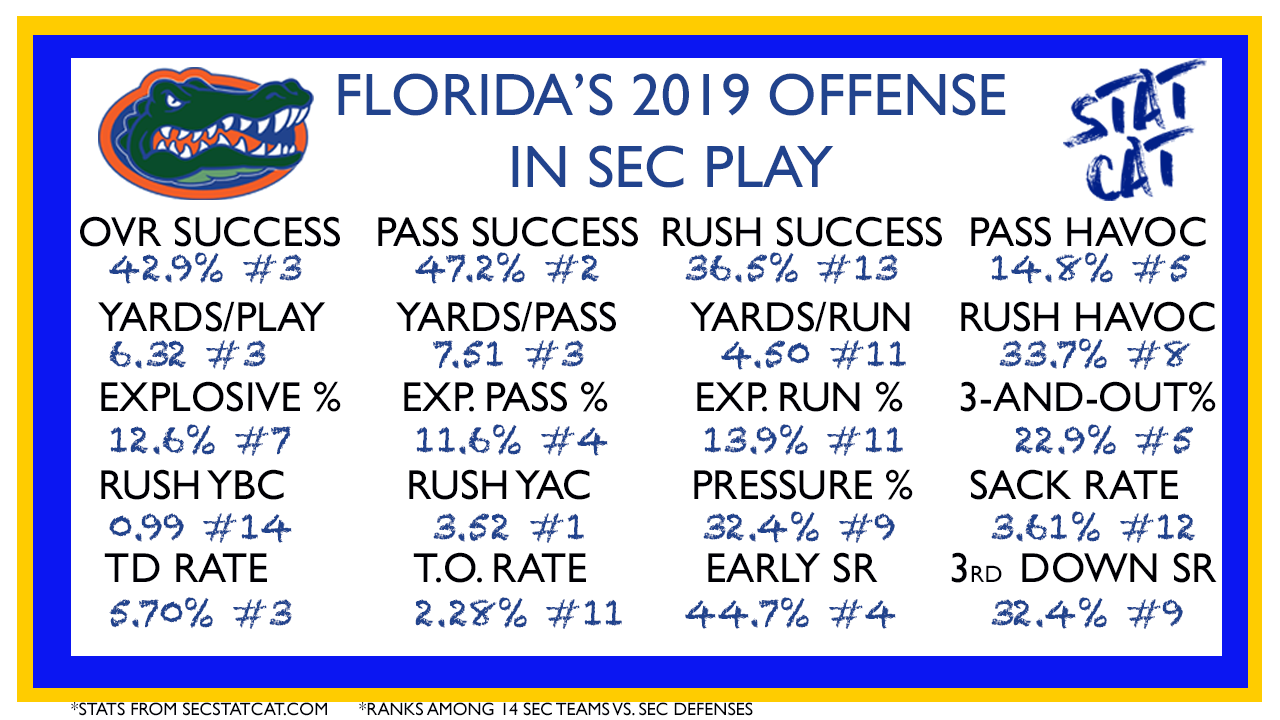
The most important stats for Florida to maintain against SEC defenses are its Passing Success Rate and Touchdown Rate. The jury is out on if Florida’s run game will be fixed. But either way, Kyle Trask and the Gators’ pass attack have to pick up where they left 2019 off. In SEC play, their 47.2% Passing Success Rate held the two-spot with only LSU and Texas A&M donning higher Pass Rates. YAC-oriented designs helped their Explosive Pass Rate and Yards/Pass sit inside the top4. Those aspects helped points come easier. Both Florida’s Touchdown Rate and points/play were top3 last season. Duplicating that output will only lead to good things in 2020.
The most important stats for Florida to improve against conference defenses are its Sack Rate and Turnover Rate. As pitiful as their rush yards before contact figure was, I’d concert my energy on improving upon a strength in this context. Again, Trask averaged roughly three turnover-worthy plays per appearance last year. All in all, Florida’s 2.28% Turnover Rate was the 4th-worst in SEC play. With more clean conditions, Trask is bound to see the field better, deliver less risky throws, and see more drives result in points. With opponents being gifted less game-altering snaps, the Gators will be that much harder to defeat.
Key Defensive Team Stats in SEC Play:
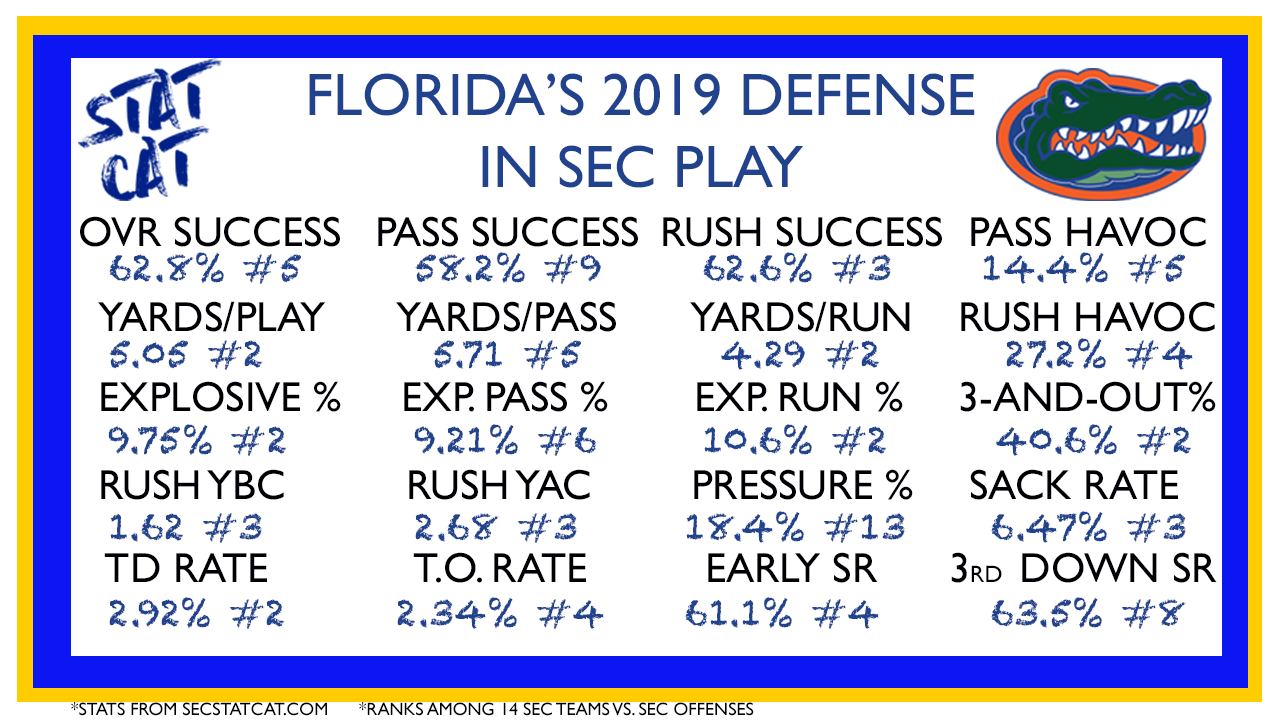
You shouldn’t need me to tell you that Florida had a pretty good defense last year. In SEC play, they held a top5 Success Rate, Takeaway Rate, and Havoc Rate. Plus their Yards/Play, Explosive Play Rate, Touchdown Rate, 3-and-Out Rate forced, Sack Rate, and rush yards before and after contact were top3. They did a lot of things well. So running back that kind of play will be paramount. However, but I’d like them to generate more pressure on average. I know Defensive Coordinator Todd Grantham likes to pick his spots when to blitz, but being more consistent altering pockets could result in key plays other than sacks. With the second worst Pressure Rate, opposing passers were able to find more success and explosive gains through the air. UF sported the 6th-worse passing Success Rate in SEC play in 2019. Creating more confusion more often upfront, should certainly slow opponents down in between sacks.
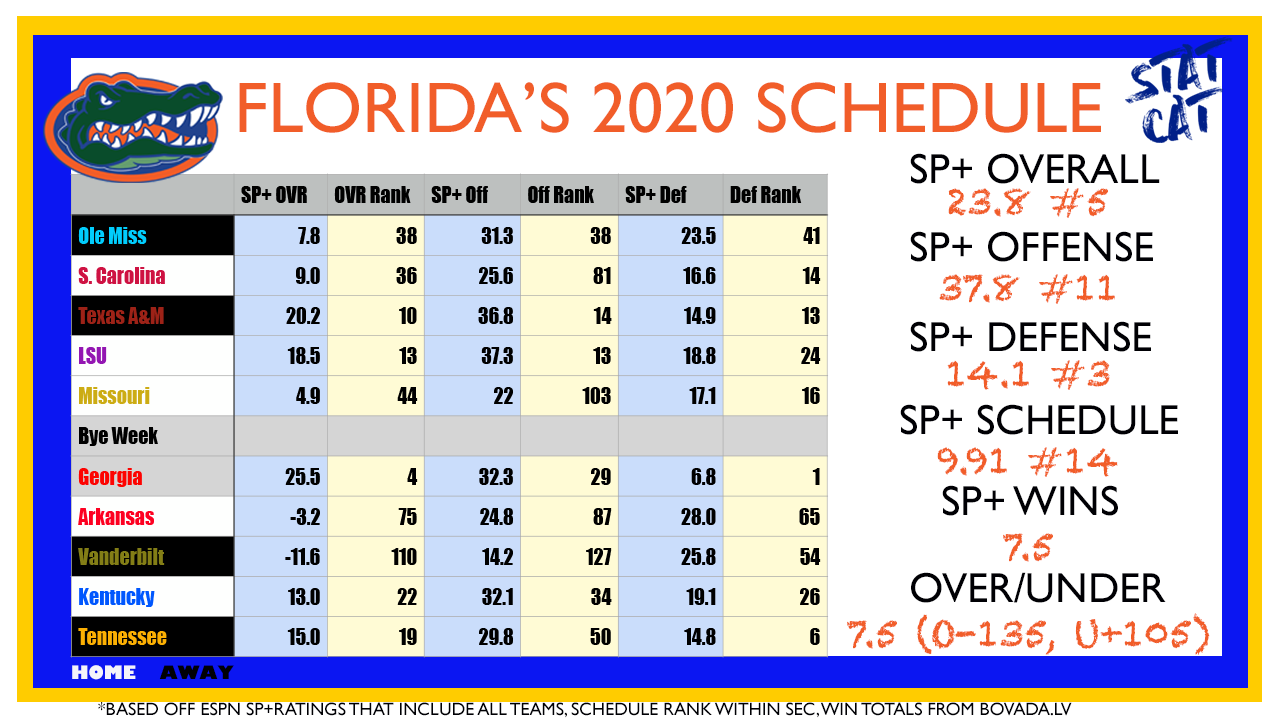
Florida's 2020 Schedule:
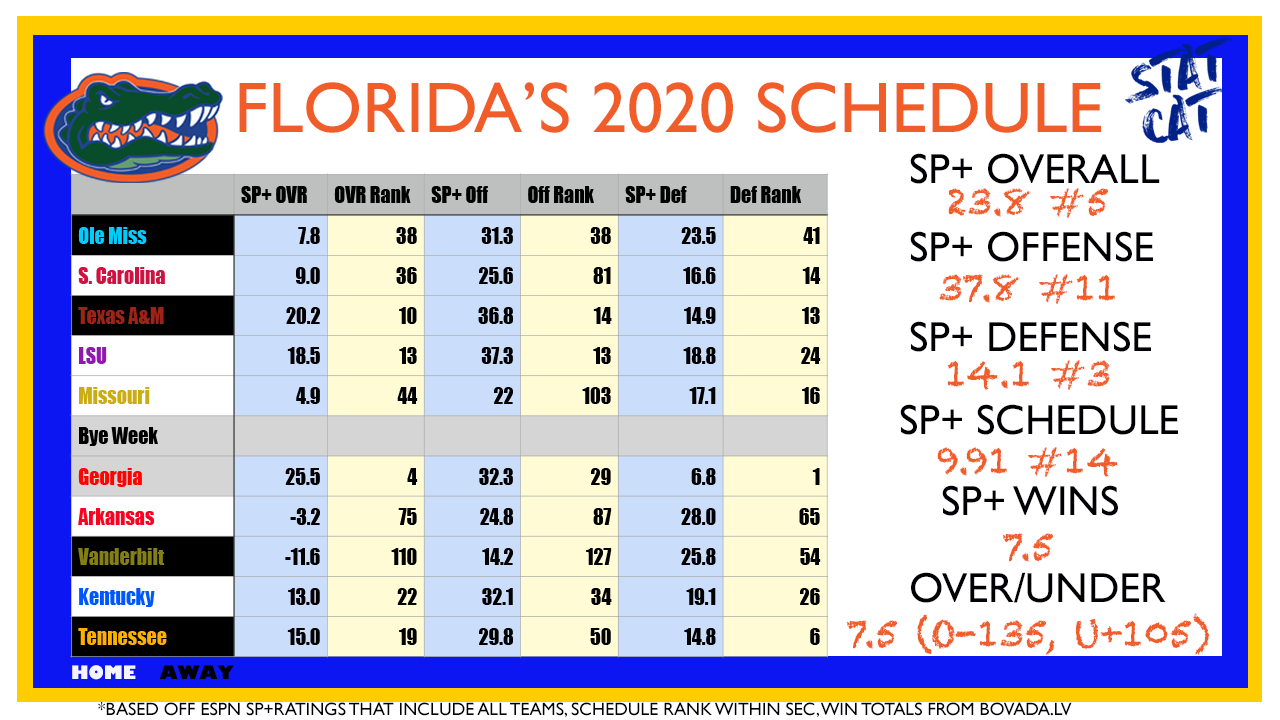
Florida will have the easiest schedule in SEC play this year according to ESPN's SP+ Ratings. Playing in the East already granted them games against bottom-feeders Vanderbilt and Missouri, but the Gators will also play the West's worst team in Arkansas. Plus depending on who you ask, Ole Miss could easily be seen as the 2nd-worst team in that division. By their schedule's "average rating faced", the Gators would face a team the caliber of South Carolina each week. The SP+ favors the Gators in eight of their ten games. Thanks to the home field advantage altering the numbers in the favor of the Aggies, Texas A&M game projects to be a pick em. So going off that alone, it Florida would hit their 7.5 season win total. The SP+'s win projection for the Gators was also set at 7.5.
Florida looks to be led by their defense, which ranks 3rd to start the season. Only two of their opponents don top20 offenses and both come on consecutive weeks: Texas A&M and LSU. Outside of their planned game in Jacksonville, those two games figure to be the most contested on Florida's schedule. The Gators should be able to hold their own defensively in their other games. Along with facing the four worst offenses in the SEC, four other foes fall outside the top25. If Florida can get to their bye week unscathed, momentum will be on their side against Georgia. The SP+ only figures the Bulldogs to be 1.5 point favorites as of today. Though a lot can happen between now and then, I figure most Swamp Dwellers like their chances with a projected margin like that. After all, UGA's offense only ranks 29th in the preseason SP+.
While the defense is Florida's backbone, the consensus is they won't be anywhere near the title discussion if their offense takes a step back. The SP+ is confident enough in UF's offense to have them ranked 11th ahead of this fall. If Kyle Trask can keep Florida's offense humming, they have nothing to worry about. However, losing a decent amount of receivers paired with a style of play that's reliant on yards after the catch screams he's due to regress in 2020. And if the Gators' ground game remains terrible, that might be all she wrote. While Florida may have gotten a pass defensively, half of their opponents are ranked top25 overall with three others being good enough to be top40. Only Vanderbilt and Arkansas fall outside of that range at this point in time. Florida might be a trendy pick to represent the East with the league's easiest schedule, but their success hinges on their offense picking up where it left off.
Before I soldier on, I probably should explain what the SP+ Ratings are a little bit. Defining the SP+ in a single sentence, it's a tempo- and opponent-adjusted measure of college football efficiency. ESPN's Bill Connelly's metric is intended to be predictive and forward-facing. That is important to remember. It is not a résumé ranking that gives credit for big wins or particularly brave scheduling -- no good predictive system is. It is simply a measure of the most sustainable and predictable aspects of football. If you're lucky or unimpressive in a win, your rating will probably fall. If you're strong and unlucky in a loss, it will probably rise. Using the initial ratings, let's check out how Alabama's schedule stacks up.
WEEK 1:
Florida @ Ole Miss: Projected Margin Florida by 13
Florida is a rough matchup for Lane Kiffin’s first game guiding the Rebels. Though it remains to be seen on how balanced Ole Miss’ offense will be, Florida’s defense was one of the best in SEC play at limiting explosive gains in both facets. Failing to win the big play battle will prevent the Rebels from contending against Florida’s methodical passing game barring turnovers. Ole Miss sported a bottom5 Defensive Pass Success Rate with the 2nd-worst Explosive Pass Rate versus conference offenses. On the other side of the ball, Florida was top4 in both aspects. Of course, the Gators had a constipated run game last year. But, Ole Miss is as good…or bad…as anyone for Florida’s line to build confidence against. The Rebels finished with the 2nd-worst Defensive Run Success Rate in SEC play last year and project to be the 3rd-worst defense the Gators face.
WEEK 2:
South Carolina @ Florida: Projected Margin Florida by 18
Though Florida’s offense and South Carolina’s defense both enter the season in the top15 in the eyes of the SP+, the Gamecocks have way too many holes offensively for me to put much faith in them considering they’ll be up against the preseason’s 3rd-best defense. But SCar’s best chance could be banking on Kyle Trask making mistakes. Though it remains to be seen if that trait was from lack of reps or just who he is, creating extra possession will be crucial if the Gamecocks want to keep things close and potentially win. That said, Ryan Hilinski equaled the same number of interceptable passes by volume as Trask last year with 27. Florida has the better players. If they can avoid playing in the muck, they should be able to coast.
WEEK 3:
Florida @ Texas A&M: Projected Margin Florida by 0.5 / Pick 'Em
This game projects to be as close as possible in the eyes the the SP+. So don’t be surprised if the line ends up being razor thin. Though Florida is rated higher on both sides of the ball in the SP+, the “home field advantage” just barely swung the edge to the Aggies. For all the offseason chatter of arguing which quarterback is better, Kellen Mond and Kyle Trask will get to decide it on the field. In SEC play last year, both team had top3 Pass Rates and top4 Passing Success Rates. Of course, the run games for these teams both left much to be desired. This game might be decided by Florida’s front and TAMU’s O-Line. The Gators rocked the conference’s 3rd-best Sack Rate and 5th-best Pass Havoc Rate against SEC offenses last year. The Aggies’ line surrendered the worst Sack Rate. If Mond is overly clean, I think Texas A&M will prevail. And, that’s a big if due to the aforementioned pass blocking woes. Simply, the Gators have more big play potential, which could easily affect the outcome.
WEEK 4:
LSU @ Florida: Projected Margin Florida by 8.5
According to the initial SP+, this game set up to be one of the more competitive games in the SEC all year. Then the opt outs came. Now the Gators are projected to win by over a touchdown. Much of the focus will be on the Gators iffy pass defense. Florida’s D sported the 6th-worst Passing Success Rate and an Explosive Pass Rate outside the top5 in SEC play. Creating Havoc, however, would allow the Gators to take control of this game. Joe Burrow erased plenty of sacks and broken snaps. Myles Brennan is far less proven on that front. And an overly new line versus a scheme that gets plenty of sack favors the Gators. Still, the UF’s offense can hold its own assuming they can take care of the ball. Florida is better on both sides of the ball to start the season per the SP+. As LSU’s first top20 opponent offensively, Florida is the first major test for the Tigers’ newly-installed 4-3 scheme.
WEEK 5:
Missouri @ Florida: Projected Margin Florida by 22
If Florida’s defense is as good as advertised, there’s no way in hell Missouri’s offense can field a good enough effort to upset the Gators in the Swamp. As the 103rd offense to start the year, the Tigers could certainly improve and be better than expected than their projection. Personally, I’m bearish on that notion with Mizzou previously facing three top25 defenses in their first month of play. But this time, they could be fairly broken-in for the Gators to cruise comfortably. Questions remain on Florida’s rush attack, and this would be a bad matchup. As a top20 defense, the Tigers best bet — like a lot of underdogs facing the Gators— is to entice Kyle Trask into mistakes. But replicating the SEC’s 3rd-best 3-and-Out Rate from last year could also do the trick. Still, the SP+ projects an easy win in the Swamp for the home team due to being significantly better on both sides of the ball.
WEEK 6:
BYE WEEK
WEEK 7:
Georgia @ Florida: Projected Margin Georgia by 1.5
Like you would except from a rivalry game of this magnitude featuring the East’s top2 teams, the SP+ figures the Florida-Georgia game will be highly contested. It truly could go either way; but as of today, the Dawgs are projected to have the upper-hand. Florida enters as the more well-rounded team. Both its offense and defense rank top11 in the initial SP+. Georgia, of course, is led by its dominant defense. Like last year, passing should present Florida its best path to victory. Even if the Gators fix their ground game, Georgia’s formidable front stands to be the best against the run in the conference. On a down-to-down basis in SEC play last year, the Dawgs were average versus the pass. With Georgia’s recent dominance over Florida’s offenses, Kyle Trask has to rise to this occasion if he wants the honor to be the SEC’s QB1. Florida obviously needs this to be in title contention. On the other side of the ball, Todd Grantham’s prudence with blitzes might allow Georgia to take advantage of Florida’s defense on early downs. With the 2nd-worst Pressure Rate, Florida had to play “bend don’t break” football. In the end, the Gators finished with a bottom6 Defensive Passing Success Rate in league play. Still, Florida stands to win if their offense shows up and bests Kirby Smart’s bunch.
WEEK 8:
Arkansas @ Florida: Projected Margin Florida by 30
Florida is blessed with its easiest stretch after the Gators’ tilt with Georgia. If they are undefeated at this point, it’s all downhill from here first starting with Arkansas. The narrative will be centered on Feleipe Franks returning to the Swamp. As publicly supportive as Dan Mullen was around Franks’ departure, you know he and Todd Grantham will know exactly how to get under his skin and make him uncomfortable. In general, Florida’s defense looks to impenetrable for Arkansas’ offense. Obviously if Arkansas sticks to their stats from last year, their first SEC win in three seasons will be hard to come by. But looking at the macro, Florida could come out flat due to the layout of their schedule. Like I mentioned after the Gators play Georgia, they get the two worst teams in the SEC. Florida could play on auto-pilot and not be as sharp. All speculative at this point, but Florida is expected to win big per the SP+.
WEEK 9:
Florida @ Vanderbilt: Projected Margin Florida by 32.5
After back-to-back road games, the Commodores get to host Florida. In general, moving the ball stands to be a challenge for Vanderbilt. Against the Gators, that will be exacerbated. Top5 in Defensive Success Rate, Yards/Play, Explosive Play Rate, Touchdown Rate, Takeaway Rate, average rush yards before and action contact, and Sack Rate in SEC play last year, Florida has every conceivable advantage against Vandy’s uninspiring offense. While Florida’s D is top3, Vandy’s O is bottom3 in the preseason SP+. Even if Trask gives away a few possessions, the Gators should win this game comfortably. Vandy might be best served saving its energy for its rivalry game against Tennessee the following week.
WEEK 10:
Kentucky @ Florida: Projected Margin Florida by 14
While Florida has dominated this matchup in modern times, only one game in this series since 2014 hasn’t been competitive. As of late, most have been one-score margins. Of course, the Cats finally broke their losing streak and won in the Swamp their last visit. It’s no secret UK will look to bash and bruise behind its Big Blue Wall. Florida managed to penetrate the Cats line last year and were one of the top run defenses in SEC play. The Gators’ sported a top2 Yards/Carry and Explosive Run Rate and were top3 in Defensive Rushing Success Rate as well as average rush yards before and after contact. The Gators banked on their nickel and dime passing game to buoy their offense. Just as Kentucky’s run game looks to be on shaky ground versus Florida’s defense, UF’s passing game could be contained by the Cats. UK sported a top4 Passing Success Rate, Top5 Explosive Pass Rate, and top2 Yards/Pass in league play last year. Perhaps the winner comes down to who can execute its secondary facet better. For Florida, that means their ground game. For the Cats, that means their passing game. As of today, however, the SP+ easily likes Florida’s chances at home.
WEEK 11:
Florida @ Tennessee: Projected Margin Florida by 6
According to the preseason metrics, this game should settle race between the SEC East's 2nd and 3rd place teams. Obviously, each team controls their own destiny and could very much sit atop the division in a few months. Still, it stands to be a good game. The SP+ likes Florida to win by less than a tuddy. Despite a relatively even turnover battle last year, Tennessee overly floundered in Kyle Trask’s first career start. Florida dominated the time of possession, number of conversions, and quest for yards. The Gators prevented Tennessee from winning the explosive play battle as well. Florida had more 30+ plays and total explosive gains than the Vols. In this one, Tennessee’s best chance to win stands to be a defensive rock fight. Per the SP+, both defenses are separated by less than a point in the preseason ratings. If the Gators don’t face much Havoc, they should win. With a bland down-to-down Pressure Rate, Tennessee’s Takeaway Rate and Pass Havoc Rate were bottom4 in SEC play last year. In order to create more mistakes for Trask, the passer who sported a share of the SEC’s most turnover-worthy throws in 2019, Tennessee has to get him on the move and prevent him from getting comfortable.
Unlimited Access
Season
TEAM OVERVIEW
PASSING EFFICIENCY
RUSHING EFFICIENCY