
2020 Vision: LSU
2020 Vision: LSU
Getting to the top of the mountain is one thing. Staying there is another. Now, everyone will want a shot at the defending national champs after their whirlwind of a season in 2019. Playing with a bullseye on its back already was a hard ask. LSU's degree of difficulty was certainly increased with the level of personnel turnover they experienced. Only two teams playing this fall lost more returning production than the Tigers, which unquestionably makes things for difficult for a program that already had a bullseye on its back. With that and a new passing game and defensive coordinator, now is the time to see if Ed Orgeron's recruiting can maintain excellence as oppose to just renting it. Of course, no one is Joe Burrow, but the Tigers still have plenty of weapons to be major players this season. In this preview, you'll see where LSU's key returners place among other SECers, key stats for the Tigers to maintain or improve on both sides of the ball, and how their schedule stacks up per ESPN's SP+ Ratings.
Passers:
Confidence is high in Myles Brennan to keep things rolling in Baton Rogue. Despite the optimism, matching the historic highs of LSU’s 2019 offense is unlikely. Still, Brennan looked capable in his spots last year. But of course those were often in garbage times or against cupcakes. He was far more likely to see play action, RPOs, and manilla coverages across his sample than Cool Joe. His limited output wasn’t world-shattering, as he mostly was a game manager. Still, he passed the sniff test. Across his 40 pass attempts last season, Brennan posted a 47.5% Success Rate, 60% Completion%, 54.8% Depth Adjusted Accuracy on a 8.27 average depth of target. Only seven of his passes occurred under duress.
Brennan’s style is different than Joe Burrow’s. While Burrow played more like Tony Romo, Brennan is more of the mold of Jared Goff. In case you don't remember, The Heisman made quite a few highlights outside of structure or dodging rushes. Brennan looks to be more upright and stiff with his best work coming from the pocket. If LSU leans into the tactics of last year, Brennan will have to stand tall with empty protection and speed up his processing time. Burrow helped hide the SEC’s 3rd-worst Broken Play Rate with his magic. And nothing against Brennan, but he hasn’t shown he’s on that level yet. Assuming the pass-happy approach remains, plenty of patterns will attack short and allow him to manage things well. Plus, he'll have two quality pass catchers despite the top receiver in college football recently opting out.
Catchers:
Ja’Marr Chase is arguably the best player in college football, let alone one of the best receivers in the SEC. With that high acclaim and a top5 draft projection, Chase decided to play it safe, focus on his future, and pass on playing this fall. As the conference's most prolific pass catcher last year, he was very much expected to provide this offense more explosive gains and be Brennan’s go-to target. While the offense was bound to fail to suprass last year's output, Chase's presence at least provided solace. Along with the 2nd-best Yards/Target and First Down+TD Rate, a share of the top Explosive Catch Rate, and the 6th-best Success Rate amongst conference returners, Chase racked up 537 more yards, 17 catches and 6 touchdowns more than the next returning SECer in line. Long or short, Chase kicked ass. Early or late downs, Chase kicked ass. You get the picture, Chase kicked ass. Losing him a month before the season is a massive blow. Regardless on how talented you feel Chase is, his production level will be nearly impossible to generate. At least, returning the conference's most successful receiver will help this unit some.
As efficient as Chase was last year, Terrace Marshall Jr held his own and even bested his top-end teammate in a couple of spots. Overall, No SECer trumped Marshall’s 69.7% Catching Success Rate or 57.6% First Down+TD Rate. Plus, TMJ was the conference’s best red zone target catching 11 of his 13 chances with 10 resulting in points. Marshall also topped Chase in 3rd down efficiency as his Success Rate, Yards/Target, Touchdown Rate, and Depth Adjusted Catch Rate cracked the top4 amongst returners. A good amount of his of his success overall came in midrange areas. While his figures took a hit versus SEC defenses, TMJ still remains one of the most efficient returners catching the ball. The vast majority of his metrics sit inside the conference's top10. With Chase gone, he's now expected to be the Tigers' top option. More volume should result in more yards and catches, but his efficiency figures will have a hard time maintaining themselves.
Racey McMath is expected to slide in and become LSU's secondary target. But it remains to be seen on where exactly he’ll line up. Though LSU’s receivers moved around the formation, Justin Jefferson was the de facto slot on the vast majority of snaps in 2019. With him out of the mix, that spot is up for grabs. Of McMath’s 20 targets, only six targeted him when he was an inside receiver. Still, it’s crazy to put too much weight into his output barring that small sample size. Should his numbers from last year come close to materializing this fall, McMath will be a good one. Of SEC returners with at least 15 targets, McMath owns the conference’s top Catching Success Rate , a top5 Yards/Target, and top10 YAC average, Explosive Catch Rate, and Depth Adjusted Catch Rate. Outside of him, no other LSU returning pass catcher logged more than five targets. The Tigers will be desperate for a tertiary option to emerge this fall despite their top2 wideouts.
Troy Carter and No. 1 TE recruit Arik Gilbert will fight it out at the Y-spot. Carter hasn’t been much of a factor backing up Stephen Sullivan or Thad Moss the last couple of years and is mostly utilized as a blocking specialist. He only logged two targets last year. Moss compiled the fourth most catches on the team and his steady presence as an underneath receiver certainly helped this unit constantly stress secondaries. Gilbert is more-suited to provide that kind of production according to his tape. Carter probably will still see usage doing what he does best. But, Gilbert can slide in day one and provide a decent option down the seam or as an outlet towards soft parts of coverages. I’m not saying he’ll come close to hauling in 50 catches, but 35 or so is obtainable in this offense.
Rushers:
Chris Curry, Tyrion Davis-Price, and John Emery will run a committee approach from LSU’s backfield. TDP logged the most reps with 64 followed by Emery’s 39 and Curry’s 38. They sport differing results from 2019. Curry was the least successful of the bunch. Yet, he was the most explosive on average and owns the best Yards/Carry. Only 14 of his carries occurred versus conference defenses last year. So his 47% Broken Tackle Rate across all of his carries doesn’t carry much weight; especially since his clip dropped to 21.4% in league play.
Tyrion Davis-Price will enter 2020 as one of the most successful ball carriers. His 54.7% overall clip and 44.4% figure against SEC foes both are top4 amongst returners. But this was more a byproduct of his environment. Looking at his snaps in league play, his 3.17 yards before contact mark is the second highest amongst returning backs and his 5.42 average yards to gain represented the the conference floor. With cushion and a low bar, TDP overly kept things going even if he wasn’t flashy or special. His yards after contact clip and Broken Tackle Rate are bottom5 amongst returners.
John Emery suffered from the lowest yards before contact mark of the three with a 1.49 clip. There was even less room to run versus conference defenses as that shrunk to 1.16 in those spots. But Emery’s 47% Broken Tackle Rate and 5.11 yards after contact average indicate his upside might be higher than his teammates. What a back does after contact often separates him from the pack. With 18% of his overall touches seeing defensive engagement occur behind the line of scrimmage in league play, posting a 48.7% Success Rate is admirable.
Glancing at the O-Line:
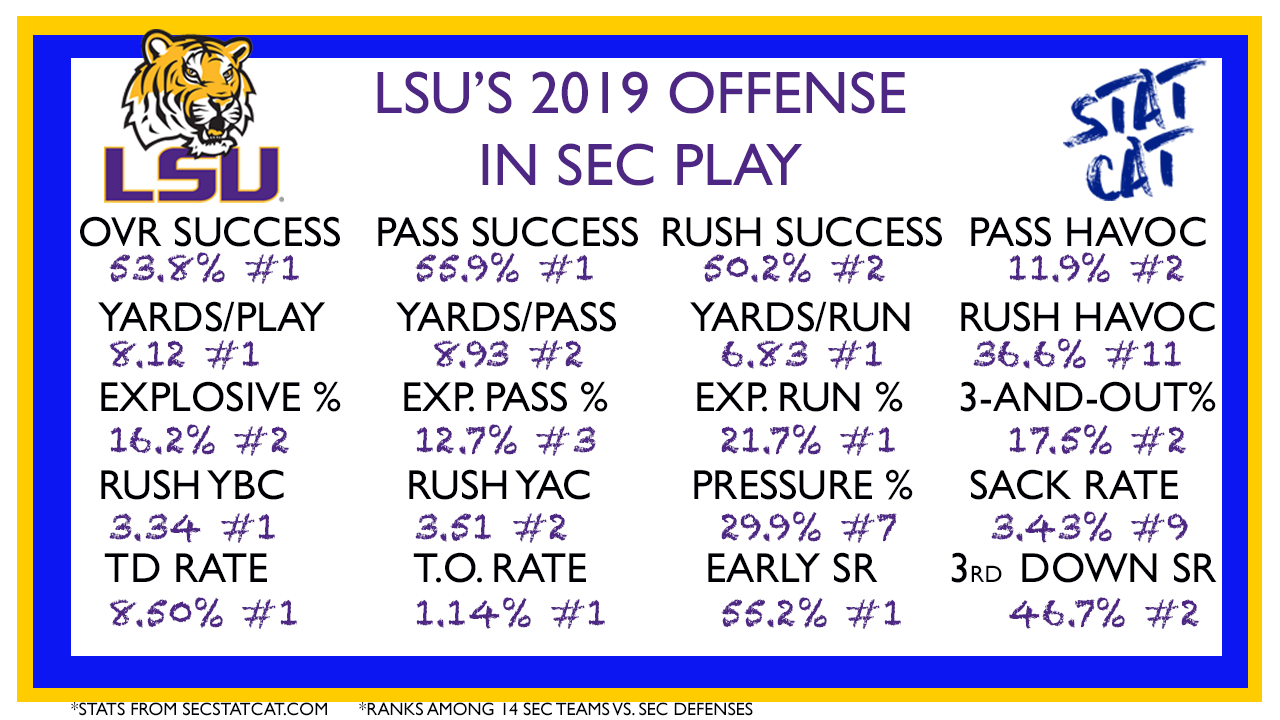
Outside of Austin Deculus at right tackle, the Tigers will have a brand new group upfront. Despite LSU owning the SEC’s top Passing Success Rate and 2nd-best Rushing Success Rate, LSU’s hog-mollies had their flaws. Maximizing pass outlets often left their line on an island, which resulted in plenty of pressure. While some plays that broke down weren’t on them, LSU’s 29.9% Pressure Rate placed 7th and 3.43% Sack Rate 9th within SEC play last year. Those figures would undeniably have been worse with an Average Joe facing that kind of heat. Burrow’s tricks were enough to offset that. If those numbers persist with a stiffer passer and a greener line, LSU will fall out of title contention.
LSU’s run blocking vastly improved against SEC foes year-over-year. Though timely audibles against compromised fronts paired with LSU’s potent passing game unequivocally helped run lanes come easier, LSU’s line led the conference in creating cushion. Their 3.34 rush yards before contact average even bested UK’s Big Blue Wall for SEC’s best in that regard. If the Tigers can average above three yards in 2020, they’ll be in a great spot. While that’s setting the bar awfully high for a mostly new line, even reaching a 2.7 clip should be enough to keep the Bayou Bengals offense efficient on the ground. If it's average or worse, regression is on the horizon.
Key Offensive Team Stats in SEC Play:
The most important stats for LSU to maintain against SEC defenses are its Touchdown Rate and Turnover Rate. Both clips led SEC play last year. LSU’s down-to-down offense was as good as any offense in the history of the game. Asking LSU to do that back-to-back seasons with plenty of new characters is unreasonable. But with Chase and Marshall in the mix, the Tigers still have the potential to score on any snap. LSU’s 8.5% Touchdown Rate was basically 8x better than their 1.14 Turnover Rate. Maximizing scoring plays while not putting the ball into harms way will make the transition from Burrow to Brennan less rocky.
The most important stats for the Tigers to improve against SEC defenses are its Pressure and Sack Rates. As aforementioned, LSU’s scheme can ask lineman to work alone. Brennan is less athletic and less tested. Providing him with ample clean pockets will be crucial in his development as well as his overall passing production. If he’s constantly firing from odd angles or running for his life, LSU can be had in this all SEC slate. Plus, Brennan is bound to be forced into more mistakes in these spots than when operating clean. If this offense is put behind the chains with an early down sack, I don’t have much confidence in Brennan digging his unit out of holes consistently at this point in time.
Key Defensive Team Stats in SEC Play:
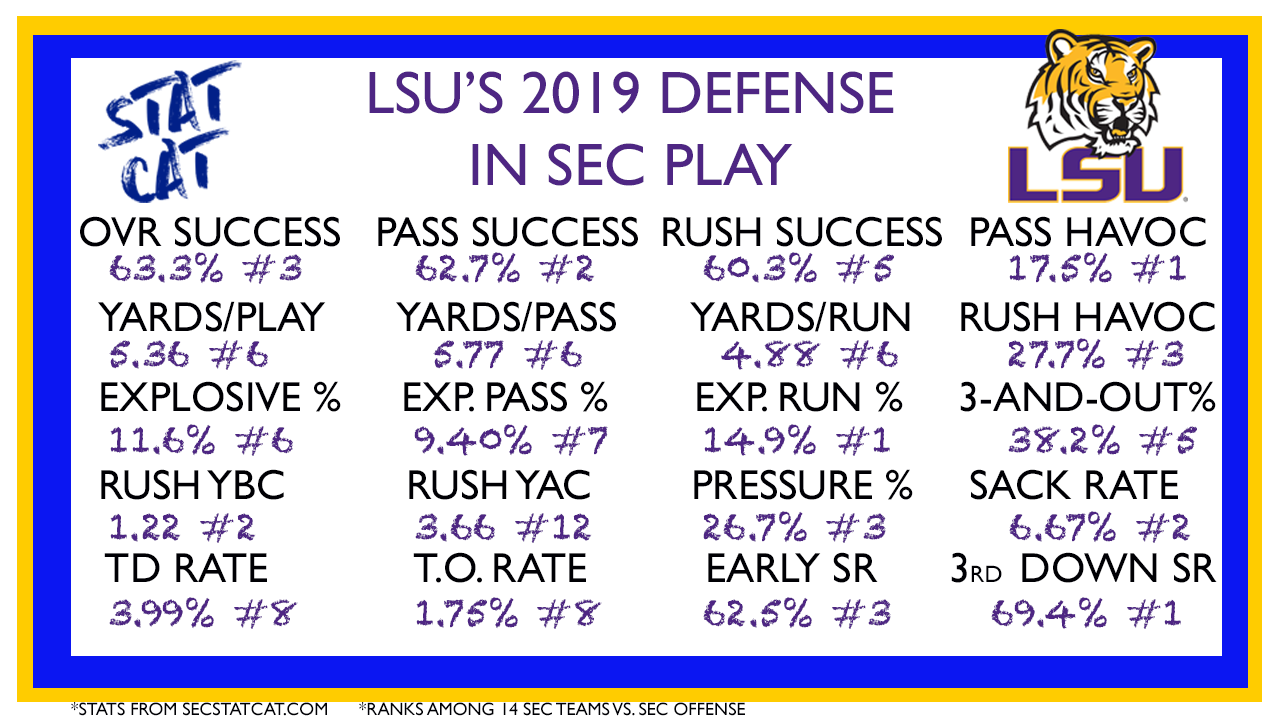
The most important stats for LSU’s defense to maintain against SEC offenses are its Pass Havoc Rate and 3rd Down Success Rate. No conference defense disrupted opponents’ passing games by generating pressures, sacks, deflections, or interceptions as well as LSU. With more obstacles creating mess, getting into a groove offensively against this bunch wasn’t easy. Moreover, hurrying a quarterback into an inaccurate throw or risky placement will help with takeaways and momentum-altering attempts. With so many other metrics stealing the spotlight, LSU’s 69.4% 3rd Down Success Rate versus conference opponents was an overlooked stat in its rise to dominance. Like most of their 2019 stats, it will be a challenge to replicate. But keeping foes off the field and out of rhythm will only boost this team’s trajectory.
The most important stats for LSU’s defense to improve versus conference offenses are its Touchdown Rate allowed and Takeaway Rate. Both metrics placed 8th within SEC play last year. Luckily, LSU’s high-powered offenses hid these shortcomings by decimating adversaries. The margin for error on scoring plays and failing to create extra possessions will certainly be smaller in 2020. Still, if the Tigers can disrupt pockets and pass attempts akin to their output last season, forcing turnovers could be a nice byproduct of creating Havoc. Switching to the 4-3 might cause this group to start slow, but play makers are still on that side of the ball. There is no magic formula for generating takeaways, but doing those kind of things couldn't hurt.
LSU's 2020 Schedule:
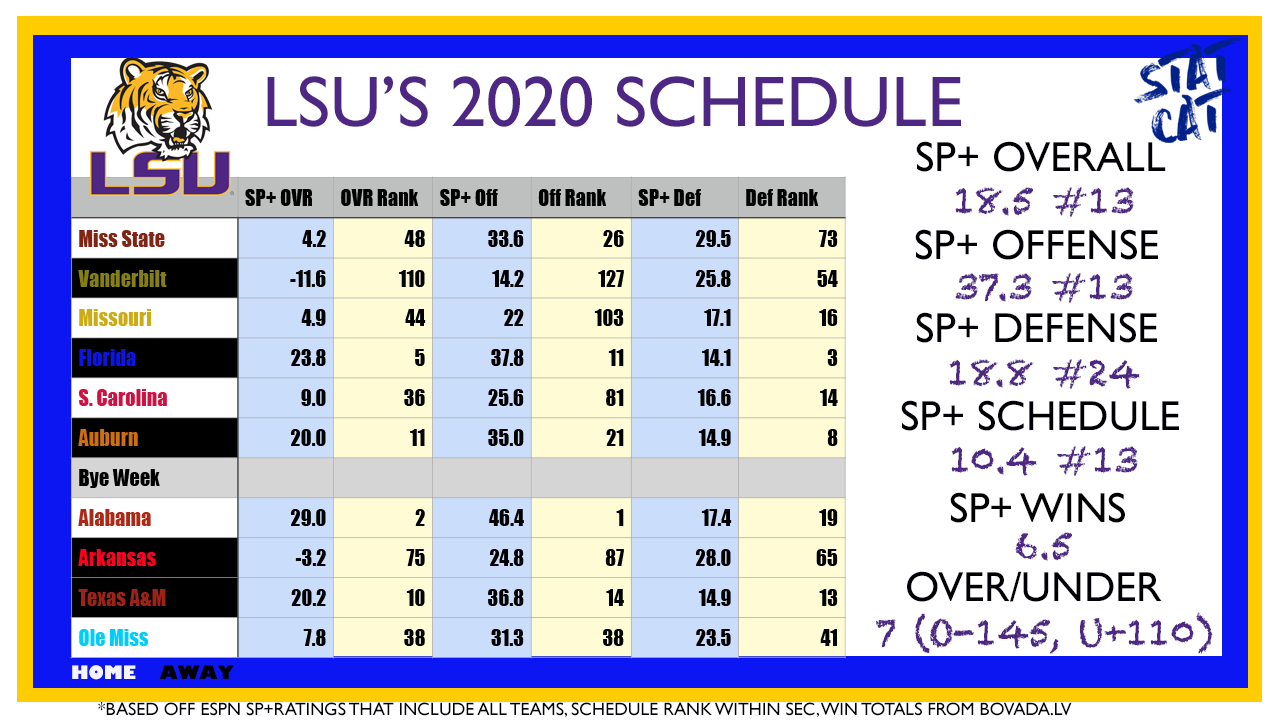
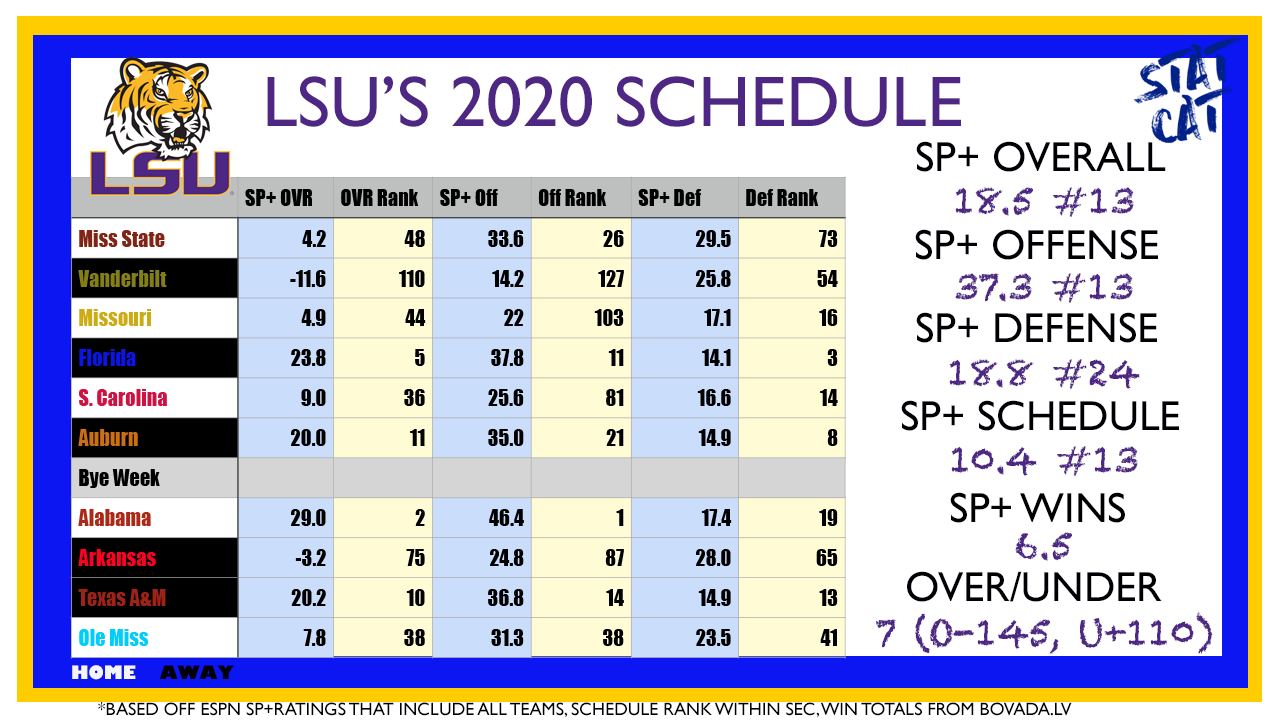
The defending national champs were gifted the 2nd-easiest schedule in the eyes ESPN's SP+ Ratings. That certainly is a sweet pill to swallow considering only two teams set to play this fall return a lower percentage of their production year-over-year than LSU. Along with naturally playing SEC West foe Arkansas, who stands to be the worst team in the division, the Tigers get to face the East's two bottom-feeders in the first three weeks of the season. Plus, they open against the only SEC defense that ranks worse than 70th in the preseason SP+ Defensive Ratings. Unfortunately, we might not know if this team if for real until their Week 4 tilt with the Gators. Plus, this game starts their toughest stretch of the season with three defensive opponents top20 in the SP+. Captain Obvious tells me away games at both Florida and Auburn stand to be heavily contested matchups even if momentum has faded for LSU. The Crimson Tide will be waiting on the other side of the bye week. Even if the Tigers lose their first two big games, they can stay alive if they win out. Lose this one and the season might be lost. Vegas set their intial win total at 8, but it has sense shrunk to 7 the last couple of weeks. Though the odds are still weighted toward the under, money is there to be had if you want to bank on the recent downturn in optimism around the Tigers. Only three SEC teams cracked the top13 in the Offensive SP+ Ratings, and the Tigers were one of them.
LSU is favored by the SP+ in six of their games, which falls below their over/under win total. But, four of those six have projected 3-score margins. Three of those four matchups come the first three weeks of action. Mind you, this is not the gambling line, but rather a margin predictor. Ja'Marr Chase's recent bow-out is undoubtedly going to make their trajectory more grounded moving forward, but such an easy start is vital for them to get in a groove as a team. More than half of LSU's defensive opponents rock top20 units. If there was ever a recipe for regression, this it is. But the Tigers project to have a fighter's chance. While their offense might have a difficult road ahead, LSU's defense gets to face the worst units the SEC has to offer. South Carolina, Arkansas, Missouri, and Vanderbilt all rank 81st or worse in the preseason ratings. Both Vandy and Mizzou sport offenses in the triple-digits.
Before I soldier on, I probably should explain what the SP+ Ratings are a little bit. Defining the SP+ in a single sentence, it's a tempo- and opponent-adjusted measure of college football efficiency. ESPN's Bill Connelly's metric is intended to be predictive and forward-facing. That is important to remember. It is not a résumé ranking that gives credit for big wins or particularly brave scheduling -- no good predictive system is. It is simply a measure of the most sustainable and predictable aspects of football. If you're lucky or unimpressive in a win, your rating will probably fall. If you're strong and unlucky in a loss, it will probably rise. Using the initial ratings, let's check out how Alabama's schedule stacks up.
WEEK 1:
Mississippi State @ LSU: Projected Margin LSU by 17
The defending national champs enter Week 1 as three-score favorites despite a boat load of departures and recent opt outs. KJ Costello and the Air Raid could make things interesting, but Miss State doesn’t have a deep cupboard of weapons. Plus, their line was one of the worst pass blocking units in SEC play last year; important aspects for a pass-happy offense to function normally. Dave Aranda no longer leading LSU’s defense, however, could result in a slow start for the Bayou Bengals. After all, LSU’s defense really didn’t turn it on until the last quarter of the season last year. Still, Derek Stingley Jr should do his part to keep the Air Raid grounded. On the other side of the ball, the Bulldogs allowed the 2nd-highest Explosive Play Rate versus SEC offenses last season. Plus, no defense projects to be worse in the SP+. Hard to pick a better first opponent for an overly green LSU offense all else considered.
WEEK 2:
LSU @ Vanderbilt: Projected Margin LSU by 27
This game is likely to have a similar result to last year’s blowout in Nashville. While there might be concerns about Myles Brennan and how soon the Tigers can get going offensively, Vanderbilt virtually has no proven dependability from any offensive skill player. While Tiger fans will groan having only the 13th rated offense to start the year, Vandy’s comes in at 127. And I shouldn’t need to remind you about the ‘Dores’ porous defense. Though the SP+ thinks it improves year-over-year, it will be no match against LSU’s playmakers. Vandy might be able to get some touchdowns like last year, but it’s hard to justify any scenario where this baby is close.
WEEK 3:
Missouri @ LSU: Projected Margin LSU by 18.5
The easy slate for LSU continues as they host Missouri. For an offense that needs to get its passer up to speed, LSU’s first three weeks are crucial if they want to get to a title-contending level again in 2020. And, that was before the recent opt outs. Versus Mizzou, the Bayou Bengals should have no trouble winning. I think most fans will be interested to see how LSU wins. If the offense is still trying to find its footing or the defense is still working through the transition to the 4-3, it might be closer than expected. Despite a top20 defense, Missouri is the 2nd-worst SEC offense with a not-so-good outlook at its quarterback position. While their offensive margin of error is super slim, Missouri’s defense has the potential to hang with the Tigers. But at the end of the day, the home team should rule the day.
WEEK 4:
LSU @ Florida: Projected Margin Florida by 8.5
According to the initial SP+, this game set up to be one of the more competitive games in the SEC all year. Then the opt outs came. Now the Gators are projected to win by over a touchdown. Much of the focus will be on the Gators iffy pass defense. Florida’s D sported the 6th-worst Passing Success Rate and an Explosive Pass Rate outside the top5 in SEC play. Creating Havoc, however, would allow the Gators to take control of this game. Joe Burrow erased plenty of sacks and broken snaps. Myles Brennan is far less proven on that front. And an overly new line versus a scheme that gets plenty of sack favors the Gators. Still, the UF’s offense can hold its own assuming they can take care of the ball. Florida is better on both sides of the ball to start the season per the SP+. As LSU’s first top20 opponent offensively, Florida is the first major test for the Tigers’ newly-installed 4-3 scheme.
WEEK 5:
South Carolina @ LSU: Projected Margin LSU by 12.5
Thanks to the recent roster shakeups, South Carolina will have a fighter’s chance in Death Valley. Led by their 14th-ranked defense, the Gamecocks face the Tigers a week before they play Auburn. With the Bayou Bengals’ high number of departures, LSU’s offense dropped from the top5 to 13th in the SP+ since February. If South Carolina’s toothless offense molds a serviceable identity by this point, things could get interesting. Still, underestimating LSU is a luxury South Carolina certainly cannot afford. Though an adequate defense in a few spots, South Carolina’s ability to prevent explosive passes and generate pressure was on the lower end in SEC play. Myles Brennan with time, should be able to deliver nice results. Expectations for SCar’s offense are one of the lowest in the conference. With lackluster passing and few apparent play makers, the Gamecocks will probably be well-contained by LSUs top25 defense.
WEEK 6:
LSU @ Auburn: Projected Margin Auburn by 4.5
The initial SP+ projected this bad boy to be a pick em. But, things change. The Steele Curtain was basically the only defense that slowed down LSU’s historic attack last year. Auburn should be able to mess with Myles Brennan and his mostly new supporting cast a little more successfully. If War Eagle is able to pester and agitate, they should be able to defend their home turf. By this point in the year, we’ll know whether the scheme changes for LSU’s D and Auburn’s O will be liabilities or allow them to stay in contention. If LSU can win early downs and sport top2 Pressure and Sack Rates like they did in SEC play last year, they could seize this minor upset. Plus, LSU’s secondary certainly has the potential to shut down Seth Williams, Anthony Schwartz and Eli Stove. It just depends on if the Bayou Bengals’ offense can find a way to fox one of the best defensive minds in college football.
WEEK 7:
BYE WEEK
WEEK 8:
Alabama @ LSU: Projected Margin Alabama by 7.5
One of the most anticipated games of the season and the highlight of Week 8, Alabama will travel to Baton Rouge looking to avenge last season’s loss. Like last year, the SP+ likes the Tide by a modest margin. Since the initial SP+ released in February, both LSU’s offense and Alabama’s defense dropped in the rankings. Regardless, the Tide enters better on both sides of the ball. Alabama will be LSU’s fourth straight top25 defensive opponent. If Brennan can get the Bayou Bengals to this point unscathed, obviously it would be quite an achievement. LSU will live or die based on how well its offense preforms. Their defense looks to be good not great. Regression at this point is all but certain for them on both sides of the ball. That said, the Tigers have potential to win any given Saturday. The Tide’s Defensive Explosive Pass Rate led the SEC last year, which is worrisome for LSU. Though Alabama has a preferable margin in every one of its games, ESPN’s metrics project the Tide to lose two games. While they should enter as comfortable favorites, a road game against quality team is no sure thing for Alabama.
WEEK 9:
LSU @ Arkansas: Projected Margin LSU by 18.5
After traveling to the Swamp, Sam Pittman’s bunch has to turnaround and host the defending national champs. Like you would expect, the SP+ view the Razorbacks as big underdogs in this one. The recent opt outs shrunk this margin by nearly a touchdown, and still LSU is favored by three scores or so. Outside of Mississippi State in Week 1, the Hogs present to be the Bayou Bengals’ least-challenging defensive opponent in the eyes of the preseason SP+ Ratings. Considering the the perception of LSU’s offense, this could be a boat race if the Tigers aren’t crestfallen from their game versus Alabama. Arkansas’ 87th ranked offense seemingly poses little threat to LSU’s top25 defense. But road conference games are never to be taken for granted.
WEEK 10:
LSU @ Texas A&M: Projected Margin Texas A&M 4.5
The last time these two met in College Station, nearly 200 plays from scrimmage occurred and the D-1 record for combined points in a game was set. The SP+ thinks the 2020 tilt between the Tigers and the Aggies will be just as contested as the game two years ago. We probably won’t see 146 points again, but it still looks to be very entertaining. This game opened as a true pick em in the initial SP+, but recent opt outs have given more of an edge towards the Aggies. Used shouldering the load, Kellen Mond won’t be able to take down the Tigers by himself. Simply put, his guys must be better after the catch, in the open field, and playmakers with the ball in their hands. If Mond has to play Superman, LSU should be well-positioned to make the Aggies pay. While there’s a good case for LSU’s defense to regress some transitioning to the 4-3, the Tigers’ D sported the 2nd-best Pressure and Sack Rate with the best 3rd Down Conversion Rate in SEC play. TAMU surrendered a bottom4 clip of the two formers and were just average in SEC play on the money down. Still, being at home and trotting out a more “balanced” team has the numbers in the Aggies’ corner.
WEEK 11:
Ole Miss @ LSU: Projected Margin LSU by 14
Though the Tigers will be significantly favored in their Week 11 closer versus the Rebels, this game is no gimme. Sure, the Tigers raced out to a big lead last year and won comfortably. But Ole Miss’s run game busted plenty of big runs and showed this team has the potential to gash anyone when their guard is left down. LSU’s offense should be able to propel them in a likewise fashion in 2020, but it will clearly have more holes and flaws. Even last year, the Tigers were bottom3 in rush yards after contact with the 6th-worst Tackle Rate and Explosive Run Rate in conference play. Ole Miss should look long and hard at those numbers. An explosive pass game should best an explosive run game all else considered, but Ole Miss will be seeking a golden capper on Lane Kiffin’s first year in Oxford and will undoubtedly play to its strengths against the defending champs. Much can change around both programs before then. While early momentum has shrunk this margin, LSU still has plenty of talent to walk off with a win at home.
For more information on LSU's schemes, scripts, and stats visit the following links: