2020 Vision: Auburn
2020 Vision: Auburn
Auburn unquestionably is one of the better programs in the SEC, but it's still not elite. While Gus Malzahn's pace and space helped bring SEC offenses out of the stone ages, the competition has caught up and War Eagle has overly lost its edge offensively. Sure, the Tigers still put up plenty of points and yards. But in their most crucial contests as of late, their defense has carried the mantle. One of the biggest offseason moves within the coaching ranks was Malzahn bringing on his buddy Chad Morris to run Auburn's offense. Despite the trainwreck he orchestrated in Fayetteville, Morris is still thought of as a QB whisperer and someone who could maximize Bo Nix. While the RPO-laded scheme and rock-steady defense will still be Auburn's identity, this team will be taken to a whole other level if its offense can hum against good defenses. In this preview, you see how Auburn's key offensive returners stack up to other SECers, important stats for the Tigers to improve or maintain on both sides of the ball, and how its schedule stacks up per ESPN's SP+ Ratings.
Passers:
Bo Nix is the reigning SEC Freshman of the Year, but he still has a long way to go as a passer. Coached to attack predominately outside the numbers and put the ball where only his guys could get it, most of Nix’s stats were middling relative to the rest of the conference. A good deal of his numbers were skewed by his offense’s affinity for RPOs. Auburn used such designs on over a third of their plays and no SEC quarterback topped Nix’s 24.1% RPO Throw Rate. Even when you evaluate him from clean+dropback situations, Nix still projects to be outside the top5 within the SEC in the major passing metrics. Overall among 9 SEC returners with 80 attempts last season, Nix finished 7th in Success Rate and First Down+Touchdown Rate, 6th in Explosive Pass Rate and Depth Adjusted Accuracy%, and has the 8th-worst Uncatchable Pass Rate.
But, the Plainsman does standout in some spots. He will be one of the conferences best deep ball passers by both volume and placement. No SEC returner will top his 738 yards to 8 TDs in those respects. Both of Nix’s deep Depth Adjusted Accuracy% and Yards/Attempt are the conference’s 2nd-best. This is something to keep an eye on as this wasn’t just a fluke versus cupcakes. Against SEC defenses, Nix’s Deep Completion% and Accuracy% were top5 figures. Regardless of opponent, he averaged roughly 4.5 deep attempts a game. Of course, how exactly he’ll be used during his sophomore campaign remains to be seen with Chad Morris orchestrating Auburn’s offense.
Catchers:
Seth Williams will enter 2020 as Auburn’s best offensive player. Amongst SEC returners, he commanded the 3rd-most targets and sits inside the top5 in yards, catches and scores. As Bo Nix’s favorite target, he saw 25 deep chances and 33 3rd Down tries. Both are the second most ahead of this fall within the conference. Yet, Williams failed to finish as one of the most successful targets in either facet. Looking at his play versus SEC defenses, both his 8.46 Yards/Target and 47.5% Success Rate were middling albeit on the good side of the conference average. Point blank, Williams will have to play more efficiently. Some of that falls on him and some falls on Nix. Posting a sub-54% Catch Rate while seeing triple-digit targets again is not a great formula to improve a middling pass game. Maybe Auburn fans clamoring for more patterns targeting the middle of the field will get their wish as Williams' frame allows him to be targeted all over the gridiron.
Anthony Schwartz frequently gets labeled as one of the fastest players in college football. For such a renown speedster, it’s odd he can’t win deep more often or generate more breakaway catches. Will Hastings saw as many as his 10 deep targets last year. Schwartz only caught three of his such chances. Those were his only catches to go for 20+ all season (Little ole Hastings himself compiled four). Of course, Malzahn got him involved in other ways like decoying on motions or taking jet sweeps or around the edge. With more emphasis closer to the line of scrimmage, Schwartz’ 76.4% Catch Rate and 54.6% Success Rate led the team. Versus SEC defenses, both of his clips sit inside the Top8 among returning conference receivers. While the consistency is nice, his speed needs to produce more potency especially if foes chose to double Williams or hone in on Auburn’s run-first approach. Auburn's 7.91% Explosive Pass Rate ranked 7th last season in SEC play.
Eli Stove from the slot is the definition of an outlet receiver. Despite a top3 YAC average amongst SEC returners in league play, only Ole Miss’s Jonathon Mingo sports a lower Yards/Target than Stove’s 5.00 clip entering 2020. Only a third of his targets found success against SEC opponents, which is good for the 4th-worst clip. Perhaps the most damning of all, no returner owns a worse Depth Adjusted Catch Rate than his 35.6% figure. FYI, that stat omits uncatchable passes and applies more weight the further a target is downfield. Stove’s role within this offense is set, but perhaps Morris will tweak some things and allow others to get touches instead. But outside of Auburn's three main returning receivers, no one else in its ranks carries any statistical weight on their profile. Still, newcomers surprise in this conference each year. Morris could also alter the preferred M.O. surrounding Auburn's RPO route tags, which overwhelmingly have been slot bubble screens. Sending Stove or whomever is lined up inside beyond the line of scrimmage more often should be a good place to start in order to generate more potency.
Involving tight ends and H-backs in the passing game isn’t something Auburn does under Malzahn. John Samuel Shenker is the presumed “sniffer” but I don’t think he’ll line out wide too often. Though Morris had a pretty good tight end in Cheyenne O’Grady at Arkansas, his play calling didn’t really help COG reach his potential. And for what it's worth, Arkansas lined up in 12 personnel less often than Auburn did last season (15.8% vs 21.6%) Plus, only Texas A&M utilized more 10 personnel than Auburn last year. I feel it will be more of the same barring a “Leak” concept every once in awhile even if there has been plenty of talk of involving TEs more besides just blocking.
Rushers:
The transfer of JaTavious Whitlow means Auburn will go with a committee approach with its backs in 2020. While Whitlow was versatile and equipped to shoulder the load of their run game, Auburn’s other backs had more defined roles. DJ Williams saw 61% of his carries come off zone looks and over 66% Shawn Shivers’s tries were off powers. Despite missing over a month of play, Whitlow logged 72 more carries than Williams and 100 more than Shivers. Take Kam Martin and Joey Gatewood out of the equation and those two will certainly see an increased workload this fall.
Sophomore DJ Williams appears to be set up for the lion’s share of the Tigers ground touches. But his freshman year output doesn’t justify that. His 2019 Success Rate was a bottom5 clip and no conference ball carrier with at least 40 carries sported a worse Explosive Run Rate than his 5.95% clip. But, his workload was undeniably made harder thanks to early defensive engagement. Williams’ 1.46 yards before contact average was a bottom5 figure against conference defenses. He’ll post better overall numbers if he’s given more room especially if he can replicate his middling Broken Tackle Rate and top7 yards after contact average like he did versus SEC foes in 2019.
Shivers mostly works as a power back or as a red zone jet sweep player. The latter created one of the most popular Iron Bowl highlights in recent years. While those elements helped him sport the team’s best yards before contact clip, his Success Rate was mediocre while his First Down+TD Rate, Broken Tackle Rate, and Gumption Rate all fell into the bottom8 of conference rushers. Amongst returning backs, his 2.08 YAC average was bottom5 and his 34.7% Success Rate is bottom7 in league play. At least, his 15.9% Explosive Run Rate finished above the conference mean. Neither Auburn’s heir apparents excite analytically. That means some freshman could see some touches. As of now, redshirt Mark-Anthony Richards and true first-year Tank Bigby are the names to keep an eye on to round out their running back room.
Most of Auburn’s inflated rushing numbers are thanks to Bo Nix keepers. While a 10-plus yard carry was seldom, Nix’s Rushing Success Rate and First Down+TD Rate versus SEC foes are top5 figures amongst returners for 2020. Anyone would be stupid to pass that kind of production up even if Nix was fairly prudent on his keeps. Obviously, that's something that can't be manipulated into happening on command, but that element is always nice to have. It may not come to fruition much, but the threat of his keeps will lie dormant in the back of the minds of defenders and their play callers. Still, the Tigers need to find more traditional ways to move the ball on the ground consistently with their two main backs.
Glancing at the O-Line:
With the aforementioned lack of room for their backs, it will be paramount for Auburn’s line to improve forging run lanes. Jet Sweeps, reverses and QB runs highly distorted the team’s 2.41 rush yards before contact average against conference defenses last year. This unit, however, certainly helped prevent Havoc and negative runs. Outside of Nix who owned one of the SEC’s highest Negative Run Rates, all other Auburn rushers with at least 20 carries saw less than 7% of their tries result in a loss. Auburn’s 24% Run Havoc Rate allowed versus conference foes earned the bronze medal. Likewise with a top4 Sack Rate, their 25.9% Pressure Rate allowed was 2nd-best. Auburn will have five new faces upfront, which could exacerbate last year's shortcomings and upend the few things this group did well. While gadgetry might help create more cushion, the Tigers will have to win between the tackles more unless they once again want to be an overly pedestrian SEC offense. Plus, it should go without saying that Chad Morris' first year on the Plains won't go so smoothly without adequate blocking upfront. Auburn's five projected starters left to right are Austin Troxwell, Tashawn Manning, Nick Brahms, Akron grad-transfer Brandon Council, and Brodarius Hamm, who is on the First-Team All SEC Name Squad.
Key Offensive Team Stats in SEC Play:
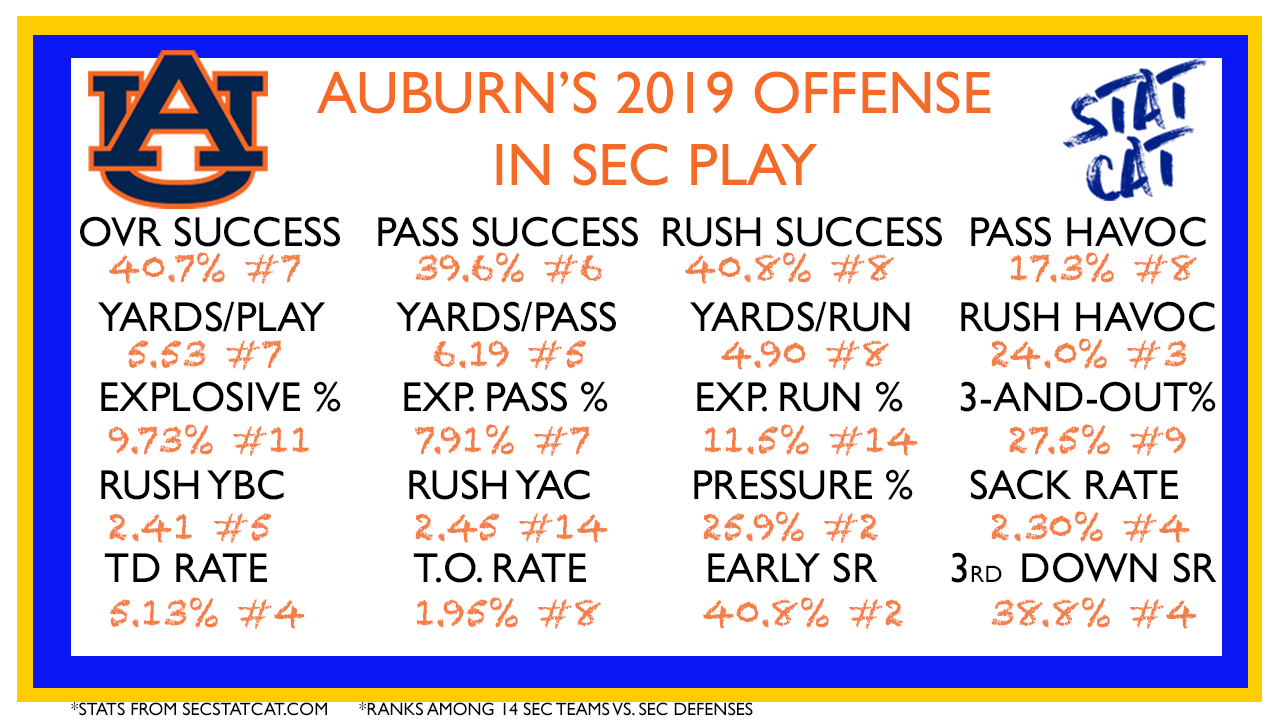
The most important stats for Auburn to maintain against SEC defenses are its Pressure Rate and Touchdown Rate. Though exactly what Auburn runs this year is yet to be determined, one of Morris’ Run and Shoot tactics is to maximize passing outlets and minimize protections. Asking five new starters to hold their own with no help might bomb. But either way, Auburn has to keep Nix upright for this mashup to work out. And while the Tigers' offense might once again be plodding, tacking on touchdowns will fabreeze any scheme. Largely a forgettable down-to-down offense, Auburn surprised with top4 a Touchdown Rate and points/play clip versus SEC defenses last year. Their stingy defense becomes all the more dangerous when Auburn operates with a lead or if they are jolted by a long scoring play from its offense.
The most important stats for Auburn to improve against conference defenses are its Explosive Play Rate and early down Success Rate. With their overall clip falling into the SEC’s bottom4, no team owned a less potent run game in league play as Auburn. “Death by 1,000 paper cuts” certainly can wear down opponents, but explosive plays correlate more the victories. Plus “four yards through a cloud of dust” by definition sets you up to play plenty of 3rd Downs. The best 3rd Down offenses are ones that avoid 3rd Downs the best. Last year, the Tigers’ 40.8% early down Success Rate placed 9th within the SEC.
Key Defensive Team Stats in SEC Play:
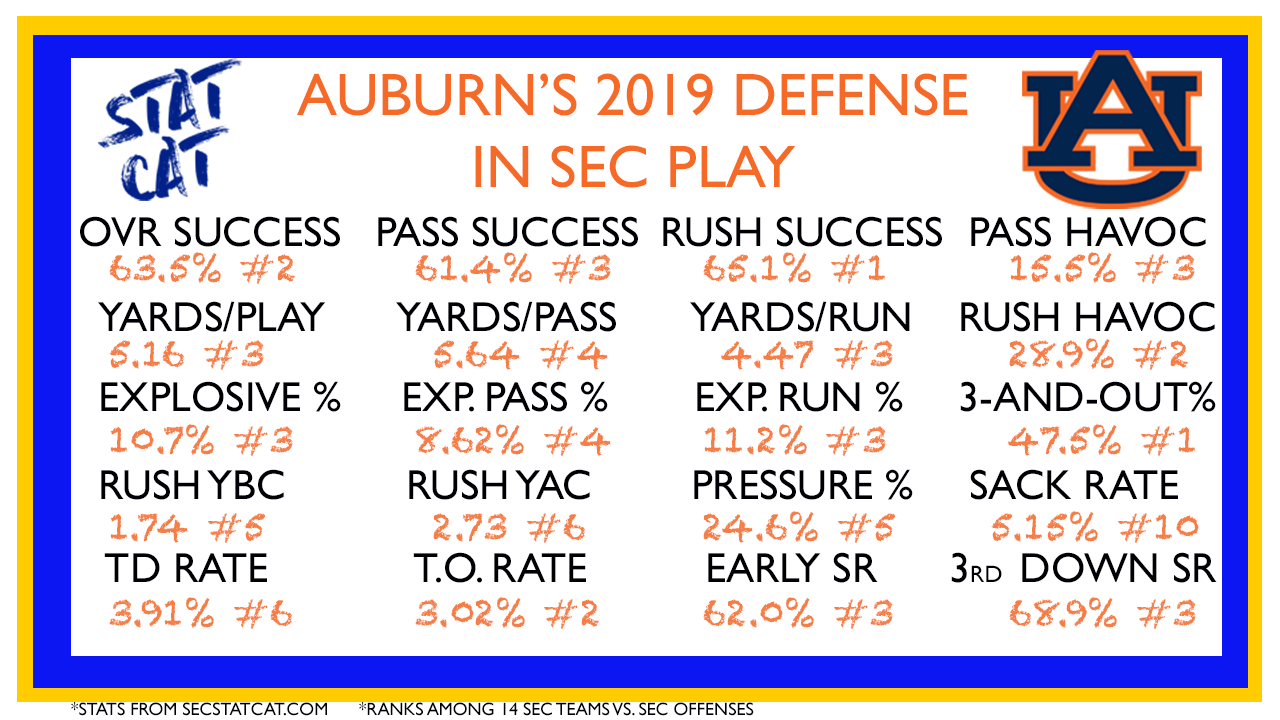
The Steele Curtain will once again be Auburn’s backbone. Last year, they were top3 in the majority of defensive metrics against SEC foes. But the most important stats they must maintain will be their Explosive Play Rate and their Takeaway Rate. As good as their defense was down-to-down, being elite in those areas will better help cover their offense’s ass in case it stalls or stutters. In games the past two seasons in which at least one SEC participates, the winner of the explosive play battle was won 75% of the time. Replicating turnovers usually doesn't carry over from one year to the next. But if War Eagle is able to be just as advantageous in that regard in 2020 as they were last year, Auburn should be able to get to seven wins.
The most important stats for Auburn’s defense to improve versus conference offenses are its Touchdown Rate allowed and Sack Rate. Both placed 6th and 10th, respectfully last year in league play. While as good as anyone down-to-down, they simply need to be more prolific at game-altering plays and preventing opponents to hang around for extended drives. If Auburn's defense wants to be one of the best in the sport, they cannot surrender a TD Rate outside the top5 in SEC play two years in a row. If their high Pressure Rate is maintained, sacks should come and takeaways might. Considering how mighty the Tigers' run defense looks to be, more teams will be inclined to dropback against them, which is all the more reason for them to improve disrupting opponents' pass games.
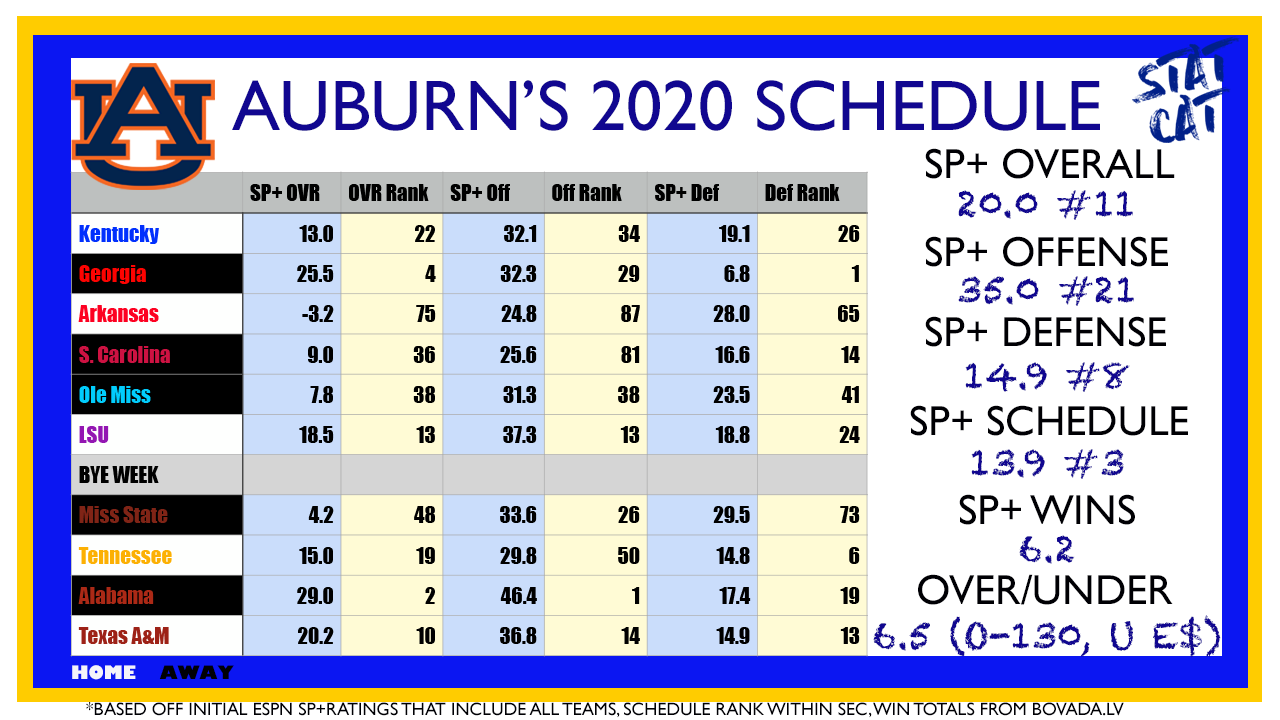
Auburn's 2020 Schedule:
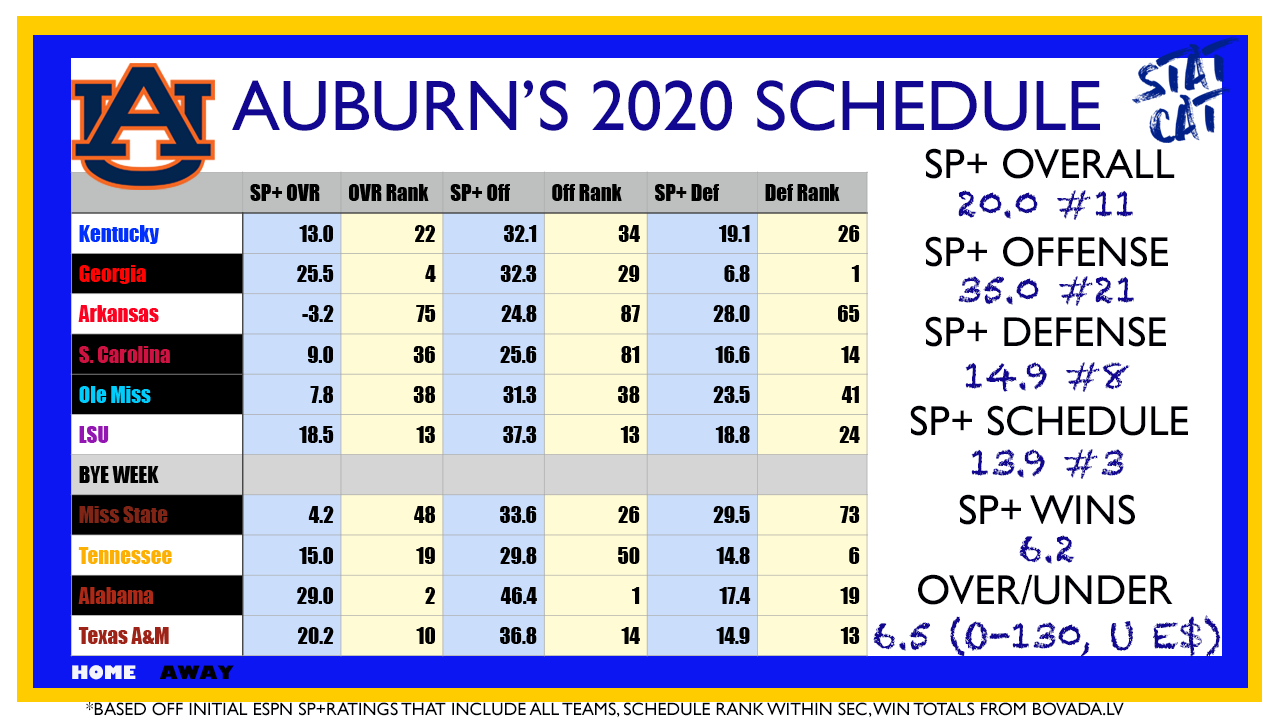
To the folks' on the Plain chagrin, Auburn will have to soldier through one of the conference's hardest schedules. Only Vanderbilt and Arkansas project to have more challenging slates per the preseason ESPN SP+ Ratings. Their "average rating faced" indicates Auburn is essentially playing a team akin to Michigan every week. While playing both their main rivals on the road is one thing, both Alabama and Georgia open as the conference's two highest rated teams. The Tide boasts the top offense with the Dawgs' championing the top defense. Plus, War Eagle will host four top25 teams, three of which are preseason top20. And, Auburn's last three weeks are absolutely brutal. Despite the trials ahead, Vegas set their win total at 6.5. As is, the SP+ projects the Tigers to be a favorite in eight of their ten games, but the model set their under/over win total at 6.2. Both the LSU and Texas A&M matchups look to be Auburn's closest contests; each game projects the Tigers to win by less than five points.
The metric is a firm believer the Steele Curtain Defense will pick up where it left off. Though donning the 3rd-best defense in the first SP+ Ratings released in February, Auburn fell to No. 8 in the updated rankings. While there's a tad of pessimism due to losing some dudes to the pros, this unit still has the potential to be elite. No defense in SEC play was better at stopping the run on any given down or forcing 3-and-Outs than the Tigers in 2019. This team will go as far as this unit will take them. While Alabama is a top10 preseason offense, the Tigers will only have to face three others in the top30: LSU, Mississippi State, and Texas A&M. Three offensive opponents fall outside the top50. That means a good amount of their games could set up to be low-scoring rock fights, which favors the Steele Curtain considerably.
But while Auburn's defense will unquestionably be this team's backbone and identity, much of the offseason narrative has followed Bo Nix's progression as a passer and the addition of Chad Morris to its offensive staff. Though they could score points, Auburn was overly a mediocre SEC offense in conference play last year. Most feel Morris will institute more Run and Shoot tactics into the Tigers' heavy-RPO scheme. What exactly he has planned, obviously, is yet to be seen. A good portion of Auburn supporters have been calling for more downfield oriented route tags off read options and more patterns that attack towards the middle of the field. For a new scheme, starting five new lineman will undoubtedly make things more difficult. Half of Auburn's defensive opponents rank inside the top20 to start the season.
Before I soldier on, I probably should explain what the SP+ Ratings are a little bit. Defining the SP+ in a single sentence, it's a tempo- and opponent-adjusted measure of college football efficiency. ESPN's Bill Connelly's metric is intended to be predictive and forward-facing. That is important to remember. It is not a résumé ranking that gives credit for big wins or particularly brave scheduling -- no good predictive system is. It is simply a measure of the most sustainable and predictable aspects of football. If you're lucky or unimpressive in a win, your rating will probably fall. If you're strong and unlucky in a loss, it will probably rise. Using the initial ratings, let's check out how WarEagle's schedule stacks up.
WEEK 1:
Kentucky @ Auburn: Projected Margin Auburn by 10
One of the most intriguing Week 1 matchups, UK’s Big Blue Wall will square off against the Steele Curtain Defense. It’s no secret the Wildcats live and die off their ability to run the football. Against SEC defenses last year, no team sported a lower Run Havoc Rate than UK. Plus, their rush yards before contact average and Explosive Run Rate were top3. But Auburn defense was the most successful versus the run while donning the 2nd-best Run Havoc Rate in SEC play. If Auburn can enforce their 47.5% 3-and-Out Rate against conference offenses from last season, UK’s ball control game plan will unravel. While the narratives on the other side of the ball also matter, the Cats won’t deliver the season’s first upset bid if they fail to forge run lanes on the Plains. As it is, the SP+ views them as a double-digit dog to start the year.
WEEK 2:
Auburn @ Georgia: Projected Margin Georgia by 8.5
This is set up to be a good one. The Deep South’s Oldest Rivalry rarely isn’t. Georgia’s defense should be well-equipped to manhandle Auburn’s offense and get under Chad Morris’ skin. I just don’t see five new O-Lineman forging serviceable holes against the best defense in the nation. Though I’m positive Gus will have a fun wrinkle, the Dawgs are set up to shut down Auburn. But Georgia’s offense will have a similar disadvantage of sorts. With a new quarterback, play caller, and lead back, it’s a hard ask to dominate a top8 SP+ defense this early in the season. Obviously, both teams will bank on great defensive play. While these two defenses open close to one another in the SP+, the gap between them is over 8 points. Meaning, versus an average college offense on a neutral field, UGA’s defense projects to surrender that many less points than the Tigers. As you can tell, that lines up perfectly with the projected margin. Such an early season clash is bound to be ugly. Most battles between two top10 defenses are.
WEEK 3:
Arkansas @ Auburn: Projected Margin Auburn by 26
After a couple of rough weeks to start their year, Auburn will get to knock around the Razorbacks at home. Auburn’s offensive woes against higher-ranked teams are well documented, but the Tigers should have no issues dismantling the SEC’s 2nd-worst defense in the SP+ ratings. Obviously if they are able to split or win both of their prior games, War Eagle will be flying high. This will be a back-to-back road trip for the Hogs who simply don’t match up well against Auburn’s Steele Curtain defense. Arkansas’ only hope is a major offensive regression from the Tigers due to a new scheme and O-Line. If dysfunction persists throughout Auburn’s first month of the season, perhaps Arkansas can hang around longer than expected. Still, Auburn will be a heavy favorite against a team that hasn’t won an SEC game since September 2017.
WEEK 4:
Auburn at South Carolina: Projected Margin Auburn by 8
On paper, Auburn should have little trouble dealing with South Carolina. The Steele Curtain will likely have no issues keeping such a hapless offense off the field. Furthermore, Auburn forced a 3-and-out on nearly half of their defensive series in SEC play last year. While a third of South Carolina’s drives in such games suffered the same fate, only one other conference team was worse. Though the Gamecocks’ defense matches up well with Auburn’s offense, the Tigers simply have more difference-makers on both sides of the ball. By this time, we should know whether or not Chad Morris’s guidance is working for Auburn’s offense. After three top25 defensive opponents over the first four weeks, this unit’s true colors will be displayed sooner rather than later. This has game has Nooner written all over it. So a slow start could allow the Gamecocks to linger.
WEEK 5:
Auburn @ Ole Miss: Projected Margin Auburn by 9
Ole Miss’s strength is running the ball. Or at least, it was last year. Lane Kiffin might be able to manufacture a serviceable passing game by this point in the season but it’s no guarantee. It would, however, be enormously beneficial for the Rebels to have one in place by this matchup. Though Auburn lost key members along their front, the Tigers’ Defensive Rushing Success Rate led the conference. The Tigers were also top3 in Early Down Success Rate and Explosive Run Rate. This lines up to Ole Miss playing a good amount of 3rd Downs where passing efficiency is vital. Auburn has the edge on both sides of the ball, but their guard could be let down. The following week, War Eagle hosts the defending national champs.
WEEK 6:
LSU @ Auburn: Projected Margin Auburn by 4.5
The initial SP+ projected this bad boy to be a pick em. But, things change. The Steele Curtain was basically the only defense that slowed down LSU’s historic attack last year. Auburn should be able to mess with Myles Brennan and his mostly new supporting cast a little more successfully. If War Eagle is able to pester and agitate, they should be able to defend their home turf. By this point in the year, we’ll know whether the scheme changes for LSU’s D and Auburn’s O will be liabilities or allow them to stay in contention. If LSU can win early downs and sport top2 Pressure and Sack Rates like they did in SEC play last year, they could seize this minor upset. Plus, LSU’s secondary certainly has the potential to shut down Seth Williams, Anthony Schwartz and Eli Stove. It just depends on if the Bayou Bengals’ offense can find a way to fox one of the best defensive minds in college football.
WEEK 7:
BYE WEEK
WEEK 8:
Auburn @ Miss State: Projected Margin Auburn by 13
Auburn falls right in the middle of Mississippi State’s hardest stretch. In a month featuring the Tigers, Alabama, and Georgia, the Bulldogs were granted no favors by the league with their post-bye week slate. It’s possible the Air Raid could catch a team off-guard one of those weeks, but it’s hard to imagine it will be Auburn coming off of its bye. As one of the best defenses around, the Steele Curtain should have a nice plan to take on the Air Raid. Again, the Tigers were practically the only team to slow down Joe Burrow’s passing last year. I think they’ll have something ready for KJ Costello who looks much worse versus pressure and more prone to turnover-worthy throws. Still, road conference games are no gimmes especially when your opponent rocks a top25 offense.
WEEK 9:
Tennessee @ Auburn: Projected Margin Auburn by 8
Though the Vols won at Auburn two years ago, it will be hard for them to get by the Steele Curtain operating with their small margin of error that they’ve banked lately. Downfield shots might come easier versus average or good defenses, but elite ones are far more stingy on allowing deep passes. The Tigers sat in the top4 in SEC play in Defensive Pass Success Rate, Yards/Pass, and Explosive Pass Rate while dialing up a top5 Pressure Rate. Auburn’s defense is well-suited to get under the skin of Tennessee’s passing game. Big Orange Nation knows Jarrett Guarantano isn’t the best when he has to play faster than his comfort level. Auburn themselves might have trouble creating big gainers with a blah run game and Tennessee’s own proclivity to prevent homeruns. But they stand to be the better down-to-down offense in terms of Success Rate and Touchdown Rate.
WEEK 10:
Auburn @ Alabama: Projected Margin Alabama by 13.5
In most rivalry games, metrics and trends are often thrown out the window. But since we are here, the SP+ figures Alabama will win by about two touchdowns hosting the Tigers in Week 10. The highlight matchup will be Alabama’s high-octane offense against the Tigers’ Steele Curtain defense. In case you forgot, Alabama really didn’t have too many issues moving the ball in 2019 with Mac Jones. The Tide averaged nearly a yard more per play and saw their Offensive Success Rate trump Auburn’s by nearly 12 percentage points head-to-head. But the defense with a top3 Havoc Rate and Takeaway Rate in SEC play ruled the day creating a couple of crucial turnovers. Alabama’s defense and the Tigers’ offense stand to each to be better in 2020. As of today, the analytics favor Nick Saban's bunch over Chad Morris’. Still If Alabama is so woefully mediocre down-to-down again against conference offenses, they’re bound to suffer more than one loss this fall. Likewise, Alabama’s D must get better on the money down. Versus SEC opponents, they sported the 4th-worst 3rd Down Conversion Rate; the Tigers’ offense finished with the 4th-best offensively. Their 38.8% clip against Alabama last year was right at their conference-play average. Auburn was able to squeak by in the Iron Bowl last year winning within the margins and obviously taking advantage with those aforementioned takeaways. With last year’s defeat still fresh in their mouths, however, Alabama should come out blazing. While the Tide close their regular season with Arkansas, War Eagle will have a tossup game with Texas A&M.
WEEK 11:
Texas A&M @ Auburn: Projected Margin Auburn by 3
Thanks to the applied home field advantage and their formidable defense, Auburn is the SP+’s favorite in this Week 11 matchup. If this baby was on a neutral field, this matchup would be as close as it gets in that metric’s mind. Both teams will be coming off heated contests the week prior. So, there’s a good chance each team will be running on fumes at this point in the year. In these instances, it’s probably best to lean on the more consistent defense. Both offenses struggled to play well last year as each sported lousy 40% Success Rate head-to-head. The Aggies averaged more per play but of course put up less points on the scoreboard. Field-flipping plays could very well determine the outcome. Despite mostly being the lesser team in that stat category across their schedule, TAMU’s Explosive Play Rate bested Auburn’s from 2019. But while the Aggies were top5 on the ground, their passing clip was 2nd-worst in SEC play. For War Eagle, their Explosive Pass Rate was rather average but no one was worse generating big runs on average. Since Auburn’s big plays led to more scores, it’s understandable why the SP+ likes their chances in this one outside of playing at home. While the Aggies’ Touchdown Rate was 7th on offense and 10th on defense, Auburn’s respective clips were 4th and 6th against conference offenses, which solidifies their odds to win.
For more information on Auburn's schemes, scripts, and stats visit the following links: