2020 Vision: Play Action Analysis
2020 Vision: Play Action Analysis
Play action is all about deception. For defenses that abide by the philosophy of "See Ball, Get Ball", it can cause momentary glitches from secondaries as they attempt to diagnose a play. Threatening to run can get zone defenders off their marks, which allows receivers to exploit the situation. And when athletes can't create separation themselves, sometimes scheme can fill in the gaps. Despite the old school mantra of needing to establish the run in order for play action to be effective, plenty of evidence suggests play fakes still work at manipulating defenders even when a run game is toothless.
Whether off jet sweep action, RPO meshes, screen fakes, stabs, or traditional play fakes, this piece will examine how nine SEC passers, as well as four transfers, faired when utilizing play action last season. Some experienced enormous returns; while others looked overly incompetent. Plus looking at the greater scope of our sample, we will be able to discover some key trends.
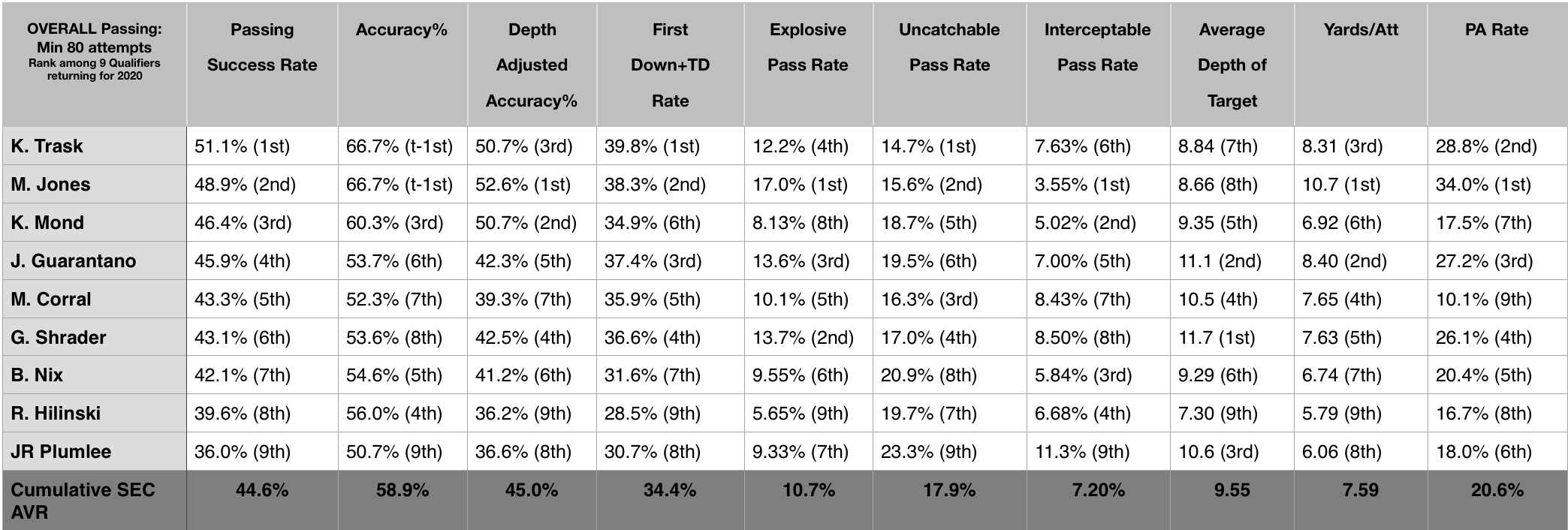
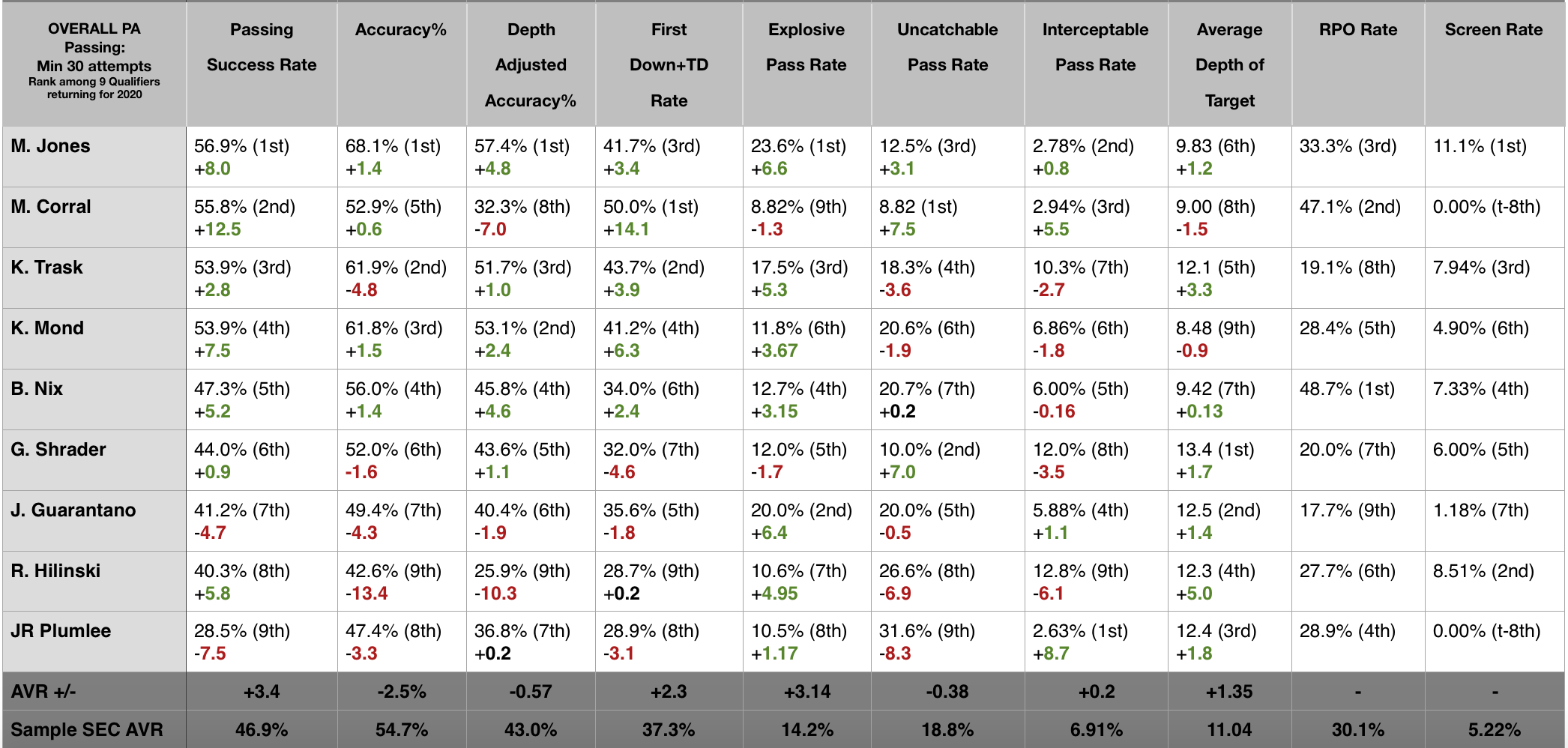
Before we look at the play action splits and the nuggets of info we can take away, we first need to get a baseline cumulative output from our respective quarterbacks. Let's glance over how 9 qualifying SECers slung the pill overall last season.
Overall Production:
Kyle Trask:
Kyle Trask very much was a product of his environment. Though he certainly showed he is above the level of a game manager, he is far from an elite quarterback; and there is no guarantee he'll be playing on Sundays with his noticeable limitations. Still, he will enter 2020 as QB1 within the SEC. Outside of an alarming 32 turnover-worthy plays (27 interceptable passes, 5 fumbles) that topped the conference, he is as consistent as they come managing down and distance on any given snap. Trask is the only returning SECer to break the 50% plateau in Success Rate. Plus, he owns the best First+Down Touchdown Rate. Sure, his nickel and dime approach begat a bottom 3 average depth of target, which allowed him be accurate on two-thirds of his attempts. But Trask's execution of Mullen's scheme boasts a top3 Depth Adjusted Accuracy% and Yards/Attempt ahead of this season.
Mac Jones:
Mac Jones was a very coddled passer when he was thrusted into Alabama's starting lineup. With limited reps, it was apparent play caller Steve Sarkisian wasn't going to put Jones into many compromising positions where he would be under the gun. Plus with the weapons in Alabama's ranks, it made plenty of sense to have Jones act as a distributor via screens, RPOs, and short timing concepts. That methodology overly worked. Despite a bottom2 average depth of target, no one sports a better raw Accuracy%, Depth Adjusted Accuracy%, Interceptable Pass Rate, Explosive Pass Rate, or Yards/Attempt. Though he ended up as the SEC's best midrange passer even besting the Heisman, plenty of motions and misdirections aided his output. Over a third of Jones' attempts came off true play action last season, which easily led the conference. Having DeVonta Smith and Jaylen Waddle at his flanks are nice, but Jones' floor isn't as high thanks to this modus operandi.
Kellen Mond:
Kellen Mond gets a lot of crap. He overthrows targets, occasionally plays stiff from the pocket, and doesn't play his best versus top-level foes. While most are dismissive of his output, his degree of difficulty is pretty steep. Of the 19 SEC passers who logged 80 attempts last season, only Ben Hicks, Deuce Wallace, and John Rhys Plumlee suffered from a higher Pressure Rate than Mond's 30.4% clip. Plus, his outlets consistently were among the worse around after the catch. His 56.9% Air Yard Makeup was fourth most within the SEC in 2019. With not much time on average to let designs develop, Texas A&M was forced to attack short and medium areas of the field. Though his Success Rate and Depth Adjusted Accuracy% are both top3 ahead of this season, Mond finished outside the top5 in First Down+Touchdown Rate and Yards/Attempt. Plus, only Ryan Hilinski owns a lower Explosive Pass Rate within the SEC.
Jarrett Guarantano:
While Mond's Air Yard Makeup was high, no SEC passer topped Jarrett Guarantano's 61.6% clip last season. As the only conference passer to crack the 60% threshold in that department, Guarantano often pushed the ball downfield or settled on an underneath curl. And, Guarantano sported the SEC's lowest RPO Throw Rate in 2019. Despite middling accuracy, his guys consistently made plays downfield that helped jolt the Vols down the stretch. With the second highest average depth of target and Yards/Attempt amongst conference qualifiers, Guarantano sits inside the top3 in First Down+Touchdown Rate and Explosive Pass Rate. Having to earn his trust back after a rough start, it was common for Tennessee to let its run game set him up. Only the run heavy offenses Kentucky, Ole Miss, Auburn, Miss State, and Georgia had lower Early Down Pass Rates than Big Orange. Looking at some of the indefensible throws Guarantano has made over his tenure at Tennessee, I can understand where his coaches came from. But to his credit, his clutch play and savvy deep passing to close the year has allowed him a chance to change his narrative.
Matt Corral:
Matt Corral is getting overlooked by basically everyone this offseason. I'm not saying he should be up for the Heisman, but I don't think it's fair to dismiss his chances to start for the Rebels. No, he's not the athlete Plumlee is in the open field, but he was unquestionably the preferable passer between the two last season. Especially after the midway point where Corral increasingly was asked to come in cold to give his unit a spark or play catch-up, he didn't have the easiest environment in which to thrive. While there are clear shortcomings, Corral sits inside the top5 amongst SEC returners in Success Rate, First Down+Touchdown Rate, Explosive Pass Rate, Yards/Attempt, and Uncatchable Pass Rate. He often had no choice but to press his luck deep. Though some big gainers were a byproduct of this aggressive style, so were interceptable passes. That rate along with his raw Accuracy% and Depth Adjusted Accuracy% fall inside the bottom3. With Corral failing to distance himself in those respects, sticking with the electric Plumlee is all the more tantalizing; even if the dynamo himself was one of the the SEC's worst passers last year.
Garrett Shrader:
Garrett Shrader probably won't see the field much in 2020. At least, that's the plan. But that was the idea last season as well. Of course, injury-prone grad transfer Tommy Stevens allowed Shrader to receive plenty of reps. With another GT QB donned to lead Mike Leach's inaugural Air Raid attack, Shrader will once again have to be ready if things go sideways. Though not particularly strong from clean pockets, Shrader played some of his best ball under pressure and outside of structure. Furthermore, while other conference youngsters were no strangers to padding their stats off RPO completions, less than 10% of his attempts targeted such designs. In Joe Moorhead's vertical scheme and faced with numerous deficits, Shrader frequently pressed downfield. Entering 2020, none of the eight qualifiers can best his 11.7 average depth of target. Sure, this style allowed him to crack top5 in numerous spots among SEC qualifiers (including First Down+Touchdown Rate and Explosive Pass Rate). But, only Plumlee sports a worse Interceptable Pass Rate.
Bo Nix:
The reigning SEC Freshman of the Year was largely a mediocre passer in his first collegiate season. By volume, he tossed the fifth most attempts, six most yards, and six most scores. Looking at his analytics above, only his raw Accuracy% and Interceptable Pass Rate crack the top5 amongst returning qualifiers. And truth be told, both of those metrics were aided by copious amounts of short RPO throws skewing his sample. Nix's 24.1% RPO Throw Rate was nearly 5 percentage points higher than the next SECer in line. Though his deep passing has some promise, that "death by 1,000 paper cuts" style sees him with a bottom3 Yards/Attempt ahead of 2020. In terms of managing down and distance with his dropbacks, his Success Rate and First Down+Touchdown Rate also fall in the lower third of conference qualifiers. Like a good deal of young quarterbacks, Nix was easily flustered when he faced pressure. So knowing new play caller Chad Morris' Run and Shoot prefers to dabble with empty protection, Nix's composure and accuracy must shore up for major growth.
Ryan Hilinski:
Ryan Hilinski is in the mold of a run-of-the-mill West Coast passer. Along with South Carolina's scheme tailoring its play calling to that style, Hilinski frequently strove to get the ball out fast towards an underneath outlet in space. His average depth of target and average time to throw were consistently near or at the conference floor the entire season. Though he showed early promise, Hilinski was easily neutralized once teams had a decent amount of tape on him. Throwing deep wasn't his thing, which invited defenses to crowd the box to hinder horizontal passing lanes and slow down South Carolina's power runs. The results weren't too glamorous by year's end. Though he sports the fourth best raw Accuracy% and Interceptable Pass Rate, his 27 interceptable pass attempts were tied with Trask for most inside the conference. Furthermore, Hilinski owns the worst Yards/Attempt, Depth Adjusted Accuracy, and First Down+Touchdown Rate amongst returning qualifiers. With so much emphasis on short stuff and lacking downfield passing ability to make secondaries pay, his 5.65% Explosive Pass Rate is the only clip among our 9 passers below 8.1%.
John Rhys Plumlee:
As dazzling as he can be as a runner, John Rhys Plumlee's passing ability hardly excites. Only Deuce Wallace, Ben Hicks, Riley Neal, and Sawyer Smith had worse Passing Success Rates within the SEC a year ago of dudes with at least 80 attempts. Since all of those guys are gone or thrusted down the depth chart, Plumlee doesn't have a lot of company at the bottom of the barrel within the SEC. Only his and Hilinski's clips fail to break the 40% barrier amongst conference qualifiers. With the third highest returning average depth of target and poor showing throwing the ball, Plumlee is at or near the bottom across the board. His 6.62 yards/carry (and 7.12 clip on designed runs) easily trumps his 6.06 yards/attempt through the air. With his speed, he is best in the open field or playing backyard ball. His play within structure has me seriously questioning his dependability moving forward considering the little solace his passing leaves behind. But those highlight plays might be just enough to win him the starting job in Oxford.
Looking at the Transfers through a Lens:
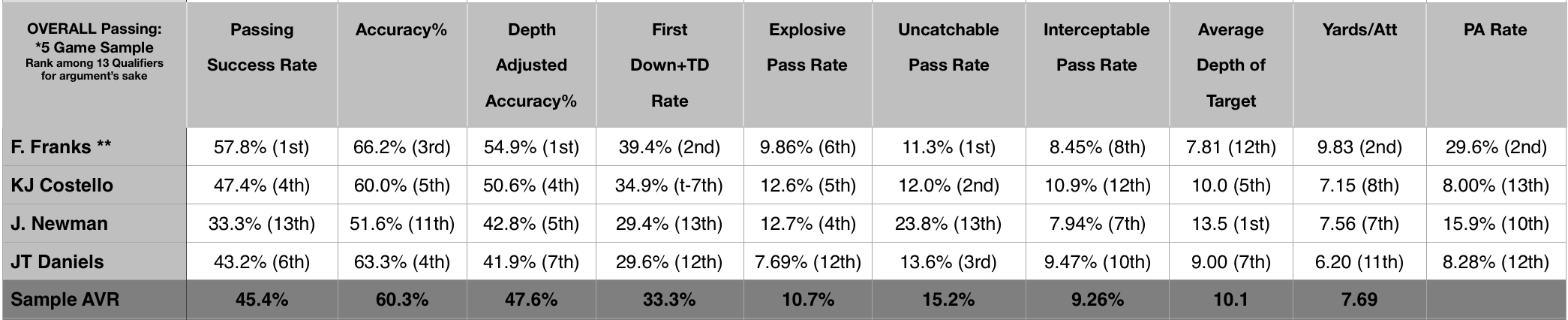
The SEC has 5 notable transfer quarterbacks vying for a starting spot this season. Unfortunately for former-Plainsman Joey Gatewood, he'll be excluded from our findings due to a small sample size and the fact he's yet to have his waiver cleared by the NCAA. Feleipe Franks himself certainly has a wonky sample thanks to only playing in 2.5 games, but it's still enough to examine. KJ Costello, JT Daniels, and Jamie Newman, on the other hand, all were charted versus some of their most challenging foes. Though a lot of stats can be thrown out the window with new schemes, play callers, and supporting casts, I am much more likely to put weight into a player's performance against good defenses than against Poop State. So while this is a conservative estimate of our non-con transfers, I'd rather undersell their passing than overpromise. Each was charted over a five game slate meant to simulate a typical SEC conference schedule in the eyes of ESPN's SP+. This past season, SEC East defenses averaged a SP+ rating of 19.5 with ones in the West sporting a 21.6 clip. In this context, good defenses have ratings closer to zero.
Feleipe Franks:
As Florida's QB1 entering last season, Feleipe Franks was used very similarly to Kyle Trask before he was sidelined because of injury. But while Trask showed he's a step above game manager territory, Franks failed to rise above his scheme. A good amount of his output was inflated by Tennessee-Martin, but Franks still put up adequate Success Rates against Miami and Kentucky, two units that finished inside the top30 defending the pass. Often taking what the defense gave him, Franks' average depth of target would have only bested Ryan Hilinski's if his clip from his 2.5 showing maintained itself over the course of the season. That and the fact his Interceptable Pass Rate was well below the conference average and decidedly worse than Trask's made him a hard passer to support. Lots of his analytics look nice from his limited stint last year, but there's more subpar to middling examples of his play than snaps where he displays top-end ability.
KJ Costello:
Since his best season was two years ago, only charting his injury-plagued 2019 season wouldn't be a sturdy barometer of what KJ Costello brings to the table. So his five game sample meant to simulate the rigors of SEC play straddled both seasons. In the end, Costello's sample included Washington (4th), Notre Dame (10th), and Utah (19th) from 2018 with Northwestern (27th) and UCF (21st) from 2019 , which yielded a 16.7 SP+ defensive average. Costello's sample omitted a fair amount of quality opponents like California (13th), San Diego State (24th), and USC (34th) from 2018 as well as 2019 Oregon (8th) and Arizona (46th).
While there are some holes in his game, there's a lot to like about Costello. Gun to my head, I'd say his style is most like Kyle Trask's of any current SECer. He's a little cement footed, lacks elite arm strength, and can be careless with the football. Still, his Success Rate, Depth Adjusted Accuracy%, Explosive Pass Rate, and Uncatchable Pass Rate all project to be top5 within SEC play. Costello noticeably puts a lot of trust into his receivers per his high rate of contested passes and backshoulder throws. But as I hinted, that often leads to a high number of interceptable passes. His 10.9% projects to only be more preferable than John Rhys Plumlee's 11.9% clip versus conference opponents.
Jamie Newman:
Until last week, Jamie Newman had the inside track to be Georgia's day-one starter. As Wake Forest's main offensive engine last year, he had to shoulder a hefty load both through the air and on the ground. Newman's five game sample consisted of Clemson (4th), Michigan State (13th), Duke (36th), Virginia Tech (39th), and North Carolina (44th) yielded an average SP+ rating faced of 20.3. This handful just so happened to represent his hardest opponents faced last season. The ACC might have had one of the best defenses. But cumulatively, it was rather blah.
Thanks to the Demon Deacons' extremely vertical passing game, nearly a quarter of his attempts traveled 20 or more yards downfield. Only Lynn Bowden would have topped that mark within SEC play. With such a high degree of difficulty, consistency wasn't really Newman's thing. Explosiveness, on the other hand, certainly was. His 12.7% clip would crack the SEC's top5 as would his 42.8% Depth Adjusted Accuracy. Newman's tape has some pop to it because of his bazooka and ability to create fantastic highlights. But since that style of play has him project the worst Success Rate, First Down+Touchdown Rate, and Uncatchable Pass Rate, it's fair to wonder if he can put it all together with the peculiar offseason.
JT Daniels:
Upon his waiver request getting the green light last week, we have to consider JT Daniels in the mix for Georgia's starting gig. But like Costello, we have to go back in time to fill out his sample. Since Daniels only logged a half of play before his 2019 ended with an ACL tear, his sample consisted of Notre Dame (10th), California (13th), Utah (19th), and Stanford (43rd) from 2018 along with Fresno State (98th) last year. His four foes from his freshman year were his hardest in the eyes of the SP+ despite Fresno State being an awful defensive unit in 2019. That game in particular ballooned his sample's average rating to 21.2 and had a considerable effect on his analytics.
Daniels was a game manager through-and-through. Like fellow West Coast passer Ryan Hilinski, Daniels largely looked to get the ball out quickly to his receivers on the perimeter. Though some situations called on him to press downfield, two-thirds of his passes failed to travel beyond ten yards downfield. In fact, nearly a third of his sample's attempts went rightward from behind the line towards the ten yard mark. Methodically moving the ball with chunk gains allowed his Success Rate and Depth Adjusted Accuracy to be serviceable albeit below the SEC average. Frequently working short or asking his guys to bail him out deep begat a Yards/Attempt, First Down+Touchdown Rate, and Explosive Pass Rate that project to be bottom3 worthy. Though certainly not sexy, his consistency was somewhat dependable. Along with such little potency, sporting a 9.5% Interceptable Pass Rate makes his outlook lukewarm at best.
General Takeaways:
Since our analysis will only be looking at one season from one conference, it's not the most scientific model to use moving forward or prognosticate success. Plus play action in general has a lot of moving parts that are not predicative on performance year in and year out.That being said, there are still plenty of items to takeaway from our findings.
No matter how it was utilized, play action increased our 9 SEC passers' Success Rate by 3.4%, First Down+Touchdown Rate by 2.3%, Explosive Pass Rate by 3.1%, and average depth of target by 1.35 yards on average. Again, a lot of that makes sense. With defenders frozen trying to diagnose the play, actions help facilitate throws towards more challenging areas of the field. With less defenders in position to stab at passes, offenses will find more gains downfield. So seeing a rise in metrics that are tied to aggressiveness isn't a novel takeaway. Still, only two passers saw their Passing Success Rate when using play action worsen compared to their overall clip; only one saw their Explosive Pass Rate shrink.
That isn't to say this tactic doesn't have drawbacks. With longer throws on average, footwook being affected, and momentarily looking away from coverages, both raw Accuracy% and Depth Adjusted Accuracy% worsened. But both averages were largely affected by one or two individuals being so disastrous on these snaps it nuked the whole conference's outlook. Accuracy% tumbled 2.5 percentage points with the Depth Adjusted variety dipping by a little more than half-a-percentage point on average. Despite precision falling off a bit, the conference-wide Uncatchable and Interceptable Pass Rates were basically flat.
Both of these takeaways get accentuated on pure dropbacks, ala non-screen or RPO attempts. While passers saw their Success Rates improve by about 3%, their First Down+Touchdown Rates by about 6%, and Explosive Pass Rates by about 4%, raw Accuracy plummeted 7.5 percentage points on average with Depth Adjusted clips falling around 2 percentage points. Obviously when the action wasn't used to hold defenders in order to gain a step laterally, take advantage in space on the perimeter, or give lineman a beat to get to their marks, passers were much more vertical in the dropback game off play action. The SEC's average depth of target ballooned by 6.6 yards and with the Uncatchable Pass Rate average increasing by 4.7 percentage points. With more downfield throws, the SEC's average Yards/Attempt rose by 2.11. But as you can expect further throws saw the Interceptable Pass Rate climb from 7.2% overall to over 8% even if the average passer saw their clip improve by about 1.2 percentage points on these attempts.
With screen and RPO throws out of the equation, all passers saw their raw Accuracy worsen and their ADOT tick up off dropback play action. All but one SECer experienced a better First Down+Touchdown Rate and Explosive Pass Rate with only two having a less favorable Yards/Attempt compared to their cumulative figures. Though the group collectively saw improvement in play from a production standpoint, not everyone came out smelling like a rose.
Since each offense operated differently and had their own way of sprinkling in actions, let's see which SECers saw the biggest gains and pitfalls using this tactic in general and exclusively off dropback designs.
Who was helped the most by Play Action:
Mac Jones:
As aforementioned, Mac Jones wasn't particularly asked to do too much as a passer last season. Versus SEC foes alone, over 30% of his throws were off either a screen or an RPO. In general, 51.1% of his throws used some form of action as eye candy. With dizzying tactics and elite weapons, Jones unsurprisingly dominated off play fakes. Only one other SECer saw bigger gains in Success Rate with no other conference passer besting his 4.8 or 6.6 percentage point increases in respects to his Depth Adjusted Accuracy or Explosive Pass Rate. Though his average depth of target was clearly brought down by 44.4% of his play actions being off RPO attempts or functional fakes for screens, Jones is a top3 producer across the board and experienced gains in each category.
Looking at his play action throws as a dropback passer, Jones bested the conference mean in a number of spots. He was one of three SECers to see their Depth Adjusted Accuracy% in these spots get better. While his average depth of target overall was only higher than Ryan Hilinski's, his clip off play action dropbacks shot up to over 19 yards. Only one SECer experienced higher increases in First Down+Touchdown Rate and Explosive Pass Rate. Jones' 16.6 Yards/Attempt topped his overall figure by 5.9 yards. That rise bested the next closest SECer by over a yard. Much of that was a direct result of over a third of his play action dropback passes netting 20 yards or more.
It's possible Jones will see more chances as a dropback passer without the aid of misdirection. But considering Najee Harris is back and set to anchor that side of the ball, it makes sense for Sark to stick with the high usage for the most part. While Alabama's receivers are top-notch separaters in general, Harris threatening on the ground makes their jobs easier and provides Jones with a more defined place on where to go with the ball. Recommendation: Keep it coming.
Matt Corral:
With only a 10.1% Play Action Rate, most of Matt Corral's fakes were the result of meshes off RPO attempts. In fact, less than a fifth of his total attempts used action; only the incessantly trailing and inept Deuce Wallace had a lower rate within the conference last season. But his lack of play action attempts had nothing to do with his inability to take care of business using that tactic. While sporting the second best Success Rate of our 9 qualifiers, no SECer's clip improved as much as the 12.5 percentage points Corral's did. Sure, his static Accuracy% barely improved and his Depth Adjusted Accuracy% worsened by the second largest amount. But half of his play action attempts resulted in either a conversion or a score. No other conference returner broke the 44% threshold in that respect. Plus, his Uncatchable and Interceptable Pass Rates off play fakes are top3 worthy. Granted, 47.1% of his play actions come off low-risk RPOs certainly was a factor there. Because of that element, his Explosive Pass Rate and average depth of target fell into bottom2 amongst qualifiers.
Like his play action use in general, half of his dropback throws moved the chains or put up points. Both that clip and his 55.6% Success Rate are inside the top3. While his decision-making and bang-for-buck plays were among the conference's best, Corral's accuracy was dreadful. Only Ryan Hilinski proved to be less accurate throwing downfield on such snaps as Corral's Depth Adjusted Accuracy% crashed by 12.3 percentage points. Others used this tactic to stretch the field. And though his average depth of target increased, Corral's Yards/Attempt and Explosive Pass only marginally enhanced. Like his teammate, Corral somehow didn't toss a single interceptable attempt off a dropback play fake. Though his awful accuracy certainly is enough to raise eyebrows, the overall good play action offered his game can't be dismissed. Recommendation: Keep it coming, but with caution.
Kyle Trask:
By volume and by a rate basis, Kyle Trask was no stranger to using play action this past season. Even though Florida's run game was overly muted, the Gators found plenty of success incorporating play fakes to help their offense. While his RPO Rate off actions only topped Jarrett Guarantano's, nearly 8% of his play fakes targeted a designed screen, which was the third highest clip amongst qualifiers. And while his raw Accuracy% and Uncatchable Pass Rate declined, both still sit inside the top4. Plus, Trask's Success Rate, Depth Adjusted Accuracy%, First Down+Touchdown Rate, and Explosive Pass Rate all were boosted on these plays compared to his overall figures. That being said, his 61.9% Accuracy% that's a top2 clip fell by 4.8 percentage points. Only Ryan Hilinski saw a steeper dropoff among our 9 qualifiers. With subpar lower body mechanics and the tactic calling for him to briefly take his eyes off coveragemen, play fakes saw his already unsatisfactory Interceptable Pass Rate crack the double-digits thanks to this dip in ball placement.

Trask was among the four SECers whose Dropback Play Action Success Rate exceeded their overall clip. So it's pretty understandable why his 87 such attempts by volume were 19 more than the next man in line. His First Down+Touchdown Rate and Explosive Pass Rate also improved and joined his Success Rate inside the top4. Even though the latter upgraded by 8.5 percentage points, his Yards/Attempt only modestly bettered. While both of his accuracy figures sit inside the top3, they were obviously far worse off than his overall clips. Play action helped Trask stretch the field more but there's no ignoring an Interceptable Pass Rate that high. Improving his footwork will go a long way reducing his missteps. Despite the glaring red flag, Dan Mullen is pretty married to this tactic. And Trask overly showed he's a top producer using it. Recommendation: Keep it coming.
Kellen Mond:
Though Kellen Mond's 17.5% Play Action Rate falls into the bottom3 amongst conference qualifiers, his 102 by volume were the SEC's fifth most in 2019. Roughly a third of his total play action attempts targeted either a screen or an RPO. That element paired with his approach that honed in on short passes made Mond's average depth of target shrink compared to his overall clip. His 8.48 figure was the lowest of our 9 passers. Though the short stuff commanded a sizable chunk of his attempts, Mond's First Down+Touchdown Rate and Explosive Pass Rate saw decent gains. Speaking of, Matt Corral's 14.1 percentage point increase on the former only bested Mond's 6.3 point growth off play fakes. But while this tactic aided Mond in finding more consistency and meaningful completions on average, play action caused him to be slightly more erratic. Both Mond's Uncatchable and Interceptable Pass Rates fall outside the top5 in this respect after each worsened by about 2%.
On play action dropback scenarios, Mond was outstanding. While his overall Play Action Success Rate was sturdy enough after boosting by 7.5 percentage points compared to his cumulative figure, his clip off dropback designs upgraded by just under 15 points. His First Down+Touchdown experienced a similar ascension. No SECer can challenge his 61.3% Success Rate in this regard as it's the only figure north of 59%. Outside of that, Mond's Depth Adjusted Accuracy inflated by about 7 points and stands as the SEC's second best ahead of 2020 along with his First Down+Touchdown Rate. Like his overall play action ADOT would suggest, Mond wasn't keen on pressing downfield. The lack of deep shots allowed him to be surgical where he went with his passes underneath. While his Uncatchable and Interceptable Pass Rates dipped considerably, both clips crack the top5 amongst returners. Considering Mond is top5 in every above metric minus his average depth of target, it's a safe move to lean more into this tactic as far as I'm concerned. Recommendation: Ramp it up.
Bo Nix:
With the high amount of RPO throws within Gus Malzahn's scheme, Bo Nix tossed the SEC's most attempts off play action last year. Nearly half of his play action throws came off RPO designs; only Matt Corral came close to challenging that. Of his 150 play fake passes, only 61 came in dropback situations. With so many bubble screens and hitches to space, Nix managed these fairly well. Every stat was preferable off play action compared to his cumulative figures outside of his Interceptable Pass Rate that only slightly fluttered in these spots. Outside of the functionality of running his RPO designs, play actions naturally aided the young passer take advantage of over-anxious blitzers aiming for his head. Nix sits inside the top5 amongst returners in Play Action Success Rate, Explosive Pass Rate, Interceptable Pass Rate, Accuracy%, and Depth Adjusted Accuracy%. The latter's 4.6 percentage point boost compared to Nix's overall numbers was the second best increase only behind Mac Jones.
Nix's output on play action dropback snaps was a mixed bag. Seeing one's raw Accuracy% drop by over 10 points is certainly a cause for concern; especially considering his 4.4 point dip in Success Rate only topped Ryan Hilinski. But Auburn loved to go deep in these spots to capture a big gainer. With their heavy RPO onslaught delivering up abundant short to modest gains, dropback play actions were when the Tigers got vertical. Nix is the only returning SECer with an average depth of target over 20 yards in these spots. So with an obvious upped degree of difficulty, his down-to-down success and raw Accuracy% were bound to suffer. That said, Nix's Depth Adjusted Accuracy% was among the three clips of our 9 passers to be positively affected. Though his 27.9% Explosive Pass Rate and 11.4 Yards/Attempt looked up to Jones', no qualifiers' clip of the former was boosted as much as Nix's 18.4 point gain. Overall, Auburn's offense was desperate for substantial plays last year. Considering his ball placement downfield and potency improved, it's worth Chad Morris to orchestrate more designs for Nix to stretch the field in this manner in 2020 even if Nix's age produced some wayward attempts. Recommendation: Keep it coming.
Garrett Shrader:
Garrett Shrader was so-so using play fakes last year. Only about a quarter of them were off screens or RPOs. Unquestionably, those throws helped vault his 10% Play Action Uncatchable Pass Rate into the top2. Like his 11.7 average depth of target overall, Shrader's 13.4 clip off play action holds the top spot amongst qualifiers. So considering what he was asked to accomplish, frequently giving his guys a stab at his attempts is worth something. Still, inexperience and a subpar group of receivers kept his production grounded. His Success Rate, Accuracy%, Depth Adjusted Accuracy%, and Explosive Pass Rate all stayed within 2 points of his cumulative figures. Though the former still cracks the top5 amongst returners, only he and Matt Corral saw their respective clips stand to be less favorable off play action than overall. With less sound mechanics, Shrader's Interceptable Pass Rate sunk by 3.5 points with his First Down Touchdown Rate showing even worse returns. Both clips sit inside the bottom3 ahead of 2020.
Though his Play Action Success Rate on dropback patterns barely dipped, his overall production in these spots doesn't offer much inspiration. It's fairly uncommonly to own both the top Uncatchable Pass Rate and worst Interceptable Pass Rate in a box, but here we are. Shrader's latter plummeted nearly 10 points -- easily the biggest drop of our 9 guys. I mean to basically have a fifth of one's throws have turnover potential makes Kyle Trask's red flag look like a napkin. Granted, the Schrute-esque slinger's accuracy figures sit inside the SEC's top5. But the soon-to-be-sophomore is inside the bottom3 in First Down+Touchdown Rate, Explosive Pass Rate, and Yards/Attempt. Already volatile, Shrader's turbulent output greatly limits is ceiling moving forward. Recommendation: Dial it back.
Jarrett Guarantano:
Though not thought of as a prevalent play action passer, Jarrett Guarantano sports the SEC third highest Play Action Rate entering this season. As aforementioned, the vast majority of these designs were dropback patterns as no SECer's RPO Throw Rate was lower than JG's. Plus, only a handful of Tennessee's screens called for play fakes. Though this tactic helped Guarantano's potency some, he was overly a worse passer off play action. Overall, his Success Rate and Depth Adjusted Accuracy are top5 clips amongst returners with his First Down+Touchdown Rate and Explosive Pass Rate inside the top3. When play action got involved, only the latter saw improvement. His Interceptable Pass Rate was preferable but his raw Accuracy% and Success Rate fall in the lower third of our qualifiers.
As Tennessee fans can attest, Guarantano isn't one to play fast. Known for holding onto the ball for a beat too long, being hesitant to let it rip has been a common rallying cry against the New Jerseyan in Knoxville. But when he does get sped up or has to pass with urgency, Guarantano is even more frustrating. Like I mentioned a good deal of his key stats move backwards with play action in general. But as you can see, the returns aren't a crappy on dropback play action attempts. So while the quick-twitch throws off RPOs were hardly rampant, they still had a noticeable affect on his production and point to why Guarantano was fed more traditional play fakes to push the ball downfield. By volume, his 68 such attempts only trail Trask for next season. On dropback play actions, Guarantano's Success Rate and accuracy figures dipped but were relatively flat while his First Down+Touchdown Rate, Explosive Pass Rate, and Yards/Attempt all experienced boosts and sit inside the top5 amongst returners. Seeing his Success Rate, Uncatchable Pass Rate, and Interceptable Pass Rate all sit inside the top5, I'd say Tennessee should continue providing Guarantano with traditional play fakes. However due to the negatives drastically outweighing their upside, RPOs should be faded if Guarantano is behind center. Recommendation: Dial it back.
Ryan Hilinski:
South Carolina had an immense big play problem last year. Their 9.08% Explosive Play Rate owned the conference's floor last season. Thought it wasn't special at unlocking aspects to this offense, play action often helped Ryan Hilinski venture more downfield, which resulted in moderate gains in Success and Explosive Pass Rates. While this tactic goaded his average depth of target out of the cellar into the top4 amongst returners, actions also helped the horizontally-inclined attack to stretch foes sideline to sideline. Only Mac Jones used play action on a higher percentage of screens than Hilinski's 8.51% clip. Other than that, play fakes apparently made an already skittish freshman even more inconsistent with his ball placement. No returning SECer sports a worst Play Action Accuracy%, Depth Adjusted Accuracy%, First Down+Touchdown Rate, or Interceptable Pass Rate.

Aiming to get the ball out fast, Hilinski's precision was clearly altered when playing hot potato; especially on RPO attempts. But as you might suspect from someone who struggled with downfield accuracy, Hilinski's already putrid accuracy sunk even further when his targets' depth increased. With his Play Action accuracy figures already experiencing double-digit dips, his dropoff on dropbacks was even more abhorrent. Unsurprisingly enough, they too sit at the bottom of the barrel amongst our 9 passers. Again, South Carolina was incessantly thirsty to quench their big play drought. Play Action was their way to try and take the top off of secondaries. Hilinski's 58 dropback play action attempts are the fifth most by volume ahead of 2020. That number ballooned his 18.6 average depth of target into the top3. But while this tactic technically did what it was supposed to, the returns were far too infrequent. Plus, Hilinski's 13.8% Interceptable Pass Rate off dropback play actions only tops Garrett Shrader's. I get why the Gamecocks would have to turn to this again in 2020. But if they can help it, I'd steer them into trying something else based on what Hilinski showed on these snaps last year. Recommendation: Dial it back.
John Rhys Plumlee:
Though play actions can help define a passer's throws, that's doesn't mean they have clarity on where to go with the ball in these spots. Though other freshman all experienced an uptick in Success Rate off play fakes, John Rhys Plumlee joined Jarrett Guarantano as the only two returning SECers to see their clips worsen while using play action. Already representing the conference's floor in that regard, his Success Rate dropped 7.5 points making his 28.5% clip the worst of our 9 passers by about 12 points. Like Corral, Plumlee didn't have a single play action screen attempt. But unlike his teammate, his RPO Rate was in the upper 20's -- not the high 40's. With less gimmes and short throws on his plate, Plumlee's Play Action average depth of target sneaks into the top3. Despite more long throws, his Interceptable Pass Rate immensely improved. In fact, no returner bests his 2.63% clip in this context.
Either because of his inexperience or Ole Miss's collective ho-hum arsenal on the perimeter, Plumlee's play action production on RPOs was lackluster. When asked to operate this tactic on dropbacks, his numbers still slide backwards in spots but were preferable all else considered. Granted, his 32% Success Rate still sits at the bottom of our qualifiers. But his Accuracy%, Depth Adjusted Accuracy%, First Down+Touchdown Rate, and Explosive Pass Rate are relatively flat with the latter two moving in the right direction when dropback play action was utilized. Though it's odd to prod using a tactic that saw Plumlee's already low Yards/Attempt worsen, helping his potency and completely eliminating turnover-worthy throws makes play action usage off dropbacks worth exploring for Lane Kiffin. Recommendation: Keep it up.
Circling back to the Transfers:
With an admittedly narrow scope, I wouldn't put too much weight into how our transfer passers performed using play actions. But at least, these findings will give fans a general idea of what they bring to the table. Some like Feleipe Franks saw bountiful play action usage at Florida. Others like KJ Costello hardly ever turned to the tactic. Below is the same exercise we did for full-time SECers, but I included the 2019 SEC average versus conference opponents as a makeshift benchmark.
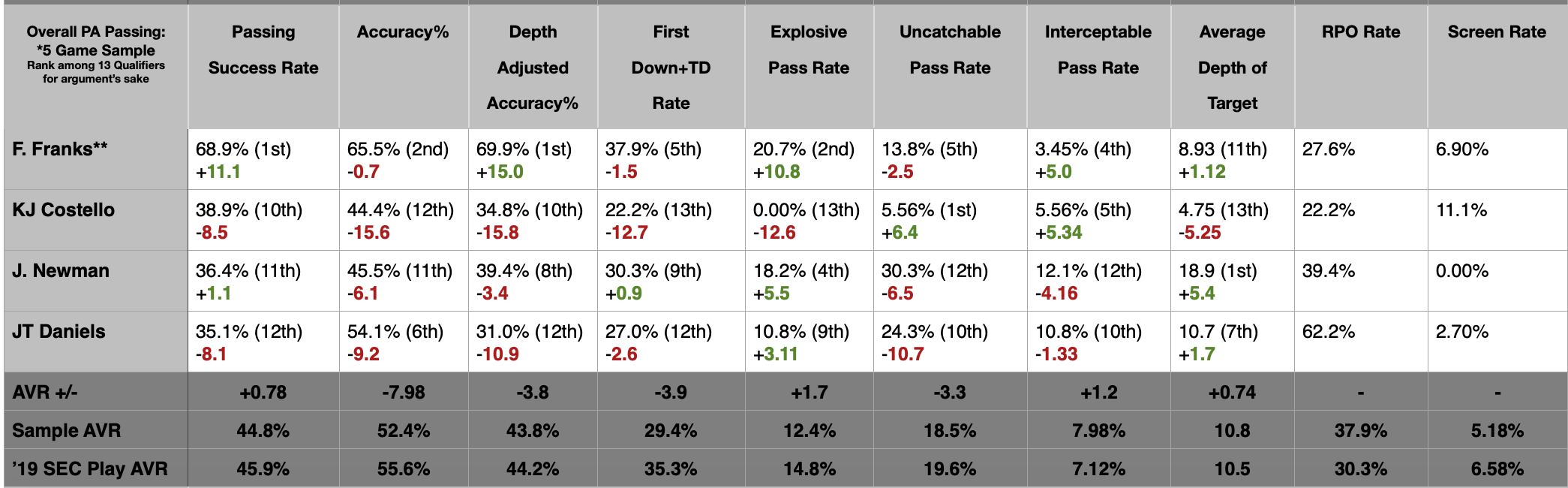
Feleipe Franks:
Feleipe Franks' output using play action should excite Hog Nation. Again, his sample size is very wonky. But in that brief stint from this past season, his level of meeting situational goals and downfield accuracy was on another level. Both his Success Rate and Depth Adjusted Accuracy% flirted with 70%. And while Franks was sometimes gun shy to let ball fly, play action at least saw him generate a healthy clip of big gainers despite his Play Action average depth of target projecting to be a bottom3 clip. Even though play fakes enticed more confidence causing his First Down+Touchdown Rate and Uncatchable Pass Rate to shrink compared to his cumulative stats, Franks looks to be a top5 play action passer across the board. Though commonly throwing short paired with an unacceptable Interceptable Pass Rate overall is a hard style to back, turnover-worthy attempts on average dropped by 5 points on play fakes.

Even on dropback play action attempts, Franks soared. Though I'm sure you noticed his average depth of target didn't move much within the projected rankings, it increased by 6.4 percentage points. His 18 dropback play action attempts, were as much as Garrett Shrader amassed over the course of his freshman campaign. Obviously, this is a tactic Kendal Briles should incorporate. While regression is obviously on the horizon trading the likes of Miami, Kentucky, and UT-Martin for the trials of the SEC West, possessing potential to be a top3 passers across the board within the conference on dropback play fakes is a great place to start. Recommendation: Ramp it up.
KJ Costello:
Despite their pro-style tendencies and run-first approach, Stanford hardly had the time to use play action to facilitate things for KJ Costello. And quite frankly, they were probably onto something looking at his figures above. Most of the time, Stanford only used them for Screens or RPOs, other tactics they used scarcely over his 5 game sample. Another reason is the Cardinal started slow in a number of these games where that kind of trickeration would see less potency. Outside of keeping his attempts in play and limiting turnover-worthy throws, Costello projects to be a well-below producer off play action.

Again, play action in general wasn't something that was common within the Cardinal's offense. Over 5 games, Costello only tossed 13 dropback play action attempts. In this context, Costello, sadly, was pull-your-hair-out-bad. So it makes sense why they limited play fakes in any shape or form. Costello's 30.8% Success Rate was almost 17 percentage points worse than his overall clip. His Depth Adjusted Accuracy%, First Down+Touchdown Rate, and Explosive Pass Rates, too, all suffered from double-digits dips in output. The latter was a big ole goose egg. Even though Mississippi State returns one of the most productive rushers in the conference, the Air Raid doesn't lend itself to deception too often. And considering how mind-numbingly ineffective Costello was in these spots, I'd say the Bulldogs will use play fakes sparingly. Recommendation: Dial it back.
Jamie Newman:
Newman generally followed the trends set by our conference qualifiers. He saw gains in Success Rate, Explosive Pass Rate, and First Down+Touchdown Rate while seeing his accuracy figures suffer. Screens were hardly part of Wake Forest's vertical pass scheme. And over his five game sample, Newman didn't log a single play action screen attempt. He was, however, fed about an average amount of RPOs as those designs accounted for roughly 40% of his play fakes. Already one to throw deep downfield, his Play Action average depth of target of 18.9 would be tops and his 18.2% Explosive Pass Rate would crack the top4. But like his overall numbers suggest, consistency wasn't a strength of Newman's. His Success Rate, Uncatchable Pass Rate, and Interceptable Pass Rate project to be bottom3 clips amongst returners.
In an offense that lived and died by explosive gains downfield, play actions on dropback designs certainly accentuated that element of Wake Forest's offense over Newman's five game sample. While seeing a slight uptick in Success Rate and his First Down+Touchdown Rate staying flat, his 23.5% Explosive Pass Rate was nearly 11 percentage points better than his overall clip. That escalation projects to be top5 worthy among returning SECers. With his average depth of target also looking to be tops, Newman averaged 12 yards per play action dropback attempt. While the high ends plays help drown out the overall volatility of his down-to-down output, Newman stands to sit inside the bottom3 in Interceptable Pass Rate and First Down+Touchdown Rate. Georgia will probably lean into its conservative ground game to start, which could clear Newman for launch as teams creep up to crowd the box. But it's worth mentioning, Jake Fromm's 14.8% Play Action Rate placed 16th out of 19 SEC qualifiers last season. Maybe the new mentality under Todd Monken will see more than one tweak within their scheme. Recommendation: Ramp it up.
JT Daniels:
Like Costello, JT Daniels wasn't really given a whole lot of play action attempts over his five game sample. And like Ryan Hilinski, this West Coast passer also looked uncomfortable when utilizing play action. Unfortunately, the two were more similar than different in this context. As it were, only John Rhys Plumlee sports a lower Success Rate than Daniels 35.1% clip over his sample. Only Hilinski owns worse First Down+Touchdown Rate and Depth Adjusted Accuracy%. Throwing to cushion is what Daniels overly sought. That conservative approach was fueled by a healthy amount of RPOs. In terms of his play action distribution, over 62% of his play fakes came off those designs. While play fakes did indeed help the Trojans manufacture big gainers at a higher rate, Daniels was just as likely to toss an interceptable pass as a 20-plus gain off a play action over his sample.
Thanks to his guys coming down with contested attempts, Daniels' Success Rate off dropback play action was a little better off. He himself on these 14 some throws was indefensibly bad in terms of ball placement. As noodle-armed as Hilinski was during his freshman season, Daniels' 18.9% Depth Adjusted Accuracy was over 3 percentage points worse than the Gamecock. To further hurt his case, his First Down+Touchdown Rate and Uncatchable Pass Rate project to sit in the bottom2. I mean he was just as likely to be successful as toss an errant throw in this context. That level of variance is too topsy-turvy for anyone to thrust on a play caller. While Newman's skill set would aid the 'Dawgs to take the top off of defenses, Daniels offering very little upside has me calling for him to be used similarly to how Fromm was. While I believe Newman will win the job, Daniels shouldn't lean on play action in the slightest. Recommendation: Dial it back.