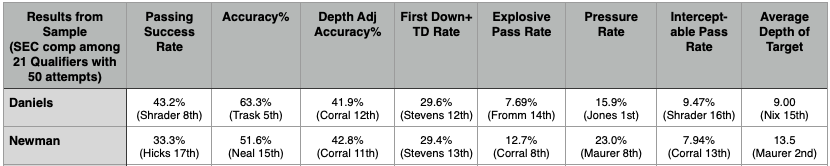
Since both passers have nearly identical First Down+Touchdown Rates and Depth Adjusted Accuracy% despite their contrasting skill sets, Kirby Smart and Todd Monken have quite the quandary. Daniels projects to be more conservative down-to-down but hasn't quite ridded himself of risky throws. Newman offers athleticism at the position with field flipping arm strength that can sway games in moments but is noticeably more volatile. Simply judging these dudes by their overall profiles won't cut it. So, let's dissect how they did under pressure, as dropback passers, throwing beyond ten yards, and situationally over their samples.
Pressured vs. Clean:

Production from clean pockets often sets a passer's floor. Since clean pockets present less variables and are more common down-to-down than pressures, evaluators are able to gauge a passer's consistency. After all if you cannot hit a target when conditions are perfect, how can you be expected to do so when a play breaks down or if a blitzer is barreling towards you? Knowing you can trust your QB to take care of business inside of structure is an important aspect when building game plans. On the other side of the coin, pressured attempts can reveal a passer's ceiling. Rhythm production is all fine and good. But sometimes, things just don't go according to plan. A lineman could whiff on a block, the secondary's coverage can force a play to extend, or a well-timed blitz can force a QB to operate outside of his comfort zone. With the increased number of variables, results can greatly fluctuate and are less consistent. This increased degree of difficulty, however, can certainly help separate game managers from playmakers and depict a passer's upside.
Though Daniels' was slightly more successful under duress than Newman, he was a significantly lesser passer. His pressured Depth Adjusted Accuracy%, First Down+Touchdown Rate, and Interceptable Pass Rate would have been bottom5 clips within SEC play last season. Daniels' lackluster arm was accentuated on these snaps. When rushed or moved off his spot, his risk-reward was dismal. Daniels was just as likely to throw for a conversion or score as he was to toss a turnover-worthy attempt when pressured. The former Trojan didn't even average 4 yards/attempt under duress. Sporting an already high Drop Rate across his sample, Newman's clip shot up to 14% on pressures. But while his Success Rate suffered, his Depth Adjusted Accuracy would have been the SEC's fourth best within league play. While more unpredictable, there's enough out there to suggest his upside is much higher than Daniels in these spots even if over 10% of such attempts could have been intercepted.
As you might suspect from a nibbler, Daniels played his best within structure. Like his overall clip, his Success Rate was about 10 percentage points better than Newman's, which unquestionably makes him "safer" on paper as clean attempts are far more common than pressures. Circling back briefly, Daniels is in the mold of a typical West Coast Offense QB who loves to get the ball out quickly to weapons in space. Thanks to that modus operandi, defenses didn't get to him too often over his sample. Daniels' 15.9% Pressure Rate would have been the best in SEC play. But while the hot potato methodology helped take the spotlight off of him, it didn't amount to much. Despite owning a top10 Success Rate while clean, he failed to largely separate himself from Newman in these spots. The two are within 3 spots in the rankings and 2.5 percentage points of one another in three of the four metrics above. Daniels' sample holds the edge except in Interceptable Pass Rate. For a program that has leaned into limiting risk in under Smart, that can't be ignored. Though the easy completions can be had, Daniels showed he can be tricked and telegraph certain throws that can nuke a drive.
Since there are less variables to point to as excuses in clean pockets, Newman's inconsistency is hard to defend. Even with his high ADOT in these spots, he simply couldn't execute. Newman wasn't average or below average, but rather damn near the worst around in terms of managing down and distance from clean pockets. His 35.1% Success Rate was similar to true freshman John Rhys Plumlee's and would be a bottom2 clip within SEC play. In terms of Depth Adjusted Accuracy and First Down+Touchdown Rate the shortcomings were less prominent. Yet, each of those stats fell below the conference mean. Still, the former Demon Deacon kept things close enough with Daniels while offering more potency. Newman's clean Touchdown Rate doubles Daniels'. His yards/completion and Explosive Pass Rate each are superior by about five points.
Dropback Passing:
Plenty of modern offenses incorporate extensions of the run game to create easy completions for their passers and get the ball to playmakers in space. While screens and RPOs are effective tactics to move the ball, quarterbacks hardly do any of the heavy lifting. Separating these plays from true dropback passes reveal a quarterback's true colors. While there's some noise Monken will incorporate more RPOs in 2020, whoever gets the nod to lead the Bulldogs will need to take care of business in the dropback game.
Daniels' so-so arm presented a good amount of off-target chances for his dudes outside the numbers. Despite the underthrows, half of these attempts resulted in situational success even if his Depth Adjusted Accuracy% fell below the SEC median. While giving your receivers a stab at a target is one thing, it's another leaving plays on the field. There were a handful of instances where a more accurate pass would have resulted in a catch-and-run score rather than a contested jump ball. That suggests there is some volatility for Daniels in these respects. You can’t expect to win every 50/50 ball. Though Daniels was largely inadequate throwing inside the hashes, his Accuracy shined on the shoulders of the field. Between the numbers and hashes, Daniels would have owned the conference's fourth best Depth Adjusted Accuracy% in league play. But like his overall clip, his Success Rate there was middling. RPOs were common in his sample, but true play actions were rare. Only KJ Costello's 8.00% clip from a similar five-game sample projects lower than Daniels 8.28% Play Action Rate within the SEC.
Though his success outside the hashes is troublesome, Newman's dropback throws insist any down and distance is manageable for him assuming his guys can create a bit of space. Used to targeting tight windows, only Newman and Joe Burrow broke a 60.0 grade per Pro Football Focus on contested targets last season. Against his hardest foes, his dropback accuracy was blah everywhere except towards the middle of the field. And while he "graded" well, significant production was seldom. No matter where he targeted sideline to sideline, his Success Rate and Depth Adjusted Accuracy failed to finish better than 10th. Via the extended mesh, Newman had a decent amount of opportunities off RPOs in his sample. But, play action wasn't a major part of their scheme. Though his 15.6% Play Action Rate basically doubled Daniels, it still would be a clip near the bottom of SEC qualifiers within league play last season.
Downfield Passing:

Taking dropback passing a step further, let's examine how these two threw beyond ten yards downfield over their sample. Let face it, not too many aspiring quarterbacks dream of playing in offenses full of screens, hitches, and drags. Scouts are always in search of the next great arm; and they won't find it by examining short throws.
Despite his relatively low average depth of target across his sample, Daniels still went deep at a respectable clip. Just under 14% of his attempts traveled 20 or more yards downfield, which would have been a top5 rate within SEC play and akin to Bo Nix's. His noodle arm, however, prevented him from finding his targets deep. His sample's Deep Completion% was middling, but being just as accurate as Ryan Hilinski doesn't quell questions about his ability to drive the ball downfield. Daniels was predominantly pedestrian targeting midrange patterns. Though he left much to be desired, his intermediate production torched Newman's. With those numbers giving him a boost, his sample equates his downfield throwing ability to Jake Fromm's Success Rate with Nix's accuracy.
Again, Newman's strength as a passer is his arm. If he couldn't make the most of that trait targeting deep, it would be frustratingly pointless especially considering how often Wake Forest pressed. Not to repeat myself, but nearly a quarter of his attempts across his sample traveled 20 or more yards downfield, which would have topped every SEC's Deep Pass Rate within league play last year. Newman’s results were respectable. His Success Rate cracked the top5, and his Depth Adjusted Accuracy just missed the cut sitting 6th. But while Newman made a name for himself on these throws, his downfield passing outlook soured due to woeful placement on midrange attempts. Both his respective Success Rate and Accuracy% would have finished dead last in the SEC in 2019. In fact, the former was so bad that it was half of the next closest conference qualifier. With those metrics being a literal drag, his 10-plus figures mirror two wayward downfield passers in Hilinski and Tennessee's Brian Maurer; both of whom played their first collegiate snaps last season.
Situational Passing:
There's a saying going around: "The best 3rd Down offenses are the offenses that avoid 3rd Downs the best." Being able to take care of business on 1st or 2nd downs can alleviate plenty of stress for an offense. Since the very nature of thirds is to do or die, some guys can falter under the pressure or fade in the moment. Not putting yourself into those situations often means an offense's regular stuff is working. While 3rd Downs can be one-offs with unique distance to gains, early downs are more common and hence better indicators of what an offense is trying to do. But when your back is against a wall and you need a play, QBs are often turned to and expected to dig their units out of holes.
Both Daniels and Newman saw over a fifth of their early down attempts come off RPOs. But while the Demon Deacons were adverse to true screens, the Californian saw a tenth of his 1st/2nd down attempts target such designs. Only six of the 22 SEC qualifiers broke that plateau. Those elements highlight an on-going theme with Daniels: he overly worked short to long and took what defenses gave him. Of the pass concepts from his sample with at least 5 early down reps, his best were Spacing/Curl+Flat patterns and Stick Variations. Those looks earned a 66.7% and 60% Success Rate, respectively. Additionally 11 of his 21 combined Curl+Seam and All Vert targets met situational goals. Though his 45.7% Early Down Success Rate was just okay, it was comparable to Tua Tagovailoa's within SEC play last season. However, his ball placement downfield was middling. Daniels' 43% Depth Adjusted Accuracy% would fall right in the middle of SECers. He only suffered from pressure on 11% of his dropbacks, which is crazy low. But again, he was fine methodically working his way downfield with modest gains.
Newman was a terrible passer on 1st and 2nd downs in his five game sample. I mean, he was as effective as a downfield thrower in those spots as Arkansas' Ben Hicks and his Success Rate would’ve be near SEC's floor. While no one passing look commanded a disproportionate amount of reps, Shot plays combined to receive the most tries out of any concept group with a 14.7% Play Share. Looking a specific designs, Solo deep balls, All Verts, All Curls, Stick Variations, and Slice were targeted the most followed by Fade combos, Curl+Seam combos, and Slant+Flat RPOs. No to beat a dead horse, but the Demon Deacons wanted to stretch defenses vertically. While that proclivity helps birth big gainers, it's a turbulent way to play. Of concepts with at least four chances, only three yielded a Success Rate of 50%: All Curls, Stick Variations, and Fox (fake screen shot plays). But it wasn't just deep looks that Newman had trouble executing. Slant Variations and outlet screens were Wake Forest's two favorite RPO route tags and neither concept group was close to breaking the 50% plateau. Newman off the extended mesh often had terrible mechanics. Since plays took a beat longer to gel, he often rushed his delivery. Balls would come out like a rocket but not always on target; sometimes right at the feet of someone ten yards away. Since Newman overly failed on early downs, the Demon Deacons were forced to duke it out on the money down frequently.
Daniels was equal to Texas A&M's Kellen Mond in terms of 3rd Down Success Rate and Depth Adjusted Accuracy%. If you have listened to the chorus of Aggie dissenters the last couple of seasons, Mond's mediocrity in those spots are a big reason why he's failed to make the leap within the conference. Also like Mond in 2019, Daniels' sample saw him experience a good amount of money downs because of his conservative early down approach. For varying reasons, both the TAMU and USC struggled with explosive gains and creating significant separation from top level defenses. Only one of the six All Vert reps resulted in success for the Trojans in these spots. For the most part, Daniels stuck with what got him there on 3rd Downs. Both his average depth of target and yards/attempt to look up at his overall clips. Furthermore, Daniels could be fairly careless with the ball in these spots. His already unsatisfactory Interceptable Pass Rate shot up to over 13%. For what it's worth, only one of those five turnover-worthy tosses was picked off.
Since Newman was accustomed to playing behind the chains and leaning on his deep passing ability, he had some of his best snaps on the do or die down. He only had one interceptable pass attempt (yes it resulted in a pick) and 11.1% of his 3rd Down attempts were dropped. When he was on, Newman displayed next-level precision. But with so many deep concepts and long developing designs on thirds, Newman suffered from a 13.9% Sack Rate with nearly a fourth of his tries being charted as uncatchable. Both clips would be considered below average in SEC play. Wake Forest almost exclusively operated out of a trips bunch set in these instances. Bunch sets naturally allow for those receivers' routes to intersect with one another, which can cause a brief pause or momentary lapse in judgement from a coverageman. To that note, Switch Variations were Newman's most targeted pass plays on 3rd Downs with ten. But a double dig wrinkle with a H wheel saw the most reps of any singular look with 7. That design was the only play with at least three 3rd Down reps in this sample to eclipse Newman's 41.7% Success Rate. But while that clip seems dismissible, it would have been one of the SEC's five best last season. Plus, the fact his 3rd Down Success Rate and Depth Adjusted Accuracy comped to Heisman Joe Burrow should be a major selling point.
Red Zone and 4th Quarter passing are even more unpredictable than output on 3rd Downs. Still, being able to perform in on crunch plays in clutch moments has decided many a ball game. Generally speaking, I'm sure evaluators would like to see sturdy play in these spots from passers than faltering or not being overly advantageous.
Inside their opponent's 20-yard line, both Newman and Daniels were poor producers. Their Depth Adjusted Accuracy clips were roughly the same and would have finished next to each other comfortably in the back half of the SEC rankings. For UGA's prospective passers, there's just not a whole lot of silver linings based on their play in this area of the field. But I will say this, Joe Burrow went from unequivocally being the SEC's least successful Red Zone passer in 2018 (his Success Rate was literally half of the next closest qualifier that season) to being a gridiron Godsend. Considering George Pickens managed to put up the SEC's sixth best Success Rate on the third most scores within the red zone, whoever gets the job will have one of the SEC's best weapons threatening to break the plain. Though nothing is for certain, I’d be moderately shocked if UGA’s starter couldn’t find success on at least a third of his red zone tries. (Fromm’s 45.9% Success Rate placed fourth within the SEC in 2019).
Of the five games composing his sample, two failed Daniels to see a 4th Quarter snap. Both were due to sustaining injuries. But looking at the other three games, the former five star totaled 30 attempts. He only completed 16 of them as his average depth of target increased to 13.3 in these spots. With no where else to turn, Daniels had to be aggressive in the final stanza of ball games. But the increased degree of difficulty didn't birth pleasant numbers. Daniels was just as likely to toss an turnover-worthy throw as suffer a sack. By volume, each had 5 occurrences. On the other side of the coin, he finished with only 8 combined first down conversions and touchdowns. With defenses able to harass him and his guys venturing more downfield, his Depth Adjusted Accuracy% plummeted to Deuce Wallace levels (not good!). Plus, his Success Rate mirrored Vandy's other QB.
All but one of Newman's 21 4th Quarter attempts occurred with Wake Forest trailing or leading by less than eight points over his sample. Used to playing hero, Newman commonly saw increased level of play in the clutch. Though his Success Rate comps to Riley Neal like Daniels', his Depth Adjusted Accuracy% cracks the top10 and trumps his overall clip by about five percentage points. By this time in the game, Newman was usually beaten down from having to help shoulder a good amount of the ground load of for the Demon Deacons, which obviously made it more challenging to direct his deep passes. It's hard enough to drop a dime in a bucket as is. It's much harder when you're gassed or your legs are starting to go. Newman certainly was preferable to Daniels here, but the gap between the two isn't predominant.
Clean+Dropback
Again, glancing at a passer's overall production doesn't necessarily reflect how they operated or what aspects helped see them elevate their outputs. Two passers could be asked to complete the same RPO read, but one could be gifted a potential first round pick while the other is dumping it off to a future salesperson. One passer could be more apt at playing backyard ball and extending plays outside of structure and make up for his lack of passing acumen. The point is, there are plenty of superfluous aspects to the game that can make evaluating a true passer's ability more murky.
Being able to make a play when a design breaks down will always be a desirable trait for quarterbacks, but that ability rarely reflects one's down-to-down trajectory. Since unpressured attempts are far more consistent than pressured ones (on average this past season only a quarter of passes faced duress), these instances provide a more solid foundation for forecasting. With less variables and more "perfect" conditions, there are simply less excuses for passers to point to on why they failed to make a throw when kept clean. You know, like I said a few sections ago. But hang on. I am building to something.

To take it one step further and to account for the variance in offensive styles, we need to separate dropback passing figures from overall numbers. I already aforementioned how those tactics can help cover a passer's ass theoretically. Plus, completing screens and RPOs doesn't require much passing talent. While those tactics absolutely can help buoy a passer's numbers or add another element to an offense, quarterbacks must have the ability to make downfield throws at the end of the day; especially if they have professional aspirations. Sure the teams with future first-rounders are better positioned to account for listless passers, but a catchable ball still has to arrive on time. Analyzing quarterbacks off dropback attempts from clean pockets presents the best criteria for determining one's expected baseline. Our previous glance at clean pockets doesn’t quite set one’s floor like this exercise.
The table above only accounts for returning SECers within league play. So forget about those Joe Burrow, Tua Tagovailoa, or Riley Neal comps for this final section. With our clean+dropback parameters applied, you can see how Newman and Daniels project as straight up passers within structure. While I was hoping for something revelatory, the findings are basically what our other breakdowns told us. Newman pressed downfield and lived and died based on his long ball. Daniels was a game manager who sought easy completions.
Where we began is also where we will end. At the end of the day, Georgia's staff will have to determine whether they want more down-to-down consistency nickel and diming or athleticism paired with potency within structure. Newman's 37.0% Success Rate on clean+dropback attempts offers the worst floor of any SEC qualifier, but only Jarrett Guarantano projects more explosiveness. Daniels' raw 68.5% raw Accuracy% stands to be the SEC's best, but only Ryan Hilinski sports a worse Explosive Pass Rate amongst returners.
Outlook:
While all these numbers, it's easy to lose sight of things. This off-season has been unlike anyone has experienced in over 100 years. Even for programs that retained their playcallers and most of their talent, new trials arise every day in this "new normal". For Georgia's offense, they lost three starting OLineman, its top2 tight ends, its top2 ball carriers, a couple of veteran receivers and, of course, QB Jake Fromm. A new offense is set to be installed despite no spring ball, limited workouts, and threat of the season being reduced, suspended, or cancelled.
When picking between guys, I generally like to focus on upside even if one option might appear safer so long their volatility doesn't handcuff or upend an offense overall. If one guy can generate splash plays, he's more likely to be a factor on the scoreboard. To me, the best bet is to have a guy in there who can make plays and is used to dragging his teammates to the Promised Land.
Jamie Newman is far from an elite passer, but he is much more equipped to deal with adversity as is than Daniels. Newman is a better athlete with a considerably preferable arm who showed more poise and promise when things broke down over his sample. Though in the past he sacrificed down-to-down dependability for big gainers, Georgia will need be able to stretch the field to reduce foes from crowding the box and neutralizing their ground game. I believe Newman's skill set is a harder beast to prepare for than Daniels.
While Daniels's style is similar to Jake Fromm's and his conservative approach checked a lot of boxes under Georgia's old scheme, it’s not exactly clear what philosophy the Bulldogs will follow in 2020. But buzz is indicating Todd Monken should have more vertical elements. That element isn’t the best suited for Daniels' arm; especially with him coming off a major knee injury. I'm not certain the offensive supporting cast Daniels had at his disposal in LA is worse than the one he might lead this fall. But that is 100% true for Newman overall even without game changing wideout Sage Surratt. Learning a third scheme in just as many offseasons with the aforementioned headaches the pandemic has created might be too much to ask for from Daniels.
The numbers say Daniels is safer -- much safer. But again that omits the landscape and the fact the grand majority of his offseason has been spent rehabbing. Despite generally sporting less favorable analytics, Newman is more likely to be a positive factor if the season starts on time due to his skill set, health, and game-changing arm.