2020 Vision: Who's Got the Highest Floor?
Who's Got the Highest Floor?
Everyone loves quarterback talk. Since it's the most important position in the sport and a passer's ability often can be the difference between a victory or defeat, extra weight is put into analyzing these fellows. While most fans are content with volume stats like completions, yards, and touchdowns scored, the archaic metrics do little to tell the story of how a passer actually operates.
Naturally, a passer's overall figures will reflect his entire body of work. Pressured, clean, screen, RPO, dropback, deep, 3rd Down attempts and others criteria are all merged together to form cumulative stats. But because no passer's style of play or scheme is exactly the same as another's, varying factors can help skew a quarterback's perception based on his final output. What if a passer leaned more on screens or lived on the wild side by pressing downfield more often or benefited from being a game manager?
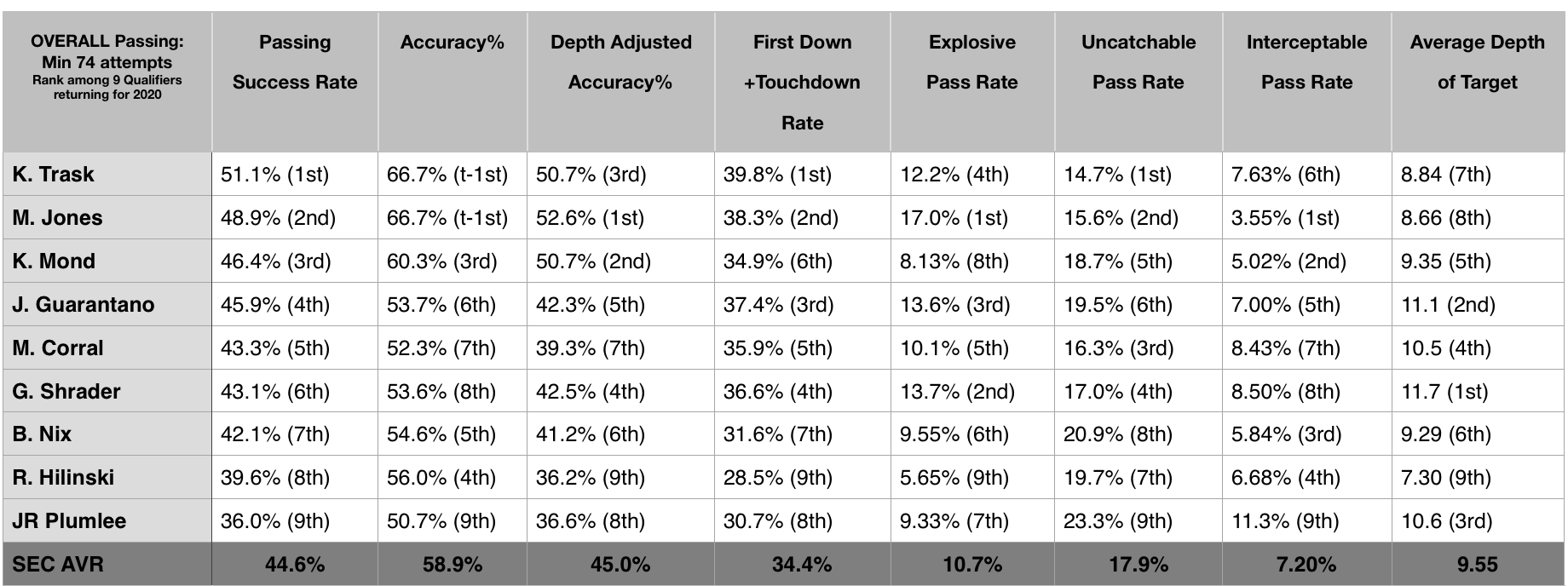
In order to determine which passers are actually good, we need to break off these extra elements that could in theory help boost a quarterback's output. But before we do that, let's set our parameters. Our qualifiers had to throw at least 74 pass attempts this past season and hold at least three starts. With all due respect to Kentucky (Terry Wilson), LSU (Myles Brennan), Arkansas (Feleipe Franks), Missouri and Vanderbilt, I wanted to include your passers for a better reflection of the conference. But your quarterbacks' small sample size presented too wonky of results to attempt to project 2020. For the two grad transfers, their criteria will be broken out in their respective section. To start our discussion, let's first see which returning quarterback had the best overall season in 2019 throwing the football.
2019 Overall Figures:
Kyle Trask
Kyle Trask burst onto the scene this past season with Feleipe Franks sidelined in their Week 3 tilt versus Kentucky. Though he was utilized similarly to Franks within Dan Mullen's scheme, the Gators took a positive step with Trask taking snaps. Like Franks, Trask used play action on 28% of his attempts, which was the SEC's third most. Furthermore, no other passers within the SEC saw screens compose over 14% of their passes. Though he saw a lower percentage of his tosses come off RPOs, there's no question some of his numbers were buoyed from simply being a facilitator. With plenty of short completions to the underneath areas of coverages, a healthy screen game, and a lack of deep throws, Trask owned the SEC's sixth-lowest average depth of target. Despite that and a bottom5 Deep Throw Rate, Florida's passing game finished above the conference average in terms of Explosive Pass Rate thanks to their athletes taking care of business in space and Mullen's sound play calling. Looking at his overall numbers, Trask has been many folks' pick for QB1 entering 2020. Sure he was a product of X's and O's, but Trask executed at a very high level in his first major action since 9th grade.
Mac Jones
Mac Jones probably expected to play some in 2019. But, I'm sure he figured most of his reps would come in relief duty against backups. As we all know, that's not how things played out. Thrusted into action more than once to keep Alabama's offense afloat with Tua Tagovailoa injured, Jones operated almost entirely as a game manager. Play action was used on over a third of his attempts. When action off motions or RPO meshes were included, over half of his attempts used some form of a play fake. With the fourth highest RPO Throw Rate and ample easy completions, Jones finished inside the SEC's bottom5 in average depth of target, which makes sense due to Alabama's collection of talent and play caller Steve Sarkisian's West Coast mentality. Still, Jones only trailed Heisman winner Joe Burrow on throws ten or more yards downfield in terms of Success Rate and Accuracy% within the conference. Jones has talent, but there's no question he was put in excellent positions to quarterback this offense while being aided by plenty of eye candy, a run-first play sheet, and conservative direction.
Kellen Mond
Kellen Mond was a good, not great passer in 2019. While other passers padded their numbers with plenty of screens or RPO attempts, Mond operated more as a traditional passer in the dropback game. Only about 15% of his throws came off either a screen or RPO. Deception wasn't a huge part of the Aggies' assault as only 17% of his attempts utilized play action, which was the SEC's third lowest clip amongst guys with double-digit starts last season. Though TAMU had talent at wide receiver and might have the best young tight end in college football, there was a noticeable lack of speed within their ranks. Either by design or because of those limitations to stretch the field consistently, Mond owned a bottom5 Deep Pass Rate and ended up with a below average Explosive Pass Rate. While he remained one of the most prolific intermediate passers within the conference, his guys rarely helped out after the catch. Just under 57% of his production came off Air Yards alone, which was seven percentage points above average and high enough to crack the SEC's top5. Mond was no stranger working outside of structure as his 30.4% Pressure Rate was the conference's fourth highest. But thanks to his athleticism and skill set, he and Tommy Stevens were the only two SEC passers with a below average Pressure Rate to finish with an above average Passing Success Rate.
Jarrett Guarantano
Jarrett Guarantano's style of play has been consistent even if his passing hasn't. He frequently lives and dies off marginal situations on deep balls or 3rd Down chances. As SEC fans saw down the stretch last season, few were better than Guarantano in those aspects despite the built-in volatility. Often criticized by Big Orange Nation for holding onto the ball too long or making inexcusable decisions, he himself experiences stints of unpredictability and variance, which notably resulted in Brian Maurer stealing snaps this season. Though ample play action off of Tennessee's run-first approach helped some, the Vols were extremely adverse to screens and RPOs with Guarantano under center, which certainly wasn't the case with Maurer. At times, it seemed like this staff went out of its way to make Guarantano's margin of error as small as possible. No SEC passer saw a lower percentage of his attempts come off RPOs with only John Rhys Plumlee owning a smaller Screen Rate. Despite his aforementioned high average time to throw (2.74), his Pressure Rate was one of the five best in the conference despite the general lacking of a quick passing game. His below average accuracy is still a concern, but it appears the light finally clicked for Guarantano in terms of decision-making and ability to lead an offense.
Matt Corral
Matt Corral has become the forgotten man. Though donned as Jordan Ta'amu's successor, injuries paired with the electricity of John Rhys Plumlee soon found Corral in a QB battle after the first month of the season. Play caller Rich Rodriguez and Corral's styles weren't perfect fits. The newfound spread-run scheme certainly seemed to suit Plumlee better as Corral was reserved for damage control or hurry up situations. Despite the high level of difficulty of coming into the game cold or in crunch time, Corral was an adequate decision-maker even if his ball placement was subpar. His hand was often forced into being more aggressive due to the context of his snaps. Though Ole Miss liked to go empty occasionally with Corral owning a bottom5 average number of pass blockers, he sported the SEC's second lowest Pressure Rate. While both he and Plumlee had average RPO Throw Rates, Ole Miss was one of the most adverse teams utilizing true screens within the conference as both finished inside the bottom3 in that respect.
John Rhys Plumlee
While the passing tactics between Corral and Plumlee were similar, there was no question the latter was the lesser thrower. Perhaps winded from helping anchor the Rebels' ground game, Plumlee struggled across the board throwing the football. I'm sure you've noticed glancing at the table above that he was considerably below the conference average in every metric while being the worst returning qualifier in terms of Success Rate, Uncatchable Pass Rate, and Interceptable Pass Rate. With his legs being his best trait, Plumlee was constantly on the move either by design or trying to escape defenders. His athleticism helped him skirt out of sacks to the tune of the SEC's fourth lowest rate in that respect, but Plumlee was no stranger to passing under duress. Only Ben Hicks and Deuce Wallace topped his 30.7% Pressure Rate within the conference. Seeing a clip so high is bound to curb any young passer's overall numbers.
Garrett Shrader
Though certainly it wasn't the plan to have Tommy Stevens suffer from injuries that subsequently created a quarterback carousel, Garrett Shrader showed he could be a solid starter one day within this conference. At a glance, he fit the mold of the passers Mississippi State has fielded over the last decade. Appearing to be run-oriented but owning an above average arm, Shrader checked a lot of boxes for Joe Morhead's offense. While playing a big part in the Bulldogs' read option scheme, no other SEC freshman passer was more inclined to dropback than Shrader. Sure, he occasionally was buoyed by an RPO or screen. But Shrader was one of the more true downfield throwers within the conference despite his age. Even with the fourth highest average depth of target last season, his overall Depth Adjusted Accuracy, First Down+Touchdown Rate, Uncatchable Pass Rate, and Explosive Pass Rate are all within the top4 among returning qualifiers. That aggressive style of play, however, certainly came with risks as Shrader found himself taking sacks at the conference's second highest clip with the second worst Interceptable Pass Rate among our returners. As you might expect, he found himself on the wrong side of the conference average in terms of Success Rate and accuracy figures.
Bo Nix
Like Shrader, Bo Nix was overly a below average passer this past season in his first collegiate action. With one of the lowest Dropback Rates around, the reigning SEC Freshman of the Year saw abundant screen and RPO attempts pad his volume numbers. He was the only SEC passer where those accounted for over a third of his throws and had 30 more such attempts than the next man in line. Only Mac Jones saw a higher percentage of his yards come off screens or RPOs than Nix within the conference. Meaning, a good deal of his passing production was literally out of his hands and reliant on his outlets to make plays in space. Furthermore, Auburn's up-tempo scheme riddled with eye candy attempted to take attention off Nix whenever possible. He faced an average amount of pressure, but Nix showed his age when under duress as his Success Rate fell inside the SEC's bottom6 in those spots. In the dropback game, Auburn's favorite area to attack was outside the numbers. But despite sporting third highest clip targeting there, only Riley Neal's Success Rate was worse. Coached to prevent passes from finding their way into defender's mitts, Nix enters 2020 with one of the lower Interceptable Pass Rates and Defender Breakup Rates despite the second worst Uncatchable Pass Rates of our returning qualifiers.
Ryan Hilinski
Ryan Hilinski is a stereotypical West Coast Offense quarterback. He consistently owned one of the lowest average time to throw and average depths of target within the conference. Since that design puts a premium on short, timing routes, Hilinski and the Gamecocks appeared to be a perfect match for a couple of weeks. But with poor downfield accuracy and by asking his targets to do most of the heavy lifting, South Carolina was predominantly bottled up as the year progressed. Only Riley Neal saw more of his passing yards come after the catch than Hilinski. While his RPO usage was about average, only Kyle Trask and Mac Jones owned higher Screen Rates within the SEC. Still with copious amounts of short routes, Hilinski wasn't up to the trask of making defenses pay for crowding the box or executing a downfield shot. Despite the lowest average depth of target of our qualifiers, he owned the third worst Uncatchable Pass Rate with no one being worse in terms of Depth Adjusted Accuracy%. However despite limited mobility and a challenging defensive slate, the soon-to-be Sophomore was an average under duress. Still, far too much of his overall game leaves much to be desired.
Sampling the Grad Transfers:
Before continuing towards to point of the analysis, let's glance at the two incoming graduate transfer quarterbacks KJ Costello, Jamie Newman, and JT Daniels. In an attempt to get a fairer reflection of each passer, I scouted a five game sample based on ESPN's SP+ metric, which it's a tempo- and opponent-adjusted measure of college football efficiency. Rather than letting the Poop State's of the world distort these passers' outputs, I preferred to chart them versus quality opponents in order to better gauge the rigors of playing within the SEC. This past season, SEC East defenses averaged a SP+ rating of 19.5 with ones in the West sporting a 21.6 clip. In this context, good defenses have ratings closer to zero.
Since Costello's most productive season was two years ago, it didn't make much sense only scouting his 2019 campaign. With that being said, I didn't want to completely ignore last year either. In the end, Costello's sample included Washington (4th), Notre Dame (10th), and Utah (19th) from 2018 with Northwestern (27th) and UCF (21st) from 2019 , which yielded a 16.7 SP+ defensive average. Unlike Newman's that included all of his most recent and challenging opponents, Costello's sample omitted a fair amount of quality opponents. Despite easily having a more trying slate than Newman, foes like California (13th), San Diego State (24th), and USC (34th) from 2018 as well as Oregon (8th) and Arizona (46th) were excluded from our findings.

From his five game sample, Costello was as sound as they come. Though he lacks a great arm and needs to hitch up in the pocket to generate his best throws, he consistently delivered a catchable ball that gave his guys a stab at it. Though sometimes his touch passes fluttered resulting in contested jump balls or straight up interceptions, Costello overly was a good decision maker. By the overall figures, only Kyle Trask and Mac Jones would have a superior Success Rate based on his sample. Plus, his accuracy puts him in the upper tier of passers entering this season. Obviously, his major problem was preventing turnover-worthy passes. Theoretically, only John Rhys Plumlee is more prone to those types of passes entering the season. Screens and RPOs were seldom in Stanford's pro scheme. Roughly less than 8% of Costello's attempts in the sample were off either a screen or RPO design. Likewise, much of the patterns didn't offer up much opportunity for yards after the catch. Nearly two-thirds of Costello's passing yards came at the point of the catch. His sample's 65.8% Air Yard Makeup would have been number one amongst our qualifiers if not for Georgia's presumed starter.
Jamie Newman
In Wake Forest's vertical passing scheme, 68.2% of Newman's yards came at the point of the catch. Reminder, the highest clip among the nine SEC returning qualifiers was Jarrett Guarantano's at 61.6%. Paired with the bombs away attitude, the Demon Deacons' run game followed an extended mesh read scheme, which is rather peculiar to say the least. But, we aren't here to dig into that chestnut. The point is, Newman was asked to shoulder quite a bit of Wake Forest's run game. By the traditional volume stats, he accumulated the 14th most rush yards among D-1 quarterbacks. Furthermore, running the ball in a tiresome scheme paired with chucking it downfield at an insane clip rarely begat efficient numbers. Route tags were common off of these as 14.3% of Newman's attempts were off RPOs. Screens were inexistent. Being winded from all the heavy lifting certainly played a toll in his numbers failing to take off. And as Wake Forest precipitously began to lose their best pass catchers to injury, Newman's numbers remained unsatisfactory against his best opponents. Georgia will undoubtedly ask him to play differently. But there's no denying those troubling stats against his hardest opponents.
JT Daniels
Using Clean+Dropback Attempts to set our Floor:
Again, glancing at a passer's overall production doesn't necessarily reflect how they operated or what aspects helped see them elevate their outputs. Two passers could be asked to complete the same RPO read, but one could be gifted a potential first round pick while the other is dumping it off to a future salesperson. One passer could be more apt at playing backyard ball and extending plays outside of structure and make up for his lack of passing acumen. The point is, there are plenty of superfluous aspects to the game that can make evaluating a true passer's ability more murky.
Being able to make a play when a design breaks down will always be a desirable trait for quarterbacks, but that ability rarely reflects one's down-to-down trajectory. Since unpressured attempts are far more consistent than pressured ones (on average this past season only a quarter of passes faced duress), these instances provide a more solid foundation for forecasting. With less variables and more "perfect" conditions, there are simply less excuses for passers to point to on why they failed to make a throw when kept clean. While play versus pressure might set a quarterback's ceiling, play from pristine pockets often sets their floor. You want a high floor. Because after all, if you cannot produce when everything goes as designed consistently, when exactly can you?
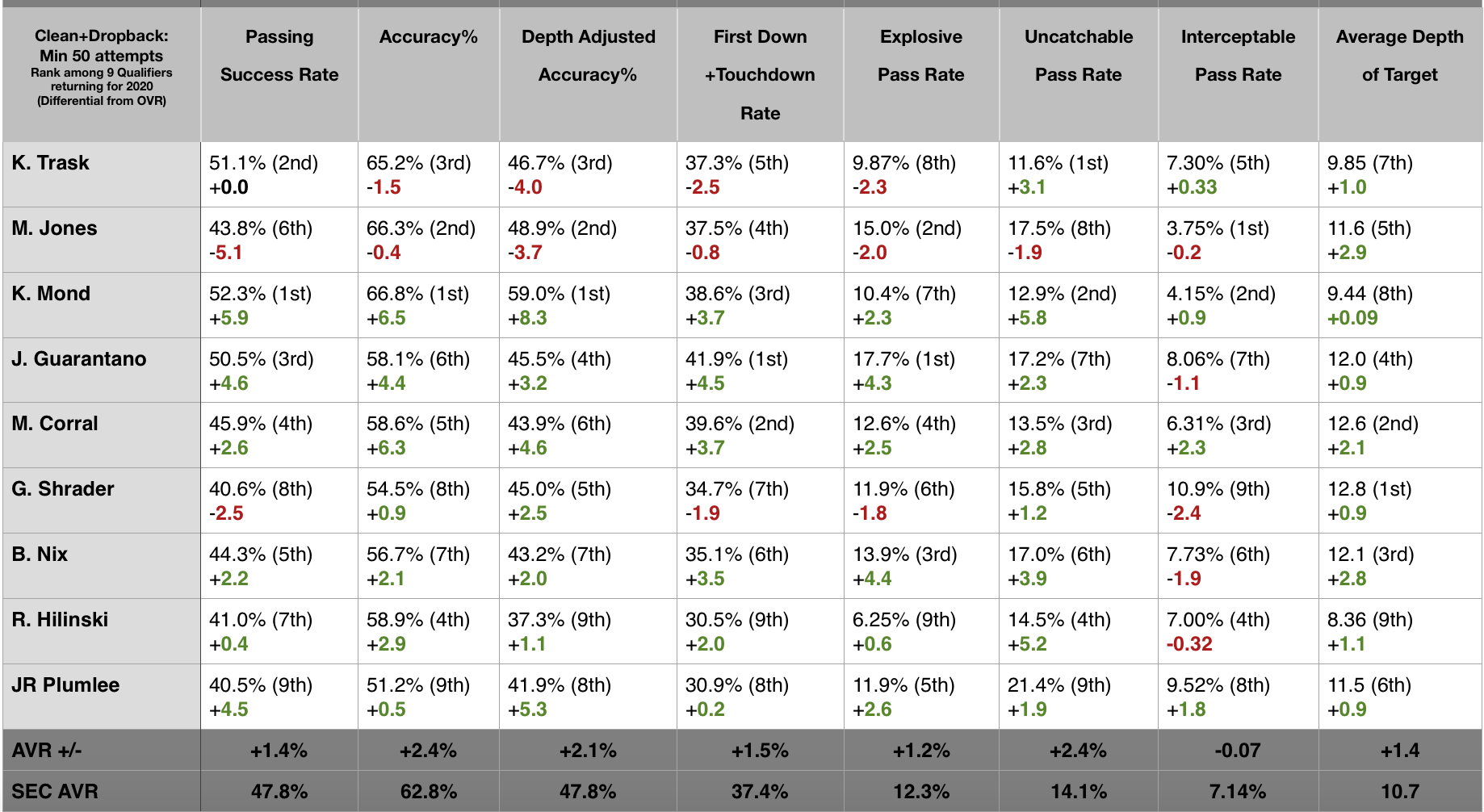
To take it one step further and to account for the variance in offensive styles, we need to separate dropback passing figures from overall numbers. I already aforementioned how those tactics can help cover a passer's ass theoretically. Plus, completing screens and RPOs doesn't require much passing talent. While those tactics absolutely can help buoy a passer's numbers or add another element to an offense, quarterbacks must have the ability to make downfield throws at the end of the day; especially if they have professional aspirations. Sure the teams with future first-rounders are better position to account for lackluster passers, but a catchable ball still has to arrive on time. Analyzing quarterbacks off dropback attempts from clean pockets presents the best criteria for determining one's expected baseline.
Kellen Mond
From these conditions, Kellen Mond projects to be the conference's best passer in 2020. With the two parameters applied, no one saw bigger increases in their Success Rate, accuracy figures, or Uncatchable Pass Rate than the Aggie. Mond was surgical in clean+dropback situations. While others saw increased aggressiveness, Mond overly honed in on targeted intermediate areas of the field as his ADOT remained relatively unchanged on these attempts. In terms of Depth Adjusted Accuracy -- which applies more risk/reward the further a pass travels downfield unlike the static Accuracy% -- Mond is in a class of his own among the qualifying returnees as no other passer eclipsed the 50% plateau. Only Joe Burrow and Tua Tagovailoa bested him in that regard last year within the SEC. Despite placing sixth in First Down+Touchdown Rate from his overall production, Mond shot up into the top3 in clean+dropback situations.
Mond's overall sample suffered due to a high Pressure Rate and mediocre play in those spots. By volume, his 127 pressured attempts were the most in the conference. While the SEC's average overall Passing Success Rate this past year was 44.6%, the conference mean hovered around 33% on pressures; Mond's clip was 33.8%. Though there's nothing particularly wrong being average in the face of pressure, it's clear TAMU's passing game was easily derailed if Mond could be flustered. That element certainly caps his ceiling. But, Mond owning an average Pressure Rate relative to the rest of the conference isn't a crazy ask. If Mond were to suffer two less pressure per game on average, his clip would shrink from 30.4% to 23.9% (assuming the Aggies pass at a similar clip). Four seniors are pegged to start on that OLine. It's certainly feasible the veteran-laden group can provide cleaner pockets for Mond's final collegiate season. If that happens, Mond will find himself as the SEC's best overall passer in 2020.
Kyle Trask
Kyle Trask's play slightly regressed in clean+dropback situations compared to his overall numbers. Already a sturdy game manager, his Success Rate stayed at 51.1% in these spots. But Trask's accuracy dipped with less screens in his sample. Plus, the Gator was one of the very best in the conference versus pressure with a 49.4% Success Rate, 56.1% Depth Adjusted Accuracy, 17.3% Explosive Pass Rate and 8.11 Yards/Attempt; all three were inside the top3 and significantly above the SEC average. With the exception of his Success Rate, all those other stats bested their counterparts overall. Also, remember that Trask was gifted the highest Screen Rate in the conference. Along with RPO attempts, Trask totaled 82, the third most by volume, and was one of six SECers to boast a Success Rate over 50% on such designs. So naturally, with those snaps removed, his numbers were bound to fade. In structure, Trask nickeled and dimed at will. No one was better at delivering a catchable ball even if his Depth Adjusted Accuracy fell below the SEC average in these spots.
The Gators lost over 55% of their receiving yards to graduation. Leading receiver Van Jefferson, YAC threat Freddie Swain, and lead back LiMical Perine were all part of the casualties. With a scheme so reliant on outlets to make plays in space or off screens, it remains to be seen if Trask can once again break a 50% Success Rate in this manner. It's literally out of his hands. Again, Trask was at his most potent standing in the face of pressure. Though it's a nice aspect gauging his upside and poise, the production in those spots isn't a great barometer for future success. Considering the personnel turnover, that is even a harder ask. Still with Trask famously limited playing time of the last half decade, one could argue there's still room for him to grow with more reps within structure. On clean+dropback attempts, decision-making doesn't appear to be a problem. His ball placement, however, has to improve to solidify his floor as a passer.
Jarrett Guarantano
Outside of Kellen Mond, no SEC passer saw a bigger jump in Success Rate than Jarrett Guarantano. When asked to operate within structure unpressured, his clip improved 4.6 percentage points making him one of the three returning qualifiers to break the 50% barrier. I already dropped the nugget that Tennessee marginalized their passing game -- often banking on winning on 3rd Down or with a downfield shot. Perhaps not the most efficient way to play, their gambles paid off considerably. When Guarantano had nice conditions, no SEC passer owned a better Explosive Pass Rate or First Down+Touchdown Rate among our returning qualifiers. While those results were golden, his accuracy downfield was still pedestrian. With a slight uptick in average depth of target and subpar precision, Guarantano found himself tossing more turnover-worthy throws on average even if his passes had improved odds of being caught.
Guarantano's Success Rate was greatly affected when he was under duress. Even with a reduced average depth of target in these instances, his clip dropped below the SEC average to 28.9% despite his Depth Adjusted Accuracy% and Explosive Pass Rate remaining constant to his overall clips. Those stats, however, were knocked by his putrid performance on non-dropbacks. Despite owning the SEC's lowest RPO Throw Rate and second lowest Screen Rate, his 28 such attempts showed why his coaches were adverse to utilizing him that way. (For what it's worth, only Bo Nix topped Brian Maurer's RPO Throw Rate with the freshman essentially doubling JG's Screen Rate). No SEC passer saw a lower Success Rate on screens+RPOs than Guarantano's 32.1% clip. But, this shortcoming was more on him rather than his outlets. On these snaps, Guarantano's 53.6% Raw Accuracy and 33.7% Depth Adjusted Accuracy screamed he struggled to put the ball where it needed to be despite his targets being far closer. Luckily for him, pro scouts will be more interested in his ability to produce within structure than as a savvy screen thrower.
Matt Corral
In terms of Success Rate on clean+dropback attempts, Matt Corral dons the best clip among guys who failed to crack the top3. Though he falls into a secondary tier, his game improved across the board unpressured within structure. Both his stats and positional rankings were boosted signifying he was his best self in those spots. In these conditions, Corral strove to push the ball downfield. This aggressiveness, however, didn't result in more carelessness. Often looked upon for an aerial spark or clutch play down the stretch, Corral delivered the second best First Down+Touchdown Rate while owning a top3 Uncatchable Pass Rate, Interceptable Pass Rate, and average depth of target. Though his decision-making was sound and he gave his guys a chance at hauling in his passes more often than not, Corral didn't finish with adequate accuracy figures. Both his Accuracy% and Depth Adjusted Accuracy% were well below the conference mean despite easily besting his overall numbers.
Even though Corral was one of the two SEC passers with a Pressure Rate under 20%, those snaps played a big role curbing his final stats. While sporting a middle-of-the-road 31.4% Success Rate under duress, his inaccuracy was unmatched within the conference. While it's not uncommon for passers to see their accuracy wane versus the blitz or playing backyard ball, Corral's 16.8% Depth Adjusted Accuracy under pressure was more than five percentage points worse than the next man while being less than half the 36.5% SEC average. Over 30% of his pressured attempts were charted as uncatchable and only three SECers put up a worse Interceptable Pass Rate than his 14.3% in these spots. It's a damn good thing he was kept upright at one of the best clips around. Corral's floor provides a nice standing on which to improve. But being so woefully inaccurate as a downfield thrower under pressure will allow questions to linger on if Plumlee has the higher upside.
Bo Nix
Bo Nix is next in the pecking order. With the lowest Dropback Rate in the conference, his overall numbers were clearly skewed by ample screens and RPO throws. With those designs taken out of the equation, Nix's average depth of target climbed to 12.1 yards, which was the third highest amongst our returning qualifiers on clean+dropback attempts. This desire to push the ball downfield resulted in the Plainsman boasting the third best Explosive Pass Rate at 13.9%. No SECer experienced a greater gain in this regard compared to their overall clip as Nix's rate increased 4.4 percentage points. This aggressiveness, however, came with risks. More downfield throws without the benefit of screens+RPOs diluting his sample begat a worse Interceptable Pass Rate. At least, his 7.73% clip was about average relative to the rest of the conference. Still not really known for being a precision passer, Nix found himself in the lower third of returning qualifiers in terms of accuracy. His 2% increase in his Depth Adjusted Accuracy% from his overall clip was one of the four lowest in the conference.
By volume, Nix had 130 combined screen and RPO attempts this past season. While his accuracy figures and Uncatchable Pass Rate were clearly aided by the copious amount of dinky completions, Nix also saw an increased Success Rate on those designs. He and his outlets failed to break the 50% plateau, but his 48.5% clip was still appreciably better than his overall and clean+dropback rates. Under duress, Nix was typical for his age. His 26.6% Success Rate and 31.6% Depth Adjusted Accuracy% when pressured were both around six percentage points below the conference mean; the former placed him in the bottom third of SEC passers. Under duress, only Riley Neal, Deuce Wallace, and Sawyer Smith donned worse Uncatchable Pass Rates to his 42.6% clip. Poise and comfortability should improve with more reps. It bares mentioning, however, Chad Morris prefers to maximize his receiving outlets and ask only the five lineman to pass block. Nix averaged 6.32 blockers per dropback, which was the fifth most among the 19 SECers with at least 60 such attempts last year. Both Nick Starkel (5.66) and Ben Hicks (5.82) fell into the bottom7. So that tactic might hinder his development. But if the pressure is kept at bay, Nix has the tools to progress. Nix was the only conference freshman to finish inside the top9 in Success Rate, Depth Adjusted Accuracy%, First Down+Touchdown Rate, Explosive Pass Rate, and Interceptable Pass Rate on clean+dropback attempts within SEC play last season.
Mac Jones
With all the razzmatazz and fire crackers stripped away, Mac Jones was a lesser version of himself on clean+dropback attempts. Though he moved backwards in a number of spots, nothing took a hit with these parameters applied like his Success Rate. Though his overall clip flirted with the 50% threshold, his 43.8% Success Rate was over five percentage points worse in comparison. This is a major, major red flag for Crimson Tiders. Dropping from second overall to sixth on clean+dropback attempts implies Jones was mightily inflated by his scheme and the talent around him. Despite his downfield accuracy staying near the top of the rankings, only Kyle Trask regressed more in these spots. Furthermore, his 17.5% Uncatchable Pass Rate only bested John Rhys Plumlee among our returning qualifiers.
Jones's numbers still find him in good company. But, there's no question he benefited from plays outside of structure or flipping it to one of his playmakers in space. Despite sporting the SEC's lowest Pressure Rate, those limited snaps ballooned his overall figures. Under pressure, Jones rocked a conference-high 28% Explosive Pass Rate (the only clip above 20%), 13.4 Yards/Attempt (no other clip was above 10.7), and 69.9% Depth Adjusted Accuracy that only trailed Joe Burrow. Still, nothing padded his figures quite like like his production on non-dropback designs. With Bo Nix being the only other SECer with a lower Dropback Rate, no one saw a higher percentage of their yards come off screens or RPOs than Jones. Likewise, only Joe Burrow and Tommy Stevens bested his 52.3% Success Rate on such attempts. The plan was never to have Tua Tagovailoa miss a start; and obviously Alabama's staff looked to prevent Jones from doing any heavy lifting. So those tactics might have been temporary to ease Jones into action. There's no question the talent around him should put up similar outputs. But with Jones's best plays occurring under duress, it remains to be seen if his overall figures will once again be near the top of the conference in 2020 even if he was one of the SEC's best throwers targeting beyond ten yard downfield.
Ryan Hilinski
It just so happened that our clean+dropback criteria naturally built tiers with our passers in terms of Success Rate. The upper tier all saw their rates finish above the 50% threshold. The middle tier roughly found themselves between 46-44%. The lower tier is composed of three freshmen. Ryan Hilinski owns the trio's top clip with a 41% Success Rate. With a style of play frequently relying on short timing routes and yards after the catch, the Californian's figures remained rather muted on clean+dropback attempts. Though his average depth of target increased by over a yard, his 8.36 clip was still the lowest amongst our returning qualifiers. Hilinski remained the least explosive passer, worst downfield thrower, and least likely to toss a completion for a first down or score on clean+dropback attempts. Outside of Kyle Trask and Mac Jones who both saw their Depth Adjusted Accuracy% worsen with our applied parameters, Hilinski's 1.1 percentage point increase was the lowest in our study. But unlike those two, Hilinski wasn't a top performer under pressure. To further pour salt into the wound, Hilinski's 37.3% clip was the only within our study to finish below 40%.
By volume, only Bo Nix topped Hilinski's 100 screen+RPO attempts within the SEC. Plus, he was one of the six passers to boast at least a 50% Success Rate on such designs. Roughly 23% of his attempts and 25% of his yards came of either a screen or RPO throw; both clips were among the five highest in the conference. But while his guys were able to make plays in space at a sturdy rate, Hilinski himself was a sitting duck when an outlet didn't manifest. Like a lot of the freshman, he struggled to consistently make throws in the face of pressure despite a lowered average depth of target. His Success Rate, Depth Adjusted Accuracy%, and Uncatchable Pass Rate all fell below the SEC mean. With a new play caller taking the reigns, priority one should be making Hilinski a more capable downfield thrower. Though he was able to get a scholarship based on his quick trigger and ability to distribute, South Carolina will be desperate for explosiveness offensively. That offense will go as far as he is able to take them. The Cocks, however, won't get very far opting for four-yard passes with a fifth of their attempts being uncatchable.
Garrett Shrader
Garrett Shrader joined Kyle Trask and Mac Jones as the only guys to see at least half of their selected metrics regress on clean+dropback attempts compared to their overall numbers. Mississippi State's vertically-oriented dropback game saw Shrader maintain a high average depth of target. While longer throws didn't negatively affect his general accuracy in these spots, Shrader's Success Rate, First Down+Touchdown Rate, Explosive Pass Rate and Interceptable Pass Rate all worsened. Despite half of his metrics cracking the top4 among our qualified returnees overall, none accomplished that on clean+dropback attempts. Only Mac Jones experienced a lower increase in respects to his Uncatchable Pass Rate. Though playing within structure saw Shrader play with less potency and consistency, no other soon-to-be sophomore donned a preferable Depth Adjusted Accuracy% despite his 45.0% clip finishing below the conference average.
Shrader's Dropback Rate was the one of the highest among the six SEC freshman that took significant reps at quarterback last season. By volume, his 30 screens and RPO attempts were the fifth fewest in the SEC. Even though they were supplemental or complimentary designs, Shrader benefited from a 50% Success Rate targeting them. Furthermore, only Kyle Trask sported a higher First Down+Touchdown Rate on screen+RPO completions within the SEC. But despite Joe Morhead's spread scheme riddled with RPO designs, even Kellen Mond saw a higher percentage of his attempts come off non-dropbacks than Shrader. While the other SEC youngsters wilted under duress, Shrader consistently made plays outside of structure. Only Joe Burrow and Kyle Trask bested his pressured 47.2% Success Rate, and only Mac Jones topped his 19.4% pressured Explosive Pass Rate. Under duress, Shrader sported a top5 Interceptable Pass Rate with a top3 Uncatchable Pass Rate. Considering no one was worse at the former from clean+dropback attempts, that forebodes bad things as that clip versus pressure is unlikely to continue. Once again, Shrader will enter the season as Plan B. If KJ Costello cannot stay healthy or suffers from the turnover bug, Shrader is battle-tested and has enough downfield accuracy for Mike Leach to work with.
John Rhys Plumlee
John Rhys Plumlee rounds out our nine man sample. Of the eight selected metrics, six of his stats finished in the bottom2. Though he has a long way to go as a passer, Plumlee saw each metric best its counterpart overall. Only Kellen Mond and Jarrett Guarantano experienced higher gains in terms of Success Rate when stripping away the superfluous aspects. While his Depth Adjusted Accuracy% also significantly improved on clean+dropback attempts, Plumlee was no where near serviceable relative to the rest of the conference in these spots.
With the SEC's third highest Pressure Rate, Plumlee's stats were obviously going to suffer. Though his Success Rate was near the conference average, his 23.2% Depth Adjusted Accuracy and 15.2% Interceptable Pass Rate fell into the bottom5 when pressured. Despite struggling throwing the ball downfield, Ole Miss was adverse to calling screens for him and defenses opted to limit his RPO throws. By volume, his 24 screen+RPO attempts were tied with Ben Hicks for the fewest in the conference as his 84% Dropback Rate was tops in the SEC. Though these designs were limited in use, a paltry 33.3% Success Rate, 62.5% Accuracy, and 38.9% Depth Adjusted Accuracy on these plays certainly restricted his numbers. Despite being an athlete with palpable electricity, Plumlee needed structure to get enhanced passing production.
Sampling the Grad Transfers' Floor:
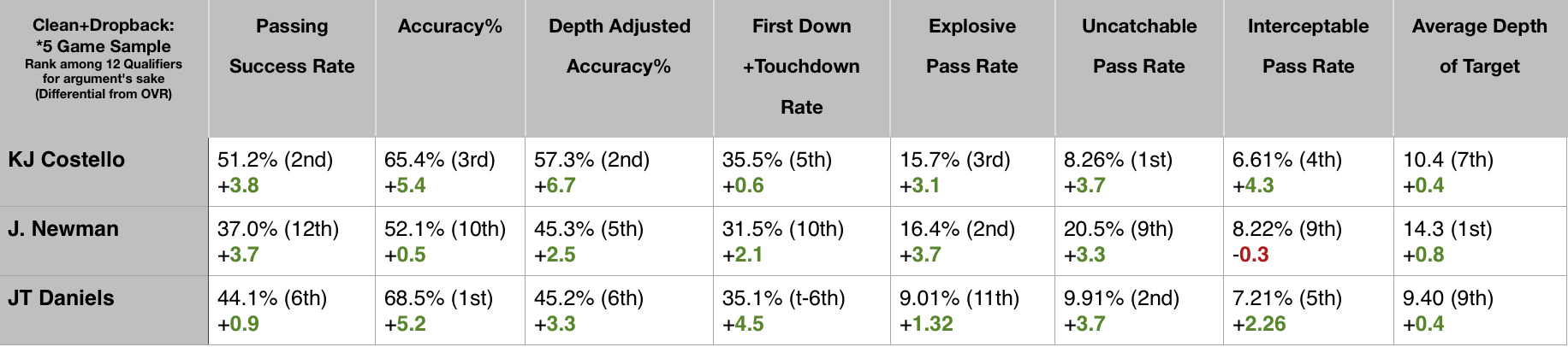
For argument's sake, let's quickly circle back to the two grad transfers. Again, this only reflects their results from a five game sample versus a slate with an SP+ average close to a typical SEC slate. While it remains to be seen how KJ Costello and Jamie Newman react in their new environments or respond to conference opponents, we at least have some stats of substance to project their 2020 season.
KJ Costello
Costello jumps right off the page and looks to present a dependable floor as a passer. On clean+dropback attempts, only Kellen Mond projects to be more preferable than the former Cardinal among our returning qualifiers. Though Costello requires a bit of inertia to generate some of his best throws, he consistently gave his guys a shot to come down with his passes. No SEC passer in our study boasted an Uncatchable Pass Rates in the single-digits, but Costello delivered such a clip over his sample. With our parameters applied, Costello's nibbling improved curbing turnover-worthy passes as only Kellen Mond and Ryan Hilinski saw bigger gains than his 3.7 percentage increase from his overall clip. His average depth of target and First Down+Touchdown Rate remained steady in these spots, but his 51.2% Success Rate and 57.3% Depth Adjusted Accuracy has Costello ready to make an immediate impact; that is, if his line can keep him clean.
In his five game sample, Costello faced pressure on 24% of his attempts, which was a typical clip within the SEC last season. His 35.7% Success Rate was pretty good and above the SEC average, but that clip was over 12 percentage points below his overall figure. Decision-making is hardly the issue with Costello. His long-windup and limited mobility make him an easy target for blitzers to pick on. Traditionally when pocket passers are knocked off their spot or put out of rhythm, their passing noticeably regresses; he was no exception. When opponents were able to harass him, Costello's explosiveness and downfield accuracy plummeted to 7.14% and 28.1%, respectively. From muddled pockets, that shoddy accuracy birthed an insanely high 23.8% Interceptable Pass Rate. Think about that. Almost a quarter of his pressured attempts from his sample had the potential to result in a turnover. Only Nick Starkel's 26.1% clip was worse within the SEC. Simply put, that shit cannot fly walking into an offense that suffered from the third worst Pressure Rate in the conference. Though Stanford's pro scheme used a low rate of screen and RPOs, these designs still impacted Costello's sample. Most quarterbacks are able to pad their accuracy clips with these plays. Costello, however, had a worse Accuracy% targeting screens+RPOs than he did in the face of pressure. At least, his outlets helped him win plenty of battles to the tune of a 50% Success Rate, a mark only a handful of SEC passers benefited from last season. While his accuracy outside of structure (paired with a high Interceptable Pass Rate) is a glaring wart on his profile, Costello has a very high floor thanks to his production on clean+dropback attempts.
Jamie Newman
Like his overall numbers from his sample suggests, Newman wanted to get vertical. This desire was accentuated on clean+dropback attempts. His 14.3 average depth of target projects to be about a yard and a half more than the highest SECer; and his 16.4% Explosive Pass Rate would only trail Jarrett Guarantano. But to reiterate, throwing downfield frequently rarely yields good efficiency. The increased degree of difficulty of pressing deep projected Newman to see a bottom3 Uncatchable Pass Rate, First Down+Touchdown Rate, and Accuracy% with no one owning a lower Success Rate than his 37.0% clip. Though his Depth Adjusted Accuracy% improved under these parameters, his 45.2% clip would have failed to finish on the good side of average within the SEC this past season. With a playing style that aimed to flip the field and subpar inaccuracy, there's not a big mystery why Wake Forest's offense stumbled down the stretch when its schedule beefed up; especially considering Newman lost his two best targets at that point.
True Screens were not a big part of the Demon Deacons' script, but Newman's RPO Throw Rate would have been above average within the SEC. Mostly targeting slants off extended mesh action, his Accuracy% showed modest gains. Poor footwork and mechanics often sabotaged these designs, however, as his 27.9% Depth Adjusted Accuracy outweighed his 9.52% Drop Rate on such plays. Newman's Success Rate was a miserable 28.6%. No one in the SEC with 24 screen+RPO attempts finished below 32% this past season. Under duress, Newman struggled to find consistency. Though he suffered pressure at a lower clip than most of the conference from his five game sample, his Explosive Pass Rate and Depth Adjusted Accuracy% bested the SEC's mean. Despite that, his 27.6% Success Rate quickly reminds you of his challenging style of play. There's no questioning Newman's arm strength, but his inaccuracy is concerning. Granted is much harder to completed a homerun ball than a shallow, but Newman even struggled completing throws in front of his face across his sample. His workload will undoubtedly shrink and he certainly won't be asked to play Superman game in and game out. His production and output should improve with a better overall cast and scheme that give him easier chances. But even when he was clean, Newman left plenty to be desired.
JT Daniels
Daniels was granted a decent amount of opportunities off RPOs across his sample. Over 17% of his attempts came off such designs. Sans RPOs, Daniels reflects a floor much like his overall numbers suggest. His Success Rate, average depth of target, and Explosive Pass Rate remain steady with only modest gains in this context. And while he's largely middle-of-the-road everywhere else, his conservative playing style resulted in a sterling Accuracy% that projects to be tops within the SEC. But as aforementioned, this notion is highly influenced by his one half of play in 2019. If his performance versus Fresno State was omitted, his clean+dropback Accuracy% would sit at 62.5% (fourth best). Needless to say, Depth Adjusted Accuracy, Interceptable Pass Rate, and Success Rate would have been negatively affected as well.
Since Daniels' five game sample only saw him suffer from a pressure on 16% of his dropbacks (which would have been the lowest in SEC play), his figures weren't altered too much by that element. Daniels, however, was terrible under duress. Looking all the 22 SECers with 12 pressured attempts in league play last year, Daniels' 20.0% Depth Adjusted Accuracy%, 14.8% First Down+Touchdown Rate, and 14.8% Interceptable Pass Rate all would have been in the bottom5 (the former two in the bottom3). So our parameters did him a solid eliminating those snaps. As a dropback passer in general, his most successful area was throwing outside of the numbers; even if his accuracy was middling. Implying he was rather reliant on his dudes to make a play for him. As it were, half of such throws resulted in success. As he traveled inward towards the middle of the field, his Success Rate dwindled. Yet, his most accurate spot was between the numbers and hashes. There, Daniels' would have owned the SEC's fourth best Depth Adjusted Accuracy%, which was akin to Kyle Trask's. Though his floor projects him being serviceable, there's not too much electricity in Daniels' modus operandi.