2020 Vision: The Sophomore QBs
2020 Vision: The Sophomore QBs
Who ya got? It's a simple question but often a sports debate staple. In the SEC where it just means more, polite discourses frequently become passionate shouting matches. Spewing stats and situational traits laced in favoritism and bias rarely goes anywhere unless it's a true slam dunk case. Otherwise, each camp becomes more entrenched on their respective side.
For this piece, I wanted to see which soon-to-be sophomore passer within the SEC is the most polished passer entering 2020. Some are expected to start without controversy while others could find themselves in position battles. But just because Player A starts for Team X doesn't mean he's better than Player B who is a backup for Team Y. Our subjects all threw at least 74 regular season passes with 50 occurring during league play. The six quarterbacks that will be evaluated are Matt Corral, John Rhys Plumlee, Ryan Hilinski, Brian Maurer, Garrett Shrader, and Bo Nix.
Traditional Stats, Starting Point:
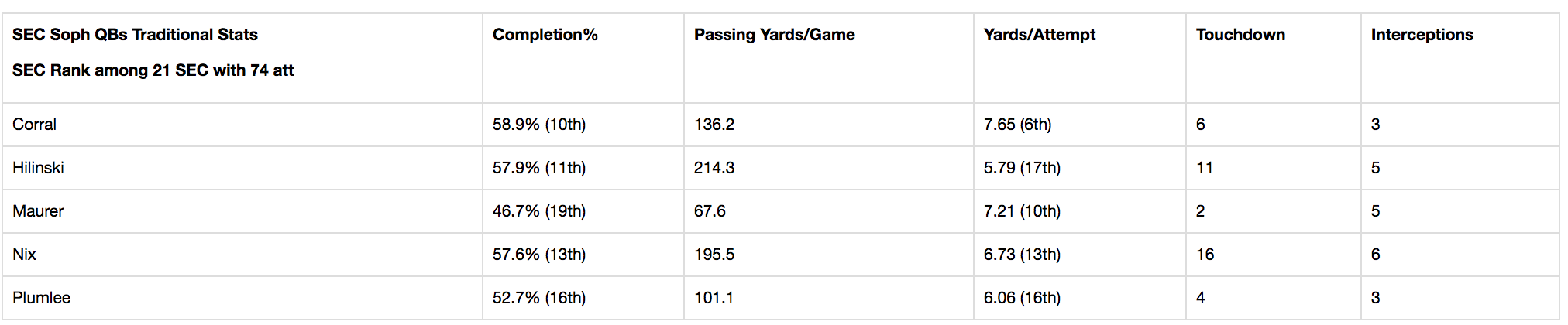
Since the average fan mostly trusts the old fashioned eye test to guide their sports opinions, easily accessible traditional stats often are the sole source of information to woo patrons in debates. Volume production frequently rules the day over efficiency outputs. Since passers commonly play in varying schemes with assorted roles, volume stats can be incredibly misleading when trying to determine who is a better quarterback. Thanks to starting every game, Auburn's Bo Nix was the clear leader in total yards and passing touchdowns. Along with playing on a high profile team, those were strong enough stats by the old ways of gauging talent for him to earn SEC Freshman of the Year honors. Based on the hardware distributed and the clear cut traditional stats, Nix should be the SEC's top sophomore passer entering 2020. Of course, it's not that simple. That would make for a very short and boring article.
To take the conversation further, we need to evaluate the context in which these quarterbacks performed. Again traditional stats don't consider where or how a passer accumulated his yards. Screen yards and production off deep balls are all the same in the box score. Plus, it's no secret plenty of young passers see an elevation in play against inferior competition. And in case you forgot, its a very common tactic for SEC programs to schedule Poop State in order to offset the rigors of the conference schedule.
For the purposes of our evaluation, I will only be looking at production in key areas from conference play this past season. Please keep that in mind moving forward. Though it's nice to see gaudy stats or a passer playing in rhythm with a cupcake in town, we simply learn more about a quarterback's trajectory by measuring how he performed against SEC defenses. In order to get a clear picture of what these passers are and what they can improve, we'll see how the sophomore quarterbacks did overall, from clean pockets, on pure dropbacks, and some combined metrics. After all, some passers offer a little more value when they can run around a little bit. But, most of this analysis will be looking solely at how these dudes can sling the pill. The goal is to strip away all the chaos and present situations to best determine who will be the most preferable sophomore passer in 2020.
Overall:
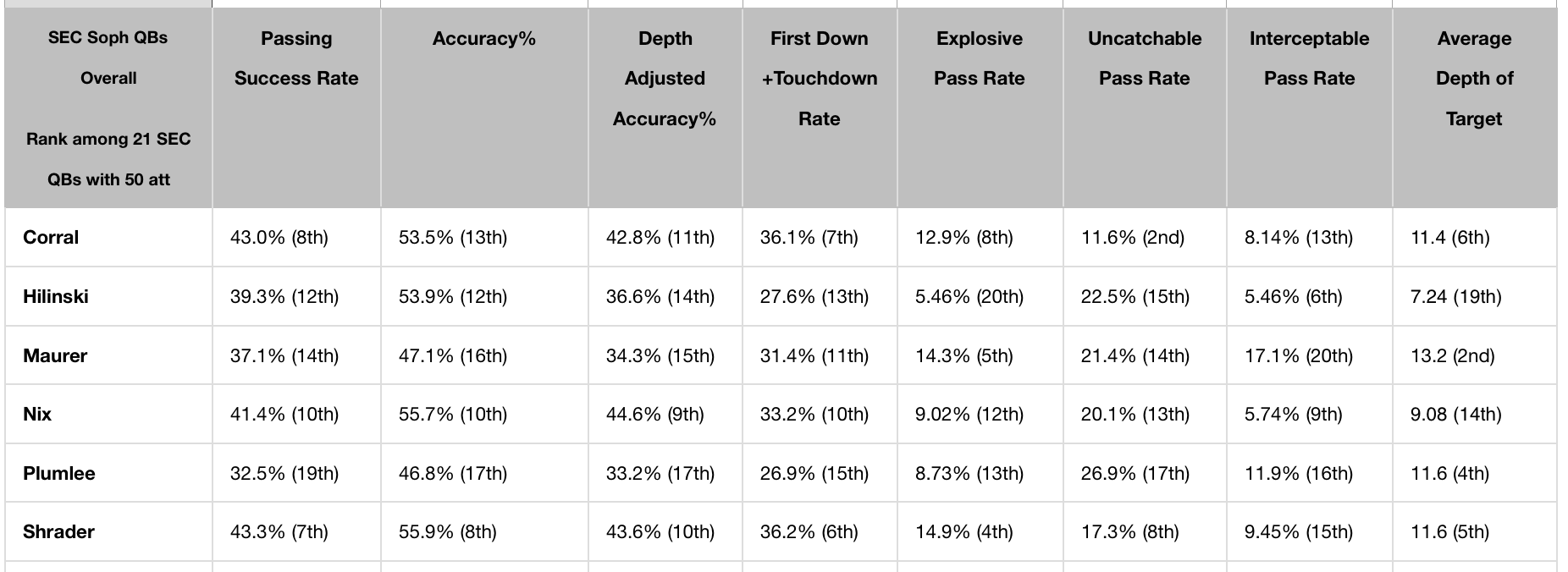
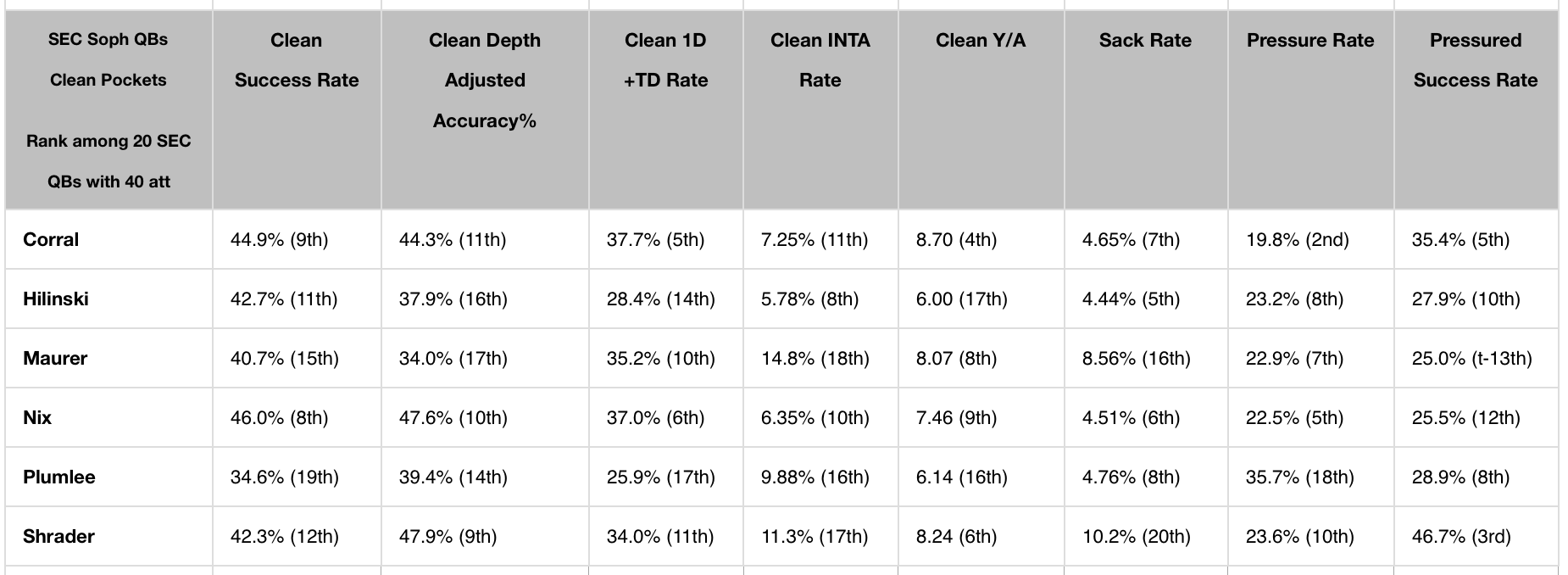
Matt Corral and John Rhys Plumlee ran a QB by committee this past season. Because of that, evaluating them by their traditional stats alone is a total crapshoot. The offense had a hard time finding rhythm even if each helped generate some big gainers. Plumlee obviously preferred to do damage on the ground while Corral took to the skies. Despite different M.O.s, both Rebel quarterbacks finished the year with equal Screen+RPO Rates. Plus, both passers ended up with similar average depths of target - or how far their guys were downfield when thrown the ball. Ole Miss's spread-run scheme didn't have many worthwhile passing wrinkles that aided these young passer's to play efficiently, and Ole Miss frequently attempted to forcefeed Elijah Moore. Corral's and Plumlee's outputs, however, differed greatly. While offering up the SEC's second lowest rate of uncatchable passes, Corral's overall numbers trumped Plumlee's across the board. For the most part, Corral placed either second or third among the six quarterbacks. Plumlee, on the other hand, represented the floor in multiple metrics including Passing Success Rate, both accuracy figures, Uncatchable Pass Rate, and First Down+Touchdown Rate.
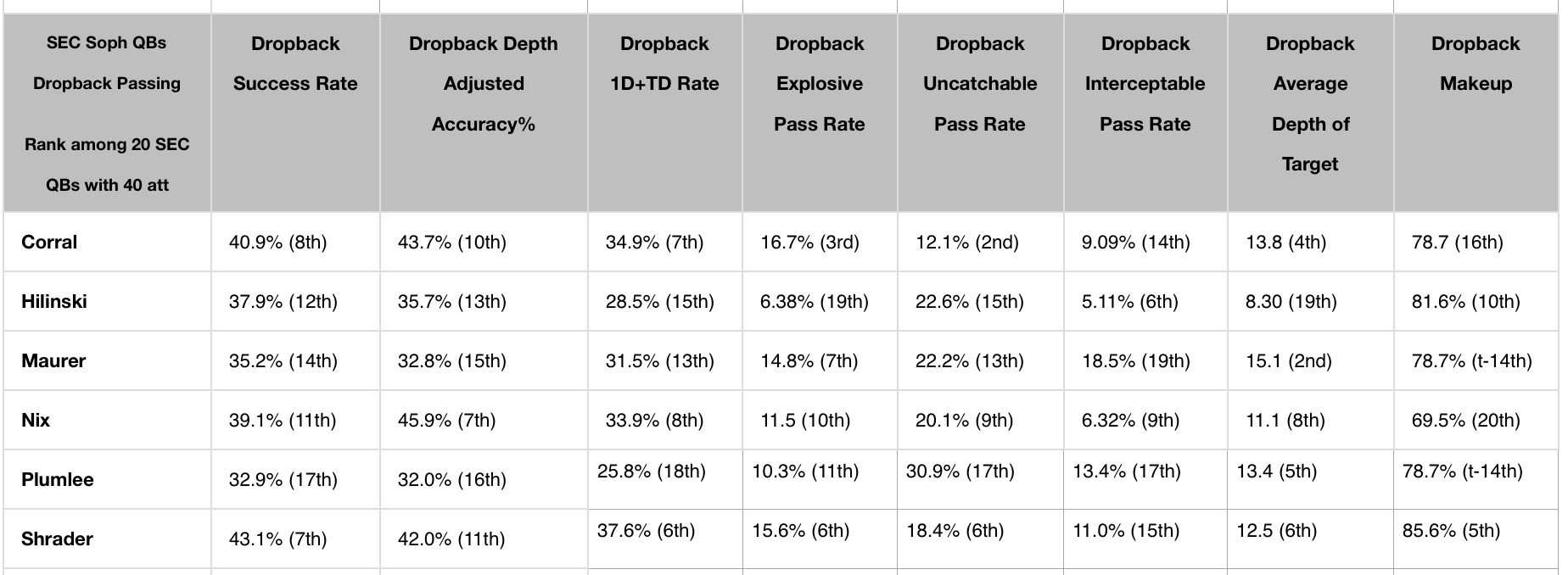
Ryan Hilinski was thrusted into the fire after incumbent starter Jake Bentley broke his foot in a Week 1 loss to North Carolina. The freshman wasted no time lighting up Charleston Southern and injecting hope into the hearts of Gamecock supporters. But as the year went along, Hilinski clearly plateaued. With defenses getting a bigger sample size on how he liked to operate, Hilinski became an easy quarterback to get off track and neutralize. The California product was made to function within a West Coast Offense that is predicated on short timing routes in the underbelly of coverages. He routinely exhibited one of the quickest average times to throw and lowest average depth of target. While he averaged the most passing yards/game and owned the second best Completion% among the six soon-to-be sophomore passers, Hilinski was not an efficient quarterback last year. Much of this was due to his immense risk aversion and desire to pass the buck at all costs. He was just as likely to throw an interception as a completion that netted 20 or more yards. This very much could have been coaching to appease the West Coast style or not to put his defense in iffy spots. No SEC passer was less explosive than him. With less downfield threats, South Carolina found it more challenging for their guys to get open short with increased box counts. At the end of the day, Hilinski was a middle of the road freshman passer relative to the rest of the youngsters within the conference.
Brian Maurer was the most raw freshman passer this past season. With Jarrett Guarantano incessantly infuriating Big Orange with inconsistent play, Maurer was called upon to provide a spark for Tennessee's ho-hum offense. Maurer wasn't ready for action, but Jeremy Pruitt felt change was needed. Tennessee -- an offense not really known for ample RPO use -- had the young passer lean on these at one of the highest clips in the conference. While they attempted to spoonfeed Maurer easy completions, he owned one of the highest average depths of target and Deep Pass Rates within the SEC. No SEC freshman was more efficient creating an explosive pass than Maurer last season as his 14.3% clip was good enough for the conference's top5. Woeful decision-making, however, made him unplayable down the stretch. With the Vols opting to play small, they couldn't afford giving away extra possessions to opponents. Maurer owned the worst Depth Adjusted Accuracy% and Interceptable Pass Rate among our six quarterbacks during SEC play last season. Guarantano has since answered the bell and seemingly reclaimed the starting job in Knoxville. Guarantano's history might indicate a murky outlook; so Maurer would be wise to sharpen his skills in case his number is called and not not be buried on the depth chart by green newcomers.
I already mentioned how Bo Nix was crowned the SEC's Freshman of the Year. The Golden Boy instantly made an impression out-dueling first round pick Justin Herbert in Week 1 with some late minute heroics. It didn't take long for many analysts to don upon him plenty of "indescribable qualities" like moxie, grit, and gumption. As the year went along, there was no shortage of these kinds of compliments. Why? Because his stats were just plain mediocre. They alone didn't merit over-the-top praise or adulation. Nix was directed to manage games and curb his aggression. With Gus Malzahn back calling plays, Auburn returned to its roots in many ways with ample RPOs, presnap movement, and a run-first approach. This meant Nix didn't have to be his unit's catalyst for success; this often resulted in him operating as a facilitator instead of a play maker. No SEC passer owned a higher Screen+RPO Throw Rate than Nix. With wolves as opponents and with experience lacking, Malzhan didn't want to ask too much of his freshman. This resulted in Nix targeting outside the numbers, where there are generally less defenders, at one of the highest clips around. Though Nix was largely middle-of-the-road, he topped all other freshman passers last year in SEC play in terms of Depth Adjusted Accuracy%, which applies more risk/reward an attempt travels downfield.
Garrett Shrader had a bumpy debut to say the least. Tommy Stevens was QB1 for Mississippi State entering the year, but injuries plagued his roller coaster grad transfer season in Starkville. There were plenty of instances when Shrader was called upon for mop-up duty. While some play callers handled their freshman passers with care, Joe Moorhead challenged Shrader to expand his game. Though known for creative RPO packages, Moorhead ran a rather vertical dropback passing scheme that hinged on All Verts, Sails, Drives, and Shallow concepts. Shrader posted the SEC's fifth lowest Screen+RPO Throw Rate in the SEC. His 14.4% clip was easily the lowest amongst the six freshman. The "no biscuit unless ya risk it" approach saw him finish the conference slate with the best Success Rate, Accuracy%, First Down+Touchdown Rate, and Explosive Pass Rate from the soon-to-be sophomores. All the while, he boasted one of the SEC's five highest ADOTs. But, this aggressive mentality resulted in plenty of turnover-worthy attempts, which certainly cools his outlook. With grad transfer KJ Costello expected to take the reigns for Mike Leach's Air Raid offense, Shrader will once again enter the season on the bench. It's worth mentioning, however, that injuries have sidelined Costello before. Shrader could be poised to slide on in if Costello cannot stay healthy.
Clean Pockets:
Dropback Passing:
Glancing at Run+Pass Figures
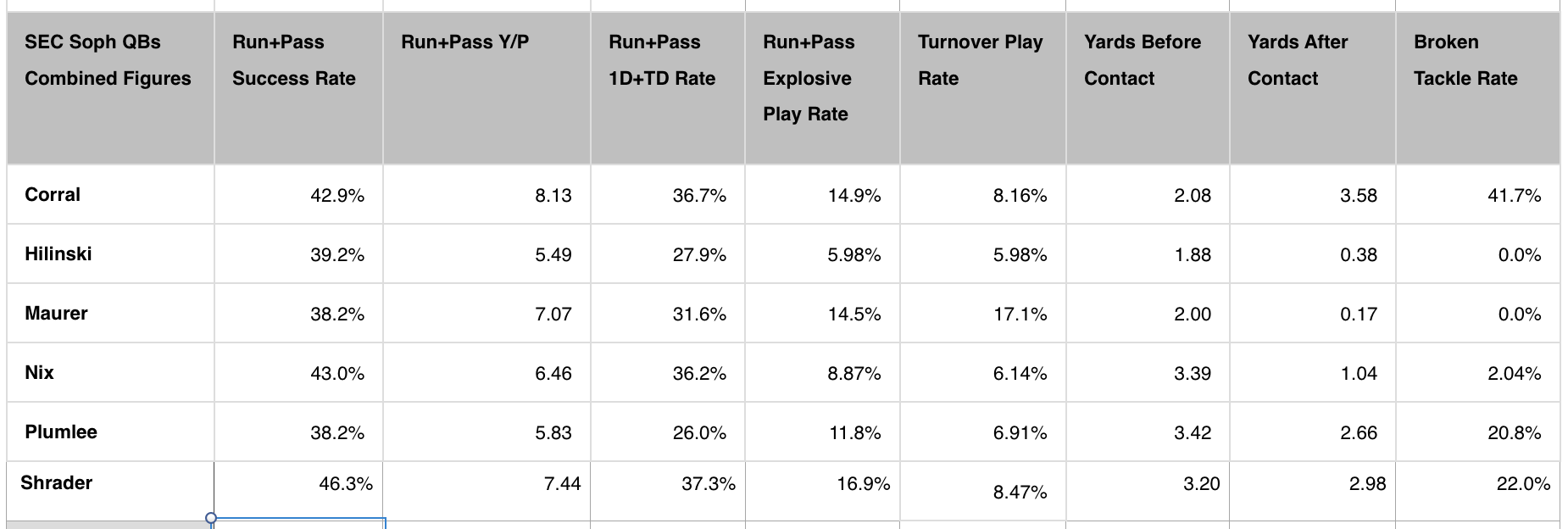
Since most Plumlee supporters are certainly poo-pooing this analysis because it omits his greatest strengths, I wanted to take a brief sidestep to see which sophomore quarterback presents the best combined upside for next season. So, I merged results from passes and designed rushes for our six QBs from SEC play. Again, this doesn't account for anything versus a non-conference opponent. Plus if you were unaware, design runs omit sack and scramble plays.
Even with adding his running ability, Plumlee remains one of the worst sophomore QB options entering 2020. Only Ryan Hilinski is less potent down-to-down in terms of yards per play and Run+Pass Success Rate. Though Plumlee's speed and quick twitch running style aided his fantastic yards before contact clip on the ground, his teammate proved to be a harder ball carrier to corral (see what I did there?). Many fans want to point to his ability to bust big runs as means to keep him behind center for the Rebels. But even there, Corral bests him via Explosive Play Rate. Within structure, Plumlee has miles to go both on the ground and through the air. While there's little question he has gobs of athleticism, that doesn't mean he's a capable football play right now. But believe me, that electricity of his is very tantalizing.
No SEC freshman averaged more per touch than Matt Corral. Granted, he was mostly a passer as he only had 12 designed runs in SEC play. Despite the small sample, Corral topped Plumlee in average yards after contact and Broken Tackle Rate -- two metrics that prognosticate a runner's ability the most accurately. Still, his passing production buoyed most of his combined numbers as he finished second or third across the board.
Bo Nix was fairly prudent with his chances on the ground. In Auburn's heavy Run-Pass Option approach, Nix really chose his spots on when to pull it. Though there are "rules" he has to follow, there were plenty of instances where Nix passed on the chance to attack the edge in favor of handing his back the ball. His prudence resulted in the second best yards before contact clip among the six freshman and his 51% Success Rate was good for the SEC's sixth best clip within conference play. Though his yards per touch is rather pedestrian, Nix's balance makes him one tough cookie to prepare for.
Brian Maurer and Hilinski's combined numbers are the closest to their overall due to the fact that each finished with six and eight designed rush attempts inside league play, respectively. Their ability to run the ball within structure isn't an aspect either wears on their sleeves.
While the turnover-worthy plays remain high when combining his run and pass numbers, Garrett Shrader appears to be the SEC's most rounded sophomore entering 2020. His overall figures already had him flirting with the top spot, and his knack for running efficiently might put him over the top. Though it remains to be seen how much designed running Mike Leach will ask of his passers, history tell us to not get our hopes up. Inverted Veers and Zone Reads might be things of the past for the Bulldogs. Still, Shrader's combined Success Rate, First Down+Touchdown Rate, and Explosive Play Rate all were tops within the group.
Clean+Dropback
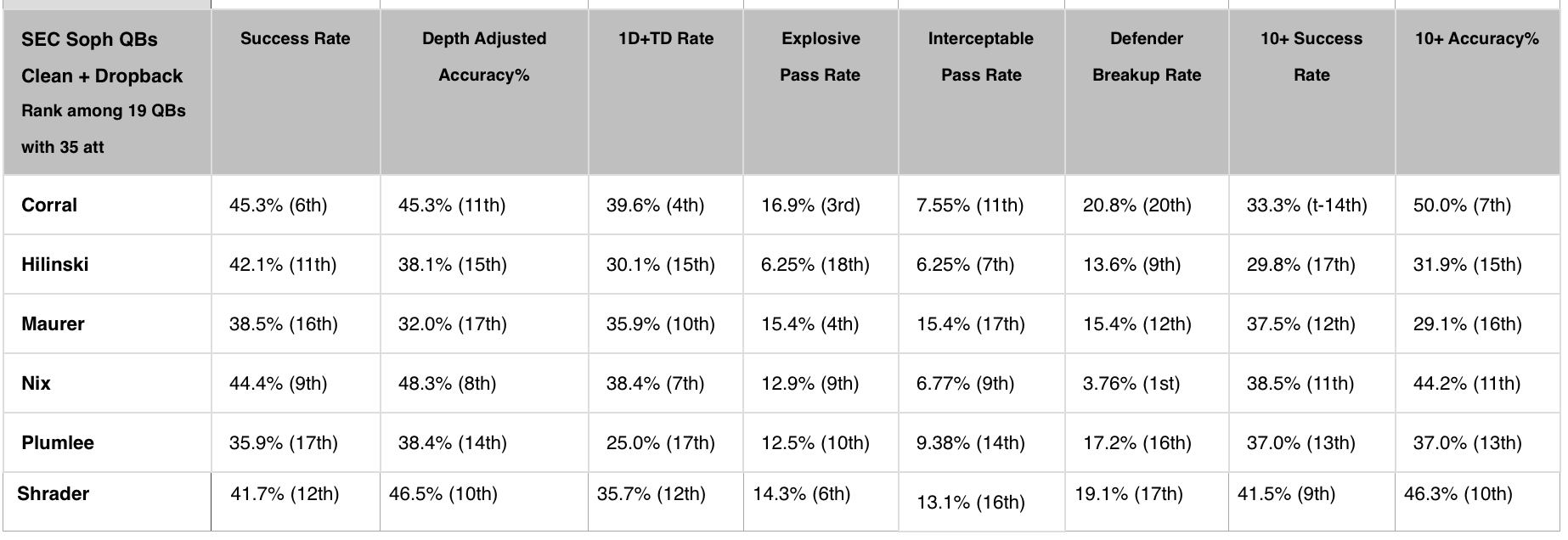
Filtering out pressured attempts, we see how consistent and effective a passer is within structure of his offense. Filtering out screen and RPO attempts, we see how much true passing ability a quarterback owns. Filtering out snaps versus non-cons, we see a passer's results against his most challenging foes. When we apply all three together, we get a better idea of what passers are preferable moving forward despite varying degrees of playing style and volume.
Like our previous breakouts indicate, Matt Corral, Box Nix, and Garrett Shrader are the three strongest candidates for honors as the SEC's most polished sophomore passer entering 2020. Maurer's inconsistency and Interceptable Pass Rate outweigh his moderate potency. Hilinski's risk aversion and lack of potency easily mutes his output. Plumlee's struggles within structure make it just as challenging for his play callers to maximize his abilities as it is for defensive coordinators to bottle him up. Though Maurer, Hilinski, and Plumlee all could conceivably make noise this season, their efficiency outputs from 2019 say otherwise.
While most SEC passers are game managers and are more than fine watching their receivers do the heavy lifting, Shrader was challenged to execute downfield in Joe Moorhead's vertical passing scheme. Shrader was the only freshman quarterback to finish inside the SEC's top10 in terms of Success Rate and Accuracy% on throws ten or more yards downfield last season within league play. Again, he sported the highest Dropback Pass Rate of any conference freshman; so Shrader is accustomed to operating like a traditional passer even if he was asked to help out in the run game. His Depth Adjusted Accuracy% in these spots was the second best in the group and was good enough for a top10 ranking within the conference. Though he wasn't as incendiary as other freshman with his arm, Shrader's Explosive Pass Rate was good enough to be the SEC's sixth best. Mike Leach puts a premium on accuracy, and Shrader should have enough to appease his new coach's standards. Decision making and risk analysis should change with a new play caller and offensive mentality. Still, Shrader's greatest shortcomings as a passer are consistently functioning within the structure of the design and limiting attempts where defenders potentially could disrupt or intercept the ball. In theory, both should improve with more reps in the line of fire. But with KJ Costello presumed to start for Mississippi State, Shrader is nothing more than Plan-B moving forward. As far as I'm concerned, he's a more-than-decent secondary option. Don't believe me? Well looking at his overall passing numbers from conference play, Shrader was the only freshman last season with a top10 Success Rate, Accuracy%, Depth Adjusted Accuracy%, First Down+Touchdown Rate, Uncatchable Pass Rate, and Average Depth of Target.
Though our findings heavily insinuate Matt Corral is a better passer and more consistent quarterback than JR Plumlee, a new regime can be numb to past production. If Lane Kiffen is giving each a clean slate to earn trust and reps, there's a very good chance Plumlee's electricity could outshine Corral's moderate, yet superior passing analytics. While it remains to be seen on who the starter in Oxford will be, Corral was one of the most consistent and worthwhile freshman passers within SEC play last year. In terms of Success Rate, First Down+Touchdown Rate, and Explosive Pass Rate, Corral was tops among the six youngsters. Looking at the latter, only Tua Tagovailoa and Jarrett Guarantano outdid his clip within SEC play. He was the only SEC freshman with an Accuracy% on throws ten-plus yards downfield to break the 50% plateau. Despite his suitable ability to throw accurately, too many passes were altered by defenders. His 20.8% Defender Breakup Rate was the SEC's worst, and his 7.55% Interceptable Rate is fairly concerning. But I want to reiterate, a good chunk of Corral's passes came during crunch time when he had no choice but to live dangerously. While the Rebels appear to be set at running back, Elijah Moore alone isn't enough to support Ole Miss's aerial assault. Kiffen is known for getting the most out of his passers. But with limited outlets, it's fair to wonder just how much better Corral can improve during an atypical offseason in a new scheme with a new coach while duking it out with Plumlee for starting honors.
The reigning SEC Freshman of the Year has plenty of traits you'd want in a passer. He appears coachable, has an above average arm, and owns enough athleticism to get him out of jams. More importantly, he might not suffer from the hubris other strong-armed quarterbacks frequently seem to exhibit. Rather than believing he can make every throw, Nix showed restraint and often strove to put passes where only his guys could get it. While that last part sounds rather cliche, Nix was a big fan of the back shoulder fade and using the sideline to his advantage. To that point, Nix was one of two SEC freshman to finish the SEC slate with a top10 Interceptable Pass Rate and no one had a lower rate of passes altered by defenders. The problem was, however, his accuracy was a little subpar relative to the rest of the conference. But when he was kept clean and was asked to execute dropback patterns, Nix was the only SEC freshman with a Depth Adjusted Accuracy% better than the conference average. Along with that metric and his aforementioned Interceptable Pass Rate, Nix finished inside the SEC's top10 in terms of Success Rate, First Down+Touchdown Rate, and Explosive Pass Rate. None of the other freshmen can make such a claim. Though both Shrader and Corral sported more refined accuracy on throws ten-plus yards downfield, Nix held his own even if he failed to crack the top10 in that department. Nix lost his bellcow back in Boobie Whitlow to transfer but should have all of his favorite weapons back, which gives him a major edge in his year-to-year development even if he's learning Chad Morris' new wrinkles.
As far as who is the best? Well, that's a matter of opinion. Nix offers the best downfield accuracy without putting the ball into harms way but is cloaked by the most screen+RPO usage in the conference and shows his age under duress. Shrader offers vertical passing skills and top-level efficiency under pressure but is iffy with turnover-worthy plays in both facets while being sack prone. Corral offers sound decision-making without curbing YOLO throws but is overly confident in his abilities as far too many passes are altered by defenders. Only Nix is slated to start the year for his respective team among the three as Corral is still battling for the number one spot with JR Plumlee and Shrader is the clear backup to grad transfer KJ Costello. There's a fairly decent chance neither plays significant snaps. Though they are all their own passers, I believe all three showed off skills that could translate into quality college passers. While Captain Obvious wanted me to reiterate these passers are far from finished products, having a solid foundation upon which to build is crucial for future development. So who ya got for 2020?