2020 Vision: Jamie Newman vs. KJ Costello
Who ya got? It's a simple question but often a sports debate staple. In the SEC where it just means more, polite discourses frequently become passionate shouting matches. Spewing stats and situational traits laced in favoritism and bias rarely goes anywhere unless it's a true slam dunk case. Otherwise, each camp becomes more entrenched on their respective side.
For this piece, I wanted to examine two incoming graduate transfers in Georgia's Jamie Newman and Mississippi State's KJ Costello. Newman will look to reinvigorate UGA's stale scheme. Costello will help Mike Leach's Air Raid offense lift off in Starkville. Both enter the SEC with high expectations but also plenty of red flags. At Wake Forest, Newman was overused, and his overall efficiency numbers suffered. All the extra running around he was forced to do in order to buoy the Demon Deacons' offense had a noticeable effect on his downfield accuracy. Costello never could win the big game. His arm strength is far from elite, which has led to plenty of turnover-worthy attempts. Plus last season, injuries ultimately cost him his starting job at Stanford.
Newman's traditional stats are solid. As Wake Forest's full-time starter and main offensive producer last season, his job wasn't easy. In addition for racking up a top50 passing total, he accumulated the 14th most total rushing yards amongst college QBs last season. Though his style of play kept defenses honest, his 60.9% Completion clip was rather average. Too many passes got away from him; and with Newman forced to play Superman, he often tried to do too much. This aggressiveness led to 11 interceptions, which were inside the NCAA's bottom15. The Demon Deacons hummed through their lesser opponents offensively. But once a pair of his favorite play makers were lost for the year and Wake hit the meat of their schedule, Newman's overall effectiveness waned. Despite being looked upon to make plays, Newman overly failed to make a difference down the stretch.

Costello was one of the best passers in the game his junior season. His yards, yards/attempt and passing TDs all placed top16 nationally and his 65.1% Completion clip just missed being inside the top20. Though Stanford has a reputation for overusing multi-tight end sets, their passing game was more open than people realize. Costello didn't mind throwing into tight windows or shy away from tossing a 50:50 ball to one of his favorite targets. He wasn't one to "make all the throws" but he had undeniable passing talent. His decision making was sound but far too often did he allow a defender to get his mitts on balls with a poorly placed pass or lazy effort. Granted a decent amount of batted balls led to his misfortune, but the final INT count omits pick attempts that were dropped. Still, his junior year volume was enough to set a high standard for his senior season. Though he started 2019 efficiently, concussions and a thumb ailment soon made him a far lesser version of himself. Costello would only appear in five games.

Evaluating quarterbacks across conferences with varying schedules and styles of play can be a tricky endeavor by just glancing at the traditional stats. While we can get a general picture of what each brings to the table, these figures simply lack the context in how they were acquired. In an attempt to get a fairer reflection of each passer, I scouted a five game sample based on ESPN SP+ metric, which it's a tempo- and opponent-adjusted measure of college football efficiency. Rather than letting the Poop State's of the world distort these passers' outputs, I preferred to chart them versus quality opponents in order to better gauge the rigors of playing within the SEC. This past season, SEC East defenses averaged a SP+ rating of 19.5 with ones in the West sporting a 21.6 clip. In this context, good defenses have ratings closer to zero.
Since Newman played in the ACC, he had an easier go of it to say the least. His five game sample of Clemson (4th), Michigan State (13th), Duke (36th), Virginia Tech (39th), and North Carolina (44th) yielded an average SP+ rating faced of 20.3. This handful just so happened to represent his hardest opponents faced last season. Since Costello's most productive season was two years ago, it didn't make much sense only scouting his 2019 campaign. With that being said, I didn't want to completely ignore last year either. In the end, Costello's sample included Washington (4th), Notre Dame (10th), and Utah (19th) from 2018 with Northwestern (27th) and UCF (21st) from 2019 , which yielded a 16.7 SP+ defensive average. Unlike Newman's that included all of his most recent and challenging opponents, Costello's sample omitted a fair amount of quality opponents. Despite easily having a more trying slate than Newman, foes like California (13th), San Diego State (24th), and USC (34th) from 2018 as well as Oregon (8th) and Arizona (46th) were excluded from our findings.
While conference play remains tough, most SEC teams take it easy when it comes to scheduling non-cons. With the reduced ability of these opponents, offenses often play more efficiently and are able to pad their stats. Since Newman and Costello didn't get the luxury of being charted versus softies, their numbers obviously would be less favorable against an SECer's slate with some cupcakes. So, I comped each passer to the most identical SEC passer per stat category. While a standalone stat can relay some information, providing a player comparison can help one grasp a passer's ability better than just staring at a number on a screen. All following tables will reflect Newman's and Costello's analytics from our five game sample and will match them with the closest SEC QB on a per stat basis.
Overall Glance:
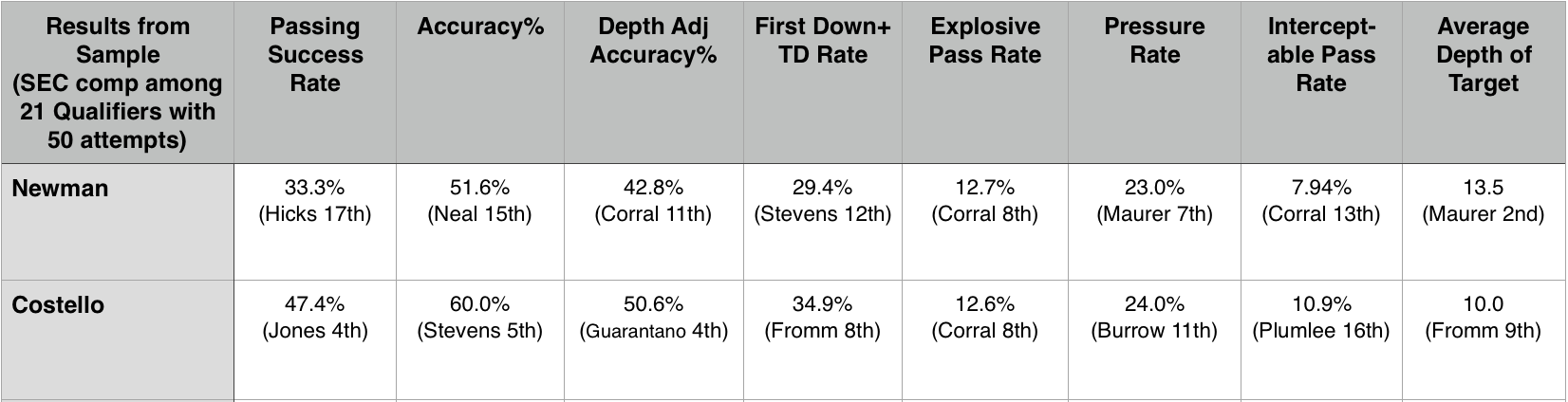
Right off the bat, we can see Costello's overall numbers from our sample trump Newman's. His Passing Success Rate and Accuracy figures all would have finished top5 within the conference versus SEC play. He was just as likely as Georgia's Jake Fromm to turn one of his passes into a conversion or a score. Considering his sample was harder than both the average SP+ rating of both SEC divisions, that should make Mississippi State fans eager AF to see him work within Mike Leach's Air Raid offense. To that note, Stanford's most targeted pass concept from his sample was All Verts, which so happens to be one of Leach's staples. Outside of the heavy usage that saw the look make up over a fifth of his yards, Costello boasted a 40% Success Rate. Only Alabama, LSU, and Ole Miss bested that clip on All Verts this past season within the SEC. After All Verts, a collection of Shot plays combined to be Stanford's second favorite concept group. Despite the Cardinal's proclivity to target dudes deep, Costello's average depth of target -- or how far his man is downfield when thrown the ball -- was about average. Their next five pass concept groups on their script all targeted short to moderate areas downfield. These included Slant Variations, checkdowns (often from deep concepts), All Curls, Levels, and Curl+Flat/spacing concepts. Though it was clear Costello had the green light to take a shot, he didn't live and die by the deep ball like Newman did.
Newman played in a vertical passing scheme at Wake Forest. The vast majority of their concepts were up and down. If the defense played up to stop the run and crowd the box, the Demon Deacons aimed to get behind the coverage. If secondaries sat back, Wake Forest would curl underneath. Shot plays, All Verts, All Curls, "Slice", and plenty of Switch Variations made up their favorite passes. Though Newman had the luxury of decent RPO utilization, he was overly directed to stretch the defense deep. Nearly a fourth of his attempts targeted 20 yard or further downfield, which caused his 13.5 average depth of target. Only Lynn Bowden had a higher ADOT within SEC play than Newman. And if you remember anything about UK's passing offense this past season, it was incredibly all or nothing and downright inefficient. Much was the same for Wake Forest. Though they feasted on lesser foes within ACC play, they overly faltered when up against competent secondaries. Plus since Newman had to help anchor the Demon Deacons' ground game, fatigue made his job more challenging. It's hard enough to throw a 30 yard pass accurately. It's even harder to accomplish if you are constantly winded or a little banged up from carrying the rock. Newman's sample birthed a Success Rate and Accuracy% that would have placed within the bottom5 of SEC play. The former would be much better off if Newman didn't suffer from a 10.3% Drop Rate. The highest clip in SEC play was Tennessee's Jarrett Guarantano's 9.3% rate. But thanks of his high ADOT, Newman was able to place closer to the mean in terms of Depth Adjusted Accuracy%, which applies more weight the further an attempt travels downfield and omits throws behind the line and judges whether a pass was accurate rather than it was completed or not.
Though Costello's sample depicted more consistency and efficiency than Newman's, the pair sported similar risk/reward figures. Their Explosive Pass Rate -- or percentage of passes that netted 20 or more yards -- were basically identical. But, both Newman and Costello threw too many turnover-worthy passes. Newman often pressed trying to make a play but obviously had some attempts get away from him. Costello noticeably put a lot of faith in his targets to win contested balls. If his timing or nuance was off, it was easy pickings for the defense. Also for whatever reason, Costello suffered from a bit of misfortunate with bats at the line of scrimmage. Each saw their Interceptable Pass Rate fall in the back half of SEC qualifiers. Maybe this shouldn't be too much of a surprise as both own an 11-INT season, but both are prone to put balls into harm's way.
For Costello, that blemish should be a massive concern since he'll be playing in the most pass-happy scheme around. Leach's Washington State teams have averaged 700 pass attempts the last 3 seasons. If that volume holds next year in Starkville and Costello doesn't curb this bad habit, do the math on the potentially insane amount of turnover-worthy passes he might throw based off his sample's 10.9% Interceptable Pass Rate. While Costello's usage through the air will surely increase, Newman's load will likely lessen. Going to a title contender will mean he won't have to be the sole source of potency offensively. Kirby Smart has hinted UGA is "modernizing" their offensive blue-print, which might be code for more Run-Pass Options. If the Dawgs follow through with that, Newman will have more manageable throws to space. Though he will still need to make some plays, Newman will probably be more of a facilitator and distributor in Athens, which should allow him to control his turnover-worthy tosses.
Pressured vs. Clean:
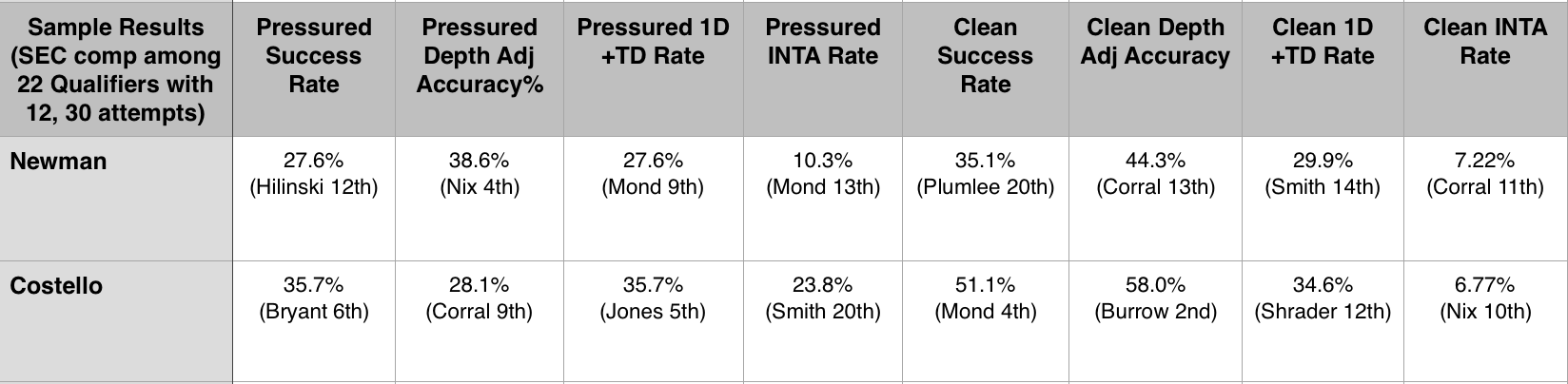
Production from clean pockets often sets a passer's floor. Since clean pockets present less variables and are more common down-to-down than pressures, evaluators are able to gauge a passer's consistency. After all if you cannot hit a target when conditions are perfect, how can you be expected to do so when a play breaks down or if a blitzer is barreling towards you? Knowing you can trust your QB to take care of business inside of structure is an important aspect when building game plans. On the other side of the coin, pressured attempts can reveal a passer's ceiling. Rhythm production is all fine and good. But sometimes, things just don't go according to plan. A lineman could whiff on a block, the secondary's coverage can force a play to extend, or a well-timed blitz can force a QB to operate outside of his comfort zone. With the increased number of variables, results can greatly fluctuate and are less consistent. This increased degree of difficulty, however, can certainly help separate game manager from playmakers and depict a passer's upside.
Looking at Newman and Costello versus pressure presents a mixed bag. Newman was the more sound downfield thrower, but Costello was more productive and effective. Newman's 38.6% Depth Adjusted Accuracy clip would have been one of the best in the conference despite an pressured ADOT just under 16 yards. The SEC average was right at 10 yards. Nearly 14% of his throws under duress were dropped, which clearly affected his output. Newman only had one pressured attempted altered by a defender out of 29 tries. Despite that, over a tenth of his pressured attempts could have resulted in an interception. Costello managed situations adequately but his greatest shortcoming overall was accentuated when under duress. While sporting a below average pressured Depth Adjusted Accuracy%, over a fifth were altered by defenders and nearly a fourth of his throws were turnover-worthy. Inside SEC play, only Tennessee's Brian Maurer and Arkansas' Nick Starkel owned worse Interceptable Pass Rates. Half of Costello's interceptable attempts when pressured resulted in turnovers in his five game sample. If defenses know a passer is uncomfortable and shaky making decisions under duress, you can bet your bottom dollar they will try to maximized their efforts to get under that guy's skin.
While interceptable passes remain Costello's biggest bugaboo, folks love his consistency within structure. From his sample, Costello's Depth Adjusted Accuracy% when clean was akin to what LSU's Joe Burrow produced within SEC play during his Heisman campaign. That stat alone has plenty of analysts sold on whether or not he can hit the ground running -- or should I say passing -- in Starkville. Plus, his Success Rate in these spots would place inside the conference's top5. Only eight SEC passers with at least 40 clean attempts broke the 50% plateau in terms of Success Rate this past season. But while Costello's downfield accuracy and decision making were on par with the best around, he was still below average in terms of making the most out of his passes. His 34.6% First Down+Touchdown from clean pockets was worse than his clip when pressured and fell into the back half of SEC qualifiers. Though he managed to control turnover-worthy attempts better than when pressured, his 6.77% was far from the SEC's best.
Newman's inefficiencies from clean pockets are very troublesome prognosticating his impact in Athens. Even with his high ADOT in these spots, he simply couldn't execute. Newman wasn't average or below average, but rather damn near the worst around in terms of managing down and distance from clean pockets. His Success Rate was similar to what true freshman John Rhys Plumlee put up at Ole Miss, which was good for the 3rd lowest clip amongst SEC qualifiers. In terms of Depth Adjusted Accuracy, First Down+Touchdown Rate the shortcomings were less prominent. Yet, each of those stats fell below the conference mean. Again since Newman had a very heavy workload not only through the air but on the ground as well, fatigue played more of a factor with him down-to-down. Being tired took his legs away quicker, which had an obvious effect on his mechanics and footwork inside the pocket. Being asked to do less can allow him to focus more on his craft throwing the ball. While he remains the Dawgs' best option at quarterback for 2020, he won't last long with a Success Rate that paltry if UGA is gunning for a title.
Dropback Passing:
Plenty of modern offenses incorporate extensions of the run game to create easy completions for their passers and get the ball to playmakers in space. While screens and RPOs are effective tactics to move the ball, quarterbacks hardly do any of the heavy lifting. Separating these plays from true dropback passes reveal a quarterback's true colors.
Newman used a decent amount of RPOs in the games I charted. Quite frankly, his number is probably slightly higher. But due to Wake Forest extended mesh read offense, I might have miscategorized a snap or six. (Unlike most run schemes that call for a vertical push, most runs are essentially blocked like a draw play). Either way his 14.3% RPO Throw was above average as far as other SEC passers were concerned within league play. With vertical-oriented concepts making up the majority of Wake Forest's passing game, the odds were stacked against Newman to play efficiently. While bombs might flip the field or net an explosive gain, their success rates are naturally lower than more manageable designs down-to-down. To that point, Newman was horrendous connecting with his targets outside the hashes. Both of his Success Rates in those areas of the field would have placed inside the SEC's bottom3. Though occasional deep completion helped keep his Depth Adjusted Accuracy% serviceable, these passes were largely failures. Like most passers, he saw his best results targeting the middle of the field. In general throws between the hashes are often shorter and hence easier chances compared to other throws. Despite that, Newman remained pedestrian relative to SEC passers.
Costello had a decent amount of screen usage; but inside Stanford's pro scheme he hardly ever turned to RPOs. His 2.86% RPO Throw Rate was basically half of what Guarantano's was whose clip represented the conference's floor. His dropback numbers basically reflect his overall ones. Also despite the Cardinal's run-first approach, play action was something he rarely leaned on. Like his overall numbers suggest Costello was a pretty good quarterback sideline to sideline. His touch passing style wasn't so hot outside the numbers. He was just as effective as South Carolina freshman Ryan Hilinski at attacking the perimeter. But, Costello's receivers made some plays for him and kept his Success Rate on par with something that would have been top5 inside the SEC. When targeting in-breaking routes or his tight ends, Costello was often at his best. Inside the numbers, his downfield accuracy clips were among the best the SEC had to offer. His Depth Adjusted Accuracy between the numbers and hashes as well as in the middle of the field comped to Alabama's Tua Tagovailoa.
Downfield Passing:
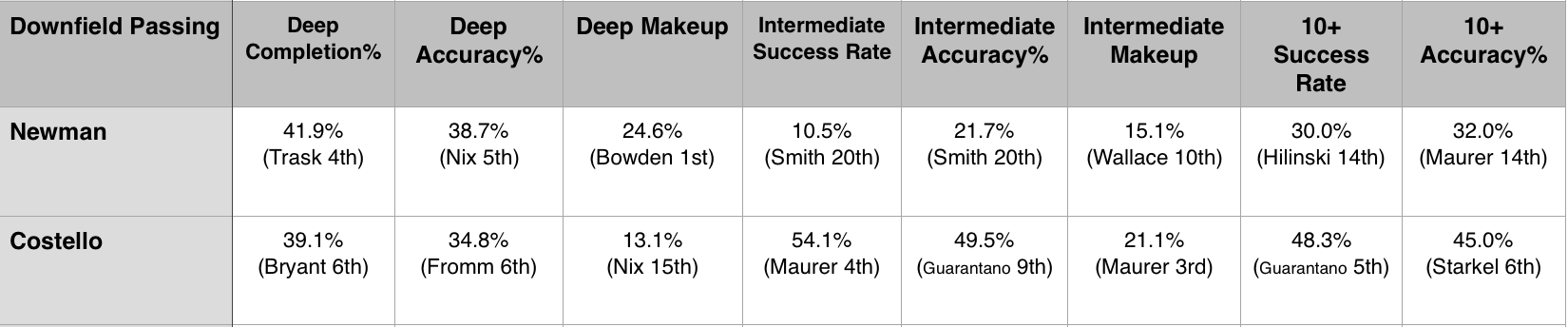
Taking dropback passing a step further, let's examine how these threw beyond ten yards downfield. Let face it, not too many aspiring quarterbacks dream of playing in offenses full of screens, hitches, and drags. Scouts are always in search of the next great arm; and they won't find it by examining short throws.
Newman was downright dreadful on intermediate passes. His 10.5% Success Rate on these throws was more than half of the closest SEC passer's clip. He was only on target on about a fifth of his throws with an ADOT 10-19 yards downfield, which would have been good for the SEC's worst. Jake Fromm had a similar percentage of his throws target those distances last year yet delivered an above average rate of return relative to the rest of the SEC. This is something to keep an eye on as the Dawgs look to "modernize" their offense. Ignoring intermediate routes has become a common tactic some new-age spread schemes have utilized. With an atypical offseason, it might be wise for UGA to look into that. But as far as the deep ball goes, Newman showed why he was a hot commodity in the transfer portal. I mean it wouldn't make too much since for Wake Forest to incorporate a vertical-minded attack if their passer didn't have the zip to make it work. Only UK's Lynnsanity Offense called for such a high percentage of deep throws on average. Again, the volume was warranted as his deep Completion% and Accuracy% would have been worthy of a top5 spot in SEC play. Only Joe Burrow tossed more passes with an ADOT 20 yards or more within the conference last season than Fromm. So UGA might lean into more shot plays. With a perceived increase in downfield weapons, Newman will be expected to make a splash via his long ball. But it's worth mentioning, nearly a third of his passes ten-plus yards downfield in his five game sample were charted as uncatchable.
Costello's so-so arm strength was revealed on his targets ten-plus yards downfield. Nonetheless, he displayed high competency. He wasn't afraid to test his guy's ability to win a tossup or come down with a contested opportunity. On deep passes, he was more than serviceable in terms of Completion% and Accuracy%. Again, Stanford called plenty of All Vert patterns and Costello was quite good at maximizing those opportunities. He was a big fan of backshoulder fades and putting the ball where only his guy could get it. His 26.1% Uncatchable Pass Rate on deep attempts was about equal to Joe Burrow's clip this past season. Unfortunately, Costello was just as likely to throw a turnover-worthy attempt as an uncatchable one when targeting deep. No matter how refined a bombardier is, having a backfire or a complete miss on half of your tries leaves plenty to be desired. Still, thanks to Costello's ability to know where to go on intermediate targets, he would have been one of the five best SEC passers throwing downfield based off his sample in terms of Success Rate with a satisfactory Accuracy%.
Situational Passing:

There's a saying going around: "The best 3rd Down offenses are the offenses that avoid 3rd Downs the best." Being able to take care of business on 1st or 2nd downs can alleviate plenty of stress for an offense. Since the very nature of thirds is to do or die, some guys can falter under the pressure or if the situation is too great. Not putting yourself into those situations often means an offense's regular stuff is working. While 3rd Downs can be one-offs with unique distance to gains, early downs are more common and hence better indicators of what an offense is trying to do. But when your back is against a wall and you need a play, QBs are often turned to and expected to dig their units out of holes.
Newman was a terrible passer on 1st and 2nd downs in his five game sample. I mean, he was as effective as a downfield thrower in those spots as Arkansas' Ben Hicks and his Success Rate would be near SEC's floor. While no one passing look commanded a disproportionate amount of reps, Shot plays combined to receive the most tries out of any concept group with a 14.7% Play Share. Looking a specific designs, Solo deep balls, All Verts, All Curls, Stick Variations, and Slice were targeted the most followed by Fade combos, Curl+Seam combos, and Slant+Flat RPOs. No to beat a dead horse, but the Demon Deacons wanted to stretch defenses vertically. While that proclivity helps birth big gainers, it's a turbulent way to play. Of concepts with at least four chances, only three yielded a Success Rate of 50%: All Curls Stick Variations, and Fox (fake screen shot plays). But it wasn't just deep looks that Newman had trouble executing. Slant Variations and outlet screens were Wake Forest's two favorite RPO route tags and neither concept group was close to breaking the 50% plateau. Newman from that extended mesh often had terrible mechanics. Since plays took a beat longer to gel, he often rushed his delivery. Balls would come out like a rocket but not always on target; sometimes right at the feet of someone ten yards away. Since Newman overly failed on early downs, the Demon Deacons were forced to duke it out on the money down frequently.
Costello was very capable managing early downs. Though both his Success Rate and Depth Adjusted Accuracy didn't cross the 50% threshold, both clips would have been among the five best in SEC play last season. Early Downs were when Stanford was their most aggressive. I already mentioned the Cardinal were not shy about dialing up the All Verts pattern. In addition to the 19 they targeted in these spots, which led all looks, Stanford called an additional 16 Shot plays. Over a fourth of their early down passes were from those two concepts. But, Costello was about average targeting All Verts and lackluster throwing Shots. Short and intermediate concepts helped him sport such favorable figures. Slant Variations, the Cardinal's third most repped pass play in early downs, boasted a 69.7% Success Rate and was the only concept with more than five reps with a Success Rate over 50%. Other pro scheme patterns like Salem (outside dig+inside hitch) and Dag (outside dig+inside out) were Costello's most successful looks to target. On their ten combined chances, only two failed to get the job done. While modest designs like Curl_Flat/spacing looks, All Curls, checkdowns from verticals, Levels, and China Variations lacked consistency, Stanford found potency with the Smash pattern Bench and an Out-and-Up+Divide wrinkle. Both received four targets and each saw three find success. Benches averaged 14.8 yards/attempt and that Deep Double Move owning a 17.8 clip.
Since Newman was accustomed to playing behind the chains and leaning on his deep passing ability, he had some of his best snaps on the do or die down. He only had one interceptable pass attempt, which just happened to result in a pick, and 11.1% of his 3rd Down attempts were dropped. When he was on, Newman displayed next-level precision. But with so many deep concepts and long developing designs in these spots, Newman suffered from a 13.9% Sack Rate with nearly a fourth of his tries being charted as uncatchable. Both clips would be considered below average in SEC play. Wake Forest almost exclusively operated out of a trips bunch set in these instances. Bunch sets naturally allow for those receivers' routes to intersect with one another, which can cause a brief pause or momentary lapse in judgement from a coverageman. To that note, Switch Variations were Newman's most targeted pass plays on 3rd Downs with ten. But a double dig wrinkle with a H wheel saw the most reps of any singular look with 7. That design was the only play with at least three 3rd Down reps in this sample to eclipse Newman's 41.7% Success Rate. But while that clip seems hohum, it would have been one of the SEC's five best last season. Plus, the fact his 3rd Down Success Rate and Depth Adjusted Accuracy comped to Heisman Joe Burrow should be a major selling point.
All Verts and Shot plays remained at the top of Stanford's passing script on 3rd Downs. For whatever reason, more of them wound up completed than on early downs. Both sported Success Rates of 40% or better despite their high degree of difficulty. Slant Variations, Levels, checkdowns from verticals and trails rounded out their most targeted looks. While the Slants and Levels each broke the 50% Success Rate plateau, checkdowns and Trails were the only two concepts with at least three money down reps to fail to see at least a third of their tries result in success. In terms of decision making, Costello received Burrow parallels due to a similar Success Rate. His Depth Adjusted Accuracy remained consistent with his clip from early downs but slightly improved in these spots even if he dropped a spot in the rankings. 3rd Downs was when Costello pressed the most. If he was going down, he was going down with a downfield pass. Costello was a passer that really trusted his guys' positioning and ability to win contested battles. Sometimes that faith got him burned. His average depth of target, Explosive Pass Rate, and First Down+Touchdown Rate experienced upticks on 3rd Downs. However, stats like Interceptable Pass Rate and Defender Breakup Rate also ballooned in these instances. Of Costello's 19 turnover-worthy passes in his sample size, 11 occurred on 3rd Down and six resulted in an outright interception.
Red Zone passing puts a premium on precision. With tighter windows and points on the line, being able to take care of business there it essential for QBs. I mean, how many games can you think of where a team ends up losing because they were forced to settle for a field goal?
Neither of these passers were strong performers inside their opponents' 20. Though Costello had the edge in terms of success, Newman proved to be more sound with his targets. Each had a rather small sample size with Costello only having 13 attempts to Newman's seven. Stanford's go-to was the goaline fade, which is look synonymous with a low success rate. Wake Forest let RPOs from its whacky extended mesh scheme present themselves. Both designs ask receivers to do the heavy lifting. Since RPO outlets were easier throws than a contested touch fade, Newman was able to sport a preferable Depth Adjusted Accuracy% even if Costello had more attempts meet situational goals. Since both quarterbacks were dissatisfactory in this area of the field in their sample, I'll spin a positive yarn. You know who owned the SEC's absolute worst Red Zone Success Rate in 2018 with a clip that was more than half of the next closest qualifier? Joe Burrow. Finding the most prudent way to maximize your passer's skill set in the Red Zone can make a world's bit of difference.
Most offenses ask their quarterbacks to perform in the clutch. When rallying from a deficit or marching down the field late, passing is the preferred modus operandi. Captain Obvious wanted me to me you aware of that before we glance at how our pair did in their samples.
Newman and Costello were no strangers to playing close contests late in ball games in their five game sample. All of Costello's 32 attempts and all but one of Newman's 21 occurred with their teams trailing on leading by less than eight points. In terms of downfield ball placement, neither would have been considered among the best. Though Newman's Depth Adjusted Accuracy would have been above the conference average, both passers' raw Accuracy% were right at the SEC mean. Neither was really special in terms of displaying precision in the clutch. But while his ball placement was forgettable, Costello boasted an outstanding 56.3% Success Rate in the 4th Quarter, which would have been tops in the SEC. Newman, on the other hand, was just as productive as Vanderbilt's Riley Neal, who faced his fair share of deficits. While Costello was able to perform well down-to-down during the final stanza, I'll remind you that he failed to win a single game in which he logged a 4th Quarter pass attempt in his five game sample.
Outlook:
Jamie Newman throws with noticeable zip on his passes. Used to his guys not creating much separation, he often had to put a little extra mustard on his attempts. That element along with a high average depth of target and battling fatigue from frequently carrying the ball all played roles in his overall passing inefficiency. He should be asked to do far less at Georgia, which should allow him to focus on his improving his shortcomings. Though Georgia takes some shots, their scheme is far less vertical than what Wake Forest set out to do. Bringing his targets in closer and granting him designs where his weapons can do damage after the catch will help Newman's production. He is leaving a place where he was the primary engine for his offense for a place where he will be a cog in a greater machine. Not to mention, he should be less stressed having a top-level defense. It is absolutely fair to worry about his high rate of uncatchable passes and dreadful results targeting intermediate areas of the field, but Newman has enough talent and athleticism to plug himself into UGA's offense and produce. With a better supporting cast, more manageable scheme, and a year of improvement, Newman has the potential to keep Georgia in that title discussion. But I would be lying if I didn't have a little trepidation about his play entering next season. To me, Newman has shades of a more aggressive Kellen Mond but the underwhelming downfield accuracy of Matt Corral.
Costello is going to a perfect situation for his style of play. The Cardinal ran a decent amount of Air Raid staples despite overly being pro-style. Moreover, Costello executed those looks quite well. Contrary to popular opinion, Leach prefers accuracy and decision making over elite arm strength. Costello certainly doesn't have a bazooka but proved to be highly capable operating within his offense's structure. Leach puts a lot on his passers' plates in terms of game managing, calling audibles, and orchestrating the offense, and Costello is well-positioned to take the reigns. While Costello should be solid when kept clean, it remains to be seen how he'll react to pressure in a new environment. He was adequate passing under duress in his sample, but a crazy-high 23.8% Interceptable Pass Rate on those snaps isn't sustainable for a pass-first offense. Costello exhibited quite a bit of trust in his receivers to make plays with their size or athleticism. Though those plays can be good decisions, operating on a wing and a prayer can also result in boo boos. Mississippi State's main receivers all are built to play that way. (In case you forgot, these guys were recruited to help glorified fullback Nick Fitzgerald stretch the field in order to open up the tackle box). They are used to fighting for their receptions downfield. With serviceable to elite production in a bevy of areas, Costello should help the Air Raid get off the ground in Starkville. To me, he reminds me of Kyle Trask with a hint of Jake Fromm. He mostly took care of business, but Costello had too many turnover-worthy throws that often created adversity from which he couldn't overcome.