2020 Vision: Bo Nix vs. Mac Jones
2020 Vision: Bo Nix vs Mac Jones
Who ya got? It's a simple question but often a sports debate staple. In the SEC where it just means more, polite discourses frequently become passionate shouting matches. Spewing stats and situational traits laced in favoritism and bias rarely goes anywhere unless it's a true slam dunk case. Otherwise, each camp becomes more entrenched on their respective side.
Bo Nix and Mac Jones first squared off in last year's Iron Bowl. For Nix, it was an opportunity to play the role of spoiler against a rival who was still gunning for a playoff big. For Jones, it was his first major test leading Alabama’s offense into a hostile environment against an upper-echelon defense. Though it's not particularly wise to judge someone's trajectory off a single game, that kind of pressure cooker atmosphere can help reveal a passer's true colors. Sure Nix helped knock off the Tide, but he still exhibited traits that left much to be desired. Despite displaying great downfield accuracy, Jones made a pair of backbreaking mistakes that altered the outcome.
Again, one game cannot tell a quarterback's entire story. In order to get a greater idea of what to expect from these passers moving forward, we need to take a big step back and look at the macro. Nix was crowned as the SEC's Freshman of the Year for a number of gutsy performances. But his stats were rather blah all else considered. Young -- a past Major in the Mop-up Duty Brigade -- displayed nice numbers but saw some inflation thanks to playing against lesser opponents. With completely different work loads, their traditional stats frankly carry less weight. Unable to make a true apples to apples comparison, figuring out the favorable option requires more digging than glancing across these stats.


While all that is well and good, that's not much of a ringing endorsement for Jones. Not too many kids dream of connecting on a screen pass in their mind's eye. At the end of the day, passers are judged on the throws they can and cannot make. Depth Adjusted Accuracy is the best stat around for judging a quarterback's true downfield accuracy. Unlike Accuracy or Completion percentages, DAA% applies more weight the further a pass travels downfield. With this risk/reward formula, passers who can slice defenses deep are separated from ones who cannot. Plus, passes behind the line of scrimmage are omitted completely.
Considering both Jones and Nix frequently targeted behind the line of scrimmage, that stat can help present a clear picture regarding these two passers. Nix joined South Carolina's Ryan Hilinski as the only two SEC passers with 90+ throws behind the line of scrimmage. By a rate basis, just under 30% of Jones's throws were directed behind the line, which was the highest clip in the conference. Contrary to the expected, Nix and Auburn's outlets topped Alabama's guys in terms of success on short throws. On attempts that traveled less than 5 yards, Nix's 49.1% Success Rate was the SEC's fifth best even if his dudes clearly lacked the collective potency of the Tide's. Nix's yards/attempt on these throws, however, was solidly pedestrian; both Tagovailoa and Jones had the SEC's best and third best clips, respectively.
When asked to operated as a downfield thrower, Jones hardly disappointed. His 52.6% Depth Adjusted Accuracy was the SEC's 3rd best and only the guy he supplanted sported a higher Explosive Pass Rate -- or percentage of throws that net 20 yards or more. And while Alabama's wideouts had the reputation for being YAC monsters, Jones only had three explosive passes on attempts that traveled less than five yards. On his 171 such attempts, Nix and his dudes only manage to produce two. With a lesser group of weapons and being outmatched in terms of accuracy, Nix was bested essentially across the board by Jones.
The ample RPOs and close-range completions may have helped Nix find production through the air, but the youngin still struggled delivering accurate balls consistently. Since his margin of error was drastically smaller than Jones', this shortcoming permeated throughout Auburn's offense. With less on-target passes, his guys had to make more midair adjustments, which occasionally threw off the design's timing and overall effectiveness. Plus, it is damn-near impossible to make much out of a pass that's sailing out of bounds or decapitating blades of grass. His Success Rate, Accuracy, Depth Adjusted Accuracy, Explosive Pass Rate, First Down+Touchdown Rate, and yards/attempt all fell below the SEC average. For what it's worth, over a fifth of Nix's attempts were charted as uncatchable. His 20.9% Uncatchable Pass Rate was the eighth highest among the 21 SEC passers with at least 74 throws.
Despite his wayward tosses, Nix did a decent job of not pressing or forcing passes into tight windows. The freshman's 22 turnover-worthy throws were the fourth most in the conference; but his 5.84% Interceptable Pass Rate was the SEC's sixth best. Nix significantly improved this aspect after the season's midpoint. From Week 7 on his clip was fourth best. But no matter what part of the season you are examining, Jones' 3.55% Interceptable Pass Rate only trailed LSU's Joe Burrow's clip. With only five turnover-worthy tosses all season, Jones' potency was hardly jeopardized by a misplaced pass. Of course, War Eagle fans will be quick to point to those two INTs in the Iron Bowl, but Jones was coached to play risk-adverse and not be the hero. Looking at some of the situations the Tigers were in this past season, Nix surely didn't have that luxury.

Before we get there, however, let's first see how each performed under duress. The most important position on the field is often looked upon to bail out designs or rise above the moment for their units. Sure this ability might not be as important in the grand scheme of things, but every team has to win outside of structure every once in awhile. The inexperienced Nix showed his age in these instances. Though it's not shocking that a true freshman would struggle in the face of pressure, it's never a good look to see less than a third of one’s passes wind up as completions. Nix managed to escape the SEC's bottom5 in terms of pressured Success Rate, First Down+Touchdown Rate, and Depth Adjusted Accuracy; but he was still comfortably in the lower third of SEC passers in this context. On the flip side, Jones was near the top across the board. Even with the increased volatility on these snaps, Jones stood tall and did his job. He was one of four SEC passers with a Success Rate 44% or better. The gap between Jones and the next closest qualifier was ten percentage points; the next man up just so happened to be Tagovailoa. But this was more than Jones hitting a hot route with a defender barreling towards him. Only Joe Burrow's pressured Depth Adjusted Accuracy% bested Jones 69.9% clip as he was 13 percentage points better than the next passer in line. Both Jones and Nix were elite at curbing turnover-worthy throws in these spots as the pair each finished with top3 clips within the conference.
Whether under duress or from clean pockets, Jones was the preferable passer. Though the gap between him and Nix wasn't as prominent, Jones sported better numbers when kept clean. Jones finished among the eight conference passers with at least a 50% Success Rate while owning the league’s sixth best Depth Adjusted Accuracy from clean pockets. Nix was right behind Jones in the conference rankings in terms of Success Rate, and he just failed to finished among the illustrious eight. Though the pair were similar in that respect with about average First Down+Touchdown Rates, Nix was clearly bested in terms of downfield throwing ability from clean pockets. His 44.2% clip was only good enough for the 13th spot within the SEC. Ironically when given more time to operate, Nix was more careless with his decisions. Despite the fact his average depth of target dipped on clean attempts, his 6.36% Interceptable Pass Rate was mediocre unlike his sterling clip against pressure.

With screen and RPO attempts omitted, Jones prevailed again. Outside the numbers, it was no contest. Jones sported a top3 Success Rate and top4 Depth Adjusted Accuracy. While Jones normally saw a low average depth of target, only Ole Miss's Matt Corral had a larger clip than his 17.4 ADOT in this area of the field. Failing to take care of business in this area of the field was perhaps Nix's greatest failure from his freshman campaign. His Success Rate only bested Vanberbilt's Riley Neal and his Depth Adjusted Accuracy rounded out the SEC's bottom5. This failure would sting far less if Auburn didn't send as many routes outward. Just under 30% of his dropback attempts targeted outside the numbers; only Tennessee's Jarrett Guarantano and Georgia's Jake Fromm had higher makeups. Gus Malzahn preferred to let his passer attack outside the numbers due to the fact less defenders typically align there. Of course, these throws are often longer, hence harder to complete than concepts heading inside. And if you notice from the table above, Nix's numbers gradually improved the closer his targets were towards the middle of the field.
Despite being very successful and sporting the conference's second best Depth Adjusted Accuracy inside the hashes, Jones was Captain Checkdown in that area of the field. His 6.70 ADOT was the only clip in the conference below seven yards. While normally Jones didn't see duress too often, his 33.3% Pressure Rate on these attempts was the third highest in the SEC. Only UK's Sawyer Smith saw a lower Air Yard% on these attempts. His decision making was solid, but it wasn't like he overly ripped it down the middle over the heads of backers. Nix's ADOT, on the other hand, was the fourth highest inside the hashes. This greater degree of difficulty resulted in an okay Success Rate and Depth Adjusted Accuracy relative to the rest of the conference.
But Nix outperformed Jones between the numbers and hashes. The pair sported nearly identical Depth Adjusted Accuracy clips there, but Nix's 47.5% Success Rate just missed out on being within the SEC's top5. While Jones had been a tremendous producer in other areas, his paltry 38.5% Success Rate between the numbers and hashes was nearly eight percentage points below the conference mean.

As much criticism as Jones gets for being a game manager, there's no denying his prowess targeting this area of the field. While it certainly helps to have one the of most eclectic receiving corps around, Jones still had to put the ball on the money in order to see great success downfield. Looking at all passes with an ADOT 10+, only Joe Burrow sported favorable a Success Rate and Accuracy clip within the SEC. There's a reason why the Floridian was a former blue chipper. Jones is a polished passer and can make defenses pay with his arm talent.
Much of this success came from Jones' ability to kickass on intermediate throws. On attempts ten to 19 yards downfield, no one bested his red-hot 75.9% Success Rate. Even the Heisman was less successful by about 5 percentage points. After that, no other SEC passer sported a Success Rate over 60%. While Burrow managed to deliver more accurate passes in these spots, he still couldn't top Jones' 73.0% Depth Adjusted Accuracy clip. Jones was simply in a class of his own on intermediate attempts relative to the rest of the conference.
Auburn's scheme largely avoided intermediate throws. With the Tigers' proclivity to target outlets short or take a chance on a one-on-one opportunity deep down the sideline, there wasn't much room for them to exploit the middle stack of coverages. In fact within the SEC, only Ryan Hilinksi and Riley Neal saw a lower percentage of throws target intermediate areas than Nix. Looking at the freshman's performance on these throws, it's easy to see why Auburn was adverse to those throws. Only Sawyer Smith was less successful on these attempts as Nix was over five percentage points below the next man up. In terms of Accuracy%, Nix's scattershot passing resulted in a bottom5 clip.
Nix tossed the SEC's third most deep attempts by volume with 60. By a rate basis, his 15.9% clip was among seven highest makeups within the conference. Thanks to the bountiful amount of bombs, only Joe Burrow finished the year with more yards off deep attempts than Nix's 768. Though his 33.3% Deep Accuracy% shared a spot inside the SEC's top5, his guys were less keen on coming down with jump balls than Alabama's guys. Even with a lesser Accuracy%, Jones owned the conference's fourth best Deep Completion%. Though it's close, I'll give the slight edge to Nix in this context.
Jones did most of his damage on early downs when Alabama's run game threatened to carve up fronts. Preoccupied to handcuff the Tide's ground game, defenses became susceptible to deception. Play Caller Steve Sarkisian wasn't afraid flaunt ample play fakes with either passer, but Jones' 34% Play Action Rate was higher than any other conference passer. While it's a fair knock to ask if he was overly reliant on theatrics in order to succeed, there's no denying his sturdy output on 1st or 2nd downs. Though there was a sizable gap between Jones and Joe Burrow, the Tider owned the SEC's second best early down Success Rate and Depth Adjusted Accuracy. On the do or die down, however, Jones fell completely apart. While Jones adequately filled in for Tagovailoa in essentially every other place possible, he simply failed to do so on 3rd Downs. Tagovailoa owned the SEC's best 3rd Down Success Rate with a 59.9% clip, which was over ten percentage points higher than the next SECer, Jarrett Guarantano. Jones was near the conference floor. The likes of Lynn Bowden, Sawyer Smith, and Deuce Wallace aren’t exactly the company you'd like to keep on clutch downs. Plus, two of Jones' three interceptions occurred on 3rd Down. His Depth Adjusted Accuracy in these spots was right at the SEC average, but the money down is a result-oriented situation. Far too often did he let his troops down despite serviceable downfield accuracy.
Nix was a below average quarterback on early downs even with the frequent RPO usage helping him manage down and distance situations. Just under a third of his early down attempts were off such a design and no other SEC passer owned a clip over 30%. While his outlets were no slouches, they paled in comparison to Alabama's guys in terms of playmaking in space. Plus, the overall inaccuracy made everything that much harder on his supporting cast. This carried over to 3rd Down where Nix's Depth Adjusted Accuracy remained in the bottom-third of conference qualifiers. But unlike on early downs, Nix's wideouts bailed him out more often. Auburn had 10 created receptions this season; six occurred on 3rd Down. The end result was a hohum 36.2% Success Rate, which was right at the conference mean.
Inside the Red Zone where mistakes can be amplified, Jones was a very capable quarterback. Though he lacked the accuracy figures he sported in other spots, he still bested the SEC average while owning the third best Red Zone Success Rate. No SEC passer averaged more yards/attempt or yards/completion in this area of the field than Jones. The latter more than doubled Nix's 3.95 clip. With tighter windows and their risk adverse natures, both passers strove to put attempts only where their receivers could come down with it. This led to a higher percentage of uncatchable balls. Both saw over a fifth of their Red Zone passes get charted as uncatchable. But again, I'm sure War Eagle peeps will be quick to point out Jones' pick-six in the Iron Bowl. Still, Nix overly struggled due to his lackluster precision. His Depth Adjusted Accuracy was about seven percentage points below the SEC average that no doubt affected his forgettable 37.5% Success Rate.
Auburn found itself in plenty of tight ball games and was often fighting late in the 4th quarter. Nix's 72 attempts in that stanza were good for the third most in the SEC; all but 10 occurred with Auburn down or only up one score. Even in his first game, Nix had to conjure up some magic down the stretch. Nix consistently elevated his play in the 4thQ as his Success Rate, First Down+Touchdown Rate, and Depth Adjusted Accuracy clips all topped his overall numbers. He was one of nine SECers with a Success Rate of at least 50% in the final stanza. Nix still struggled at times with his ball placement, but only 2.78% of his attempts were altered by defenders, which was good for the second best clip in the conference.
Though the Tide rarely found themselves facing a deficit late, Jones found himself on the right side of average in terms of Success Rate. Sure he wasn't entirely blistering in that regard; but his Depth Adjusted Accuracy clip remained inside the top-third of SEC qualifiers. Even if he was a lesser version of himself down-to-down, Jones displayed an increased potency in his limited 4th quarter action. His average depth of target remained firm at 8.86, but both Jones' yards/attempt and Explosive Pass Rate improved. While the former led the SEC, only Arkansas' Nick Starkel boasted a better 4thQ Explosive Pass Rate than Jones' 21.7% clip.
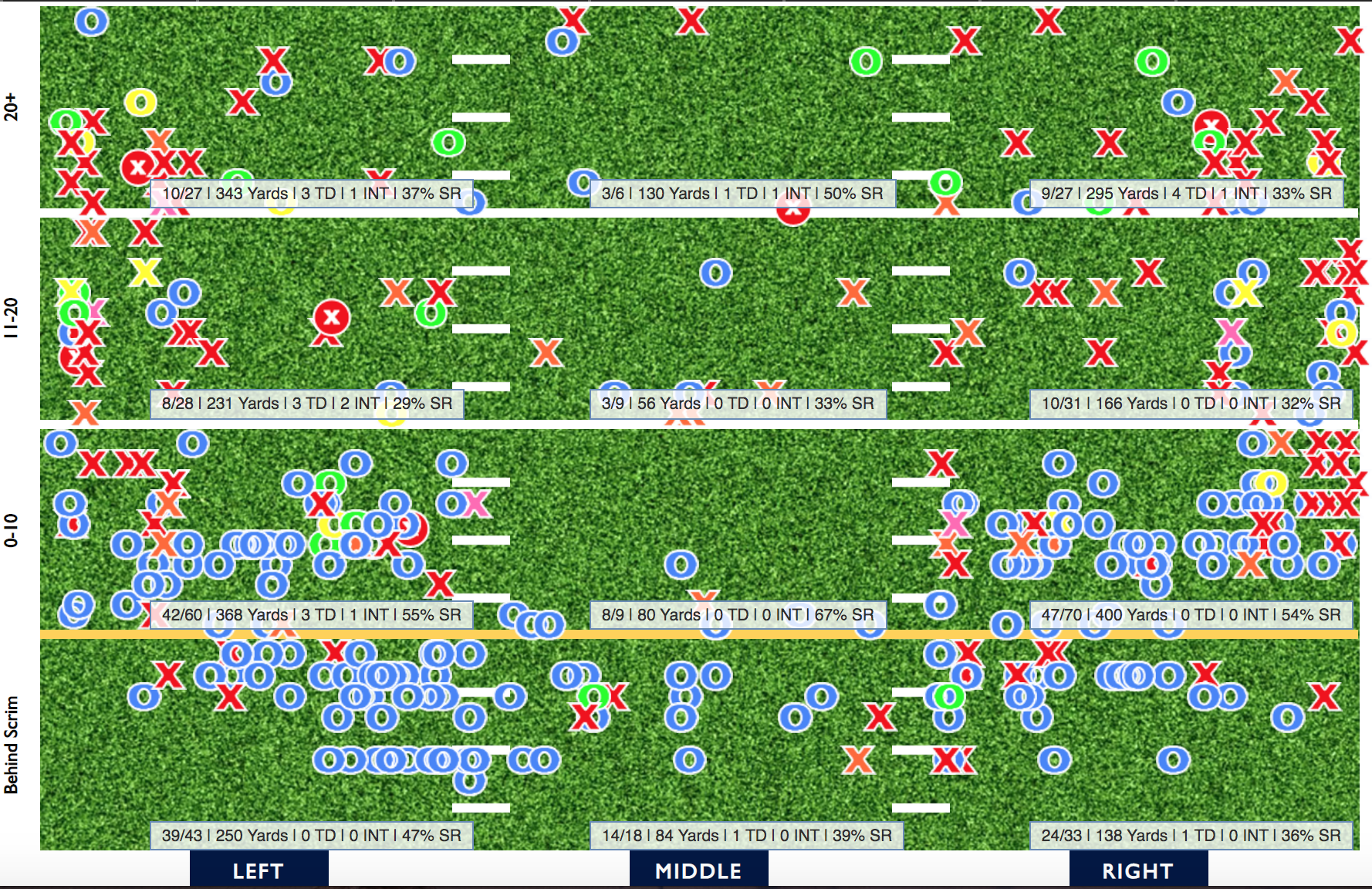
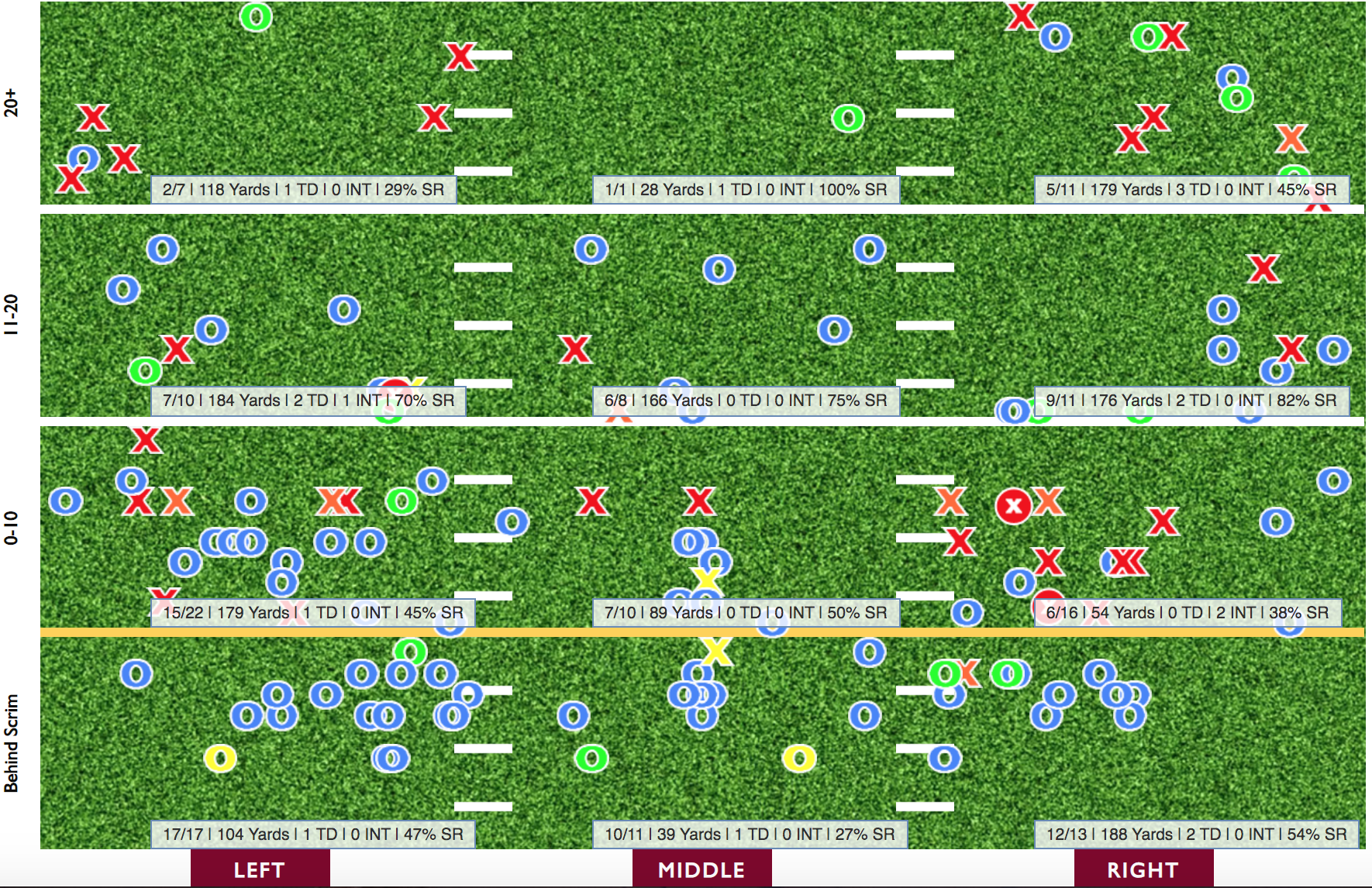
With all that being said, I have to go with Mac Jones, but this endorsement does come with a word of caution. Since Jones is fairly reliant in general on screens and RPOs within Alabama's design, a good deal of his production is out of his hands. Once he flips it out to a playmaker in space, it's on them if the play design is to result in success. Plus, Jones frankly has not had to carry the load for Alabama's offense. To that point, Alabama's offense is all about threatening defenses in various ways with eye candy, motions, and frequent play action. If a team looks to take away Jones, the Tide can still find ways to win in theory. That isn't really the case for the Tigers and Nix. When Auburn couldn't run the ball, there wasn't much recourse Nix could turn to other than looking to make some plays with his arm. If Alabama's dropback game fails, they can still explore gains on the ground or see if their outlets can break free.
Jake Fromm is a great example of how this modus operandi can turn sour quickly. Fromm went from one of the premier passers in the SEC last year to an average one this past season. Like Jones, his play caller opted to lighten his load by leaning on the run game and allowing his weapons' collective speed to create space outside the numbers or down the field. When UGA's receivers lost a step and its run game started to falter, Fromm was exposed as a middling talent. Against tighter windows and with the spotlight more on him, he fizzled compared to previous performances.
Jones has displayed elite ability throwing the ball beyond ten yards downfield, but he'll need to replicate that in 2020 to shake off the perception of being a game manager. When over 30% of your throws are either a screen or an RPO, only worthwhile completions can accomplish that. Since Alabama returns half of its dynamic receiving corps, the Tide should operate like that did this year. Though Sarkisian smartly uses plenty of play action to aid Jones versus run-anxious defenses, Jones has to evolve and learn to operate without that crutch. No SEC passer had a higher Play Action Rate than Jones' 34.0% clip as nearly two-thirds of his yards came on plays that utilized that tactic. But at the end of the day, Jones still has to make the throws and exhibit a natural ability to place passes. As it stands right now, he is unquestionably further along in that respect compared to Nix. Nix can still improve his downfield accuracy, but he has ways to go before he's even an average SEC passer. For 2020, I'm giving the edge to Jones.