2020 Vision: Kellen Mond vs. Kyle Trask
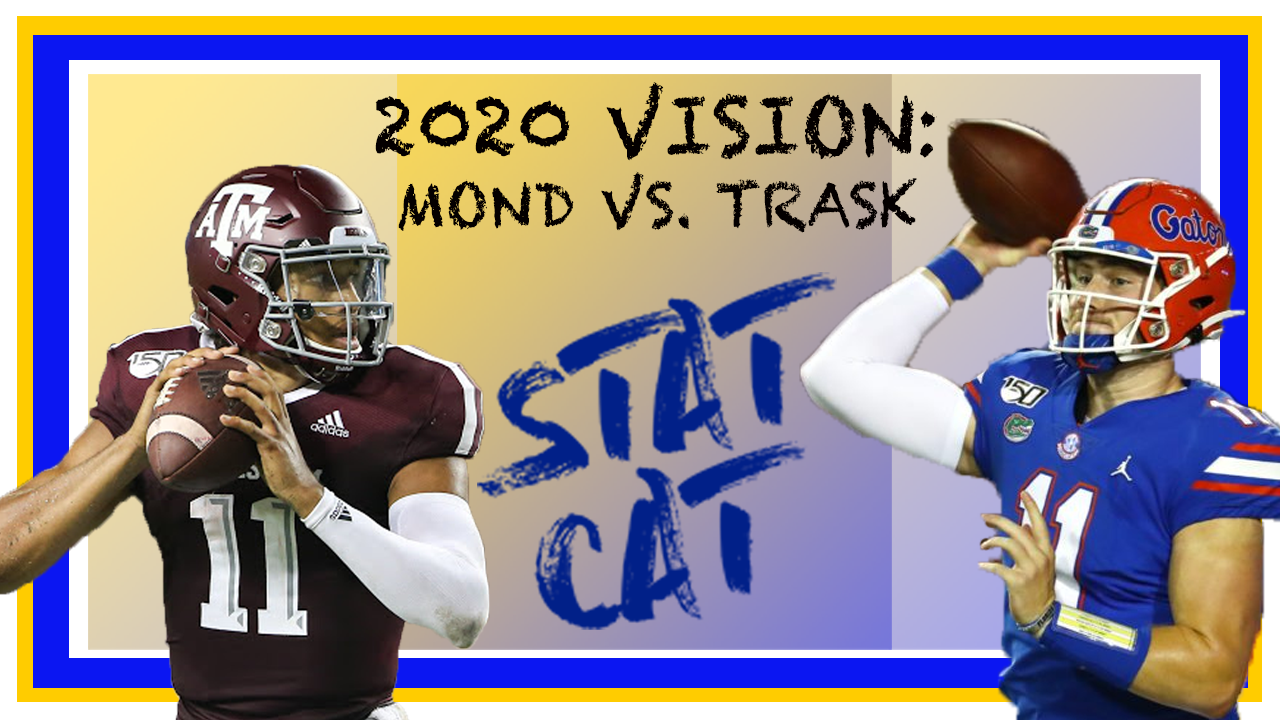
2020 Vision: Kellen Mond or Kyle Trask?
Who ya got? It's a simple question but often a sports debate staple. In the SEC where it just means more, polite discourses frequently become passionate shouting matches. Spewing stats and situational traits laced in favoritism and bias rarely goes anywhere unless it's a true slam dunk case. Otherwise, each camp becomes more entrenched on their respective side.
Since it's the most important position in the sport, ranking quarterbacks certainly comes up from time to time. With three of the SEC's best passers taking their talents to the professional ranks and a few others graduating, there's a discussion to be had on who will be the conference's premier passer in 2020. Both Texas A&M's Kellen Mond and Florida's Kyle Trask have good cases on why the should receive that moniker. While each passers' situation is different, both of their coaches will be entering the all-important third year on the job. While traditional stats can be an okay baseline, they do not tell the whole picture. Plus, Kellen Mond was unquestionably one of the most successful rushers within the conference this last season (his Success Rate, Explosive Run Rate, and First Down+TD Rate all fell inside the SEC's top3). That extra layer can muddle overall evaluations. But, I am more interested in how a quarterback functions as a passer.

On the surface, Kyle Trask appears to have the edge. Despite playing in less games and tossing less throws, Trask topped Kellen Mond across the board as far as the traditional stats are concerned. In fact, this is an open and shut case. There is no debate to embrace based on these figures. But, the traditional stats don't tell the entire picture. They don't reflect how those yards were acquired nor what the passers were asked to do.
In order to prevent further bias that might corrupt our conclusion, I will label our two players as QB A and QB B moving forward. Rather than just talking traditional and volume stats, I'll provide more context on how each of these passers operated within their respective offenses. We might reach the same conclusion dictated to us from the traditional stats, but at least we will have a more clear picture of both moving forward for 2020. We'll know who was better overall, who stood tall in the face of pressure, who relied on outlets more to make plays post catch, and who was a more sound dropback passer.

Though QB A was bested in most spots, he was more aggressive and relatively better at curbing risky throws than his counterpart. Despite having a significantly worse Accuracy%, QB A was just as keen at directing downfield attempts as QB B. Both passers posted a 50.7% Depth Adjusted Accuracy Clip, which applies more risk/reward the further a pass travels. Unlike Accuracy or Completion clips that don't consider the context and distance of the throw, no stat is better constructed to reflect true downfield accuracy than this stat. Even with the good precision, QB A was one of the worst passers orchestrating completions of 20 yards or more within the SEC. Facing pressure on over 30% of his dropbacks clearly affected this passer's overall production. Right off the bat, QB B jumps out in front. With a preferable Success Rate, Accuracy%, and big play stats compared to QB A, this passer posted some of the SEC's best numbers in those categories. This passer faced far less pressure on average and was able to use these fair conditions to deliver top notch returns through the air. Despite having a lower average depth of target than QB A, this passer benefited from having explosive weapons. But while QB B seems to have the clear edge, he was more prone to turnover worthy throws. In fact by a volume standpoint, QB B tossed a conference-high 27 interceptable passes this past season, which was six more than QB A. Captain Obvious wanted me to inform you that turnovers are bad and often can dictate a game's outcome.

While it's a desirable trait for a quarterback to excel when a play breaks down or if a defender is barreling towards him, pressured attempts are less common than clean ones. Since they are more frequent and present less variables, clean pockets are a better reflection of someone's consistency; and therefore upside. It's all well and good if you can play Superman every now and then, but how good are you if you cannot hit an open man when conditions are perfect?Versus this high volume of pressure, QB A faltered. Though looking around the conference, this passer was right at the SEC average across the board under duress. While most quarterbacks would take being average in those spots, QB A's figures were dwarfed by QB B's as the former was one of the premier producers against pressure. In fact, QB B's Success Rate, Depth Adjusted Accuracy, and First Down+Touchdown Rate all fell inside the SEC's top3.
Both passers displayed similar Success Rates from clean pockets, but QB A was the more sound thrower. While being a better executer down-to-down, QB A posted the third best Depth Adjusted Accuracy% and Interceptable Pass Rate from clean pockets in the conference; the two guys that bested him in both respects will be first round picks very soon. QB B remained one of the best decision makers from clean pockets, but his high Interceptable Pass Rate in these spots is a major red flag. Of his 27 turnover-worthy throws overall, 20 occurred from clean pockets. Strangely enough, QB B was more accurate and effective when pressured compared to his clean attempts.
While QB A struggled versus pressure, he was one of the most consistent quarterbacks when kept clean. Despite elite poise in the face of danger, QB B was less effective on clean snaps. But even with the statistical downturns, QB B was solid in both aspects. But since QB A was fantastic from clean pockets, evaluators have to love his comparative upside considering the high amount of duress he encounters.

Despite his play caller's affinity for screens and RPOs, QB B was the better quarterback on dropbacks. All three areas of the field saw him exhibit a Success Rate of 50% or better. Outside the numbers, only Joe Burrow and Alabama's two passers sported better Success Rates. Though he remained solid between the numbers and the hashes, that is where a good portion of this turnover-worthy targets occurred. Despite the second best Success Rate inside the hashes in the SEC, QB B finished with a modest 43.1% Depth Adjusted Accuracy. The next level could give a sh*t if these guys can complete a screen pass or take an easy completion off an RPO design. A quarterback's ability to make wise decisions and deliver the passes accurately on dropback designs is crucial for his next level ceiling. As much as college-oriented schemes are infiltrating professional offenses, a quarterback still has to manage himself from the pocket and operate within the structure of typical pass plays. QB B was far more reliant on yard-after-the-catch oriented patterns as nearly a fourth of his attempts came off a screen or RPO throw. With such a high volume of attempts coming off these designs, his overall totals could easily be skewed and hence alter his perception as a pure passer.
The two passers posted similar clips outside the hashes, but QB A was the better option targeting the middle of the field even if his Success Rate didn't follow suite. Still, his Success Rate inside the hashes was well above the conference average; his clips in other spots were at or barely above that threshold. From the numbers in, QB A boasted top4 Depth Adjusted Accuracy clips despite pedestrian situational returns. Outside the numbers, this passer was just okay in both respects.

Both quarterbacks played in offenses that didn't call for a lot of shots. In fact, the pair each finished inside the SEC's bottom5 in terms of Deep Pass Rate. Despite QB A being more accurate on these attempts, QB B was more effective. Only Joe Burrow, Tua Tagovailoa and Kelly Bryant finished with a better Deep Accuracy% rate than QB A within the SEC, but his Completion% was five points below average. QB A averaged 8.17 yards/deep attempt to QB B's 11.6. Even though QB B only had two more attempts beyond 20 yards downfield, he finished with 139 yards off these throws than QB A. While the vast majority of a passer's resume consists of short targets, excelling in deep can open up offenses and allow for a more versatile attack. With the obvious increased difficulty on these chances, having a pretty deep ball and creating explosive gains can often help separate game managers from play makers. Field flipping arm strength or homerun ability is tantalizing for any pro scout.
With the deep ball providing instant splash plays and short stuff igniting YAC opportunities, thriving in intermediate areas is often overlooked in today's game. No SEC passer had a higher volume of attempts or percentage of passes target these areas more than QB A. Heck, he was one of three conference passers where at least a quarter of his completions occurred between ten and 19 yards downfield. But even though QB A commonly targeted intermediate spots more, QB B sported preferable outputs. Both his Success Rate and Accuracy% cracked the conference's top5.
As aforementioned, QB B was frequently buoyed by screen and RPOs. Not to paint with a wide brush, but an overwhelming majority of those designs are targeted at or behind the line of scrimmage. To that point, QB B was one of seven SEC passers where at least a fifth of his attempts went backwards. This methodology was justified as he was the only one with a Success Rate to break the 50% plateau. While some of these plays were QB B making a sound decision, most were him simply executing the offense as designed. Acting nothing more than a facilitator, QB B benefited from having copious amounts of play makers do the heavy lifting after the catch. Outside of Garrett Shrader and Tua Tagovailoa, no SEC passer sported a highest Explosive Pass Rate on throws behind the line of scrimmage than QB B's 8.22% clip (this bested his overall clip in case you forgot). QB A clearly lacked this luxury. His forgettable 38.2% Success Rate was below the SEC average and his Explosive Pass Rate was easily inside the bottom10.

Both quarterbacks were great play action passers. Though their level of reliance on these designs varied, each finished with similar Success Rates, Depth Adjusted Accuracy clips, and First Down+Touchdown Rates. Play fakes helped both passers experience gains in all three of those areas as well as yards/attempt and Explosive Pass Rate. Deception-based play action attempts are all about manipulating defenses out of position. By flashing a threat on the ground, backers and safeties often are frozen for an extra beat or two when deciphering the play. This hesitation can create chances for targets to separate from defenders. The very idea of these designs is to create more defined throwing alley and less-challenged downfield throws. Because of that, passers generally see an uptick in production off these plays. In fact even if the run game is floundering and diverting little attention from the passing attack, play action consistently proves to be effective.
QB A used far less play action than QB B. His 17.5% Play Action Rate just missed being inside the conference's bottom5. As aforementioned, his play callers should have used play fakes more often considering how they helped spark a more desirable output. While QB B mostly outperformed QB A on these designs, there's no denying how they helped the former play more effectively. Play fakes helped QB A play more consistently and limit risky throws as only four SEC quarterbacks topped his 53.1% Depth Adjusted Accuracy clip.
Inside the SEC, only Mac Jones and Tommy Stevens had higher Play Action Rates than QB B this past season. Nearly 30% of his attempts and 40% of his total yards were off play fakes. QB B finished with the fourth most yards off play action within the conference. This tactic was clearly utilized by his play caller to incite more explosive gains. QB B's percentage of passes that netted 20 or more yards off play fakes doubled-up his overall clip. While play fakes coaxed more aggressive throws, QB B let some passes get away from him. Whether it was overlooking an underneath defender, being out of rhythm, or itching for a big play, QB B owned the SEC's fifth highest Interceptable Pass Rate off play actions. Nearly half of his total turnover-worthy throws occurred off play fakes. This severe shortcoming had to drive his play caller mad considering the overall gains play fakes provided his aerial assault.

Both passers were accurate enough downfield throwers to be included in the six SEC passers with a Depth Adjusted Accuracy% of at least 50% on early downs. Still, QB A was more precise with his chances. Plus, a higher percentage of his attempts were on pure dropbacks rather than screens or RPOs. With the latter removed, QB A's Depth Adjusted Accuracy% remains steady, but QB B's drops to 47.3%. However, QB B was still more successful with or without those designs padding his accuracy clips. Joe Burrow and Mac Jones were the only other SEC passers with preferable early down Success Rates to QB B. Both passers saw heavy use on early downs. In terms of volume of attempts, only Joe Burrow had more passes on 1st or 2nd downs than QB A while QB B cracked the SEC's top4. Since both hinged their offenses's trajectory based on the workload, taking care of business on early downs was vital. There's a saying going around, "The best 3rd Down offenses are the offenses that avoid 3rd Down the best." Since 3rd Downs are one-off and can be instant drive killers, it's a bold move to set yourself up for a do-or-die snap with a smaller margin of error.
QB A was also the lesser option on the money down. QB B boasted a better Success Rate and Depth Adjusted Accuracy% in those spots. Both passers were on the good side of average within the conference in terms of Success Rate, and each fell into the top-third of passers in terms of downfield accuracy. With a bottom5 Pressure Rate faced and bottom4 Sack Rate, QB A didn't have the luxury consistent clean conditions on 3rd Downs yet was right with QB B. In case you were wondering, QB B had a top5 Pressure Rate relative to other SEC starters.
Inside the Red Zone, QB B had a clear edge in terms of down-to-down consistency. QB B was one of four SEC passers with at least a 50% Success Rate in that area of the field. QB A's clip, on the other hand, was five percentage points below the conference mean. Like on 3rd Downs, both passers were adjacent to one another in the rankings per Depth Adjusted Accuracy% with the ninth and tenth best clips, respectively. Even though QB B was very dependable on any given snap to make the right choice, he noticeably struggled with tighter windows within the Red Zone. His 18.5% Defender Break Up Rate was the SEC's third highest. Both passers tossed six interceptable passes within the Red Zone, which were tied for the conference's third most. But the wayward attempts didn't deter their play callers when they wanted scores. QB A saw 75% of this TDs come within the Red Zone, which shared the highest rate within the SEC. QB B's 68% clip wasn't too far behind.
Though both quarterbacks played within pass-happy schemes, QB B's team didn't take to the skies as much as QB A's in the final stanza. The latter had a 60.4% 4thQ Pass Rate, which was the SEC's third highest. It's a damn good thing that QB A boasted the conference's third best Success Rate in those spots. Generally speaking, a team isn't passing that much in the 4thQ unless they are playing tight or trying to erase a deficit.
Despite still facing a immense amount of pressure in the 4th, QB A suffered from significantly less sacks. His and QB B's Sack Rates were top5 within the SEC. But since he consistently was under duress, his production was affected more in terms of downfield accuracy. While QB B boasted the third best 4Q Depth Adjusted Accuracy, QB A had to settle for the SEC's eighth best clip. For whatever reason, more conference passers displayed a higher level of ability in the final quarter of action.
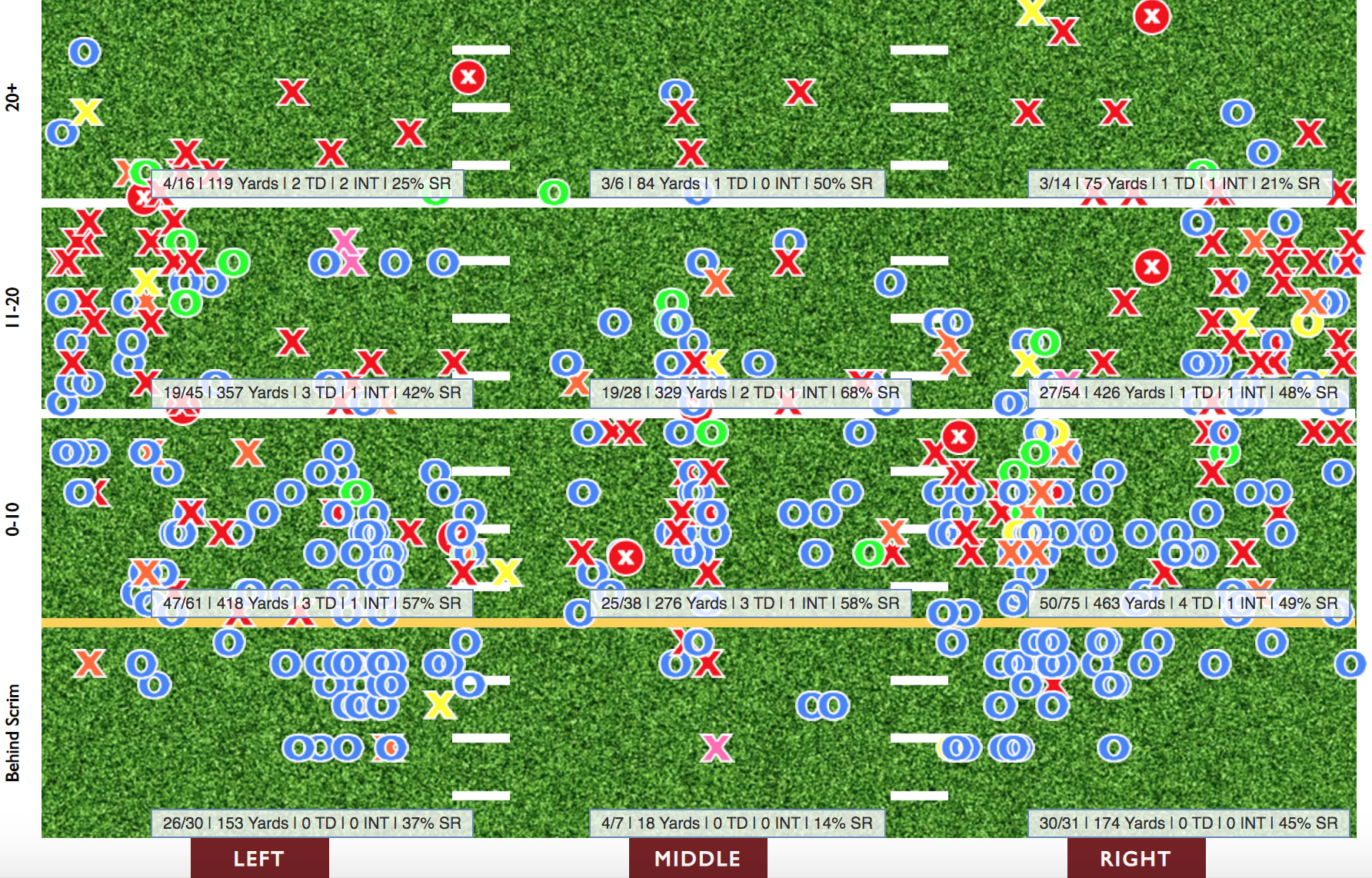
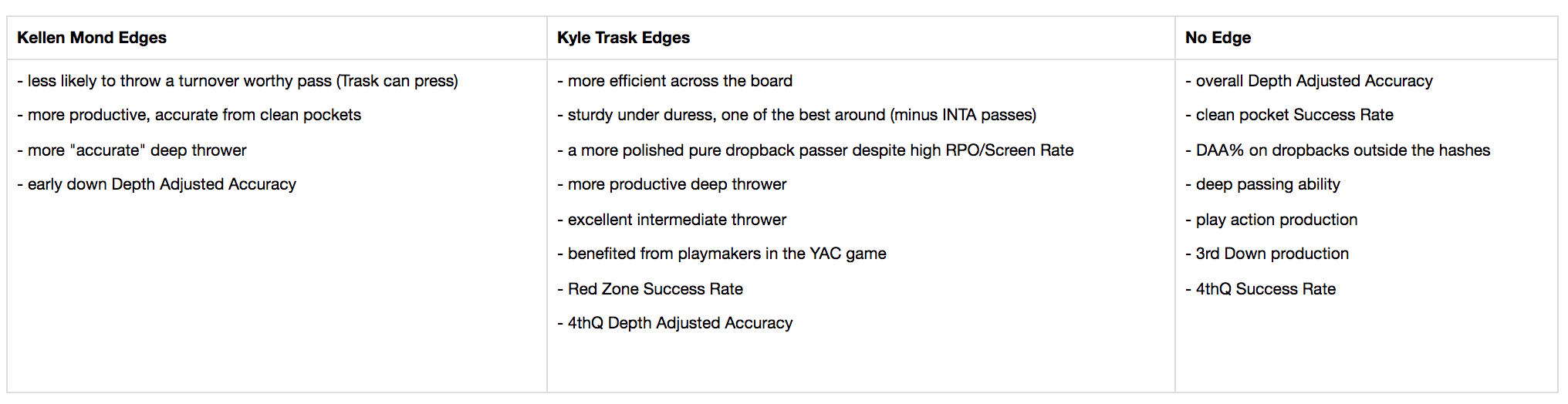
If you haven't cracked the code by now, Kellen Mond was QB A and Kyle Trask was QB B. Like the traditional stats suggested, Trask was the better passer this past season. His overall analytics topped Mond's even if he was more prone to soul-crushing throws and reliant on screens and RPOs to pad his numbers. Not only was Trask sound and dependable from clean pockets, he excelled when pressured. While the former was true for Mond, he was dreadfully average when pressured. Since Mond was frequently one of the most pressured passers within the SEC, failing to rise above mediocrity curbed his final figures. But because Mond's numbers from clean pockets were preferable to Trask's, one could argue his ceiling is more defined and hence more desirable. Even though Trask was one of the best producers when kept clean, he pressed way too much. If that element was a tie-breaker, Mond gets that edge.
Though both passers had similar Depth Adjusted Accuracy clips outside the hashes, Trask benefited from the collective speed of his weapons. While Texas A&M's wideouts are no slouches, they rarely leave secondaries in the dust or create explosive gains after the catch. Since Mond lacked the luxury of a pass behind the line or a quick outlet going for a big gainer, he was less explosive and potent as a passer. Despite being more accurate on deep attempts than Trask, Mond was less productive in that respect to the Gator. Both passers also posted similar results on 3rd Downs and within the 4thQ. Since these moments are when you expect your quarterbacks to rise, lead, and make sound choices, it was nice to see Trask and Mond sport adequate figures in these spots. Though both were about average on the money down, the pair took care of business in the 4thQ.
Since Trask is losing a good amount of weapons this offseason and Kellen Mond's unit remains in tact, it's fair to wonder if Trask takes a slight step back. Though Florida will return a few key targets like Kyle Pitts, Jacob Copeland, Trevon Grimes and Kadarius Toney, it remains to be seen if that group can maintain the status quo. Mond, on the other hand, will bring back all of his main weapons. Plus, sophomore-to-be Jalen Wydermeyer might enter this season as the best tight end in the SEC if his role is expanded further. Continuity with a senior quarterback is a great blueprint for an offense to make the leap, especially if it's in year 3 of a coach's tenure. TAMU will have to tap into more explosive plays for this to occur. Florida still has some burners, but their question remains whether they can play more balanced. Since their run game was the least successful in the SEC, executing RPOs and screens as extensions were paramount to keep defenses from pinning their ears back.
For now, give me Kyle Trask. I am willing to deal with the occasional errant throw or interceptable pass, because Trask has shown to be a more polished passer. Sure Florida's offense will gift him plenty of YAC oriented designs, but he is exceptional targeting intermediate areas and managing down and distance in all spots of the field while boasting preferable dropback numbers. For what Florida wants to do offensively, Trask has the skill set to get the Gators over the hump.