Sideline to Sideline: Missouri 2019
Missouri at a glance
Heading into the year, the Tigers had the makings of a team that could challenge for an SEC East title. Though the program regressed to the mean since their back-to-back divisional titles in 2013-14, plenty analysts and computer algorithms liked the Tigers' chances of playing spoiler and representing the East in Athens. They landed one of the hottest names in the transfer portal in Kelly Bryant, returned an experienced defense, and had plenty of continuity on offense. Plus, their schedule was front heavy in a way that the Tigers could enter November unbeaten. By ESPN's SP+ metric, Missouri came into the year rated as the country's 13th best team. By that, Missouri was favored in every game until they faced Georgia. There was a buzz around Columbia that the Tigers would be back in the discussion if they just took care of their business. But, things immediately went off the rails. Though the computers still made excuses for their on-field mishaps, it was soon clear the Tigers were much farther away from contending than anticipated.
The Tigers stumbled right out of the gate. Wyoming's mighty scheme -- the Cowboys finished the season as the SP+'s 66th rated team -- outlasted Missouri in a Week 1 shootout. Missouri's makeup resembled the past two seasons. The Tigers' offense gobbled up an abundant about of yards -- no SEC offense gained more yards in Week 1 than their 546 -- and their defense was porous and pedestrian in its best spots. Though the defense improved and remained one of the most consistent in the conference, the offense plateaued in the early part of Missouri's season. Considering that stretch only had one opponent that finished inside the SP+ top60, red flags should have been unfurled.
Despite having the SEC's fifth best yards/play in the first six weeks, the Tigers were an average offense per Success Rate. Both facets saw their Success Rate sport a 44% clip. With Bryant still being able to burst around the edge, their run game displayed moments of potency. The first six weeks of the season saw the Tigers boast the SEC's third highest Explosive Run Rate at 18.2% despite owning the ninth highest yards/carry. Even versus the softer portion of their schedule, the Tigers had a bottom5 Rushing Success Rate within the conference. At least with a decent yards before contact clip -- heightened by Bryant's play -- the Tigers were at least mediocre at forging run lanes. Still, looking at who they spent their first month-plus blocking, you knew things would probably sour when Missouri reached the meat of their conference schedule.
Once Kelly Bryant hurt his knee in meaningless minutes versus Troy, the offense showed a noticeable dip in output. Though he started the next game, there was a considerable downtick in his accuracy after that point. This also happened to coincide with the Tigers' schedule beefing up. After hosting Ole Miss in Week 7, the next three games were roadies versus divisional opponents. That's when the offensive dysfunction was kicked into high gear. Despite scoring 80 points in Weeks 6 and 7, the Tigers only scored 71 points in their remaining six games. It didn't matter that the defense held their own, the offense lacked rhythm.
With Bryant hobbled, Missouri's read-heavy scheme took a massive knock in efficiency. Even though the grad-transfer boasted a 52.4% Success Rate the first six weeks of the season, no ball carrier suffered a higher Negative Run Rate or lower average yards before contact than Bryant by the end of the year. Both the Tigers' Rush and Pass Success Rated dropped over eight percentage points from Week 7 through the end of the season. Their line rarely got push in the back half of their schedule as the Tigers posted the conference's second worst yards before contact average a 1.3. Since Bryant was the engine for this offense -- often providing X-factor abilities to bailout bland designs or botched executions -- it ultimately sputtered when he stalled due to complications.
Missouri's offense consistently suffered from "broken plays" -- or when the play fails to function as designed. A good deal of their passing game was either watered-down concepts or rudimentary man beaters. When those failed, this forced Bryant to run around and make something happen. Even before his injury, Missouri was prone to broken plays. Before Week 7, the Tigers suffered from one eight times out of one-hundred snaps. After that, 13.3% of their plays were charted as broken; this far and away led the SEC. With that element constantly creating more hurdles, this offense stumbled. After Week 7, both their Rushing and Passing Success Rate finished in the bottom4 of the conference. Since Bryant wasn't able to opening things up on the ground or take advantage downfield with his declining accuracy and risk-adverse style, Missouri's offense constricted down the stretch.
Like most frustrating offenses, Missouri was not good on 1st Downs. Ironically, last year's scheme with Drew Lock at the helm had the SEC's third lowest 1st Down Pass Rate at 38.2%. The Tigers passed far more often to start a set of downs in 2019. Since Missouri frequently played from behind in the back half of their schedule, it didn't make a whole lot of sense to turn to a inept ground game to save the day. Still even with the increased 1st Down Pass Rate, the Tigers ran more than they passed in those spots. Roughly 52% of Missouri's 1st Down plays were runs, and only a third of them resulted in success. Again, this shortcoming was really accentuated once Bryant was less-than-100%. Even before Bryant was dinged up, the Tigers 1st Down Rushing Success Rate failed to eclipse 40% or break out of the SEC's bottom4. During the softer part of their slate, they only averaged a mere 1.84 yards before contact. Though Bryant was decently successful relative to the rest of the SEC when he passed, it wasn't enough to prevent the Tigers from having a bottom5 Success Rate on 1st Down during the first six weeks of the season.
Things went from bad to worse as the year progressed. From Week 7 on, no SEC offense sported a lower Success Rate on 1st Downs than Missouri's 35.5% clip. Both their Run and Pass Success Rates fell into the bottom4 down the stretch. A pathetic 28% of their runs met situational goals. The Tigers' already putrid yards before contact clip further soured. Missouri only managed to average 1.65 yards before contact after Week 7 on 1st Downs. When basically a third of your plays in these spots fails to keep you ahead of the chains, its easy to understand why this offense constantly looked discombobulated. On the year, the Tigers had the second worst Early Down Conversion Rate inside the conference. This translated to having to play 3rd Downs quite often. Like I always enjoy to say: the best 3rd Down offenses are the offense that avoid 3rd Downs the best.
During the first part of their season, Missouri was a rather average team on the money down. Their 40.5% 3rd Down Success Rate placed eighth within the SEC. Though the Tigers actually saw improvement on the ground on thirds, their passing took a big step backwards. The first six weeks of the season saw Missouri own the SEC's sixth best Passing Success Rate at 38.3% clip. It wasn't otherworldly, but they Tigers held their own. Once Bryant hurt his knee, Missouri's clip dropped to 28.6%. Sure this managed to finished outside of the bottom5 in the conference. But that stat on its face its not a desirable level of efficiency on the do or die down. Again, Missouri managed to see an uptick in their rushing numbers after Week 7. Despite owning a bottom5 Rushing Success Rate on 3rd Downs until Week 6, the Tigers upgraded their production by four percentage points. But thanks to their downturn through the air, their overall 3rd Down Success Rate dipped to under 34%. Not to beat a dead horse; but when a only a third of your 1st Downs and 3rd Downs end in success, much will be left to be desired. In case you were wondering, Missouri was also dreadful on 2nd Downs where they owned the SEC's fourth worst Success Rate (39.7%) after Week 7.
Looking at their year comprehensively, Missouri flat out stunk offensively. Their offense finished bottom5 within the conference in Success Rate (39.7%), Passing Success Rate (39.6%), Rushing Success Rate (39.9%), yards/play (5.32), yard/game (375.8), points/game (25.3), Explosive Play Rate (11.6%), Touchdown Rate (3.89%), Scoring Drive Rate (33.3%), Early Down Conversion Rate (65.2%), Sack Rate (3.07%), and Broken Play Rate (10.9%). Derek Dooley take a bow, my friend. Since both aspects of this offenses appeared tied at the hip (both clips were about the same as one another before and after Bryant's knee injury), this was a reflection of an overall systematic failure. Though this offense was able to stay on the field and average the fourth most plays, a good portion of their snaps were futile.
For whatever reason, Missouri opted to reduce the number of Run-Pass options in its plays. Less than 19% of the Tigers' offensive snaps were RPOs compared to 31.6% in 2018. Only LSU passed less on average on RPO designs than the Tigers. Both were the only schools in the conference with RPO Throw Rates under 8%. This reluctance also carried over to the ground game where less than 32% of Missouri's rush attempts occurred on a RPO. Keep in mind over 22% of their passes and 40% of their runs utilized RPOs a year ago. Despite the fact Missouri averaged the exact same 4.53 yards/carry on both nonRPO and RPO runs, the Tigers experienced an increased efficiency when route tags were attached to their read options. The gains were marginal, but there was absolutely a case to be made for Missouri to go to these more frequently. On RPO run plays, the Tigers sported a 41.7% Success Rate compared to 38.9% on traditional rushes. Again, that still wouldn't have solved the major issues on the ground. But, it would have helped them play more effectively.
Despite coming into the season as the weak link, Missouri's defense was one of the most consistent in the conference particularly against conference foes. While averaging the fourth lowest yards/game to SEC offenses, no SEC defense boasted a better Success Rate within conference play than the Tigers. Though Barry Odom's side of the ball still possessed major flaws, that's a fairly impressive stat considering all of the defensive stalwarts in the southeast. Because of their dependability in this regard, ESPN's SP+ donned the Tigers as a Top20 defense. Conference opponents averaged a paltry 35.3% Success Rate as the Tigers stifled offenses by land and by air. Looking at the archaic yards/play allowed stat, you never would have know that his defense was one of the most hard-nosed in the SEC. The Tigers allowed 5.54 yards/play to conference offenses which was right at the league median. Despite their consistency, Missouri relinquished a fair amount of explosive gains. Over 12% of their defensive snaps in SEC play went for either a run or 10 or more yards or a pass of 20 or more yards.
Missouri bottled up both aspects well but were more prone to big plays through the air. No SEC defense sported a better Pass Defense Success Rate in conference play than the Tigers' 34.6% clip despite their bottom5 6.5 yards/pass allowed. Though the Tigers were consistent against the pass, big gainers still took place. While their Explosive Pass Rate and Explosive Run Rates allowed were both 11.7%, there's a lower bar for ten yard runs over 20 yard completions. The former joined Missouri's yards/pass allowed in the SEC's bottom5 while the latter was the fourth best. Creating Havoc plays was a major element that allowed Missouri pass defense to stand tall. No SEC defense had a higher Pass Havoc Rate (15.5%). These plays are essentially anything bad that can happen to a passing offense: sacks, throwaways, QB pressures, broken plays, pass breakups, batted balls, interceptions, etc. It didn't matter Missouri's defense had the lowest Sack Rate (4.17%) in SEC play, they found other ways to disrupt aerial assaults.
The Tigers' run defense was far less sexy. Looking at Run Havoc Rate, only Vanderbilt was less prolific challenging SEC offenses' ground game than Missouri. Despite the lowest Tackle For Loss Rate in SEC play (7.1%) and a pedestrian AF yards before contact allowed (2.26), the Tigers were one of the best around limiting conference foes' rushing ability. With the second best Run Defense Success Rate and fourth best Explosive Run Rate allowed, the Tigers were sound tacklers that didn't relent too many hidden yardage opportunities. Missouri averaged the lowest yards after contact clip on rushes (2.3) and yards after the catch (2.44) in SEC play.
Granted, some of their efficiency was due to playing in the SEC East. Teams in the East were just worse offensively compared to the seven in the West. Five of the offenses in the East finished the season with an Offensive Success Rate below the conference average. Plus, Missouri's two foes from the Western Division this season were Ole Miss and Arkansas. Ole Miss was average on its best day and Arkansas... well they were unequivocally horrible in their own ways. The less-challenging slate boosted Missouri towards the top of the efficiency rankings as all five downs sports a top5 Success Rate in SEC play. Still, the Tigers held the division's two best offenses below their average yards/game. Missouri's 19.4 average points/game allowed actually tied 15th nationally. But even with the drastic development defensively, the Tigers just couldn't put it all together.
Misdeeds off the field involving academic misconduct doomed Odom's tenure. With on-field regression following the absolute implosion of his offense, an upheld postseason ban wiped out any positivity the Tigers had hoped to salvage from 2019. After plateauing the last couple of seasons with a potent offense and underwhelming defense, the Tigers seemingly lost all of their momentum as a program when that dynamic was flipped. Eli Drinkwitz is known for getting more out of less. At least in the short term, that skill will need to be activated in order to stop the bleeding and prevent the Tigers from defaulting into overall irrelevancy.
Missouri's favorite run looks
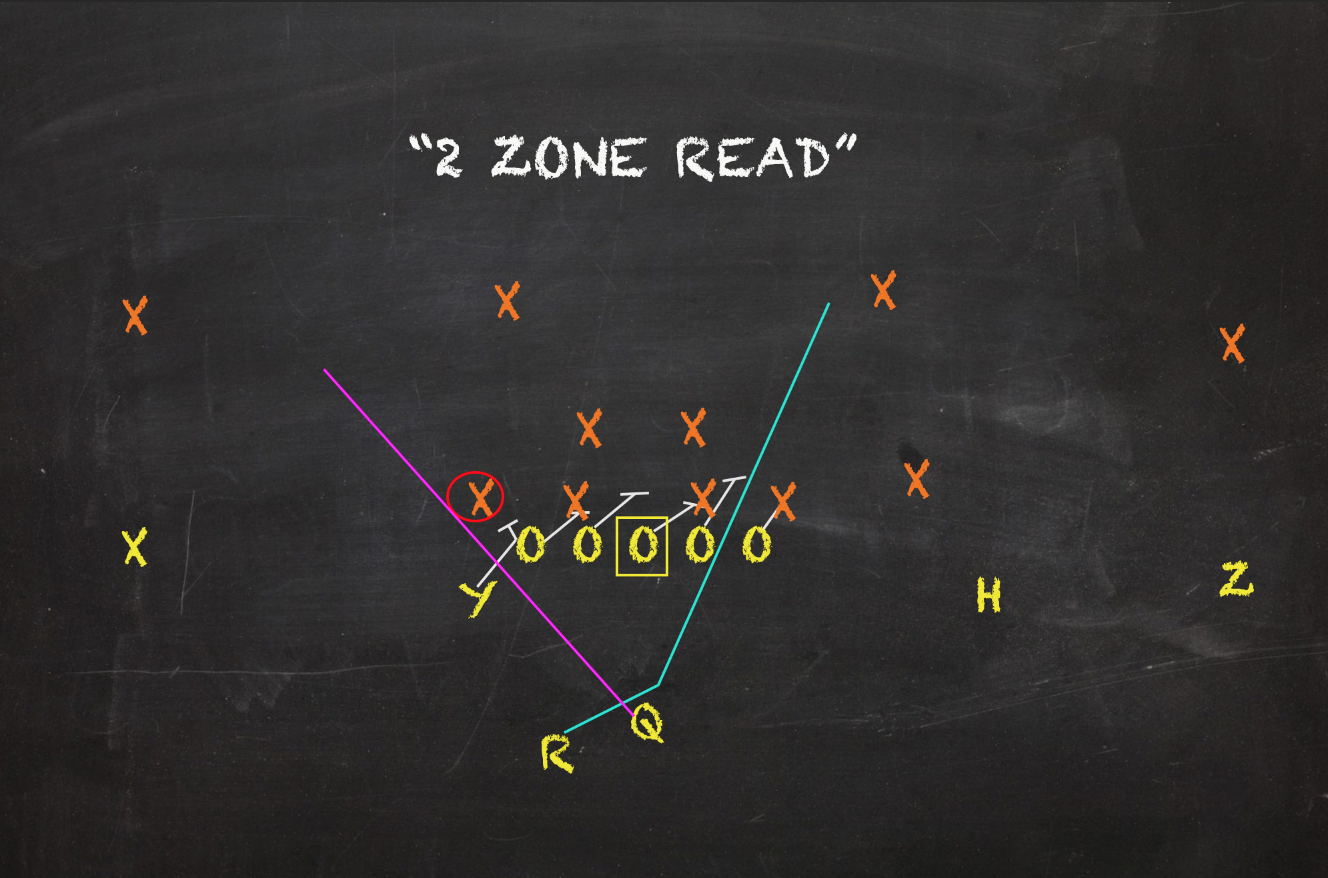
1. Inside Zone Slam Read 8.73% Play Share 3.43 Y/A 41.9% Success Rate
Like a good deal of offenses in the conference, Missouri featured Inside Zone Slam Reads more than any other concept in their script. Though they were one of the handful of SECers to limit this look's play share to the single digits, the Tigers' yards/attempt executing this basic read play was the worst in the conference. That putrid clip paired with a middling 41.9% Success rate rooted Missouri's underwhelming ground game. Even Kelly Bryant's extensive experience operating a spread scheme couldn't balloon Slam Reads'. The Tigers consistently failed to get significant push upfront. Looking at all Inside Zone Read designs, Missouri only averaged 1.74 yards before contact, which was even low for their diminished standards this past season. This early contact resulted in about 11% of Inside Zone Reads going for a loss (Bryant's individual Negative Run Rate was 22.7%).
Again, Derek Dooley drastically reduced this unit's RPO usage despite the fact Bryant fit that style of play more than Drew Lock. Still, Inside Zone Slam Reads were one of the Tigers' favorite designs to anchor RPOs. Of the look's 74 reps, 34 incorporated route tags. No other run concept amassed more than 12 RPO reps. Like you'd expect, the additional outlet in space helped open things up inside. Though decidedly disappointing, Slam Read RPOs saw a marginal uptick in yards/attempt (3.79) and Success Rate (44.1%). Whether with RPOs or as straight read plays, Slam Reads were utterly disastrous on 1st Downs where they received the second most snaps of any concept. There, the look only averaged 2.84 yards/attempt with less than a fifth of its reps resulting in success. Though it helped get the job done occasionally on 3rd-and-shorts, Slam Reads were overly a very inefficient play for the Tigers and often put or kept them behind the chains on early downs. But then again, that was most of their run game in 2019.
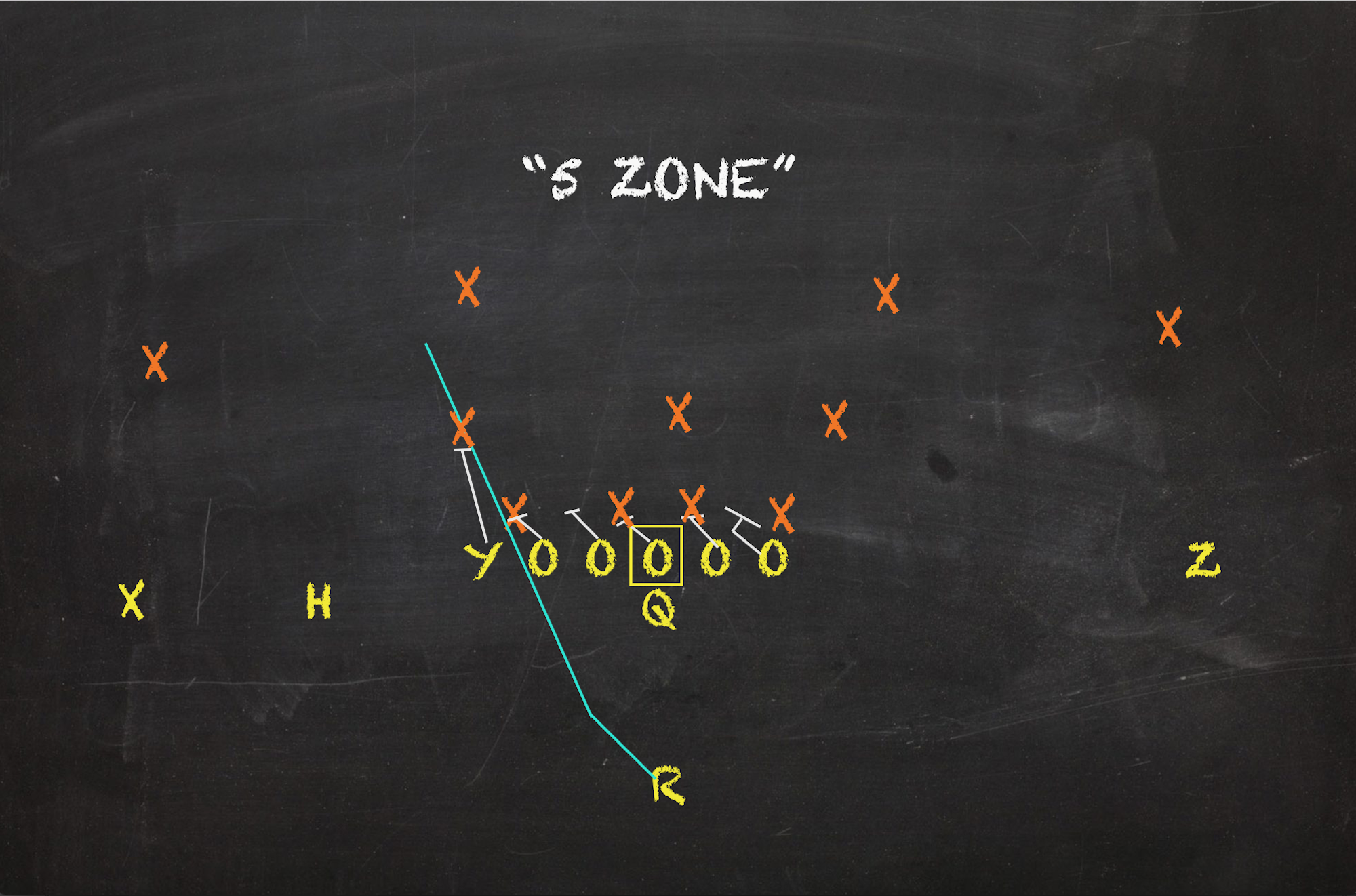
2. Outside Zone Off-Tackles 6.84% Play Share 4.02 Y/A 31.0% Success Rate
Outside Zone Off-Tackles have been one of the Tigers' favorite looks since Derek Dooley has been calling plays. Despite divvying out 18 less reps to this look year over year, this Outside Zone owned the second highest play share of any concept. This slashing design aims to get speed towards the edge of the formation and find a quick crease north and south. Since Missouri's line struggled to create much cushion, this design suited them in theory. Off-Tackles prefer quick, playside seals over blowing defenders backwards. Still, the Tigers couldn't maximize this concept's opportunities. Missouri's 11.5% Negative Run Rate on this concept topped its Explosive Run Rate that finished in the single digits. Off-Tackles were exclusively called from either undercenter or the pistol, which often tipped defenders to what was coming. Out of the gun and with a read aspect attached, Outside Zone Reads were actually one of the two run concepts to break the 50% Success Rate threshold.
The Off-Tackle was Missouri's favorite to call to start a set of downs. But again, that wasn't because the Tigers kicked ass executing it. On the play's 32 1st Down chances, Missouri only managed to average 3.25 yards/attempt on a 25% Success Rate. Since only a quarter of this concept's tries begat a 2nd-and-5 or better, it immensely hindered this unit's ability to play aheads of the chains. Roughly 45% all Off-Tackles gained between zero and three yards. That's not great. But thanks to the shear volume of touches Off-Tackles received, the look was able to generate the third most yards of any Missouri concept with 233, which only trailed their two Inside Zone Read designs.
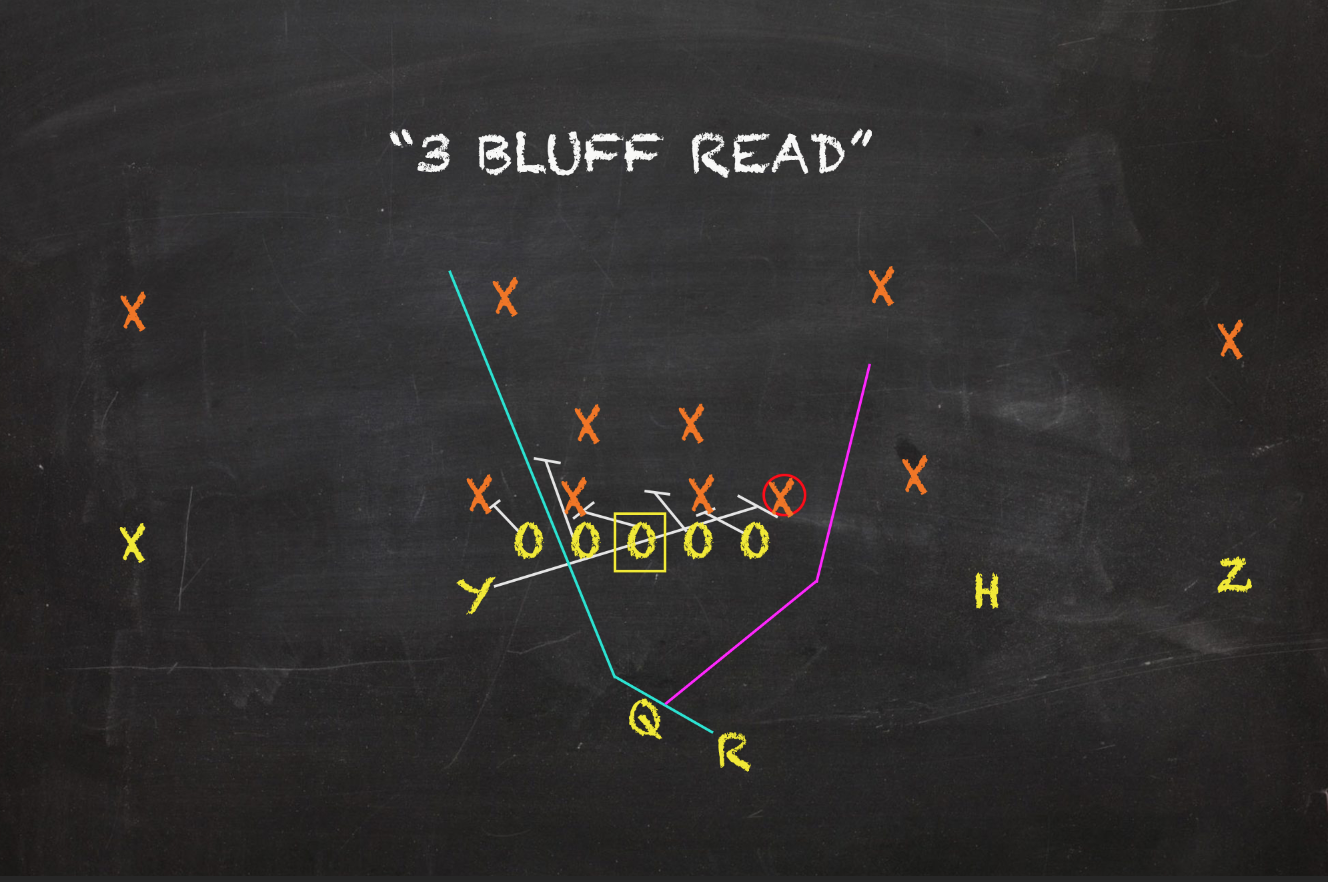
3. Inside Zone Bluff Read 6.13% Play Share 4.73 Y/A 48.1% Success Rate
Though a good deal of Missouri's primary run concepts were letdowns, Inside Zone Bluff Reads plodded their way to a decent statline by the end of the year. Only two run concepts with at least a 1.3% play share boasted Success Rates over 50%. Though Bluff Reads failed to cross that threshold, the look's 48.1% clip was preferable compared to the Tigers' other most featured runs. Bluff Reads are split zones. This means unlike a total playside coordination of zone blocking upfront, an offset tight end or fullback fires against the grain of the line's orientation to seal a backside edge defender. If the playside zone blocks are stuffed, this creates a hard edge on the backside in case the ball carrier needs to bounce back. In the read game, that little wrinkle often provided the QB a personal protector on his keeps. While 46% of Slam Reads incorporated route tags, only ten of the 52 Bluff Reads operated as RPOs.
While a good portion of Missouri's ground game floundered on 1st Downs, Bluff Reads saw some of their most productive reps occur in those spots. Of Missouri's six most called concepts on firsts, Bluff Reads were the only look with a Success Rate north of 40%. The look's 56.4% clip dwarfed every one of their other highly featured plays. But the look saw waning results on subsequent downs as both its yards/attempt and Success Rate dwindled on each passing down. Though it was one of the Tigers' favorite 3rd Down plays, only three of its nine money down reps resulted in a conversion. But again, Bluff Reads were widely one of this offense's most fruitful plays in the run game. If this look had netted nine more yards, Bluff Reads would have finished the year as the top yardage gainer for this offense.
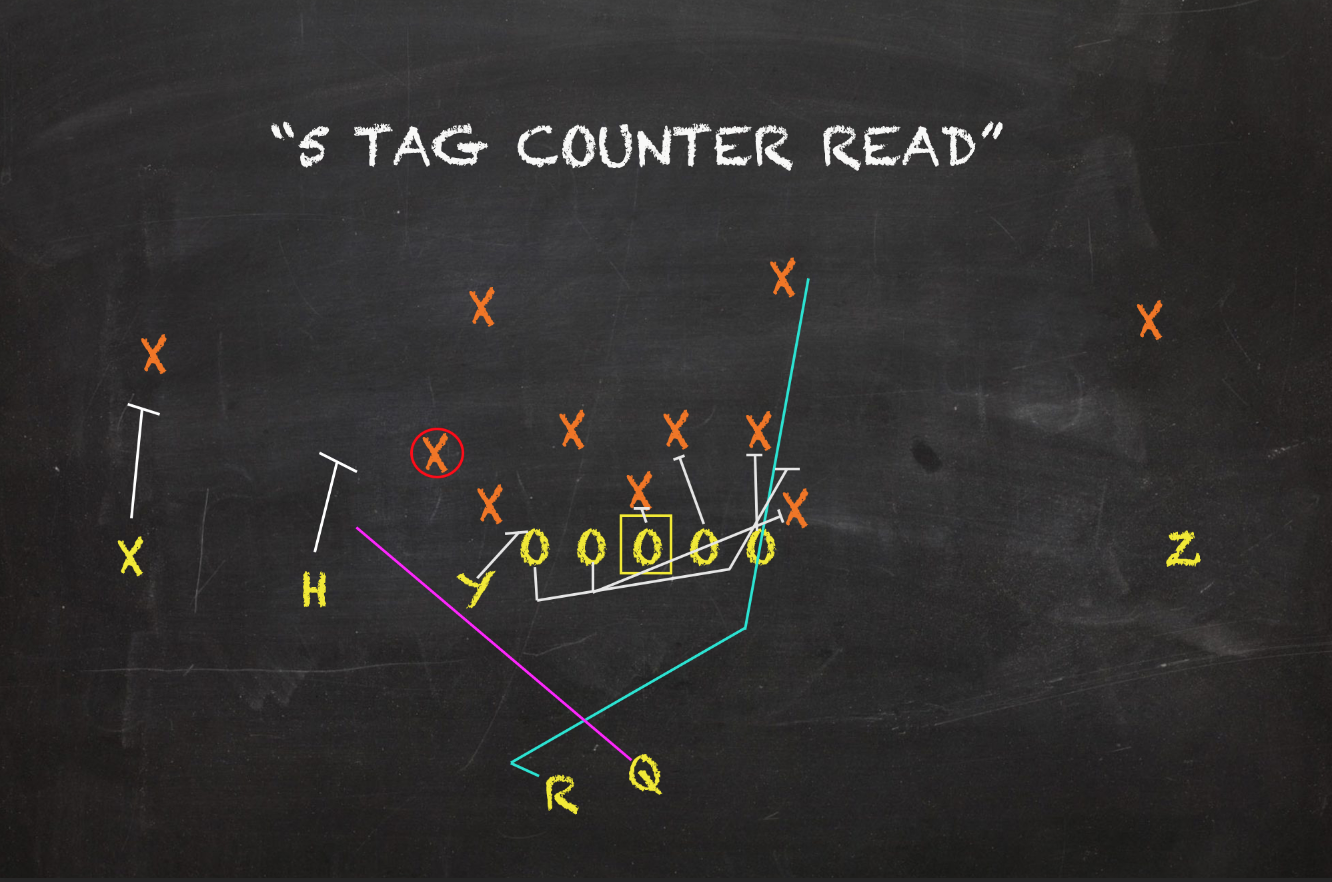
4. Tackle Counter Reads 3.54% Play Share 5.93 Y/A 33.3% Success Rate
With three zone concepts owning the top play shares within this offense, it was only natural some form of misdirection would be featured. Though some Q-Counters showed up from time to time, Tackle Counter Reads were Missouri's favorite power play. Missouri went to two wrinkles when executing this concept. First was the Tackle and Guard variety. Like on traditional Counters, "TAG" Counter Reads call for backside pullers to operate as a trapper -- or edge setter -- and a wrapper -- or lead blocker. While the backside guard still acts as the former in this regard, the backside tackle operates as the lead blocker through the hole unlike an offset tight end or fullback like on the basic design. The other variety was what we label as "Tonka". These plays only ask the backside tackle to pull. Both wrinkles saw equal reps and both were only successful on a third of their reps.
The TAG Counter Reads saw most of their chances before Kelly Bryant first sustained his knee injury. While Tonka Reads saw a steady stream all season, TAG Counter Reads saw two-thirds of their reps before Week 7. For this concept as a whole, the game versus Southeast Missouri State in Week 3 yielded its best snaps. Tyler Badie exploded with a 48 yarder off a Tonka Read in the 2Q and Larry Rountree added a pair of 20+ carries in the 3Q giving each wrinkle a big gainer. Of all Tackle Counter Reads' 178 yards, 104 occurred in the game against SEMO. The TAG variety wouldn't see another carry gain more than 8 yards the remainder of the year. Without those explosive carries in that game, there's no way this concept would have totaled the fifth most yards for this offense. In theory, the balance between the two wrinkles along with their misdirection elements playing off zone schemes should have produced better numbers especially on 1st Downs. But Tackle Counter Reads -- like the vast majority of Missouri's run game -- fell flat far too often in those spots. There, this look only averaged 3.6 yards/attempt on a paltry 26.7% Success Rate.
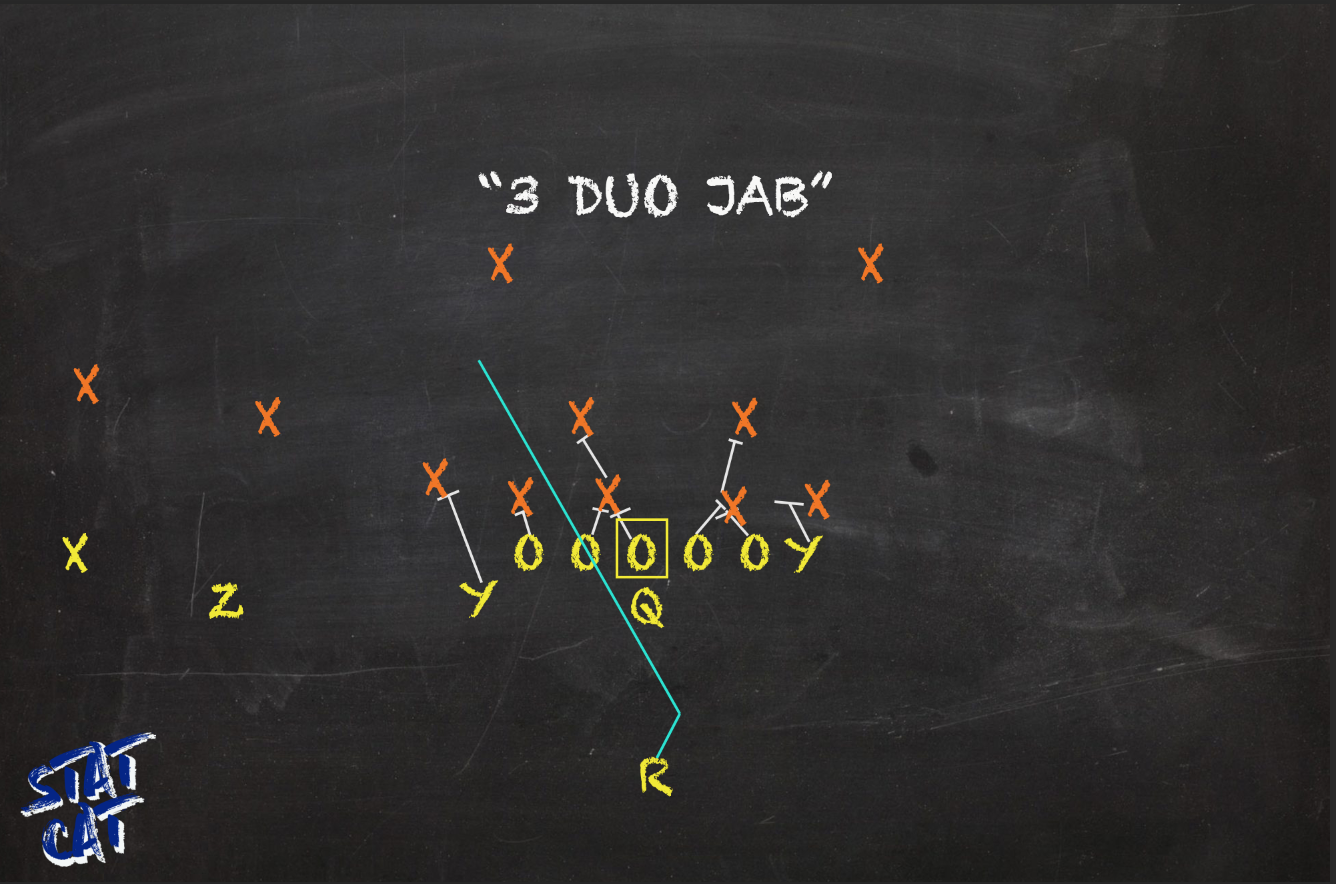
5. Duo Jab 2.59% Play Share 6.41 Y/A 31.8% Success Rate
Duo Jabs were another gap scheme that was either all or nothing for the Tigers. Unlike its brother concept Duo Dives that was one of the two run concepts to break the 50% Success Rate plateau for this offense, Jabs were one of this unit's most inefficient plays. Only Off-Tackles and Slip Screens were less consistent down-to-down among Missouri's favorite designs in terms of Success Rate. Duo Jabs -- or "Counter Duos" -- have an element of misdirection unlike the more straightforward Dive run. Mostly called from undercenter of the pistol, Duo Jabs' counter action is only undertaken by the backfield, which makes this a power play without a puller. This leaves the line to focus on forging double teams for which the concept gets its name. The jab step away from the hole attempts to freeze backers and allow a run lane to present itself.
Missouri almost exclusively featured Duo Jabs on 1st Downs. Though Dives also saw most of their usage in these spots, 18 of the look's 22 reps occurred on firsts. Duo Jabs saw a few nice gains, but the concept predominantly fizzled like the majority of Missouri's other run plays to start a set of downs. Only 27.8% of Duo Jabs gained half of the necessary yards to gain on 1st Downs. Still, both Duos were largely change-of-pace looks to their top zone looks. On average, the Tigers would call about two Duo Jabs per contest.
Missouri's favorite pass looks
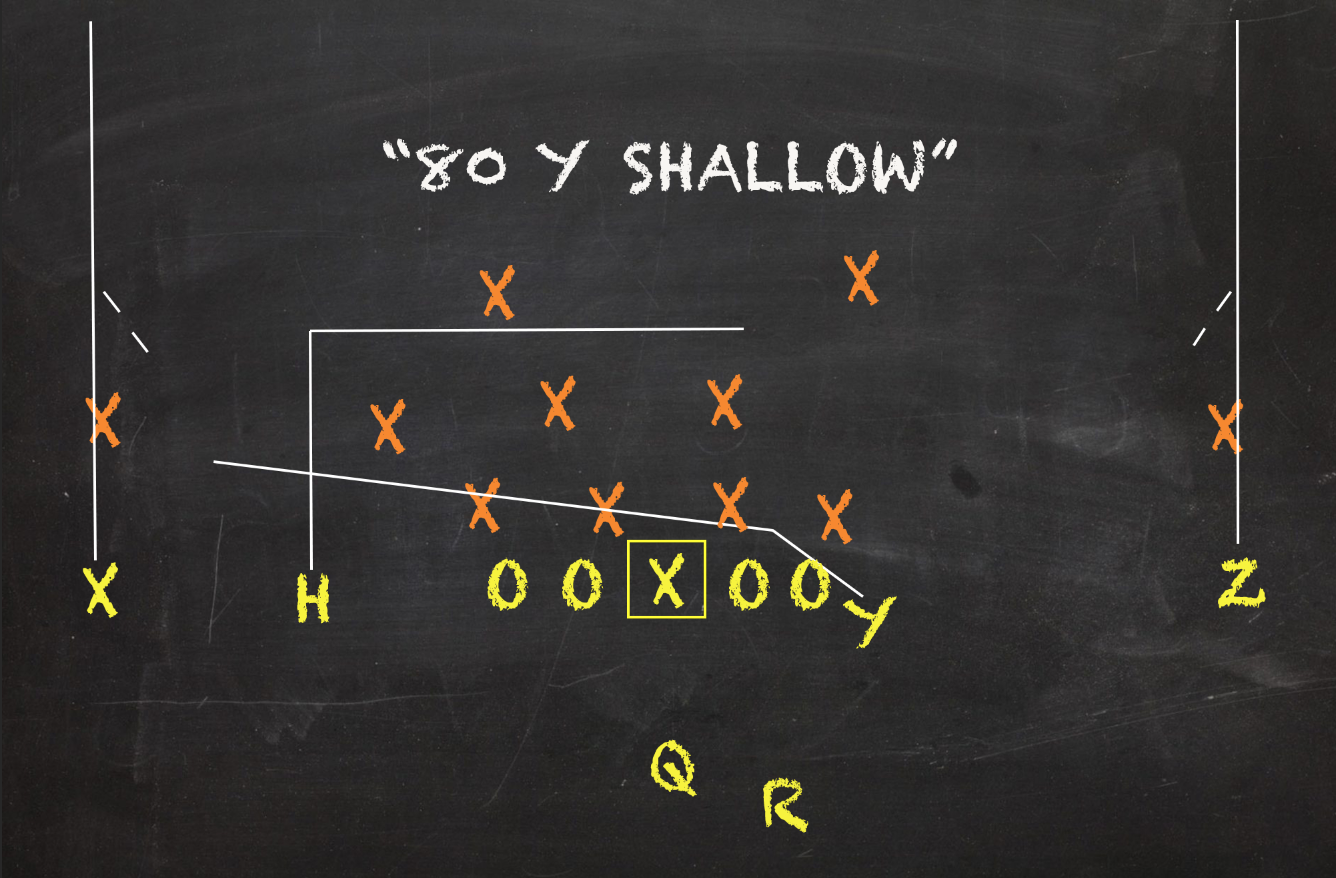
1. Shallow 2.95% Play Share 8.68 Y/A 52.0% Success Rate
The Shallow concept saw more targets than any other pass pattern for the Tigers in 2019. Missouri's favorite pass play was among of the seven looks that was able to finish the season with a 50% Success Rate or better. Named for the titular shallow cross route, this concept creates a high-low read for the quarterback towards the middle of the field pairing said drag with an overtop dig flowing the opposite direction. Shallows are closely related to the Drive concept, which sees both routes break the same way. Though pesky camera angles often cut off what the complimentary receivers were doing on these designs, it's clear Dooley instructed them to get vertical. Plenty of other offenses commonly preach this with outlets either running a streak, post, or deep curl.
Though Shallow was one of Missouri's most called concepts on 3rd Downs, the look wasn't efficient at helping the Tigers convert. Shallow only averaged 2.43 yards/attempt on a cringeworthy 28.7% Success Rate in those spots. This concept was far better on early downs. There, Shallows averaged 8.88 yards/attempt on a 58.8% Success Rate. Due to decent production and reps, Shallow was among the Tigers six best yardage gainers by year's end. Only the Smash concept gained more yards through the air than this look's 168.
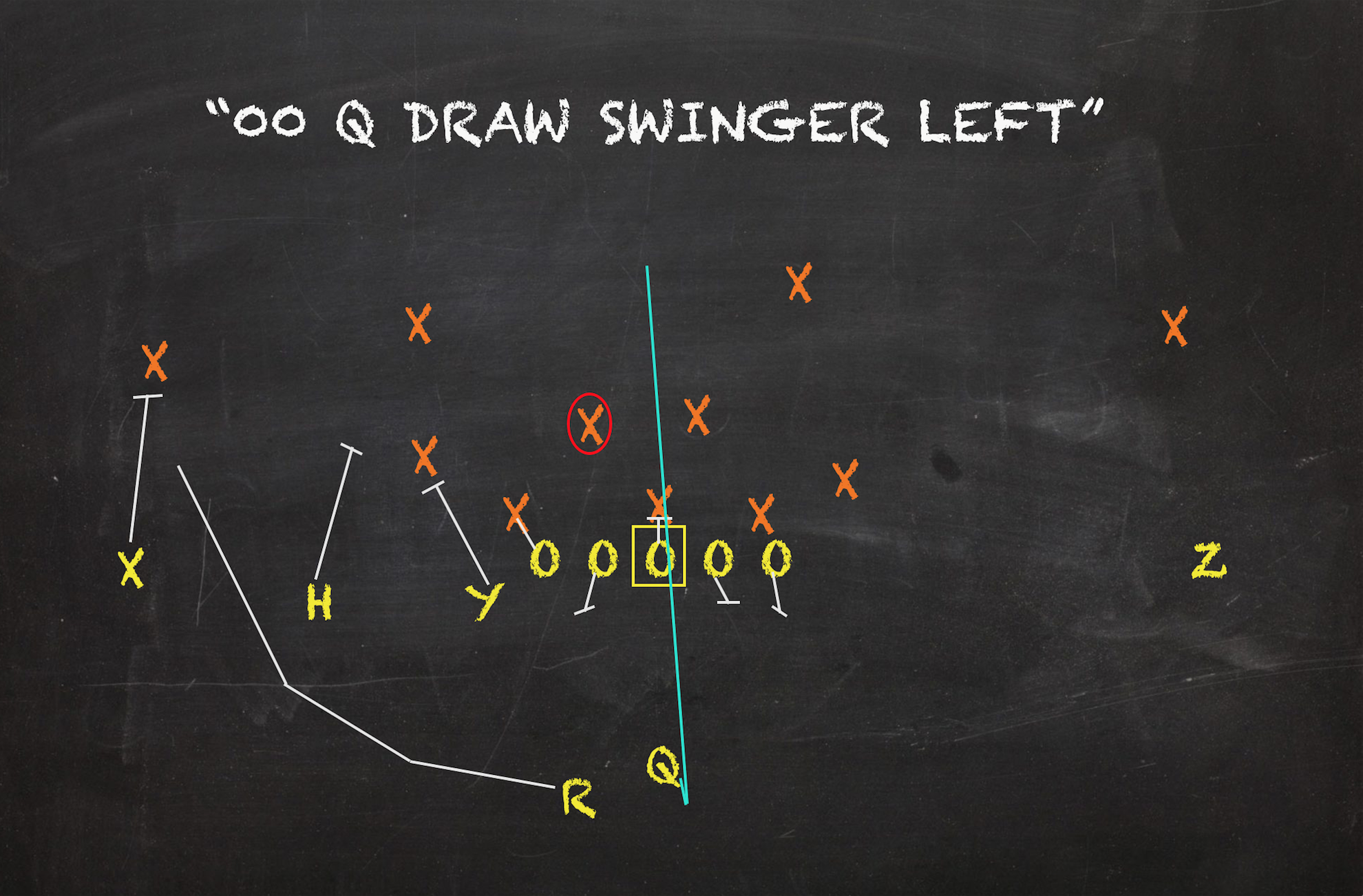
2. Run-Pass Option Outlets 2.48% Play Share 3.63 Y/A 46.7% Success Rate
Of the 21 SEC passers with at least 74 attempts last year, Kelly Bryant was one of the seven with an RPO Rate in the single digits. Though Missouri dramatically reduced the amount of RPOs they called year over year, pass outlets off those designs combined to totaled the second most play share of any pass concept. Outlet Screens like Swings, Tunnels and Bubbles along with isolated spacing routes like curls or flats provided avenues for Missouri to win horizontally or in space if their numbers were prudent. But, subpar decision making and lackluster perimeter blocking saw these mostly falter. The three screen outlets particularly struggled to produce consistently as they combined to averaged a mere 3 yards/attempt on a 33.3% Success Rate. On the other hand, spacing outlets found success on two-thirds of their targets, which clearly ballooned this concept's overall figures.
LSU and Tennessee were the only other SEC offenses where outlets were't among their six most featured looks to start a set of downs. Again with the emphasis to fade these plays year over year, that shouldn't come as much of a shock. Though these presented an easy option for Bryant to pad his completion numbers, outlets generally struggled to gain more than just a handful of yards when targeted.
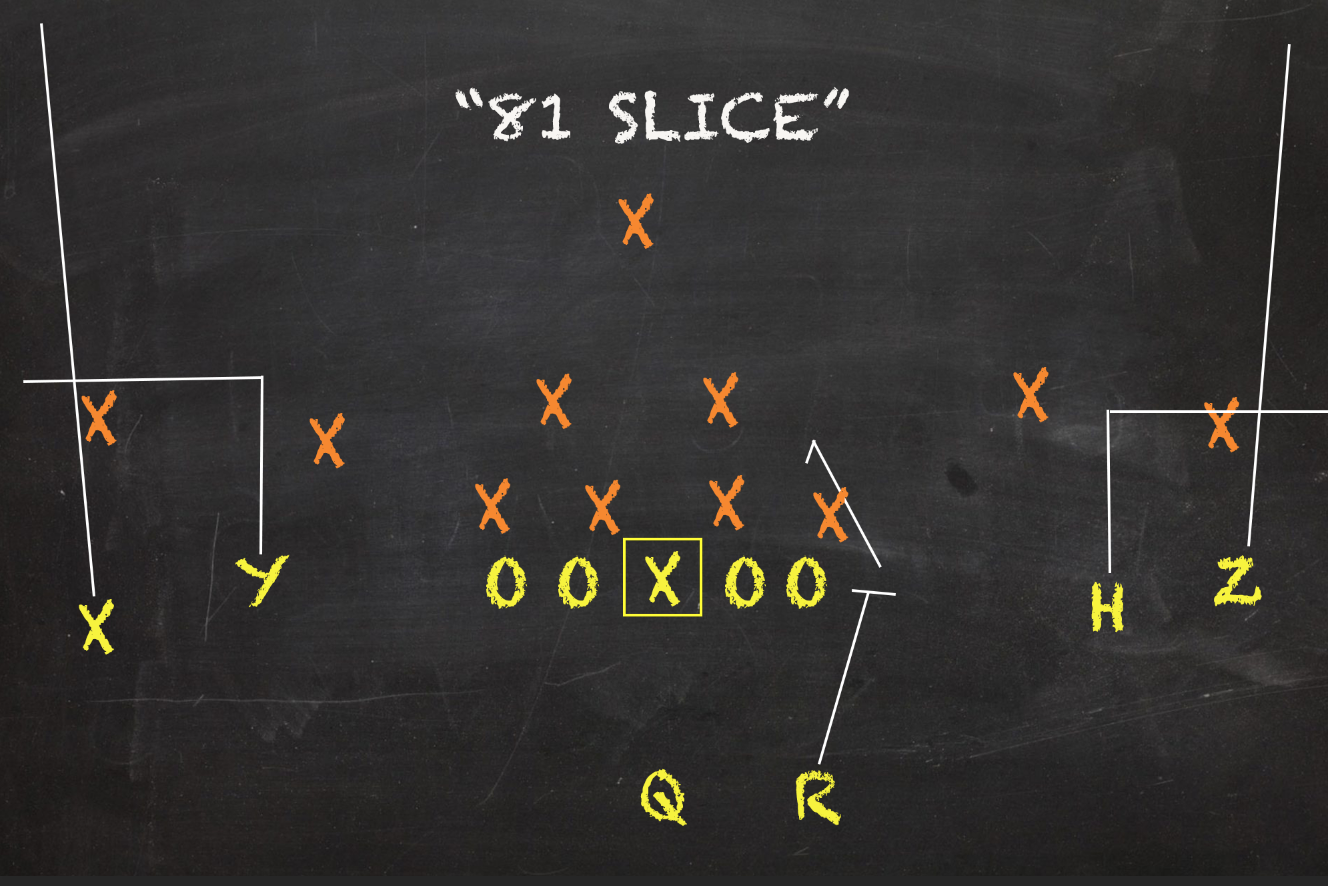
3. Ohio/Slice 2.24% Play Share 7.32 Y/A 52.6% Success Rate
The "Slice" concept is rather rudimentary but numerous SEC offenses were able to find success outside of the numbers with this two-man pattern. Consisting of an outside streak and an inside quick-out, this simple design can beat a number of coverage. In Cover 2, the streak can fall into the "honey hole" between the curl/flat corner and deep half safety. Versus Cover 3, the quick out often has cushion underneath. Against man, both routes have been known to win matchups. Like the Shallow concept, Slice was among Missouri's most featured pass plays and one of their most successful overall. Much of the Tigers' dropback passing game hit snags when their passers couldn't analyze the field efficiently. This often led to them patting the ball too long in the pocket, misdiagnosing coverages, or seeing plays break down. But thanks to the quick developing nature of this pattern, Missouri passers were able to get the ball out of their hands with more urgency and hit their playmakers outside.
This concept was overly an early down play for the Tigers. Of the 19 Slices targeted, 16 occurred on either 1st or 2nd Down. But execution in those spots were rather rocky as only seven of those 16 attempts resulted in success. If it wasn't for a sterling clip on the money down, this concept would have placed with the other copious amounts of concepts that sucked for the Tigers this past season. But thanks to a 3/3 mark on 3rd Downs, Slice ended the year as Missouri's fourth most successful look.
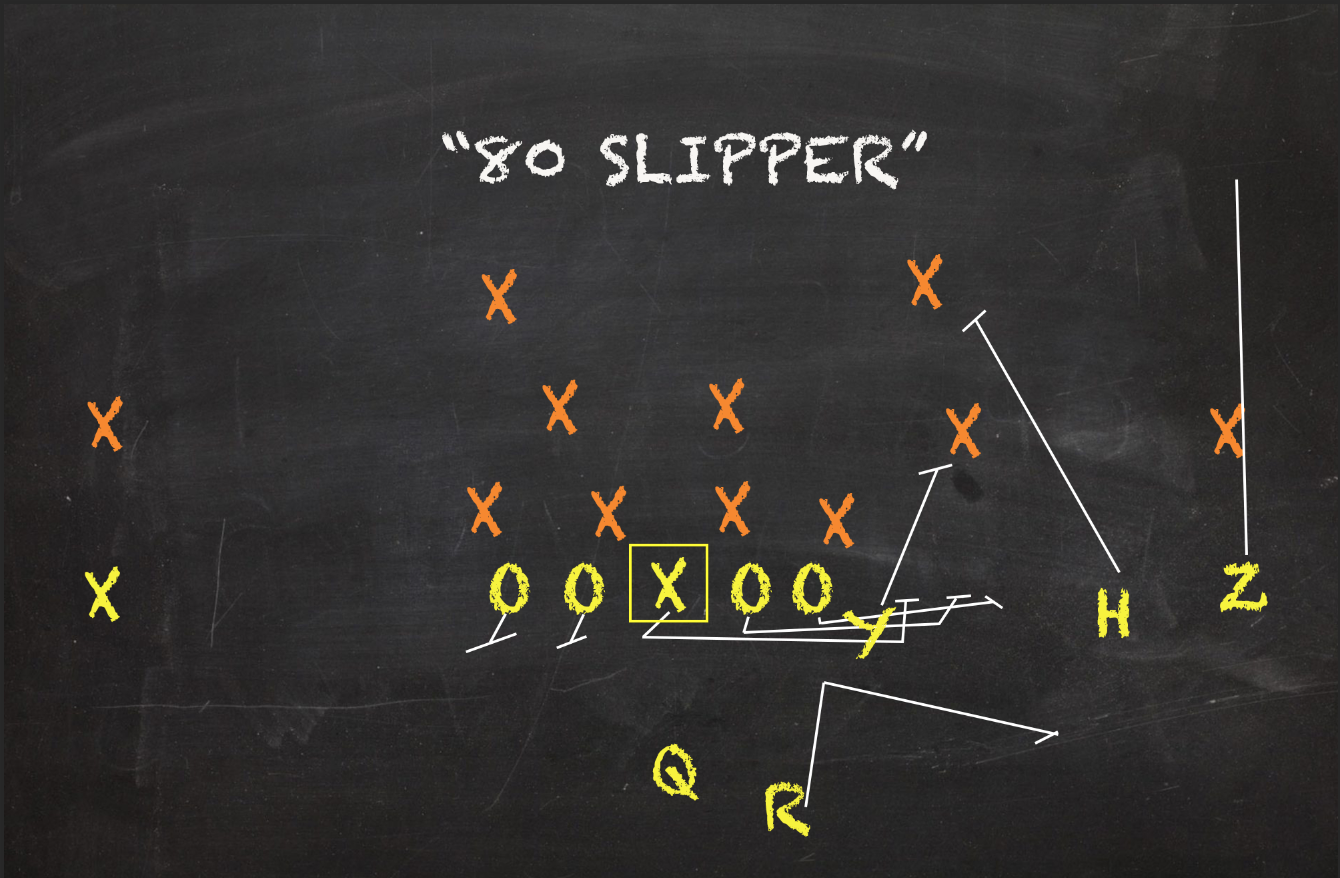
4. Slip Screen 2.00% Play Share 8.71 Y/A 29.4% Success Rate
While a few SEC offenses had a true screen finish among their favorite concepts, Missouri's affinity for Slip Screens was unmatched in this conference. Due to the fact their line wasn't the best in space and their wideouts weren't the best blockers on the perimeter, other true screens failed to offer what Slip Screens did for this offense. Since Missouri overly struggled to get its ground game going, Derek Dooley had to find other ways to get his backs the ball. While Larry Rountree only saw two screen targets all season, no SEC player commanded more true screens than Tyler Badie. Plus, his 197 yards off true screens were 35 more than the next closest SECer. His jitterbug style seemingly does fairly well in open field situations, and the majority of his screen production came off Slip Screens.
Slip Screens are a low-risk design. Like most true screens, they mostly are called on 3rd-and-long. The passer won't have to process too much as he's read is predefined and he only has to toss the ball a few yards. But with the increased degree of difficulty due to the down and distance, rarely do these designs result in success. Missouri sprinkled Slip Screens across the three downs opting to avoid that status quo. Less than a quarter of the Tigers' Slip Screen's reps occurred on the money down. Only one of their money down Slip Screens resulted in success, a 74-yard touchdown on 3-and-18 versus Kentucky. Still, the fact Slip Screens were so featured by this offense wasn't a good thing.
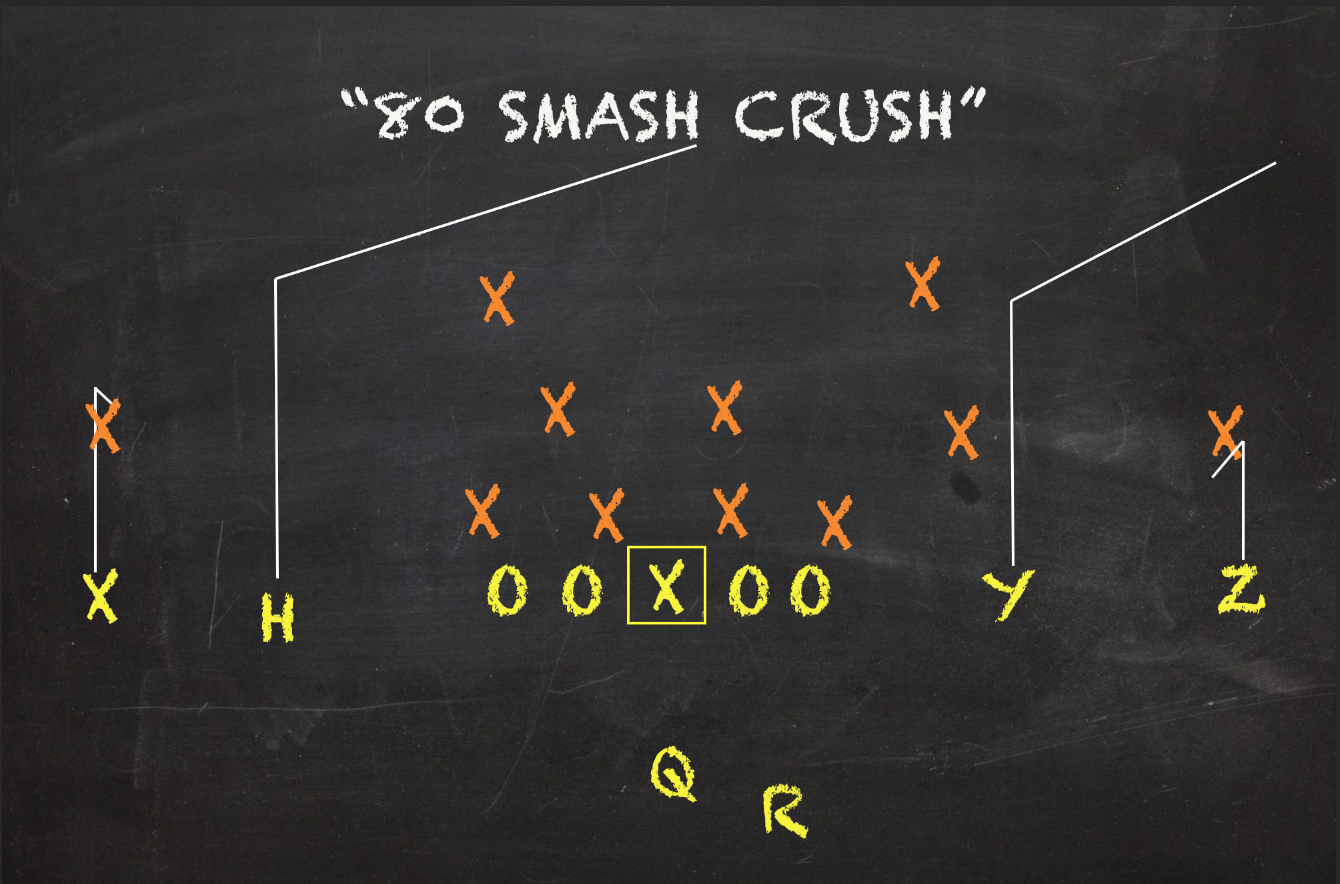
5. Smash 2.00% Play Share 10.7 Y/A 64.7% Success Rate
A variety of Smash patterns were seen from Missouri's offense last season. In addition to the traditional Smash that led the way in terms of reps, yards/attempt, and Success Rate, the Tigers also occasionally deployed the Corners and Bench wrinkle. But Missouri clearly preferred the basic outside hitch+inside corner design. Smash is one of the oldest pass combos in the sport. The reason it has stood the test of time is because this concept is versatile and can beat a number of coverages. Cover 2 is vulnerable deep if the safety is hesitant to flock towards the sideline. Cover 3 has no answer for the quick underneath hitch throw. While there's less certainty of this pattern topping man coverages, it's not out of the question an advantageous matchup can arise. For Missouri, none of their other favorite pass concepts could claim a higher yards/target or Success Rate. After all, this look boasted the highest clip among all of their concepts with at least a 1.3% play share. Though Smashes accumulated the fourth most yards of any look for this offense, no other pass play topped its 182 yards.
Missouri would call about one Smash or so on average per game. This was predominantly an early down play as Smash only saw a single 3rd Down target. Most of the concept's reps and success came on 2nd Downs. Of the look's 17 targets, nine occurred on seconds. There, Smashes boasted a 66.7% Success Rate on 14 yards/attempt. For good measure, this look posted a rather serviceable 57.1% Success Rate and 6.86 yards/attempt. Considering how comfortable the Tigers were executing this basic design, we will never know what preventing Dooley from calling this concept more for an offense that was desperate for consistency.
Chalking up Missouri's most successful looks
(min 1.3% Play Share)
1. Smash 2.00% Play Share 10.7 Y/A 64.7% Success Rate
The Smash pattern easily was the Tigers best concept. Besides sporting a team high 64.7% Success Rate, the look's 10.7 yards/attempt was the best of any of Missouri's five most successful plays. While the basic outside hitch+inside corner combo remained true, Missouri had a few designs to keep the concept from getting stale. One wrinkle is known as "Smoke" within some West Coast Offenses, which is a rollout towards the smash. Smoke often has max protection with a backside cross or curl. Before Bryant's boo boo started to pile up, Smoke was Missouri's most featured rendition of the concept. Not only did it get the athletic Bryant on the move, it made his throw shorter and predefined his read. The Tigers also paired Smashes with Sticks, Levels, Shallows, Verts, and Curl+Post combos. A wrinkle that came about to compliment Missouri's China concept was also seen from time to time. In China, you'll see in routes from the outermost receivers with a corner by the tight end/slot. On the "return" variation, those in routes pivot/sit back towards the outside in the holes of the underneath coverage. Now, these very well might be Chinas and a post-snap coaching point, but we still charted them as Smashes due to the route combo.
2. Play Action Boot 1.77% Play Share 7.40 Y/A 60.0% Success Rate
Despite the fact that Missouri's six most called 1st Down plays were run concepts and Kelly Bryant delivered a plus-50% Success Rate off fakes, play action wasn't a key characteristic of this offense. Overall, Bryant's Play Action Rate fell into the lower third of SEC passers. Still, Play Action Boots complimented Missouri's leanings towards the run on early downs quite nicely when they were called. Along with Smokes -- or rollout Smashes -- Waggles and Boots often called for similar route combinations with their QB working outside the pocket. Boots and Waggles are both weakside floods, and the only real difference in their categorization is the presnap alignment of the tight end. Waggles usually have the tight end aligned towards the play fake with him running a slide underneath the passer's bootleg. Boots generally see a delayed release to the flat on the same side as the boot. Sprintouts were also seen from time to time to help created YAC opportunities for their backs off the initial action. Derek Dooley did a decent job of mixing up his actions between zones and powers. The latter obviously would pull a backside lineman to help sell the fake. Again, they were mostly an early down play. Of the concept's 13 reps, 15 occurred on either 1st or 2nd Down.
3. Mesh Variations 1.3% Play Share 8.63 Y/A 54.5% Success Rate
Meshes were a sporadic look for Missouri's offense. When all the separate varieties combined, Meshes barely qualified in terms of sample size. This concept is a member of the Rub family and its most signifying feature are intersecting drag routes. The tight paths aim to create space versus man as defenders have to maneuver through traffic in order to cover their man. To whoop zones, Meshes are commonly paired with several vertical patterns like corners, posts, or digs. For the Tigers, Meshes coupled with the Mills concept yielded some of their best completions. In addition to those patterns, Missouri occasionally would deploy the Kelly Mesh -- named for the rendition Chip Kelly made famous. Some refer to this wrinkle as a sit or spot mesh.
4. Ohio/Slice 2.24% Play Share 7.32 Y/A 52.6% Success Rate
Since the Slice combination is simple and versatile versus numerous coverages, Missouri got its bang for its buck on this basic design. Missouri would call Slice off play fakes with max protection, tag it on run plays to create RPOs, mirror it on both sides of the formation, and couple it with other concepts. Though this look was presented a bevy of different ways from this offense, one particular design doesn't stand out. Again this look was predominately an early down play. Despite that fact, the only reason this play is considered one of the Tigers' best plays is due to Missouri's perfect execution of this look on the money down. Bryant was one of the four SEC passers to amass over 100 yards on this look.
5. Shallow 2.95% Play 8.68 Y/A 52.0% Success Rate
Of Missouri's five most successful looks -- all of which are passes -- none was as featured as much as the Shallow concept. Again, it saw more targets than any other aerial design by this offense. Whether it was first year growing pains in Missouri's scheme or an overall lack of comfortability within the pocket, Bryant appeared slow to process a good amount of dropbacks. Now, this very well could be because no one was open downfield. But nevertheless, Bryant was at his best when his primary read came open and was easily defined. The Shallow concept was one that consistently presented a straightforward read. Plus, it's a rather low-risk throw when targeting the titular route on this pattern. But the Tigers did a good job of hitting the open man and not force feeding only the drag. Looking at Shallows and its brother concept Drive, the drag was targeted on 17 of 32 attempts.
Where Missouri's weapons ranked
In 2018, Missouri had the SEC's fourth best passing game as far as Success Rate is concerned. While I would have put Drew Lock's skills at the forefront, Offensive Coordinator Derek Dooley seemingly narrowed his gunslinger's focus by giving him copious amounts of RPO outlets and made running the football a priority. Lock was never much of a scrambler or dynamo in the read game. But Dooley figured outlet screens and spacing routes via RPOs could help Lock rack up easy completions and be more consistent due to his intermediate accuracy concerns. The results were good, not great.
When Kelly Bryant announced his intentions to transfer to Missouri, many assumed this offense would continue to be serviceable. With past experience managing a spread scheme, increased mobility at the QB spot, and hunger to prove himself, Bryant came in with high expectations. Of course, Injuries, shaky line play, and a failure to click schematically all played a part in Bryant's lackluster 2019 season. When things started to go downhill, Bryant couldn't rise above the moment to save his drowning offense. As far as scouts are concerned, he considerably hurt his profile for the next level but still resulted with decent figures.

Though the tactics changed year over year, Missouri wanted to have plenty of options in the underneath areas of coverages. Like Lock, Bryant had one of the lowest average depths of target in the SEC. Only Vanderbilt's Riley Neal and South Carolina's quick-triggered freshman Ryan Hilinski had clips lower than Bryant's 7.79 ADOT. But unlike the now Denver Bronco, Bryant saw significantly less production of RPO throws. He was one of seven SEC qualifiers to have an RPO Rate in the single digits. Again, many of Mizzou's favorite pass patterns attacked short (see section).
Now before we continue, Missouri had hell of a problem catching footballs. I touched on this earlier, but it's hard to get on Dooley's play calling if players are consistently leaving plays on the field. On the year, Bryant's 8.56% Drop Rate was the SEC's second highest (Tyler Powell's 14.5% as high as it was failed to qualify due to number of pass attempts). While there can be some cases made on behalf of their wideouts for some miscues, drops on accurate passes are far less defensible. Among SEC players with at least 15 accurate targets, five Missouri receivers had double-digit Drop Rates. Big O and Jalen Knox were the worst offenders as they possessed the second and third highest clips in the SEC. Both dropped over a fifth of their accurate targets. This obviously hurt Bryant's Passing Success Rate numbers. His sturdy precision was wasted overly with those drops.
Early in the season, those weren't so costly. All else considered, Missouri's first six games was not a juggernaut. None of their defensive opponents cracked ESPN's SP+ metic's top30. While FCS opponent SEMO wasn't ranked, West Virginia and Troy's defense finished the year ranked 73rd and 112th out of 130 teams. While I'll give him a pass on account of the numerous drops, Dooley passing game was...safe. Missouri frequently called static passing concepts where guys weren't necessarily schemed open. Or in other words, if Tiger targets couldn't win their matchup battle, there was nowhere to go with the ball. Another tactic presented predefined reads often complimented by "run offs" -- decoy routes meant to occupy coverage men.This tactic soon presented a double-edged sword for this offense. If that primary concept failed to come open, Bryant would drop his eyes and look to play backyard ball.
You'd think with such a low ADOT that Bryant would be keen on getting the ball out of his hands quickly towards an outlet in space, but you'd be mistaken. Bryant displayed trepidation quite often and held onto the ball far too long at times. His average time to throw of 2.52 seconds was the SEC's third highest amongst qualifiers. When he trusted what he saw, Bryant was able to function well operating as a primary read quarterback. If his pre-snap diagnosis was right, he often played confidently and delivered results. The problem that kept rearing its head was finding production once the primary read was muffled. Even on designs where he was coached to have a progression, Bryant often got tunnel vision and the play often broke down. On the year, 19.2% of Missouri's dropbacks were charted as "broken".
Captain Obvious wanted me to remind you all that Bryant's accuracy noticeably downturned after his knee injury. Since his movement was wishy-washy, defenses started to treat him more like a rigid pocket passer. More defenders would drop into coverage and help neutralize the Tigers' downfield options. With tighter windows and an uptick in quality of opponents, the hobbled Bryant kept trying to save his unit from drowning. But his downfield passing suffered per his Depth Adjusted Accuracy. He only trailed Joe Burrow in that regard before his injury and finished the season outside of the SEC's top5.
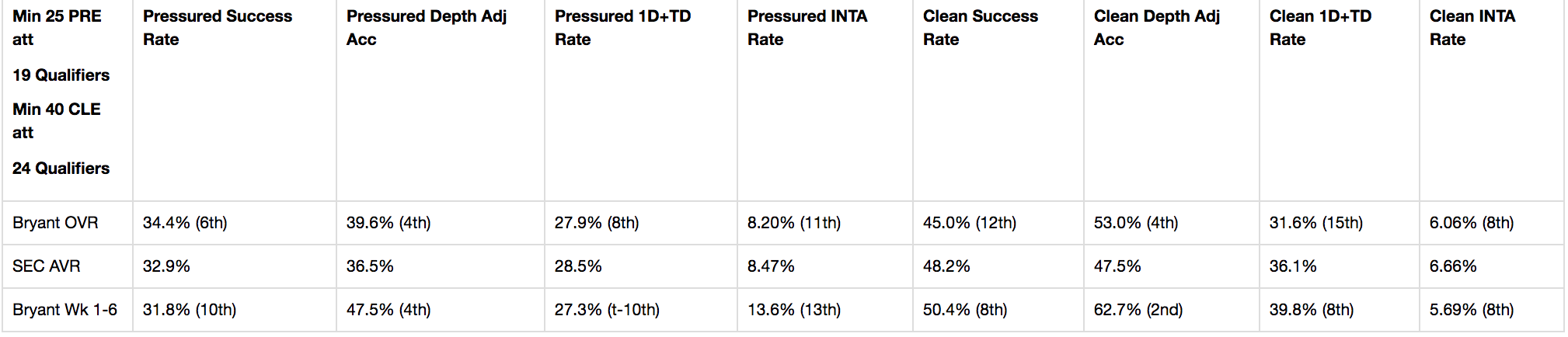
Bryant's upside was clear with how he operated from clean pockets prior to hurting his knee. He was able to post a Passing Success Rate over 50% and only Joe Burrow was more accurate downfield. When he was able to fully maneuver around and outside the pocket, his mechanics were more clean and he was able to pass accurately. Even when he was pressured, he was one of the most accurate passers in the SEC. But since he overly looked to check down or "pass the buck" when things got hairy, his accuracy failed to amount to key completions consistently. After his injury, Bryant actually pressed slightly more downfield under duress. But, much of that was because of the Tigers played from behind often after Week 7. The pressing brought up his key completions slightly even if the injury hindered his downfield accuracy. But again, his Pressured Depth Adjusted accuracy was good for the fourth best in the SEC.
Pressured dropbacks are far more volatile than passing from clean pockets. While it's nice to have someone who can make a play when things break down, it's a far more inconsistent representation of someone's output. Considering that a hurt Bryant was more productive relative to the conference when pressured reflects this offense's erraticism. Playing it safe and frequently passing up more rewarding throws made his accuracy less valuable.
Bryant was at his most efficient targeting between the numbers and the hashes on his dropbacks. Before his injury, both his Success Rate and Accuracy cracked the SEC's top4. This was the section where his average depth of target was the lowest. Only Jake Fromm had a lower ADOT than Bryant's 5.61 clip on throws from the numbers to the hashes within the conference. Still, that was the only area of the field where Bryant's Success Rate topped the league average. Since Bryant wasn't reliant on RPOs to pad his passing numbers, his dropback numbers are pretty close to his overall numbers. Still, Bryant was one of the most frequent screen throwers in the conference with a 11.1% clip. Breaking out his true pass attempts omit all of those run game extensions from his output. Not to sound redundant, but his accuracy was solid from sideline to sideline. For the most part that, was because Bryant targeted throws closer to the line of scrimmage. Deep attempts only made up 9.59% of Bryant's throws, which was the fifth lowest clip in the conference. I mean come one, ten of Bryant's 16 TDs were on throws ten yards or less downfield with five behind the line of scrimmage. Bryant either by design or by decision, what noticeably risk adverse. I would be remiss, however, if I didn't bring up his respectable 39.2% Completion Percentage on deep attempts. It was easily in the top third of SEC qualifiers.
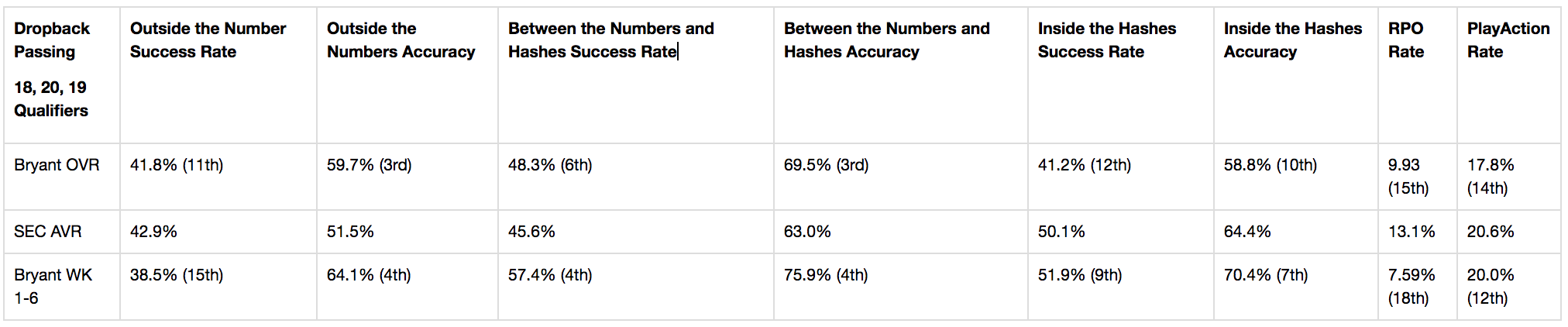
Though Bryant took a step back in all areas of the field after his injury, his regression inside the hashes was the most prominent. Both his Success Rate and Accuracy targeting that area of the field declined by over ten percentage points and finished in the back half of qualifiers. You can see from Bryant's pass chart below. Outside the hashes, his Success Rate essentially stays the same between 42-44% regardless of depth. When targeting his favorite area of the field -- short/intermediate throws to the right -- it even climbed up to 48%. But towards the middle of the field, Bryant's passes mostly failed.Either due to plays breaking down or operating play action bootlegs, one out of six plays on average occurred outside the pocket. By volume his 48 were the sixth most in the SEC. Though his Success Rate and Depth Adjusted Accuracy outside the pocket managed to top his overall clips, Bryant was more prone to Interceptable Passes and saw his First Down+Touchdown Rate and Explosive Pass Rate dip.
While it's not always the smartest way to play, there's some weight to the saying, "No biscuit unless ya risk it." While injuries, stale designs, and broken plays often forced Bryant to become a Checkdown Charlie, I would have liked to see him throw downfield more often. Though he could hit a man underneath, he failed to show he could confidently thread the needle down the seam or beyond ten yards downfield. Showing an inability to process post-snap changes quickly, display poise under pressure, or boast sturdy downfield numbers greatly dinged Bryant's draft resume.
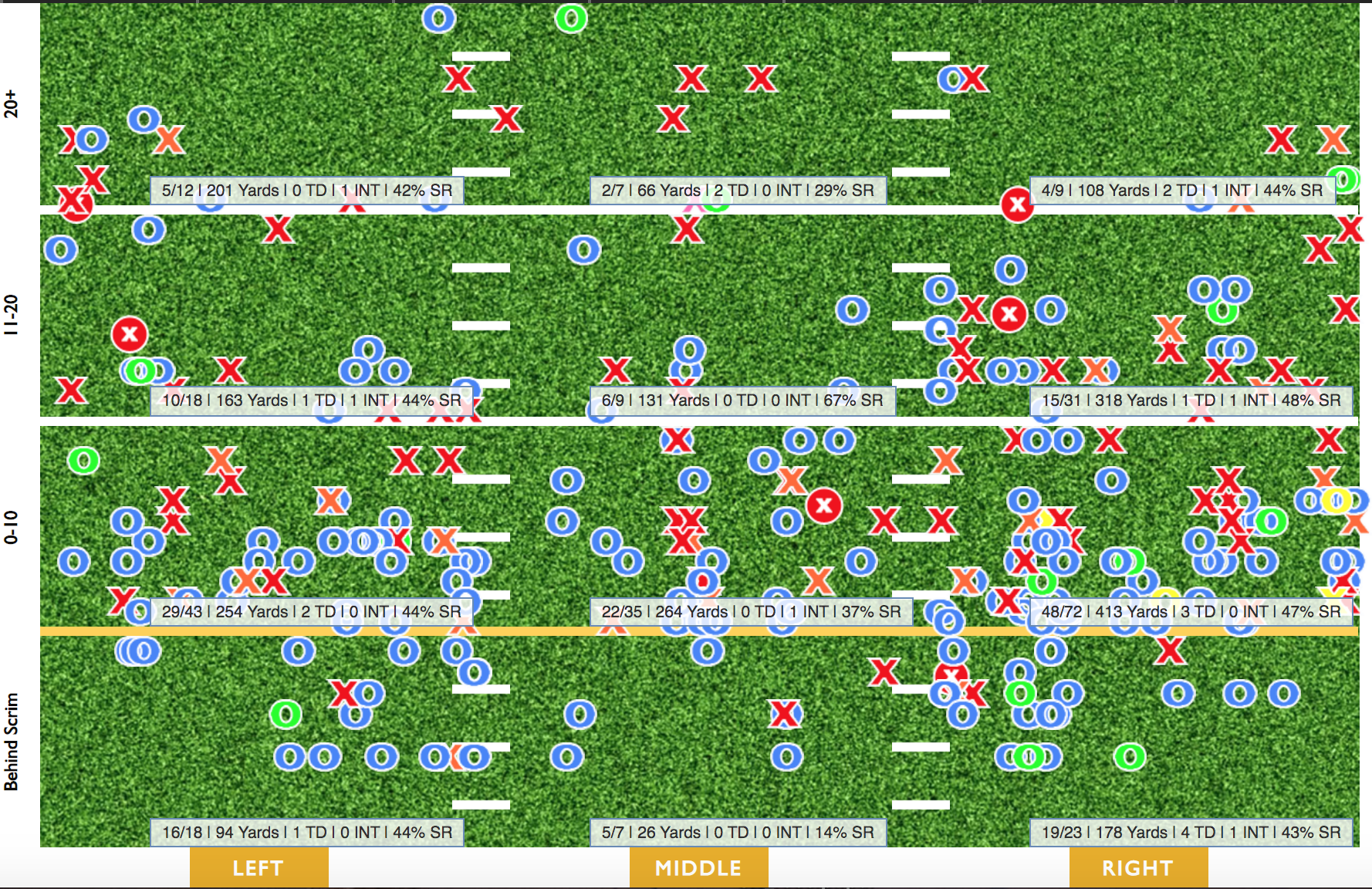
While Bryant was full of faults, it's hard to get on him for his ball placement. You can get on him for lacking aggression, weariness to test defenses downfield, or that he held onto the ball too long. But when you recall his pass catchers' poor Drop Rates, it's easy to see why Bryant played a certain way. I'm sure his targets had more than enough drops on the practice field for seeds of mistrust to manifest. Bryant had enough to process for this offense, and it was amplified when he second guessed his receivers before throwing them the ball. Of their four main pass catchers, three fell into the SEC's bottom10 in Drop Rate. Looking at contested targets, Tyler Badie failed to corral a single attempt, and the other three easily finished with Contested Catch Rates near the conference floor.
The Tigers had a clear pecking order regarding preferred targets. Still, each of their four main receivers' Target Share was within 3.5 percentage points of one another. Only 13 chances separated their target leader from their fourth option. But just because a receiver was given more attention doesn't mean it was justified. Some of Missouri's most productive receivers were ones that failed to see 40 targets. Even though Kam Scott, Jalen Knox, and Barrett Banister failed to be among the Tigers four most targeted outlets, they finished third, fourth, and seventh on the team in receiving yardage.
Though Scott had his own drop problem, he was one of the best in the conference after the catch. Averaging 10 YAC yards per pop, he boasted the highest Yards/Target (11.7) and Explosive Catch Rate on the team (21.4%). Over 70% of his catches resulted in a first down. Thanks to those elements, Scott managed to post a 53.6% Success Rate despite a 17.9% Drop Rate. Barrett Banister from the slot commanded a team-high 58.2% Success Rate. But he was overly a safety valve. Of his 34 targets, 22 were ten yards or less downfield, which lowered the degree of difficulty on his chances. No other Missouri receiver could claim a higher Catch Rate than his 79.4% clip. Despite consistently helping the Tigers manage their down and distance, he sported a team-low Yard/Catch among their wide receivers (9.15). Knox was the most productive deep threat on the team. Like last year, deep catches boosted his overall volume. He was able to haul in five of his seven deep targets for 181 yards. His Deep Catch Rate tied Big O's clip, which was good enough to be the sixth best in the SEC. But at the end of the day, his overall Success Rate and Catch Rate were below average within the conference.

Jonathon Nance led this team and targets and was often their most efficient among Missouri's favorite outlets. Operating from the outside, he ventured more downfield on average than Okwuegbunam and Johnson. His 10.7 ADOT was the highest of Missouri's four most targeted receivers. The same was true of his Success Rate and Yards/Target. Despite that, Nance was the least explosive of their top pass catchers. Less than 9% of his catches resulted in a gain of 20 or more yards, which was a bottom15 clip within the SEC. He only saw five deep targets and finished with a single catch. As aforementioned, this was a group of receivers that weren't the best in tight windows or when defenders contested a target. Barely over a fifth of Nance's contested opportunities resulted in a catch. Much of these tries occurred on 3rd Down or within the Red Zone. Contested or not, Nance only managed to succeed on about a third of those targets. As easy as it is to pile on him due to his disappointing Drop Rate and subpar ability to win contested battles, there's no question Nance would have seen better numbers if he didn't own the team's highest Uncatchable Target Rate. Over 21% of his total targets were deemed as uncatchable and 50% were considered inaccurate.
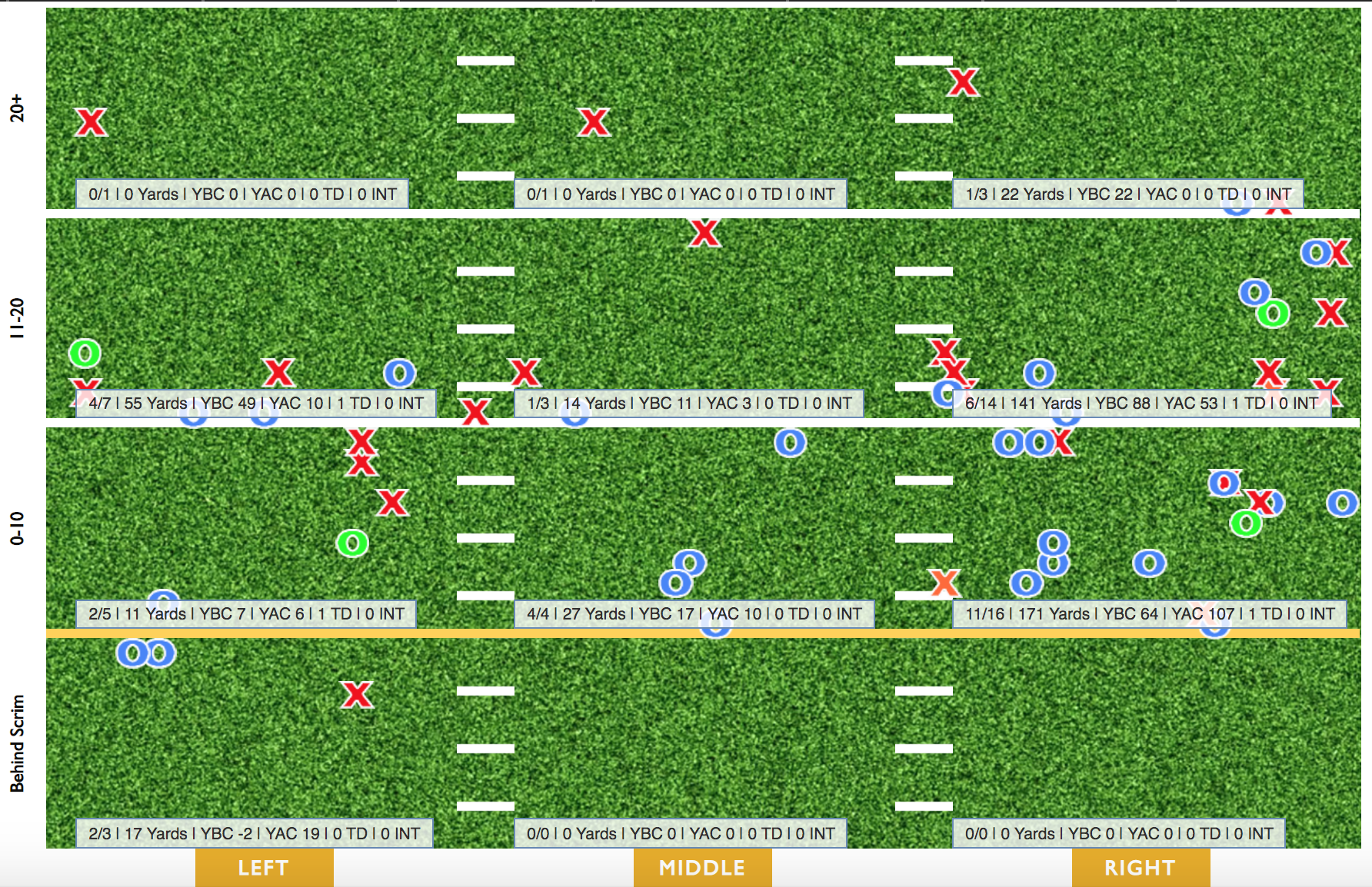
Albert Okwuegbunam presented the largest matchup opportunity for this offense. Despite leaving Columbia on a high note, Big O had his worst statistical year catching the football. His total catches and total receiving yards from his junior campaign were less than what he was able to do as a freshman. While his six touchdowns led the team, inconsistent ball placement and lack of concentration killed his efficiency. Though he saw one of the better Uncatchable Pass Rates on the team, nearly 38% of his targets were not deemed accurate. Despite his size and past success, Okwuegbunam failed to win his contested battles. Though he was better than Missouri's other main targets in this regard, Big O only controlled about a quarter of his contested targets. Extra physicality and tight windows made his degree of difficulty higher. Despite operating mostly as a safety valve or down the seam in years past, Okwuegbunam ended the year with the SEC's highest Drop Rate. An insane 16.7% of his targets resulted in a drop (it was even worse on accurate passes). All but one drop occurred on a contested target. Like last year, Missouri moved Okwuegbunam around the formation but they targeted him more vertically. In 2018, he only commanded a single target over 20 yards downfield. This past season, his seven deep targets were tied for the most on the team, and his 57.1% Deep Catch Rate was good for sixth best in the SEC. Four of those seven targets went for scores.
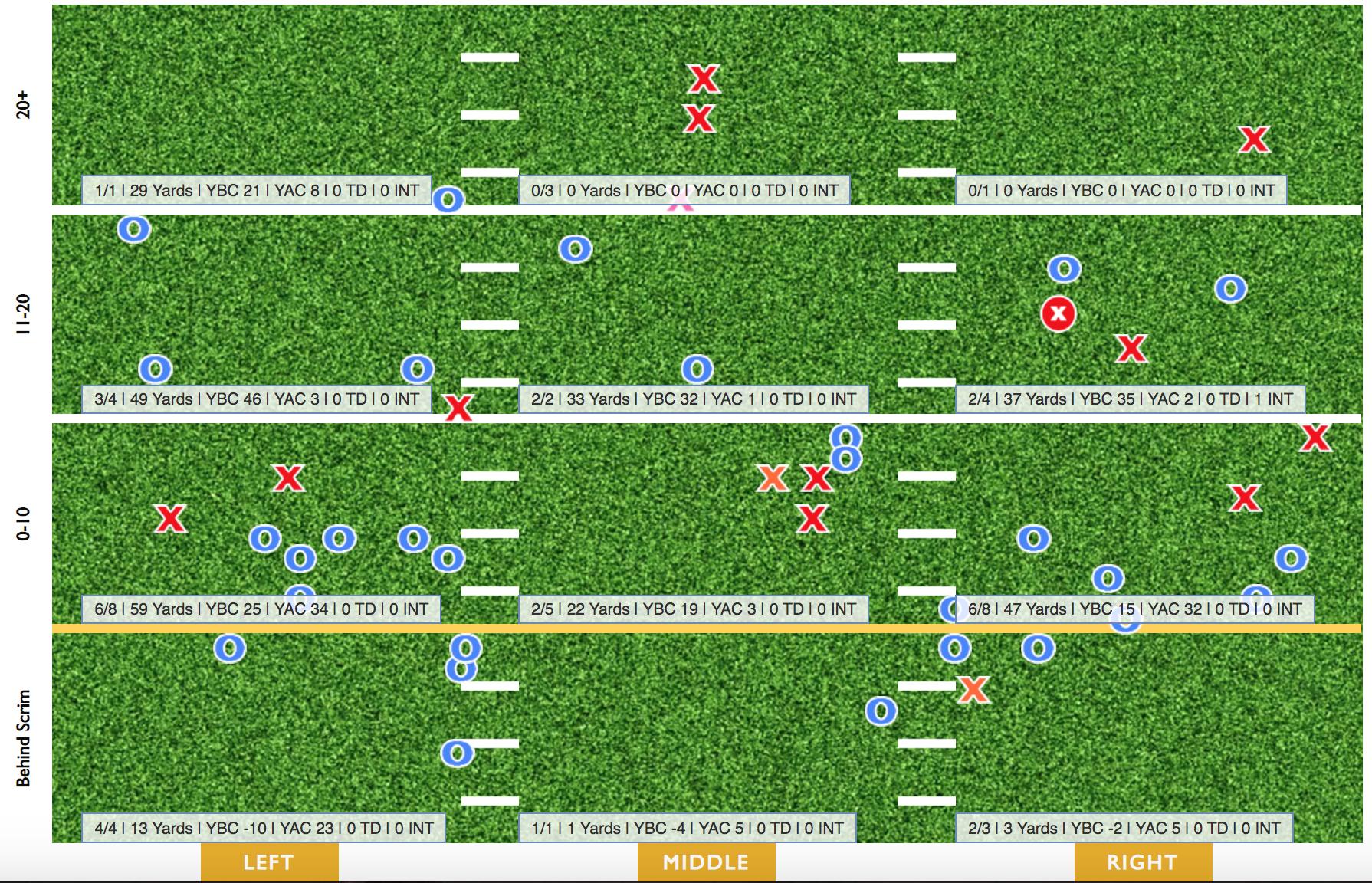

Jonathon Johnson for two straight years has been Missouri's manilla option in the slot. Though the Tigers reduced their amount of RPOs in 2019, Johnson was still one of their go-tos on quick patterns to the flat or underneath areas. (Johnson saw 15 RPO targets last year compared to just four this season). Thanks to his slight frame and playing style, Johnson was never going to bully secondaries. Still, Missouri would have liked to see a better showing on contested targets and on key downs. Unless Johnson was given the ball in space, there was a good chance nothing great would come of it. Only 20% of his contested chances resulted in a catch, which was the SEC's third worst clip. Neither of his two Red Zone targets found their mark. Johnson was the Tigers' third option on the money down. Though Nance and Okwuegbunam saw more targets in those spots, Johnson's 3rd Down Catching Success Rate was the best among Missouri's four main receivers. Half of his catches beyond ten yard downfield occurred on 3rd Downs. While some injuries limited him, Johnson had his worst season by volume. Despite topping 720 yards, 40 catches and 5 TDs the last two seasons, Johnson's 2019 failed to break 300, 30, and 1, respectfully.
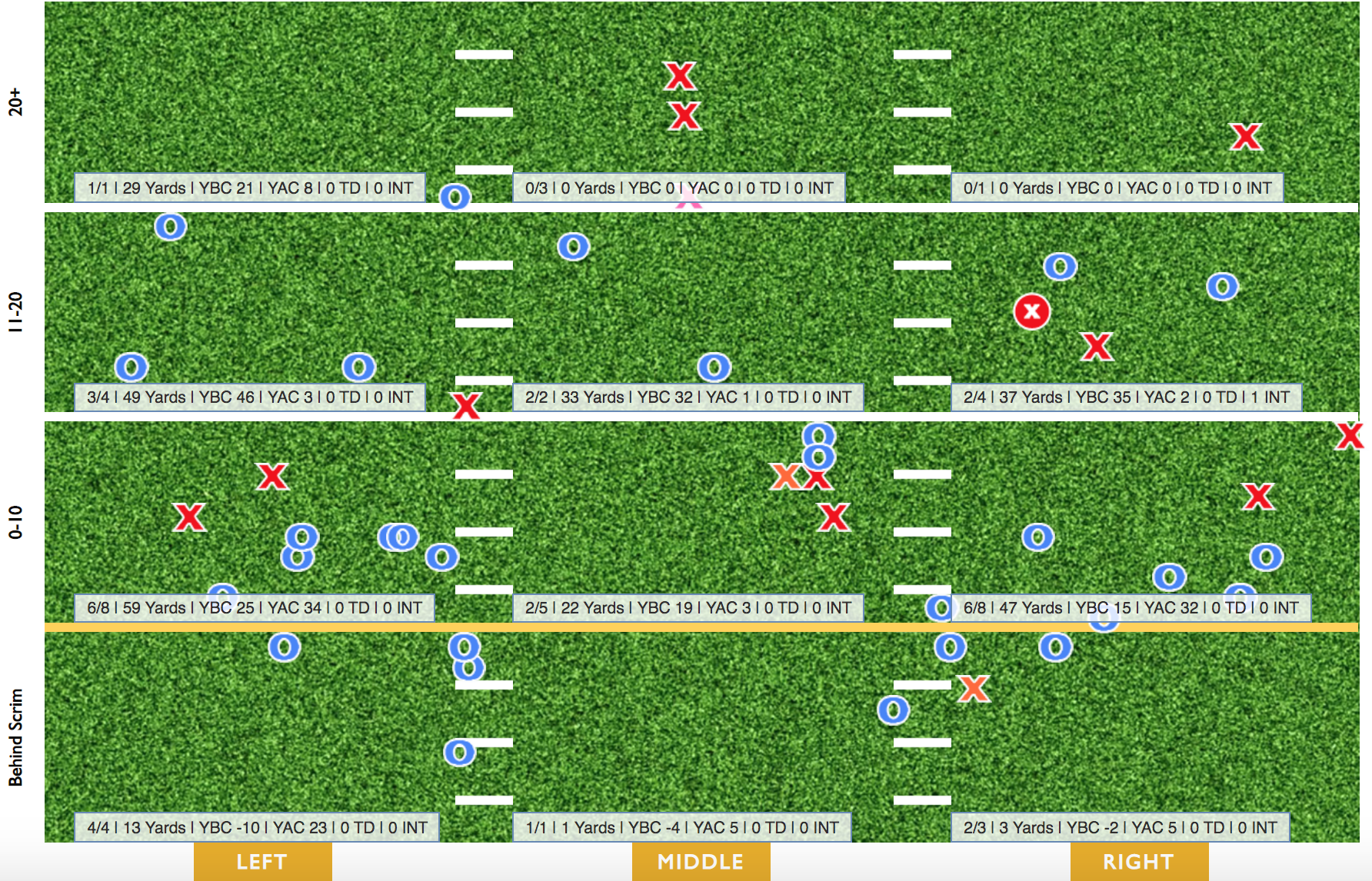
Only LSU' Clyde Edwards-Helaire and Florida's LaMichal Perine commanded more pass targets among SEC backs than Tyler Badie's 45. More than half of those targets came off true screens. Since screens are conservative designs and require the receiver shoulder the bulk of the load, their rate of success is often much lower than other passes. Plus, true screens often come on later downs when the offense is behind the chains. Because he overly was targeted at or behind the line of scrimmage, no other SEC player with at least 40 targets ended the year with a lower average depth of target. This also had a incredible effect on on his Depth Adjusted Catch Rate. Though the metric omits targets behind the line of scrimmage, he ended up leading the SEC in that stat. But that wasn't because he was a phenomenal downfield threat. Badie was as good after the catch as anyone in the SEC. No one could top his 12.2 YAC average. But again since most were on screens behind the line of scrimmage, he ended with a so-so Yards/Target. Such a low average depth of target handcuffed his efficiency. Even with four of his five scores being on throws behind the line, Badie's 35.6% Success Rate was the third lowest in the SEC.
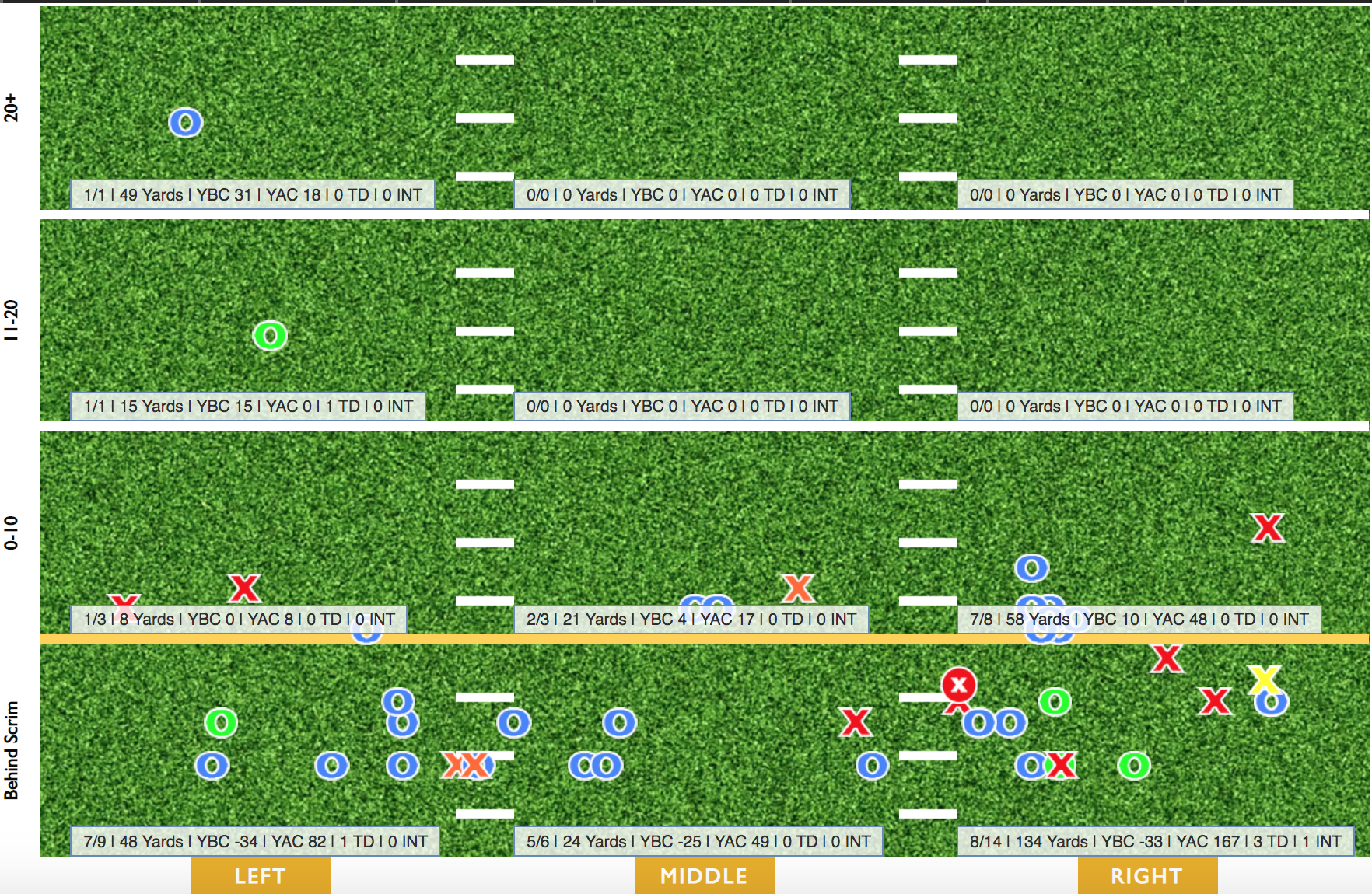
Missouri's run game was toothless. While Larry Rountree and Tyler Badie both finished 2018 with Rushing Success Rates above the SEC average, the Tigers' ground assault was muted, dull, and often uneventful. Drew Lock's vertical passing helped open up run lanes and made safeties think twice before they flocked inside the box creating more room underneath for them to run the ball. Despite being an experienced spread quarterback, Kelly Bryant's athleticism didn't translate to continued success in run game. Only Florida had a higher percentage of runs gain between zero and three yards than Missouri's 45.8% clip. Think about that. Nearly half of their rush attempts were bottled up for a measly gain. Plus, that doesn't take into account all of the tackles for loss this unit allowed. Over 10.8% of Missouri's designed runs gained negative yardage, which was the fourth highest clip in the SEC.
A reduction in RPO tactics allowed perimeter defenders to largely ignore outlets and hone in on stuffing run-of-the-mill read options, zones, and counters. With a more crowded box, their backs encountered obstacles sooner rather than later. Missouri was one of the three teams in the conference to average less than 2 yards before contact in 2019. The Tigers' main ball carriers aren't designed bruise, bash, or move the pile after contact. As bad as this unit was before contact, no SEC rush offense was worst after contact than Missouri. Naturally, this drastically limited this run game's ceiling.

Larry Rountree was the Tigers' primary ball carrier. Since he received the volume that's typical of a number one back in this conference, he led the team in carries, yards, touchdowns, and first down conversions. But like Missouri's run game as a whole, Rountree experienced a downturn in production. While he still managed to finished top10 within the conference in rush yards, he was well off from accumulating 1,000 yards. With below average spurt and brawn, Rountree was easily contained this past season. Defenses aimed to make Bryant's job harder by narrowing in on the ground game, and Rountree got the bulk of their attention. Of Missouri's three main backs, none suffered a lower average yards before contact clip. Though he was okay after contact, he clearly lacked the means to consistently break tackles and rip off chunk gains. With the early defensive contact hindering his carries, Rountree was below average essentially across the board. But despite fifth worst yards before contact clip in the conference, Rountree was able to avoid negative tries better than the other main ball carriers for this offense. His overall 6.45% Negative Run Rate was the tenth lowest in the SEC. Every other of Missouri's top rushers saw contact behind the line on over 10% of their carries. Rountree was a forgettable runner and clearly lacked the ability to make a difference for the Tigers' run game.
Bryant was caught "dead" more often than any ball carrier in the SEC. While a good amount of his rushing figures were distorted with the ungodly amount of scrambles/sacks he took, no SEC ball carrier suffered from a higher Negative Run Rate. In the read game without a pass outlet, Bryant was often caught with his pants down after a botched read. With nowhere to go with the ball, he overly had to eat it and take a loss. His 26.9% clip was over ten percentage points higher than the next closest qualifier. And when we tack on his "gumption carries" (instances of initial defensive contact behind the line of scrimmage but a positive gain is made), Bryant engaged with defenders on 32.7% of his designed carries. With that element incessantly handcuffing Missouri's rushing numbers, no SEC rusher finished with a worse average yards before contact clip than Bryant's 1.15. Though the read game often opens things up for QBs to extend their legs outside, Bryant mostly floundered. He very rarely was able to create an explosive gain when not scrambling. Bryant's Explosive Run Rate finished in the single digits and shared the third worst clip in the SEC. At least Bryant made is difficult on his opponents. Rather than just going down, Bryant often scratched and clawed for extra yardage. Like most quarterbacks, he posted a bland -- in this case a bottom5 -- yards after contact clip. But his Gumption Run Rate and Broken Tackle Rate both cracked the conference's top10 and led the team.
A good number of Bryant's designed carries occurred with a favorable yards to gain. Meaning, he wasn't itching to run on many 2nd or 3rd-and-longs. With manageable down and distance on the bulk of his carries, Bryant's First Down+Touchdown Rate also led the team. But if you notice, Bryant was just as likely to run for a key play or be hit behind the line of scrimmage by a defender. That great level of volatility greatly hurt this offense. Again, these numbers only reflect designed rushes. Though Bryant logged 106 rush attempts on the year, 54 were off sacks or scrambles. Much of his run game woes were a direct result to the injuries he sustained. During the first six weeks of the season, Bryant averaged 3.1 yards before contact on a 52.4% Success Rate. Nearly 43% of his carries resulted in either a first down or a score. But once he lost his gallop, his numbers plummeted.
Tyler Badie was this offense's factor back. Since he's more agile and well-rounded as a player, Badie was used to help spread the field horizontally on screens as well as inside Missouri's ground game. Despite his jitterbug playing style, Badie was not great after contact. He mediocre at breaking tackles, but his lack of production after engaging with defenders was troublesome. Not that many were expecting the 5'9 sophomore to go Barry Sanders on folks; but since most of his production came without interference from defensive fronts, Badie failed to move his game forward. Though his skill set differentiated himself from Rountree, subpar blocking and vision resulted in middling efficiency numbers. Like Rountree, Badie saw over half of his carries gain between zero and three yards (Both backs finished in the SEC's bottom5 in that regard). Though he finished the season as the Tigers most successful ball carrier, there wasn't much else to point to in order to make a sound case for his improvement.
Though his extended snaps this season occurred in garbage time, junior Dawson Downing provided a decent tertiary option on the ground. Being largely overlooked, Downing posted the team's best before and after contact clips. Though you wouldn't know by looking him, Downing ended the season as the Tigers' most explosive ball carrier. Nearly 17.5% of his carries gained ten yards or more, which was the 12th best clip in the SEC. Though he suffered from his fair share of early contact -- highlighted by his high Negative Run Rate, he was clearly the most physical of their three running backs. Again, Downing was mostly utilized in second halfs either when the defense had shakier legs or when the game was already decided. Of his 40 carries, all but eight occurred in the 3rd or 4th quarter. With his lack of breakaway speed, Downing had to be crafty and prudent with his chances. For better or worse, Downing went against the grain of the run design on exactly 20% of his carries. No other Missouri ball carrier had a Cutback Rate over 15%.
Like most right-handed offenses, Missouri directed the majority of their runs towards the right. Nearly 56% of their carries went that way with midright quadrant being their favorite place to attack. Just under 40% of Missouri's rushes were inside runs towards the right. Though that quadrant birthed 23 of their 52 explosive carries, rushing figures in that spot was mediocre. Overall, both sides of the formation yielded terrible returns as neither produced a Success Rate over 40% or a yards before contact clip over 1.95 yards. With a new scheme in place, there is a big area of opportunity for this ground game to look itself in the mirror. It can be easy to regress and blame it on a new offense or coach. But if Eli Drinkwitz wants to prevent this program from becoming overly irrelevant, he has to act fast and get this aspect of Missouri's offense fixed. No matter who was going to be the head coach, there would be uncertainly surrounding the QB position. But with three veteran returnees, the ground game has to be solid in order for a less-experienced quarterback to find his footing.