Sideline to Sideline: LSU 2019
LSU's offense at a glance
"Flipping the script" has been a major theme writing about LSU's offensive turnaround this season. The general status quo, which LSU used to blindly follow, is for offenses to run to set up the pass. In order to establish the run, you need to dedicate a good amount of your early down play calling to pound the rock on the ground.
Last season, LSU had the definition of an average Pass Rate by SEC standards across all downs. Outdated not only in scheme but also in tactics, LSU's early down Pass Rate was 43.3%, which was also right at the conference average. Their Success Rate in those spots was 41.1% -- third worst in the SEC. Like a good deal of Tiger offenses over the last two decades, talent was in its ranks; but LSU failed to make the most of it.
Then things started to look up -- literally. Coach O made the call to switch towards an Air Raid scheme and the rest is history. Sure running the Air Raid means more than just throwing the ball a lot, but that is still a big part of it. No other offense in the SEC was as pass-happy as LSU. Challenging the status quo, LSU passed to set up the run. In general, pass plays gain more yards on average than run plays. The average yards/rush from the best run offense is often less than the average yards/attempt from a middling offense. So the earlier you get to passing, the more chances stay ahead of the chains... or so the theory suggests.
Naturally, LSU dedicated a good amount of its early down play calling taking to the skies. Their 60.4% Pass Rate on 1st and 2nd Downs easily lead the conference; so did their 55.9% Success Rate. On firsts, the Tigers were particularly aggressive and explosive. On average, 1st Down passes gained over 11 yards (LSU's overall yards/pass was 9.3 on the year). Doing some creative accounting, about one in five of their 1st Down passes targeted concepts aimed at attacking deep downfield. These included All Verts, Shot Plays, Portland Variations, Switch Variations, Mill/Double Post designs, and Deep Double moves like Sluggos, Forks, or Flags. LSU's Explosive Pass Rate on 1st Down was 18.3% compared to 7.72% on 2nd and 3rd Downs.
Throwing the ball around a lot is only one part of the Air Raid offense. Overloading vulnerable spots a defense presents is football 101. But the Air Raid takes this idea and floors it. The Air Raid also has an innate belief its designs can whoop any coverage. Maybe you have noticed watching Mike Leach or Dana Holgorsen operate, but the Air Raid guys aren't afraid to call the same pass play over and over again. Nor are they weary or trepidatious the defense knows what is coming. Much of the Air Raid's swagger comes from this mentality. "Yea we know what we're running. You know we're running it. Try and stop it." Especially in today's world with constant sideline checks and audibles that can make the game more lumbering, many find this style of play refreshing. Though there was still a good amount of "check with me" before Burrow snapped the ball this season, LSU relied on a shortlist of core concepts. But, we'll get into those later.
With the increased chances through the air, LSU was able to pick their battles on the ground. As a result, the Tigers' ball carriers were subsequently more advantageous with their tries. No SEC rush offense averaged less yards to gain on average than LSU's. Even on early downs, the new mentality has allowed them to seize yardage when defenses were on their heels. Year over year, LSU's early down Rushing Success Rate increased from the conference's second worst 40.2% clip to 50.4% this season; only Alabama's 52.7% finished better within the SEC.
Another aerially inclined aspect that aided LSU's run game was calling more route tags on top of its read options. Perhaps you have heard of these referred to as Run-Pass Options, or RPOs if you sit at the cool table. In 2018, no SEC team used fewer RPOs in its script than the Bayou Bengals; less than 10% of their play calls were labeled as RPOs a year ago. In terms of Success Rate, LSU was the only team in the conference with a figure south of 40%. LSU struggled mightily to make these looks worthwhile. Fast forward to today and nearly a quarter of LSU's script was composed of RPOs, and their Success Rate year over year is about 10 percentage points higher -- good for the SEC's fourth best clip. In 2019, the Tigers averaged 6.73 yards on RPO runs compared to 4.59 on normal runs. But in terms of Success Rate, non-RPO runs ended in success about 56% of the time, which was roughly seven percentage points higher than RPO runs.
Besides stressing defenses conceptually, LSU's offense took it to them formationally. Since the Air Raid aims to go after the weakest spot of the defense, seeing how it lines up is important. One very Air Raidy tactic LSU used this season was going empty. LSU spread-out and went five-wide on 13% of their snaps this season, which was good for the third most in the conference. Naturally, these formations accentuated LSU passing the ball, which led to a higher yards/play than their overall clip. From empty, LSU averaged 8.95 yards/play compared to their regular 8.09 clip. A third of their plays from five-wide sets gained ten or more yards.
Despite the increased potency, leaving your passer with minimal blocking is bound to have some drawbacks. Though they had a magician in terms of escaping from pressure, 36% of LSU's passes from empty were under duress with 5.4% of them resulting in sacks; that nearly doubled their overall Sack Rate from 2019. Over 10% of plays resulted in a scramble. All in all, over 22% of LSU's plays from empty were considered "broken". Despite the increased yards/play, constant pressure affected their success. LSU's 49.2% Success Rate out of empty was considerably worse than their league-leading 55.2% overall figure.
While spreading out to five-wide is one extreme, LSU also wasn't shy of lining up in bunched or condensed sets to create mismatches on the interior. In fact, LSU went tight more than they went five-wide this past season. Over 14% of their plays were from bunched or condensed sets. Only Florida and Alabama used those formations more. Like common sense suggests, empty formations helped open up the offense for better or for worse, which led to more explosiveness but less consistency. On the other side of the coin, condensed sets lowered LSU's yards/play but sported a solid Success Rate. No other SEC offense claimed a Success Rate in these spots better than LSU's 52.5% clip. Though that too was lower than their overall clip, LSU frequently went to these sets with 11 personnel in short yardage situations. No conference offense averaged less yards to gain in these sets than the Bayou Bengals.
Not only did this offense flip the script on early downs; they also did so on the money down by running more than others. LSU had the SEC's third-lowest Pass Rate on 3rd Downs and finished with the conference's second best Overall, Passing, and Rushing Success Rate in those spots. The early down passing and complimentary play calling frequently set up LSU to succeed on the money down. No SEC team averaged less than their 5.53 yards to gain on thirds. Last year, the Tigers averaged 6.69 yards to gain, which was the conference mean. Their Success Rate of 37.9% was the SEC's sixth worst.
Despite being able to convert more times than not on 3rd Downs, LSU relied on the do or die down the least within the SEC. There's an adage going around: "The best 3rd down offenses are the offenses that don't play 3rd downs." Since a drive can end instantly if an offense fails to execute in those spots, smart play callers have learned to succeed on early downs so that there would be less chances a drive would be "killed." LSU's Early Down Conversion Rate led the SEC with a 77.1% clip. In general, 31.4% of their plays resulted in a 1st Down, which also was tops.
What hasn’t been already written about this historic offense? Forgive me for just hitting the highlights. When we step back and examine the macro, it's hard to find shortcomings. I already mentioned the Tigers led the SEC in Overall and Passing Success Rate, Early Down Conversion Rate, and yards/play. The SECs most pass-happy team also finished with the lowest Three-and-Out Rate and Turnover Rate while scoring more points and gaining more yards than anyone else in the conference. Their Explosive Play Rate -- or percentage of plays that consist of passes that net 20+ or runs that net 10+ -- of 15.5% was fourth within the SEC, but both of LSU’s Explosive Pass and Run Rates placed within the top3.
Burrow toppled plenty of our stat records and had the best season Pro Football Focus has ever seen. Even going beyond their grades, his Win Above Replacement -- a popular sabermetric used in baseball -- of 2.95 games was also the highest PFF ever calculated. (Oregon’s Marcus Mariota’s 2.36 in 2014 was the previous high). But if you aren’t too keen on analytics, Burrow also threw more passing TDs and finished with the highest QB Rating for a single season in the history of the sport.
While LSU’s offense deservedly received a bulk of the praise for the team’s rise to dominance, it’s not like their defense was a push over. Versus SEC competition, LSU’s defense was top3 in Defensive Success, Havoc Rate, and Pressure Rate. Though they let up a decent amount of yards and were average curbing scoring and explosive plays, LSU’s faults defensively, in my opinion, were always about focus rather than ineptitude. Their play down the stretch certainly backed up my thoughts on the matter.
Over the course of their final four games (Texas A&M, Georgia, Oklahoma, and Clemson), LSU’s defense allowed Success Rates of 25%, 32.4%, 39.3%, and 43.8% respectively. Only Clemson in the CFP Final eclipsed the average Success Rate for an SEC offense against an SEC defense (41.2%). While TAMU and UGA were two of the five most successful offenses within the conference, Oklahoma and Clemson were two of the best units in the country per ESPN’s SP+.
The only spots where LSU had a negative relationship (or where a net negative outweighed a net positive) against conference opponents was in Run Havoc Rate, Pressure Rate, and average rush yards after contact. Though LSU’s run game drastically improved by making that aspect a more complimentary part of their gameplan, LSU’s backs constantly had to bail themselves out of jams. The Tigers’ Run Havoc Rate on offense was the third worst in the SEC. Over 36% of their rush attempts faced forms of Havoc. Sure, their backs did a fine job fending off defenders and making the most of it as they finished with the conference’s second best Rushing Success Rate. But LSU ball carriers were collectively average before and after contact relative to the rest of the SEC.
When Passing, Burrow himself did a great job of limiting Havoc plays. But thanks to facing an average amount of pressure and seeing the SEC’s second highest “Broken” Play Rate, he suffered from a fair amount of sacks. Though the Tigers had a positive relationship in terms of Sack Rate, their front pressured opposing QBs at a worse rate than what their OL allowed.
Still, LSU’s 2019 championship team will be remembered for their incendiary offense that lit up scoreboards for five months. With so many important cogs taking their talents to the professional ranks, it’s a very hard ask to expect the Tigers to run it back. No one will boo their efforts this season. But if LSU wants to continue to sit at the big boys table, they cannot take a major step back or concede ground to other up-and-comers within their division.
LSU’s favorite run looks

1. Inside Zone Slam Read 17.5% Play Share 6.22 Y/A 54.6% Success Rate
Before it underwent a tactical awakening in 2019, LSU allowed ten different run concepts to own at least a 2% play share; six broke the 3% threshold. With various pass concepts now being the preferred method to move the ball, a good amount of LSU's ground attack was simplified and streamlined into just a few looks. Only two run looks eclipsed a 2% play share this season for the Tigers. Their favorite was the Inside Zone Slam Read. This basic read option received more calls than any other concept for LSU's pass-happy attack. The majority of its reps were paired with RPOs.
Across all downs, Slam Reads led LSU's play sheet. On 1st Downs, they almost doubled the calls that the next closest concept received and almost tripled such on thirds. This allowed the look plenty of opportunities to accumulate yardage. In fact, LSU's 1,150 rush yards off Slam Reads only trailed UK's Lynnsanity Offense within the SEC. LSU and UK were the only two SEC offenses to break the 1,000 yard barrier. In terms of Success Rate, Slam Reads produced their worst results on firsts. While most teams would be doing backflips to get this level of production, they just were lesser than their outputs on other downs. On firsts, LSU's Success Rate running Slam Reads was only 50.5% -- compared to 57.7% or 60% on the following downs. Still when over half of their chances resulted in a 2nd and 5 or better, executing Slam Reads efficiently made LSU's ground game -- and overall offense -- a hard force to get off the field.

2. Duo Dives 9.92% Play Share 5.30 Y/A 57.1% Success Rate
Duo Dives were the other run concept that survived LSU's brass play share redistribution. This gap scheme is all about double teams, hence the name of the look. Duo Dives are excellent compliments to Inside Zone Slams and its read wrinkles. Zones call for a coordinated flow from the lineman towards the playside hole. Their combo blocks work diagonally and aim to reach second and third level defenders when prudent. This movement is easily recognizable for defenders when diagnosing a play. Operating off of their opponents assumption a zone read was likely, LSU loved sprinkling in a Duo Dive to get north and south in a hurry.
I've purposefully diagrammed LSU's Duo Dive and Slam Read from a condensed set. You can see how similar the two plays are. But while all zones called for the back to cross the face of the quarterback to hit the playside hole, the vast majority of Duo Dives had the back hit the side to which he was aligned. Though they averaged about a yard less than Slam Reads, Duo Dives were more successful. Duo Dives were LSU's second favorite play to go to on 1st or 2nd downs. Though the look only received 8 on the money down, it remained one of LSU's five most called plays in those spots. But regardless of down, their output remained consistent. Their 557 yards on the year were second most of any concept.

3. Iso Insert 1.51% Play Share 11.1 Y/A 75.0% Success Rate
This gap scheme play occasionally showed up in LSU's script this past season. Though streamlining its run game to predominantly two plays yielded excellent returns, there were still instances where the Tigers needed to provide an additional ground look. This staff mostly wanted to use this look as a secret sauce. On average, they only called about one per contest. By keeping it mostly hidden, LSU was able to pick its spots to unleash this power wrinkle.
Iso Inserts are meant to initially resemble split zone action, but are just a modern twist to the old Isolation play design with a lead blocker from the backfield. But make no mistake; this is a power play through and through. I'll explain in further detail in a video below. A number of the look's best gains featured RPOs attached to them. LSU weren't the only ones to boast successful gains with this design. And due to the copycat nature of coaches, don't be shocked if a number of other SEC offenses start running this look themselves.

4. QB Draw 1.42% Play Share 6.73 Y/A 40.0% Success Rate
LSU loved operating out of empty sets this past season. Over 13% of their plays were out of five-wide formations, which was the third most in the SEC. Though the set maximized their passing outlets like no other, less than half of LSU's snaps were successful. Already a pass-happy scheme, going five-wide takes that mentality up a notch. Spreading defenders out often presented plenty of avenues to run between the tackles. So LSU smartly incorporated QB Draw RPOs from these sets into their offense. The exact variants of route tags that LSU paired with Burrow's option to tuck it and run on a draw varied, but most leaned on Stick and Slice concepts to opposite sides of the formation. Burrow just had to count and make a decision based on where the Tigers had numbers.
Over the course of the year, LSU had 21 plays where there was an RPO off a draw play; 15 of those ended up being QB Draws. Though the look resulted in a few clutch carries, it wasn't an overly successful play. It's 40% Success Rate was the lowest among LSU's favorite run and pass concepts.
LSU's favorite pass looks

1. Tosser 3.59% Play Share 7.37 Y/A 71.1% Success Rate
A good portion of LSU's upgraded passing attack came from the Air Raid philosophy. But the use of a West Coast staple permeated their play sheet no matter who the Tigers faced. Slant Variations combined to total just under 8% of LSU's total plays from 2019. LSU used slants in RPOs and normal dropbacks and their attempts rarely fell to the turf as incomplete. The Tosser wrinkle was targeted the most by a considerable amount. Calling for dual or all slants to one side of the formation, Tosser saw plenty of chances on early downs when the Tigers wanted to manage their down and distance.
All but five of the concept's 38 reps occurred on either 1st or 2nd Down. This low-risk play consistently delivered. Though the bar was set low, over 71% of targeted Tossers resulted in success. Thanks to their receivers’ collective ability to stretch defenses deep, plenty of opponents offered up underneath cushion for slants to do work. Being the most targeted pass concept on the most pass-happy team in the conference allowed Tosser to finish with 280 yards, which was the fifth most of any look for the Tigers this season.

2. Stick Variations 3.49% Play Share 6.51 Y/A 64.9% Success Rate
While slants are one of the West Coast Offense's favorite ways to generate easy completions, Stick Variations are how Air Raid offenses like to win in the underneath areas of the field. Since LSU is now a bastard child of the Air Raid offense, it was only natural to see Sticks show up in their script. Offering a sit player to beat zones and a hot route versus man, Sticks are relatively conservative designs that are quick reads for passers. LSU called them from normal, empty, and condensed sets. Sure they had their favorite wrinkles, but the Tigers ran over a half a dozen variations of this concept. No other SEC offense loved Sticks like LSU. Burrow had 20 more attempts and 19 more completions on these looks than the next closest SEC passer.
Like Slant Variations, Sticks were one of the looks LSU liked to lean on to manage down and distance situations. Of the concept's 37 reps, 33 of them occurred on either 1st or 2nd Down. They were at their best on firsts. There, Stick Variations received the fourth most calls of any concept while sporting a 71.4% Success Rate. But due to the nature of the route combo, these gains were contained better than slants. Only one targeted Stick netted more than 20 yards compared to five slant plays. Also Sticks' First Down+Touchdown Rate was about six percentage points worse than their number from Slant Variations. Still, Sticks were one of LSU's best designs in terms of success with only Iso Inserts and Tosser being better.

The Comebacks concept was LSU's most targeted intermediate pass play. While Slant Variations like Tosser and variations of Sticks were far and away their preferred way to attack short, Comebacks allowed LSU's vertical-minded passing scheme to kill single high coverages down the seam or on the outside. Despite sporting a very healthy 53.1% Success Rate, I'll remind you the Tigers' overall Passing Success Rate was 56.9% -- making this look technically below average in their eyes. That's how prolific this aerial assault was. No pass concept started a set of downs more than Comebacks for the Tigers. In those spots, the look posted a 10.3 yards/attempt and a Success Rate just under 60%.
With a good amount of LSU's other pass plays aiming to go deep or seize yardage in the underbellies of the defense, Comebacks filled a natural need of providing a steady combo to win intermediately.Though somewhat basic, Comebacks can win versus a number of coverages. The outside comebacks are natural winners against Cover 3 and Cover 4 or if the receiver can whoop his defender in man. The seams can slice right down the middle of the field and find room versus Cover 2 or Cover 3. It wasn't uncommon for this design to use play action or max protection. About 83% of LSU's seam+sideline combos were off play fakes. Being fifth in overall play share, the Comebacks concept accumulated the fifth most yards at 304 for the Tigers.

4. All Verts 2.55% Play Share 12.5 Y/A 48.1% Success Rate
The Air Raid scheme didn't always use All Verts as its preferred method to beat defenses deep. But over the course of the last two decades, no concept encapsulates the Air Raid mentality more than All Verts. Bombs and deep shots along the sideline are great ways to generate explosive gains even if they might not always deliver consistent results. But while most SEC offenses turned to All Verts to dig themselves out of holes when behind the chains or when they needed a big play on 3rd Downs, LSU was more aggressive. Of LSU's 27 All Vert patterns, 19 occurred on 1st Down.
Though a number of LSU's passing concepts incorporated vertical aspects, All Verts didn't pull any punches with it's intentions. No SEC offense that targeted All Verts at least 10 times had a better Success Rate on this look than the Tigers. While their clip is below 50%, I'll remind you this look often has a higher degree of difficulty. For LSU, five attempts resulted in scrambles. Still, Cool Joe completed 10/20 throws on this design. No other pass play surpassed All Verts' 338 yards for the Tigers.

5. Solo Slant 2.55% Play Share 11.6 Y/A 62.9% Success Rate
I already touched on why LSU's new offensive philosophy enjoyed littering its script with Slant Variations. First off, LSU often pressured deep, which created cushion underneath. Second, their personnel were very good throwing and catching these rudimentary patterns that allowed the Tigers to manage down and distance as good as any college offense. I mean, Burrow targeted 34 more Slant Variations than the next closest passer in the SEC (and this omits slants on Rub/Pick designs). In case you needed more evidence that LSU loved these patterns, two of LSU's five favorite pass concepts were Slant Variations. Again, both merited the number of calls as each boasted golden Success Rates. Solo Slants just missed the cut to be among the Bayou' Bengals five most successful.
A modern tactic passing offenses use places a zone-beating concept on one side of the formation and a manbeater on the other. Few routes are designed to win quickly like a slant; so they're a natural route to pair on the backside. And boy did Solo Slants help beat plenty of defenders this past season for the Tigers. Let's remember the very first touchdown for LSU's history season was a Solo Slant off a power RPO. Though Tosser and Slap wrinkles are more concepts than routes, deploying a simple Solo Slant backside or as a RPO outlet helped deliver superb figures for the Bayou Bengals as they averaged 11.6 yards/target, which was only bested by All Verts among their six most favorite passes. Targeting a Solo Slant produced the fourth most yards of any concept with 314.

6. Corners 2.46% Play Share 9.04 Y/A 50.0% Success Rate
The Corners concept at its base is an inverted Smash Concept. Smashes are one of the most common high-low reads teams use along the sideline. The basic Smash calls for an outside hitch with an inside corner. So if we were to invert this design to get our Corners wrinkle, the outside man runs the corner with the inside guy running towards the flat. Sometimes blitzing backers prevented the flat from releasing as the Tigers opted to absorb the pressure. These instances resulted in a solo corner route to the outside.
Corners was used both as a mirror concept (where both sides of the formation run it) and as a compliment to looks like Tosser or Levels. It wasn't out of the question for LSU's diverse passing offense to skip this look in the script every once in awhile. But in some games -- the Mississippi State game for example, Corners provided chunk gains and were a big part of the Tigers' attack. Of the concept's 236 total yards gained over the course of the season, 116 of them came off the four targets Corner's received against the Bulldogs. I'm sure LSU's brass was happy that half of the look's overall targets ended in success. But looking around at the other concept's that fueled this passing onslaught, Corners' 50% Success Rate wasn't one of the Tigers' best designs all else considered.
LSU's most successful looks
(min 1.3% Play Share, click on concept name for video)
1. Iso Inserts 1.51% Play Share 11.1 Y/A 75.0% Success Rate
Heading into the Florida game, LSU had only called two Iso Inserts for a grand total of 8 yards on the year. It was a throwaway play that offered just a little mutation to their ordinary rush attack. Versus the Gators, however, LSU's staff didn't waste much time before this slobber knocker design was seen in their script. To start their second drive of the game, LSU turned to the Iso Insert and it produced a 57 yard burst. LSU would call the look three more times over the course of the game; two of those ended in success. LSU then went two weeks without calling it with two more subsequent weeks of the Inserts only receiving one rep (neither of which ended in success).
Three of LSU's next four games saw Inserts boast multiple successful calls. The concept had its most prolific day against Oklahoma in the CFP Semifinal. That was the only game where LSU ran these designs and Burrow attempted a RPO throw. Both resulted in first downs. Half of the gives to the back resulted in explosive gains. It's understandable why the staff wanted to keep this look mostly hid and use it when defenses least expected it. But looking at how efficient this run was for the Tigers, I certainly would have featured it more if I had any say in the matter.
2. Tosser 3.59% Play Share 7.37 Y/A 71.1% Success Rate
It's pretty common sense. If you run something a lot and you get good results doing so, then your offense is likely to reap those rewards. LSU targeted slants more than anyone else in the conference and consistently won their battles in those spots. Dual or all slant patterns known as Tosser were the family's best subconcept. Either as the primary, secondary, or as a RPO tag, Tosser consistently delivered. LSU mostly used this look on early downs to help them march down the field with adequate gains when the defense was weary of getting beat deep. Tiger wideouts quickly earned the respect of secondaries across the country, and it didn't take long before they started backing up pre-snap.
While other Slant Variations netted an explosive gain, Tosser didn't produce a single 20 yarder in 2019. But, the Tigers didn't need or depend on these designs to do so. LSU found other ways to be explosive. They were content riding a reliable connection in the underbellies of coverages on 71.1% of targets.
3. Stick Variations 3.49% Play Share 6.51 Y/A 64.9% Success Rate
Sticks -- like Tosser -- were very common on LSU's play sheet; and more times than not, they got the job done. LSU's second favorite pass concept was their third most successful look. The Tigers' passing game had a number of core concepts, but it was big on offering a little bit of variety. That was their use of Sticks in a nutshell. Though LSU dedicated a good amount of its reps to Sticks, not one variety stood above the rest. All were efficient and each offered a little wrinkle. They rain the standard Air Raid Stick, which is a design deployed out of trips. The outside receiver will get vertical with the two middle guys running hitch/out choice routes. They also ran Traditional Sticks where the back races to the flat with the middle most receiver running a hitch. They ran a few varieties from tight and condensed sets -- two of which I drew up in the video. Though I charted these as members of the Fade family, there was also an inverted Stick version out of empty sets.
It didn't matter what specific wrinkle they chose to run. Sticks were very dependable early down pass plays to keep the Tigers on the move and in manageable situations. Burrow connected on 30 of his 33 Stick attempts but only nine resulted in a first down. Though they were good for a little chunk of grass, they very rarely produced much after the catch.
4. Shallow 2.08% Play Share 10.9 Y/A 63.6% Success Rate
Ironically, a concept named for its titular route that aims to work short was one of LSU's most explosive plays in 2019. That's because Burrow rarely targeted the shallow in favor of one-on-one opportunities he was presented on the perimeter. A common aspect of LSU's offense was the use of the "Doubles" philosophy. This thought process isn't as revolutionary as Aristotle or Socrates's teachings, but they still rocked plenty of secondaries' minds this past season. "Doubles" basically is a pre-snap instruction that both outside receivers with both run the same deep route; either a streak, comeback, or curl for the most part. It's just how LSU assigns their responsibilities on certain plays.
A good portion of LSU's vertical offense surrounding this design. Depending on how they tweaked it, it could turn into a number of concepts. If they ran it out of twin sets to the strength, the Follow wrinkle could be seen (think the CFP Final versus Clemson). If they kept the tight end in to block, All Verts or Divide combos could manifest. If Joe Brady was feeling particularly frisky, you could see either of those deep-minded concepts paired with a shallow cross. This variety met with the potency of their personnel made this core concept a hard beast to corral. Again in the video, LSU runs the look two straight times on the way to scoring very quickly against a Nick Saban defense.
5. Levels 2.08% Play Share 7.05 Y/A 63.4% Success Rate
I hope you see a pattern by now. While there is no denying Burrow's arm talent, LSU thrived working short. But again, that is very Air Raidy. That mentality operates much like a resurgent force against an invading army. Though the offense was designed to maximize outlets and overwhelm the vulnerable parts of the defense so that an undersized team could win in space, it gets turned up to 11 once playmakers and athletes can run its concepts. Not every play is bells and whistles. But efficient five, six, seven yard gains can drive a defensive coordinator mad. I mean, Will Muschamp is still angry about something right now I'm sure.
Like Tosser and Sticks, the Levels concept isn't designed to go the distance. But it compliments their other passing looks well. All three were commonly seen out of trips this season from the Tigers. Before the receivers make their initial stems, the routes are impossible to decipher. And since they are often quick developing plays, this slight hesitation in diagnosing the look can be the difference from an uncontested catch and a deflection. Levels are two or three man high-lows toward the middle of the field. The most common see the inside receiver running a dig coupled with ins.
Where LSU's weapons ranked
It's one thing to put up a prolific passing season when you have been on the scene for awhile. Colt Brennan, Case Keenum, Marcus Mariota, and Baker Mayfield are quarterbacks of yesteryear who built brands of being premier college passers doing it across multiple seasons. Whether by their own ability or if it was because they played in systems that allowed them to produce video game numbers weekly, each has a case their best individual season could be the G.O.A.T. fall any college signal caller ever had. That was, of course, until this past season . Flanked by elite weapons and thrusted into a modern scheme that wasn't scared to take to the skies, Joe Burrow's 2019 reason was dominating, impressive, and out of f*cking nowhere.
Burrow's first season down in the bayou was rather forgettable. In LSU's archaic offense that was predicated on establishing the run, it was the same ole same ole in Baton Rogue. Clear talent was in its ranks, but LSU just couldn't put it all together offensively. Though he was the SEC's fifth best downfield passer per Depth Adjusted Accuracy, he was bottom five in other areas like Success Rate, Accuracy, First Down+Touchdown Rate, yards/attempt and Interceptable Pass Rate. He was pressured on nearly 30% of his attempts and was below average as generating explosive gains through the air. Despite his sturdy Depth Adjusted Accuracy, there was absolutely nothing on paper that would forecast what would come in 2019.
But Coach O wasn't having that. Yada yada yada. New offense. Yada yada yada. Joe Brady from the Saints. Yada yada yada. It's all been well documented.

The light went on and Burrow started his epic senior season. There was not a better passer in college football this season than Burrow. Naturally, he owned mostly every major statistical category within the conference. His Passing Success Rate climbed nearly 20 percentage points to break the 60% barrier - a threshold no other SEC passer broke. Both his raw Accuracy and Depth Adjusted Accuracy improved by about 10 points. His clip from the latter was the highest I personally have ever charted. His yards/attempt ticked up by over three yards and his Interceptable Pass Rate was nearly cut in half. Oh and not to mention, Burrow set national records for QB Rating and Passing TDs in a season.
As aforementioned, LSU's new offense was all about attacking the defense was it was its most vulnerable. There were games where LSU kept pressing, and there were ones where the Tigers didn't mind being methodical nickel-and-diming down the field. So while there are plenty of homerun highlights, their ability to consistently win their battles situationally allowed this masterful transformation. While some were quick to call him a Checkdown Charlie due to LSU's increased targets of Texas, Slant, Stick, and Levels concepts, it didn't take long for Burrow and Co. to remind you of their ability to score a ton of points.

Evaluating passers from clean pockets is a more consistent depiction of their ceiling. Since clean pockets don't present any crazy variable or factor that could lead to a bad throw or decision, these instances are the closest scouts get to see passers in a "laboratory environment" sans throwing without pads on via 7-on-7. After all if you cannot hit a receiver when everything is perfect consistently, how can you be expected to do the same when the degree of difficulty increases?
Burrow and Tua Tagovailoa were basically 1-2 across the board within the SEC when kept clean. They were the conference's only passers to eclipse the 60% threshold in terms of Success Rate. Both passers reflected abilities that forecast solid foundations for quarterbacking professionally.
While some of the nation's best passers were able to kill it from clean pockets, not a lot were able to replicate their success under pressure. Tagovailoa and Trevor Lawrence -- two passers the media have been salivating over -- both saw drastic drops in play when under duress. For instance, Tagovailoa when pressured saw his Success Rate plummet roughly 20 percentage points and his Interceptable Pass Rate nearly triple compared to his numbers from clean pockets.
Cool Joe was one of the few passers to not let these factors affect him too much. He was the only SEC passer with a Success Rate in the 50's and held the lone Depth Adjusted Accuracy clip in the 70's. Speaking of the latter, only three SEC passers broke the 55% barrier with the vast majority failing to break 40%. Plus in case you didn't notice, Burrow was even more accurate throwing downfield when under duress than when conditions were perfect. His Depth Adjusted Accuracy was over ten points higher when pressured compared to when he wasn't. That is unheard of. Ironically, Burrow was able to curb turnover-worthy throws better when pressured as well. For what it's worth, Burrows average depth of target -- or how far his player is downfield when thrown the ball -- possessed about a half yard difference between pressured and un-pressured attempts.

From sideline to sideline, Burrow was the SEC's most successful and accurate dropback passer. Though LSU heavily increased the rate at which RPOs were called, Burrow remained rather adverse to throwing off of them opting to do his damage in their dropback game. Only two SEC passers with at least 74 reps were less RPO-reliant than Burrow. He was simply elite with his decision making and placement. On throws outside the numbers, he was one of four SEC passers with a Success Rate in the 50's and Accuracy in the 60's. On throws from the numbers to the hashes, he was the only one with a Success Rate in the 60's and a Accuracy in the 70's. On throws inside the hashes, he was one of three passers with a Success Rate over 60% and the only one with a clip in the 70's while owning the top Accuracy% targeting that area of the field by roughly 12 percentage points. He did all of that despite not necessarily needing play action to open things up for him. Burrow's Play Action Rate of 19.7% was below the conference average.
Burrow was prolific all over the field. While a good portion of his yards came targeting intermediate and deep routes, over half of the man's attempts were directed at routes between zero and ten yards downfield. Again just because the Tigers went adopted the Air Raid offense doesn't mean they were just slinging it around willy nilly. In case you were wondering, the charts below only reflect Burrow's passing up until the College Football Playoff.


But where would Burrow be without the best receiving corps in college football. Though some could nitpick and prefer Alabama's crew's collective skill sets, I'm going with the Bayou Bengals in this regard. I mean, come on. Each of their four main downfield options all finished inside the conference's top10 in Catching Success Rate. The Bama Jammers cannot make that claim.
Though all of their options are talented, it took some reshuffling within their ranks along with the play calling awakening to unleash their potential. In 2018, Justin Jefferson operated mostly on the outside with Terrance Marshall and Ja'Marr Chase being afterthoughts. Each saw fewer targets than tight end Foster Moreau received last year with neither owning over a 10% target share. Thaddeus Moss didn't even take the field before 2019 due to redshirting and rehabbing from a foot injury for a couple of seasons after transferring over from NC State. The new mentality and M.O. quickly identified each player's upside within LSU's Air Raid scheme.

In 2018, LSU's passing attack was largely a tunnel offense for Jefferson. He more than doubled the number of targets the next closest Tiger receiver saw and commanded nearly a quarter of the team's targets. Though he sported a Success Rate over 51%, LSU's brass knew it had to have more than one playmaker if this offense was going to be transcendent. Rather than leaving him on the perimeter, LSU bumped Jefferson inside to the slot.
The thinking was: if you can whoop corners consistently, surely you can do the same to backers and safeties. Plus, it moved Burrow's favorite target in closer so the two could have a clearer connection. And maybe that could lead to extra attention that could generate more one-on-one matchups on the outside. Those aspects paired with the change in tactics resulted in Jefferson becoming one of the most productive receivers in the game. As he racked up well over 1,000 yards and 100 catches, no SEC receiver boasted a better raw Catch Rate than Jefferson's this past season (only Clyde Edwards-Helaire's clip was better).
On the outside, Jefferson was often asked to vertically stretch the defense. But from the slot, he provided a dependable set of hands slicing through the underbelly of coverages. He saw his average depth of target shrink by about four yards year over year. Though his volume of targets increased, Jefferson consistently delivered. Despite ranking second on his own team in these areas, Jefferson finished top5 in the conference in Catching Success Rate, yards/target, and First Down + Touchdown Rate. Jefferson's ability to win in crunch situations merited his heavy chances. He was the only one of LSU's four main outlets to place inside the conference's top6 in 3rd Down Success Rate, Red Zone Success Rate, and Contested Success Rate. Regardless of the situation, Jefferson kept making plays. Though most of his targets were short, Jefferson finished with the fifth most deep receiving yards in the SEC while being the seventh most efficient on those chances. With his ability to corral a pass long or short, Jefferson led the team in Depth Adjusted Catch Rate at 82.7% -- which was remarkably close to his raw clip. Per his Catch Chart (below and omits targets from the CFP Final), Jefferson impressed at all areas of the field.

Chase went from nothing special to the best deep threat in the SEC. As much as I despise hyperbole, he was on a whole other level compared to other conference receivers when it came to hauling in a homerun ball downfield. After all, Chase's overall Catching Success Rate was worse than his clip on deep targets. And that wasn't due to a small sample size. His 32 tries of with an average depth of target of at least 20 yards were seven more than the next closest SEC player. And more importantly, his 811 deep yards were over 400 more than the conference's runner-up. Eleven of his 32 deep targets ended in scores. I wasn't kidding. Chase was in a class of his own in this regard. (NOTE: his Catch Chart below omits his targets from the CFP Final).
Because of his keen ability to win deep, Chase ended the year as the SEC's second most explosive pass catcher. Not bad for a player who only amassed four explosive gains a year prior. Only Alabama's DeVonta Smith beat out his average yards/target within the conference. Even with an increased degree of difficulty on a good portion of his targets, Chase saw over 60% of his opportunities end in success with over half of his catches resulting either a first down or a score; both clips were inside the SEC's top10. Despite his potency, Chase put up one of the worst Catching Success Rates within the SEC in the red zone and was rather average on the money down. His biggest shortcoming was his number of drops. In terms of Drop Rate, only five SEC receivers with at least 40 targets were worse in that regard this past season.


Marshall also rose from obscurity to become one of the most efficient weapons in college football. With Jefferson commanding and receiving plenty of attention inside, Marshall -- like Chase -- was left to his own devices to whoop his man on the outside. Frequently operating on an island, Marshall saw his Catching Success Rate increase from a pedestrian 42.9% to a league-leading 69.7% clip. Though his raw Catch Rate was middling, every single one of Marshall's catches ended in success. Part of that was because Marshall wasn't targeted much as an underneath receiver. His 15.2 average depth of target led the team and was the SEC's fifth highest. Still most of his damage occured in short to intermediate areas of the field. Look how dominant Marshall was when targeted on the left side of the field this year per his Catch Chart (bottom right).
Though injuries limited his volume numbers, again no conference receiver was as successful as him catching passes. Though he was adequate deep, Marshall did his heavy lifting in crunch situations for the Tigers. Like his overall clip, no SEC pass catcher topped his Success Rate within the red zone. When points are at a premium, trotting off the field with six points is way more satisfying than settling for a field goal. Marshall helped Burrow improve from being the SEC's least successful red zone passer in 2018 to second best in 2019. Oh and not to mention, Marshall also was one of the most consistent options on the do or die down. Nearly 60% of his 3rd Down targets resulted in success.

While Chase and Marshall went from backups to big play threats, it's hard to argue no LSU weapon's accession was as unpredictable as their tight end. For over two seasons riding the pine redshirting and recovering, Moss had yet to log a single snap of action. But his surehandedness and knack for finding holes in coverages soon were called by LSU's brass. Though his Catch Chart below inexplicably omits his crazy grab along the sideline against Alabama and is neglecting his targets in the CFP Final, you can see how much of a safety valve Moss was in LSU's short game. But being a big body, he often attacked snug areas of the defense with defenders in the immediate vicinity. Despite that, Moss caught 53.8% of his contested targets, which was among the conference's ten best clips.
Moss was rarely presented with a pass he had no chance of catching. Only 3.51% of his chances were labeled as "uncatchable" and his rate was the lowest on the team. Due to his relatively low degree of difficulty on his targets, Moss sported one of the best Catching Success Rates and raw Catch Rates in the SEC. But with one of the conference's lowest average depth of targets, his success was overly contained. His average YAC gain, yards/target, and First Down + Touchdown Rate were the lowest amongst LSU's four top outlets. But Moss will depart Baton Rogue with the most prolific pass catching seasons ever seen by a Bengal Tiger. His 47 catches and 570 receiving yards are the most in LSU history by a tight end.

Getting Edwards-Helaire involved in the passing game was also crucial to LSU's offense flipping the script. While slots and tight ends are good avenues to exploit mismatches in the middle of the field or else where, a receiving back often can be the straw that breaks the proverbial camel's backs as far as defenses are concerned. Chase, Jefferson, Marshall, and Moss are hard enough to stifle. Add in CEH leaking out of the backfield or running an aggressive choice route towards a slow footed backer and the task becomes that more challenging. CEH actually drew more targets than Moss did this season. And since he mostly caught passes at or near the line of scrimmage, it was mostly pitch and catch for him and Burrow. No SEC target claimed a higher raw Catch Rate than his 85.9% in 2019. With most of his production coming after the catch, CEH put up the ninth best YAC average within the conference and wound up being above average in terms of success. His 53.1% Catch Success Rate finished 16th within the SEC.
Having a back that can both help maximize outlets in the pass game and pound the rock with the best of them inside allowed the Tigers to truly toy with fronts all season. In terms of Success Rate, LSU's rush offense went from a basement dweller to one of the best in conference in 12 short months. Making the most of the versatile CEH was a major catalyst in the improvement. Along with streamlining its run concepts and turning more to the air in early down situations, LSU's ground game had a much lower degree of difficulty than in years past. With the bar lowered, the Tigers' thrived. No SEC offense averaged less yards to gain per rush attempt than LSU's 6.33 figure.
Incorporating RPOs opened up more run lanes inside. With an additional backer, nickel back, or safety preoccupied defending a potential outlet, less men naturally would be prepared to stuff the run. Though it didn't reflect as much in terms of Success Rate, rush attempts off RPOs averaged over 2 yards more per carry than their nonRPO counterparts. The Tigers averaged 3.1 yards before contact alone on RPO rushes.
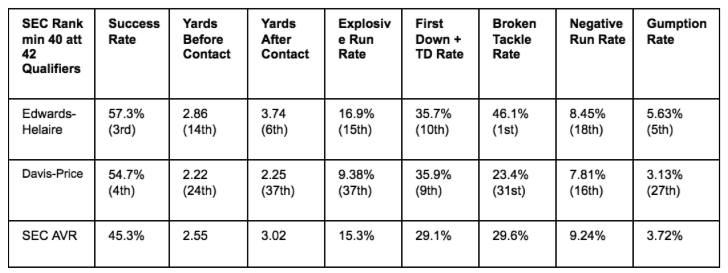
CEH and Tyrion Davis-Price both were among the conference's most successful ball carriers. There wasn't much separating them in that regard. While there was no doubt CEH was the main back, it was reassuring to see there wasn't much of a drop off -- if at all -- when TDP lined up in the backfield. But there was one clear area where CEH reigned supreme. Per his 46.1% Broken Tackle Rate, no one was better as squirting out of contact. Being able to extend a play by shedding a would-be tackler was huge for a ground game that saw reduced usage. CEH's grand talent of breaking tackles helped him boast top5 yards after contact averages and Gumption Run Rates within the conference. With less yards to gain on average, CEH was gifted plenty of short situations. His ability to win in these spots helped his First Down + Touchdown Rate be among the ten best in the SEC despite not overly being an explosive runner.
TDP was a lesser version of CEH even if the pair's Success Rates were adjacent to each other in the rankings. His yards before and after contact were below the conference average as was his Broken Tackle Rate and Gumption Rate. But TDP slightly edged out CEH in First Down + Touchdown Rate and faced less negative attempts on average.
Burrow's running ability mostly gets tied to his skills avoiding the pass rush or scrambling for gains once a play breaks down. Of Burrow's 115 rush attempts this season, only 37 were within the structure of the offense. So, it's easy to get blinded by his Tony Romo impersonations. But within LSU's read stuff, Burrow showed he was a capable ball carrier. While his 54% Rushing Success Rate finished behind CEH’s and TDP's , it still was a top10 clip within the SEC. His First Down + Touchdown Rate further reflected Burrow's prudence and knack for making plays when running. His 54% clip was over ten percentage points higher than the next closest conference rusher. Do-it-all Joe, indeed.