Sideline to Sideline: The 2019 SEC Championship
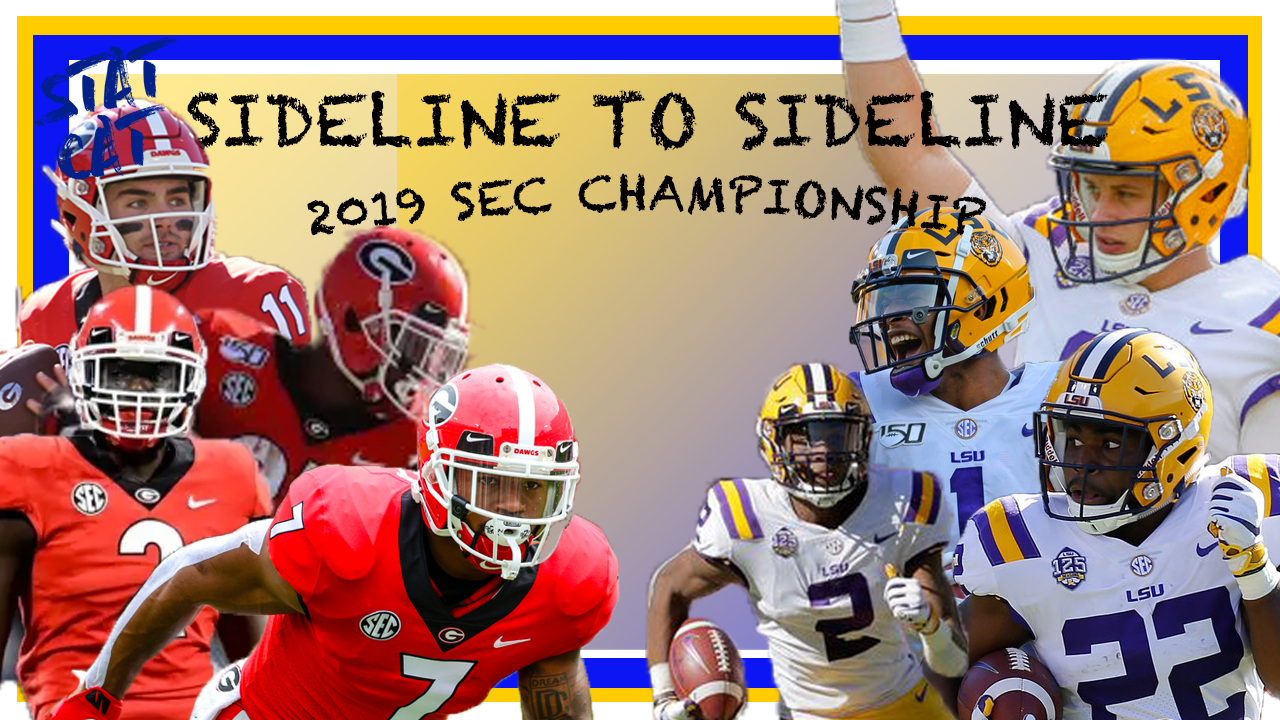
Saturday's contest between No. 4 Georgia and No. 2 LSU has everything a college football fan should want. A Heisman hopeful flanked by his offensive toadies known for igniting boxscores and producing bountiful points will engage one of the stingiest defensive units at surrendering scores and preventing big gainers.
On the flip side, a wishy washy Tiger defense known largely as a liability for their lapses in play and proclivity to allow a score or four will take on a Georgia offense that has been downtrending for seven weeks. Both of these teams have their flaws and both teams play hard. While their trials have varied, each team has been tested. Regardless on how you feel about these two, the winner will have a chance to reign supreme over college football.
So going into the biggest game of the SEC season, who will have the edge?
Georgia at a Glance:
Let's first start with the lower ranked Georgia Bulldogs. Since their loss to South Carolina, this offense has managed to get by, but they are no longer the dominant unit they were the first six weeks of the season or the well-oiled machine of last year.
Its no secret that Georgia is a run-first attack and much of its success hinges on being bigger and stronger than their defensive counterparts. Their script is heavy with zone runs and the pass patterns often are heavily reliant on their wideouts to win one-on-one. Despite the love to feed D'Andre Swift and Brian Herrien, they are adverse to play action and the modern day triple option, the RPO. UGA has the second lowest RPO Rate within the SEC and Fromm has one of the lowest Play Action Rates amongst conference passers. Their scheme is rather straightforward and is rooted in old-school philosophy that you should expect from a defensive-minded head coach.
The rug was pulled out from under this offense when they met South Carolina. The run game was brought down from elite status to below-average. While Jake Fromm is considered one of the better passers in the SEC, his play since that game has not reflected such. In the first 6 weeks of the season, no SEC offense had a better Success Rate than Georgia's 58.5% clip. But since Week 7 - the week they lost - the Bulldogs have the conference's sixth-worst at 40.3%.
From the season's midpoint, Georgia falls within the back half of the conference in Yards/Carry (4.74), Average Rush Yards Before Contact (2.1), Touchdown Rate (3.82%), Three-and-Out Rate (31.8%), Negative Play Rate (8.5%), and Broken Play Rate (9.6%). Not to mention, their Explosive Play Rate - or percentage of plays that consist of runs that net 10+ yards and passes that net 20+ yards - only was behind Alabama's the first six weeks of the season. But that too is now solidly planted within the SEC's back half.
Georgia's schedule has not benefited this offense. Of the SEC defenses the Bulldogs have faced since the Week 7, only South Carolina's and Texas A&M's Defensive Success Rate finished below the median against conference offenses in that timespan. Week 8 opponent Kentucky finished with the third-best, Week 10 opponent Florida had the sixth-best, Week 11 opponent Missouri had the second-best, and Week 12 opponent Auburn had the fourth-best. In case you were wondering, Georgia has the SEC's top Defensive Success Rate against conference foes. But, more on them later.
With their no-frills approach, they became predictable. Defenses started to play them closer, call more man coverages, and be more aggressive. With more strain on the ground game and lacking burners on the outside to keep opponent's honest, Georgia's slash and gash scheme became more plodding each subsequent week.
Even after suffering a loss, they aimed to hone in on their core zone looks. Since Week 7, their top4 most called plays have been Inside Zone Slam Reads, Inside Zone Slams, Off-Tackles, and Outside Zone Reads. Talk about no-nonsense. But as you might have guessed with the lackluster advanced metrics I mentioned earlier, these have not yielded great returns.
It all starts on 1st downs. In such a run-heavy offense, it only makes sense that your offense will lose potency the worse it performs in the trenches. Three of these zone looks have been criminally inefficient on firsts.
Slam Reads, like in many offenses, have been the foundation and have received the bulk of calls to start a set of downs with 39 since the halfway point. But only about two out of five on average meet their situational goals in that span. Non-read Slams have received the second-most reps with 13, but they have been executed even worse with only 38.5% of them being successful. Non-read Off-Tackles have the worst yards/attempt of any of their 1st Down runs that receive significant reps and has only a 41.7% Success Rate.
Of their four zone run staples, only Outside Zone Reads are more successful on 1st Downs than their overall clip. In fact, I would highly recommend the 'Dawgs run these more to start series against LSU. Of the 10 1st Down reps they've gotten since Week 7, eight have been successful as the look as averaged over 12 yards per pop. But when not called on first downs, these have been disastrous averaging 3.05 yards/attempt on a 27.3% Success Rate. That just has to frustrate their coaches to no end.
When UGA has turned to power runs recently, they too have disappointed. Inside Powers like Duo Dives, Duo Jabs, Powers, and Counters conglomerated to sh*t out a 26.1% Success Rate over 23 reps. Their three best runs since Week 7 all involve an element of deception providing further evidence this unit isn't set up to operate like it has in the past by simply just showing up and pushing fronts around. While their share in the script is small, Draws, Jet Handoffs, and Nakie Read Options all have been successful on at least half of their reps.
While you should know what a Draw and Jet Handoff looks like, Nakie Reads are rather unconventional. Functionally, they are Outside Zone Reads with the QB and RB swapping run lanes. Normally on Zone Reads, the two mesh while the QB reads a key defender. Depending on how the key defender reacts to the mesh determines whether the back gets the ball working towards the OLine's zone action or if the QB keeps it on a naked bootleg. Since Nakie Reads are designed to catch a key defender flat footed, its a great way for a speedy back to work the edge of the formation. These have averaged 8 yards per pop on a 66.7% Success Rate since the halfway point of the season.
With the decline of their run game production, Fromm has been given a few more chances per game to dropback. Not to beat a dead Dawg, but that hasn't delivered excellent results either. But this offense has excellent relative to other SEC offenses on vertical pass patterns.
The All Verts concept has been this offense's fifth-most called look since the South Carolina game. Plus, among SEC offenses that have called at least 10 of them, only LSU has been better. On 1st Downs in particular, 62.5% of Georgia's All Verts targets have been successful. Either via backshoulder fades or letting his man run under a bomb, a few of these plays have bailed UGA's offense out when it needed a play.
Another vertical-oriented concept their pass game has leaned on asks for the outside receivers to run deep comebacks or curls. Hoss/Comebacks when combined have been Georgia's sixth-most called look since Week 7. They had been old-reliable for this team when their receiving corps was intact. These Sideline+Seam attacking combos were by far the Bulldogs' most successful look in that span sporting a 64.3% Success Rate.
But outside of winning with matchup routes, Georgia's pass game has crashed and burned. The seven next most-called pass concepts all have Success Rates south of 39%. These include Smash Variations, Rubs - like Meshes and Pick Plays, Floods, Slant Variations, Shot Plays, and Pivots. Also for what its worth, UGA has not been great running any kind of screen whether it's an RPO outlet or traditional. Only four of their 17 repped Screens since Week 7 have been Successful.
While the Dawgs have slumped to start series, they have remained rather study offensively on 3rd Downs. There is no doubt that when Georgia gets to the money down, they want the ball in Jake Fromm's hands. Despite having 206 1st Down snaps since South Carolina game, they have only called 84 pass plays. Compare that to their 108 3rd Down snaps and 90 pass plays. No SEC offense goes to the air more in these spots. Plus, the Bulldogs have the SEC's third-best Passing Success Rate with the fourth-best Overall Success Rate on 3rd Down.
It's a pretty good thing Georgia has stepped it up here. With the drop in their 1st Down numbers, Georgia has the third-worst Early Down Conversion Rate in the conference. Meaning, they've played 3rd Downs at the third-highest rate in the SEC.
The money down is where Georgia's pass game has displayed variety. While Inside Zone Slam Reads share the most reps, six pass patterns have received between eight and five 3rd Down calls. Pivots, Sails, Benches, and Meshes have underwhelmed when James Coley's bunch needed a conversion. All of these have failed to produce 50% Success Rates since the South Carolina game on thirds. But Drives and Spots have been efficient when targeted. I'll quickly mention this is the only down were Slam Reads have earned their share in the script with a 62.5% Success Rate.
Winning on 3rd Downs and kicking ass on defense has Kirby Smart's squad on the cusp of a playoff birth. Against conference opponents, Georgia has dominated defensively. They have the top Touchdown Rate Allowed (1.6%), Scoring Drive Rate Allowed (8.9%), Explosive Play Rate Allowed (7.4%), Average Rush Yards Before Contact Allowed (0.82) while having the conferences second-best Defensive Success Rate (63.6%). They also have a top3 Pressure Rate, Havoc Rate, and Early Down Conversion Rate for good measure. I kid you not, their defense slaps.
This defense has been it's shakiest on 1st Downs since the halfway point, especially against the pass. I'm sure that perked up LSU fans upon reading, but its true. Since Week 7, Georgia's defense has the SEC's fifth-worst Pass Defense Success Rate with a 44.3% clip. While I certainly will have more detail on LSU's first down offense later, just know they absolutely can sling it around efficiently to start a set of downs. While the secondary might get dinged from time to time in these spots, the Dawgs' front usually controls the line of scrimmage. Unlike its pass defense, Georgia has the SEC's second-best Defensive Success Rate against the run on 1st Downs. It's a very sound makeup against most SEC offenses that are still predicated on establishing the run.
Like their offense, Georgia's defense has excelled mightily on the money down relative to conference competition. When trying to convert against UGA's defense the last seven weeks, SEC offenses have failed more versus them than anyone else. Nearly three-fourths of their 3rd down defensive snaps since Week 7 have prevented a conversion. Both of their Defensive Run and Pass Success Rates are north of 71% in this span. Even for Joe Burrow and company who have the SEC's bronze medal for 3rd Down Success Rate, winning on the money down will be a hard ask.
Their clutch play on thirds follows them when their back is against the wall in the Red Zone. Like on 3rd Downs, Georgia has the SEC's top Defensive Success Rate inside their own 20 yard line. Since Week 7, they have posted the best clip defending conference offenses through the air here paired with the fifth-best stopping teams on the ground.
Whether early on or in the meat of the conference schedule, Georgia's defense has consistently showed up each week and been one of the best across the entire country. After all, there is a reason why it's currently ESPN's SP+ metric's No. 1 defense in college football. UGA limits scoring chances are well as anyone, they're fantastic on clutch downs, and it appears no one can really run on them all that well. If this defense balls out, Georgia will be playoff bound. But not if Burrow and dem boys have anything to say about it.
LSU at a Glance
Perhaps you have heard, the Bayou Bengals have themselves quite an offense this season. Led by the conference's premier passer and Heisman front-runner Joe Burrow, LSU has become the poster child for college football's most electric attacks. While having a decent pro scheme in Ed Orgeron's first two seasons, the Tigers have gone all in on the Air Raid in 2019.
But donning the moniker of an Air Raid offense means more than just simply passing a lot. It's a mentality, a philosophy, and conceptualization this team has fully embraced. Aiming to attack the defense with a number of core concepts where it's most vulnerable, LSU has proved to be dynamic all over the field. Whether its nickel and diming with Slant Variations, Meshes, or Texas looks or hitting homeruns with Divides or All Verts, few have been able to make things difficult for LSU to move the ball. And contrary to some popular beliefs, LSU can run the football. This offense is as complete as one can be in the amateur ranks.
Like Georgia, I want to reflect what LSU has done over the back half of its schedule. It's one thing to put up gaudy stats, but it's another to do so in one of hardest divisions in America. No one in the SEC has a better Offensive Success Rate (54.9%), Touchdown Rate (8.58%), Scoring Drive Rate (58.6%), Early Down Conversion Rate (80%), and Average Rush Yards before Contact (3.9) than LSU. Plus they've put up the conference's second-lowest Three-and-Out Rate (16.1%) with top4 Havoc Rate Allowed (21%) and Negative Play Rate (7.3%), and Turnover Rate (1.07%). LSU has been very hard to derail and has seemingly played its best football since Week 7.
As I have written about before, LSU has used the Air Raid to flip the script. Instead of allowing the run the set up the pass, the Tigers have been aggressive coming out throwing to set up everything else. In general, pass plays gain more yards on average than run plays. The average yards/rush from the best run offense is often less than the average yards/attempt from a middling offense. So the earlier you get to passing, the more chances stay ahead of the chains. But, I'd rather not repeat myself. You can look up past LSU articles on the matter.
Dropping back to pass early and often has resulting in the Tigers having the SEC's second-highest 1st Down Pass Rate in the SEC. With the ample chances and a scheme that has facilitated things for their athletes, LSU has had the conference's top 1st Down offense. Since Week 7, no SEC offense has a better Success Rate and only UK's Lynnsanity Offense has a better Explosive Play Rate to start a set of downs.
But despite being cleared for takeoff, two run plays own the highest play share in this offense's script. All season long, Inside Zone Slam Reads and Duo Dives have received the majority of LSU's calls. Since the season's halfway point, Slam Reads compose 17% of their plays and Duo Dives 11%. No other run concept of theirs owns over 2% of their play share since Week 7. They run Slam Reads and Duo Dives a lot and they run them well. In this span, Slam Reads have a 54.4% Success Rate with Duo Dives having a 52.9% clip. Like I always say: if you plan to run something a lot, you better be good at executing it.
To start series, they remain the top two most-called looks for the Bayou Bengals. While Slam Reads are less succesful per snap, their yards/attempt on 1st Downs is 8.63 compared to 7.58 overall. This is not the case for Duo Dives as both numbers are higher on firsts. Thanks to these two runs, LSU has the SEC second most successful 1st Down rushing offense.
While Slam Reads and Duo Dives have carved out roles, the pass game relies on a number of pass patterns to keep defenses guessing. After all, LSU runs the Air Raid.
Since Week 7, five passes own at least a 3% play share for LSU: Tosser (Dual or All Slants), Stick, Shallow, Corners - or inverted Smashes - and All Verts. Of these often-called looks, only Corners patterns have a Success Rate below 50%. Tossers and Sticks are short patterns geared towards stealing yards in the underbelly of zones or winning quick one-on-one. Shallows and Corners are two different kinds of high-low reads built for intermediate gains. All Verts are - of course- designed to stress defenses deep.
While Slam Reads and Duo Dives get the lion's share of the Tigers 1st Down calls, Shallows, Sticks, and All Verts each have received 11 reps in these spots in the back half of the schedule. All three have put up greater numbers on first downs than their overall clip.
Shallows - named for the primary route - have netted big gains for LSU to start series even if the titular pattern hasn't been targeted all that much. A good deal of this look's best plays have come targeting outside receivers on curls or go routes against single-high coverages. This play has averaged 13.6 yards per pop on a 81.8% Success Rate since Week 7.
Sticks, which are mostly designed to seize a quick chunk and keep offenses ahead of the chains, have been a great way for LSU's speedy weapons to win quickly. Rather than leaning on one particular Stick pattern, LSU's offense has been comfortable enough to call three different variations of this look. On firsts, 55% of them have met situational goals.
As you might guess with an aggressive, pass-happy offense, 1st Downs have been LSU's favorite spot to do deep. Whether coming fresh from the sidelines or the in the middle of a drive, expect the Tigers to press here. Eleven of LSU's 14 All Vert targets, all six Yankee Shots, and three of their four Vertigo designs since Week 7 all have occurred on firsts. Vertigoes and Yankees each average over 30 yards per target with Success Rates 75% or better. All Verts - a look with a naturally high degree of difficulty - has been successful on 63.6% of first downs and 64.3% overall since Week 7 for LSU. For the record, this kind of production deep downfield is simply phenomenal and not normal by any means. All three of these looks are among the top yardage gainers for the Tigers over the last seven weeks.
Not only has this offense flipped the script on early downs by passing more; they also have flipped the script on the money down by aiming to run more than others. Since Week 7, LSU has the SEC's third-lowest pass rate on 3rd Downs. Inside Zone Slam Reads have gotten the most calls and have mostly met their goals. Mostly a 3rd and Short look, Slam Reads average 6.71 yards/attempt on a 64.3% Success Rate. That level of efficiency is simply hard to come by on the do-or-die down, and their potency is a major reason why LSU owns conference's second-best Rushing Success Rate in these spots since the halfway point.
While better than most on 3rd Down, LSU doesn't have a lot of looks with sustained success on the money down. Sure, Slam Reads do well. But among plays with at least three 3rd Down reps since Week 7, only the concepts Kelly Mesh, Trail, and Pivot have Success Rates 50% or better. Looks like Fades, Sticks, non-Read Slams, and Duo Dives all have struggled to move the chains as of late for the Tigers. Even Slant Variations have failed when called upon. Despite being the second most called 3rd Down concept since Week 7, Slant Variations have only been successful on 36.4% of targets.
Rarely has LSU's offense displayed signs of weakness, but their should be three areas of concerns for the Tigers against UGA's rock steady defense. Firstly, Burrow has been sacked at the SEC's third-highest rate since the Florida game. Burrow has played as well as anyone when behind the chains, but LSU is far less aggressive the more yards they have to gain. If behind the down and distance, slants and screens are far more likely to be run than something deep. That sets up nicely for a defense so stingy as Georgia's on thirds.
Secondly, this offense's plays have broken down at the second highest rate in the conference over the back half of the season. Luckily for the Tigers, Burrow has been the best QB in college football against pressure. His legs have been able to extend plays and lead to chunk gains via scrambles or backyard ball. But a number of his interceptions have occurred in these spots. One area where UGA's juggernaut defense has struggled is generating takeaways against conference opponents. One would think: if they were to turnover the Tigers, the best way to do it is by attempting to rattle Cool Joe rather than hoping for a fumble.
Thirdly, LSU's offense down-to-down has been average in the Red Zone since Week 7. Like their 3rd Down Defensive Success Rate, the Bulldogs own the SEC's best clip in the Red Zone against conference opponents. It's hard enough to operate in the Red Zone. But when you are up against one of the best defending their own turf in the country, yards are at an even greater premium. Of course, LSU can bypass the Red Zone with explosive scores. Something tells me it won't be so easy against this Georgia defense.
In terms of Defensive Success Rate on the year against conference opponents, LSU is right with Georgia. LSU's clip of 62.8% is only slightly worse than Georgia's 63.6%. LSU has been one of the SEC's best defending the pass. Along with the second-best Pass Defense Success Rate, LSU sported the top Havoc Rate (19.5%), second best Sack Rate (3.6%), Pressure Rate (27.9%), and Average Yards Before Contact (1.34) guarding the gridiron against conference foes.
Though top5 at forcing three-and-outs and limiting early down conversions, teams can bruise them. While very good in a number of areas, there's no denying major shortcomings. In the Red Zone, LSU has the SEC's third-worst Defensive Success Rate against conference opponents on the year. LSU's defense is just an average or below average SEC defense at curbing explosive plays, forcing takeaways, allowing scoring drives, and limiting rush gains after contact. It's all well and good they are right with Georgia in terms of Success Rate, but its ultra-concerning UGA's Touchdown Rate Allowed is basically a third of LSU's. Maybe because their offense has been so prolific, but there's no doubt LSU's defense lacks drive and focus when given a cushion.
While they can play bend-don't-break at times, the Tigers' defense are at their best on 3rd Downs. There, they have the SEC's third-best Defensive Success Rate. While superb at grounding offenses aerially and struggling against runs on 1st Downs, it gets swapped on the money down. Despite the third-best Defensive Success Rate against the run versus conference opponents, LSU owns a bottom5 clip against the pass on 3rd Downs. In case you already forgot, Jake Fromm is a top3 passer on the do-or-die down within the SEC.
Common Opponents at a Glance
It's not every year the two titans of the southeast have a fair amount of common opponents when they meet in Atlanta to duke it out for the conference's crown. But this year, Georgia and LSU have three common opponents. Plus, all three are SEC opponents. Plus plus, all three common opponents faced these two after Week 7. What's a better way to gauge these two teams than to judge what they did against these quality opponents in recent weeks. Rather than looking at the Poop States or results from early in the season, these numbers are much more valuable to people in my line of work.
From Weeks 7-14, both LSU and Georgia faced top15 teams Florida and Auburn along with Texas A&M, a sound team stricken with a difficult schedule.
| Overall Success Rate | Passing Success Rate | Rushing Success Rate | TD Rate | Negative Play Rate | Three-and-Out Rate | Havoc Rate | Explosive Play Rate | |
| LSU Defense | 65.3% | 65.8% | 60.2% | 3.29% | 8.92% | 40.5% | 18.8% | 8.96% |
| UGA Offense | 36.2% | 37.1% | 35.2% | 3.24% | 11.4% | 40.0% | 23.2% | 10.3% |
| Overall Success Rate | Passing Success Rate | Rushing Success Rate | TD Rate | Negative Play Rate | Three-and-Out Rate | Havoc Rate | Explosive Play Rate | |
| LSU Offense | 51.5% | 55.4% | 45.8% | 7.35% | 7.35% | 14.3% | 22.1% | 15.7% |
| UGA Defense | 59.3% | 52.8% | 68.2% | 2.51% | 8.54% | 30.3% | 18.6% | 6.53% |
Looking at the defenses first, LSU's mostly outperformed Georgia's in these three games. But the Dawgs have the edge in perhaps the two most important stats - albeit barely. UGA allowed a lower TD Rate and surrendered less explosive plays. Again, explosive plays consist of runs of 10+ yards and passes of 20+. Scoring and preventing points, winning the turnover battle, and outperforming your opponent in explosive plays are the big three areas that often determine the outcome of ballgames. Despite the fact LSU was better down-to-down, generating Havoc plays, and forcing three-and-outs, Georgia had the preferable numbers against those three opponents. Still when everything is taken into account, it's hard not to give LSU the hat tip. Though UGA was better at curbing scoring and big plays than the Tigers, their edges are slim.
Offensively, it's no contest. LSU was far an away the better offensive team against Florida, Auburn, and TAMU. Both Throwing and Rushing, the Bayou Bengals outdid the Bulldogs down-to-down, were more potent scoring, had less negative plays, a drastically smaller Three-and-Out Rate, and were considerably more explosive. Even though the Havoc Rates were similar, LSU still had a better clip than UGA's. Remember, all three of these defenses finished within the conference's top6 units against SEC offenses. Georgia was clearly affectedly negatively and LSU appeared to not bat an eye.
Will this play out based on conventional wisdom presented or will the old adage come to fruition? Offenses win games, but defenses win championships.
I think Georgia wins if....
They play their game. Georgia likes to run early and often in the downs and lean heavily on the pass on 3rd Downs. While their 1st Down offense has drastically gotten wore over the course of the back half of the schedule, Georgia remains rather sturdy on the money down. But, LSU's inconsistent defense just so happens to have a below average Success Rate defending the run on firsts and is bottom5 within the conference against the pass on thirds. With the fifth-highest 1st down Run Rate and the top 3rd Down Pass Rate, Georgia can naturally be advantageous against LSU.
One thing is for sure, the run game has to give Jake Fromm some leeway. I'm not so sure he can play the role of Superman even against a defense so inclined to let up big plays and scores like LSU. While Fromm is better than most behind the chains and on 3rd Down, he - like most passers - play better when his run game can help alleviate some pressure. If Georgia can win half of its 1st Down battles versus the Tigers, it can allow them to play a grind-it-out defensive slugfest and limit the number of snaps LSU's offense is on the field.
I think LSU wins if....
They are +2 in the turnover battle. While the Dawgs' defense has limited scoring chances as well as anyone in college football. LSU has essentially scored on everybody at will. Odds are they will score far less than their season average of 48.7 points/game. But the way Georgia's offense has struggled as of late doesn't forebode a sudden awakening; especially with them not close to full strength, taking an extra possession or two away from them should allow LSU's defense to maintain its aggressiveness throughout.
UGA's defense has the SEC's best 3rd Down and Red Zone Defensive Success Rate against conference opponents. While I'm positive the Tigers will win a few of these skirmishes, one way to break this UGA defense is to force them into these chances more often. Despite the bad vibes since Week 7, Georgia still does a great job at limiting turnovers and LSU has struggled to generate takeaways. But since LSU has been one of the best at making SEC backs work for their yardage posting the best Average Yards Before Contact since the midway point of the season, a pass or two just might get away from Fromm when backed up behind the chains and with UGA's best weapons not at 100%. As great as LSU's offense has been, I think they can run away with the SEC title if granted extra touches.