Sideline to Sideline: The 2019 Iron Bowl
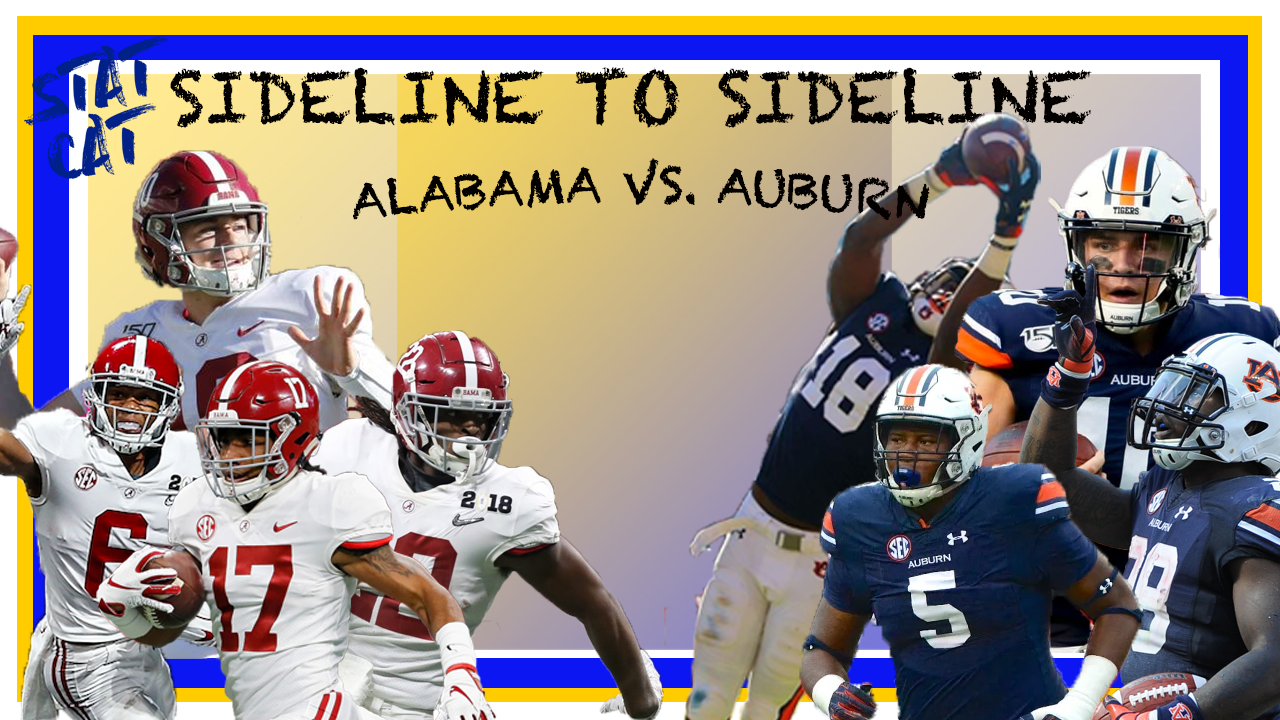
The "Iron Bowl" is one of the best named rivalries around. Its very name conjures up countless instances of hard-nosed, gritty gridiron movements involving Alabama and Auburn. With plenty at stake both on and off the field for both these programs and their fan bases, I say we get to the good stuff. I mean, I could spend time coming up with a flowery, creative lede or I can spend more time writing about one of the college best rivalries. After all, this is the SEC and this is the "Iron Bowl".
It just means more...
Alabama at a Glance
Per usual, let's start with the visiting team. Before I bang you over the head with analytics, trends, and play call data, just know this offense is elite -- with or without Tua Tagovailoa. Their loaded receiving corps and bruising backs facilitate any passer's job. Don't believe me? Well, hang tight.
Our eyes have told us that this is a very explosive unit and capable of lighting up scoreboards. They are good across downs and their balance makes them a very hard team for which to prepare. But unlike some offensive philosophies that aim to win on braun and speed alone, the Tide smartly use their personnel to maximize every snap.
No SEC team uses more motion to alter its formation presnap or more orbit motion (the long, roundabout motion that sends the receiver way back around the QB and RB) than Alabama. With the electricity and home run ability of their wideouts, it only makes sense to make this a focal point for their assault. Either acting as eye candy or acting as an RPO outlet, these actions force defenses to constantly key on them. Because if they don't, six point could be on the scoreboard seconds later. If extra attention is bestowed upon these motions, Alabama is more than happy to win inside the tackles, which they've done quite a lot of with Nick Saban in charge.
Najee Harris owns the SEC's top Rushing Success Rate and is the only ball carrier with a clip north of 60%. Over a fifth of his runs gain at least 10 yards or more, which is the most of any running back. To that point, he also leads the conference in percentage of carries that result in either a conversion or a score with a 42.4% clip. No one else in the SEC has a rate over 39%. Last year he led the conference in Broken Tackle Rate and is still within the Top10 entering Week 14.
Alabama's four main wideouts are all within the SEC's Top15 in terms of Receiving Success Rate with Jaylen Waddle and DeVonta Smith being Top5. All four are within the Top8 in Explosive Catch Rate - or percentage of catches that gain 20 or more yards. Jerry Jeudy is the only one not inside the Top5 in terms of Yards/Target, which makes some sense due to the amount of targets he has received. He has the 3rd most in the SEC and more than 20 more than the next closest Crimson Tide receiver. But the point remains, this is a stacked position group capable of making any secondary look foolish.
On the season, Alabama only trails LSU in Offensive Success Rate amongst SEC teams and have been rather impressive across the board. They have the conference's highest Explosive Play Rate, Touchdown Rate, and Rush Yards After Contact Average with the lowest Negative Play Rate, Pressure Rate, Havoc Rate Allowed, and second lowest Turnover Rate. They also have the second lowest Broken Play Rate in the SEC. On the surface, that's a pretty formidable unit. It's one thing to get the talent; its another to make the most of it.
While the flashy aspects of this offense surely are easy on the eyes and major elements that put them in a class above most, the run game has always been this offense's foundation. The motions, the RPO Outlets, screens, and shots off play action all hinge on being able to win on the ground. Alabama has been their usual dominant selves paving a the top Rushing Success Rate in the SEC, which is 10 percentage points higher than the league average. Even before losing Tagovailoa to injury, five of the Tides six most called looks were runs.
While it's still safe to look at this unit's productivity over the course of the year, it's not very prudent to evaluate their schemes. Sure, Alabama mostly calls the same stuff with Mac Jones quarterbacking the Tide but Offensive Coordinator Steve Sarkisian has made sure the former second-stringer is put in positions to succeed and not be a liability. While this stat is somewhat loaded due to the level of competition, only Kentucky's Lynnsanity Offense had a higher Run Rate than Alabama the two weeks Jones started at QB for Alabama.
To help our sample size, we included the second half snaps of the Mississippi State and Tennessee games in addition to the plays from the Arkansas and Western Carolina beatdowns to create a more clear picture of what Alabama's offense is without Tagovailoa.
As aforementioned, the offense hasn't been flipped upside down. Alabama already was led by its core run concepts. There has just been some shuffling on the volume of these looks. Heading into the LSU game, the Tide's most called plays in order were Inside Zone Slam Reads, Off Tackle Zones, Duo Dives, Traditional Counters, Split Zones, and Tosser (Dual or All Slants). In the recent snaps without Tagovailoa, Off Tackles and Split Zones are now the top two most called concepts. But there are only four reps separating Off Tackles (17) from Traditional Counters (13), which have gotten the fourth most calls with Tagovailoa sidelined.
Still, it's worth mentioning that Inside Zone Slam Reads (Alabama's most run play when Tagovailoa was healthy) have received the sixth most reps without him. Plus the way they've been drawn up Off Tackles, Split Zones, Duo Dives, and Counters, Alabama has minimized the amount of reads Jones has had to make.
That isn't to say Alabama has totally abandoned the read game. Already a high RPO team in terms of usage, No SEC passer has a higher rate of RPO throws than Jones. While reads are seemingly on the decline in their script, their potency is still through the roof. RPO Outlet screens like Bubbles, Tunnels, and Swings have 11 targets and have accumulated 195 yards - the most of any look in this stint. What's more impressive besides the eye-popping 17.6 yards/attempt average is the outstanding 81% Success Rate. Though Tagovailoa was adverse to running the ball on his keeps this season, he was more of a threat than Jones. Opponents have banked on that zeroing in on ball carriers with the Floridian handing off the ball. This tunnel vision has done well limiting Slam Reads to a 33.3% Success Rate without Tagovailoa. But again, Jones and Company have made them pay dearly when he's dished it to his playmakers in space.
Overall in this period, zones have been less efficient than power and gap schemes. Two zone looks might lead the way in overall reps, but Duo Dives and Counters have been considerably more effective. Off Tackle Zones have averaged 4.3 yards/attempt on a 41% Success Rate while Split Zones average 3.9 yards/attempt on a 50% Success Rate. Duo Dives and Counters have put up 4.8 and 6.6 yards/attempt averages on 67% and 62% Success Rates, respectively.
It all starts on first downs. All season Alabama has been dangerous running and passing to start series. They have the SEC's second best 1st Down Success Rate and Explosive Play Rate and are tops in both areas when solely looking at running the ball. While they are trending towards the ground more in these spots, they are actually the most "balanced" in the conference with a 49.1% 1st Down Pass Rate on the season.
The Tide will come in with the second best 1st Down Success Rate in the conference. Its a damn good thing they've been one of the SEC's best on 1st downs. No other SEC team has been better than Auburn at curbing conference opponents to start series. Alabama has been successful on 55.8% of first down snaps while Auburn's defense owns a 64.6% Success Rate. Alabama must keep Auburn's Steele Curtain defense guessing.
By refusing to tip their hand on what they're doing on the ground by calling a variety of run plays paired with the razzmatazz that is their exotic motions, this offense's mentality is more set on creating apprehension than "lulling" opponents to sleep.
Mac Attack
It's only natural to compare the backup to the starter when he gets into the game. As we have seen, this offense has not missed a beat without Tagovailoa. With the greater emphasis on the run and less risk being attributed to their passer when dropping back, Alabama has returned it's offense to the days of old... that is before it went all in on the spread.
As we touched on the spread hasn't been completely shelved. But like Saban offenses early in his Alabama tenure, the quarterback's role is more of a game manager than playmaker. Still, that doesn't mean the QB can't put up sturdy passing numbers in the process.
| Passer (SEC QBs with at Least 70 att -- 20 Qualifiers) | Accuracy% | Depth Adjusted Accuracy% | Success Rate | Explosive Pass Rate | 1D+TD% | RPO Throw Rate | Average Depth of Target |
| Tua Tagovailoa | 68.3% (3rd) | 54.2% (3rd) | 54.4% (2nd) | 20.6% (1st) | 44.4% (2nd) | 19.8% (4th) | 8.75 (16th) |
| Mac Jones | 68.8% (2nd) | 54.6% (2nd) | 53.3% (4th) | 14.3% (4th) | 40.3% (4th) | 25.9% (1st) | 7.20 (19th) |
Before we get ahead of ourselves, I am not indicating Jones is a better quarterback than Tagovailoa. While there's a case to be made about Tua being a product of a system, I will continue to default to his arm talent's resume to fight that notion. Jones, on the other hand, seems to be certainly benefiting from his environment. Simplified passing reads, lots of protection, and a stout running game has put Jones's numbers right up there with Tua's. But he is still far from Tua's level at this point in time.
I mean come on, look at the teams Jones has had to face and the situations he inherited upon taking the field. It's not like he was down multiple scores at half and he was forced to rally the troops to victory. When given the keys to the offense his instructions have been "drive the speed limit, wear your seatbelt, and check your mirrors to avoid a major accident." Unlike Tagovailoa who was given the green light to street race and drive on the sidewalk at times, Jones has been instructed to stay within the lines of this scheme's structure.
Auburn at a Glance
Though Auburn's identity and best recipe for victory falls on its defense, I will talk mostly about its offense. Unlike Alabama that aims to disorient with firecrackers and sparklers, Auburn's offense has mostly resembled a Black Snack. Though somewhat of a fast paced script, its rather deliberate and predictable. And while you might see some sparks and flashes along the way, it ultimately leads to a slight sense of disappointment.
That isn't to say their offense sucks, because it certainly does do some things well. Though the offensive line gets some crap, they are one of the best at keeping their passer clean per Pressure Rate and have the second best Havoc Rate Allowed in the SEC. Without letting defenses get them out of their comfort zone often, they have sported the 3rd lowest Broken Play Rate in the SEC while owning a Top4 Touchdown Rate and Rush Yards Before Contact. Still, much is left to be desired.
On the year, this unit has not been special. In fact, they've been down right mediocre sporting the 7th best Offensive Success Rate within the SEC. Much of their middling is because of an inability to consistently generate explosive plays (Auburn currently ranks 9th and 12th in Explosive Pass and Run Rates, respectively). Another part of this is due to the fact they play a lot of third downs. War Eagle currently has the 5th worst Early Down Conversion Rate in the SEC.
Plenty of others have presented Auburn's splits against ranked and unranked foes under Gus Malzahn's reign on the Plains. The returns reflect a rather ho hum product. But since Alabama is still a highly rated team, it's only prudent to measure how Auburn's offense has done schematically against Power 5 defenses.
Before we forge ahead, I think it's fair to mention Auburn's Passing Success Rate dips from 40.4% to 39.2% and its Rushing Success Rate drops from 47.2% to 42.9% when facing Power 5 defenses this season. With clips that lackluster, it puts an awful lot of pressure on a defense to make up for their inefficiencies.
While Alabama leads the SEC in use of presnap motion and orbit motion, no one else in the conference uses presnap formational shifts or Jet motion than Auburn. While the eye candy remains just as functional as Alabama's, it just hasn't been as effective comparatively.
It's no secret Auburn's offense is pace and space and hinges off having a successful Inside Zone Read attack with built-in RPO Outlets to stress defenses horizontally. While Alabama doesn't necessarily have a foundational look since they want to show a variety of looks, Auburn is all about Slam and Bluff Reads.
Slam Reads compose over 15% of Auburn's reps against P5 defenses and have gained almost 200 more yards than the next closest concept, which happens to be Bluff Reads' 194. Slam Reads are not an overly efficient look for the Tigers but will undoubtedly continue to be the most run look for this offense. Even though they only average 4.5 yards/attempt on a 42.5% Success Rate, no other look has over a 7.3% Play Share for War Eagle.
Slam Reads are by far the most popular play for the Tigers to start a new set of downs as they have gotten 51 reps. Their efficiency has been even worst on first downs than their overall clip. In these spots, Slam Reads only average 4.25 yards/attempt on a 35.3% Success Rate. Now, talking concepts and using fancy terms like Success Rate might be over some of your heads. But I think its easy to understand that if you run something way more than anything else and you aren't particularly good at it, you offense will suffer. While a good deal of the blame can be placed on the offensive line for failing to forge run lanes inside, some of it needs to go on Malzahn for not deviating from his preferences. I'll circle back and talk about Slam Read momentarily.
Bluff, or Split Zone, Reads are the Tigers' second most repped concept overall. Along with being responsible for the second most yards against P5 defenses, Bluff Reads have been one of their best looks in terms of success. These have been successful 62% of reps averaging 4.62 yards/attempt. Though they have been less mighty to start series, they still have a 50% Success Rate on first downs. For whatever reason, Bo Nix has been more willing to keep the ball on his reads on these than Slam Reads which have helped their numbers.
I'm sure you can guess what concept is next in the pecking order... RPO Outlets. Bubbles, Tunnels, and Swing screens off Zone Reads make up 5.6% of Auburns calls and have gained 177 yards against P5 foes. Sure these are used to stress defenses and make them pay for crowding the box, but Outlets are also easy completions for a young passer to make. The read is defined and the throw is usually low risk, which can help pad air numbers and/or build up a quarterback's confidence. Overall their Success Rate have been equal Slam Reads, but RPO Outlets have been much better when targeted on first downs. Their clip is about 10 percentage points higher on first down than their overall number. Two-thirds of their targets have come on first downs. These mainly operate to steal yards when the defense is slightly lulled by the methodical Inside Zone action. While Bubbles and Tunnels have put up pretty good numbers, Swing screens bring down the group's production as a whole.
Three power run concepts round out Auburn's six most called plays. Tackle Counters - or perhaps you heard them referred to as Counter Treys or TAG Counters - in the read game get a healthy portion of plays in Auburn's script. They aren't executed well. Overall, they are only successful a quarter of the time. Though slightly better on first downs, their numbers do not reflect a look deserving to be among War Eagle's four most called plays.
While they sparked a run game that looked dead in the water against Florida, Iso Reads have had middling success since. Sure they average a nice 6.00 yards per pop but have only been successful on 42% of calls. It's a look Auburn has used as a change-of-pace wrinkle rather than cornerstone concept.
Outside Power Reads have been much more consistent at meeting situational goals. When writing my Sideline to Sideline on the Auburn/LSU game, this concept was a look I strongly recommended the Tigers to run more. But alas, Gus had to die by his love for Inside Zone Reads in that game. Here we are weeks later and they are still fighting to take play shares away from zones. Outside Power Reads when combined make up about 5% of the Tigers plays on a 63% Success Rate.
Among the subconcepts that make them up, Power Toss Reads have gotten the most reps. Overall, they own a 71% Success Rate on 8.9 yards/attempt. Remember, these number being reflected are against P5 defenses. With a good sample size, these have largely been Auburn's most successful concept. Outside Power Reads like Power Toss, Veer, and Buck Sweep Reads have combined for 14 first down reps on a 50% Success Rate. Again, I'd recommend more of these be seen in their script.
But while I normally would say run them into the ground, they might need to pick their spots with them against the Tide. Despite having the third-worst Success Rate defending Inside Zone Reads versus SEC offenses, Alabama is one of the very best stuffing Outside Power Reads. It's possible Malzahn gets tunnel vision and runs his bread and butter nonstop with Alabama allowing a 47% Success Rate defending Inside Zone Reads against SEC opponents. Regardless, variety will be needed. This offense as is will not bull over the Crimson Tide defense by will alone. They must win with variety and deception.
Auburn's dropback passing game, as you might of heard, prefers to attack secondaries outside the hashes. The vast majority of their schemes call for a high-low read along the sideline. These plays include Ohio/Slice (Outside Vertical, Inside Quick Out), Smashes Variations, and Seam+Sideline combos like Hoss or Comebacks. Other dropback concepts like Shot Variations (Fades, Solo Deep Routes, and Divide [Outside Streak, Inside Post]), Slant Variations, and Switch Variations round out some of their favorite looks.
Ohio/Slice gets the most reps than the rest and have gained the fourth most yards of any concept for them against P5 defenses while being successful 61% of the time. Though not a flashy play by any means, it's a manageable design for a young passer like Bo Nix. Divide Shot plays have gained the fifth most despite only being successful on three of its seven targets. Smash Variations and Switch Variations have overall bad returns. But Malzahn likes "Wheelie" Switches, especially with backs in the backfield. While certainly hit or miss, they usually generate big plays when completed.
Twelve of the 16 Slant Variations targeted have met their goals. Seeing what other teams are doing with slants, Auburn was quick to insert these into their offense midseason. Starting with moving Seth Williams around the formation rather than always lining him up at X (outside left WR), slants have been used to keep down and distance situations manageable without having to solely resort to RPOs. Slants by far have been the most successful pass play with a 67% clip.
Ok before we move onto the defense, let's dish about the money down. As promised, let's quickly circle back to Inside Zone Reads. While they are mostly frustrating on early downs, these have been otherworldly in terms of moving the chains on 3rd downs. Both Slam and Bluff Reads are among the Tigers' three favorite looks on 3rd downs. Combined, these two concepts have been successful on 87.5% of reps on the money down; 14 of their 16 reps have ended in a conversion.
Here's the list of all the other plays with at least three 3rd down reps with Success Rates 50% or better: Slant Variations (7) for 57%, Stick (4) 100%, Power Toss Read (4) 100%, end of list. Screens, All Verts, and RPO Outlets all are among their top five most called money down plays but have 40%, 20%, and 20% Success Rates, respectively.
LSU's and Alabama's 3rd Down Offense are heads and shoulders better than the rest of the SEC. But with that in mind, Auburn has the fourth best Success Rate in these instances within the conference. Thanks to Inside Zone Reads and Power Toss Reads, Auburn is the SEC's 3rd best on the ground on the money down. While rather disastrous when put in long yards to gain situations, they are better than most when its manageable.
And that should be bad news for Alabama fans. While I'm sure what I said about Auburn's first down offense might not worry them a lick, the Tigers' ability to move the chains on the money down absolutely should. Again, Alabama has the third-worst 3rd Down Success Rate against SEC offenses with the third-worst clip versus the run.
Like I said at the top of this section, Auburn's defense is really the aspect that makes this team hard to beat. You don't need me to relay that piece of information to you. Though only two spots better than Alabama in both ESPN SP+ metric and Total Defense, Auburn's defense has done some pretty impressive things against SEC competition in 2019.
On a snap-to-snap basis, no one has been better defending SEC offenses than Auburn. No one. Their 65.2% Defensive Success Rate is tops as is their Three-and-Out Forced Rate. Almost exactly half of their drives defending SEC offenses have ended in a Three-and-Out.
Auburn owns a Top3 Rush Yards Before Contact Average, First Down Rate, Takeaway Rate, Touchdown Rate, Explosive Play Rate Allowed, Havoc Rate (with both Run and Pass Havoc being Top2), and Tackle For Loss Rate while being the most sound tackling team against the run. Their front can play with anyone and keep Auburn in a game with anyone. There really isn't much of a weakness to be found anywhere. This is a stretch but they are average in terms of Early Down Conversion Rate Allowed.So in theory, an offense who wins early can win often on them.
But it bears mentioning again that Auburn has the best 1st Down Defensive Success Rate against conference. Teams often have to excel behind the chains to get the best of them. Plus if Auburn does hold their own and get to the money down, only Georgia has been better at bringing on the punt unit against SEC opponents than the Tigers. Without question, this unit will be the best Alabama has faced this year. Kevin Steele should be itching to rattle Mac Jones to upend War Eagle's most hated rival.
Bo Nix's Progress
It can be a box of chocolates when a team turns to a freshman passer. Ole Miss, South Carolina, Tennessee, and Arkansas are other SEC schools that have turned to a freshman to quarterback their offenses at some point this season. But none is as weathered or battle-tested going into Week 14 than Auburn's Bo Nix.
Already viewed as the Golden Boy across the Plains upon winning the starting nod, his clutch performance in Week 1 set the bar high for the rest of his season. While rocky and turbulent, his growing pains caused me many grimaces in film review. But I kept having to remind myself, his age and his unit's limitations. While it usually wasn't pretty, Nix kept getting a little bit better.
Bo Nix Splits -min 60 atts. each span (16 Qualifiers WK 1-6, 14 WK 7-13) | Accuracy | Depth Adjusted Accuracy | Success Rate | Explosive Pass Rate | Passing TD Rate | Interceptable Pass Rate | RPO Throw Rate |
| Weeks 1-6 | 46.7% (14th) | 34.4% (15th) | 41.5% (13th) | 13.8% (3rd) | 5.26% (10th) | 7.24% (10th) | 22.4% (2nd) |
| Weeks 7-13 | 59.8% (5th) | 44.2% (8th) | 42.6% (6th) | 6.51% (11th) | 3.55% (10th) | 4.73% (6th) | 24.4% (1st) |
Early on this season, Nix was one of the most explosive passers in the SEC...and one of the most inaccurate despite being fed easy RPO completions by Auburn's scheme. With raw mechanics and operating under gumption, many passes got away from Nix and some led to turnovers. But since Week 7, Nix finds himself in the top half of a number of key areas among SEC passers. Sure the high RPO reliance remains and the deep passing has been less consistent, but Nix is making better decisions with the ball. His overall Accuracy, Depth Adjusted Accuracy, Interceptable Pass Rate and Success Rate have all improved over the back half of the season.
All he had early on was his deep ball and it destroyed Auburn's down-to-down efficiency when he failed to connect with his target. He seems far more comfortable with his role. While he has miles to go as a passer, it should ease War Eagle peeps he hasn't stagnated or regressed like other freshmen thrusted into the starting role within the southeast.
I think Alabama wins if....
They start fast. This means winning in the first half and taking care of business on first downs. While Auburn's defense makes it very hard for opponents to score and push them around to start series, Alabama is one of the best in the nation at both. Alabama will approach this game conservatively. Again, they don't want to make Jones do too much. If they are able to win on first downs, keep Auburn guessing with variety and exotic motions, and stay ahead of the chains, Alabama has more than enough weapons to get free for big gains or scores. Auburn's offense isn't equipped to erase large deficits. And they've struggled to generate explosive plays since Week 7. The longer Auburn can hang around, the better their chances are with their Steele Curtain defense. Alabama needs to nuke them early and dictate the gameflow.
I think Auburn wins if....
They get Alabama to 3rd Downs. That might seem like a cop-out. But when half of your defensive possessions in league play have been Three-and-Outs and you own the best 3rd Down Defensive Success Rate, you have to make things hard on a passer unaccustomed to the moment. Defense is this team's strenth and if they plan to win, Auburn must disrupt. It remains to be seen just how capable Mac Jones is when things go awry. Filling in with big leads against Tennessee and Mississippi States and starting against Arkansas and Western Carolina haven't really allowed us to get a good idea of what kind of passer Jones is. But one thing is for sure, it will be hard for Alabama's high-powered offense to put up points if they aren't on the field. While Alabama is going back to its roots with power football, there still will be chances to affect Jones. An early down sack or TFL can put Jones into positions he's yet to be in, which could lead to turnover or abbreviated possessions.