Sideline to Sideline: LSU vs. Alabama
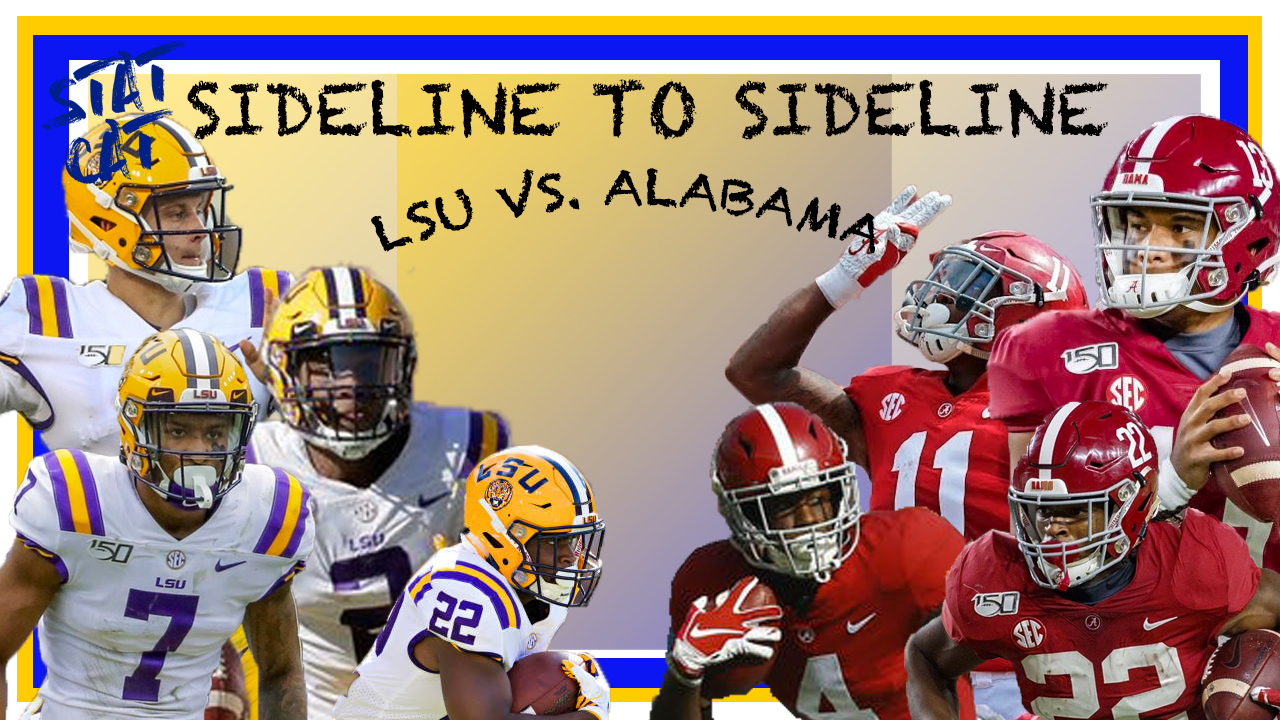
This game has everything. Two premier passers, hard-nosed run games, playmaking defenses that can also bow their necks, offenses built to be explosive and high-scoring, and of course big stakes attached. While Alabama has owned LSU since 2011, the Tigers feel they finally have a team that can go toe-to-toe with Tuscaloosa's finest.
Though the College Football Playoff Committee disagrees, these are the Top2 teams in the country. Alabama has the benefit of the doubt with their humming offense and young yet more-than-capable defense. LSU has plowed through the nation's 4th hardest schedule with a new and electric offense. Both do a lot of things well with talent at all the important places.
As of right now, Alabama and LSU are currently rated first or second in the conference in Offensive Success Rate, Passing Success Rate, Explosive Pass Rate, 3rd Down Success Rate, Touchdown Rate, Turnover Rate, Havoc Rate and percentage of plays that gain 15 or more yards while being adjacent in the Top5 rankings in other things such as Negative Play Rate, Sack Rate Allowed, and Explosive Play Rate Allowed. Plus, both teams average over 46 points a game.
This should be a classic battle.
LSU at a Glance
Per usual, let's start with the visiting team.
As I have written about before, LSU has done a tremendous job "flipping the script" this season with their new offensive mindset. Instead of the traditional philosophy of running to set up the pass, the Tigers pass to set up the run. And they have not been shy doing so. No SEC offense passes more on 1st Downs. No SEC offense has a better Success Rate on 1st Downs. No SEC offense has a better percentage of their 1st Down snaps result in a run gain of 10+ or a pass gain of 20+. Sure Burrow has been sensational slinging the pill over the yard in these spots, but the Tigers' often overlooked run game has the 3rd best Success Rate as a result of this playcalling.
LSU passes the ball 62% of the time on 1st Downs. The next closest team in the conference has a 55% clip. When you have an accurate passer like Joe Burrow, you shouldn't need much goading as a offensive coordinator to allow him to dropback more often. Passing more earlier in the series has created an efficient foundation for LSU's offense.
Though they are a pass-first team more often than not, two run looks have gained the most and second most amount of yards for them while being the top two calls for them across all downs.
Like a good number of SEC offenses, Inside Zone Slam Reads get the most reps. Nearly 19% of their total offensive plays are Slam Reads.This is often the hinge for many of their RPOs -- though Burrow targets his outlets at one of the lowest rates in the SEC. The Tigers are quite good at running them, too. Only Georgia has a higher Success Rate running Inside Zone Reads than LSU.
Duo Dives are next in line and compose about 12% of their plays. Both looks have Success Rates around 53%. Though both have better yards/attempt clips on 1st Downs, their Success Rates to start series are less far off. Slam Reads only meet their goals on half their reps with Duo Dives sporting a 48% Success Rate on firsts. With Slams looking to create alleys via zone blocks and Dives looking to create hard edges with double teams, they pair very well together.
Both aim to initially attack the B-gap between the guard and tackle. The only differences are the rules the line uses to block the defensive front. Though this might seem minor, an extra split second a backer has to take to diagnose a play can be the difference in a stuffed run or a bounced scamper for a score.
Slam Reads have been called 44 times and Duo Dives 29 times on firsts. The next closest plays have gotten 11 and 10 reps. Much is the same with their overall playcall composition. After Slam Reads 18.7% and Duo Dives 11.9% Play Shares, the next closest look has around a 4% clip. But this is the area where all their lovely Air Raid staples have engrained themselves.
Sticks have the 3rd highest Play Share for the Tigers and have gained the 5th most yardage as two-thirds of this play's reps have been successful situationally. With the collective speed of their receiving corps, these plays often are designed to steal quick yardage by the means of a hitch and route towards the flat. But, LSU has shown plenty of Stick varieties to keep defenses off their scent.
Another design they have targeted a lot in order to seize real estate is Tosser, which is what StatCat has dubbed dual or all slant patterns. Tosser patterns when targeted have a 70.6% Success Rate, which is the highest of any of their six most-repped plays. I'll talk more about slants later. But in general, Slant Variations are LSU's 3rd most call look and have accumulated the 4th most yards with a 53% Success Rate when all the subconcepts are pooled together.
As you can tell, a good portion of LSU's passing game is designed to work against man coverage. While Sticks and Slants can work short, Seam+Comeback combos, All Verts, Shot Plays, and Flood Variations are their favorite intermediate and deep concepts. They are very Air Raidy in this regard. What's also very Air Raidy is the fact LSU is exceptional executing these plays that often have a higher degree of difficulty than hitting a seven-yard slant.
Take All Vert patterns for instance. No play is as synonymous with the modern Air Raid than sending four guys deep simultaneously.The SEC average Success Rate on these plays is around 30%. The Tigers have hit on 54% of their targets on All Verts. Mike Leach would be proud.
But it doesn't stop there. Vertigo, another deep pass concept with intersecting streaks, has only been targeted three times yet produced 130 yards on a 100% Success Rate. Divide Shots, which call for an outside streak and inside post or dig, are their most-called 1st Down pass play; 11 of its 12 reps have occurred on firsts. Despite this, Divide has been responsible for 205 yards, 3rd most of any subconcept for the Tigers. On first downs, these combos have been successful 64% of the time while averaging 18.6 yards/attempt.
When corners are weary of getting burnt, the Comebacks concept has proved to be a consistent series starter. On the play's 10 1st Down reps, eight have gained at least half of the yards to gain, which is the threshold in order for a play to be successful in these situations. That's right. This play has met its 1st Down goals 80% of the time while averaging 8.5 yards per pop. No other look with at least five reps in these spots has such a high Success Rate.
But even with the vertical oriented passes living healthily in their script, LSU wouldn't really be a bastard of Hal Mumme without their Cross and Sail plays. Crosses are weakside floods and Sails are strongside floods. LSU has run a combination of 16 of those two floods with nine of them being successful entering Week 11. Overall, Flood Variations are the Tigers seventh most called concept.
A bevy of pass-happy favorites paired with tried and true inside run plays have allowed LSU to manage their situations and be one of the best offenses around. Flipping the script for them isn't isolated to 1st Downs. While conventional wisdom says 3rd Downs are when you should pass, no SEC offense has a higher Run Rate on the money down than the Bayou Bengals. While LSU's designed runs only post the 4th best clip in the SEC in these spots, their passing game is tops. In the end, it balances out to the Tigers owning the second best Success Rate on 3rd Downs in the conference -- trailing only Alabama.
While Slam Reads get the lion's share of the Tigers' reps on the money down, Duo Dives, Pivots, Fades, Slant Variations, Meshes, and Screens have seen between four and eight calls. Both Slam Reads and Duo Dives have Success Rates north of 50% on thirds. In fact of their six most-called subconcepts on 3rd Downs, none have a Success Rate under that mark. Staying true to how phenomenal this offense has been when going deep, Fades attempts have found their target 75% of the time.
If it wasn't already, it should now be clear this is a tough team to get off the field. The Tigers have the conference's 3rd lowest percentage of drives that end in a Three-and-Out. This isn't the best thing to hear if you're an Alabama defense that's just average at forcing those with the SEC's 3rd worst Success Rate on 3rd Downs against conference opponents
Of SEC players with at least 30 targets, Justin Jefferson, Terrance Marshall, and Ja'Marr Chase are Top10 in Catching Success Rate, Yards/Target, and Explosive Catch Rate with Jefferson and Marshall having the 1st and 3rd highest percentage of catches that result in either a first down or a touchdown.
Of SEC players with at least 30 designed carries, Clyde Edwards-Helaire and Tyrion Davis-Price are Top10 in Rushing Success Rate and First Down + Touchdown Rate with CEH posting the best Broken Tackle rate in the conference with a 53% clip. No other active SEC rusher has a clip north of 40%. That stat will be put to the test against Nick Saban's defense that currently has the best Run Tackle Rate against conference opponents and the second lowest Yards After Contact average.
But while the passing game is designed to be potent and gain chunk yards, it's run game has been far more plodding. The traditionalists that gauge rushing prowess based on how much you average per attempt regardless of the situation has labeled this as a below average rush attack. While I vehemently disagree with that diagnosis, there is no denying their backs haven't been the best at busting big gainers consistently. They have the 3rd worst Explosive Run Rate in the SEC.
Piggybacking off of that point, their line has been good not great overall. Burrow has seen one of the lowest amounts of pressure in the conference and LSU has one of the better sack rates. Still, their Havoc Rate allowed and Yards before contact are average to below average. Whatever long gains their backs have been able to manufacture, it's often on their gumption and not the OLine's. For what it's worth, LSU has the 3rd highest Broken Play Rate in the conference.
That should be a bit concerning for the Purple and Gold with the Crimson Tide having the conference's 2nd best Havoc Rate and Tackle For Loss Rate with the 8th most takeaways in college football.
LSU's defense has been pretty acceptable. Its in the Top25 in both the old-school total yards allowed and ESPN's new-age analytic metric. Against SEC competition, the Tigers have the 4th best Success Rate. Though they lead the league in Havoc Rate, (percentage of plays where the defense "f**** s*** up for the offense like on sacks, TFLs, turnovers, deflections, etc), they are 67th in the country in takeaways.
They seem to make their best plays when in a pinch. While ranking inside the Top25 nationally in 3rd Down and Red Zone Conversion Defense, they force Three-and-Outs at the 2nd best Rate in the SEC. Over 47% of their defensive drives have forced one against conference opponents. Less than 4% of SEC offenses' drives have ended in a touchdown, which is the 5th best mark in the league.
So far, LSU has proved to be better at attacking downhill versus the run against SEC foes than the pass. They have the 3rd best Success Rate here and have the 5th best TFL rate. But it's concerning that they allow the 4th highest amount of yards after contact on average within the SEC against conference foes and are middling in Missed Run Tackle Rate. Still, they are one of the best around at bottling up opposing offenses. Less than 9% of their defensive plays have allowed a run of 10+ yards or a pass of 20+ yards -- good for the SEC's second best clip.
Alabama at a Glance
While LSU has made strides riding a modern approach, Alabama has still excelled doing business as usual. They are a sturdy bunch that don't allow much of anyone disrupt what they want to do offensively. They are either 1st or 2nd in the SEC in Touchdown Rate, Turnover Rate, Havoc Rate Allowed, Sack Rate, Three-and-Out Rate, and 3rd Down Success Rate. LSU might be stealing some of the limelight, but Alabama's offense is still better in the eyes of ESPN's SP+ metric and has been more explosive by land and by air than the Tiger's pass-first operation.
Alabama offenses always hinge of its ground game. Even with a Heisman hopeful and future professional passer, this has largely been the case for the Tide this season. Five all Alabama's most called plays are all runs. By leaning on a variety of run plays, they are able to be much harder to predict for opposing defenses. Plus, they do a great job of mixing zone with gap schemes in their script.
Like most SEC teams, Inside Zone Slam Reads have their highest share of playcalls. But as aforementioned, these do not receive anywhere near the volume other teams give them. About 7.5% of Alabama's plays are Slam Reads. This look is flanked by other runs like Off-Tackle Zones (6.1%), Duo Dives (5.8%), Counters (4.0%), and Split Zones (3.8%). Outside of Off-Tackles' middling 44% Success Rate, all of these subconcepts have Success Rates north of 55%.
While runs get things going, pass plays make up four of their six best looks at accumulating yards. Their core zone plays of Inside Slam Reads and Off-Tackles have been responsible for the most and 5th-most real estate with 263 yards and 159 yards, respectively. Tosser -- or dual slants -- Slant+Flat Patterns, Crosses, and Chip Kelly's version of the Mesh play have been their best yardage gainers. If Slant Variations were all combined together, they'd be responsible for the largest amount of the Tide's yards followed by Screens (both normal and RPO outlets). Jerry Jeudy, DeVonta Smith, and Henry Ruggs are all in the SEC's Top6 in Total Yards After the Catch. Getting them the ball in space with these designs have played a vital part in that.
Alabama calls RPO's at the 5th highest rate in the conference and Tua Tagovailoa leads all starters in RPO Throw Rate with a 22.2% clip. You might have heard Slants and Screen Outlets like swings, bubbles and tunnels are popular route tags on RPOs. Alabama has turned basic backyard routes into one of the most potent patterns in college football.
No other SEC passer has more yards off play fakes or RPOs than Tagovailoa. Clearly, this passing game has been facilitated by Alabama's ability to lure in safeties with their run-first attack. With the speed this position group has, it only makes sense to spread the field and force the defense into bad mismatches. If foes only deploy six or seven man boxes, the Tide will be more than happy to keep gobbling up green grass on the ground. But as soon as safeties sell out downfield, defenses usually get caught with their pants down for a big play or score.
Alabama is a very hard team to predict on 1st Downs. Even with the SEC's 5th highest Pass Rate on 1st Downs, their top six most called plays to start series are all runs.
Off-Tackle Zones have gotten the most 1st Down reps entering Week 11 with 24. But the five next most called plays have gotten between 17 and 13 reps. While Counters have kind of become a inefficient look across the conference, the Sabanites still execute them at a high clip. On 1st Downs, they have met their goals on half of their chances. True one-guard Powers themselves average 7.3 yards/attempt on a 71.4% Success Rate. Duo Dives are successful nearly 70% of the time despite a pedestrian 4.23 average. If Inside Powers Runs were thrown all together into one group, these plays would be the Tide's favorite first down concept.
By keeping defenses weary of what might start a new set of downs, the Tide often rolls. No other SEC offense has been more successful running the rock to start a series than they have. So you can see how someone might have a momentary lapse in judgement and try to get the Tide Behind the chains. Like I said, more often than not those left in coverage become Jim Nantz' breakfast. .
Alabama has the SEC's most successful 3rd Down Offense. But like their first down offense, Offensive Coordinator Steve Sarkisian keeps opponents from getting comfortable on what's coming. Eighteen different concepts have received at least two reps on 3rd downs this year with Inside Zones and Screens getting the most with 15 and 10, respectively. As far as subconcepts go, Slam Reads and Duo Dives carry the mantle. Slam Reads have moved the chains on 10 of their 12 tries and Duo Dives have converted on six of their seven chances. Other than those two dependable run game staples to lean on in short yardage opportunities, Sark's 3rd Down calls are nearly impossible to nail down.
For what it's worth, Floods like Crosses, Sails, and Play Action Boots and Rubs like Meshes and Pick Plays have gotten the most calls of any pass concepts in these spots due to the fact they are designed manbeaters. Floods have a 3rd Down Success Rate of 80% on 12.2 yards per pop with Rubs converting on 56% of attempts. Alabama currently has the SEC's top 3rd Down Rushing Success Rate with a Passing Success Rate that's only worse than LSUs'.
Jeudy, Smith, and Ruggs fall within the Top12 of SEC players with at least 30 targets in Catching Success Rate, Explosive Catch Rate, First Down + Touchdown Rate, and Raw Catch Rate. Smith and Ruggs are the conference's top two performers entering Week 11 in Yards/Target with 16.1 and 13.9, respectively. Plus, the fourth-wheel Jaylen Waddle has the 4th best average at 11.9. All of Alamaba's wideout's are burners. Speed kills, As I hinted earlier, these fellows are quite good at working on an island with quick, manbeating routes.
Najee Harris has been making a solid case that he is the SEC's best running back. Nearly two-thirds of his rushes have gained the appropriate amount of yardage situationally. Among SEC running backs with at least 30 designed attempts, Harris has the SEC's best Rushing Success Rate, First Down + Touchdown Rate, and Explosive Run Rate while being in the Top 10 in Broken Tackle Rate and Total Yards After Contact. But don't sleep on Brian Robinson. His Rushing Success Rate is among the ten best in the conference as well.
This offense is all about bending defenses to their breaking points. This offense is just as likely to throw a Utah "push" pass as it is to attempt a bomb via a Portland Variation. The Tide loves to utilize eye candy to screw with opponents as no one one else in the conference uses as much true motion or "orbit" motion. For good measure, Alabama is also Top5 in the SEC in Jet Motion Rate. With the proven level of big play ability by their burners, moving them around the formation moments before the snap makes containing this offense a much more stressful endeavor for the opposition. All in all, over 35% of Alabama snaps use some form of motion.
Thier OLine has been the unsung hero in all of this. If you recall, I mentioned they limit Havoc Plays better than any other offense in the SEC and average nearly 2.6 yards BEFORE contact on their designed rush attempts. Working so well within the structure of their designs has limited their Broken Play Rate to 4.99%, second best in the conference.
One concern with their offense is that they play a lot of 3rd Downs. While the have the SEC's second best percentage of plays that wind up moving the chains on any given down, their Conversion Rate on 1st and 2nd Downs is the 4th worst in the league. It's a damn good thing the Tide is so superb on the money down. Still, refer to the preamble where they have dominated opponents in a good deal of game-altering analytic metrics.
Bama is one of the best disrupting defenses around. Injuries and a youthful corp be damned, Alabama enters Saturday as a Top 10 squad in ESPN's SP+ metric and 16th in the archaic Total Yards Allowed/Game. But as far as I am concerned, they have the SEC's second-best TD Rate Allowed, Havoc Rate, and TFL Rate; yet, they have an average Success Rate and Three-and-Out Forced Rate relative to the rest of the league. If they don't initially reach home or obstruct passing lanes, offenses have had sustained drives against them. Still, they don't allow many splash plays. They essentially share the 2nd best Explosive Play Rate Allowed with a 8.9% clip.
It should be a little concerning Alabama's defense currently has the 4th worst Defensive Success Rate against conference opponents in the 2nd Half. Fortunately, Sark's side of the ball has the top Offensive Success Rate.
The Great SEC Quarterback Debate
As with any game with a pair of premier passers, we gotta whip 'em out and measure how they have stacked up to one another. Both passers are running offenses different to the ones they ran last year. Alabama is more RPO heavy and versatile on the ground and LSU has taken flight using Air Raid concepts.
First, let's take a gander at each under perfect conditions; ie when the aren't facing pressure. As volatile and variable dropbacks can be from one to the next, the best way to measure a passer's consistency and best-case scenario ability is by looking at his numbers in clean pockets.
Passer Under Clean Pockets Min 30 att (20 Qualifiers) | Success Rate | Average Depth of Target | Adjusted Completion% | Depth Adjusted Accuracy% | Explosive Pass Rate | 1st Down + TD Rate | Interceptable Pass Rate | Accuracy 10+ |
| Burrow | 64.8% (1st) | 9.21 (11th) | 86.3% (1st) | 63.0% (1st) | 15.2% (2nd) | 46.7% (2nd) | 4.29% (3rd) | 64.4% (1st) |
| Tagovailoa | 60.7% (2nd) | 7.66 (17th) | 83.4% (2nd) | 55.9% (4th) | 20.7% (1st) | 50.3% (1st) | 2.58% (1st) | 51.1% (3rd) |
Sure it's nice to measure upside. But this is reality. We need to get the full idea of a passer's output. Otherwise, you might as well chart their Seven-on-Seven matches.
Passer Under Pressure Min 30 att (15 Qualifiers) | Success Rate | Average Depth of Target | Adjusted Completion% | Depth Adjusted Accuracy% | Explosive Pass Rate | 1st Down + TD Rate | Interceptable Pass Rate | Accuracy 10+ |
| Burrow | 52.0% (1st) | 9.09 (13th) | 85.4% (1st) | 77.6% (1st) | 18.0% (1st) | 42.0% (3rd) | 4.00% (2nd) | 72.2% (1st) |
| Tagovailoa | 41.0% (4th) | 10.8 (8th) | 57.6% (8th) | 35.8% (8th) | 15.4% (4th) | 30.8% (5st) | 10.3% (12th) | 26.7% (10) |
Slanted Perception
Over the course of this season, many talking heads and fans alike have labeled Alabama's offense as a slant-happy passing attack. While on the surface, that is a benign claim. The underlying insinuation is that they don't run an overly complex scheme or ask Tua Tagovailoa to complete passes with a high degree of difficulty. Truth be told, Slant patterns have been well represented on Alabama highlights this season.
But what if I told you that Slants are actually a much bigger part of LSU's offense down to down than Alabama's.
| Targeted Slant Routes (Route Share) | Slant Routes Catch Rate | Slant Variations Play Share (Team Rank) | Slant Variations Success Rate (Y/A) | |
| Alabama | 26 (10.2%) | 65.4% | 5.18% (7th) | 62.9% (16.7) |
| LSU | 37 (12.9%) | 72.9% | 7.73% (3rd) | 53.5% (6.84) |
While Slants are the most targeted route for each team, LSU has thrown them considerably more than the Tide. Plus, it appears Burrow and his receivers are able to connect on them at a higher rate.
But the potency is all in Alabama's corner. The good old-fashioned eye test of watching their SportsCenter flashes is backed up with gaudy numbers. They average nearly 17 yards PER ATTEMPT with a very good rate of success. When all of its variations are combined together, Slants lead all concepts for Alabama in terms of gaining yards despite being seventh in number of reps. For Alabama, Slants are calculated and often part of their RPO offense. Their eye-popping results speak for themselves.
For LSU, Slant Variations are patterns to help them manage down and distance. Alabama aims to go the distance with the way they prudently set up Slants, but LSU doesn't mind calling quick slants to get four to eight yards on first or second downs. Even though LSU receivers have a better Catch Rate than Alabama's on Slants, far more of their connections fail to be successful. Only 2.5% of caught Crimson Tide Slants don't end up being successful compared to 19.4% of LSU's. LSU is the offense that uses these patterns to pad easy completions and nickel and dime down the field; not Alabama.
Though the Tide are far more explosive running Slants and are more likely to have one appear on a highlight, these designs are far more likely to consistently appear on LSU's offensive script than Alabama's.
I think LSU wins if....
They consistently harass Tua Tagovailoa. Looking up the numbers above when he has been under pressure this year, Tagovailoa is a far worse passer than out of clean pockets. And those are numbers when he wasn't coming off a tightrope ankle surgery playing the nation's top team. Now, Alabama has the SEC's lowest Havoc Rate Allowed, so it will not be easy for LSU to accomplish this. Tagovailoa only sees pressure on 20% of his dropbacks. But, LSU does have the best Havoc Rate against SEC competition. If any team is up to the task, it is this one.
Especially when running their RPO offense, Tagovailoa is nearly impossible to sack. And not to drive point into the ground, but they are very dangerous when they get safeties off their mark. Blitzing is ill-advised. In order to neutralize this, they have to stop the run to invite more dropback passing where LSU's front can disrupt.
Though their Run Havoc is just okay, LSU sports the conference's 3rd best Defensive Success Rate against the run versus SEC foes. But Najee Harris is hard to bottle up. Again, he has a very good case to be the Southeast's best rusher. Still, LSU should be able to win a battle here and there. Alabama is one of the worst in the conference at gaining a first down on early downs. While the SEC's best on the money down, converting on 3rd Downs cannot be taken for granted; especially against the nation's 7th best 3rd Down defense. The best money down offenses are money on other downs.
I think Alabama wins if....
They win the second half. For whatever reason, Alabama's defense currently has the 4th worst Success Rate against SEC opponents in the second half. Against a tougher conference slate to date, LSU has the 3rd best. Offensively, these are the conference's top two teams in second half Success Rate. Alabama has yet to play an offense with the firepower and grit akin to what the Tigers are capable of. LSU has been more tested to date and has a better track record thus far across all four quarters. So there is a decent amount of anxiety for how this team responds in the moment before you even consider their QB's health.
Granted the Bayou Bengals have yet to face the LED sensation at Bryant-Denny, but LSU will likely come out swinging hard and fast. Either through quick-paced, methodically long drives or splash plays in the blink of an eye, the first half is setting up to be an intense affair. And this LSU team has showed a number of times its resilient and doesn't mind grinding it out into crunch time.
Alabama's offense could hum and explode right out of the gates and allow them to coast. Playing catchup on the scoreboard could force their hands into becoming more predictable. In obvious passing situations, LSU has been more prone to mistakes, pressure, and broken plays. Nick Saban is still a defensive genius and I fully expect him to save a wrinkle for a clutch moment in the second half. The Tigers own the SEC's 3rd lowest Three-and-Out Rate but Alabama forces them at the 2nd highest Rate. Both defenses are great at stifling big gainers so it might cause the match to lag and handcuff playcallers into more conservative tendencies.
But it is clear this game will not be won in the first, second, third or even the fourth quarter; it will be won throughout them all. If Alabama gets complacent or loses focus at any point, LSU has enough talent to make them pay dearly.