Sideline to Sideline: Auburn vs. LSU
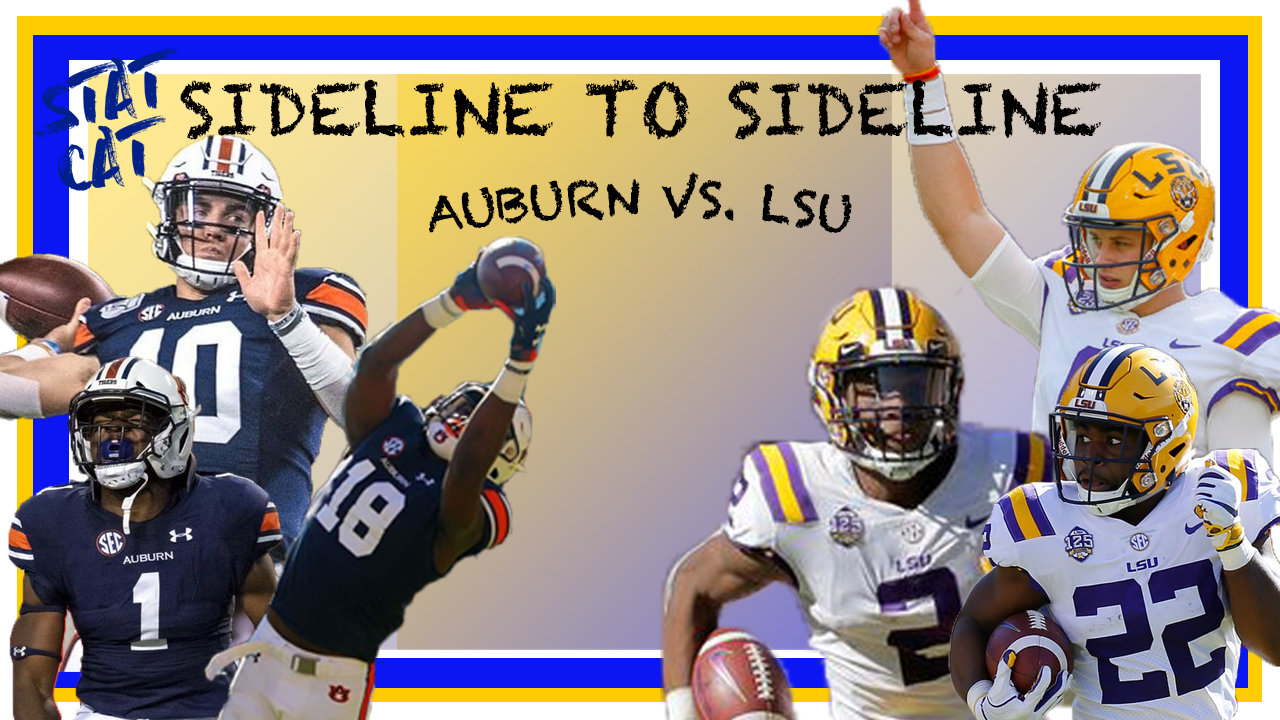
On the surface, Saturday's slugfest between LSU and Auburn has plenty to offer. Besides being a de facto playoff game, this will be a contest against the SEC's most successful offense against the defense best at winning situationally against conference foes. The last two Tiger Bowls have seen Ed Orgeron's team rally from multi-score deficits to snatch a pair of wins.
While there are plenty of unknowns and topics up for speculation, one thing is for sure: the Tigers will win. Now that we have that lame ass joke out of they way, let's examine a matchup between two Top10 teams still aiming for a playoff spot.
Auburn at a Glance
Let's take a look at Auburn first. To kick it off, no SEC team is as run-heavy than the team on the Plains. The Tigers are the only SEC team where designed runs composed over 60% of their play calls. Their team makeup is largely old-school where a rock solid defense has been paired with a run-first offense. It's a tried and true methodology in which many schools have found success. So far in 2019, it has mostly worked out for War Eagle. While the unit is far from perfect, it is currently in the Top-50 in Total Offense and in the Top-30 in ESPN's SP+ analytics metric while being a Top-25 scorer.
Like a vast majority of SEC offenses, the foundation for their ground game - and their offense as a whole - is the Inside Zone Read. Over a quarter of Auburn's total play calls are Inside Zone Reads. Slam Reads, which are their bread and butter and are inside zones designed to hit the 2-hole or B-gap, compose over 19% of their offensive reps. Bluff Reads, another inside zone look known as a split zone read by some, are directly next in the pecking order. It's a good thing both of these subconcepts have a Success Rate over 50%. If you are going to run a play a sh*t ton, you should probably be very good at executing it.
Auburn's next four most-called looks are all runs. But, they are all of the power (gap) scheme variety such as Tackle Counters, Inverted Power Veers, Iso/Split Zone Inserts, and Power Toss Reads - all of which have a built-in read aspect for their QB. Though combining for about 5% of all play calls, Outside Power Reads of the Inverted Veer and Toss variety are two of Auburn's most successful looks with Success Rates of 60% and 70%, respectively. Due to their potency, both have started to pop up more in the Tigers' script. In fact, seven of the ten Power Toss Reads Auburn has dialed up on the year came last week against Arkansas. Tackle Counter Reads are the only one of Auburn's favorite play types to have a Success Rate under 50% despite having the second highest yards per attempt clip.
The last couple of seasons put Malzahn's preferred methodology on the back burner as the now-departed Jarrett Stidham was set up to do more with his arm than his legs. Not that he was immobile or cement footed, but Malzahn's offenses like to get the most out of their QB's abilities to steal yards on the ground. Freshman Bo Nix is a return to the mold that has had the most success in his system. With ample read opportunities, Nix is currently tied with teammate Joey Gatewood as the SEC's fourth most successful ball carriers with a 60% Success Rate of guys with at least 15 reps on read plays. The duo is also the most prone to secure a conversion as they are number one and two in the conference in First Down Run Rate on these looks.
To start series, only Ole Miss calls more runs than Auburn. With an athletic yet raw freshman passer, Malzahn has been more than happy to let his rushing attack dictate things in order to create better chances for Nix through the air. And as aforementioned, Nix has faired well when he has pulled it.
In the read-laden scheme, Bubble Screen outlets from RPO tags are the only pass subconcept within their most repped looks on first downs. With teams bogging down their backfields, there is often plenty of space in the flat or edge of the formation for plays to be made, which is why Bubble Screens are their most successful first down play with at least seven calls.
The rest of their favorite first down looks are the play types I previously mentioned. But only Tackle Counter Reads exceed their overall yards per attempt and Success Rate clips on these instances compared to their overall numbers. In general, they average 7.44 yards per attempt with a Success Rate of 43.8% compared to 8.29 yards and 57.1% on first downs. Spread Isos are by far their least efficient play type to start series. Despite averaging 6 yards per attempt on a 41.7% Success Rate overall, they only gain 3.71 yards on a 14.3% Success Rate on average on first downs. I think its safe to say, Gus should be more prudent calling these over the back half of the season.
Despite the downticks, Auburn is still possesses the SEC's 5th best Rushing Success Rate and 6th best overall Success Rate in these spots.
Misdirection with counters as well as jet motion is a big aspect to what they want to do to create run lanes. Playing stout SEC defenses straight up rarely yield favorable results, and Gus is one of the best a designing deception on the ground. No SEC offense deploys more jets than the Tigers and a fifth of their run plays utilize them. As a result, defenses have been giving plenty of eye candy. With the motions causing backers an extra beat to read their keys, it has allowed extra cushion for backs to hit holes. Plus, its not like Auburn has just been doing that for show. Jet Sweeps and Reverses have combined to total 161 yards with half of their attempts being successful. If they were a single subconcept, Jet Sweeps and Reverses would be responsible for the 5th most yards of any play type for the Tigers.
But at the heart of their misdirection is their modern day triple-option - the RPO. In general, only Ole Miss calls more of them than Auburn. While their freshman QB is full of "moxy", "grit", and "natural born leader" qualities, Bo Nix is far from a polished passer at this point in time, which is why Gus has given him plenty of chances to obtain easy completions and get production aerially. No SEC starter has a higher percentage of his pass attempts come from RPO throws than Nix despite having the highest average depth of target - or how far his man is downfield on average per pass - among SEC starters.
With that high ADOT, it should be no surprise the degree of difficulty on his dropback throws have caused Nix to be among the SEC's lower quality passers. When omitting his screen and RPO throws, Nix has the conference's second worst Accuracy%, Adjusted Completion%, and Uncatchable Pass Rate while being in the bottom 5 in Success Rate and Interceptable Pass Rate.
But despite the growing pains, he has been one of the most explosive passers in the SEC. On dropback throws, Nix only trails Alabama's Tua Tagovailoa in percentage of passes that net at least 20 yards. In fact, the two are the only ones in the conference with Explosive Pass Rates north of 20%. Furthermore on dropback passes, Nix leads the SEC in yards per completion in this regard while being in the top 5 in yards per attempt and Passing TD Rate. When looking at all throws, Auburn currently has the SEC's 3rd highest Explosive Pass Rate.
Like with any young passer, Nix is far worse against pressure. When under duress, Nix's Accuracy% drops from 47.9% to 27.9%, his Success Rate dips from 43.8% to 27.9%, and his First Down Pass Rate falls from 26.3% to 18.6%. For what it's worth, he sees the 6th most pressure of SEC passers with at least 70 attempts.
But where would be Auburn be without their Steele Curtain defense? Against SEC competition so far in 2019, they have the best Havoc Rate, Run Tackle Rate, Allowed Explosive Play Rate, Tackle for Loss Rate, Takeaway Rate, and Overall Defensive Success Rate. They also have a Top-3 Three-and-Out Rate and TD Allowed Rate within the conference. So while this unit might be just inside the Top-25 in Total Defense, advanced metrics prove this is one of the most formidable units in all of college football.
Managing the Running Back by Committee
When healthy, there is no question JaTarvious "Boobie" Whitlow is War Eagle's bellcow back. In the first six weeks of the season, Mississippi State's Kylin Hill was the only other SEC back in the Top5 in both yards off zone concepts and power concepts. That versatility was a big part of what made Auburn's ground game effective and from pigeon holing itself into predictable looks. While his overall Success Rate was below average, he was still the most consistent of their backs regardless of what they were running.
With injury causing the rest of his sophomore campaign to be murky, Auburn has deployed a running back by committee with a combination of Kam Martin, Shaun Shivers, and DJ Williams.
| Runner | OVR Success Rate | Zone Success Rate | Power Success Rate | Zone Carry Makeup | Power Carry Makeup | Zone Exp. Run Rate | Power Exp. Run Rate | Zone Y/A | Power Y/A |
| Martin | 43.2% | 47.6% | 40.9% | 47.7% | 50.0% | 9.52% | 18.2% | 4.10 | 7.64 |
| Shivers | 40.6% | 12.50% | 62.5% | 25.0% | 50.0% | 0.0% | 31.3% | 2.38 | 8.38 |
| Williams | 33.3% | 42.9% | 30.0% | 38.9% | 55.6% | 28.6% | 0.0% | 4.71 | 4.40 |
While Martin and Williams are far more consistent rushers on Zone plays, Shivers is without a doubt their best Power option. The problem now becomes managing efficiency with tendencies. Meaning, they have to figure out how to not tip their hand with Shivers on the field that a Gap scheme run is on the horizon. He's been awful on his Zone carries and people who are paid to stop offenses for a living should know that.
Of course, one solution could be calling more Power plays. I already aforementioned Power Toss Reads for one saw 70% of their yearly reps last week. Martin, though less efficient, is still a capable Power runner and is more explosive on these plays than his Zone reps. So he can hold his own if asked to find a lane behind a lead blocker or a pair of pullers. Plus, Williams' sample size is the smallest and still developing so there is a chance he becomes a better bruiser.
I don't expect Gus to fade Auburn's favorite play much especially with the great chances and production it has created for his young QB. It's a damn good thing both of Auburn's QBs (both out of traditional and Wildcat sets) have been near the top in terms of Rushing Success Rate on their designed chances regardless on if it was a Zone or Power look. So it might not particularly matter what is called as long as Nix is a great keeper on reads in terms of being situationally successful. But it will be interesting to see what manifests itself more: if Powers capture more of the Tigers' play share or if Gus doesn't mind using certain backs in certain situations regardless of the heavy handedness.
LSU at a Glance
Much of what I wrote about LSU going into their matchup with Florida remains the same today. They are the SEC's most successful offense, Joe Burrow is the conference's best passer and leads a boatload of advanced passing categories, they score a lot of points, they limit mistakes, and have one of the more efficient ground games despite a middling yards per carry average and Explosive Run Rate. So I might speak more about the Purple and Gold in general terms in this piece than the detail-oriented items I shared about Auburn or in the S2S two weeks ago.
On the surface, going towards more of spread oriented attack seemed to be the major catalyst on Burrow's sensational second season in the Bayou. But there's a little bit more to it than just running less I-formation and heavily sets.
One major philosophical change has been flipping the script. While the old way of thinking is establishing the run to set up the pass, LSU inverts this thinking. LSU has the SEC's most pass-heavy offense on first downs and has the second highest Success Rate with the highest Explosive Play Rate, which is heavily inflated by their ability to sling it around the yard. They are one of two SEC offenses with Passing Success Rates north of 60% on these downs.
Meanwhile, only Auburn is more run-heavy on the money down than LSU. LSU currently has the conference's second highest Success Rate on third downs and while posting the third lowest Negative Play Rate and lowest Sack Rate. The Tigers have been successful on 55.2% of their third down carries - this shoots up to 62.1% if scrambles were included. The pass sets up the run nicely for them, wouldn't you say?
Though two run subconcepts still get the lion's share of the Tigers calls. Like Auburn, their Inside Zone Slam Read received the vast majority of their offensive reps. But instead of Bluff Reads - essentially a wrinkle on the standard inside zone play - LSU goes the route of a gap scheme staple, the Duo Dive. Duo Dives hinge on playside double teams and aim to create hard edges unlike Slams that look to create alleys based on defensive alignment. Both plays aim to attack the same hole but they are blocked differently. The variation picks on overanxious backers without the need of misdirection or doing anything crazy.
Overall, Slam Reads average 5.67 yards per carry with a 54% Success Rate while Duo Dives get 4.91 yard per carry with a 53.7% Success Rate for the Tigers. These two are also their two best play types at accumulated yardage with Slams capturing 537 yards and Duo Dives seizing 238 yards.
LSU's four next most popular subconcepts are all passes. Sticks, Seam+Comeback Patterns, Tosser (dual or all slants), and the Shot play Divide are their next most called looks after their two favorite inside runs. While the others have been seen across downs, Divide is has been a go-to design for a first down bomb. All ten of this subconcepts reps have occurred to start series and LSU has hit on six of them for 160 yards - the most of any pass play and only behind Slam Reads and Duo Dives.
Other top yardage gainers include Corners, which is an inverted Smash subconcept. But this play is a recent dandy for this offense; 100 of its 144 yards gained came last week on three plays against Mississippi State. Sticks by success and volume have gained the fifth most of any subconcept. Vertigo, a vertical switch play made famous by the game-sealing TD to Justin Jefferson against Florida, has gained 130 yards on its three reps while posting a perfect Success Rate.
Slant Variations play a big role in what they like to do due to their wideout's speed and route running abilities against man coverage. Slant Variations have combined for 256 yards on a 57.6% Success Rate thus far. Over 57% of slant yards have come on first downs - often when the defense is already on its heals.
On the money down, the Tigers don't necessarily have a narrowed down approach in terms of play calling through the air like it does on the ground. Slam Reads have gotten 19 3rd down calls and Duo Dives have gotten five. No pass play has seen more than three. But, Mesh, Pivot, Stick, Slot Fades, Swing Screen, and Convoy Screens have all been looks with three reps on the money down. I'm sure it doesn't shock you that LSU's 50% Success Rate on third down passes is the SEC's best clip.
Having a stable of hard-to-tackle backs makes things that much easier for LSU. Clydesdale Edwards-Helaire (I assume that is his full name due to his running style) is the only SEC player with a Broken Tackle Rate north of 46% among rushers with at least 20 carries. His clip is 59.6%. He is also just outside the the Top-5 both yards after contact average and Rushing Success Rates when looking at SEC running backs.
Their defense is still a Top-30 unit in both the traditional yards allowed and advanced SP+ metric. They are good in crucial spots as their Defensive 3rd Down Success Rate is 30th and their Red Zone Scoring% is 11th nationally. Against SEC competition, LSU's defense has the 3rd best Three-and-Out Rate, 3rd best Average Yards after Contact Allowed, and the 4th best Success Rate. Only Auburn's defense has a higher Havoc Rate, but LSU is number one against the pass in this regard. But, they are below average in takeaways, Tackle Rate, and Tackles For Loss Rate.
Justin Jefferson: The Slot Machine
Justin Jefferson has been one of the key ingredients for LSU's recipe for success through the air. In case you are unaware, the former two-star has been a superstar for the Bayou Bengals this season. He currently leads the SEC in receiving yards with the conference's second best Yards/Target, Catching Success Rate, and First Down+TD Rate of guys with at least 20 targets. It wasn't like Jefferson sucked or wasn't productive last year, because he sure as hell was very good for LSU. But, the main difference year over year has been lining him up in the slot to create better chances, not only for himself but for the rest of the Tigers' targets.
| YEAR | OVR Success Rate | Success From Slot (Y/H) | Success From Outside (X/Z) | Slot Target Makeup (H/Y) | Outside First Down+TD% | Slot First Down+TD% | Slot Catches | Slot Yards | Slot TDs |
| 2019 | 74.1% | 75.0% | 66.7% | 88.9% | 100% | 64.6% | 42 | 690 | 6 |
| 2018 | 51.2% | 30.8% | 56.9% | 15.9% | 40.0% | 30.8% | 7 | 51 | 1 |
While seeing his Target Share slightly decrease by moving to the inside, Jefferson has commanded much more attention from defenses than when he was isolated outside the numbers. In modern football, slot receivers and vertical pass catching tight ends are in high demand due to the mismatches they can create on backers and safeties.
By alignment, those are the defenders most likely responsible to cover slots and tight ends downfield. A slot's speed or route running could cause major fits for backers, nickel backs and safeties built to play closer to the line of scrimmage the further a pattern takes them downfield. Plus if they can get a step on their man, a help defender is forced to try to stop the bleeding, which in turn can leave another target with a sure-fire one:one opportunity.
With fixed mismatches, it can quickly turn into a game of chess if an offense has enough fire power to prevent a "tunnel scheme" that force feeds guys regardless of alignment.
LSU took its best weapon, put him inside to devastate defenders inside-out, and facilitated Terrence Marshall's Ja'Marr Chase's roles. While some offenses move around their best weapons formationally, locking him into the slot allows more consistency play-to-play for not only the slot but his quarterback too.
It was a bold move for LSU to put Jefferson inside considering he was rather limited in terms of production there last year. But as solid as a receiver as he was outside, he has become one of the elite slot receivers in college while putting up some pretty impressive numbers. While Jefferson has certainly made strides in his game to become more effective besides just lining up as a slot, it all would be a mute point if Burrow's accuracy didn't progress as well.
I think Auburn wins if....
They have above a 50% Rushing Success Rate with 8+ explosive runs. Auburn is set up to run the ball and run it a lot. While I believe Nix will get a few chunk gains through the air, Auburn must keep its offense on the field and Joe Burrow off of it. The Team from the Plains is good at creating runs of 10+ yards by volume but they are rather average by a percentage basis. Still coming into Saturday, they average 6.4 of such runs per game. One of this unit's weak spots is limiting wasted possessions via Three-And-Outs; their offense is currently in the bottom 5 Three-And-Out Rate within the conference. LSU's defense has been one of the best so far against conference foes at forcing them, but have been average at tackling ball carriers.
If Auburn can turn a three yard gain into a 13 or 30 yard gain, it will make their freshman QB's job all the easier. To reiterate, no SEC defense has been better at forcing Pass Havoc Plays (sacks, batted passes, deflected passes, INTs, broken dropbacks, etc) than the Bayou Bengals against conference opponents. Nix is one of the least accurate passers in general and under pressure so it is a little unreasonable to expect him to fix that in a road game against the No. 2 team in the nation. But if they can run the ball even when LSU is expecting it, I love Auburn's chances based on what their defense has shown thus far. Again, Kevin Steele's squad has the best defensive Success Rate when facing SEC competition.
The spread has been hovering around 11 in LSU's favor since the line opened. LSU is also favored by ESPN's SP+ prognostication metric by 9.5. Both are direct reflections on how others feel about LSU's firepower. Auburn has to be a wet blanket and have long, methodical drives with an occasional splash play if it wants to play the role of spoiler.
I think LSU wins if....
They aren't forced to settle. This has two meanings. The first, they gotta score touchdowns and not allow Auburn to sick around with a series of field goals. While Auburn's rush attack is average AF at generating explosive runs, Bo Nix and their passing offense have the 3rd highest Explosive Pass Rate in the SEC. So one play can change the game rather suddenly against LSU's good, not great defense. No doubt, Kevin Steele will try his damnedest to confuse Burrow into mistakes and limit the big play ability of his receivers.
This leads into the second meaning of not having to settle. With more cushion underneath to prevent homeruns deep, the Baton Rogueers might need to get creative in order to take the top off this Auburn defense. War Eagle will no doubt look to keep everything in front of them. LSU must be on the attack and get Auburn on its heals rather than just taking what they will be easily given. LSU's offense is so potent a couple of quick early scores can change the whole make up of the game. Auburn's offense isn't really equipped to play from behind for sustained periods of time. If they can get hot with a couple of quick tuddy's it could be all downhill from there.
Seven points are worth more than three points. Everyone knows that. The matchup between the SEC's most successful offense against the most successful defense against conference opponents will determine the victor.